
Inertial Navigation Systems Market Size, Share & Analysis

Inertial Navigation Systems Market by Application (Munition, Airborne, Marine, Land, Unmanned), Grade (>10,1-10, 0.1-1,0.01-0.1/hr), Technology (Integrated GNSS/INS, Hybrid), Solution (Ring Laser, Fiber-Optic, MEMS), Region - Global Forecast To 2030




OVERVIEW
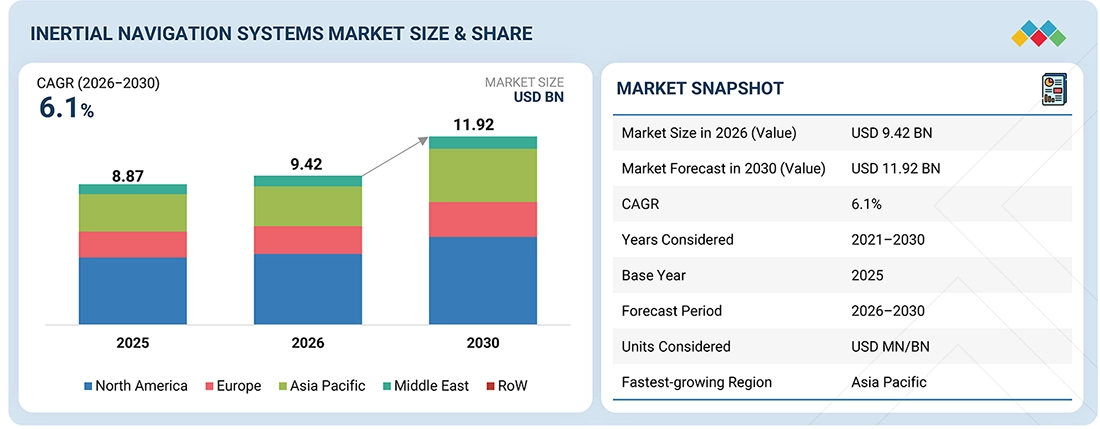
Source: Secondary Research, Interviews with Experts, MarketsandMarkets Analysis
The inertial navigation systems market is projected to reach USD 11.92 billion in 2030 at a CAGR of 6.1%. Market growth is driven by rising demand for accurate navigation across defense and commercial platforms, as well as the increasing need for reliable systems in GPS-denied environments.
KEY TAKEAWAYS
-
Paragraph ContentThe inertial navigation systems market is supported by rising defense spending and ongoing modernization programs across major economies. Increasing geopolitical tensions are driving the need for reliable navigation systems in advanced platforms and mission-critical operations. Governments are also focusing on strengthening domestic capabilities to ensure supply stability. The market is expected to grow steadily as countries continue to invest in long-term defense and technology development.
-
By RegionThe North Americaninertial navigation systems market accounted for a 45.5% revenue share in 2025.
-
By ApplicationThe missile & munition segment is expected to have the largest market share during the forecast period.
-
By GradeThe navigation segment is projected to be fastest growing during the forecast period.
-
By TechnologyThe integrated GNSS/INS segment is projected to be the most dominant during the forecast period.
-
By SolutionThe algorithm & processor segment is projected to be the most dominant during the forecast period.
-
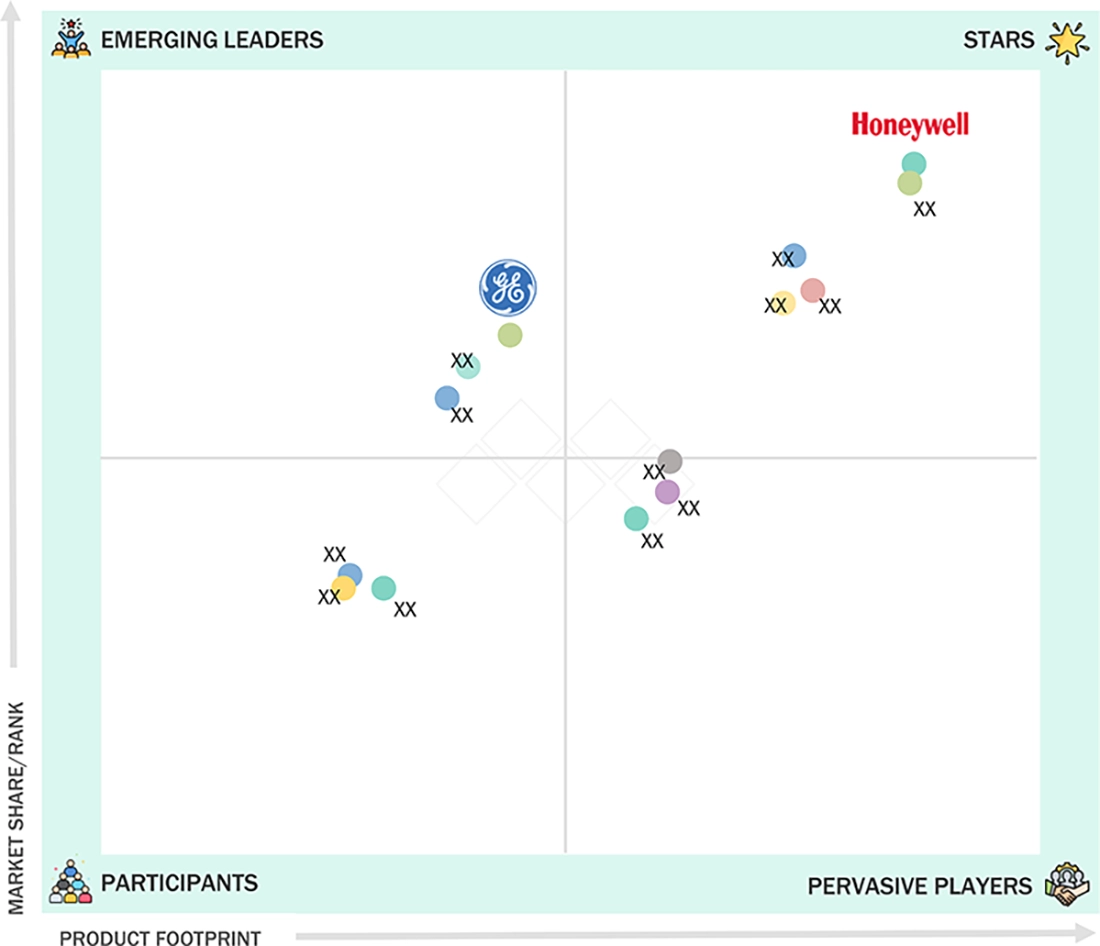
Competitive Landscape- Key PlayersHoneywell International Inc, Northrop Grumman Corporation, and Hexagon AB, among others, were identified as some of the star players in the inertial navigation systems market, given their strong market share and product footprint.
-
Competitive Landscape- Other PlayersVectorNav Technologies, SBG Systems, and Inertial Labs Inc, among others, have distinguished themselves among startups and SMEs by securing strong footholds in specialized niche areas, underscoring their potential as emerging market leaders
TRENDS & DISRUPTIONS IMPACTING CUSTOMERS' CUSTOMERS
The inertial navigation systems market is changing as the needs of defense and commercial users keep evolving. Currently, there is a strong demand for dependable navigation in platforms like aircraft, missiles, and autonomous systems, especially in situations where GPS is not available. Going forward, the focus is likely to move toward more advanced and integrated systems that can deliver better accuracy and overall performance. There is also growing attention on sensor fusion, processing, and system integration to ensure everything works smoothly across different platforms.
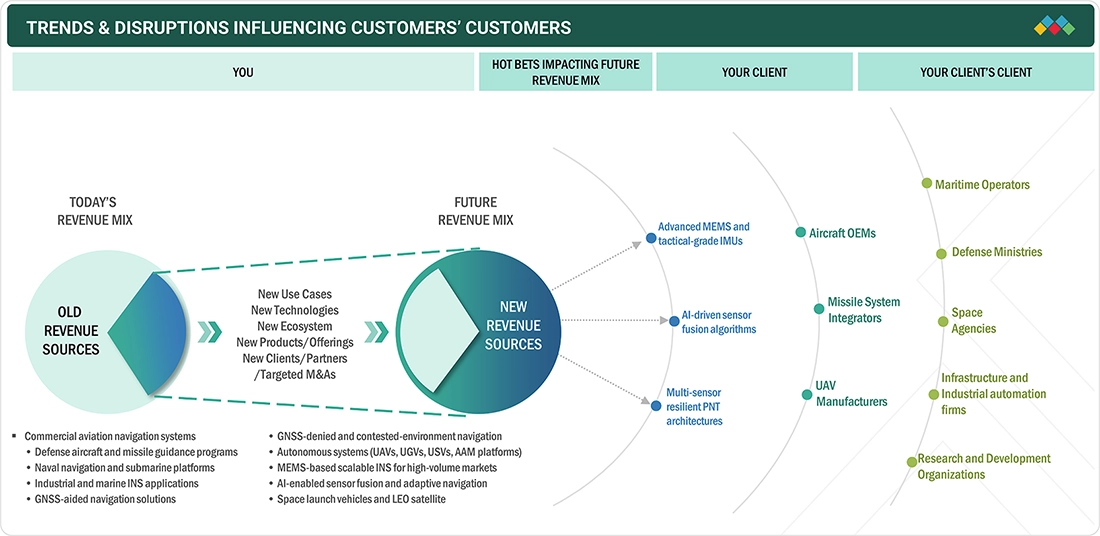
Source: Secondary Research, Interviews with Experts, MarketsandMarkets Analysis
MARKET DYNAMICS

Level
-
Rising emphasis on assured and resilient navigation architectures

-
Expansion of autonomous and unmanned platform deployments


Level
-
High cost of navigation-grade inertial systems

-
Cumulative drift and dependence on external aiding for long-duration missions


Level
-
Integration with Low Earth Orbit satellite constellations and hybrid navigation architectures

-
Growth of urban air mobility and advanced air mobility platforms


Level
-
Maintaining long-term accuracy under extended mission durations

-
Environmental sensitivity and performance stability

Source: Secondary Research, Interviews with Experts, MarketsandMarkets Analysis
Driver: Rising emphasis on assured and resilient navigation architectures
Military and commercial platforms are increasingly operating in environments where GPS signals can be weak, jammed, or unavailable. This is creating a strong need for navigation systems that can work independently and still provide accurate positioning. Inertial navigation systems are being widely adopted across aircraft, missiles, naval vessels, and autonomous systems to ensure continuous navigation. As modern operations become more complex, the focus on reliable and resilient navigation solutions continues to grow.
Restraint: High cost of navigation-grade inertial systems
High-performance inertial navigation systems, especially navigation-grade solutions, involve advanced sensors and complex technologies, which make them expensive. Many platforms, particularly smaller or cost-sensitive ones, face challenges in adopting these systems due to budget constraints. In addition, integration and maintenance can increase overall costs, making widespread adoption across all applications difficult.
Opportunity: Integration with Low Earth Orbit satellite constellations and hybrid navigation architectures
There is increasing interest in combining inertial navigation systems with other technologies such as GNSS and Low Earth Orbit satellite constellations. These hybrid systems help improve accuracy and reliability by compensating for the limitations of standalone systems. As new satellite networks continue to expand, they are creating opportunities for more advanced and robust navigation solutions that can perform well even in challenging conditions.
Challenge: Maintaining long-term accuracy under extended mission durations.
Inertial navigation systems tend to accumulate small errors over time, which can affect accuracy during long missions. This becomes a challenge for applications that require continuous operation without external correction. While integration with other systems can help reduce these errors, ensuring consistent accuracy over extended durations remains a key challenge for system developers.
INERTIAL NAVIGATION SYSTEMS MARKET SIZE, SHARE & ANALYSIS: COMMERCIAL USE CASES ACROSS INDUSTRIES
| COMPANY | USE CASE DESCRIPTION | BENEFITS |
|---|---|---|
 |
Supply of inertial navigation systems for commercial and military aircraft platforms, including flight control, navigation, and attitude reference systems used across Boeing and Airbus aircraft as well as US military aviation programs | High reliability for aviation navigation | Proven performance across commercial and defense platforms | Continuous positioning in GPS-degraded environments | Integration with avionics and flight management systems |
 |
Development and supply of advanced inertial navigation systems such as LN-100G for military aircraft, missiles, and precision guided munitions used by the US Department of Defense | High-precision navigation for mission-critical applications | Support for GPS-denied operations | Widely deployed across airborne and weapon systems | Strong integration with defense platforms |
 |
Development of Sigma family inertial navigation systems used in naval vessels, submarines, and military aircraft for navigation, pointing, and stabilization applications | Very high accuracy and low drift performance | Suitable for long-duration missions | Strong adoption in naval and defense platforms | Proven performance in harsh environments |
Logos and trademarks shown above are the property of their respective owners. Their use here is for informational and illustrative purposes only.
MARKET ECOSYSTEM
The inertial navigation systems market ecosystem includes manufacturers, solution providers, and end users working across defense, aerospace, and industrial applications. Companies such as Honeywell International Inc., Northrop Grumman Corporation, Safran Electronics & Defense, Israel Aerospace Industries Ltd., Teledyne Technologies Incorporated, and Exail SAS develop and supply core systems, while players like Thales Group, Honeywell International Inc., Teledyne Technologies Incorporated, and Trimble Inc. focus on integration and positioning solutions. Key end users include the United States Department of Defense, Defence Research and Development Organisation (India), NASA, and Israel Ministry of Defense, with the market largely driven by government programs, contracts, and advanced platform deployments.
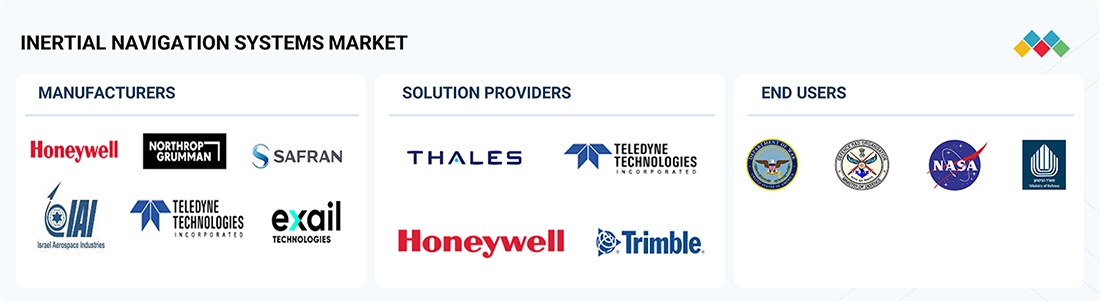
Logos and trademarks shown above are the property of their respective owners. Their use here is for informational and illustrative purposes only.
MARKET SEGMENTS
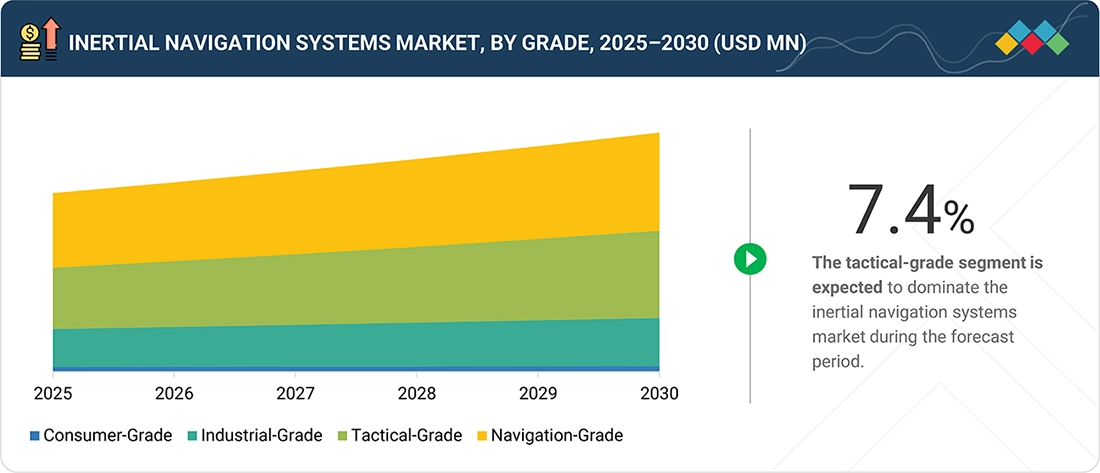
Source: Secondary Research, Interviews with Experts, MarketsandMarkets Analysis
Inertial Navigation Systems Market, By Application
As of 2025, the missile & munition segment held the largest share of the inertial navigation systems market, as these systems depend heavily on accurate, continuous navigation for guidance and targeting. Inertial systems are widely used in missiles, guided munitions, and torpedoes, where GPS may not be available or reliable. The increasing focus on precision-strike capabilities and the modernization of defense systems is driving strong adoption across this segment.
Inertial Navigation Systems Market, By Grade
As of 2025, the navigation-grade segment accounted for the largest share in the market due to its high accuracy and reliability. These systems are mainly used in critical applications such as aircraft, naval vessels, and missile systems, where even small errors cannot be tolerated. The growing demand for high-performance navigation in defense and aerospace platforms is supporting the dominance of this segment.
Inertial Navigation Systems Market, By Technology
As of 2025, the integrated GNSS/INS segment held the largest share as it offers improved accuracy and reliability by combining inertial systems with satellite navigation. These systems are widely used across military and commercial platforms to ensure continuous positioning, even in challenging environments. The ability to provide stable navigation in GPS-degraded conditions is driving their adoption.
Inertial Navigation Systems Market, By Solution
As of 2025, the accelerometers segment held the largest share of the inertial navigation systems market, as it is a core component used to measure motion and velocity. Accelerometers are widely used across all types of INS applications, from high-end defense systems to commercial platforms. Their importance in calculating position and movement supports their strong market demand.
REGION
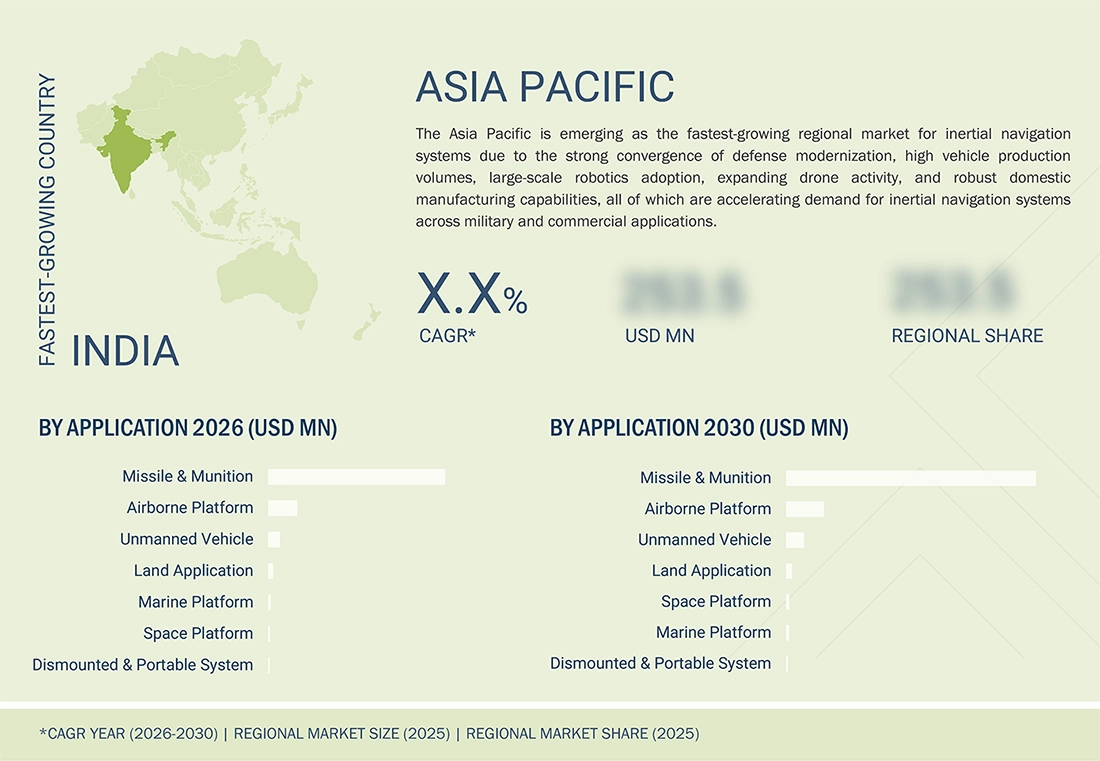
Asia Pacific to be fastest-growing region in inertial navigation systems market during forecast period
The Asia Pacific is emerging as the fastest-growing regional market for inertial navigation systems, driven by strong convergence of defense modernization, high vehicle production volumes, large-scale robotics adoption, expanding drone activity, and robust domestic manufacturing capabilities, all of which are accelerating demand across military and commercial applications.
INERTIAL NAVIGATION SYSTEMS MARKET SIZE, SHARE & ANALYSIS: COMPANY EVALUATION MATRIX
In the inertial navigation systems market matrix, Honeywell International Inc. (Star) holds a strong position due to its wide presence across both commercial and defense platforms. The company develops and supplies advanced inertial navigation and sensor solutions used in aircraft, military systems, and autonomous platforms. Its long-term relationships with major aerospace OEMs and defense organizations, along with strong integration capabilities, support its leadership in the market. General Electric Company (Emerging Leader) is gradually strengthening its position through developments in navigation and sensing technologies for aviation and defense applications. The company is involved in improving system performance and supporting next-generation platforms, which are helping expand its presence in the inertial navigation systems market.
Source: Secondary Research, Interviews with Experts, MarketsandMarkets Analysis
KEY MARKET PLAYERS
- Honeywell International Inc. (US)
- Northrop Grumman Corporation (US)
- Safran Electronics & Defense (France)
- Thales Group (France)
- Hexagon AB (Sweden)
- Collins Aerospace (US)
- Teledyne Technologies Incorporated (US)
- Trimble Inc. (US)
- General Electric Company (US)
- Leonardo S.p.A. (Italy)
- Israel Aerospace Industries Ltd. (Israel)
- Bharat Electronics Limited (India)
- ASELSAN A.S. (Turkey)
- Kongsberg Defence & Aerospace AS (Norway)
- Exail SAS (France)
MARKET SCOPE
| REPORT METRIC | DETAILS |
|---|---|
| Market Size in 2025 (Value) | USD 8.87 Billion |
| Market Size in 2026 (Value) | USD 9.42 Billion |
| Market Forecast in 2030 (Value) | USD 11.92 Billion |
| CAGR | 6.1% |
| Years Considered | 2021–2030 |
| Base Year | 2025 |
| Forecast Period | 2026-2030 |
| Units Considered | Value (USD Million/Billion) |
| Report Coverage | Revenue forecast, company ranking, competitive landscape, growth factors, and trends |
| Segments Covered |
|
| Regions CoveredA12 | North America, Asia Pacific, Europe, Middle East, and Rest of the World |
WHAT IS IN IT FOR YOU: INERTIAL NAVIGATION SYSTEMS MARKET SIZE, SHARE & ANALYSIS REPORT CONTENT GUIDE
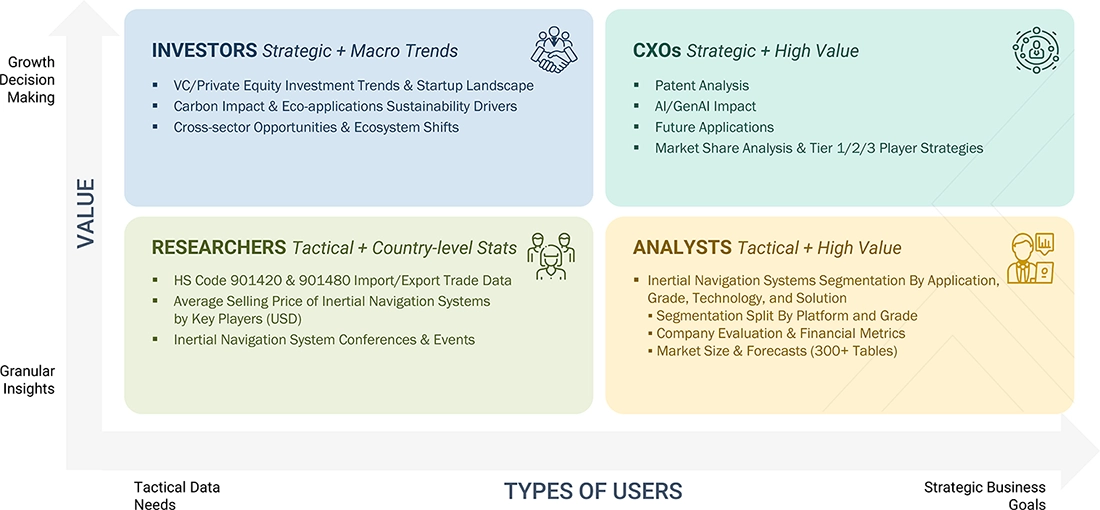
DELIVERED CUSTOMIZATIONS
We have successfully delivered the following deep-dive customizations:
| CLIENT REQUEST | CUSTOMIZATION DELIVERED | VALUE ADDS |
|---|---|---|
| Leading Manufacturer | Additional segment breakdown for countries | Additional country-level market sizing tables for segments/sub-segments covered at the regional/global level to gain an understanding of market potential by each country |
| Emerging Leader | Additional company profiles | Competitive information on targeted players to gain granular insights into direct competition |
| Regional Market Leader | Additional country market estimates | Additional country-level deep dive for a more targeted understanding of the total addressable market |
RECENT DEVELOPMENTS
- September 2025 : The Space Development Agency awarded Northrop Grumman a contract worth USD 3.5 billion as part of the Tranche 3 missile tracking layer program for a proliferated low Earth orbit satellite constellation. The program will deploy advanced tracking satellites capable of detecting and tracking missile threats, supporting precision targeting and navigation within the US defense space architecture.
- July 2025 : Honeywell was selected by the US Department of Defense’s Defense Innovation Unit to participate in the Transition of Quantum Sensing program under contracts including CRUISE and QUEST. The work focuses on developing quantum sensor technologies that support next-generation inertial sensing and alternative positioning, navigation, and timing capabilities for military platforms.
- July 2025 : Exail secured a contract to supply 100 PHINS Compact inertial navigation systems for integration into unmanned underwater vehicles. The PHINS Compact INS provides high-precision navigation and maintains reliable performance in GNSS-denied maritime environments, enabling autonomous underwater vehicles to perform defense missions with improved operational flexibility.
- June 2023 : Wisk Aero (US), a leading advanced air mobility (AAM) company, entered into a contract with Safran Electronics & Defense to supply SkyNaute inertial navigation systems for its Generation 6 autonomous, all-electric air taxis.
Table of Contents
 Exclusive indicates content/data unique to MarketsandMarkets and not available with any competitors.
Methodology
The study involved four major activities in estimating the current size of the inertial navigation systems market. Exhaustive secondary research was done to collect information on the market, its adjacent markets, and its parent market. The next step was to validate these findings, assumptions, and sizing with industry experts across the value chain through primary research. Demand-side analysis was conducted to estimate the overall market size. After that, market breakdown and data triangulation procedures were employed to estimate the sizes of various segments and subsegments within the inertial navigation systems market.
Secondary Research
During the secondary research process, various sources were consulted to identify and collect information for this study. The secondary sources included government sources, such as SIPRI, corporate filings, including annual reports, press releases, and investor presentations from companies, white papers, journals and certified publications, and articles from recognized authors, directories and databases.
Primary Research
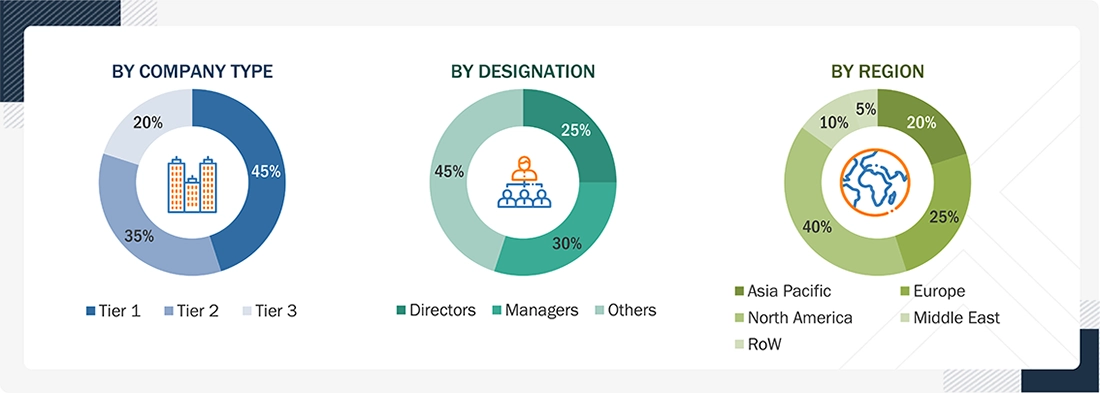
Extensive primary research was conducted after acquiring information regarding the inertial navigation systems market scenario through secondary research. Several primary interviews were conducted with market experts from the demand and supply sides across major countries of North America, Europe, the Asia Pacific, the Middle East, and the Rest of the world. Primary data was collected through questionnaires, emails, and telephonic interviews.
To know about the assumptions considered for the study, download the pdf brochure
Market Size Estimation
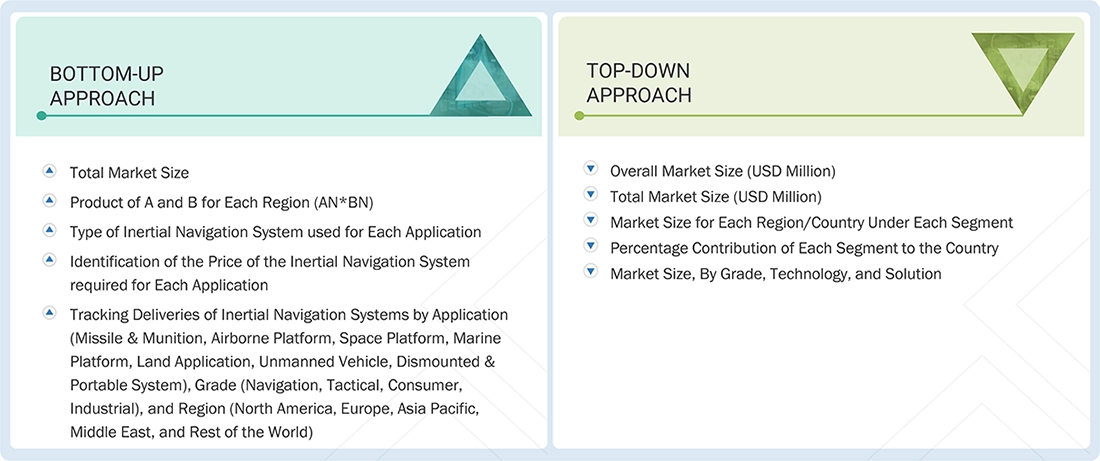
The top-down and bottom-up approaches were used to estimate and validate the size of the inertial navigation systems market. The research methodology used to estimate the size of the market included the following details:
- Key players in the market were identified through secondary research, and their market shares were determined through a combination of primary and secondary research. This included a study of the annual and financial reports of the top market players, as well as extensive interviews with leaders, including directors, engineers, marketing executives, and other key stakeholders of leading companies operating in the market.
- All percentage shares, splits, and breakdowns were determined using secondary sources and verified through primary sources.
- All possible parameters that affect the markets covered in this research study were accounted for, viewed in extensive detail, verified through primary research, and analyzed to obtain the final quantitative and qualitative data on the inertial navigation systems market. This data was consolidated, enhanced with detailed inputs, analyzed by MarketsandMarkets, and presented in this report.
Inertial Navigation Systems Market: Top-Down and Bottom-Up Approach
Data Triangulation
After determining the overall market size, the total market was divided into several segments and subsegments. The data triangulation and market breakdown procedures explained below were implemented, wherever applicable, to complete the overall market engineering process and arrive at the estimated market numbers for the market segments and subsegments. The data was triangulated by studying various factors and trends from the demand and supply sides. Additionally, the market size was validated using top-down and bottom-up approaches.
Market Definition
An inertial navigation system evaluates inputs from accelerometers and gyroscopes to track the position and orientation of an object relative to its starting point and velocity. These systems are utilized across airborne, ground, and naval platforms. Position, velocity, and orientation are essential parameters of navigation systems. Most navigation systems, such as the global positioning system (GPS), do not provide real-time details on the above-mentioned parameters. The deployment of GPS across various platforms depends on its signal strength and the equipment’s location. Additionally, precise and reliable navigation inputs are required to ensure the efficient functioning of GPS and other satellite communication and airborne equipment. Inertial navigation systems provide these details with the desired accuracy and reliability.
Key Stakeholders
- Inertial Navigation System Manufacturers
- Inertial Navigation System Wholesalers, Retailers, and Distributors
- System Integrators
- Technology Providers
- Sensor Manufacturers
- Raw Material Suppliers
- Aircraft Regulatory Bodies
Report Objectives
- To define, describe, and forecast the inertial navigation systems market based on application, grade, technology, and solution
- To forecast the size of different segments of the market with respect to North America, Europe, the Asia Pacific, the Middle East, and the Rest of the World
- To identify and analyze the drivers, restraints, opportunities, and challenges influencing the growth of the market
- To identify industry trends, market trends, and technology trends currently prevailing in the market
- To analyze micro markets with respect to individual growth trends, prospects, and their contribution to the overall market
- To analyze the degree of competition in the market by analyzing recent developments adopted by leading market players
- To provide a detailed competitive landscape of the market, along with a ranking analysis of key players, and an analysis of startup companies in the market
- To strategically profile the key market players and comprehensively analyze their core competencies
- To provide a detailed competitive landscape of the market, along with a market share analysis and revenue analysis of key players
Available customizations:
MarketsandMarkets offers the following customizations for this market report:
- Additional country-level analysis of the inertial navigation systems market
- Profiling of other market players (up to 5)
Product Analysis
- Product matrix, which provides a detailed comparison of the product portfolio of each company in the inertial navigation systems market
Need a Tailored Report?
Customize this report to your needs
Get 10% FREE Customization
Customize This ReportPersonalize This Research
- Triangulate with your Own Data
- Get Data as per your Format and Definition
- Gain a Deeper Dive on a Specific Application, Geography, Customer or Competitor
- Any level of Personalization
Let Us Help You
- What are the Known and Unknown Adjacencies Impacting the Inertial Navigation Systems Market
- What will your New Revenue Sources be?
- Who will be your Top Customer; what will make them switch?
- Defend your Market Share or Win Competitors
- Get a Scorecard for Target Partners

Custom Market Research Services
We Will Customise The Research For You, In Case The Report Listed Above Does Not Meet With Your Requirements
Get 10% Free CustomisationGrowth opportunities and latent adjacency in Inertial Navigation Systems Market






User
Feb, 2020
Hi Team, I am interested in buying market research on inertial navigation and gyrocompass for a naval or maritime small carrier like UUV, UAV, USV. Thanks, Hortense BASTIE..