KSA IoT Market

KSA IoT Market by Hardware (Modules/Sensors, Security Hardware), Connectivity (Cellular, LPWAN, Satellite), Software (IoT Platforms, Application Software, Analytics Software, Security & Safety Software) - Forecast to 2031




OVERVIEW

Source: Secondary Research, Interviews with Experts, MarketsandMarkets Analysis
Saudi Arabia's IoT market is driven by the national transformation framework and significant government investment in digital infrastructure and high-speed connectivity. Large projects like NEOM, the Red Sea Global initiatives, and the creation of smart districts in Riyadh support better urban management and more efficient industrial processes. Additionally, the smooth integration of IoT in logistics, healthcare, and manufacturing opens up new possibilities for innovation across industries. This focus is set to change the Kingdom’s economic landscape, transforming it into a modern, data-driven global technology center that shapes the future of connected infrastructure and digital resilience.
KEY TAKEAWAYS
-
By Module TypeBy module type, the connectivity segment is expected to register the highest CAGR of 8.2%.
-
By HardwareBy hardware, the other hardware segment is anticipated to account for the largest market from 2025 to 2031.
-
By ConnectivityBy connectivity, the satellite segment is projected to register the highest CAGR of 13.3%.
-
By SoftwareBy software, the IoT platforms segment is estimated to lead the market from 2025 to 2031.
-
By ServiceBy service, the managed services segment is estimated to register the highest CAGR of 8.2%
-
By Focus AreaBy focus area, the smart manufacturing segment is anticipated to lead the market from 2025 to 2031.
-
Competitive Landscape Key PlayersSTC, Huawei Technologies, AWS, Microsoft, Cisco, and Ericsson were identified as some of the star players in the KSA IoT market, given their strong market share and product footprint.
The KSA IoT market is increasingly shaped by the combination of artificial intelligence (AI) and high-speed 5G connectivity, led by the National Strategy for Data and AI. Major projects like Aramco Digital’s national industrial network and the automation of the Kingdom’s power distribution using smart grids are changing the energy sector. These improvements, along with better resource management in holy cities, provide great opportunities for edge computing and real-time predictive maintenance. In the end, this technological growth will go beyond basic connectivity, helping to build a strong, knowledge-based economy where data-driven insights enhance industrial productivity and secure Saudi Arabia's position in the global digital space.
MARKET DYNAMICS

Level
-
Vision 2030-led national programs and heavy public digital budgets

-
Expanding 5G coverage and high smartphone penetration


Level
-
Data security and privacy concerns

-
Regional wars and maritime corridor disruptions


Level
-
Public-private partnerships and sovereign funding under national transformation plans

-
Smart manufacturing growth


Level
-
Rising cyber threats and weak device security

-
Interoperability issues with legacy systems

Source: Secondary Research, Interviews with Experts, MarketsandMarkets Analysis
Driver - Expanding 5G coverage and high smartphone penetration
5G is spreading quickly across cities like Riyadh and Jeddah, acting as the main backbone for the Saudi IoT surge. Because smartphone use is so high, consumers are already tech-ready, making the jump to smart homes and wearables feel natural. This widespread connectivity means businesses no longer see high-speed data as a luxury, but as a basic tool for real-time tracking. Ultimately, this shift is pushing a massive wave of automation across the Kingdom's industrial and retail sectors.
Restraints - Data security and privacy concerns
While the tech is ready, many Saudi businesses are slowing down due to serious concerns over data privacy. The strict rules of the PDPL mean that companies have to be incredibly careful with how they handle information to avoid massive fines. This regulatory pressure often delays the launch of new data-driven projects. It is especially visible in sectors like healthcare and finance, where the risk of a security breach still feels bigger than the potential rewards of going digital.
Opportunities - Public-private partnerships and sovereign funding under national transformation plans
Vision 2030 has essentially opened the doors for IoT, especially with the Public Investment Fund (PIF) backing major projects. Large-scale developments like NEOM act as "live labs" where global tech firms can test smart city tools at a scale. This government support makes it much less risky for private companies to jump in and invest. By bringing together state funding and private innovation, the Kingdom is quickly cementing its place as a top-tier digital economy.
Challenge - Rising cyber threats and weak device security
The downside of connecting everything is that it opens up thousands of new targets for cyberattacks. Many basic IoT devices lack proper encryption, making them "weak links" that hackers can easily exploit. For a country as economically important as Saudi Arabia, these security gaps are a major national concern. It forces the government and private firms to spend heavily on cybersecurity just to keep their digital infrastructure from being compromised.
KSA IOT MARKET: COMMERCIAL USE CASES ACROSS INDUSTRIES
| COMPANY | USE CASE DESCRIPTION | BENEFITS |
|---|---|---|
 |
Huawei, in collaboration with STC, enables AI-driven IoT solutions by integrating data platforms and intelligent systems. These solutions help businesses improve operational efficiency, automate processes, and enhance customer experience through real-time data insights and smart decision-making systems. | AI-driven analytics | Intelligent operations | Real-time data insights | Enhanced customer experience |
 |
AWS provides cloud platforms that allow businesses to connect IoT devices, collect large volumes of data, and analyze it in real time. Companies use AWS IoT services to build scalable applications, automate processes, and gain insights from connected devices across industries like manufacturing and logistics. | Scalable cloud platform | Real-time IoT analytics | Device data management | Flexible IoT application development |
 |
Microsoft Azure IoT enables organizations to monitor assets and equipment remotely through connected sensors. Businesses use this to track performance, predict failures, and optimize operations using dashboards and AI-powered analytics, especially in industries like manufacturing and energy. | Remote asset monitoring | Predictive maintenance | AI-powered insights | Improved operational efficiency |
 |
Cisco partnered with STC to deliver real-time monitoring and high-performance network connectivity during large-scale events like the Esports World Cup. Using IoT-enabled network analytics and automation tools, they ensured seamless connectivity, zero downtime, and optimized user experience. | Real-time network visibility | High reliability & uptime | Automated monitoring | Seamless digital experience |
Logos and trademarks shown above are the property of their respective owners. Their use here is for informational and illustrative purposes only.
MARKET ECOSYSTEM
The KSA IoT ecosystem is a collaborative network driven by global technology leaders like Microsoft, Cisco, IBM, Oracle, and Siemens, which provide the foundational cloud platforms, infrastructure, and AI capabilities. This technological core is supported by major telecom operators, including stc, Zain, and Mobily, which manage the vital connectivity and network infrastructure. Locally, regional system integrators and specialized firms close the gap by offering custom implementations and industry-specific applications. Regulatory authorities like SDAIA and CITC ensure proper oversight for data governance, security, and compliance. Together, these stakeholders form a unified framework that ensures the development of a secure, scalable, and sophisticated digital economy within the Kingdom.

Logos and trademarks shown above are the property of their respective owners. Their use here is for informational and illustrative purposes only.
MARKET SEGMENTS

Source: Secondary Research, Interviews with Experts, MarketsandMarkets Analysis
KSA IoT market, By Module Type
The service segment maintains the largest share of the KSA IoT market, primarily due to the essential need for system integration and the ongoing management of complex digital ecosystems. As organizations align with Vision 2030, the shift toward digital transformation has intensified the demand for managed support to ensure both operational continuity and scalability. Businesses increasingly look to specialized providers for custom configurations, robust cybersecurity, and performance optimization, making end-to-end service capabilities a dominant force in the industry.
KSA IoT market, By Hardware
Modules and sensors are the fastest-growing hardware category, propelled by the rapid rollout of smart infrastructure and industrial automation throughout the Kingdom. The expansion of smart city projects and predictive maintenance strategies has created a critical need for real-time data collection. These components serve as the fundamental layer of any IoT network, facilitating the communication and data capture necessary for intelligent decision-making. Their essential role in bridging the physical and digital worlds ensures their continued upward trajectory.
KSA IoT market, By Connectivity
The other connectivity category leads the market by supporting specialized and diverse use cases that standard networks cannot always accommodate. As enterprises deploy solutions in increasingly complex or remote environments, they require flexible, cost-efficient options that prioritize low power consumption and wide geographic coverage. This adaptability makes the segment a vital enabler for large-scale industrial deployments, providing the reliable transmission required for sophisticated operational needs.
KSA IoT market, By Software
Analytics software has emerged as the fastest-growing software segment in the Kingdom, filled by the critical requirement to transform vast quantities of raw data into strategic business intelligence. Organizations across Saudi Arabia are increasingly adopting data-centric operational models to improve both process efficiency and predictive precision. This shift is further intensified by the integration of artificial intelligence and machine learning, as enterprises seek sophisticated platforms capable of automating complex workflows and securing a competitive advantage through high-level data insights.
KSA IoT market, By Services
Professional services represent a major portion of the IoT service market, fueled by a high demand for expert consulting, system design, and strategic implementation. As IoT adoption scales, organizations require specialized guidance to ensure their technology investments align with both commercial goals and local regulatory frameworks. By offering risk mitigation and ensuring peak system performance, professional service providers play a strategic role in the successful deployment and long-term viability of high-level IoT projects.
KSA IoT Market, By Focus Area
The smart cities segment holds the largest market share in the KSA IoT market, driven by significant government investments under Vision 2030 to build connected and sustainable urban environments. Key focus areas such as smart transportation, buildings, energy, and utilities are being integrated to improve infrastructure efficiency and quality of life. The adoption of IoT in healthcare, agriculture, manufacturing, and retail further supports the broader smart city ecosystem. These initiatives rely on real-time data, automation, and intelligent resource management to enhance operational performance. As a result, smart cities continue to lead the market, acting as the foundation for widespread IoT adoption across the Kingdom.
KSA IOT MARKET: COMPANY EVALUATION MATRIX
In the KSA IoT market, stc and Zain have built a strong position by leveraging their extensive telecom infrastructure and nationwide network coverage. Rather than acting as simple connectivity providers, they play a central role in enabling seamless device communication, ensuring that IoT applications function reliably at scale. Their networks handle the complexity of high data volumes, low-latency requirements, and secure transmission, which is critical for use cases like smart cities, industrial automation, and connected healthcare. By continuously investing in 5G expansion and digital platforms, they are strengthening their role in the IoT value chain. This combination of robust infrastructure and evolving digital capabilities allows them to remain key enablers of Saudi Arabia’s rapidly growing IoT ecosystem.

Source: Secondary Research, Interviews with Experts, MarketsandMarkets Analysis
KEY MARKET PLAYERS
- STC (Saudi Arabia)
- Microsoft (US)
- Huawei Technologies Co. (China)
- Amazon Web Services (US)
- Cisco Systems (US)
- Intel Corporation (US)
- Qualcomm Technologies (US)
- Texas Instruments Incorporated (US)
- STMicroelectronics (Switzerland)
- Microchip Technology Inc. (US)
- NXP Semiconductors (Netherlands)
- Hewlett Packard Enterprise Deveopment Lp (US)
- TE Connectivity (Switzerland)
- Advantech Co. (Taiwan)
- Dell Inc. (US)
- Siemens (Germany)
- Hellium (US)
- Bosch Sensortec GmbH (Germany)
- TDK Corporation (Japan)
- Infineon Technologies AG (Germany)
- Analog Devices (US)
- OMRON Corporation (Japan)
- Honeywell Intemational Inc. (US)
- Knowles Electronics (US)
- ABB (Switzerland)
- Sensata Technollogies (US)
- Emerson Electric Co. (US)
- IBM (US)
- Oracle (US)
- Fortinet (US)
- Rockwell Automation (US)
- SAMSUNG (South Korea)
- General Electric Company (US)
- Schneider Electric (France)
- Hitachi (Japan)
- Software GmbH (Germany)
- Sigfox (France)
- Telefonaktiebolaget LM Ericsson (Sweden)
- ZAIN (Kuwait)
- Disrupt-X (UAE)
- LTS Connecting Things (Saudi Arabia)
- WakeCap (Saudi Arabia)
- Mobily (Saudi Arabia)
- OQ Technologies (Luxembourg)
- Myriota (Australia)
MARKET SCOPE
| REPORT METRIC | DETAILS |
|---|---|
| Market Size in 2025 (Value) | USD 2.88 Billion |
| Market Forecast in 2031 (Value) | USD 4.33 Billion |
| Growth Rate | CAGR of 7.2% from 2026 to 2031 |
| Years Considered | 2020-2031 |
| Base Year | 2025 |
| Forecast Period | 2026-2031 |
| Units Considered | Value (USD Billion) |
| Report Coverage | Revenue forecast, company ranking, competitive landscape, growth factors, and trends |
| Segments Covered | By Module Type (Hardware, Connectivity, Software, Services), By Hardware (Module/Sensors, Security Hardware, Other Hardware), By Connectivity (Cellular, LPWAN, Satellite), Software (IOT Platforms, Application Software, Analytics Software, Security & Safety Software, Other Software) By Focus Area (Smart Citie, Smart Buildings, Smart Transportation, Smart Healthcare, Smart Energy, Smart Agriculture, Smart Manufacturing, Smart Retail, Other Focus Areas) |
WHAT IS IN IT FOR YOU: KSA IOT MARKET REPORT CONTENT GUIDE

DELIVERED CUSTOMIZATIONS
We have successfully delivered the following deep-dive customizations:
| CLIENT REQUEST | CUSTOMIZATION DELIVERED | VALUE ADDS |
|---|---|---|
| Leading Service Provider (KSA) | Regional Analysis: • Further breakdown of the KSA IoT market | • Identifies high-growth regional opportunities, enabling tailored market entry strategies. • Optimizes resource allocation and investment based on region-specific demand and trends. |
| Company Information | Detailed analysis and profiling of additional market players (up to 5) | • Broadens competitive insights, helping clients make informed strategic and investment decisions. • Reveals market gaps and opportunities, supporting differentiation and targeted growth initiatives. |
RECENT DEVELOPMENTS
- November 2025 : Cisco rolled out a tool called Unified Edge that basically brings a huge amount of computing power right to where the data is actually being created. Instead of the old way of sending every bit of info back to a far-away server, this platform lets businesses handle their networking, security, and data processing all in one spot, right on the front lines. This is a game-changer for places like smart factories, hospitals, and retail stores because it allows them to run AI and complex analytics instantly. By processing everything on the fly exactly where the devices are, companies can make much faster decisions and keep their operations running a lot more smoothly without any annoying lag.
- November 2025 : Qualcomm introduced its Dragonwing IQ-X Series, which is essentially a lineup of heavy-duty processors built to give industrial tech a serious brain boost. By using its specialized Oryon CPU architecture, it has managed to pack a lot of power and smart AI capabilities into a chip that does not eat up too much energy. This matters because it allows factories and complex industrial systems to crunch massive amounts of data and make snap decisions right on the spot, rather than waiting for a distant server to respond. By cutting out that lag, the whole operation becomes much faster and more efficient, making it way easier to manage a massive web of connected machines without the usual technical hiccups.
- May 2025 : Advantech and Qualcomm joined forces to bring the high-powered Dragonwing platform directly into Advantech’s line of industrial edge products. By combining their expertise, they are making it much easier for industries like smart manufacturing and transportation to handle heavy-duty AI tasks right where the action happens. This partnership is especially focused on things like autonomous robots and intelligent retail systems, where the ability to process data and make snap decisions on the spot is crucial. Ultimately, it is all about giving machines the "brains" they need to work faster and more independently, ensuring smoother operations across the board.
- January 2026 : At CES 2026, Bosch Sensortec rolled out its new BMI5 motion sensor platform, which is basically a set of three high-tech sensors—the BMI560, BMI563, and BMI570—built to help machines move more naturally. These sensors are perfect for things that need to be incredibly precise, like XR headsets, robots, and even the smartwatches or earbuds we wear every day. By using its latest internal design architecture, Bosch managed to make these sensors super quiet and tough enough to handle heavy vibrations without getting "confused." It also doubled how much movement these sensors can actually track compared to the older versions, making them a huge upgrade for any device that needs to stay perfectly balanced or track every tiny tilt and turn.
Table of Contents
 Exclusive indicates content/data unique to MarketsandMarkets and not available with any competitors.
Methodology
This research study involved four major activities in estimating the KSA IoT market size. Exhaustive secondary research was conducted to collect important information about the market and peer markets. The next step involved validating these findings and assumptions and sizing them with the help of primary research with industry experts across the value chain. Both top-down and bottom-up approaches were used to estimate the market size. Post which, the market breakdown and data triangulation were adopted to estimate the market sizes of segments and sub-segments.
Secondary Research
The market size of the companies offering smart learning solutions to various end users was arrived at based on the secondary data available through paid and unpaid sources, and by analyzing the product portfolios of major companies in the ecosystem and rating the companies based on their performance and quality. In the secondary research process, various sources were referred to to identify and collect information for the study. The secondary sources included annual reports, press releases, investor presentations of companies, white papers, certified publications, and articles from recognized associations and government publishing sources. Several journals were also referred to, such as the International Journal of Computer Science and Information Technology and Security (IJCSITS), ScienceDirect, ResearchGate, Academic Journals, and Scientific.Net; and various telecom and smart learning associations/forums, Citizens Broadband Radio Service (CBRS) Alliance, MulteFire Alliance, and 3GPP.
Secondary research was mainly used to obtain critical information about industry insights, the market’s monetary chain, the overall pool of key players, market classification, and segmentation according to industry trends to the bottom-most level, regional markets, and key developments from both market- and technology-oriented perspectives.
Primary Research
In the primary research process, various sources from the supply and demand sides were interviewed to obtain qualitative and quantitative information for the report. The primary sources from the supply side included Chief Executive Officers (CEOs), Chief Technology Officers (CTOs), Chief Operating Officers (COOs), Vice Presidents (VPs), Managing Directors (MDs), technology and innovation directors, and related key executives from various key companies and organizations operating in the KSA IoT market.
Primary interviews were conducted to gather insights, such as market statistics, data on revenue collected from software and services, market breakups, market size estimations, market forecasts, and data triangulation. Stakeholders from the demand side, such as Chief Information Officers (CIOs), Chief Finance Officers (CFOs), Chief Strategy Officers (CSOs), and the installation team of end users that use smart learning, were interviewed to understand buyers’ perspectives on suppliers, products, service providers, and their current usage of smart learning hardware, solutions, and services, which is expected to affect the overall KSA IoT market growth.
BREAKDOWN OF PRIMARIES

Note: Tier 1 companies have revenues of more than USD 10 billion; tier 2 companies’ revenue ranges from USD 1 billion to USD 10 billion; and tier 3 companies’ revenue ranges from USD 500 million to USD 1 billion
Source: Secondary Research, Interviews with Experts, and MarketsandMarkets Analysis
To know about the assumptions considered for the study, download the pdf brochure
Market Size Estimation
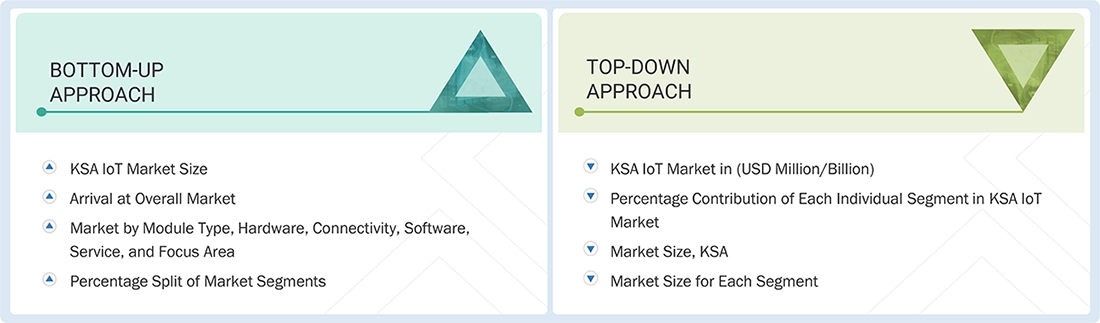
In the market engineering process, the top-down and bottom-up approaches were used along with multiple data triangulation methods to estimate and validate the size of the KSA IoT market, as well as other dependent submarkets. The research methodology used to estimate the market sizes includes the following:
- Initially, MarketsandMarkets focuses on top-line investments and spending in the ecosystems. Further, significant developments in the critical market area were considered.
- Tracking the recent and upcoming developments in the KSA IoT market that include investments, R&D activities, product launches, collaborations, mergers and acquisitions, and partnerships, as well as forecasting the market size based on these developments and other critical parameters.
- Conducting multiple discussions with key opinion leaders to learn about the diverse types of authentications and brand protection offerings used, and the applications for which they are used, to analyze the breakdown of the scope of work carried out by major companies.
- Segmenting the market based on technology types concerning applications, wherein the types are to be used, and deriving the size of the global application market.
- Segmenting the overall market into various market segments
- Validating the estimates at every level through discussions with key opinion leaders, such as chief executives (CXOs), directors, and operations managers, and finally with the domain experts at MarketsandMarkets
KSA IoT Market: Top-Down and Bottom-Up Approach
Data Triangulation
After arriving at the overall market size from the above estimation process, the KSA IoT market was split into several segments and sub-segments. To complete the overall market engineering process and arrive at the exact statistics for all segments and sub-segments, data triangulation and market breakdown procedures were used, wherever applicable. The data was triangulated by studying various factors and trends from both the demand and supply sides.
The KSA IoT market size was validated using top-down and bottom-up approaches.
Market Definition
The Internet of Things (IoT) is a network of physical devices embedded with sensors and software that can collect and exchange data over the internet, enabling them to communicate and interact with each other without human intervention. Essentially, it encompasses hardware, software, connectivity, and services used to build and operate IoT systems across various focus areas such as smart cities, smart transportation, smart energy & utilities, smart manufacturing, and smart retail, among others. IoT is a key part of Saudi Arabia's strategy to boost innovation, optimize operations, and achieve technological transformation aligned with its Vision 2030.
Key Stakeholders
- Government agencies
- IoT service providers
- Telecom companies
- System integrators
- Smart device manufacturers
- Healthcare providers and institutions
- Automotive and mobility solution providers
- Energy and utility companies
- Retailers and E-commerce platforms
- Industrial enterprises
- Construction and real estate developers
- Agricultural enterprises
- Financial institutions and banks
- Research and development institutions
- Educational and training organizations
Report Objectives
- To determine, segment, and forecast the Kingdom of Saudi Arabia (KSA) IoT market based on module type (hardware, connectivity, software, services), hardware (modules/sensors, security hardware, other hardware), software (IoT platforms, application software, analytics software, security and safety software, other software), connectivity (cellular, LPWAN, satellite, other connectivity), service (professional services, managed services), and focus area (smart transportation/mobility, smart buildings, smart energy & utilities, smart healthcare, smart agriculture, smart manufacturing, smart cities, smart retail, other focus areas) from 2026 to 2031, and analyze various macroeconomic and microeconomic factors that affect market growth
- To forecast the size of the market segments with respect to the KSA region
- To provide detailed information about the major factors (drivers, restraints, opportunities, and challenges) influencing the growth of the market
- To strategically analyze the macro and micromarkets with respect to individual growth trends, prospects, and contributions to the total market
- To study the complete value chain and related industry segments, and perform a value chain analysis of the market landscape
- To analyze the industry trends, pricing data, and innovations related to the market
- To analyze the opportunities for stakeholders by identifying the high-growth segments of the market
- To profile the key players in the market and comprehensively analyze their market share/ranking and core competencies
- To track and analyze competitive developments, such as mergers & acquisitions, product launches & developments, partnerships, agreements, collaborations, business expansions, and R&D activities
- To track and analyze competitive developments in the market, such as mergers and acquisitions, product developments, partnerships and collaborations, and Research and Development (R&D) activities
Available customizations:
With the given market data, MarketsandMarkets offers customizations per the company’s specific needs. The following customization options are available for the report:
Company Information
- Detailed analysis and profiling of additional market players (up to 5)
Key Questions Addressed by the Report
What is the projected size of the KSA IoT Market by 2031?
The KSA IoT market is projected to grow from USD 3.06 billion in 2026 to USD 4.33 billion by 2031, at a CAGR of 7.2% during the forecast period.
What is the primary factor driving the growth of the KSA IoT Market?
The market is driven by the increasing adoption of IoT across healthcare, retail, energy, and smart city projects to improve operational efficiency and real-time decision-making.
Which module type is expected to register the highest growth in the KSA IoT Market?
The connectivity segment is expected to register the highest CAGR due to increasing demand for seamless communication between connected devices and expanding 4G and 5G networks.
Which connectivity technology is projected to grow the fastest in the KSA IoT Market?
The satellite connectivity segment is projected to register the highest CAGR during the forecast period.
Which software segment is expected to lead the KSA IoT Market?
The IoT platforms segment is expected to lead the market throughout the forecast period.
How is Saudi Vision 2030 influencing the KSA IoT Market?
Saudi Vision 2030 is accelerating IoT adoption by promoting digital transformation, smart infrastructure, advanced connectivity, and AI-enabled innovation across industries.


Personalize This Research
- Triangulate with your Own Data
- Get Data as per your Format and Definition
- Gain a Deeper Dive on a Specific Application, Geography, Customer or Competitor
- Any level of Personalization
Let Us Help You
- What are the Known and Unknown Adjacencies Impacting the KSA IoT Market
- What will your New Revenue Sources be?
- Who will be your Top Customer; what will make them switch?
- Defend your Market Share or Win Competitors
- Get a Scorecard for Target Partners

Custom Market Research Services
We Will Customise The Research For You, In Case The Report Listed Above Does Not Meet With Your Requirements
Get 10% Free CustomisationTESTIMONIALS






Growth opportunities and latent adjacency in KSA IoT Market