Machine Vision Camera Market Size, Share & Growth, 2030

Machine Vision Camera Market by Imaging Spectrum (Visible Light, Visible + IR/NIR), Frame Rate (<25 fps, 25-125 fps, >125 fps), Format (Area Scan, Line Scan), Deployment (General, Robotic Cell), Vision Type (1D, 2D, 3D), System Type - Forecast to 2030




OVERVIEW
Source: Secondary Research, Interviews with Experts, MarketsandMarkets Analysis
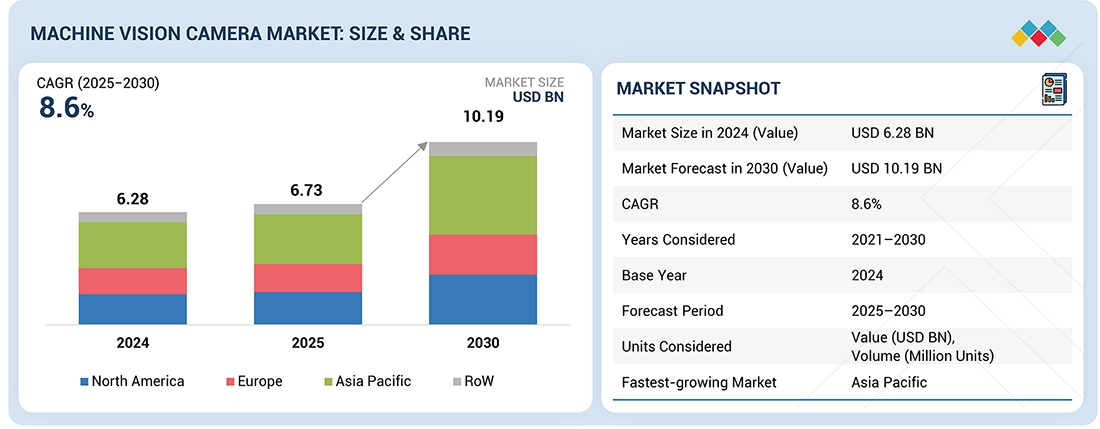
The machine vision camera market is projected to reach USD 10.19 billion by 2030 from USD 6.73 billion in 2025, growing at a CAGR of 8.6% during the forecast period. Market expansion is driven by the accelerating automation across the electronics, automotive, and packaging industries, coupled with a rising demand for high-speed, high-resolution imaging. Advancements in CMOS sensors and high-bandwidth interfaces, along with the increasing adoption of smart cameras and edge AI systems, as well as expanding opportunities in semiconductor, EV battery, and electronics manufacturing, continue to strengthen market momentum worldwide.
Market Size & Forecast
KEY TAKEAWAYS
-
By RegionThe Asia Pacific dominated the machine vision camera market, accounting for a 41% share in 2024.
-
By Imaging SpectrumBy imaging spectrum, the Visible + IR segment is expected to register the highest CAGR of 10.0%.
-
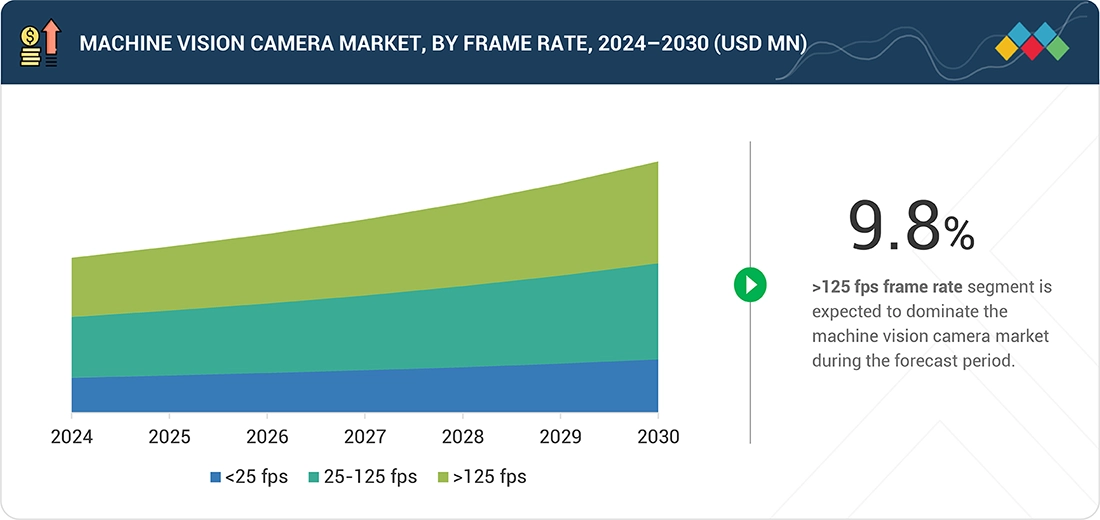
By Frame RateBy frame rate, >125 fps segment is projected to grow at the fastest rate from 2025 to 2030.
-
Competitive LandscapeBasler AG, Cognex Corporation, and Teledyne Technologies Inc. were identified as key players in the machine vision camera market, given their strong market share and extensive product portfolios.
-
Competitive LandscapeBaumer, JAI A/S, and IDS Imaging Development Systems GmbH have distinguished themselves among startups and SMEs by securing strong footholds in specialized niche areas, underscoring their potential as emerging market leaders
The machine vision camera industry is experiencing strong growth, driven by the rapid adoption of automation and the rising need for high-speed, high-resolution imaging across diverse manufacturing sectors. Expanding electronics, semiconductor, automotive, and packaging industries are accelerating deployment, supported by advancements in CMOS sensors, smart camera technologies, and edge-AI processing that enhance accuracy, productivity, and real-time inspection capabilities across modern industrial operations.
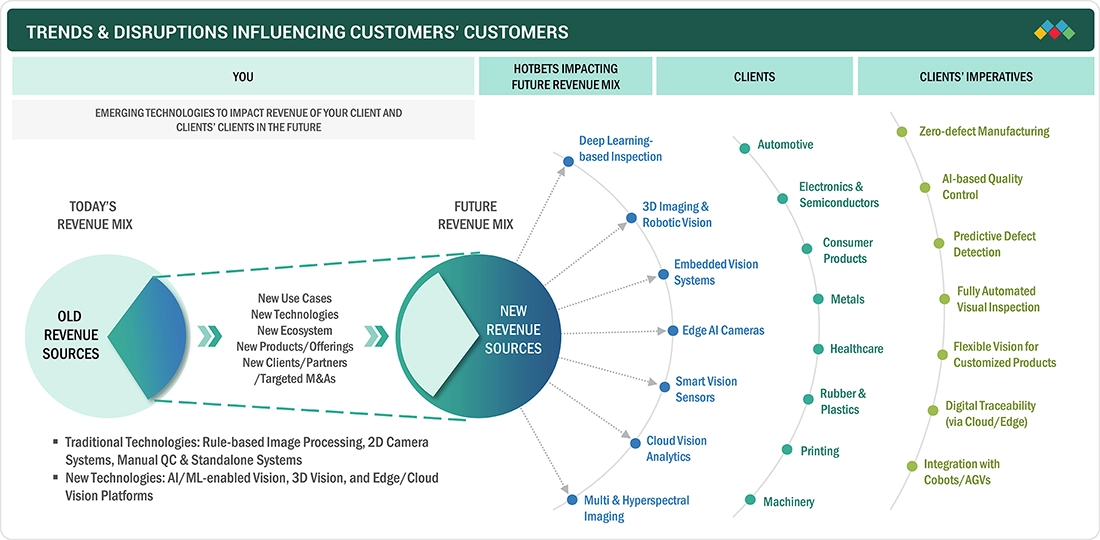
TRENDS & DISRUPTIONS IMPACTING CUSTOMERS' CUSTOMERS
The impact on customers’ businesses in the machine vision camera market is increasing rapidly as industries transition from manual inspection to high-speed, camera-driven automation. Advancements in CMOS sensors, high-resolution imaging, smart cameras, and edge-AI processing are enhancing quality control, defect detection, and process traceability across electronics, automotive, semiconductor, EV battery, food and beverage, and general manufacturing. This shift is fueling demand for zero-defect production, faster cycle times, predictive quality analytics, and fully automated inspection workflows, enabling higher productivity, reduced operational downtime, and improved manufacturing efficiency worldwide.
Source: Secondary Research, Interviews with Experts, MarketsandMarkets Analysis
MARKET DYNAMICS

Level
-
Growing automation in electronics, automotive, and packaging accelerating demand for high-speed, high-resolution vision cameras

-
Advancements in CMOS sensors and high-bandwidth interfaces (GigE, CoaXPress, USB3) boosting adoption


Level
-
High cost of advanced cameras and integration limits adoption among small manufacturers

-
Compatibility and setup complexity slow deployment in multi-vendor environments


Level
-
Rising adoption of smart cameras and edge-AI vision systems across factories and logistics

-
Expanding semiconductor, EV battery, and electronics assembly sectors increase demand for precision imaging


Level
-
Shortage of skilled machine vision engineers for system integration

-
Supply-chain constraints for image sensors and optics affect production timelines

Source: Secondary Research, Interviews with Experts, MarketsandMarkets Analysis
Driver: Growing automation in electronics, automotive, and packaging accelerating demand for high-speed, high-resolution vision cameras
Growing automation across electronics, automotive, and packaging sectors is boosting the need for advanced vision cameras that support faster inspection and accurate defect detection. As manufacturers shift toward smart factories, high-performance imaging has become essential for improving throughput, ensuring product consistency, and enabling real-time decision-making, thereby driving strong adoption of high-speed, high-resolution machine vision cameras.
Restraint: High cost of advanced cameras and integration limits adoption among small manufacturers
The high cost of next-generation machine vision cameras and the added expenses of integration, customization, and software significantly restrict adoption among smaller manufacturers. Limited budgets make it difficult for SMEs to justify investment in premium imaging systems. This cost barrier slows modernization efforts, reducing the pace at which smaller players can transition to automated inspection and quality control.
Opportunity: Rising adoption of smart cameras and edge-AI vision systems across factories and logistics
Increasing use of smart cameras and edge-AI-enabled vision systems is unlocking new opportunities across factories and logistics operations. These solutions minimize data-processing loads, enhance real-time analytics, and support autonomous decision-making on the production floor. As industries move toward predictive quality control and decentralized architectures, demand for compact, intelligent, and easily deployable machine vision devices continues to grow.
Challenge: Shortage of skilled machine vision engineers for system integration
The industry faces a notable shortage of skilled machine vision engineers capable of handling system integration, calibration, algorithm tuning, and robotics alignment. This talent gap increases deployment timelines and costs, often forcing companies to depend on external specialists. The lack of expertise slows down large-scale implementation of advanced vision systems, hindering automation progress across manufacturing and logistics.
MACHINE VISION CAMERA MARKET: COMMERCIAL USE CASES ACROSS INDUSTRIES
| COMPANY | USE CASE DESCRIPTION | BENEFITS |
|---|---|---|
 |
Machine vision cameras perform automated inspection of body panels, verify weld seam quality, and guide robots for precision assembly of drivetrain components. | Higher assembly precision, reduced rework, and improved vehicle quality |
 |
High-speed cameras inspect semiconductor wafers for micro-defects, verify photolithography alignment, and monitor packaging processes for fine-pitch components. | Enhanced wafer yield, reduced pattern defects, and greater process stability |
 |
Vision cameras check packaging integrity, verify label accuracy, detect contamination, and inspect bottle caps and seals on high-speed food production lines. | Improved food safety, fewer packaging errors, and reduced product recalls |
 |
Machine vision cameras monitor electrode coating uniformity, detect separator defects, and verify alignment during cell stacking for EV battery production. | Higher battery reliability, reduced defect rates, and improved safety standards |
 |
Cameras automate inspection of sachets, cartons, and bottles, detecting seal defects, misprints, and under/overfilled products in consumer goods packaging. | Improved packaging quality, lower rejection rates, and consistent brand presentation |
Logos and trademarks shown above are the property of their respective owners. Their use here is for informational and illustrative purposes only.
MARKET ECOSYSTEM
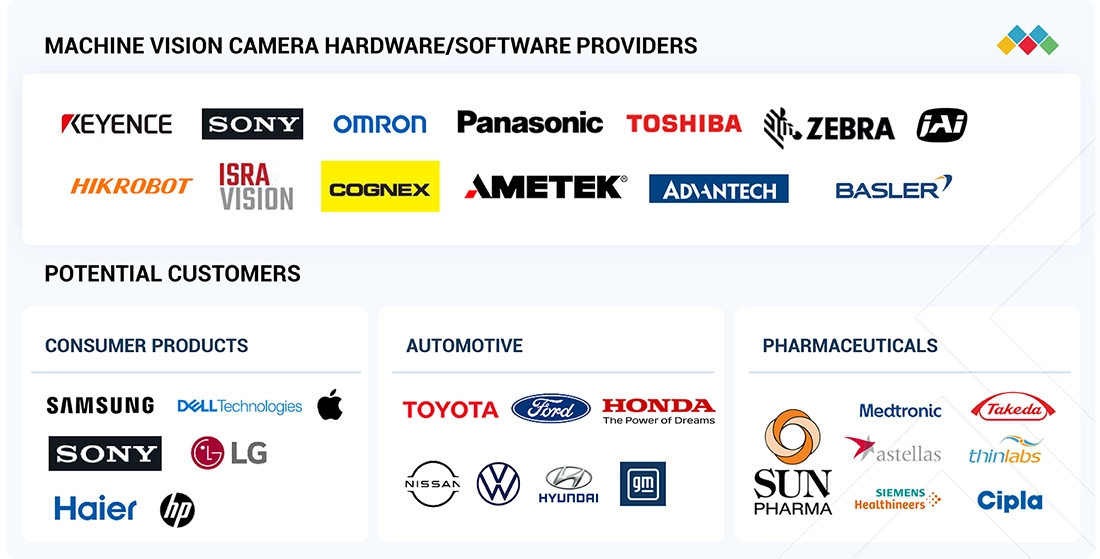
The machine vision camera market ecosystem is driven by leading hardware and software providers, including Keyence, Sony, Cognex, Basler, Omron, Panasonic, and Teledyne, which supply high-resolution industrial cameras, smart imaging sensors, embedded vision modules, and advanced processing software. These technologies support deployment across major end-user industries, including consumer electronics (Samsung, Dell, LG), automotive manufacturing (Toyota, Ford, Honda), pharmaceuticals (Sun Pharma, Cipla, Takeda), food & beverages (Nestlé, PepsiCo, Yili), and industrial machinery (Mitsubishi, Fanuc, Yaskawa). This interconnected global ecosystem enhances inspection accuracy, production efficiency, traceability, and automated decision-making, strengthening digital transformation and quality control across diverse manufacturing environments.
Logos and trademarks shown above are the property of their respective owners. Their use here is for informational and illustrative purposes only.
MARKET SEGMENTS
Source: Secondary Research, Interviews with Experts, MarketsandMarkets Analysis
Machine Vision Camera Market, by Imaging Spectrum
Visible-spectrum cameras hold the largest share of the machine vision camera market and are expected to maintain their leadership throughout the forecast period, driven by their broad applicability in industrial inspection, strong compatibility with standard lighting environments, and increasing adoption of high-resolution CMOS technology. Their cost efficiency, reliability in high-speed production lines, and essential role in ensuring consistent product quality reinforce their dominant market position.
Machine Vision Camera Market, by Frame Rate
The >125 fps frame rate segment is projected to register the highest CAGR in the machine vision camera market during the forecast period, driven by the rising demand for ultra-fast inspection in electronics, automotive, and packaging lines. Its ability to capture rapid motion with exceptional clarity, reduce error rates, and enhance throughput makes high-speed imaging a critical enabler of next-generation automated production environments.
Machine Vision Camera Market, by Format
Area-scan cameras hold the largest share of the machine vision camera market and are expected to maintain their dominance throughout the forecast period, driven by their versatility in handling diverse inspection tasks across electronics, automotive, packaging, and pharmaceuticals. Their ability to capture full-frame images with high resolution, support flexible installation, and deliver reliable performance in both static and dynamic applications reinforces their strong market position.
Machine Vision Camera Market, by Industry
The food & beverages industry is projected to record the highest CAGR in the machine vision camera market during the forecast period, driven by the rising need for automated inspection, contamination detection, packaging verification, and compliance with stringent safety standards. Increasing adoption of vision-enabled sorting, labeling, and quality control systems across high-throughput production lines further accelerates demand, positioning the sector as the fastest-growing end-use industry.
REGION
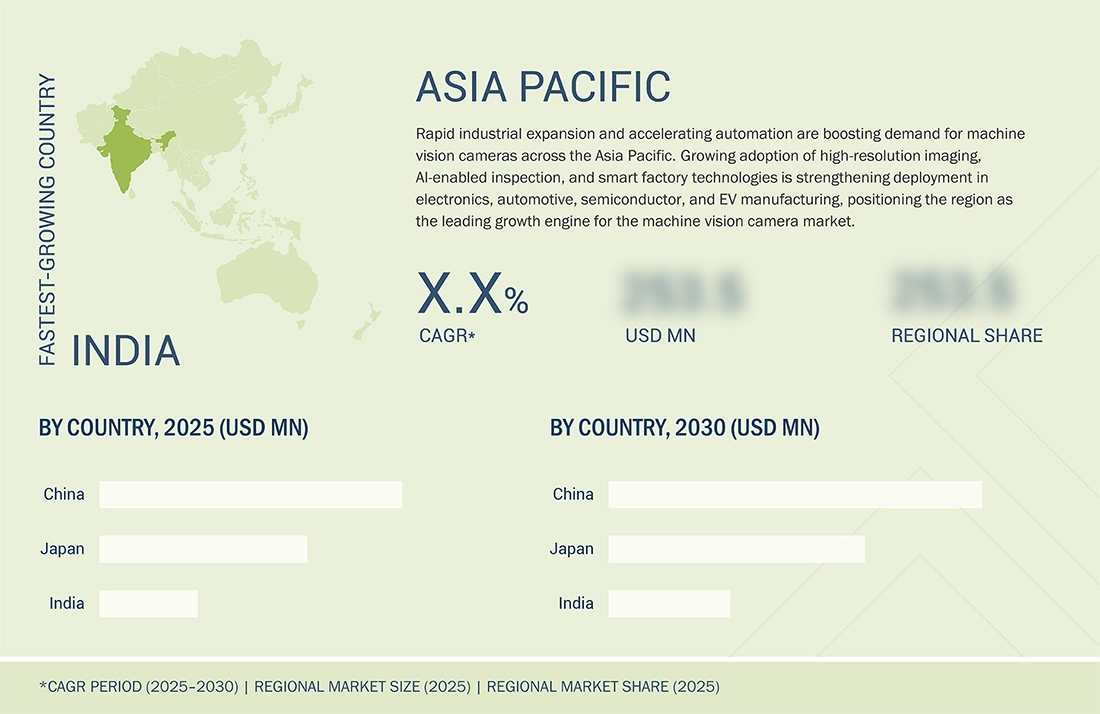
India is expected to be the fastest-growing region in the Asia Pacific machine vision camera market during the forecast period
In the Asia Pacific machine vision camera market, India is expected to emerge as the fastest-growing country during the forecast period. This growth is fueled by accelerating industrial automation, strong expansion in electronics manufacturing, and increasing adoption of vision-enabled quality inspection across automotive, pharmaceuticals, and FMCG sectors. Government-led initiatives such as Make in India, rising investments in semiconductor and electronics assembly, and rapid modernization of production facilities are further strengthening demand. Additionally, the growing presence of global manufacturing players and widespread deployment of smart factories position India as a key high-growth market within the region’s machine vision ecosystem.
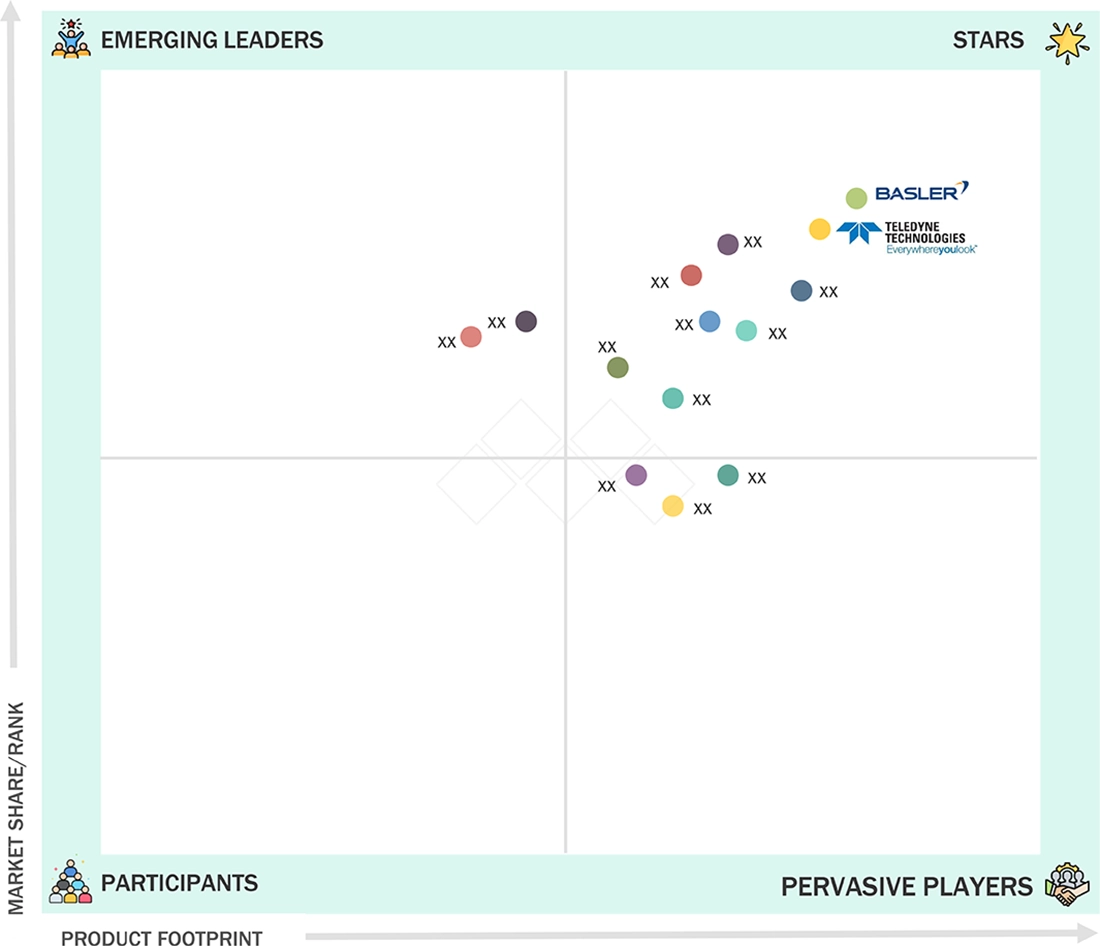
MACHINE VISION CAMERA MARKET: COMPANY EVALUATION MATRIX
In the machine vision camera market matrix, Basler AG and Teledyne Technologies (Star Players) lead with strong innovation, advanced imaging portfolios, and extensive global presence. Basler AG drives adoption through its high-resolution area-scan and line-scan cameras, compact smart vision systems, and reliable integration across electronics, automotive, and logistics sectors. Teledyne Technologies strengthens the market with its high-performance sensors, industrial cameras, and precision imaging platforms. Together, they enable superior inspection accuracy, support advanced automation, and accelerate the transition toward intelligent, high-efficiency manufacturing.
Source: Secondary Research, Interviews with Experts, MarketsandMarkets Analysis
KEY MARKET PLAYERS
- Keyence Corporation (Japan)
- Basler AG (Germany)
- Cognex Corporation (USA)
- Teledyne Technologies Inc. (US)
- Sony Group Corporation (Japan)
- Omron Corporation (Japan)
- Panasonic Corporation (Japan)
- SICK AG (Germany)
- AMETEK Inc. (US)
- Canon Inc. (Japan)
- TKH Group (Netherlands)
- Emerson Electric Co. (United States)
- Toshiba Teli Corporation (Japan)
- JAI A/S (Denmark)
- IDS Imaging Development Systems GmbH (Germany)
MARKET SCOPE
| REPORT METRIC | DETAILS |
|---|---|
| Market Size in 2024 (Value) | USD 6.28 Billion |
| Market Forecast in 2030 (Value) | USD 10.19 Billion |
| Growth Rate | CAGR of 8.6% from 2025–2030 |
| Years Considered | 2021–2030 |
| Base Year | 2024 |
| Forecast Period | 2025–2030 |
| Units Considered | Value (USD Million/Billion) |
| Report Coverage | Revenue Forecast, Company Ranking, Competitive Landscape, Growth Factors, and Trends |
| Segments Covered |
|
| Regions Covered | North America, Asia Pacific, Europe, South America, and Middle East & Africa |
WHAT IS IN IT FOR YOU: MACHINE VISION CAMERA MARKET REPORT CONTENT GUIDE
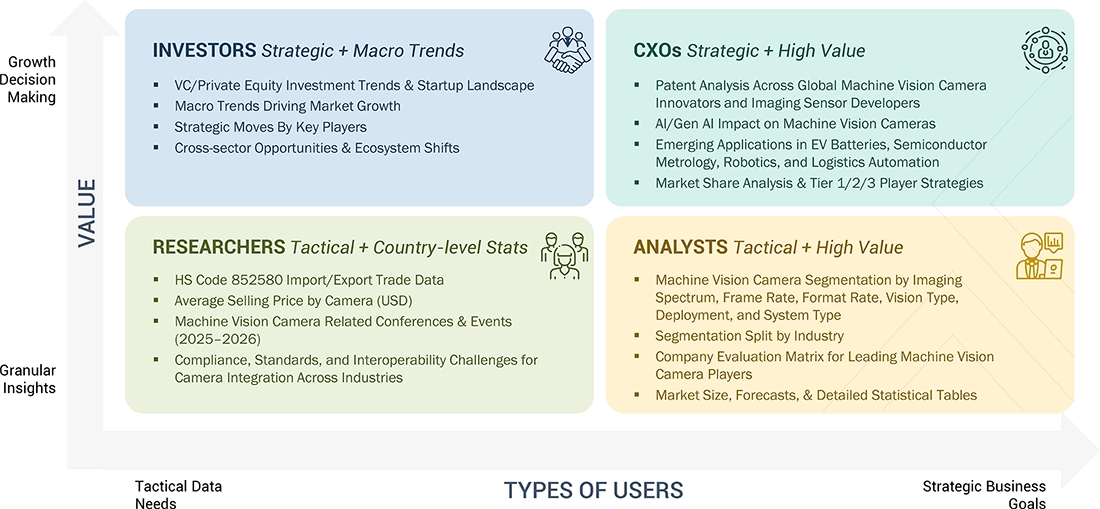
DELIVERED CUSTOMIZATIONS
We have successfully delivered the following deep-dive customizations:
| CLIENT REQUEST | CUSTOMIZATION DELIVERED | VALUE ADDS |
|---|---|---|
| Local Competitive Landscape |
|
|
| Regional Market Entry Strategy |
|
|
| Application-specific Opportunity Assessment |
|
|
| Technology Adoption by End-use Industries |
|
|
RECENT DEVELOPMENTS
- November 2024 : Sony Group Corporation launched the IMX925 stacked CMOS image sensor, featuring a back-illuminated pixel structure and global shutter for industrial imaging. This sensor delivers 394 fps high-speed processing and 24.55 effective megapixels.
- September 2024 : Teledyne DALSA, a subsidiary of Teledyne Technologies Inc., introduced the Linea HS2 TDI line scan camera family. It offers ultra-high-speed imaging with 16k resolution and 1 MHz line rates, excelling in light-starved environments. This next-generation TDI technology achieves 16 Gigapixels per second data throughput, representing a significant advancement in line scan imaging.
- June 2024 : Basler's ace 2 V series introduced compact CoaXPress 2.0 cameras (29x29 mm) with Sony Pregius S sensors (5-24 MP, up to 212 fps), offering high bandwidth (12.5 Gbps) and diverse resolutions. These new models expand Basler's CoaXPress 2.0 portfolio, providing customers with integrated hardware and software solutions from a single vendor.
Table of Contents
 Exclusive indicates content/data unique to MarketsandMarkets and not available with any competitors.
Methodology
The study involved four major activities for estimating the current size of the Machine Vision Camera Market. Exhaustive secondary research has been done to collect information on the market. The next step is to validate these findings, assumptions, and size with industry experts across the value chain through primary research. Both the top-down and bottom-up approaches have been employed to estimate the complete market size. After that, market breakdown and data triangulation methods have been used to estimate the market size of the segments and subsegments. Two sources of information, secondary and primary, have been used to identify and collect information for an extensive technical and commercial study of the Machine Vision Camera Market.
Secondary Research
Various secondary sources have been referred to in the secondary research process to identify and collect information important for this study. The secondary sources include annual reports, press releases, and investor presentations of companies; white papers; journals and certified publications; and articles from recognized authors, websites, directories, and databases. Secondary research has been conducted to obtain key information about the industry’s supply chain, the market’s value chain, the total pool of key players, market segmentation according to the industry trends (to the bottom-most level), regional markets, and key developments from market- and technology-oriented perspectives. Secondary data has been collected and analyzed to determine the overall market size, which is further validated through primary research.
Primary Research
Extensive primary research was conducted after gaining knowledge about the current scenario of the Machine Vision Camera Market through secondary research. Several primary interviews were conducted with experts from the demand and supply sides across four major regions North America, Europe, Asia Pacific, and RoW. This primary data was collected through questionnaires, emails, and telephonic interviews.
Market Size Estimation
Both the top-down and bottom-up approaches have been used to estimate and validate the total size of the Machine Vision Camera Market. These methods have also been used extensively to estimate the size of various subsegments in the market. The following research methodology has been used to estimate the market size:
- Major players in the market have been identified through extensive secondary research.
- The industry’s value chain and market size (in terms of value) have been determined through primary and secondary research processes.
- All percentage shares, splits, and breakdowns have been determined using secondary sources and verified through primary sources.
Data Triangulation
After arriving at the overall size of the Machine Vision Camera Market from the market size estimation process explained above, the total market has been split into several segments and subsegments. Data triangulation and market breakdown procedures have been employed, wherever applicable, to complete the overall market engineering process and arrive at the exact statistics for all segments and subsegments of the market. The data has been triangulated by studying various factors and trends from both the demand and supply sides. Along with this, the market size has been validated using both the top-down and bottom-up approaches.
Market Definition
Machine vision systems use a combination of hardware and software to provide operational guidance to devices in executing their functions. Visual inspections are automated, and product assembly equipment are precisely guided using sensors (cameras), processing hardware, and software algorithms. The system relies on digital sensors installed in cameras with specialized optics to acquire images. These images are then processed, analyzed, and measured by artificial intelligence (AI) technology embedded in the computer hardware for decision-making. AI allows machines to learn from experience, intercept new inputs, and perform human-like tasks. Machine learning and natural language processing (NLP), used to train computers, are also used in machine vision to perform specific tasks by processing large data captured by cameras. Machine vision systems offer fast response, a tailored approach, accurate information, and fewer redundancies—all essential to achieving higher organizational efficiency. Machine vision systems encompass all industrial and non-industrial applications.
Key Stakeholders
- Government bodies and policymakers
- Industry organizations, forums, alliances, and associations
- Raw material suppliers and distributors
- Research institutes and organizations
- Original equipment manufacturers (OEMs)
- Technology, service, and solution providers
- Intellectual property (IP) core and licensing providers
- Market research and consulting firms
Report Objectives
- To describe, segment, and forecast the overall Machine Vision Camera Market by application, vision type, deployment, component, system type, and industry, in terms of value
- To describe and forecast the market for four key regions: North America, Europe, Asia Pacific, and Rest of the World (RoW), along with their respective countries, in terms of value
- To provide an overview of the recent trends in the market
- To provide detailed information regarding the drivers, restraints, opportunities, and challenges influencing the growth of the market
- To analyze the supply chain, trends/disruptions impacting customer business, market/ecosystem map, pricing analysis, and regulatory landscape pertaining to the Machine Vision Camera Market
- To strategically analyze micromarkets with respect to individual growth trends, prospects, and contributions to the overall market size.
- To analyze opportunities in the market for stakeholders and provide a competitive landscape of the market
- To strategically profile the key players and comprehensively analyze their market positions in terms of their ranking and core competencies, along with detailing the competitive landscape for market leaders
- To analyze competitive developments, such as product launches, acquisitions, collaborations, agreements, and partnerships, in the Machine Vision Camera Market
- To provide ecosystem analysis, case study analysis, patent analysis, technology analysis, value chain analysis, trends/disruptions impacting customer business, impact of AI/Gen AI, key conferences and events, pricing analysis, Porter’s five forces analysis, and regulations pertaining to the market under study
- To provide a macroeconomic outlook based on all the regions in the region chapter
Available Customizations:
With the given market data, MarketsandMarkets offers customizations according to the company’s specific needs. The following customization options are available for the report:
Company Information:
- Detailed analysis and profiling of additional market players (up to 5)
Key Questions Addressed by the Report
What is the projected market size of the machine vision camera market?
The machine vision camera market is projected to grow from USD 6.73 billion in 2025 to USD 10.19 billion by 2030, at a CAGR of 8.6%.
Which region dominates the machine vision camera market?
The Asia Pacific dominates the market, accounting for around 41% share due to strong manufacturing and automation adoption.
Which segment by imaging spectrum is expected to grow the fastest?
The Visible + IR/NIR segment is expected to grow at the highest rate due to increasing demand for advanced inspection and imaging capabilities.
Which segment by frame rate is witnessing the highest growth?
The >125 fps segment is projected to register the fastest growth due to rising demand for high-speed inspection in industries like electronics and automotive.
Who are the key players in the machine vision camera market?
Key players include Basler AG, Cognex Corporation, Teledyne Technologies, Keyence Corporation, and Sony Group Corporation.


Personalize This Research
- Triangulate with your Own Data
- Get Data as per your Format and Definition
- Gain a Deeper Dive on a Specific Application, Geography, Customer or Competitor
- Any level of Personalization
Let Us Help You
- What are the Known and Unknown Adjacencies Impacting the Machine Vision Camera Market
- What will your New Revenue Sources be?
- Who will be your Top Customer; what will make them switch?
- Defend your Market Share or Win Competitors
- Get a Scorecard for Target Partners

Custom Market Research Services
We Will Customise The Research For You, In Case The Report Listed Above Does Not Meet With Your Requirements
Get 10% Free CustomisationTESTIMONIALS

Tetsuya Ohhira
Business Development Manager-Technology Business
Nikon Corporation,
Leading Japanese MNC specializing in optics and imaging productswww.nikon.com
MarketsandMarkets™ response
is quick. Their attitude is flexible and positive. Analyst Insights are globally considered and
significant. Client Services quickly respond to our inquiry and demand. Their wide range of global
surveys help us make our strategic plan.
We hope Knowledge Store will be easier to search
for a report.
VP - Marketing & Business Development
Leading Provider of Process Control Solutions
We engaged with MarketsandMarkets on a study to perform an analysis and recommend a Go-To-Market strategy for metrology and process control in the semiconductor market. The study was tailored to our targets and needs with well-defined milestones. Our overall experience with the MarketsandMarkets team was very good throughout the project in all aspects including the analysis methodologies used, the quality and depth of primary and secondary data sets, the professionalism and flexibility of the team and the ability to meet the target schedule and milestones. We want to thank MarketsandMarkets team for a job well done.






Growth opportunities and latent adjacency in Machine Vision Camera Market