North America Personal Protective Equipment Market

North America Personal Protective Equipment Market by Type (Hand & Arm Protection, Protective Clothing, Foot & Leg Protection), End-use Industry (Manufacturing, Construction, Oil & Gas, Healthcare, Transportation), and Region - Forecast to 2030




OVERVIEW
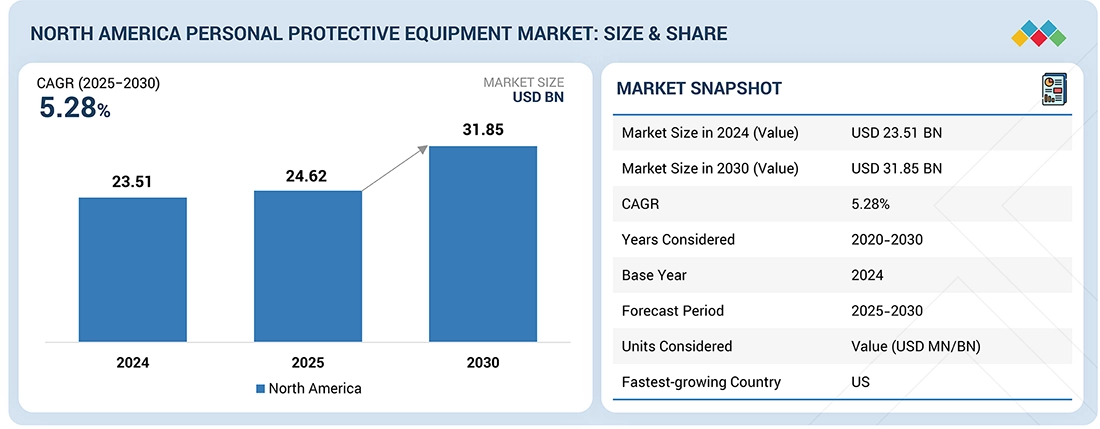
Source: Secondary Research, Interviews with Experts, MarketsandMarkets Analysis
The North America personal protective equipment market is projected to grow from USD 24.62 billion in 2025 to USD 31.85 billion by 2030, at a CAGR of 5.28%, during the forecast period. The reasons for the growth of the personal protective equipment market in North America are the region's stricter workplace safety regulations, rising industrial risk exposure, and a greater employer focus on compliance, which continue to drive mandatory PPE adoption. The growth is also enabled by ongoing infrastructure activities, strong manufacturing output, and increased demand for advanced, high-performance protective solutions from the manufacturing, construction, oil & gas, and healthcare industries. These factors ensure consistent spending on PPE, thereby maintaining the market's projected growth trajectory until 2030.
KEY TAKEAWAYS
-
BY TYPEThe hand & arm protection segment is projected to be the fastest-growing type of personal protective equipment, with a CAGR of 5.49%, in terms of value, between 2025 and 2030
-
BY END-USE INDUSTRYThe healthcare industry is projected to register the highest CAGR of 6.65%, in terms of value, during the forecast period.
-
BY COUNTRYThe US dominated the North America personal protective equipment market in 2024, accounting for a market share of 84.2%, in terms of value.
-
COMPETITIVE LANDSCAPE - KEY PLAYERSProtective Industrial Products, Inc., 3M company, and Alpha Pro Tech, Ltd. are identified as key players in the North America personal protective equipment market. These companies have strong market presence and extensive product portfolios.
-
COMPETITIVE LANDSCAPE - STARTUPSMoldex-Metric, Klein Tools, Inc., and National Safety Apparel (NSA), among other emerging players, have established solid positions within specialized niche segments, underscoring their potential to evolve into future market leaders.
The North America personal protective equipment market is growing as employers face heightened safety expectations, stricter OSHA compliance pressures, and rising liability concerns across high-risk industries. The expansion of industrial activity is further driving demand for durable, certified protective gear. Additionally, companies are upgrading to more advanced PPE solutions to enhance worker protection and reduce operational disruptions, reinforcing steady market expansion across the region.
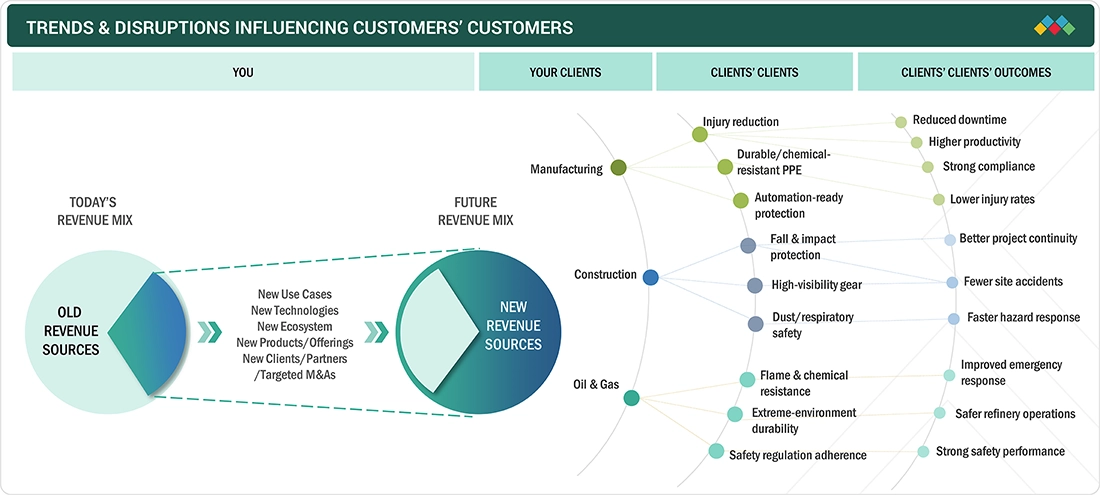
TRENDS & DISRUPTIONS IMPACTING CUSTOMERS' CUSTOMERS
The?????? consumers’ business influence on the North America PPE market is mostly due to the increased safety regulations and quick changes in the needs for protection in the workplace. Key sectors, including manufacturing, construction, oil & gas, and healthcare, are the primary consumers of certified, high-quality PPE for compliance and risk reduction in operations. Changes in safety regulations, the use of technology (such as smart PPE), or the hazardous situations in the industry have a direct impact on the spending of final users, which also affects demand levels in the main PPE markets, thus determining the revenue growth of manufacturers in the region.
Source: Secondary Research, Interviews with Experts, MarketsandMarkets Analysis
MARKET DYNAMICS

Level
-
Heightened workplace safety awareness

-
Sustained demand from healthcare & medical sector


Level
-
Complex and evolving regulatory compliance

-
Counterfeit and substandard products/quality concerns


Level
-
Expansion in non-traditional PPE demand sectors

-
Smart PPE and innovation-driven adoption


Level
-
Risk of market saturation in mature segments

-
Balancing cost vs. performance (especially for SMEs)

Source: Secondary Research, Interviews with Experts, MarketsandMarkets Analysis
Driver: Diversified industrial base and large end-use industries
The highly diversified industrial base of the region is a major driver of demand in the North America PPE market. Due to strong activity across construction, manufacturing, oil & gas, chemicals, food processing, and healthcare, this market enjoys a wide and stable set of end-users who consistently have needs for protective equipment to meet safety and compliance standards. Such a wide industry footprint not only guarantees a steady baseline demand but also reduces dependence on any single sector, ensuring resilient, long-term market growth.
Restraint: Complex and evolving regulatory compliance
The primary restraint in the North America PPE market is the complex and ever-changing regulatory compliance requirements. The strict standards of safety propel overall demand; however, the frequent updating of regulations with respect to design, materials, labeling, and testing presents significant challenges for manufacturers. These continuous changes result in increasing manufacturing costs, prolonged time-to-market, and a growing compliance burden, primarily affecting smaller-scale suppliers with limited resources. Thus, understanding regulatory complexity not only delays the launches of products but also restricts certain firms from competing well in the region.
Opportunity: Expansion in non-traditional PPE demand sectors
In the North America PPE market, a key growth opportunity exists due to expanding demand from beyond the traditional sectors, including heavy industry and healthcare. Food processing, cold-chain logistics, pharmaceuticals, and other hygiene-sensitive industries are showing an increasing interest in the safety of their employees, as well as control over contamination. All these factors drive demand for protection equipment and open new revenue streams for PPE manufacturers, enabling companies to diversify their customer base and capture demand from emerging applications. Addressing target markets in these non-traditional sectors may help an enterprise accelerate market growth while strengthening its position across a wider range of industries in the region.
Challenge: Balancing cost vs. performance (especially for SMEs)
In the North America PPE market, a major challenge is maintaining the quality of personal protective equipment while lowering costs, especially for SMEs. The major players in the market can opt for the latest, smartest, most ergonomic, and longest-lasting solutions to keep their workers safe and to stay on the safe side of the law, whereas SMEs are in a position where they cannot afford to make such investments due to their limited budget. This situation creates a performance gap, which in turn limits the adoption rate of advanced personal protective equipment (PPE) among SMEs, resulting in low overall market penetration.
NORTH AMERICA PERSONAL PROTECTIVE EQUIPMENT MARKET: COMMERCIAL USE CASES ACROSS INDUSTRIES
| COMPANY | USE CASE DESCRIPTION | BENEFITS |
|---|---|---|
 |
Deployment of advanced protective clothing, cut-resistant gloves, and smart PPE for assembly-line workers and maintenance teams | Reduced injury rates | Higher compliance with OSHA standards | Improved productivity through safer workflows |
 |
Use of flame-resistant clothing (FRC), intrinsically safe headgear, and respiratory protection in high-risk refining and drilling operations | Enhanced worker safety in hazardous zones | Regulatory compliance | Minimized downtime from safety incidents |
 |
Adoption of ergonomic helmets, anti-impact gloves, fall-protection systems, and connected PPE with hazard alerts across project sites | Lower accident frequency | Stronger safety culture | Better real-time monitoring of worker exposure and site risks |
 |
Use of medical-grade gloves, surgical masks, respirators, gowns, and infectious-disease protective systems in clinical settings | Reduced infection transmission | Improved patient and staff safety | Adherence to CDC and hospital quality standards |
Logos and trademarks shown above are the property of their respective owners. Their use here is for informational and illustrative purposes only.
MARKET ECOSYSTEM
The ecosystem of the North America personal protective equipment market comprises a well-established network of manufacturers, distributors, certification bodies, and end-use industries operating under stringent regulatory oversight. Product innovation is supported by compliance with standards such as OSHA, NIOSH, and ANSI, with distributors playing a crucial role in the supply chain by ensuring regional accessibility in industries including healthcare, construction, oil & gas, manufacturing, and the chemical sector. This demand becomes prominent through evolving workplace safety mandates, greater needs for risk mitigation, and rigorous procurement measures among end-users. Therefore, the ecosystem is performance-oriented, centered on compliance with enhanced durability, advanced protection technologies, and consistency in worker safety.
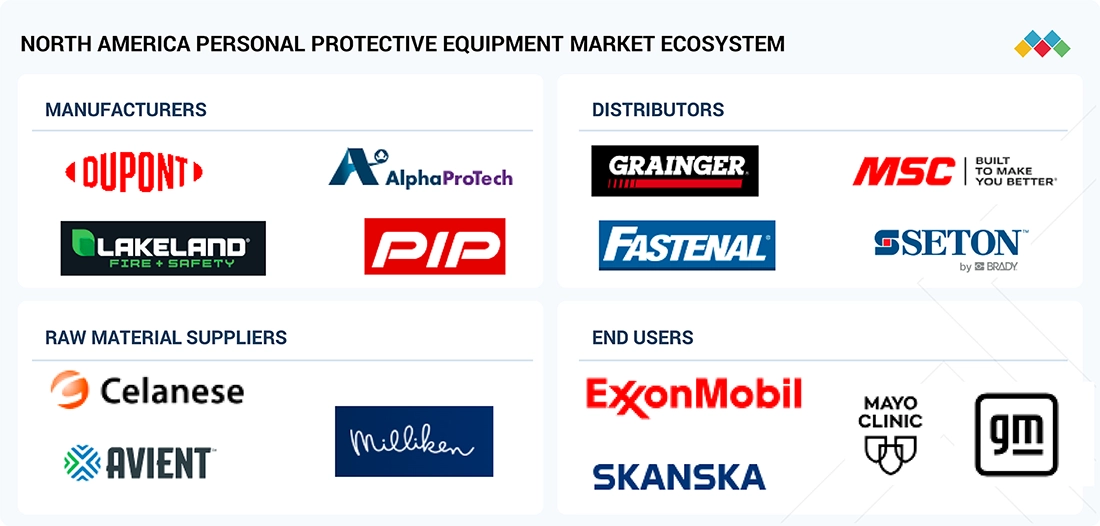
Logos and trademarks shown above are the property of their respective owners. Their use here is for informational and illustrative purposes only.
MARKET SEGMENTS
Source: Secondary Research, Interviews with Experts, MarketsandMarkets Analysis
North America Personal Protective Equipement Market, By Type
In 2024, the hand & arm protection segment led the North America PPE market, as products are used to prevent workplace injuries in major industries in the region, including manufacturing, construction, oil & gas, logistics, and healthcare. The stringent regulatory laws ensure strict wearing of gloves and arm guards in activities with risks of cuts, abrasions, chemicals, and heat, as well as impact, which provides a steady demand. Additionally, specialized gloves such as chemical-resistant, cut-resistant, disposable, and heat-protective types are available, facilitating wide usage in a diverse range of applications. This regulatory need, combined with high use intensity and rising demand, makes the hand & arm protection segment dominant in the North America market.
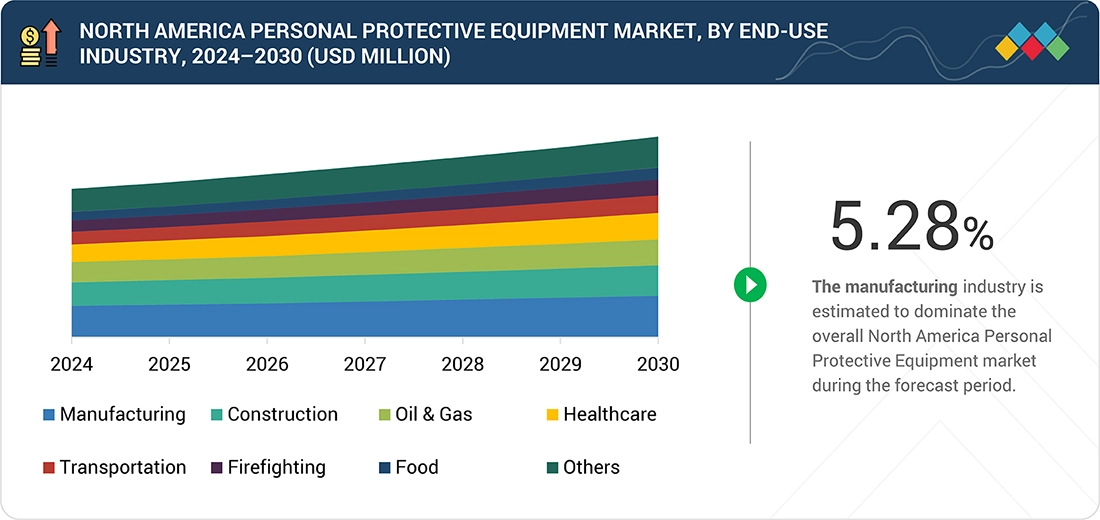
North America Personal Protective Equipement Market, By End-use Industry
The manufacturing sector was the largest in the North America personal protective equipment market in 2024. This dominance is driven by widespread exposure of the workforce to mechanical, chemical, thermal, and ergonomic hazards within the manufacturing industry. The region's strong industrial base, combined with strict safety requirements, drives a growing demand for gloves, protective clothing, eye protection, and respiratory equipment. Growing automation of processes increases efficiency, but workers still have to work with heavy equipment and dangerous substances, which supports the use of PPE. The high replacement rate and compliance audit also increase consumption and, as a result, manufacturing is the main contributor to the demand of PPE in the region.
REGION
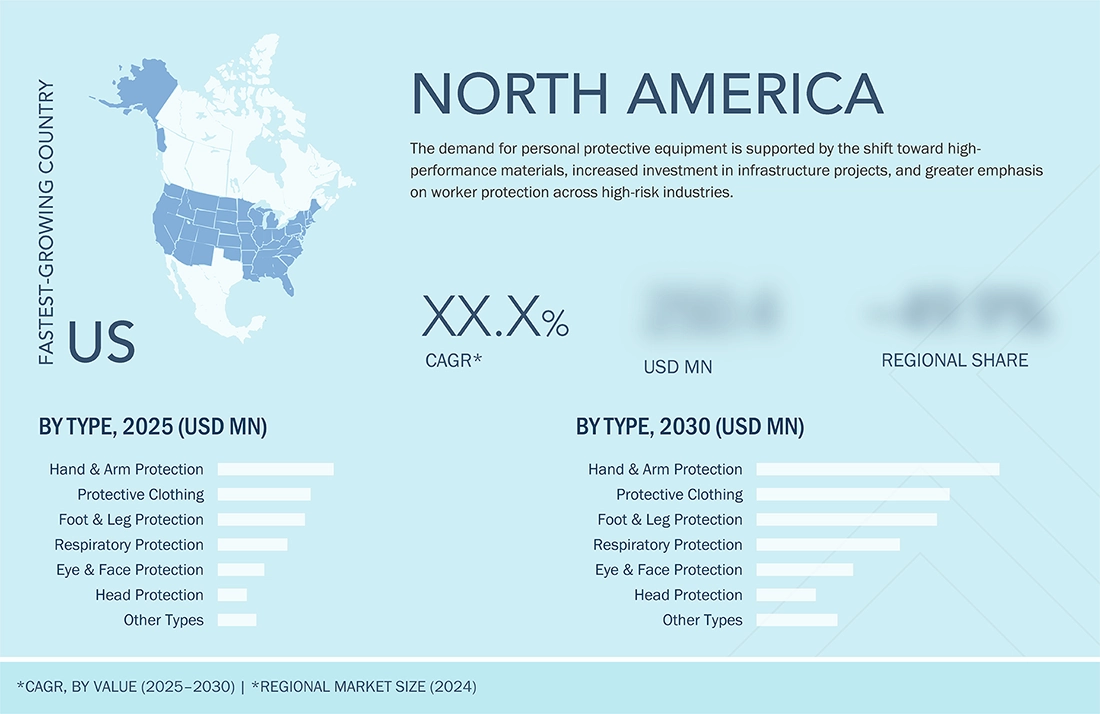
The US is projected to be the fastest-growing country in the North America PPE market during the forecast period.
The US is expected to be the fastest-growing market for PPE in North America, owing to its diversified industries, high standards of safety compliance, and sustained investments in high-tech manufacturing, construction, and medical and healthcare facilities. The increasing utilization of high-performance and smart PPE technologies, combined with high demand in the pharmaceutical, logistics, and oil & gas sectors, further accelerates growth. Additionally, reshoring projects and a greater emphasis on safety standards in the workplace are leading to increased procurement in both the public and private sectors. All of these factors position the US as the leading player in the PPE market in the region.
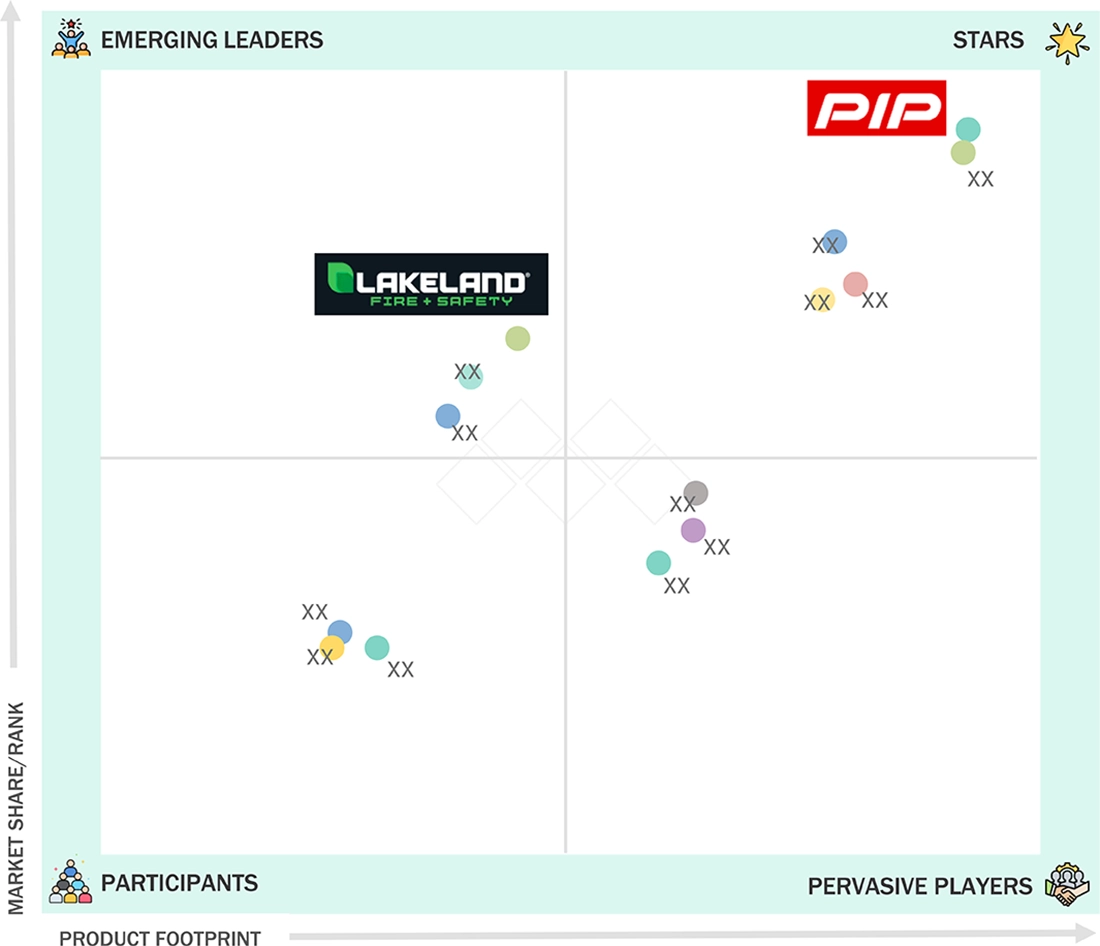
NORTH AMERICA PERSONAL PROTECTIVE EQUIPMENT MARKET: COMPANY EVALUATION MATRIX
In the North America personal protective equipment market matrix, Protective Industrial Products, Inc. (Star) leads with a strong market share and broad product portfolio, underpinned by its advanced protective equipment that caters to manufacturing, healthcare, construction, oil & gas, and other industries. Its ability to deliver high-performance, sustainable, and regulatory-compliant solutions has positioned it as a preferred partner for global brand owners and converters. Lakeland Industries, Inc. (Emerging Leader) is gaining traction with its cost-competitive formulations and expanding presence in the North America personal protective equipment market. While Protective Industrial Products, Inc. dominates through scale, regional reach, and innovation-driven offerings, Lakeland Industries, Inc. demonstrates strong potential to advance toward the leaders’ quadrant as demand for region-specific, high-performance, and value-driven personal protective equipment accelerates.
Source: Secondary Research, Interviews with Experts, MarketsandMarkets Analysis
KEY MARKET PLAYERS
MARKET SCOPE
| REPORT METRIC | DETAILS |
|---|---|
| Market Size in 2024 (Value) | USD 23.51 BN |
| Market Size in 2030 (Value) | USD 31.85 BN |
| Growth Rate | CAGR of 5.28% from 2025 to 2030 |
| Years Considered | 2020–2030 |
| Base Year | 2024 |
| Forecast Period | 2025–2030 |
| Units Considered | Value (USD MN/BN) |
| Report Coverage | Revenue forecast, company ranking, competitive landscape, growth factors, and trends |
| Segments Covered |
|
| Regional Scope | North America |
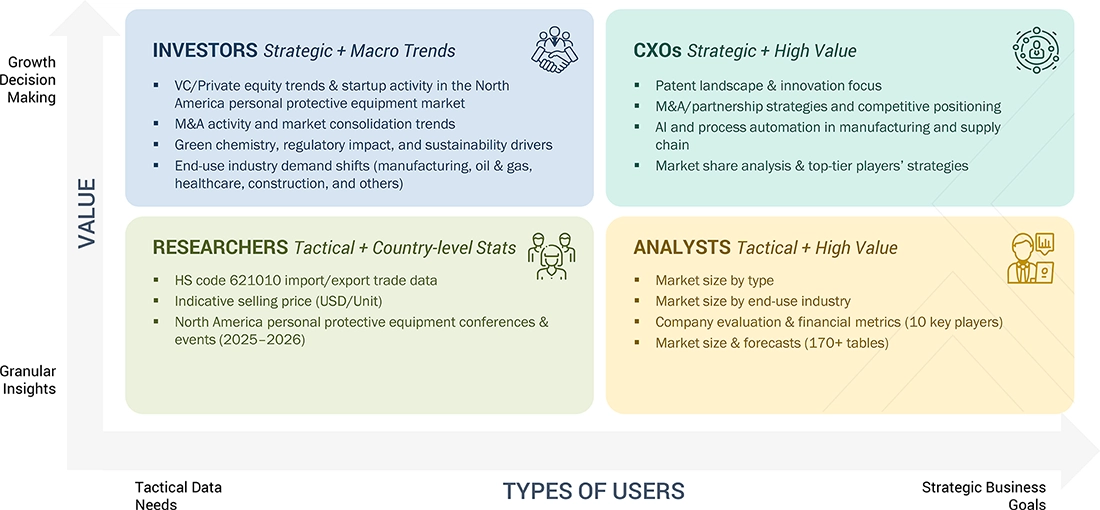
WHAT IS IN IT FOR YOU: NORTH AMERICA PERSONAL PROTECTIVE EQUIPMENT MARKET REPORT CONTENT GUIDE
DELIVERED CUSTOMIZATIONS
We have successfully delivered the following deep-dive customizations:
| CLIENT REQUEST | CUSTOMIZATION DELIVERED | VALUE ADDS |
|---|---|---|
| North America Personal Protective Equipment – Technology & Product Trends |
|
|
| Customer Intelligence on Key End-use Industries | Delivered insights on buying patterns, price sensitivity, and key selection criteria from major customer groups | Enables client to tailor product positioning and pricing strategies to match customer expectations |
RECENT DEVELOPMENTS
- July 2024 : Ansell Limited completed the acquisition of Kimberly-Clark's Personal Protective Equipment (KCPPE) business. This strategic acquisition enhances Ansell's PPE portfolio by adding the Kimtech and KleenGuard brands, expanding its reach in scientific and industrial markets.
- November 2023 : Protective Industrial Products, Inc. acquired Final Fit Safety, a manufacturer known for its sustainable earplugs, such as BioSoft and Pinch Fit, which are crafted from biobased materials. The company’s eco-friendly innovations enhance PIP’s ECOSeries portfolio. This acquisition strengthens PIP’s commitment to sustainable PPE solutions, offering environmentally conscious alternatives in the hearing protection market.
- May 2022 : 3M Company announced an expansion to grow its plant in Valley, Nebraska. The Company is investing approximately USD 58 million to fund the 80,000-square-foot expansion that is expected to create approximately 50 new jobs at the facility. This facility is expected to produce respiratory and hearing protection products.
- November 2020 : MSA Safety Inc. launched its next-generation Advantage 290 LS Air-Purifying Respirator (APR), the first designed without an exhalation valve to receive approval from the National Institute for Occupational Safety & Health (NIOSH).
Table of Contents
 Exclusive indicates content/data unique to MarketsandMarkets and not available with any competitors.
Methodology
The study involved four major activities in estimating the market size for the North America Personal Protective Equipment market. Exhaustive secondary research was done to collect information on the market, the peer market, and the parent market. The next step was to validate these findings, assumptions, and sizing with industry experts across the value chain through primary research. Both top-down and bottom-up approaches were employed to estimate the complete market size. After that, the market breakdown and data triangulation procedures were used to estimate the market size of the segments and subsegments.
Secondary Research
Secondary sources used in this study included annual reports, press releases, and investor presentations of companies; white papers; certified publications; articles from recognized authors; and gold standard & silver standard websites such as Factiva, ICIS, Bloomberg, and others. The findings of this study were verified through primary research by conducting extensive interviews with key officials such as CEOs, VPs, directors, and other executives. The breakdown of profiles of the primary interviewees is illustrated in the figure below:
Primary Research
The North America Personal Protective Equipment market comprises several stakeholders, such as raw material suppliers, end-product manufacturers, and regulatory organizations in the supply chain. The demand side of this market is characterized by key opinion leaders in various applications for the North America Personal Protective Equipment market. The supply side is characterized by advancements in technology and diverse application industries. Various primary sources from both the supply and demand sides of the market were interviewed to obtain qualitative and quantitative information.
To know about the assumptions considered for the study, download the pdf brochure
| COMPANY NAME | DESIGNATION | |
|---|---|---|
| Honeywell International Inc. | Senior Manager | |
| 3M Company | Innovation Manager | |
| DuPont de Nemours, Inc. | Vice-President | |
| Ansell Limited | Production Supervisor | |
| MSA Safety Incorporated | Sales Manager | |
Market Size Estimation
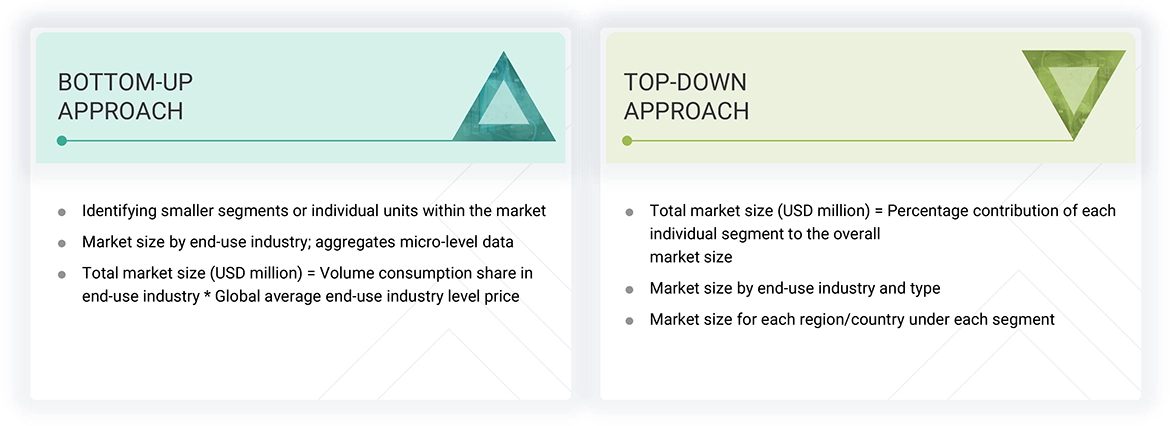
Both top-down and bottom-up approaches were used to estimate and validate the total size of the North America Personal Protective Equipment market. These methods were also used extensively to estimate the size of various subsegments in the market. The research methodology used to estimate the market size includes the following:
- The key players in the industry have been identified through extensive secondary research.
- The supply chain of the industry has been determined through primary and secondary research.
- All percentage shares, splits, and breakdowns have been determined using secondary sources and verified through primary sources.
- All possible parameters that affect the markets covered in this research study have been accounted for, viewed in extensive detail, verified through primary research, and analyzed to obtain the final quantitative and qualitative data.
North America Personal Protective Equipment Market: Bottom-up and Top-down Approach
Data Triangulation
After arriving at the overall market size—using the market size estimation processes as explained above—the market was split into several segments and subsegments. To complete the overall market engineering process and arrive at the exact statistics of each market segment and subsegment, data triangulation, and market breakdown procedures were employed, wherever applicable. The data was triangulated by studying various factors and trends from both the demand and supply sides in the North America Personal Protective Equipment industry.
Market Definition
According to the International Safety Equipment Association, Personal Protective Equipment (PPE) is worn to minimize exposure to hazards that can cause serious injuries. PPE protects workers from life-threatening hazards such as chemical burns, explosions, contamination, and falls from heights. It includes gloves, safety glasses and shoes, respirators, earplugs, hard hats, coveralls, and full-body suits. PPE is mainly used in healthcare, manufacturing, construction, oil & gas, mining, transportation, food, and firefighting sectors.
Stakeholders
- North America Personal Protective Equipment manufacturers
- North America Personal Protective Equipment distributors
- Raw material suppliers
- Service providers
- Government and research organizations
Report Objectives
- To define, describe, and forecast the market size for North America Personal Protective Equipment in terms of value
- To provide detailed information about drivers, restraints, opportunities, and challenges influencing the market growth
- To analyze and forecast the North America Personal Protective Equipment market by type and end-use industry
- To strategically analyze the micromarkets with respect to individual growth trends, prospects, and their contribution to the overall market
- To track and analyze recent developments, such as product launches, deals, and other developments, in the market
- To analyze the opportunities for stakeholders in the market and provide a competitive landscape for market leaders
- To strategically profile the key players and comprehensively analyze their market shares and core competencies


Personalize This Research
- Triangulate with your Own Data
- Get Data as per your Format and Definition
- Gain a Deeper Dive on a Specific Application, Geography, Customer or Competitor
- Any level of Personalization
Let Us Help You
- What are the Known and Unknown Adjacencies Impacting the North America Personal Protective Equipment Market
- What will your New Revenue Sources be?
- Who will be your Top Customer; what will make them switch?
- Defend your Market Share or Win Competitors
- Get a Scorecard for Target Partners

Custom Market Research Services
We Will Customise The Research For You, In Case The Report Listed Above Does Not Meet With Your Requirements
Get 10% Free CustomisationTESTIMONIALS

We at Nissan Chemicals Corporation have been clients of MarketsandMarkets for more than a year now. We recently consulted MarketsandMarkets for a study, the team at MarketsandMarkets was extremely professional and organized. The business insights were very detailed and aligned well with our expectations that really helped us formulate the Business Plans and device new strategies for development themes. MarketsandMarkets offers a unique combination of expertise and dedicated engagement model. Their research findings have helped us in designing our Pricing Strategy which will make it easier for us to predict the future sales and profits for the next ten years. We look forward to working with MarketsandMarkets in the future.
VP of Strategy & New Business Development
Leading Specialty Chemical Company
The MarketsandMarkets Engagement Model, composed of both the Knowledge Store and advisory custom research, has greatly helped us in understanding our markets and making strategic decisions. The Knowledge Store is a fast way to allow everyone in our organization to understand more about most any market they are interested in. The ability to then get custom research done and get answers to specific strategic questions and market insight has been spectacular. The Markets and Markets team feel more like colleagues than vendors and their services have helped us change our culture where statements of things like growth opportunities and competitive position are always backed by industry research.

Rich Gibson,
Director, Corporate Strategy
Milliken & Company,
Leading Industrial Manufacturer of specialty chemical, floor covering, performance and protective textile materials, and healthcaremilliken.com
MarketsandMarkets is a trusted resource that helps us to better understand markets that are near-adjacencies-whether its technology, value chain or geography. Their Knowledge Store platform provides a dashboard of markets and their characteristics which is easy to use and saves us time.
Adam Shaw,
Market Development and Strategy Manager
AdvanSix Inc. USA,
An American Leader in Chemicalswww.advansix.com
The Knowledge Store from MarketsandMarkets is a valuable tool which has helped my team acquire greater insight in to the end markets that our business serves. This has enabled us to help our company build stronger strategies throughout our planning process.
TOSHIO KINOSHITA
Senior Chif Consultion Research & Consulting Division
Mitsubishi Chemical Research Corporation,
Leading Manufacturer of Chemical Productswww.mitsubishichem-res.co.jp/en/

We recently engaged with MarketsandMarkets for a study, the team not only clearly understood our business objectives but was also extremely professional in the way they handled the entire project. The study was efficiently conducted in a phase-wise manner, and the engagement model furnished us with high-quality business insights that far exceeded our expectations at each phase. We were especially happy that MarketsandMarkets could provide us with both, an English as well as a Japanese version of the study. A special thanks to the Analyst Team and Client Services Team, whose fluency in Japanese enhanced our comfort level, as we could converse with them in our preferred language.
Independent entrepreneurs
Arrow Precision
We approached MarketsandMarkets for study on Proppants Market, and their work exceeded our expectations. The study conducted was comprehensive and enabled us to view the market through the various dimensions. In addition, the team was extraordinarily responsive throughout the process and resolved our queries on time. I strongly recommend MarketsandMarkets and will certainly consider them for additional market assessments we will need in the future.
Global engineering company, Japan
Deputy Manager,
Strategic Planning OfficeThe high-quality insights shared by the MarketsandMarkets team helped us understand the pharmaceutical plant designers in a specific geography. It also captured the risks that we may likely face in communicating with our potential partners. The study would enable us identify partners, which would impact our future growth.






Growth opportunities and latent adjacency in North America Personal Protective Equipment Market