North America Real-time Location Systems (RTLS) Market

North America Real-time Location Systems (RTLS) Market by Offering (Tags/Badges, Readers/Trackers/Access Points), Technology (RFID, Wi-Fi, UWB, BLE, Infrared, Ultrasound, Zigbee), Application (Inventory Tracking, Personnel Tracking) - Forecast to 2030




OVERVIEW
-market-img-overview.webp "North America Real-time Location Systems (RTLS) Market Size, Share and Trends")
Source: Secondary Research, Interviews with Experts, MarketsandMarkets Analysis
The RTLS market in North America is projected to reach USD 5.95 billion by 2030 from USD 2.76 billion in 2025, at a CAGR of 16.6% from 2025 to 2030. The regional market is expected to be driven the rising development of cost-effective, application-specific RTLS solutions, particularly from agile startups. Furthermore, the increasing use of RTLS tags for asset tracking to maximize return on investment contributes to the RTLS market growth in the region.
KEY TAKEAWAYS
-
BY COUNTRYBy country, Mexico is projected to register a CAGR of 20.1% between 2025 and 2030.
-
BY TECHNOLOGYThe Wi-Fi technology segment held a 31.8% share of the RTLS market in North America in 2024.
-
BY VERTICALThe transportation & logistics segment is expected to grow at a CAGR of 19.0% during the forecast period.
-
COMPETITIVE LANDSCAPESecuritas, Zebra Technologies, and Impinj, Inc. were identified as some of the star players in the RTLS market in North America, given their strong market share and product footprint.
-
COMPETITIVE LANDSCAPERedpoint Positioning and Quuppa have distinguished themselves among startups and SMEs due to their strong product portfolio and business strategy.
The RTLS market in North America is projected to grow strongly over the next decade, driven by the escalating demand for asset visibility, personnel safety, and operational efficiency across healthcare, manufacturing, logistics, and e-commerce. Adoption is accelerating in the US and Canadian hospitals for patient/staff tracking, in mega-warehouses and fulfillment centers for inventory and robot navigation, and in reshored automotive and semiconductor plants for tool and work-in-progress monitoring. Stringent HIPAA, FDA, and OSHA regulations, combined with labor shortages and the push for lights-out operations, position RTLS as a cornerstone technology for enabling smart facilities, enhancing workflow optimization, and supporting digital transformation goals across the region.
TRENDS & DISRUPTIONS IMPACTING CUSTOMERS' CUSTOMERS
Emerging technologies are set to disrupt traditional revenue streams by shifting the future revenue mix toward innovation-driven solutions. Key growth areas, such as asset tracking, inventory management, supply chain optimization, and environmental monitoring, fuel the demand across industries, including healthcare, retail, manufacturing, and logistics. Disruptive enablers, including IoT/IIoT, AI, machine learning, and wireless connectivity, accelerate this shift, creating opportunities in fleet tracking, geo-fencing, and smart monitoring. This transition underscores businesses' need to adopt new technologies to stay competitive and capture high-growth revenue streams.
-market-img-disruption.webp "North America Real-time Location Systems (RTLS) Market Trends/Disruptions")
Source: Secondary Research, Interviews with Experts, MarketsandMarkets Analysis
MARKET DYNAMICS

Level
-
High emphasis on safety, compliance, and operational efficiency across enterprises

-
Growing safety and security concerns in healthcare sector


Level
-
Data security and privacy issues

-
High installation and maintenance costs


Level
-
Mounting demand for hybrid RTLS solutions

-
Emerging applications of RTLS technology


Level
-
Persistent trade-offs in RTLS design

-
Interoperability issues due to lack of standardized protocols

Source: Secondary Research, Interviews with Experts, MarketsandMarkets Analysis
Driver: High emphasis on safety, compliance, and operational efficiency across enterprises
The RTLS market in North America is witnessing accelerated growth as hospitals, manufacturing facilities, educational institutions, and oil & gas companies increasingly demand real-time visibility of assets, equipment, and personnel. Strong regulatory emphasis on worker safety, compliance, and operational efficiency further fuel RTLS adoption across the region. Although RTLS solutions remain costlier than traditional tracking methods, the rising competition from innovative US and Canada-based startups and niche-focused vendors pushes providers to deliver more affordable, high-accuracy, application-specific solutions tailored to North American operational environments.
Restraint: High installation and maintenance costs
Deploying RTLS in North America involves substantial investment, with costs rising based on facility size and technology type—Wi-Fi being more affordable than UWB, while RFID and BLE vary. Total ownership expenses remain high due to ongoing maintenance and support. Implementations are rarely plug-and-play, as hospitals and enterprises face integration challenges that require extensive customization and onsite engineering, leading some projects to stall or fail.
Opportunity: Mounting demand for hybrid RTLS solutions
In North America, the demand for hybrid RTLS solutions is rising as organizations seek to overcome the limitations of single-technology systems. Localized RTLS options offer a practical alternative in GPS-challenged indoor environments, delivering reliable performance without heavy infrastructure costs. Hybrid deployments combining Wi-Fi, ZigBee, BLE, IR, or ultrasound provide a balance of accuracy and cost-efficiency. Technologies such as Wi-Fi and ZigBee can penetrate walls, while IR supports room-level precision, and ultrasound enables broader coverage and fast communication between multiple tags, making hybrid systems well-suited for diverse North American facility layouts.
Challenge: Persistent trade-offs in RTLS design
In North America, hybrid RTLS solutions are gaining traction as they overcome the limitations of single-technology systems. Localized RTLS offers a reliable, lower-infrastructure option for GPS-challenged indoor spaces, while hybrid setups combining Wi-Fi, ZigBee, IR, BLE, or ultrasound deliver a balance of cost and accuracy. Wi-Fi and ZigBee provide better wall penetration, IR supports room-level precision, and ultrasound enables wider-area coverage and fast tag communication, making hybrid RTLS well-suited for varied facility needs.
North America Real-time Location Systems (RTLS) Market: COMMERCIAL USE CASES ACROSS INDUSTRIES
| COMPANY | USE CASE DESCRIPTION | BENEFITS |
|---|---|---|
-market-zebra.svg) |
RTLS solutions for asset tracking and staff workflow optimization in US hospitals, such as Cleveland Clinic's implementation for locating IV pumps and monitoring nurse rounds in real time | Improved operational efficiency | Reduced equipment loss | Enhanced patient care by cutting response times by 30% |
-market-siemens.svg) |
RTLS systems for hospitals to track medical devices, monitor patients, and ensure staff safety, as seen in Johns Hopkins Hospital's deployment for bed management and emergency response | Increased patient safety | Optimized asset utilization | Compliance with HIPAA and Joint Commission standards |
-market-ubisense.svg) |
RTLS platforms for automotive and aerospace assembly lines, such as Ford's Michigan plants using UWB for tool tracking and Boeing's Everett facility for part localization in 737 production | Higher productivity | Real-time insights | Minimized downtime through precise workflow visibility |
Logos and trademarks shown above are the property of their respective owners. Their use here is for informational and illustrative purposes only.
MARKET ECOSYSTEM
The North America RTLS ecosystem comprises specialized participants fueling innovation in healthcare, manufacturing, logistics, and more. Component providers supply core hardware like RFID tags, UWB chips, beacons, and readers for accurate tracking. RTLS providers offer integrated platforms combining hardware and software for enterprise-grade positioning and analytics. System integrators customize deployments and ensure seamless integration with existing systems and workflows. Technology providers deliver networking, cloud, and domain-specific enhancements for scalability. Research institutions/organizations establish standards and interoperability protocols. Verticals/end users drive adoption, providing feedback and proving ROI in asset tracking, safety, and efficiency. This collaborative, innovation-focused ecosystem supports rapid advancement and widespread RTLS deployment across the region.
-market-img-ecosystem.webp "North America Real-time Location Systems (RTLS) Market Top Companies")
Logos and trademarks shown above are the property of their respective owners. Their use here is for informational and illustrative purposes only.
MARKET SEGMENTS
-market-img-segment.webp "North America Real-time Location Systems (RTLS) Market End Users")
Source: Secondary Research, Interviews with Experts, MarketsandMarkets Analysis
North America RTLS Market, By Technology
In North America, the Bluetooth Low Energy (BLE) segment is poised for strong growth in the RTLS market in North America, driven by its efficiency, affordability, and ease of deployment. BLE consumes far less power than traditional Bluetooth, enabling longer battery life and reducing maintenance needs—an advantage for large US and Canadian healthcare and industrial facilities. Its ability to penetrate walls and obstacles makes it well-suited for complex indoor layouts commonly found in North American hospitals, warehouses, and campuses. As a result, BLE is increasingly becoming the preferred technology for scalable, energy-efficient RTLS deployments across the region.
North America RTLS Market, By Vertical
The RTLS market in North America for transportation and logistics is growing rapidly as companies prioritize real-time tracking to enhance fleet visibility, optimize warehouse operations, and reduce shipment delays. Rising e-commerce volumes and the need for accurate, time-sensitive deliveries are pushing logistics providers to adopt RTLS for asset monitoring, trailer tracking, and yard management. Regulations around worker safety and cargo security further support adoption. Additionally, the presence of leading RTLS vendors and advanced digital infrastructure in the US and Canada accelerates large-scale deployments across distribution centers, ports, and logistics hubs.
REGION
Mexico to be fastest-growing country across North America RTLS market during forecast period
The RTLS market in Mexico is growing as manufacturing expansion, nearshoring, and rising warehouse activity drive the need for real-time visibility of assets, equipment, and personnel. Increased investment from US companies relocating supply chains to Mexico is accelerating digital adoption, including RTLS for safety, compliance, and operational efficiency. Strengthening logistics networks and industrial growth further support this rising demand.
-market-img-region.webp "North America Real-time Location Systems (RTLS) Market Regional CAGR, Size, Share")
North America Real-time Location Systems (RTLS) Market: COMPANY EVALUATION MATRIX
In the North America RTLS market matrix, Securitas Technology (Star) leads with a strong global presence and a comprehensive portfolio spanning various technologies of RTLS offerings. It also caters to a number of verticals, such as healthcare, manufacturing, and automotive. GE Healthcare (Emerging Leader) is gaining momentum with innovative RTLS solutions in the healthcare vertical.
-market-img-evaluation.webp "North America Real-time Location Systems (RTLS) Market Emerging Leaders")
Source: Secondary Research, Interviews with Experts, MarketsandMarkets Analysis
KEY MARKET PLAYERS
- Securitas AB (Sweden)
- Zebra Technologies Corp. ( US)
- Impinj, Inc. (US)
- CenTrak, Inc. (US)
- Siemens (Germany)
- Qorvo Inc. (US)
- GE Healthcare (US)
- TeleTracking Technologies, Inc. (US)
- Midmark Corporation (US)
- Litum (Turkey)
MARKET SCOPE
| REPORT METRIC | DETAILS |
|---|---|
| Market Size in 2024 (Value) | USD 2.44 Billion |
| Market Forecast in 2030 (Value) | USD 5.95 Billion |
| Growth Rate | 16.6% |
| Years Considered | 2021–2030 |
| Base Year | 2024 |
| Forecast Period | 2025–2030 |
| Units Considered | Value (USD Million/Billion), Volume (Million Units) |
| Report Coverage | Revenue forecast, company ranking, competitive landscape, growth factors, and trends |
| Segments Covered |
|
| Countries Covered | US, Canada, and Mexico |
WHAT IS IN IT FOR YOU: North America Real-time Location Systems (RTLS) Market REPORT CONTENT GUIDE
-market-img-content.webp "North America Real-time Location Systems (RTLS) Market Growth Decision, Granular Insights")
DELIVERED CUSTOMIZATIONS
We have successfully delivered the following deep-dive customizations:
| CLIENT REQUEST | CUSTOMIZATION DELIVERED | VALUE ADDS |
|---|---|---|
| Healthcare Provider |
|
|
| Industrial Manufacturer |
|
|
| Logistics and Warehousing Company |
|
|
RECENT DEVELOPMENTS
- March 2025 : CenTrak, Inc. expanded its RTLS portfolio with the launch of a fully integrated, plug-and-play Bluetooth Low Energy (BLE) platform, featuring new BLE tags, badges, and network devices that deliver unprecedented flexibility and scalability for real-time tracking, staff duress systems, and asset management in healthcare environments.
- July 2024 : TeleTracking Technologies, Inc. launched Capacity?IQ, its SaaS version of the Capacity Management Suite. It offers hospitals cloud-based tools to optimize bed capacity, accelerate discharges, reduce emergency department boarding, and eliminate hardware investments.
- November 2023 : Impinj, Inc. launched the R720 RAIN RFID reader. It has more processing power and memory than Impinj’s prior-generation reader and helps meet the most demanding requirements of large-scale enterprise deployments.
Table of Contents
 Exclusive indicates content/data unique to MarketsandMarkets and not available with any competitors.
Methodology
The study involved four major activities in estimating the current size of the North America real-time location systems (RTLS) market. Exhaustive secondary research has been conducted to gather information on the market, adjacent markets, and the overall North America RTLS landscape. These findings, along with assumptions and projections, were validated through primary research involving interviews with industry experts and key stakeholders across the value chain. Both top-down and bottom-up approaches were utilized to estimate the overall market size. Subsequently, market breakdown and data triangulation techniques were applied to determine the sizes of various segments and subsegments. Two key sources, secondary and primary, were leveraged to conduct a comprehensive technical and commercial assessment of the North America RTLS market.
Secondary Research
Various secondary sources have been referred to in the secondary research process to identify and collect important information for this study. The secondary sources include annual reports, press releases, and investor presentations of companies; white papers; journals and certified publications; and articles from recognized authors, websites, directories, and databases. Secondary research has been conducted to obtain key information about the industry’s supply chain, the market’s value chain, the total pool of key players, market segmentation according to the industry trends (to the bottom-most level), regional markets, and key developments from market- and technology-oriented perspectives. The secondary data has been collected and analyzed to determine the overall market size, further validated by primary research.
Primary Research
Extensive primary research was conducted after gaining knowledge about the current scenario of the North America RTLS market through secondary research. Several primary interviews were conducted with experts from the demand and supply sides across North America. This primary data was collected through questionnaires, emails, and telephone interviews.
To know about the assumptions considered for the study, download the pdf brochure
Market Size Estimation
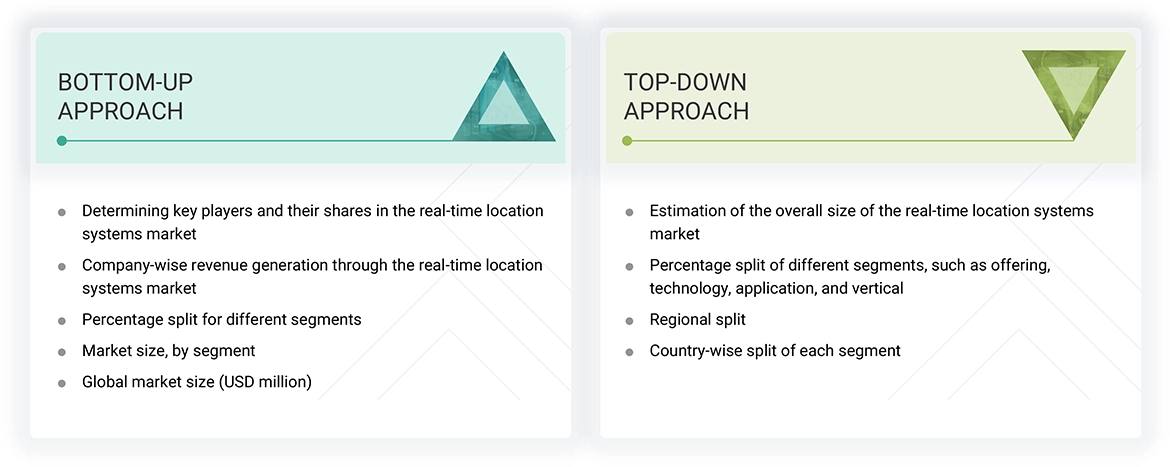
Both top-down and bottom-up approaches have been used to estimate and validate the total size of the North America RTLS market. These methods have also been used extensively to estimate the size of various subsegments in the market. The following research methodology has been used to estimate the market size:
- Major players in the industry and markets have been identified through extensive secondary research.
- The industry’s value chain and market size (in terms of value) have been determined through primary and secondary research processes.
- All percentage shares, splits, and breakdowns have been determined using secondary sources and verified through primary sources.
North America Real-time Location Systems (RTLS) Market : Top-Down and Bottom-Up Approach
Data Triangulation
After arriving at the overall size of the RTLS market from the market size estimation process explained above, the total market has been split into several segments and subsegments. Data triangulation and market breakdown procedures have been employed, wherever applicable, to complete the overall market engineering process and arrive at the exact statistics for all segments and subsegments of the market. The data has been triangulated by studying various factors and trends from both the demand and supply sides. Along with this, the market size has been validated using both top-down and bottom-up approaches.
Market Definition
A real-time location system (RTLS) is designed to automatically detect, identify, and track the position of objects, individuals, or targets within a defined area with high precision. These systems typically comprise location tags or badges affixed to assets or worn by personnel, a network of readers, sensors, or access points strategically deployed across the facility, and a centralized software platform that processes and visualizes location data in real time. RTLS components communicate wirelessly, leveraging a range of enabling technologies such as radio-frequency identification (RFID), Wi-Fi, ultrasound, infrared (IR), Bluetooth Low Energy (BLE), or global positioning systems (GPS) to accurately determine movement and positioning. The core objective of RTLS is to deliver continuous visibility and situational awareness across sectors, including healthcare, manufacturing, logistics, warehousing, and transportation. By providing real-time tracking of high-value assets and personnel, RTLS helps organizations improve operational efficiency, ensure safety compliance, prevent loss or theft, streamline workflow, and optimize resource utilization, making it a critical tool for data-driven decision-making in dynamic operational environments.
Key Stakeholders
- RTLS Hardware Providers
- RTLS Software Providers
- RTLS-related Service Providers
- Government Bodies and Policymakers
- Industry-standard Organizations, Forums, Alliances, and Associations
- Market Research and Consulting Firms
- Raw Material Suppliers and Distributors
- Research Institutes and Organizations
- Testing, Inspection, and Certification Providers
- Distributors and Resellers
- End Users
Report Objectives
- To define, describe, and forecast the North America RTLS market in terms of offering, technology, application, and vertical
- To provide detailed information regarding major factors influencing the market growth (drivers, restraints, opportunities, and challenges)
- To provide a detailed overview of the value chain of the North America RTLS market
- To strategically analyze micromarkets with respect to individual growth trends, prospects, and contributions to the North America RTLS market
- To analyze opportunities for stakeholders by identifying high-growth segments of the North America RTLS market
- To strategically profile key players and comprehensively analyze their market position in terms of ranking and core competencies, along with detailing the competitive landscape for market leaders
- To analyze competitive strategies, such as product launches, expansions, mergers, and acquisitions, adopted by key market players in the North America RTLS market
Customization Options
With the given market data, MarketsandMarkets offers customizations according to the company’s specific needs. The following customization options are available for the report:
Company Information
- Detailed analysis and profiling of additional market players (up to 5)


Personalize This Research
- Triangulate with your Own Data
- Get Data as per your Format and Definition
- Gain a Deeper Dive on a Specific Application, Geography, Customer or Competitor
- Any level of Personalization
Let Us Help You
- What are the Known and Unknown Adjacencies Impacting the North America Real-time Location Systems (RTLS) Market
- What will your New Revenue Sources be?
- Who will be your Top Customer; what will make them switch?
- Defend your Market Share or Win Competitors
- Get a Scorecard for Target Partners

Custom Market Research Services
We Will Customise The Research For You, In Case The Report Listed Above Does Not Meet With Your Requirements
Get 10% Free CustomisationTESTIMONIALS

Tetsuya Ohhira
Business Development Manager-Technology Business
Nikon Corporation,
Leading Japanese MNC specializing in optics and imaging productswww.nikon.com
MarketsandMarkets™ response
is quick. Their attitude is flexible and positive. Analyst Insights are globally considered and
significant. Client Services quickly respond to our inquiry and demand. Their wide range of global
surveys help us make our strategic plan.
We hope Knowledge Store will be easier to search
for a report.
VP - Marketing & Business Development
Leading Provider of Process Control Solutions
We engaged with MarketsandMarkets on a study to perform an analysis and recommend a Go-To-Market strategy for metrology and process control in the semiconductor market. The study was tailored to our targets and needs with well-defined milestones. Our overall experience with the MarketsandMarkets team was very good throughout the project in all aspects including the analysis methodologies used, the quality and depth of primary and secondary data sets, the professionalism and flexibility of the team and the ability to meet the target schedule and milestones. We want to thank MarketsandMarkets team for a job well done.






Growth opportunities and latent adjacency in North America Real-time Location Systems (RTLS) Market