Poultry Processing Equipment Market

Poultry Processing Equipment Market by Equipment Type (Live Bird Handling, Slaughtering & Defeathering, Evisceration, Cut-up & Portioning, Deboning & Filleting, Others), Product Type, Automation Level, Plant Capacity, and Region - Global Forecast to 2035




OVERVIEW
Source: Secondary Research, Interviews with Experts, MarketsandMarkets Analysis
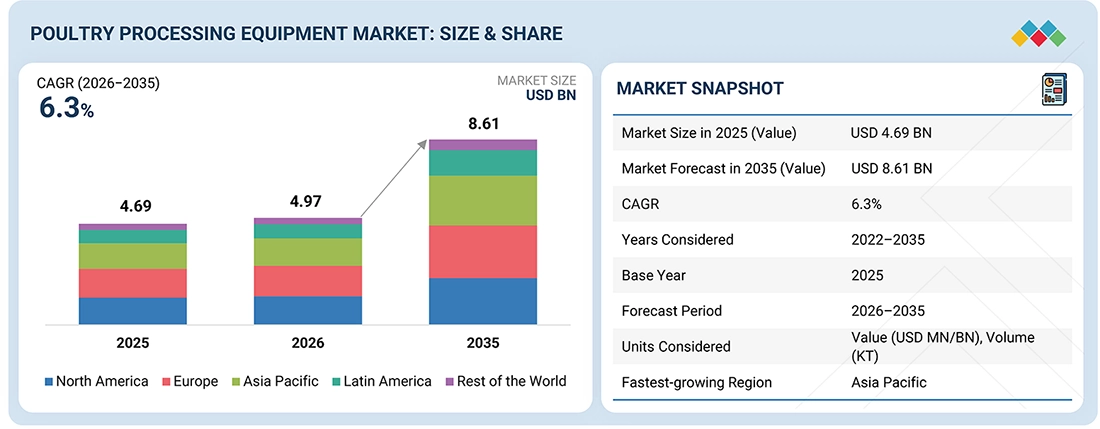
The poultry processing equipment market is projected to reach USD 8.61 billion by 2035 from USD 4.97 billion in 2026, at a CAGR of 6.3% from 2026 to 2035. The growth of this market is driven by increasing poultry meat production, rising demand for processed and packaged poultry products, growing adoption of automation in poultry processing facilities, and stringent food safety and hygiene regulations across the global poultry industry.
Market Size and Forecast:
- Market Size Value in 2025: USD 4.69 Billion
- Market Size Value in 2026: USD 4.97 Billion
- Revenue Forecast in 2035: USD 8.61 Billion
- Growth Rate: CAGR of 6.3% from 2026 to 2035
- Data available from 2022 to 2035
- Base year: 2025
- Forecast period: 2026–2035
- The Asia Pacific region is estimated to account for 25.6% of the poultry processing equipment market in 2026.
- By product type, the fresh processed segment is projected to witness a CAGR of 6.2% from 2026 to 2035.
Key Market Trends and Insights
- By Equipment Type: Slaughtering & defeathering equipment, evisceration systems, deboning & skinning equipment, marination & tumbling systems, and cut-up & further processing machinery are witnessing strong demand due to increasing automation and the growing need for high-capacity poultry processing operations.
-
Key Advantages: Poultry processing equipment enhances operational efficiency, improves product quality and hygiene standards, reduces labor dependency, ensures food safety compliance, and enables consistent processing with higher throughput and reduced wastage.
- Growing Trends: Poultry processors are increasingly adopting automated and smart processing technologies, robotic systems, advanced inspection solutions, and energy-efficient equipment to improve productivity, traceability, and sustainability across processing facilities.
- Growth Opportunities: Rising global poultry meat consumption, increasing demand for processed and value-added poultry products, expansion of large-scale poultry farming operations, and growing investments in modern food processing infrastructure are creating significant growth opportunities for the poultry processing equipment market.
KEY TAKEAWAYS
-
BY REGIONThe Asia Pacific region is estimated to account for 25.6% of the poultry processing equipment market in 2026.
-
BY EQUIPMENT TYPEBy equipment type, the cut-up and portioning equipment segment is estimated to lead the market with a share of 14.2% in 2026
-
BY PRODUCT TYPEBy product type, the fresh processed segment is projected to witness a CAGR of 6.2% from 2026 to 2035.
-
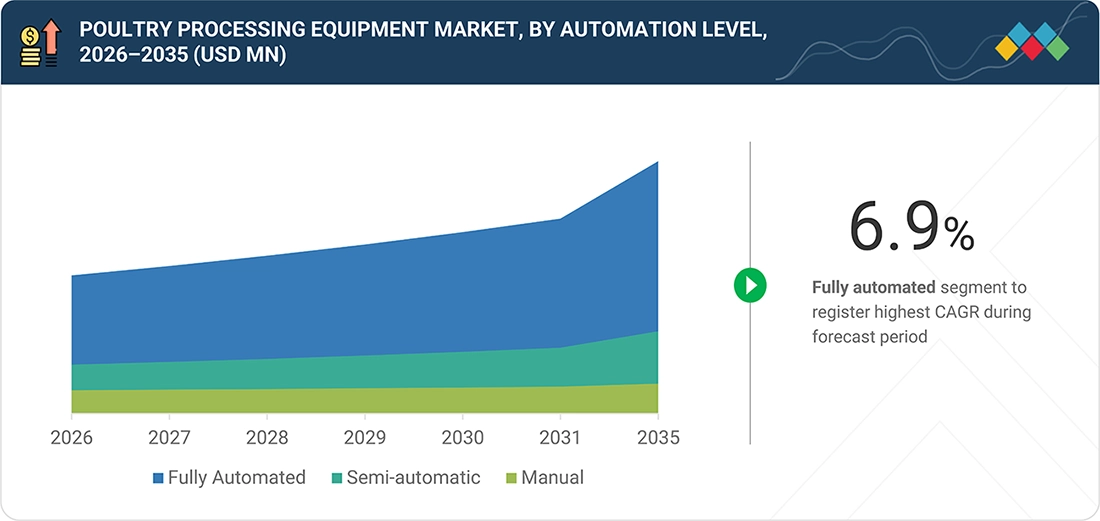
BY AUTOMATION LEVELBy automation level, the fully automated segment is expected to hold a dominant market share.
-
COMPETITIVE LANDSCAPE - KEY PLAYERSJBT Marel Corporation (US), GEA Group Aktiengesellschaft (Germany), and BAADER Group (Germany) were identified as some of the star players in the poultry processing equipment market, given their global presence and strong product footprint.
-
COMPETITIVE LANDSCAPE - STARTUPSPoultry Processing Equipment Worldwide Ltd. (UK), Featherman Equipment (US), and Qingdao Raniche Machinery Technology Co., Ltd. (China), among others, have distinguished themselves among startups and SMEs by securing strong footholds in specialized niche areas, underscoring their potential as emerging market leaders.
The market for poultry processing equipment is experiencing substantial growth. This is primarily due to the growing global demand for poultry meat products and the increasing need for processed poultry products.
TRENDS & DISRUPTIONS IMPACTING CUSTOMERS' CUSTOMERS
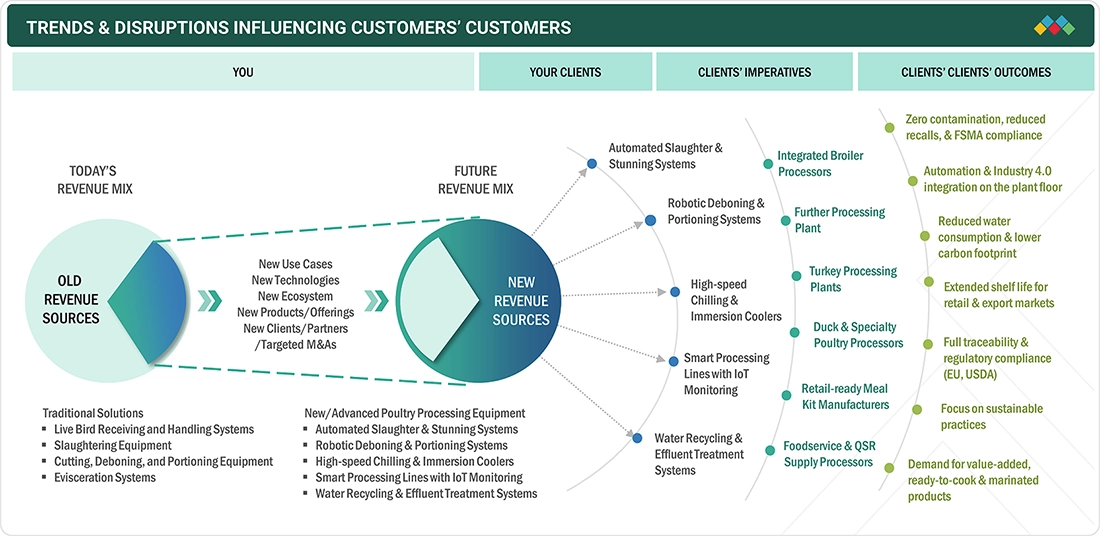
Customer business in the poultry processing equipment market is influenced by rising automation demand, stricter food safety regulations, and increasing consumption of processed poultry products. Demand is shifting toward advanced, high-speed, and IoT-enabled processing solutions to improve efficiency, hygiene, and sustainability. These trends impact operational productivity and processing costs, which, in turn, influence the revenues of poultry processors, foodservice suppliers, and equipment manufacturers.
Source: Secondary Research, Interviews with Experts, MarketsandMarkets Analysis
MARKET DYNAMICS

Level
-
Growth in chicken meat production due to increasing poultry consumption

-
Increasing food safety compliance requirements


Level
-
Rising maintenance complexity of high-speed automated poultry processing lines

-
High capital requirement for automated inspection and yield optimization systems


Level
-
Growing adoption of smart monitoring and traceability systems in poultry processing plants

-
Increasing stringency of food safety regulations and poultry inspection standards


Level
-
Difficulty in integrating advanced automation with legacy systems

-
Increasing regulatory pressure on hygiene, traceability, and inspection standards

Source: Secondary Research, Interviews with Experts, MarketsandMarkets Analysis
Driver: Growth in chicken meat production due to increasing poultry consumption
Global chicken meat production is increasing steadily due to rising poultry consumption, urbanization, population growth, and increasing preference for affordable animal protein sources. Chicken remains one of the most consumed meat products globally because of its lower production cost, shorter production cycle, and strong demand across retail and foodservice channels. The increasing demand for fresh and processed poultry products is encouraging poultry producers and processors to expand slaughtering and processing capacities across major producing countries.
Restraint: Rising maintenance complexity of high-speed automated poultry processing lines
The increasing deployment of high-speed automated poultry processing systems is significantly increasing maintenance complexity, spare-part dependency, and operational downtime risks across poultry processing facilities. Modern poultry slaughterhouses increasingly operate automated slaughtering, evisceration, chilling, grading, and deboning systems under continuous high-throughput conditions, requiring frequent maintenance, calibration, and technical servicing.
Opportunity: Growing adoption of smart monitoring and traceability systems in poultry processing plants
As poultry processors continue transitioning toward data-driven and digitally connected processing environments, demand for IoT-enabled monitoring systems, traceability platforms, smart sensors, and integrated plant management technologies is expected to create substantial growth opportunities for the poultry processing equipment market
Challenge: Difficulty in integrating advanced automation with legacy systems
The integration of advanced automation technologies with existing poultry processing infrastructure remains a major challenge for poultry processors. Many poultry slaughterhouses continue operating with legacy processing lines and standalone machinery that were not originally designed to support AI-enabled inspection systems, robotic deboning equipment, automated grading technologies, or centralized digital monitoring platforms. Hence, processors face operational challenges related to compatibility between legacy machinery and modern automation platforms, workforce training requirements, cybersecurity risks, and real-time data integration across production systems.
POULTRY PROCESSING EQUIPMENT MARKET: COMMERCIAL USE CASES ACROSS INDUSTRIES
| COMPANY | USE CASE DESCRIPTION | BENEFITS |
|---|---|---|
 |
JBT Marel introduced Innova Manufacturing Execution System (MES) software for poultry processors to improve monitoring, traceability, and production management across poultry processing operations. The solution supports data-driven processing and automation integration throughout the production cycle. | Improved operational visibility and decision-making l Enhanced product traceability and food safety compliance l Increased production efficiency and process optimization l Better inventory and production management l Reduced data errors through automated monitoring systems |
 |
BAADER provides scalable and modular poultry processing solutions designed for small, medium, and expanding poultry processors. The company supports processors in developing new facilities, modernizing existing plants, and increasing production capacity through integrated poultry processing systems covering live bird handling to final packaging. | Improved poultry processing efficiency and higher production throughput l Enhanced hygiene compliance and reduced contamination risks l Reduced labor dependency through automation technologies l Better traceability and real-time process monitoring using digital software platforms l Flexible and scalable plant expansion capabilities for growing poultry processors l Increased yield optimization and operational profitability |
Logos and trademarks shown above are the property of their respective owners. Their use here is for informational and illustrative purposes only.
MARKET ECOSYSTEM
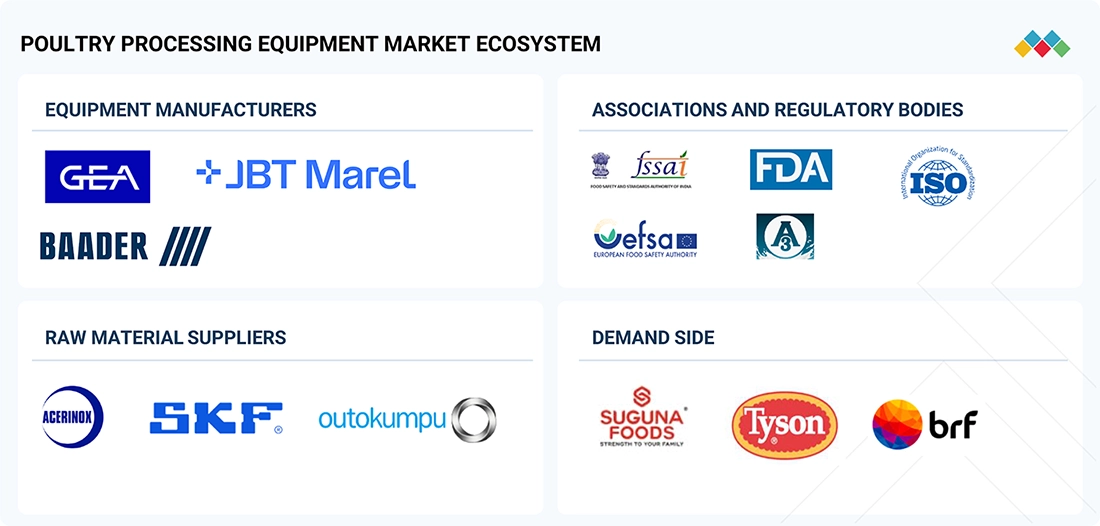
The poultry processing equipment market ecosystem is categorized into equipment manufacturers, regulatory bodies, raw material suppliers, and the demand side. The poultry processing equipment market is a dynamic and rapidly expanding ecosystem characterized by diverse stakeholders and innovative products. Established companies and agile startups are central to this market, and they develop poultry processing equipment.
Logos and trademarks shown above are the property of their respective owners. Their use here is for informational and illustrative purposes only.
MARKET SEGMENTS
Source: Secondary Research, Interviews with Experts, MarketsandMarkets Analysis
Poultry Processing Equipment Market, By Equipment Type
Cut-up and portioning equipment holds the largest market share due to growing demand for standardized poultry cuts and value-added products. These systems improve processing speed, precision, and operational efficiency in large-scale poultry plants.
Poultry Processing Equipment Market, By Product Type
Fresh processed poultry products account for the largest market share, supported by rising consumer preference for fresh and protein-rich meat products. Increasing retail and foodservice demand is driving the need for efficient poultry processing systems.
Poultry Processing Equipment Market, By Automation Level
Fully automated systems dominate the market owing to their ability to improve productivity, hygiene, and processing consistency. Rising adoption of smart and high-speed processing technologies is further supporting segment growth.
REGION
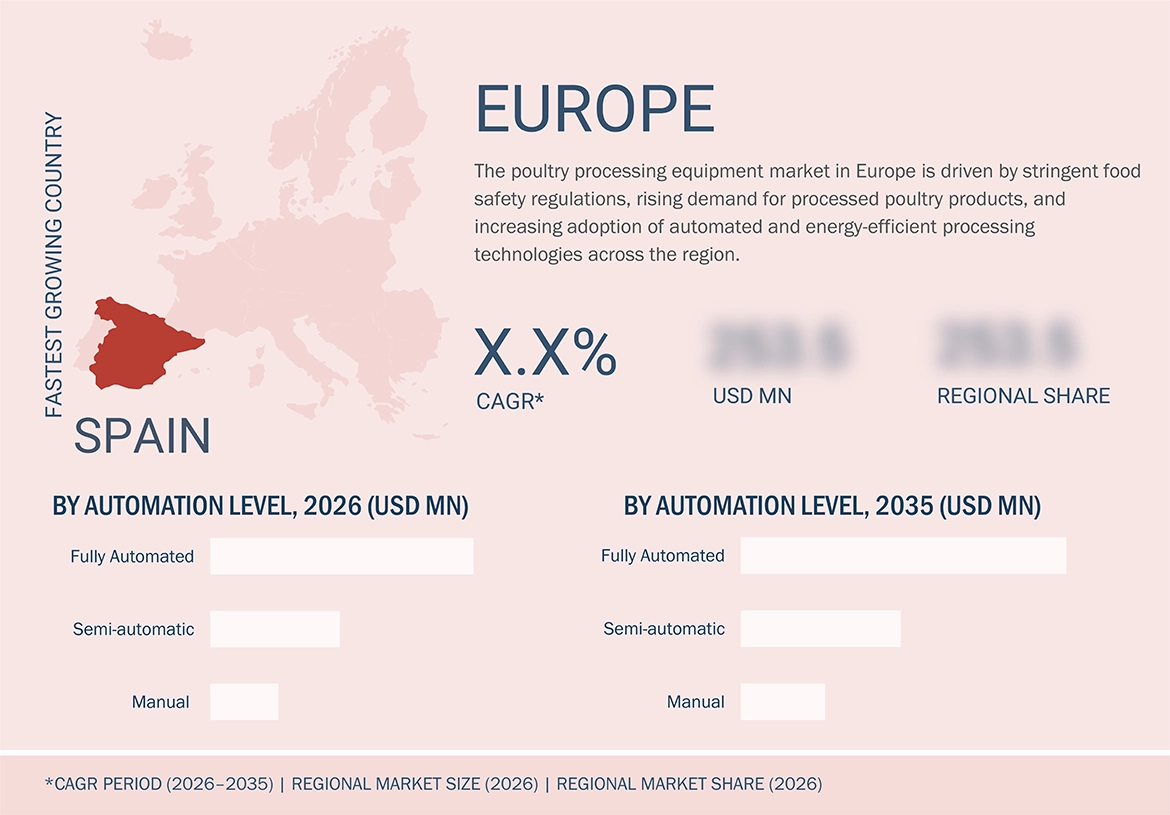
Europe to lead global poultry processing equipment market
Europe is estimated to lead the poultry processing equipment market. This leadership is mainly attributed to the region’s advanced poultry processing infrastructure, strong presence of leading equipment manufacturers, stringent food safety regulations, and increasing adoption of automated and high-efficiency poultry processing technologies.
POULTRY PROCESSING EQUIPMENT MARKET: COMPANY EVALUATION MATRIX
In the poultry processing equipment market matrix, JBT Marel Corporation, GEA Group Aktiengesellschaft, and BAADER Group (Stars) lead with a moderate market share and extensive product portfolios, driven by their strong global presence, advanced automation technologies, and broad processing equipment capabilities. Bayle SA (Emerging Leader) is gaining visibility through specialized and cost-efficient poultry processing solutions, strengthening its market position through innovation and expanding regional reach.

Source: Secondary Research, Interviews with Experts, MarketsandMarkets Analysis
KEY MARKET PLAYERS
- JBT Marel Corporation (US)
- GEA Group Aktiengesellschaft (Germany)
- BAADER Group (Germany)
- Meyn Food Processing Technology B.V. (Netherlands)
- Middleby Corporation (US)
- Duravant LLC (US)
- Mayekawa Mfg. Co., Ltd. (Japan)
- Bayle SA (France)
- Cattaruzzi Srl (Italy)
- Drobtech (Poland)
- Cantrell•Gainco Group, Inc. (US)
- Jilin SSK Electromechanical Co., Ltd. (China)
- Dutch Poultry Technology B.V. (Netherlands)
- Meitech (Brazil)
- Wrightfield Ltd. (UK)
MARKET SCOPE
| REPORT METRIC | DETAILS |
|---|---|
| Market Size in 2026 (Value) | USD 4.97 BN |
| Market Forecast in 2035 (Value) | USD 8.61 BN |
| Growth Rate | CAGR of 6.3% from 2026 to 2035 |
| Years Considered | 2022–2035 |
| Base Year | 2025 |
| Forecast Period | 2026–2035 |
| Units Considered | Value (USD Million/Billion), Volume (KT) |
| Report Coverage | Revenue Forecast, Company Ranking, Competitive Landscape, Growth Factors, and Trends |
| Segments Covered |
|
| Regions Covered | North America, Europe, Asia Pacific, Latin America, Rest of the World |
WHAT IS IN IT FOR YOU: POULTRY PROCESSING EQUIPMENT MARKET REPORT CONTENT GUIDE
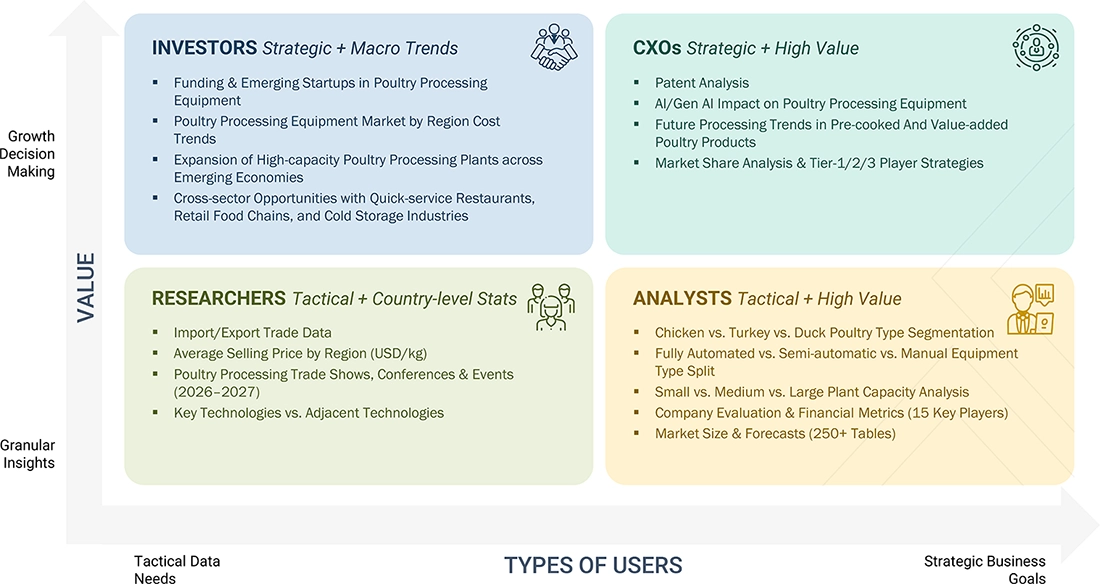
DELIVERED CUSTOMIZATIONS
We have successfully delivered the following deep-dive customizations:
| CLIENT REQUEST | CUSTOMIZATION DELIVERED | VALUE ADDS |
|---|---|---|
| Poultry-based processing equipment manufacturers |
|
|
| Poultry processing equipment type segment assessment |
|
|
RECENT DEVELOPMENTS
- February 2026 : JBT Marel expanded its manufacturing and testing capabilities in the US to support growing demand for automated protein processing solutions, including poultry chilling, portioning, and marination systems.
- May 2025 : BAADER inaugurated its first Asian production facility in Malaysia to enhance regional manufacturing and service capabilities for protein processing equipment, including poultry processing systems.
- February 2024 : Duravant acquired Ferdinand Henneken GmbH to expand its protein processing equipment portfolio, including marination, tumbling, and injection technologies relevant to poultry value-added processing.
Table of Contents
 Exclusive indicates content/data unique to MarketsandMarkets and not available with any competitors.
Methodology
This study employed two primary approaches to estimate the current size of the Poultry processing equipment market. Exhaustive secondary research was carried out to collect information on the equipment type, product type, poultry type, automation level, plant capacity and regions for the market. The next step involved validating these findings, assumptions, and sizing with industry experts across the value chain through primary research. The top-down and bottom-up approaches were employed to estimate the complete market size. Thereafter, data triangulation was used to estimate the market size of segments and subsegments.
Secondary Research
This research study used extensive secondary sources—directories and databases such as Bloomberg Businessweek and Factiva—to identify and collect information for a technical, market-oriented, and commercial market study. In the secondary research process, sources such as annual reports, press releases & investor presentations of companies, white papers, agriculture and Poultry processing equipment-related journals, certified publications, articles from recognized authors, directories, and databases were referred to to identify and collect information. Secondary research was mainly used to obtain key information about the industry’s supply chain, the pool of key players, and market classification and segmentation based on the industry trends to the bottom-most level, regional markets, and key developments from market- and technology-oriented perspectives.
Primary Research
Extensive primary research was conducted after obtaining information regarding the Poultry processing equipment market scenario through secondary research. Several primary interviews were conducted with market experts from the demand and supply sides. Primary data was collected through questionnaires, emails, and telephonic interviews. The primary sources from the supply side included various industry experts, such as chief experience officers (CXOs), vice presidents (VPs), directors from business development, marketing, research, and development teams, and related key executives from distributors and key opinion leaders.
Primary interviews were conducted to gather insights, including market statistics, revenue data from products and services, market breakdowns, market size estimations, market forecasting, and data triangulation. Primary research also helped to understand the various trends related to equipment type, product type, poultry type, automation level, plant capacity and region. Stakeholders from the demand side, including poultry processors, meat producers, quick-service restaurants, retail food chains, cold storage providers, and foodservice companies, were interviewed to understand the buyers’ perspective on suppliers, products, and the future outlook of the poultry processing equipment market.The following is the breakdown of primary respondents:
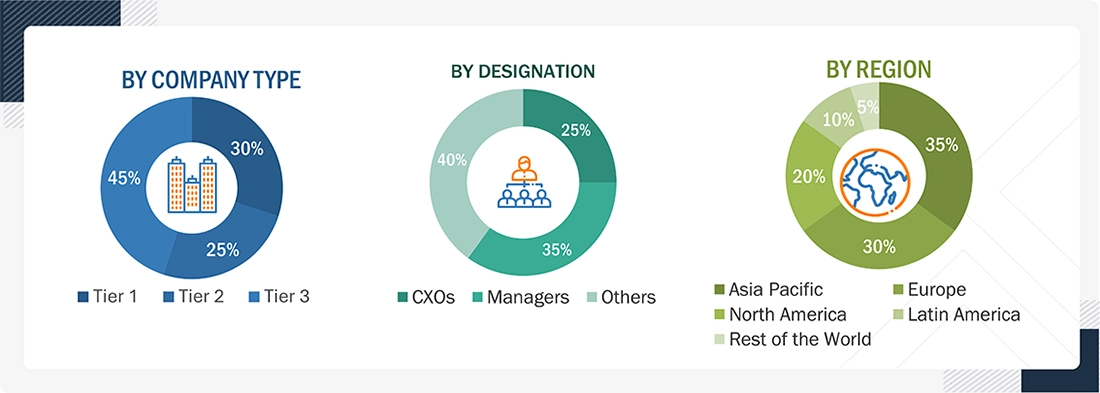
Note: The three tiers of the companies are defined based on their total revenues in 2023 or 2024, based on the availability of financial data: Tier 1: Revenue >USD 1 billion; Tier 2: USD 100 million ≤ revenue ≤ USD 1 billion; Tier 3: Revenue <USD 100 million.
|
COMPANY |
DESIGNATION |
|
JBT Marel Corporation (US) |
Regional Sales Manager |
|
GEA Group Aktiengesellschaft (Germany) |
Marketing Manager |
|
BAADER Group (Germany) |
General Manager |
|
Dutch Poultry Technology B.V. (Netherlands) |
Sales Manager |
|
Nanjing Eruis Equipment Co., Ltd. (China) |
Sales Manager |
|
Shandong Osaint Machine Co., Ltd. (China) |
Sales Executive |
To know about the assumptions considered for the study, download the pdf brochure
Market Size Estimation
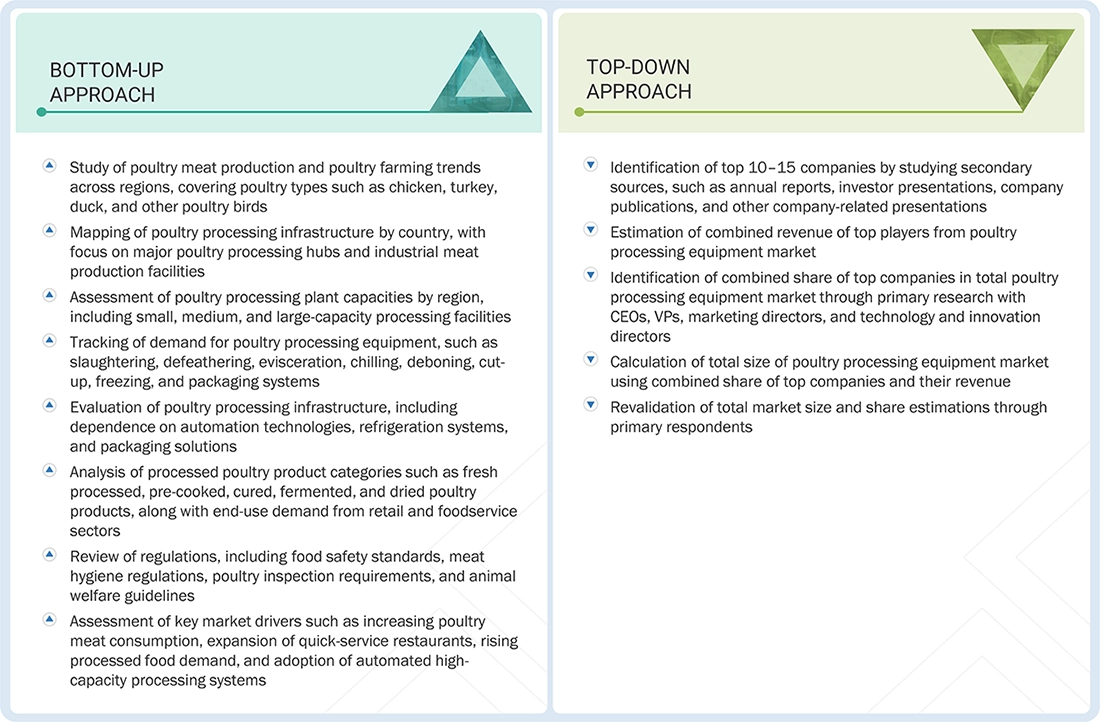
The top-down and bottom-up approaches were used to estimate and validate the total size of the Poultry processing equipment market. These approaches were also used extensively to determine the size of various subsegments in the market. The research methodology used to estimate the market size includes the following details:
- The key players in the industry and the overall markets were identified through extensive secondary research.
- All shares, splits, and breakdowns were determined using secondary sources and verified through primary sources.
- All possible parameters that affect the market covered in this research study were accounted for, viewed in extensive detail, verified through primary research, and analyzed to obtain final quantitative and qualitative data.
- The research included the study of reports, reviews, and newsletters of top market players, along with extensive interviews for opinions from leaders, such as CEOs, directors, and marketing executives
Data Triangulation
After determining the overall market size from the estimation process explained above, the total market was split into several segments and subsegments. The data triangulation procedure was employed, wherever applicable, to estimate the overall Poultry processing equipment market and obtain precise statistics for all segments and subsegments. The data was triangulated by studying various factors and trends from the demand and supply sides. The market size was also validated using the top-down and bottom-up approaches.
Market Definition
The poultry processing equipment market includes the production and sale of machinery and systems used for the processing of poultry birds such as chicken, turkey, duck, and other poultry types. The market comprises equipment used across multiple processing stages, including live bird handling, slaughtering, defeathering, evisceration, washing and cleaning, chilling, deboning, cut-up and portioning, freezing, packaging, and quality inspection. These equipment systems are widely utilized by poultry processors, meat manufacturers, food service companies, and export-oriented poultry processing facilities across global markets.
Manufacturers develop poultry processing equipment with advanced automation, hygiene control, and high-capacity processing capabilities to improve operational efficiency, product quality, and food safety compliance. The market is driven by rising poultry meat consumption, increasing demand for processed and ready-to-cook poultry products, and growing investments in automated poultry processing plants. Additionally, stringent food safety regulations, labor cost reduction requirements, and the adoption of smart processing technologies such as AI-enabled inspection and automated monitoring systems are further supporting the growth of the poultry processing equipment market globally.
Key Stakeholders
- Supply-side: Poultry processing equipment manufacturers, component suppliers, automation technology providers, refrigeration system suppliers, distributors, importers, and exporters
- Processing and product manufacturers: Poultry meat processors, slaughterhouses, packaged poultry product manufacturers, ready-to-cook and ready-to-eat poultry product companies, and food service suppliers using poultry processing equipment for large-scale operations
- Demand-side: Poultry farms, meat processing companies, quick-service restaurants, retail food chains, supermarkets, cold storage facilities, and foodservice providers requiring processed poultry products
- Regulatory side: Food safety authorities, animal welfare regulatory bodies, meat inspection agencies, and industrial safety organizations ensuring compliance with hygiene, processing, labeling, and operational standards
- Associations and industry bodies:
-
- National Chicken Council (NCC)
- US Poultry & Egg Association (USPOULTRY)
- European Food Safety Authority (EFSA)
- World Health Organization (WHO)
- International Poultry Council (IPC)
- European Poultry Club (EPC)
- American Association of Meat Processors (AAMP)
- North American Meat Institute (NAMI)
- US Food and Drug Administration (USFDA)
- Food Safety and Standards Authority of India (FSSAI)
Report Objectives
- To determine and project the size of the poultry processing equipment market based on equipment type, poultry type, product type, automation level, plant capacity, and region over the forecast period
- To identify key growth opportunities by analyzing the largest and fastest-growing segments across regions
- To provide detailed insights on factors influencing market growth, including drivers, restraints, opportunities, and challenges
- To evaluate market opportunities for stakeholders and present the competitive landscape of leading players
- To analyze micro-markets with respect to individual growth trends, future potential, and their contribution to the overall market
- To identify and profile key companies operating in the poultry processing equipment market
- To assess the competitive environment and highlight key strategies adopted by major players across regions
Available customizations:
With the given market data, MarketsandMarkets offers customizations according to company-specific scientific needs. The following customization options are available for the report:
PRODUCT ANALYSIS
- Product matrix, which gives a detailed comparison of the product portfolio of each company.
Segmental ANALYSIS
With the given market data, MarketsandMarkets offers customizations according to company-specific scientific needs.
- Further breakdown of the Rest of Europe poultry processing equipment market into key countries
- Further breakdown of the Rest of Asia Pacific poultry processing equipment market into key countries
- Further breakdown of the Rest of Latin America poultry processing equipment market into key countries
COMPANY INFORMATION
- Detailed analyses and profiling of additional market players (up to five)
Key Questions Addressed by the Report
What is the current size of the poultry processing equipment market?
The global poultry processing equipment market is valued at USD 4.97 billion in 2026 and is projected to reach USD 8.61 billion by 2035.
What is the CAGR of the poultry processing equipment market?
The poultry processing equipment market is expected to grow at a CAGR of 6.3% during the forecast period from 2026 to 2035.
What factors are driving poultry processing equipment market growth?
Market growth is driven by rising poultry meat consumption, increasing demand for processed and packaged poultry products, growing automation adoption, and stricter food safety regulations.
What are the key trends shaping the poultry processing equipment industry?
Major trends include the adoption of robotic processing systems, smart inspection technologies, automated production lines, and energy-efficient equipment.
What opportunities exist in the poultry processing equipment market?
Opportunities are emerging from expanding poultry production, investments in food processing infrastructure, and increasing demand for value-added poultry products worldwide.


Personalize This Research
- Triangulate with your Own Data
- Get Data as per your Format and Definition
- Gain a Deeper Dive on a Specific Application, Geography, Customer or Competitor
- Any level of Personalization
Let Us Help You
- What are the Known and Unknown Adjacencies Impacting the Poultry Processing Equipment Market
- What will your New Revenue Sources be?
- Who will be your Top Customer; what will make them switch?
- Defend your Market Share or Win Competitors
- Get a Scorecard for Target Partners

Custom Market Research Services
We Will Customise The Research For You, In Case The Report Listed Above Does Not Meet With Your Requirements
Get 10% Free CustomisationTESTIMONIALS

Business Innovation Director
US Based Leading Agribusiness,
Food and Ingredients ManufacturerI highly appreciate the team's efficiency for a well conducted study that helped us clarify some blind spots in food and agricultural niche markets. Although compiling information for B2B markets is very difficult, the MnM team pulled out the task successfully. The quality of research, level of insights, and responsiveness of team were commendable.
- US Poultry Processing Equipment Market
- Canada Poultry Processing Equipment Market
- Germany Poultry Processing Equipment Market
- UK Poultry Processing Equipment Market
- France Poultry Processing Equipment Market
- Spain Poultry Processing Equipment Market
- Italy Poultry Processing Equipment Market
- China Poultry Processing Equipment Market
- India Poultry Processing Equipment Market
- Japan Poultry Processing Equipment Market
- Brazil Poultry Processing Equipment Market
- Mexico Poultry Processing Equipment Market
- Argentina Poultry Processing Equipment Market
- Rest Of Europe Poultry Processing Equipment Market
- Rest Of Asia Pacific Poultry Processing Equipment Market
- Rest Of Latin America Poultry Processing Equipment Market






Growth opportunities and latent adjacency in Poultry Processing Equipment Market