



Radiation Hardened Electronics Market Size, Share & Trends
Report Code
SE 2934
Published in
Sep, 2026, By MarketsandMarkets™
Radiation Hardened Electronics Market by Component (Mixed Signal ICs, Processors & Controllers, Memory, Power Management), Manufacturing Technique (RHBD, RHBP), Product Type (COTS, Custom), Application, and Region - Global Forecast to 2032

USD 2.91 BN
MARKET SIZE, 2032

CAGR 6.1%
(2026-2032)

300
REPORT PAGES

180
MARKET TABLES
OVERVIEW
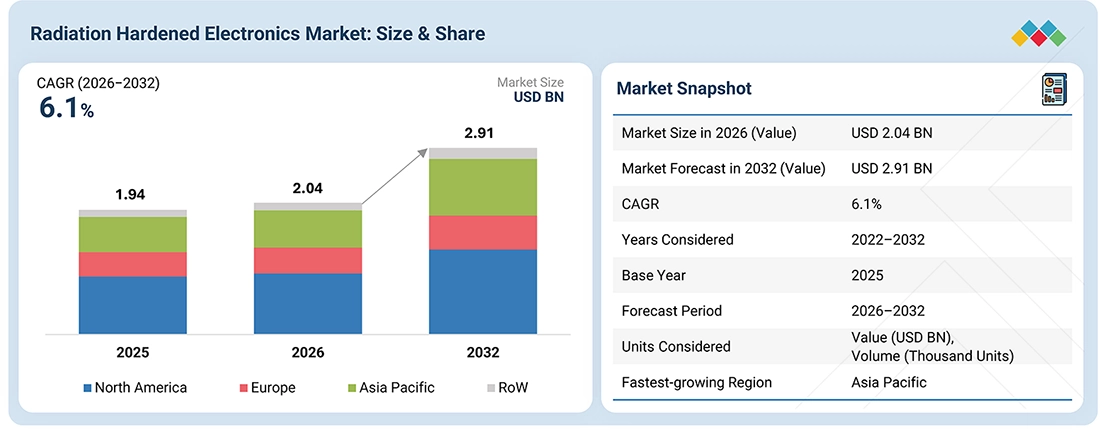
Source: Secondary Research, Interviews with Experts, MarketsandMarkets Analysis
The radiation hardened electronics market is valued at USD 2.04 billion in 2026 and is projected to reach USD 2.91 billion by 2032, growing at a CAGR of 6.1% from 2026 to 2032. Growth is driven by increasing satellite launches, space exploration missions, defense modernization, and nuclear power infrastructure. Rising demand for reliable processors, power-management devices, memory, and image sensors in high-radiation environments will further support market expansion.
KEY TAKEAWAYS
-
By REGIONNorth America accounted for the largest share of 47% of the radiation hardened electronics market in 2025.
-
By COMPONENTImage sensors is expected to register the highest CAGR of 9.8% during the forecast period.
-
BY MANUFACTURING TECHNIQUERHBD accounted for the largest share of 83% of the radiation hardened electronics market in 2025.
-
By PRODUCTCOTS is expected to register the highest CAGR during the forecast period.
-
BY APPLICATIONSpace (satellites) is expected to account for the largest market share during the forecast period.
-
COMPETITIVE LANDSCAPE (KEY PLAYERS)BAE Systems (UK), Microchip Technology (US), Renesas Electronics Corporation (Japan), Infineon Technologies (US), and STMicroelectronics (Switzerland) are among the leading players in the radiation hardened electronics market, supported by extensive product portfolios.
-
COMPETITIVE LANDSCAPE (STARTUPS/SMES)PCB Piezotronics (US) and GSI Technology (US) are among the notable startups and small and medium-sized enterprises (SMEs) in the radiation hardened electronics market. These vendors have been marking their presence by offering solutions as per end user requirements and adopting growth strategies to achieve their targets.
The radiation hardened electronics market is primarily driven by increasing satellite deployments, space-exploration missions, defense modernization, and investments in nuclear infrastructure. Growing electronic complexity and the need for reliable processors, memory, power-management devices, and sensors capable of operating in high-radiation environments further support market growth.
TRENDS & DISRUPTIONS IMPACTING CUSTOMERS' CUSTOMERS
Increasing development in government and commercial satellites and the proliferation of several space missions, which include long-term satellites in high Earth orbit, boost growth opportunities for the radiation hardened electronics market. However, the driver for the radiation hardened electronics market is low Earth orbit applications, such as reconnaissance orbiting and communication satellites, which use advanced radiation hardened ICs for mission reliability. NewSpace is a key driver for radiation-hardened electronics manufacturers as it pushes for compact, affordable, and capable radiation-hardened technology for short-duration spacecraft. NewSpace has accelerated the development of COTS electronic technologies, design approaches, and open system architecture in the radiation hardened electronics market to deliver improved size, weight, and power consumption capabilities.
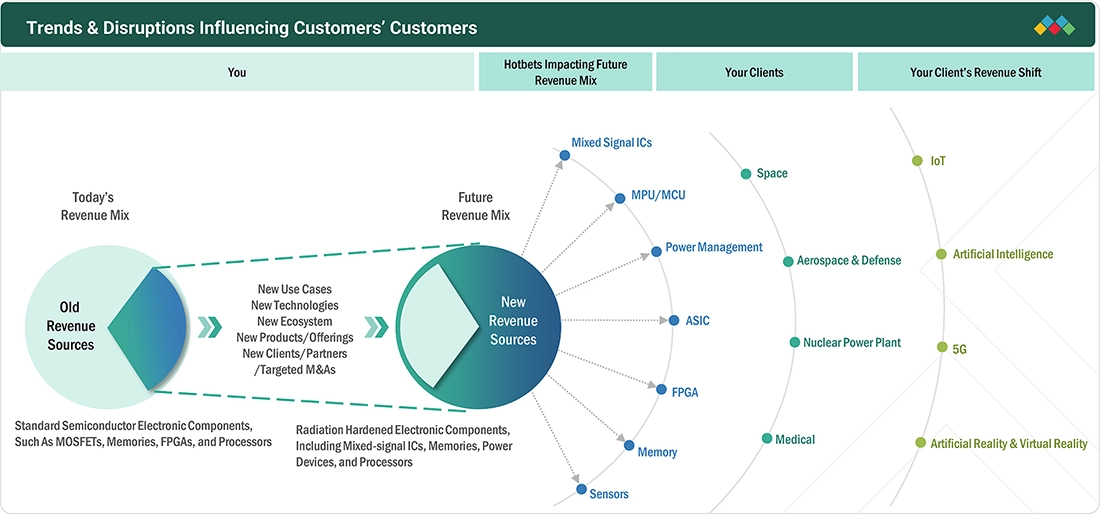
Source: Secondary Research, Interviews with Experts, MarketsandMarkets Analysis
MARKET DYNAMICS

Drivers
Impact
Level
Level
-
Rising intelligence, surveillance, and reconnaissance (ISR) activities

-
Technology advancements in multicore processors used for military and space applications


RESTRAINTS
Impact
Level
Level
-
Difficulties in creating real testing environments

-
High costs associated with development of radiation hardened products


OPPORTUNITIES
Impact
Level
Level
-
Increasing space missions globally

-
Demand for reconfigurable radiation hardened electronics


CHALLENGES
Impact
Level
Level
-
Customized requirements from high-end consumers

Source: Secondary Research, Interviews with Experts, MarketsandMarkets Analysis
Driver: Rising intelligence, surveillance, and reconnaissance (ISR) activities
Global ISR operations have increased exponentially in the last few years due to which the demand for robust and reliable electronic components has increased.
Restraint: Difficulties in creating real testing environments
It is highly expensive to construct a rad-hard electronics test lab. The creation of a testing environment, which can actually represent the space, a nuclear reactor, or combat scenarios is difficult to imitate.
Opportunity: Increasing space missions globally
The increasing number of space missions around the globe are driving the market for rad-hard electronics and semiconductor systems.
Challenge: Customized requirements from high-end consumers
Military and space missions are highly confidential and application oriented, due to which there is a wide difference between the requirements of one consumer from another. These customization requirements seem to be a challenge in this market.
RADIATION HARDENED ELECTRONICS MARKET SIZE, SHARE & TRENDS: COMMERCIAL USE CASES ACROSS INDUSTRIES
| COMPANY | USE CASE DESCRIPTION | BENEFITS |
|---|---|---|
 |
Deployment of BAE Systems’ RAD750 radiation-hardened processor in NASA’s Perseverance Mars Rover to support the Rover Compute Element for spacecraft command, instrument control, engineering functions, and science-data processing. | Enables reliable onboard computing in high-radiation environments, protects critical processing functions from radiation-induced failures, and supports continuous command, navigation, and scientific data processing during long-duration planetary missions. |
 |
Deployment of RTG4 radiation-tolerant FPGAs across space missions, including Mission Extension Vehicles (MEV-1 and MEV-2), CAS-500, and Artemis II, supporting high-speed processing and programmable spacecraft electronics. | Provides resistance to single-event upsets and radiation damage, improves reliability of mission-critical electronics, enables high-speed signal processing, and supports long-duration operation across LEO, GEO, and deep-space missions. |
 |
Deployment of Intersil-branded radiation-hardened ICs in NASA’s Artemis II mission, including the Orion spacecraft and Space Launch System, for avionics, launch-safety systems, power regulation and distribution, signal conditioning, and onboard computing. | Ensures stable power delivery and signal integrity under radiation and extreme temperatures, improves reliability of safety-critical spacecraft systems, and reduces the risk of electronic failures during crewed deep-space missions. |
Logos and trademarks shown above are the property of their respective owners. Their use here is for informational and illustrative purposes only.
MARKET ECOSYSTEM
The radiation hardened electronics market ecosystem consists of material suppliers, semiconductor manufacturers, fab facility providers, system integrators, distributors, and end users working across the value chain. Key semiconductor players such as Microchip, AMD, STMicroelectronics, Renesas, Infineon, and BAE Systems develop radiation-hardened components, supported by specialized material and fabrication partners. These products are integrated into mission-critical aerospace, defense, and space systems for end users such as NASA, ESA, Boeing, ISRO, Airbus, and Lockheed Martin.
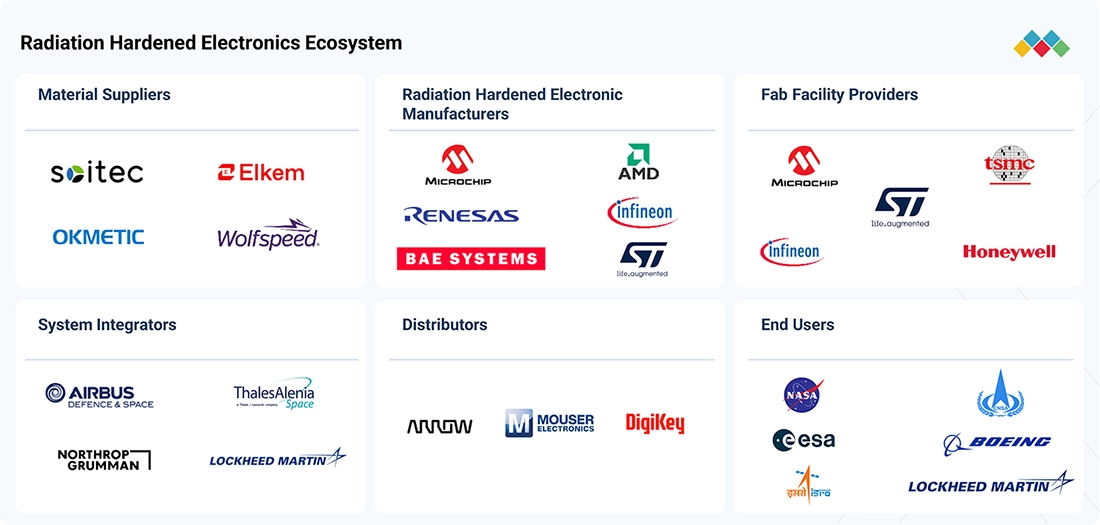
Logos and trademarks shown above are the property of their respective owners. Their use here is for informational and illustrative purposes only.
MARKET SEGMENTS
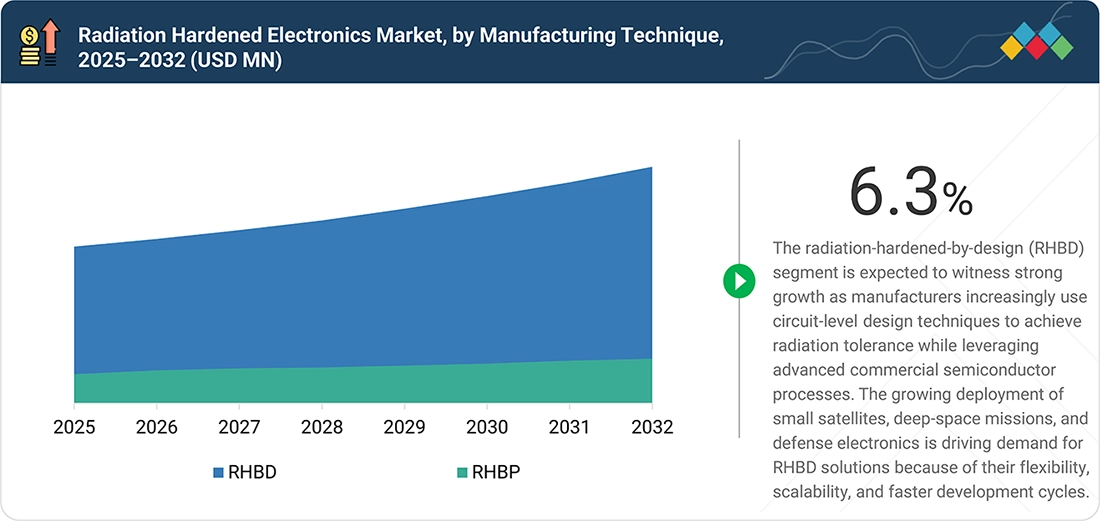
Source: Secondary Research, Interviews with Experts, MarketsandMarkets Analysis
Radiation Hardened Electronics Market, by Component
The image sensors segment is expected to register the highest growth in the radiation hardened electronics market during the forecast period, driven by rising deployment of high-resolution imaging payloads in Earth observation, planetary exploration, surveillance, and scientific missions. Growing demand for radiation-tolerant CMOS and CCD sensors in small satellites and deep-space platforms is further expanding their adoption. In addition, growing requirements for autonomous navigation, optical sensing, and real-time image processing are driving faster growth in radiation-hardened image sensors.
Radiation Hardened Electronics Market, by Manufacturing Technique
The radiation hardened by design (RHBD) segment is expected to witness strong growth as manufacturers increasingly use circuit-level design techniques to achieve radiation tolerance while leveraging advanced commercial semiconductor processes. Growing deployment of small satellites, deep-space missions, and defense electronics is driving demand for RHBD solutions due to their flexibility, scalability, and comparatively faster development cycles.
Radiation Hardened Electronics Market, by Product Type
The commercial off-the-shelf (COTS) segment held the largest market share in the radiation hardened electronics market due to its lower cost, shorter procurement cycles, and wide availability compared with fully custom radiation-hardened components. Increasing use of radiation-tolerant COTS electronics in small satellites, LEO constellations, and cost-sensitive space missions is further supporting its dominant market position.
Radiation Hardened Electronics Market, by Application
The space applications segment is expected to account for the largest market share in the radiation hardened electronics market, driven by extensive use of rad-hard components in satellites, launch vehicles, spacecraft, and deep-space missions. Growing satellite constellations, Earth observation programs, and government and commercial space investments are further sustaining demand for highly reliable electronics capable of operating in intense radiation environments.
REGION
Asia Pacific to be fastest-growing region in radiation hardened electronics market during forecast period
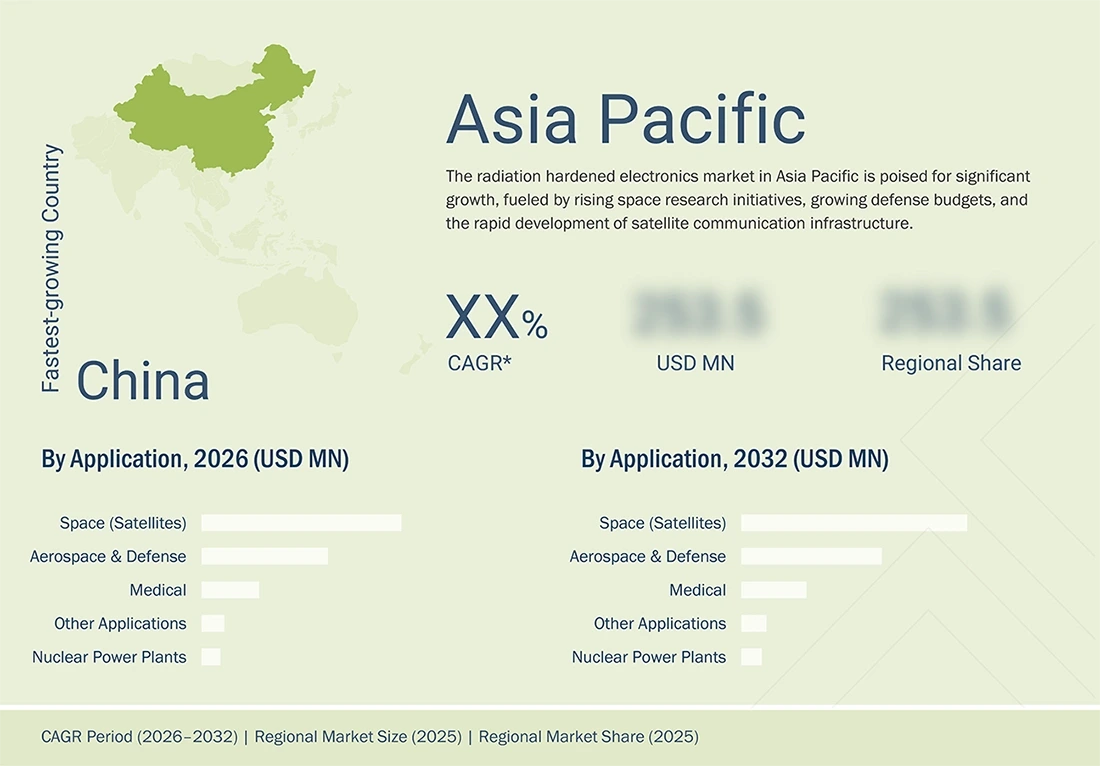
Asia Pacific is expected to register the highest growth in the radiation hardened electronics market, supported by expanding space and defense programs in China, India, Japan, and South Korea. Rising satellite launches, indigenous semiconductor development, and increasing investments in space exploration and military electronics are accelerating regional demand for radiation hardened components.
United States to Drive Growth of the Radiation-Hardened Electronics Market During the Forecast Period
The United States radiation-hardened electronics market is expected to witness steady growth, driven by increasing demand for reliable electronic components in satellites, spacecraft, defense systems, and other mission-critical applications. This growth is supported by investments from government agencies, defense contractors, aerospace companies, and semiconductor manufacturers to enhance the reliability and resilience of electronics operating in high-radiation environments. Radiation-hardened technologies, including rad-hard processors, memory devices, power management components, and integrated circuits, are gaining adoption, supported by advances in semiconductor design, radiation-tolerant architectures, advanced packaging, and government-funded space and defense programs.
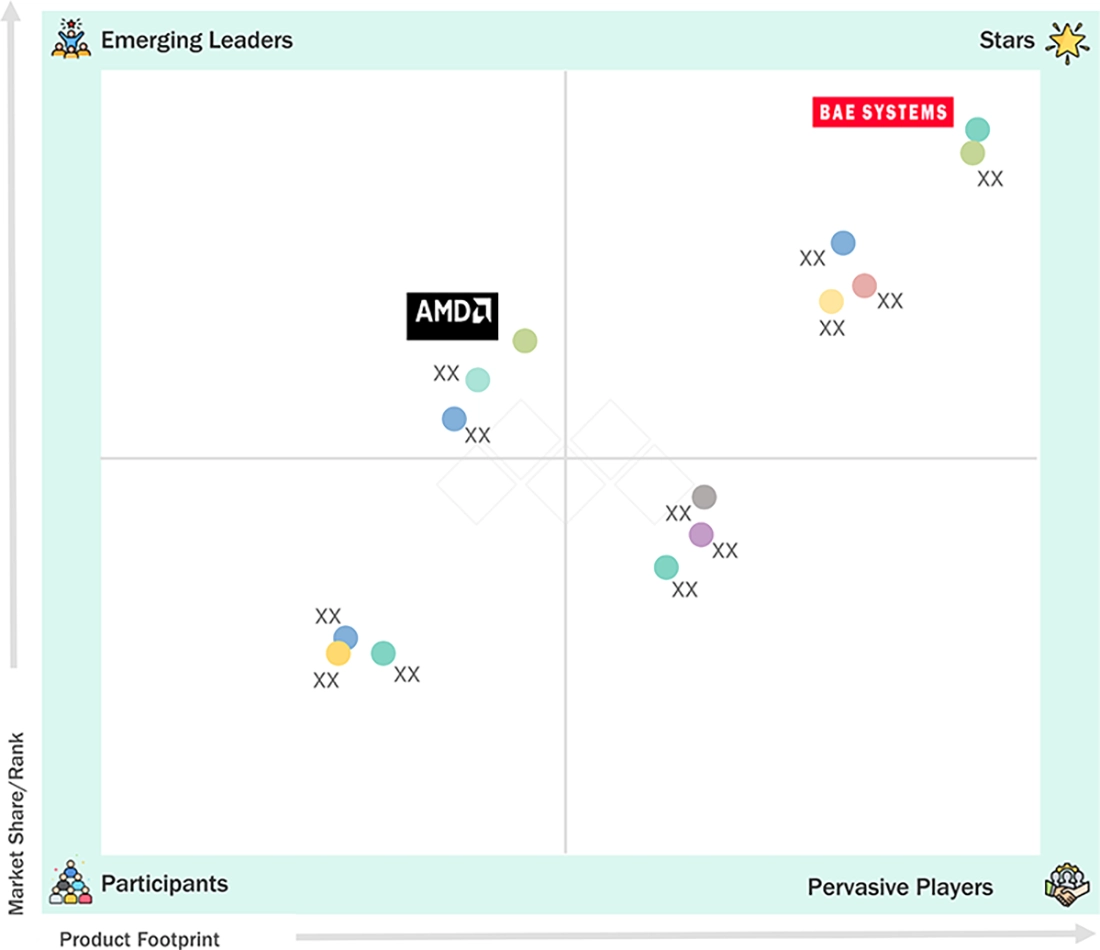
RADIATION HARDENED ELECTRONICS MARKET SIZE, SHARE & TRENDS: COMPANY EVALUATION MATRIX
In the radiation-hardened electronics market matrix, BAE Systems (US) (Star Player) leads with a strong market presence and a broad portfolio of radiation hardened processors, memory, and electronic solutions for critical space and defense applications. AMD (US) (Emerging Leader) is strengthening its position through advanced adaptive computing and FPGA solutions designed for high-reliability aerospace and space environments. While BAE Systems maintains its leadership through extensive industry experience, technological capabilities, and strong customer relationships, AMD continues to expand its market presence through innovation in programmable and radiation-tolerant electronics.
Source: Secondary Research, Interviews with Experts, MarketsandMarkets Analysis
KEY MARKET PLAYERS
- Microchip Technology Inc. (US)
- BAE Systems (UK)
- Renesas Electronics Corporation (Japan)
- Infineon Technologies AG (Germany)
- STMicroelectronics (Switzerland)
- Advanced Micro Devices, Inc. (US)
- Texas Instruments Incorporated (US)
- Honeywell International Inc. (US)
- Teledyne Technologies Incorporated (US)
- TTM Technologies Inc. (US)
- Thales (France)
- Analog Devices, Inc. (US)
- Data Device Corporation (US)
- 3D Plus (France)
- Mercury Systems, Inc. (US)
- PCB Piezotronics, Inc. (US)
- Vorago Technologies (US)
- GSI Technology, Inc. (US)
- Everspin Technologies Inc. (US)
- Semiconductor Components Industries, LLC (US)
- Aitech (US)
- Microelectronics Research Development Corporation (US)
- Triad Semiconductor (US)
- Zero Error Systems (Singapore)
- Resilient Computing (US)
MARKET SCOPE
| REPORT METRIC | DETAILS |
|---|---|
| Market Size in 2025 (Value) | USD 1.94 Billion |
| Market Size in 2026 (Value) | USD 2.04 Billion |
| Market Forecast in 2032 (Value) | USD 2.91 Billion |
| CAGR | 6.1% |
| Years Considered | 2022–2032 |
| Base Year | 2025 |
| Forecast Period | 2026–2032 |
| Units Considered | Value (USD Billion/Million), Volume (Thousand Units) |
| Report Coverage | Revenue Forecast, Company Ranking, Competitive Landscape, Growth Factors, and Trends |
| Segments Covered |
|
| Regions Covered | North America, Europe, Asia Pacific, Rest of the World (RoW) |
WHAT IS IN IT FOR YOU: RADIATION HARDENED ELECTRONICS MARKET SIZE, SHARE & TRENDS REPORT CONTENT GUIDE
DELIVERED CUSTOMIZATIONS
We have successfully delivered the following deep-dive customizations:
| CLIENT REQUEST | CUSTOMIZATION DELIVERED | VALUE ADDS |
|---|---|---|
| Space Agency/Satellite Manufacturer | Assessment of radiation hardened electronics requirements across processors, memory, power management, mixed-signal ICs, and image sensors by satellite type, orbit, and mission profile, with supplier benchmarking |
|
| Aerospace & Defense OEM | Evaluation of rad-hard and radiation-tolerant electronics demand across avionics, missiles, UAVs, communication systems, and defense platforms with technology and supplier assessment |
|
| Radiation Hardened Semiconductor Manufacturer | Competitive benchmarking of RHBD/RHBP and COTS/custom-made products by component, application, pricing, technology, and regional demand with market opportunity analysis |
|
| Nuclear/High-reliability Electronics Organization | Analysis of radiation hardened electronic requirements for nuclear power plants, medical equipment, and other radiation-intensive environments with application-level demand and supplier mapping |
|
RECENT DEVELOPMENTS
- August 2026 : Microchip Technology launched the Space CSAC-SA65 radiation-tolerant Chip Scale Atomic Clock, offering radiation tolerance of at least 30 krad and extended-temperature operation for satellite communications, navigation, and Earth-imaging applications.
- July 2026 : Infineon Technologies introduced the RIC70115 radiation hardened GaN HEMT driver for satellite and high-reliability space applications, supporting efficient GaN-based power conversion while maintaining reliable operation in harsh radiation environments.
- October 2025: Infineon Technologies AG (Germany) introduced the RIC70847, described as the industry's first radiation-hardened buck controller with an integrated gate drive. Designed for point-of-load power rails in commercial spacecraft and other extreme environments, the new controller supports distributed satellite power architectures and digital-processing payloads such as FPGA- and ASIC-based systems.
- July 2025: TTM Technologies Inc. (US) launched the MSK5065RH, a compact radiation-hardened synchronous buck switching regulator for space and defense applications. The new module provides more than 3 A of continuous output current, peak efficiency above 90%, and radiation tolerance up to 100 krad(Si), with low sensitivity to single-event effects for LEO, MEO and deep-space missions.
- February 2025: Honeywell International Inc. (US) launched a strategic collaboration with ForwardEdge ASIC to develop high-reliability, radiation-hardened microelectronics for space applications. Honeywell will provide its trusted-foundry capabilities while ForwardEdge ASIC contributes architecture and design solutions, with the collaboration targeting next-generation semiconductor devices for satellites and other space systems.
Table of Contents
 Exclusive indicates content/data unique to MarketsandMarkets and not available with any competitors.
TITLE
PAGE NO
1
INTRODUCTION
34
2
EXECUTIVE SUMMARY
39
3
PREMIUM INSIGHTS
44
4
MARKET OVERVIEW
Radiation-hardened electronics market thrives on ISR demand and rapid multicore processor advancements.
48
4.1
INTRODUCTION
4.2
RADIATION-HARDENED ELECTRONICS MARKET EVOLUTION
4.3
MARKET DYNAMICS
4.3.1
DRIVERS
4.3.1.1
RISING INTELLIGENCE, SURVEILLANCE, AND RECONNAISSANCE (ISR) ACTIVITIES
4.3.1.2
RAPID ADVANCES IN MULTICORE PROCESSORS FOR MILITARY AND SPACE APPLICATIONS
4.3.1.3
GROWING EMPHASIS ON COST-EFFECTIVE SATELLITE COMMUNICATION
4.3.1.4
INCREASING DEMAND FOR ELECTRONIC SYSTEMS RESILIENT TO SEVERE NUCLEAR ENVIRONMENTS
4.3.2
RESTRAINTS
4.3.2.1
BARRIERS TO ESTABLISHING REAL-WORLD TESTING ENVIRONMENTS
4.3.2.2
HIGH COSTS AND LONG DEVELOPMENT CYCLES
4.3.3
OPPORTUNITIES
4.3.3.1
INCREASING NUMBER OF GLOBAL SPACE MISSIONS
4.3.3.2
MOUNTING DEMAND FOR RECONFIGURABLE RADIATION-HARDENED FPGAS
4.3.3.3
RISING ADOPTION OF COMMERCIAL OFF-THE-SHELF COMPONENTS IN SATELLITES
4.3.4
CHALLENGES
4.3.4.1
COMPLEXITIES IN SCALING CUSTOMIZED PRODUCT OFFERINGS
4.4
INTERCONNECTED MARKETS AND CROSS-SECTOR OPPORTUNITIES
4.4.1
INTERCONNECTED MARKETS
4.4.2
CROSS-SECTOR OPPORTUNITIES
4.5
STRATEGIC MOVES BY TIER-1/2/3 PLAYERS
5
INDUSTRY TRENDS
Asia Pacific leads satellite manufacturing shift, reshaping global space and defense industry dynamics.
57
5.1
PORTER’S FIVE FORCES ANALYSIS
5.1.1
INTENSITY OF COMPETITIVE RIVALRY
5.1.2
BARGAINING POWER OF SUPPLIERS
5.1.3
BARGAINING POWER OF BUYERS
5.1.4
THREAT OF SUBSTITUTES
5.1.5
THREAT OF NEW ENTRANTS
5.2
MACROECONOMIC OUTLOOK
5.2.1
INTRODUCTION
5.2.2
GDP TRENDS AND FORECAST
5.2.3
TRENDS IN GLOBAL SPACE INDUSTRY
5.2.3.1
SHIFT OF SATELLITE MANUFACTURING TOWARD ASIA PACIFIC
5.2.3.2
LOCALIZATION OF SPACE ELECTRONICS SUPPLY CHAINS
5.2.3.3
INCREASING INVESTMENT IN SATELLITE CONSTELLATION PROGRAMS
5.2.3.4
GROWING PUBLIC-PRIVATE PARTNERSHIPS IN SPACE PROGRAMS
5.2.4
TRENDS IN GLOBAL AEROSPACE & DEFENSE INDUSTRY
5.2.4.1
INDIA’S EMERGENCE AS A HUB FOR DEFENSE ELECTRONICS MANUFACTURING
5.2.4.2
ACCELERATING MODERNIZATION OF NEXT-GENERATION DEFENSE PLATFORMS
5.2.4.3
INCREASING INVESTMENT IN ELECTRONIC WARFARE AND MISSILE DEFENSE SYSTEMS
5.3
SUPPLY CHAIN ANALYSIS
5.4
ECOSYSTEM ANALYSIS
5.5
PRICING ANALYSIS
AVERAGE SELLING PRICE OF POWER MANAGEMENT PRODUCTS OFFERED
PRICING RANGE OF MIXED-SIGNAL ICS OFFERED BY KEY PLAYERS,
PRICING RANGE OF PROCESSORS & CONTROLLERS OFFERED
5.5.4
PRICING RANGE OF MEMORY PRODUCTS, BY KEY PLAYER, 2025
AVERAGE SELLING PRICE TREND OF RADIATION-HARDENED
5.6
TRADE ANALYSIS
5.6.1
IMPORT SCENARIO (HS CODE 8541)
5.6.2
EXPORT SCENARIO (HS CODE 8541)
5.7
KEY CONFERENCES AND EVENTS, 2026–2027
5.8
TRENDS/DISRUPTIONS IMPACTING CUSTOMER BUSINESS
5.9
INVESTMENT AND FUNDING SCENARIO
5.10
CASE STUDY ANALYSIS
5.11
IMPACT OF US TARIFFS – RADIATION-HARDENED ELECTRONICS MARKET
5.11.1
INTRODUCTION
5.11.2
KEY TARIFF RATES
5.11.3
PRICE IMPACT ANALYSIS
5.11.4
KEY IMPACTS ON COUNTRIES/REGIONS
5.11.4.1
US
5.11.4.2
EUROPE
5.11.4.3
ASIA PACIFIC
5.11.5
IMPACT ON APPLICATIONS
6
TECHNOLOGICAL ADVANCEMENTS, AI-DRIVEN IMPACT, PATENTS, INNOVATIONS, AND FUTURE APPLICATIONS
AI-driven innovations are revolutionizing radiation-hardened electronics, unlocking new market potentials and applications.
81
6.1
TECHNOLOGY ANALYSIS
6.1.1
KEY TECHNOLOGIES
6.1.1.1
RADIATION-HARDENED SEMICONDUCTORS
6.1.1.2
RAD-HARD DESIGN TECHNIQUES
6.1.1.3
RAD-HARD PACKAGING
6.1.2
COMPLEMENTARY TECHNOLOGIES
6.1.2.1
RADIATION TESTING AND SIMULATION TOOLS
6.1.2.2
THERMAL MANAGEMENT SOLUTIONS
6.1.3
ADJACENT TECHNOLOGIES
6.1.3.1
SATELLITE AND SPACE SYSTEMS
6.1.3.2
DEFENSE ELECTRONICS AND AVIONICS
6.1.3.3
CRYOGENIC ELECTRONICS
6.2
PATENT ANALYSIS
6.3
IMPACT OF AI/GEN AI ON RADIATION-HARDENED ELECTRONICS MARKET
6.3.1
TOP USE CASES AND MARKET POTENTIAL
6.3.2
BEST PRACTICES FOLLOWED BY MANUFACTURERS IN RADIATION-HARDENED ELECTRONICS MARKET
6.3.3
CASE STUDIES RELATED TO AI/GEN AI IMPLEMENTATION IN RADIATION-HARDENED ELECTRONICS MARKET
6.3.4
INTERCONNECTED ECOSYSTEMS AND IMPACT ON MARKET PLAYERS
6.3.5
CLIENTS’ READINESS TO ADOPT AI/GEN AI-INTEGRATED RADIATION-HARDENED ELECTRONICS
6.4
FUTURE APPLICATIONS
7
REGULATORY LANDSCAPE
Navigate complex global regulations with insights into key regional standards and compliance bodies.
88
7.1
REGIONAL REGULATIONS AND COMPLIANCE
7.1.1
REGULATORY BODIES, GOVERNMENT AGENCIES, AND OTHER ORGANIZATIONS
7.1.2
STANDARDS AND REGULATIONS
7.1.2.1
NORTH AMERICA
7.1.2.1.1
US
7.1.2.1.2
CANADA
7.1.2.2
EUROPE
7.1.2.2.1
ECSS-Q-60-01A
7.1.2.2.2
ECSS-Q-ST-60-15C
7.1.2.2.3
ECSS-Q-HB-60-02A
7.1.2.3
ASIA PACIFIC
7.1.2.3.1
INDIA
7.1.2.3.2
JAPAN
7.2
REGULATORY POLICY INITIATIVES
8
CUSTOMER LANDSCAPE AND BUYER BEHAVIOR
Uncover decision-making dynamics and unmet needs shaping stakeholder influence in key buying processes.
93
8.1
INTRODUCTION
8.2
DECISION-MAKING PROCESS
8.3
KEY STAKEHOLDERS INVOLVED IN BUYING PROCESS AND THEIR EVALUATION CRITERIA
8.3.1
KEY STAKEHOLDERS IN BUYING PROCESS
8.3.2
BUYING CRITERIA
8.4
ADOPTION BARRIERS AND INTERNAL CHALLENGES
8.5
UNMET NEEDS OF VARIOUS APPLICATIONS
9
RADIATION-HARDENED ELECTRONICS MATERIALS AND PACKAGING TYPES
Discover advanced materials and packaging optimizing durability in radiation-prone environments.
96
9.1
INTRODUCTION
9.2
MATERIALS
9.2.1
SILICON (SI)
9.2.2
SILICON CARBIDE (SIC)
9.2.3
GALLIUM NITRIDE (GAN)
9.2.4
GALLIUM ARSENIDE (GAAS)
9.3
PACKAGING TYPES
9.3.1
FLIP-CHIP
9.3.2
CERAMIC PACKAGES
10
RADIATION-HARDENED ELECTRONICS MARKET, BY COMPONENT
Market Size & Growth Rate Forecast Analysis to 2032 in USD Million and Units | 134 Data Tables
100
10.1
INTRODUCTION
10.2
MIXED-SIGNAL ICS
10.2.1
A/D & D/A CONVERTERS
10.2.1.1
ONGOING TREND OF COMPACT-SIZED SATELLITES TO CONTRIBUTE TO SEGMENTAL GROWTH
10.2.2
MULTIPLEXERS & RESISTORS
10.2.2.1
INCREASING SPACE MISSIONS AND USE OF DATA ACQUISITION SYSTEMS TO BOLSTER SEGMENTAL GROWTH
10.3
PROCESSORS & CONTROLLERS
10.3.1
MPU
10.3.1.1
RISING DEVELOPMENT IN MULTICORE PROCESSORS FOR SPACE AND DEFENSE APPLICATIONS TO FUEL SEGMENTAL GROWTH
10.3.2
MCU
10.3.2.1
PROLIFERATING DEEP SPACE MISSIONS AND PLANETARY EXPLORATION TO AUGMENT SEGMENTAL GROWTH
10.3.3
ASIC
10.3.3.1
HIGH DEGREE OF FLEXIBILITY AND ABILITY TO ADDRESS HIGHLY CUSTOMIZED DESIGN REQUIREMENTS TO SPUR DEMAND
10.3.4
FPGA
10.3.4.1
INCREASING USE TO ELIMINATE COSTS RELATED TO REDESIGNING OR MANUAL UPDATING TO EXPEDITE SEGMENTAL GROWTH
10.4
MEMORY
10.4.1
VOLATILE
10.4.1.1
DRAM
10.4.1.1.1
HIGH NODE CAPACITANCE AND GRADUAL VOLTAGE SCALING TO FOSTER SEGMENTAL GROWTH
10.4.1.2
SRAM
10.4.1.2.1
HIGH ADOPTION IN IMAGE PROCESSING APPLICATIONS TO ACCELERATE SEGMENTAL GROWTH
10.4.2
NON-VOLATILE
10.4.2.1
MRAM
10.4.2.1.1
NON-VOLATILE AND POWER-EFFICIENT FEATURES TO BOOST SEGMENTAL GROWTH
10.4.2.2
FLASH
10.4.2.2.1
ABILITY TO PROVIDE HIGH-DENSITY MEMORY CAPACITY IN SMALL VOLUMES TO AUGMENT SEGMENTAL GROWTH
10.4.2.3
OTHER MEMORY TECHNOLOGIES
10.5
POWER MANAGEMENT
10.5.1
MOSFETS
10.5.1.1
USE TO ADDRESS HIGH-RELIABILITY REQUIREMENTS AND OUTER SPACE APPLICATIONS TO FACILITATE SEGMENTAL GROWTH
10.5.2
DIODES
10.5.2.1
HIGH VOLTAGE AND IMPROVED ELECTRICAL RADIATION PERFORMANCE TO CONTRIBUTE TO SEGMENTAL GROWTH
10.5.3
THYRISTORS
10.5.3.1
ADOPTION IN AEROSPACE AND DEFENSE APPLICATIONS TO BOLSTER SEGMENTAL GROWTH
10.5.4
IGBTS
10.5.4.1
HIGH CURRENT DENSITY AND LOW POWER DISSIPATION TO FUEL SEGMENTAL GROWTH
10.6
IMAGE SENSORS
10.6.1
MOUNTING DEMAND FOR RELIABLE IMAGING SYSTEMS IN SPACE AND DEFENSE APPLICATIONS TO BOOST SEGMENTAL GROWTH
10.7
OTHER COMPONENTS
11
RADIATION-HARDENED ELECTRONICS MARKET, BY MANUFACTURING TECHNIQUE
Market Size & Growth Rate Forecast Analysis to 2032 in USD Million | 22 Data Tables
145
11.1
INTRODUCTION
11.2
RADIATION-HARDENED BY DESIGN
11.2.1
LOW CHIP COSTS, FLEXIBILITY IN HIGH-VOLUME PRODUCTION, AND LESS CUSTOMIZED PROCESSES TO FUEL SEGMENTAL GROWTH
11.2.2
TOTAL IONIZING DOSE
11.2.3
SINGLE EVENT EFFECT (SEE)
11.3
RADIATION-HARDENED BY PROCESS
11.3.1
INCREASING INVESTMENT AND STRATEGIC ADVANCEMENTS TO BOLSTER SEGMENTAL GROWTH
11.3.2
SILICON ON INSULATOR (SOI)
11.3.3
SILICON ON SAPPHIRE (SOS)
11.4
RADIATION-HARDENED BY SOFTWARE (QUALITATIVE)
12
RADIATION-HARDENED ELECTRONICS MARKET, BY PRODUCT TYPE
Market Size & Growth Rate Forecast Analysis to 2032 in USD Million | 23 Data Tables
156
12.1
INTRODUCTION
12.2
COMMERCIAL OFF-THE-SHELF
12.2.1
BURGEONING DEMAND FOR RELIABLE AND LOW-COST MICROELECTRONICS IN SPACE INDUSTRY TO FUEL SEGMENTAL GROWTH
12.3
CUSTOM-MADE
12.3.1
ABILITY TO WITHSTAND HIGH LEVELS OF RADIATION TO ACCELERATE SEGMENTAL GROWTH
13
RADIATION-HARDENED ELECTRONICS MARKET, BY APPLICATION
Market Size & Growth Rate Forecast Analysis to 2032 in USD Million | 18 Data Tables
166
13.1
INTRODUCTION
13.2
SPACE
13.2.1
COMMERCIAL
13.2.1.1
ESCALATING ADOPTION OF GLOBAL POSITIONING SYSTEMS AND NAVIGATION SYSTEMS TO EXPEDITE SEGMENTAL GROWTH
13.2.1.2
SMALL SATELLITES
13.2.1.3
NEW SPACE
13.2.1.4
NANOSATELLITES
13.2.2
MILITARY
13.2.2.1
RISING NEED FOR QUALITY COMPONENTS THAT CAN WITHSTAND HIGH LEVELS OF RADIATION TO DRIVE MARKET
13.3
AEROSPACE & DEFENSE
13.3.1
WEAPONS & MISSILES
13.3.1.1
USE OF PROCESSORS WITH HIGH RADIATION RESISTANCE AND LOW POWER CONSUMPTION TO FOSTER SEGMENTAL GROWTH
13.3.2
VEHICLES/AVIONICS
13.3.2.1
REQUIREMENT FOR ELECTRONICS THAT OPERATE EFFECTIVELY IN HARSH ENVIRONMENTS TO EXPEDITE SEGMENTAL GROWTH
13.4
NUCLEAR POWER PLANTS
13.4.1
STRONG FOCUS ON ENVIRONMENT-FRIENDLY POWER GENERATION TO AUGMENT MARKET GROWTH
13.5
MEDICAL
13.5.1
IMPLANTABLE DEVICES
13.5.1.1
ADVANCES IN MEDICAL DEVICES AND CHRONIC DISEASE PREVALENCE TO FACILITATE SEGMENTAL GROWTH
13.5.2
RADIOLOGY
13.5.2.1
GROWING PREVALENCE OF CHRONIC DISEASES AND AGING POPULATION TO FACILITATE SEGMENTAL GROWTH
13.6
OTHER APPLICATIONS
14
RADIATION-HARDENED ELECTRONICS MARKET, BY REGION
Comprehensive coverage of 8 Regions with country-level deep-dive of 12 Countries | 96 Data Tables.
180
14.1
INTRODUCTION
14.2
NORTH AMERICA
14.2.1
US
14.2.1.1
INCREASING INVESTMENT IN CIVIL, DEFENSE, AND COMMERCIAL SPACE PROGRAMS TO BOOST MARKET GROWTH
14.2.2
CANADA
14.2.2.1
RISING GOVERNMENT INITIATIVES IN SPACE EXPLORATION TO CONTRIBUTE TO MARKET GROWTH
14.2.3
MEXICO
14.2.3.1
EXPANDING SATELLITE INFRASTRUCTURE AND DOMESTIC SPACE CAPABILITIES TO FOSTER MARKET GROWTH
14.3
EUROPE
14.3.1
UK
14.3.1.1
INCREASING INVESTMENT IN SATELLITE COMMUNICATIONS, IN-ORBIT SERVICING, AND NATIONAL SPACE INFRASTRUCTURE TO DRIVE MARKET
14.3.2
GERMANY
14.3.2.1
GROWING PARTICIPATION IN SPACE MISSIONS TO CONTRIBUTE TO MARKET GROWTH
14.3.3
FRANCE
14.3.3.1
INCREASING PARTNERSHIP IN SPACE LAUNCH MISSIONS TO BOLSTER MARKET GROWTH
14.3.4
REST OF EUROPE
14.4
ASIA PACIFIC
14.4.1
CHINA
14.4.1.1
INCREASING FUNDING FOR MILITARY OPERATIONS AND TECHNOLOGIES TO EXPEDITE MARKET GROWTH
14.4.2
INDIA
14.4.2.1
GROWING EMPHASIS ON SATELLITE MANUFACTURING, EARTH OBSERVATION, AND ADVANCED SPACE EXPLORATION PROGRAMS TO DRIVE MARKET
14.4.3
JAPAN
14.4.3.1
STRONG FOCUS ON DEVELOPING ADVANCED SPACE TECHNOLOGIES TO ACCELERATE MARKET GROWTH
14.4.4
SOUTH KOREA
14.4.4.1
INCREASING INVESTMENT IN INFRASTRUCTURE, INDUSTRIAL, COMMERCIAL, MILITARY, SPACE, AND DEFENSE PROJECTS TO FUEL MARKET GROWTH
14.4.5
REST OF ASIA PACIFIC
14.5
ROW
14.5.1
MIDDLE EAST
14.5.1.1
SAUDI ARABIA
14.5.1.1.1
AMBITIOUS SPACE AND DEFENSE INITIATIVES TO SUPPORT MARKET GROWTH
14.5.1.2
UAE
14.5.1.2.1
EXPANDING SPACE PROGRAM AND FOCUS ON DEFENSE MODERNIZATION TO FOSTER MARKET GROWTH
14.5.1.3
REST OF MIDDLE EAST
14.5.2
SOUTH AMERICA
14.5.2.1
RISING PARTNERSHIP WITH FOREIGN AGENCIES FOR SPACE MISSIONS TO AUGMENT MARKET GROWTH
14.5.3
AFRICA
14.5.3.1
INCREASING INVESTMENT IN SATELLITE PROGRAMS, DEFENSE UPGRADES, AND SPACE EXPLORATION INITIATIVES TO BOOST MARKET GROWTH
15
COMPETITIVE LANDSCAPE
Uncover strategic dominance and emerging contenders shaping market dynamics and competitive shifts.
227
15.1
OVERVIEW
15.2
KEY PLAYER COMPETITIVE STRATEGIES/RIGHT TO WIN, 2023–2026
15.3
REVENUE ANALYSIS, 2021–2025
15.4
MARKET SHARE ANALYSIS, 2025
15.5
COMPANY VALUATION AND FINANCIAL METRICS
15.6
BRAND/PRODUCT COMPARATIVE ANALYSIS
15.6.1
BAE SYSTEMS (UK)
15.6.2
MICROCHIP TECHNOLOGY (US)
15.6.3
STMICROELECTRONICS (SWITZERLAND)
15.6.4
RENESAS ELECTRONICS (JAPAN)
15.6.5
INFINEON TECHNOLOGIES (GERMANY)
15.7
COMPANY EVALUATION MATRIX: KEY PLAYERS, 2025
15.7.1
STARS
15.7.2
EMERGING LEADERS
15.7.3
PERVASIVE PLAYERS
15.7.4
PARTICIPANTS
15.7.5
COMPANY FOOTPRINT: KEY PLAYERS, 2025
15.7.5.1
COMPANY FOOTPRINT
15.7.5.2
REGION FOOTPRINT
15.7.5.3
COMPONENT FOOTPRINT
15.7.5.4
MANUFACTURING TECHNIQUE FOOTPRINT
15.7.5.5
PRODUCT TYPE FOOTPRINT
15.7.5.6
APPLICATION FOOTPRINT
15.8
COMPANY EVALUATION MATRIX: STARTUPS/SMES, 2025
15.8.1
PROGRESSIVE COMPANIES
15.8.2
RESPONSIVE COMPANIES
15.8.3
DYNAMIC COMPANIES
15.8.4
STARTING BLOCKS
15.8.5
COMPETITIVE BENCHMARKING: STARTUPS/SMES, 2025
15.8.5.1
DETAILED LIST OF KEY STARTUPS/SMES
15.8.5.2
COMPETITIVE BENCHMARKING OF KEY STARTUPS/SMES
15.9
COMPETITIVE SCENARIO
15.9.1
PRODUCT LAUNCHES
15.9.2
DEALS
15.9.3
EXPANSIONS
16
COMPANY PROFILES
In-depth Company Profiles of Leading Market Players with detailed Business Overview, Product and Service Portfolio, Recent Developments, and Unique Analyst Perspective (MnM View)
251
16.1
KEY PLAYERS
16.1.1
MICROCHIP TECHNOLOGY INC.
16.1.1.1
BUSINESS OVERVIEW
16.1.1.2
PRODUCTS/SOLUTIONS/SERVICES OFFERED
16.1.1.3
RECENT DEVELOPMENTS
16.1.1.3.1
PRODUCT LAUNCHES
16.1.1.3.2
DEALS
16.1.1.3.3
EXPANSIONS
16.1.1.4
MNM VIEW
16.1.1.4.1
RIGHT TO WIN
16.1.1.4.2
STRATEGIC CHOICES
16.1.1.4.3
WEAKNESSES AND COMPETITIVE THREATS
16.1.2
BAE SYSTEMS
16.1.3
RENESAS ELECTRONICS CORPORATION
16.1.4
INFINEON TECHNOLOGIES AG
16.1.5
STMICROELECTRONICS
16.1.6
ADVANCED MICRO DEVICES, INC. (AMD)
16.1.7
TEXAS INSTRUMENTS INCORPORATED
16.1.8
HONEYWELL INTERNATIONAL INC.
16.1.9
TELEDYNE TECHNOLOGIES INCORPORATED
16.1.10
TTM TECHNOLOGIES, INC.
16.2
OTHER PLAYERS
16.2.1
THALES
16.2.2
ANALOG DEVICES, INC.
16.2.3
DATA DEVICE CORPORATION
16.2.4
3D PLUS
16.2.5
MERCURY SYSTEMS, INC.
16.2.6
PCB PIEZOTRONICS, INC.
16.2.7
VORAGO TECHNOLOGIES
16.2.8
GSI TECHNOLOGY, INC.
16.2.9
EVERSPIN TECHNOLOGIES INC.
16.2.10
SEMICONDUCTOR COMPONENTS INDUSTRIES, LLC (ON SEMICONDUCTOR)
16.2.11
AITECH
16.2.12
MICROELECTRONICS RESEARCH DEVELOPMENT CORPORATION
16.2.13
TRIAD SEMICONDUCTOR
16.2.14
ZERO TEST SYSTEMS
16.2.15
RESILIENT COMPUTING
17
RESEARCH METHODOLOGY
314
17.1
RESEARCH DATA
17.1.1
SECONDARY AND PRIMARY RESEARCH
17.1.2
SECONDARY DATA
17.1.2.1
LIST OF KEY SECONDARY SOURCES
17.1.2.2
KEY DATA FROM SECONDARY SOURCES
17.1.3
PRIMARY DATA
17.1.3.1
KEY DATA FROM PRIMARY SOURCES
17.1.3.2
LIST OF PRIMARY INTERVIEW PARTICIPANTS
17.1.3.3
BREAKDOWN OF PRIMARIES
17.1.3.4
KEY INDUSTRY INSIGHTS
17.2
MARKET SIZE ESTIMATION
17.2.1
BOTTOM-UP APPROACH
17.2.1.1
APPROACH TO OBTAIN MARKET SIZE USING BOTTOM-UP ANALYSIS
17.2.2
TOP-DOWN APPROACH
17.2.2.1
APPROACH TO OBTAIN MARKET SIZE USING TOP-DOWN ANALYSIS
17.3
DATA TRIANGULATION
17.4
RESEARCH ASSUMPTIONS
17.5
RESEARCH LIMITATIONS
17.6
RISK ANALYSIS
18
APPENDIX
325
18.1
DISCUSSION GUIDE
18.2
KNOWLEDGESTORE: MARKETSANDMARKETS’ SUBSCRIPTION PORTAL
18.3
CUSTOMIZATION OPTIONS
18.4
RELATED REPORTS
18.5
AUTHOR DETAILS
LIST OF TABLES
TABLE 1
RADIATION-HARDENED ELECTRONICS MARKET: INCLUSIONS AND EXCLUSIONS
TABLE 2
RADIATION-HARDENED ELECTRONICS MARKET: SUMMARY OF CHANGES
TABLE 3
IMPACT OF PORTER’S FIVE FORCES
TABLE 4
ROLE OF COMPANIES IN RADIATION-HARDENED ELECTRONICS ECOSYSTEM
TABLE 5
PRICING RANGE OF POWER MANAGEMENT PRODUCTS OFFERED BY KEY PLAYERS, BY TYPE, 2025 (USD)
PRICING RANGE OF A/D & D/A CONVERTERS OFFERED BY KEY PLAYERS,
2025
(USD)
67
TABLE 7
PRICING RANGE OF PROCESSORS & CONTROLLERS OFFERED BY KEY PLAYERS, BY TYPE, 2025 (USD)
TABLE 8
PRICING RANGE OF MEMORY PRODUCTS OFFERED BY KEY PLAYERS, 2025
TABLE 9
AVERAGE SELLING PRICE TREND OF RADIATION-HARDENED ELECTRONICS, BY REGION, 2022–2025 (USD)
TABLE 10
IMPORT DATA FOR HS CODE 8541-COMPLIANT PRODUCTS, BY COUNTRY, 2021–2025 (USD MILLION)
TABLE 11
EXPORT DATA FOR HS CODE 8541-COMPLIANT PRODUCTS, BY COUNTRY, 2021–2025 (USD MILLION)
TABLE 12
LIST OF KEY CONFERENCES AND EVENTS, 2026–2027
TABLE 13
SKYWATER TECHNOLOGY’S ASSESSMENT OF 90 NM PROCESS HARDENING TECHNIQUE
TABLE 14
ÅAC MICROTEC AND TOHOKU UNIVERSITY’S ASSESSMENT OF 4MBIT MRAM DEVICE IN SATELLITES
TABLE 15
BAE SYSTEMS’ ASSESSMENT OF RADIATION-HARDENED BY DESIGN MICROELECTRONICS
TABLE 16
NASA AND AIR FORCE RESEARCH LABORATORY’S ASSESSMENT OF ARM MCUS FOR SPACE CONDITIONS
TABLE 17
MERCURY SYSTEMS’ ASSESSMENT OF SSDS FOR LOW EARTH ORBIT SATELLITES
TABLE 18
US-ADJUSTED RECIPROCAL TARIFF RATES
TABLE 19
LIST OF KEY PATENTS, 2016–2025
TABLE 20
NORTH AMERICA: REGULATORY BODIES, GOVERNMENT AGENCIES, AND OTHER ORGANIZATIONS
TABLE 21
EUROPE: REGULATORY BODIES, GOVERNMENT AGENCIES, AND OTHER ORGANIZATIONS
TABLE 22
ASIA PACIFIC: REGULATORY BODIES, GOVERNMENT AGENCIES, AND OTHER ORGANIZATIONS
TABLE 23
ROW: REGULATORY BODIES, GOVERNMENT AGENCIES, AND OTHER ORGANIZATIONS
TABLE 24
INFLUENCE OF STAKEHOLDERS ON BUYING PROCESS FOR TOP THREE APPLICATIONS (%)
TABLE 25
BUYING CRITERIA FOR TOP THREE APPLICATIONS
TABLE 26
RADIATION-HARDENED ELECTRONICS MARKET, BY COMPONENT, 2022–2025 (USD MILLION)
TABLE 27
RADIATION-HARDENED ELECTRONICS MARKET, BY COMPONENT, 2026–2032 (USD MILLION)
TABLE 28
MIXED-SIGNAL ICS: MARKET, BY TYPE, 2022–2025 (USD MILLION)
TABLE 29
MIXED-SIGNAL ICS: MARKET, BY TYPE, 2026–2032 (USD MILLION)
TABLE 30
MIXED-SIGNAL ICS: MARKET, BY MANUFACTURING TECHNIQUE, 2022–2025 (USD MILLION)
TABLE 31
MIXED-SIGNAL ICS: MARKET, BY MANUFACTURING TECHNIQUE, 2026–2032 (USD MILLION)
TABLE 32
MIXED-SIGNAL ICS: MARKET, BY PRODUCT TYPE, 2022–2025 (USD MILLION)
TABLE 33
MIXED-SIGNAL ICS: MARKET, BY PRODUCT TYPE, 2026–2032 (USD MILLION)
TABLE 34
MIXED-SIGNAL ICS: MARKET IN NORTH AMERICA, BY COUNTRY, 2022–2025 (USD MILLION)
TABLE 35
MIXED-SIGNAL ICS: MARKET IN NORTH AMERICA, BY COUNTRY, 2026–2032 (USD MILLION)
TABLE 36
MIXED-SIGNAL ICS: MARKET IN EUROPE, BY COUNTRY, 2022–2025 (USD MILLION)
TABLE 37
MIXED-SIGNAL ICS: MARKET IN EUROPE, BY COUNTRY, 2026–2032 (USD MILLION)
TABLE 38
MIXED-SIGNAL ICS: MARKET IN ASIA PACIFIC, BY COUNTRY, 2022–2025 (USD MILLION)
TABLE 39
MIXED-SIGNAL ICS: MARKET IN ASIA PACIFIC, BY COUNTRY, 2026–2032 (USD MILLION)
TABLE 40
MIXED-SIGNAL ICS: MARKET IN ROW, BY REGION, 2022–2025 (USD MILLION)
TABLE 41
MIXED-SIGNAL ICS: MARKET IN ROW, BY REGION, 2026–2032 (USD MILLION)
TABLE 42
A/D & D/A CONVERTERS: MARKET, BY MANUFACTURING TECHNIQUE, 2022–2025 (USD MILLION)
TABLE 43
A/D & D/A CONVERTERS: MARKET, BY MANUFACTURING TECHNIQUE, 2026–2032 (USD MILLION)
TABLE 44
A/D & D/A CONVERTERS: MARKET, BY PRODUCT TYPE, 2022–2025 (USD MILLION)
TABLE 45
A/D & D/A CONVERTERS: MARKET, BY PRODUCT TYPE, 2026–2032 (USD MILLION)
TABLE 46
MULTIPLEXERS & RESISTORS: MARKET, BY MANUFACTURING TECHNIQUE, 2022–2025 (USD MILLION)
TABLE 47
MULTIPLEXERS & RESISTORS: MARKET, BY MANUFACTURING TECHNIQUE, 2026–2032 (USD MILLION)
TABLE 48
MULTIPLEXERS & RESISTORS: MARKET, BY PRODUCT TYPE, 2022–2025 (USD MILLION)
TABLE 49
MULTIPLEXERS & RESISTORS: MARKET, BY PRODUCT TYPE, 2026–2032 (USD MILLION)
TABLE 50
PROCESSORS & CONTROLLERS: MARKET, BY TYPE, 2022–2025 (USD MILLION)
TABLE 51
PROCESSORS & CONTROLLERS: MARKET, BY TYPE, 2026–2032 (USD MILLION)
TABLE 52
PROCESSORS & CONTROLLERS: MARKET, BY TYPE, 2022–2025 (THOUSAND UNITS)
TABLE 53
PROCESSORS & CONTROLLERS: MARKET, BY TYPE, 2026–2032 (THOUSAND UNITS)
TABLE 54
PROCESSORS & CONTROLLERS: MARKET, BY MANUFACTURING TECHNIQUE, 2022–2025 (USD MILLION)
TABLE 55
PROCESSORS & CONTROLLERS: MARKET, BY MANUFACTURING TECHNIQUE, 2026–2032 (USD MILLION)
TABLE 56
PROCESSORS & CONTROLLERS: MARKET, BY PRODUCT TYPE, 2022–2025 (USD MILLION)
TABLE 57
PROCESSORS & CONTROLLERS: MARKET, BY PRODUCT TYPE, 2026–2032 (USD MILLION)
TABLE 58
PROCESSORS & CONTROLLERS: MARKET IN NORTH AMERICA, BY COUNTRY, 2022–2025 (USD MILLION)
TABLE 59
PROCESSORS & CONTROLLERS: MARKET IN NORTH AMERICA, BY COUNTRY, 2026–2032 (USD MILLION)
TABLE 60
PROCESSORS & CONTROLLERS: MARKET IN EUROPE, BY COUNTRY, 2022–2025 (USD MILLION)
TABLE 61
PROCESSORS & CONTROLLERS: MARKET IN EUROPE, BY COUNTRY, 2026–2032 (USD MILLION)
TABLE 62
PROCESSORS & CONTROLLERS: MARKET IN ASIA PACIFIC, BY COUNTRY, 2022–2025 (USD MILLION)
TABLE 63
PROCESSORS & CONTROLLERS: MARKET IN ASIA PACIFIC, BY COUNTRY, 2026–2032 (USD MILLION)
TABLE 64
PROCESSORS & CONTROLLERS: MARKET IN ROW, BY REGION, 2022–2025 (USD MILLION)
TABLE 65
PROCESSORS & CONTROLLERS: MARKET IN ROW, BY REGION, 2026–2032 (USD MILLION)
TABLE 66
MPU: MARKET, BY MANUFACTURING TECHNIQUE, 2022–2025 (USD MILLION)
TABLE 67
MPU: MARKET, BY MANUFACTURING TECHNIQUE, 2026–2032 (USD MILLION)
TABLE 68
MPU: MARKET, BY PRODUCT TYPE, 2022–2025 (USD MILLION)
TABLE 69
MPU: MARKET, BY PRODUCT TYPE, 2026–2032 (USD MILLION)
TABLE 70
MCU: MARKET, BY MANUFACTURING TECHNIQUE, 2022–2025 (USD MILLION)
TABLE 71
MCU: MARKET, BY MANUFACTURING TECHNIQUE, 2026–2032 (USD MILLION)
TABLE 72
MCU: MARKET, BY PRODUCT TYPE, 2022–2025 (USD MILLION)
TABLE 73
MCU: MARKET, BY PRODUCT TYPE, 2026–2032 (USD MILLION)
TABLE 74
ASIC: MARKET, BY MANUFACTURING TECHNIQUE, 2022–2025 (USD MILLION)
TABLE 75
ASIC: MARKET, BY MANUFACTURING TECHNIQUE, 2026–2032 (USD MILLION)
TABLE 76
ASIC: MARKET, BY PRODUCT TYPE, 2022–2025 (USD MILLION)
TABLE 77
ASIC: MARKET, BY PRODUCT TYPE, 2026–2032 (USD MILLION)
TABLE 78
FPGA: MARKET, BY MANUFACTURING TECHNIQUE, 2022–2025 (USD MILLION)
TABLE 79
FPGA: MARKET, BY MANUFACTURING TECHNIQUE, 2026–2032 (USD MILLION)
TABLE 80
FPGA: MARKET, BY PRODUCT TYPE, 2022–2025 (USD MILLION)
TABLE 81
FPGA: MARKET, BY PRODUCT TYPE, 2026–2032 (USD MILLION)
TABLE 82
MEMORY: MARKET, BY TYPE, 2022–2025 (USD MILLION)
TABLE 83
MEMORY: MARKET, BY TYPE, 2026–2032 (USD MILLION)
TABLE 84
MEMORY: MARKET, BY TECHNOLOGY, 2022–2025 (USD MILLION)
TABLE 85
MEMORY: MARKET, BY TECHNOLOGY, 2026–2032 (USD MILLION)
TABLE 86
MEMORY: MARKET, BY MANUFACTURING TECHNIQUE, 2022–2025 (USD MILLION)
TABLE 87
MEMORY: MARKET, BY MANUFACTURING TECHNIQUE, 2026–2032 (USD MILLION)
TABLE 88
MEMORY: MARKET, BY PRODUCT TYPE, 2022–2025 (USD MILLION)
TABLE 89
MEMORY: MARKET, BY PRODUCT TYPE, 2026–2032 (USD MILLION)
TABLE 90
MEMORY: MARKET IN NORTH AMERICA, BY COUNTRY, 2022–2025 (USD MILLION)
TABLE 91
MEMORY: MARKET IN NORTH AMERICA, BY COUNTRY, 2026–2032 (USD MILLION)
TABLE 92
MEMORY: MARKET IN EUROPE, BY COUNTRY, 2022–2025 (USD MILLION)
TABLE 93
MEMORY: MARKET IN EUROPE, BY COUNTRY, 2026–2032 (USD MILLION)
TABLE 94
MEMORY: MARKET IN ASIA PACIFIC, BY COUNTRY, 2022–2025 (USD MILLION)
TABLE 95
MEMORY: MARKET IN ASIA PACIFIC, BY COUNTRY, 2026–2032 (USD MILLION)
TABLE 96
MEMORY: MARKET IN ROW, BY REGION, 2022–2025 (USD MILLION)
TABLE 97
MEMORY: MARKET IN ROW, BY REGION, 2026–2032 (USD MILLION)
TABLE 98
VOLATILE: MARKET, BY MANUFACTURING TECHNIQUE, 2022–2025 (USD MILLION)
TABLE 99
VOLATILE: MARKET, BY MANUFACTURING TECHNIQUE, 2026–2032 (USD MILLION)
TABLE 100
VOLATILE: MARKET, BY PRODUCT TYPE, 2022–2025 (USD MILLION)
TABLE 101
VOLATILE: MARKET, BY PRODUCT TYPE, 2026–2032 (USD MILLION)
TABLE 102
NON-VOLATILE: MARKET, BY MANUFACTURING TECHNIQUE, 2022–2025 (USD MILLION)
TABLE 103
NON-VOLATILE: MARKET, BY MANUFACTURING TECHNIQUE, 2026–2032 (USD MILLION)
TABLE 104
NON-VOLATILE: MARKET, BY PRODUCT TYPE, 2022–2025 (USD MILLION)
TABLE 105
NON-VOLATILE: MARKET, BY PRODUCT TYPE, 2026–2032 (USD MILLION)
TABLE 106
POWER MANAGEMENT: MARKET, BY TYPE, 2022–2025 (USD MILLION)
TABLE 107
POWER MANAGEMENT: MARKET, BY TYPE, 2026–2032 (USD MILLION)
TABLE 108
POWER MANAGEMENT: MARKET, BY MANUFACTURING TECHNIQUE, 2022–2025 (USD MILLION)
TABLE 109
POWER MANAGEMENT: MARKET, BY MANUFACTURING TECHNIQUE, 2026–2032 (USD MILLION)
TABLE 110
POWER MANAGEMENT: MARKET, BY PRODUCT TYPE, 2022–2025 (USD MILLION)
TABLE 111
POWER MANAGEMENT: MARKET, BY PRODUCT TYPE, 2026–2032 (USD MILLION)
TABLE 112
POWER MANAGEMENT: MARKET IN NORTH AMERICA, BY COUNTRY, 2022–2025 (USD MILLION)
TABLE 113
POWER MANAGEMENT: MARKET IN NORTH AMERICA, BY COUNTRY, 2026–2032 (USD MILLION)
TABLE 114
POWER MANAGEMENT: MARKET IN EUROPE, BY COUNTRY, 2022–2025 (USD MILLION)
TABLE 115
POWER MANAGEMENT: MARKET IN EUROPE, BY COUNTRY, 2026–2032 (USD MILLION)
TABLE 116
POWER MANAGEMENT: MARKET IN ASIA PACIFIC, BY COUNTRY, 2022–2025 (USD MILLION)
TABLE 117
POWER MANAGEMENT: MARKET IN ASIA PACIFIC, BY COUNTRY, 2026–2032 (USD MILLION)
TABLE 118
POWER MANAGEMENT: MARKET IN ROW, BY REGION, 2022–2025 (USD MILLION)
TABLE 119
POWER MANAGEMENT: MARKET IN ROW, BY REGION, 2026–2032 (USD MILLION)
TABLE 120
MOSFETS: MARKET, BY MANUFACTURING TECHNIQUE, 2022–2025 (USD MILLION)
TABLE 121
MOSFETS: MARKET, BY MANUFACTURING TECHNIQUE, 2026–2032 (USD MILLION)
TABLE 122
MOSFETS: MARKET, BY PRODUCT TYPE, 2022–2025 (USD MILLION)
TABLE 123
MOSFETS: MARKET, BY PRODUCT TYPE, 2026–2032 (USD MILLION)
TABLE 124
DIODES: MARKET, BY MANUFACTURING TECHNIQUE, 2022–2025 (USD MILLION)
TABLE 125
DIODES: MARKET, BY MANUFACTURING TECHNIQUE, 2026–2032 (USD MILLION)
TABLE 126
DIODES: MARKET, BY PRODUCT TYPE, 2022–2025 (USD MILLION)
TABLE 127
DIODES: MARKET, BY PRODUCT TYPE, 2026–2032 (USD MILLION)
TABLE 128
THYRISTORS: MARKET, BY MANUFACTURING TECHNIQUE, 2022–2025 (USD MILLION)
TABLE 129
THYRISTORS: MARKET, BY MANUFACTURING TECHNIQUE, 2026–2032 (USD MILLION)
TABLE 130
THYRISTORS: MARKET, BY PRODUCT TYPE, 2022–2025 (USD MILLION)
TABLE 131
THYRISTORS: MARKET, BY PRODUCT TYPE, 2026–2032 (USD MILLION)
TABLE 132
IGBTS: MARKET, BY MANUFACTURING TECHNIQUE, 2022–2025 (USD MILLION)
TABLE 133
IGBTS: MARKET, BY MANUFACTURING TECHNIQUE, 2026–2032 (USD MILLION)
TABLE 134
IGBTS: MARKET, BY PRODUCT TYPE, 2022–2025 (USD MILLION)
TABLE 135
IGBTS: MARKET, BY PRODUCT TYPE, 2026–2032 (USD MILLION)
TABLE 136
IMAGE SENSORS: MARKET, BY MANUFACTURING TECHNIQUE, 2022–2025 (USD MILLION)
TABLE 137
IMAGE SENSORS: MARKET, BY MANUFACTURING TECHNIQUE, 2026–2032 (USD MILLION)
TABLE 138
IMAGE SENSORS: MARKET, BY PRODUCT TYPE, 2022–2025 (USD MILLION)
TABLE 139
IMAGE SENSORS: MARKET, BY PRODUCT TYPE, 2026–2032 (USD MILLION)
TABLE 140
IMAGE SENSORS: MARKET IN NORTH AMERICA, BY COUNTRY, 2022–2025 (USD MILLION)
TABLE 141
IMAGE SENSORS: MARKET IN NORTH AMERICA, BY COUNTRY, 2026–2032 (USD MILLION)
TABLE 142
IMAGE SENSORS: MARKET IN EUROPE, BY COUNTRY, 2022–2025 (USD MILLION)
TABLE 143
IMAGE SENSORS: MARKET IN EUROPE, BY COUNTRY, 2026–2032 (USD MILLION)
TABLE 144
IMAGE SENSORS: MARKET IN ASIA PACIFIC, BY COUNTRY, 2022–2025 (USD MILLION)
TABLE 145
IMAGE SENSORS: MARKET IN ASIA PACIFIC, BY COUNTRY, 2026–2032 (USD MILLION)
TABLE 146
IMAGE SENSORS: MARKET IN ROW, BY REGION, 2022–2025 (USD MILLION)
TABLE 147
IMAGE SENSORS: MARKET IN ROW, BY REGION, 2026–2032 (USD MILLION)
TABLE 148
OTHER COMPONENTS: MARKET, BY MANUFACTURING TECHNIQUE, 2022–2025 (USD MILLION)
TABLE 149
OTHER COMPONENTS: MARKET, BY MANUFACTURING TECHNIQUE, 2026–2032 (USD MILLION)
TABLE 150
OTHER COMPONENTS: MARKET, BY PRODUCT TYPE, 2022–2025 (USD MILLION)
TABLE 151
OTHER COMPONENTS: MARKET, BY PRODUCT TYPE, 2026–2032 (USD MILLION)
TABLE 152
OTHER COMPONENTS: MARKET IN NORTH AMERICA, BY COUNTRY, 2022–2025 (USD MILLION)
TABLE 153
OTHER COMPONENTS: MARKET IN NORTH AMERICA, BY COUNTRY, 2026–2032 (USD MILLION)
TABLE 154
OTHER COMPONENTS: MARKET IN EUROPE, BY COUNTRY, 2022–2025 (USD MILLION)
TABLE 155
OTHER COMPONENTS: MARKET IN EUROPE, BY COUNTRY, 2026–2032 (USD MILLION)
TABLE 156
OTHER COMPONENTS: MARKET IN ASIA PACIFIC, BY COUNTRY, 2022–2025 (USD MILLION)
TABLE 157
OTHER COMPONENTS: MARKET IN ASIA PACIFIC, BY COUNTRY, 2026–2032 (USD MILLION)
TABLE 158
OTHER COMPONENTS: MARKET IN ROW, BY REGION, 2022–2025 (USD MILLION)
TABLE 159
OTHER COMPONENTS: MARKET IN ROW, BY REGION, 2026–2032 (USD MILLION)
TABLE 160
RADIATION-HARDENED ELECTRONICS MARKET, BY MANUFACTURING TECHNIQUE, 2022–2025 (USD MILLION)
TABLE 161
RADIATION-HARDENED ELECTRONICS MARKET, BY MANUFACTURING TECHNIQUE, 2026–2032 (USD MILLION)
TABLE 162
RADIATION-HARDENED BY DESIGN: RADIATION-HARDENED ELECTRONICS MARKET, BY COMPONENT, 2022–2025 (USD MILLION)
TABLE 163
RADIATION-HARDENED BY DESIGN: RADIATION-HARDENED ELECTRONICS MARKET, BY COMPONENT, 2026–2032 (USD MILLION)
TABLE 164
RADIATION-HARDENED BY DESIGN: RADIATION-HARDENED ELECTRONICS MARKET FOR MIXED-SIGNAL ICS, BY TYPE, 2022–2025 (USD MILLION)
TABLE 165
RADIATION-HARDENED BY DESIGN: RADIATION-HARDENED ELECTRONICS MARKET FOR MIXED-SIGNAL ICS, BY TYPE, 2026–2032 (USD MILLION)
TABLE 166
RADIATION-HARDENED BY DESIGN: RADIATION-HARDENED ELECTRONICS MARKET FOR PROCESSORS & CONTROLLERS, BY TYPE, 2022–2025 (USD MILLION)
TABLE 167
RADIATION-HARDENED BY DESIGN: RADIATION-HARDENED ELECTRONICS MARKET FOR PROCESSORS & CONTROLLERS, BY TYPE, 2026–2032 (USD MILLION)
TABLE 168
RADIATION-HARDENED BY DESIGN: RADIATION-HARDENED ELECTRONICS MARKET FOR MEMORY, BY TYPE, 2022–2025 (USD MILLION)
TABLE 169
RADIATION-HARDENED BY DESIGN: RADIATION-HARDENED ELECTRONICS MARKET FOR MEMORY, BY TYPE, 2026–2032 (USD MILLION)
TABLE 170
RADIATION-HARDENED BY DESIGN: RADIATION-HARDENED ELECTRONICS MARKET FOR POWER MANAGEMENT, BY TYPE, 2022–2025 (USD MILLION)
TABLE 171
RADIATION-HARDENED BY DESIGN: RADIATION-HARDENED ELECTRONICS MARKET FOR POWER MANAGEMENT, BY TYPE, 2026–2032 (USD MILLION)
TABLE 172
RADIATION-HARDENED BY PROCESS: RADIATION-HARDENED ELECTRONICS MARKET, BY COMPONENT, 2022–2025 (USD MILLION)
TABLE 173
RADIATION-HARDENED BY PROCESS: RADIATION-HARDENED ELECTRONICS MARKET, BY COMPONENT, 2026–2032 (USD MILLION)
TABLE 174
RADIATION-HARDENED BY PROCESS: RADIATION-HARDENED ELECTRONICS MARKET FOR MIXED-SIGNAL ICS, BY TYPE, 2022–2025 (USD MILLION)
TABLE 175
RADIATION-HARDENED BY PROCESS: RADIATION-HARDENED ELECTRONICS MARKET, BY MIXED-SIGNAL ICS, BY TYPE, 2026–2032 (USD MILLION)
TABLE 176
RADIATION-HARDENED BY PROCESS: RADIATION-HARDENED ELECTRONICS MARKET FOR PROCESSORS & CONTROLLERS, BY TYPE, 2022–2025 (USD MILLION)
TABLE 177
RADIATION-HARDENED BY PROCESS: RADIATION-HARDENED ELECTRONICS MARKET FOR PROCESSORS & CONTROLLERS, BY TYPE, 2026–2032 (USD MILLION)
TABLE 178
RADIATION-HARDENED BY PROCESS: RADIATION-HARDENED ELECTRONICS MARKET FOR MEMORY, BY TYPE, 2022–2025 (USD MILLION)
TABLE 179
RADIATION-HARDENED BY PROCESS: RADIATION-HARDENED ELECTRONICS MARKET FOR MEMORY, BY TYPE, 2026–2032 (USD MILLION)
TABLE 180
RADIATION-HARDENED BY PROCESS: RADIATION-HARDENED ELECTRONICS MARKET FOR POWER MANAGEMENT, BY TYPE, 2022–2025 (USD MILLION)
TABLE 181
RADIATION-HARDENED BY PROCESS: RADIATION-HARDENED ELECTRONICS MARKET FOR POWER MANAGEMENT, BY TYPE, 2026–2032 (USD MILLION)
TABLE 182
RADIATION-HARDENED ELECTRONICS MARKET, BY PRODUCT TYPE, 2022–2025 (USD MILLION)
TABLE 183
RADIATION-HARDENED ELECTRONICS MARKET, BY PRODUCT TYPE, 2026–2032 (USD MILLION)
TABLE 184
BENEFITS OF COMMERCIAL OFF-THE-SHELF (COTS) PRODUCTS
TABLE 185
COMMERCIAL OFF-THE-SHELF: MARKET, BY COMPONENT, 2022–2025 (USD MILLION)
TABLE 186
COMMERCIAL OFF-THE-SHELF: MARKET, BY COMPONENT, 2026–2032 (USD MILLION)
TABLE 187
COMMERCIAL OFF-THE-SHELF: MARKET FOR MIXED-SIGNAL ICS, BY TYPE, 2022–2025 (USD MILLION)
TABLE 188
COMMERCIAL OFF-THE-SHELF: MARKET FOR MIXED-SIGNAL ICS, BY TYPE, 2026–2032 (USD MILLION)
TABLE 189
COMMERCIAL OFF-THE-SHELF: MARKET FOR PROCESSORS & CONTROLLERS, BY TYPE, 2022–2025 (USD MILLION)
TABLE 190
COMMERCIAL OFF-THE-SHELF: MARKET FOR PROCESSORS & CONTROLLERS, BY TYPE, 2026–2032 (USD MILLION)
TABLE 191
COMMERCIAL OFF-THE-SHELF: MARKET FOR MEMORY, BY TYPE, 2022–2025 (USD MILLION)
TABLE 192
COMMERCIAL OFF-THE-SHELF: MARKET FOR MEMORY, BY TYPE, 2026–2032 (USD MILLION)
TABLE 193
COMMERCIAL OFF-THE-SHELF: MARKET FOR POWER MANAGEMENT, BY TYPE, 2022–2025 (USD MILLION)
TABLE 194
COMMERCIAL OFF-THE-SHELF: MARKET FOR POWER MANAGEMENT, BY TYPE, 2026–2032 (USD MILLION)
TABLE 195
CUSTOM-MADE: MARKET, BY COMPONENT, 2022–2025 (USD MILLION)
TABLE 196
CUSTOM-MADE: MARKET, BY COMPONENT, 2026–2032 (USD MILLION)
TABLE 197
CUSTOM-MADE: MARKET FOR MIXED-SIGNAL ICS, BY TYPE, 2022–2025 (USD MILLION)
TABLE 198
CUSTOM-MADE: MARKET FOR MIXED-SIGNAL ICS, BY TYPE, 2026–2032 (USD MILLION)
TABLE 199
CUSTOM-MADE: MARKET FOR PROCESSORS & CONTROLLERS, BY TYPE, 2022–2025 (USD MILLION)
TABLE 200
CUSTOM-MADE: MARKET FOR PROCESSORS & CONTROLLERS, BY TYPE, 2026–2032 (USD MILLION)
TABLE 201
CUSTOM-MADE: MARKET FOR MEMORY, BY TYPE, 2022–2025 (USD MILLION)
TABLE 202
CUSTOM-MADE: MARKET FOR MEMORY, BY TYPE, 2026–2032 (USD MILLION)
TABLE 203
CUSTOM-MADE: MARKET FOR POWER MANAGEMENT, BY TYPE, 2022–2025 (USD MILLION)
TABLE 204
CUSTOM-MADE: MARKET FOR POWER MANAGEMENT, BY TYPE, 2026–2032 (USD MILLION)
TABLE 205
RADIATION-HARDENED ELECTRONICS MARKET, BY APPLICATION, 2022–2025 (USD MILLION)
TABLE 206
RADIATION-HARDENED ELECTRONICS MARKET, BY APPLICATION, 2026–2032 (USD MILLION)
TABLE 207
SPACE: MARKET, BY END USE, 2022–2025 (USD MILLION)
TABLE 208
SPACE: MARKET, BY END USE, 2026–2032 (USD MILLION)
TABLE 209
SPACE: RADIATION-HARDENED ELECTRONICS MARKET, BY REGION, 2022–2025 (USD MILLION)
TABLE 210
SPACE: MARKET, BY REGION, 2026–2032 (USD MILLION)
TABLE 211
AEROSPACE & DEFENSE: MARKET, BY END USE, 2022–2025 (USD MILLION)
TABLE 212
AEROSPACE & DEFENSE: MARKET, BY END USE, 2026–2032 (USD MILLION)
TABLE 213
AEROSPACE & DEFENSE: RADIATION-HARDENED ELECTRONICS MARKET, BY REGION, 2022–2025 (USD MILLION)
TABLE 214
AEROSPACE & DEFENSE: MARKET, BY REGION, 2026–2032 (USD MILLION)
TABLE 215
NUCLEAR POWER PLANTS: MARKET, BY REGION, 2022–2025 (USD MILLION)
TABLE 216
NUCLEAR POWER PLANTS: RADIATION-HARDENED ELECTRONICS MARKET, BY REGION, 2026–2032 (USD MILLION)
TABLE 217
MEDICAL: MARKET, BY APPLICATION, 2022–2025 (USD MILLION)
TABLE 218
MEDICAL: MARKET, BY APPLICATION, 2026–2032 (USD MILLION)
TABLE 219
MEDICAL: RADIATION-HARDENED ELECTRONICS MARKET, BY REGION, 2022–2025 (USD MILLION)
TABLE 220
MEDICAL: MARKET, BY REGION, 2026–2032 (USD MILLION)
TABLE 221
OTHER APPLICATIONS: MARKET, BY REGION, 2022–2025 (USD MILLION)
TABLE 222
OTHER APPLICATIONS: RADIATION-HARDENED ELECTRONICS MARKET, BY REGION, 2026–2032 (USD MILLION)
TABLE 223
RADIATION-HARDENED ELECTRONICS MARKET, BY REGION, 2022–2025 (USD MILLION)
TABLE 224
RADIATION-HARDENED ELECTRONICS MARKET, BY REGION, 2026–2032 (USD MILLION)
TABLE 225
NORTH AMERICA: RADIATION-HARDENED ELECTRONICS MARKET, BY COUNTRY, 2022–2025 (USD MILLION)
TABLE 226
NORTH AMERICA: MARKET, BY COUNTRY, 2026–2032 (USD MILLION)
TABLE 227
US: MARKET FOR MIXED-SIGNAL ICS, BY APPLICATION, 2022–2025 (USD THOUSAND)
TABLE 228
US: MARKET FOR MIXED-SIGNAL ICS, BY APPLICATION, 2026–2032 (USD THOUSAND)
TABLE 229
US: MARKET FOR PROCESSORS & CONTROLLERS, BY APPLICATION, 2022–2025 (USD THOUSAND)
TABLE 230
US: RADIATION-HARDENED ELECTRONICS MARKET FOR PROCESSORS & CONTROLLERS, BY APPLICATION, 2026–2032 (USD THOUSAND)
TABLE 231
US: MARKET FOR MEMORY, BY APPLICATION, 2022–2025 (USD THOUSAND)
TABLE 232
US: MARKET FOR MEMORY, BY APPLICATION, 2026–2032 (USD THOUSAND)
TABLE 233
US: MARKET FOR POWER MANAGEMENT, BY APPLICATION, 2022–2025 (USD THOUSAND)
TABLE 234
US: MARKET FOR POWER MANAGEMENT, BY APPLICATION, 2026–2032 (USD THOUSAND)
TABLE 235
US: RADIATION-HARDENED ELECTRONICS MARKET FOR IMAGE SENSORS, BY APPLICATION, 2022–2025 (USD THOUSAND)
TABLE 236
US: MARKET FOR IMAGE SENSORS, BY APPLICATION, 2026–2032 (USD THOUSAND)
TABLE 237
US: MARKET FOR OTHER COMPONENTS, BY APPLICATION, 2022–2025 (USD THOUSAND)
TABLE 238
US: MARKET FOR OTHER COMPONENTS, BY APPLICATION, 2026–2032 (USD THOUSAND)
TABLE 239
CANADA: MARKET FOR MIXED-SIGNAL ICS, BY APPLICATION, 2022–2025 (USD THOUSAND)
TABLE 240
CANADA: MARKET FOR MIXED-SIGNAL ICS, BY APPLICATION, 2026–2032 (USD THOUSAND)
TABLE 241
CANADA: MARKET FOR PROCESSORS & CONTROLLERS, BY APPLICATION, 2022–2025 (USD THOUSAND)
TABLE 242
CANADA: RADIATION-HARDENED ELECTRONICS MARKET FOR PROCESSORS & CONTROLLERS, BY APPLICATION, 2026–2032 (USD THOUSAND)
TABLE 243
CANADA: MARKET FOR MEMORY, BY APPLICATION, 2022–2025 (USD THOUSAND)
TABLE 244
CANADA: MARKET FOR MEMORY, BY APPLICATION, 2026–2032 (USD THOUSAND)
TABLE 245
CANADA: MARKET FOR POWER MANAGEMENT, BY APPLICATION, 2022–2025 (USD THOUSAND)
TABLE 246
CANADA: MARKET FOR POWER MANAGEMENT, BY APPLICATION, 2026–2032 (USD THOUSAND)
TABLE 247
CANADA: MARKET FOR IMAGE SENSORS, BY APPLICATION, 2022–2025 (USD THOUSAND)
TABLE 248
CANADA: MARKET FOR IMAGE SENSORS, BY APPLICATION, 2026–2032 (USD THOUSAND)
TABLE 249
CANADA: MARKET FOR OTHER COMPONENTS, BY APPLICATION, 2022–2025 (USD THOUSAND)
TABLE 250
CANADA: MARKET FOR OTHER COMPONENTS, BY APPLICATION, 2026–2032 (USD THOUSAND)
TABLE 251
EUROPE: RADIATION-HARDENED ELECTRONICS MARKET, BY COUNTRY, 2022–2025 (USD MILLION)
TABLE 252
EUROPE: MARKET, BY COUNTRY, 2026–2032 (USD MILLION)
TABLE 253
UK: MARKET FOR MIXED-SIGNAL ICS, BY APPLICATION, 2022–2025 (USD THOUSAND)
TABLE 254
UK: MARKET FOR MIXED-SIGNAL ICS, BY APPLICATION, 2026–2032 (USD THOUSAND)
TABLE 255
UK: MARKET FOR PROCESSORS & CONTROLLERS, BY APPLICATION, 2022–2025 (USD THOUSAND)
TABLE 256
UK: RADIATION-HARDENED ELECTRONICS MARKET FOR PROCESSORS & CONTROLLERS, BY APPLICATION, 2026–2032 (USD THOUSAND)
TABLE 257
UK: MARKET FOR MEMORY, BY APPLICATION, 2022–2025 (USD THOUSAND)
TABLE 258
UK: MARKET FOR MEMORY, BY APPLICATION, 2026–2032 (USD THOUSAND)
TABLE 259
UK: MARKET FOR POWER MANAGEMENT, BY APPLICATION, 2022–2025 (USD THOUSAND)
TABLE 260
UK: MARKET FOR POWER MANAGEMENT, BY APPLICATION, 2026–2032 (USD THOUSAND)
TABLE 261
UK: MARKET FOR IMAGE SENSORS, BY APPLICATION, 2022–2025 (USD THOUSAND)
TABLE 262
UK: RADIATION-HARDENED ELECTRONICS MARKET FOR IMAGE SENSORS, BY APPLICATION, 2026–2032 (USD THOUSAND)
TABLE 263
UK: MARKET FOR OTHER COMPONENTS, BY APPLICATION, 2022–2025 (USD THOUSAND)
TABLE 264
UK: MARKET FOR OTHER COMPONENTS, BY APPLICATION, 2026–2032 (USD THOUSAND)
TABLE 265
GERMANY: MARKET FOR MIXED-SIGNAL ICS, BY APPLICATION, 2022–2025 (USD THOUSAND)
TABLE 266
GERMANY: MARKET FOR MIXED-SIGNAL ICS, BY APPLICATION, 2026–2032 (USD THOUSAND)
TABLE 267
GERMANY: MARKET FOR PROCESSORS & CONTROLLERS, BY APPLICATION, 2022–2025 (USD THOUSAND)
TABLE 268
GERMANY: RADIATION-HARDENED ELECTRONICS MARKET FOR PROCESSORS & CONTROLLERS, BY APPLICATION, 2026–2032 (USD THOUSAND)
TABLE 269
GERMANY: MARKET FOR MEMORY, BY APPLICATION, 2022–2025 (USD THOUSAND)
TABLE 270
GERMANY: MARKET FOR MEMORY, BY APPLICATION, 2026–2032 (USD THOUSAND)
TABLE 271
GERMANY: MARKET FOR POWER MANAGEMENT, BY APPLICATION, 2022–2025 (USD THOUSAND)
TABLE 272
GERMANY: MARKET FOR POWER MANAGEMENT, BY APPLICATION, 2026–2032 (USD THOUSAND)
TABLE 273
GERMANY: MARKET FOR IMAGE SENSORS, BY APPLICATION, 2022–2025 (USD THOUSAND)
TABLE 274
GERMANY: MARKET FOR IMAGE SENSORS, BY APPLICATION, 2026–2032 (USD THOUSAND)
TABLE 275
GERMANY: RADIATION-HARDENED ELECTRONICS MARKET FOR OTHER COMPONENTS, BY APPLICATION, 2022–2025 (USD THOUSAND)
TABLE 276
GERMANY: MARKET FOR OTHER COMPONENTS, BY APPLICATION, 2026–2032 (USD THOUSAND)
TABLE 277
FRANCE: MARKET FOR MIXED-SIGNAL ICS, BY APPLICATION, 2022–2025 (USD THOUSAND)
TABLE 278
FRANCE: MARKET FOR MIXED-SIGNAL ICS, BY APPLICATION, 2026–2032 (USD THOUSAND)
TABLE 279
FRANCE: MARKET FOR PROCESSORS & CONTROLLERS, BY APPLICATION, 2022–2025 (USD THOUSAND)
TABLE 280
FRANCE: RADIATION-HARDENED ELECTRONICS MARKET FOR PROCESSORS & CONTROLLERS, BY APPLICATION, 2026–2032 (USD THOUSAND)
TABLE 281
FRANCE: MARKET FOR MEMORY, BY APPLICATION, 2022–2025 (USD THOUSAND)
TABLE 282
FRANCE: MARKET FOR MEMORY, BY APPLICATION, 2026–2032 (USD THOUSAND)
TABLE 283
FRANCE: MARKET FOR POWER MANAGEMENT, BY APPLICATION, 2022–2025 (USD THOUSAND)
TABLE 284
FRANCE: MARKET FOR POWER MANAGEMENT, BY APPLICATION, 2026–2032 (USD THOUSAND)
TABLE 285
FRANCE: MARKET FOR IMAGE SENSORS, BY APPLICATION, 2022–2025 (USD THOUSAND)
TABLE 286
FRANCE: RADIATION-HARDENED ELECTRONICS MARKET FOR IMAGE SENSORS, BY APPLICATION, 2026–2032 (USD THOUSAND)
TABLE 287
FRANCE: MARKET FOR OTHER COMPONENTS, BY APPLICATION, 2022–2025 (USD THOUSAND)
TABLE 288
FRANCE: MARKET FOR OTHER COMPONENTS, BY APPLICATION, 2026–2032 (USD THOUSAND)
TABLE 289
ASIA PACIFIC: RADIATION-HARDENED ELECTRONICS MARKET, BY COUNTRY, 2022–2025 (USD MILLION)
TABLE 290
ASIA PACIFIC: MARKET, BY COUNTRY, 2026–2032 (USD MILLION)
TABLE 291
CHINA: MARKET FOR MIXED-SIGNAL ICS, BY APPLICATION, 2022–2025 (USD THOUSAND)
TABLE 292
CHINA: MARKET FOR MIXED-SIGNAL ICS, BY APPLICATION, 2026–2032 (USD THOUSAND)
TABLE 293
CHINA: MARKET FOR PROCESSORS & CONTROLLERS, BY APPLICATION, 2022–2025 (USD THOUSAND)
TABLE 294
CHINA: RADIATION-HARDENED ELECTRONICS MARKET FOR PROCESSORS & CONTROLLERS, BY APPLICATION, 2026–2032 (USD THOUSAND)
TABLE 295
CHINA: MARKET FOR MEMORY, BY APPLICATION, 2022–2025 (USD THOUSAND)
TABLE 296
CHINA: MARKET FOR MEMORY, BY APPLICATION, 2026–2032 (USD THOUSAND)
TABLE 297
CHINA: MARKET FOR POWER MANAGEMENT, BY APPLICATION, 2022–2025 (USD THOUSAND)
TABLE 298
CHINA: MARKET FOR POWER MANAGEMENT, BY APPLICATION, 2026–2032 (USD THOUSAND)
TABLE 299
CHINA: MARKET FOR IMAGE SENSORS, BY APPLICATION, 2022–2025 (USD THOUSAND)
TABLE 300
CHINA: MARKET FOR IMAGE SENSORS, BY APPLICATION, 2026–2032 (USD THOUSAND)
TABLE 301
CHINA: RADIATION-HARDENED ELECTRONICS MARKET FOR OTHER COMPONENTS, BY APPLICATION, 2022–2025 (USD THOUSAND)
TABLE 302
CHINA: MARKET FOR OTHER COMPONENTS, BY APPLICATION, 2026–2032 (USD THOUSAND)
TABLE 303
INDIA: MARKET FOR MIXED-SIGNAL ICS, BY APPLICATION, 2022–2025 (USD THOUSAND)
TABLE 304
INDIA: MARKET FOR MIXED-SIGNAL ICS, BY APPLICATION, 2026–2032 (USD THOUSAND)
TABLE 305
INDIA: MARKET FOR PROCESSORS & CONTROLLERS, BY APPLICATION, 2022–2025 (USD THOUSAND)
TABLE 306
INDIA: RADIATION-HARDENED ELECTRONICS MARKET FOR PROCESSORS & CONTROLLERS, BY APPLICATION, 2026–2032 (USD THOUSAND)
TABLE 307
INDIA: MARKET FOR MEMORY, BY APPLICATION, 2022–2025 (USD THOUSAND)
TABLE 308
INDIA: MARKET FOR MEMORY, BY APPLICATION, 2026–2032 (USD THOUSAND)
TABLE 309
INDIA: MARKET FOR POWER MANAGEMENT, BY APPLICATION, 2022–2025 (USD THOUSAND)
TABLE 310
INDIA: RADIATION-HARDENED ELECTRONICS MARKET FOR POWER MANAGEMENT, BY APPLICATION, 2026–2032 (USD THOUSAND)
TABLE 311
INDIA: MARKET FOR IMAGE SENSORS, BY APPLICATION, 2022–2025 (USD THOUSAND)
TABLE 312
INDIA: MARKET FOR IMAGE SENSORS, BY APPLICATION, 2026–2032 (USD THOUSAND)
TABLE 313
INDIA: MARKET FOR OTHER COMPONENTS, BY APPLICATION, 2022–2025 (USD THOUSAND)
TABLE 314
INDIA: MARKET FOR OTHER COMPONENTS, BY APPLICATION, 2026–2032 (USD THOUSAND)
TABLE 315
ROW: RADIATION-HARDENED ELECTRONICS MARKET, BY REGION, 2022–2025 (USD MILLION)
TABLE 316
ROW: MARKET, BY REGION, 2026–2032 (USD MILLION)
TABLE 317
MIDDLE EAST: RADIATION-HARDENED ELECTRONICS MARKET, BY COUNTRY, 2022–2025 (USD MILLION)
TABLE 318
MIDDLE EAST: MARKET, BY COUNTRY, 2026–2032 (USD MILLION)
TABLE 319
MAJOR STRATEGIES FOLLOWED BY KEY PLAYERS, JANUARY 2023–AUGUST 2026
TABLE 320
DEGREE OF COMPETITION, 2025
TABLE 321
RADIATION-HARDENED ELECTRONICS MARKET: REGION FOOTPRINT
TABLE 322
RADIATION-HARDENED ELECTRONICS MARKET: COMPONENT FOOTPRINT
TABLE 323
RADIATION-HARDENED ELECTRONICS MARKET: MANUFACTURING TECHNIQUE FOOTPRINT
TABLE 324
RADIATION-HARDENED ELECTRONICS MARKET: PRODUCT TYPE FOOTPRINT
TABLE 325
RADIATION-HARDENED ELECTRONICS MARKET: APPLICATION FOOTPRINT
TABLE 326
RADIATION-HARDENED ELECTRONICS MARKET: DETAILED LIST OF KEY STARTUPS/SMES
TABLE 327
RADIATION-HARDENED ELECTRONICS MARKET: COMPETITIVE BENCHMARKING OF KEY STARTUPS/SMES
TABLE 328
RADIATION-HARDENED ELECTRONICS MARKET: PRODUCT LAUNCHES, JANUARY 2023–AUGUST 2026
TABLE 329
RADIATION-HARDENED ELECTRONICS MARKET: DEALS, JANUARY 2023–AUGUST 2026
TABLE 330
RADIATION-HARDENED ELECTRONICS MARKET: EXPANSIONS, J ANUARY 2023–AUGUST 2026
TABLE 331
MICROCHIP TECHNOLOGY INC.: COMPANY OVERVIEW
TABLE 332
MICROCHIP TECHNOLOGY INC.: PRODUCTS/SOLUTIONS/SERVICES OFFERED
TABLE 333
MICROCHIP TECHNOLOGY INC.: PRODUCT LAUNCHES
TABLE 334
MICROCHIP TECHNOLOGY INC.: DEALS
TABLE 335
BAE SYSTEMS: COMPANY OVERVIEW
TABLE 336
BAE SYSTEMS: PRODUCTS/SOLUTIONS/SERVICES OFFERED
TABLE 337
BAE SYSTEMS: PRODUCT LAUNCHES
TABLE 338
BAE SYSTEMS: DEALS
TABLE 339
RENESAS ELECTRONICS CORPORATION: COMPANY OVERVIEW
TABLE 340
RENESAS ELECTRONICS CORPORATION: PRODUCTS/SOLUTIONS/ SERVICES OFFERED
TABLE 341
RENESAS ELECTRONICS CORPORATION: PRODUCT LAUNCHES
TABLE 342
RENESAS ELECTRONICS CORPORATION: DEALS
TABLE 343
INFINEON TECHNOLOGIES AG: COMPANY OVERVIEW
TABLE 344
INFINEON TECHNOLOGIES AG: PRODUCTS/SOLUTIONS/SERVICES OFFERED
TABLE 345
INFINEON TECHNOLOGIES AG: PRODUCT LAUNCHES
TABLE 346
INFINEON TECHNOLOGIES AG: DEALS
TABLE 347
STMICROELECTRONICS: COMPANY OVERVIEW
TABLE 348
STMICROELECTRONICS: PRODUCTS/SOLUTIONS/SERVICES OFFERED
TABLE 349
STMICROELECTRONICS: PRODUCT LAUNCHES
TABLE 350
STMICROELECTRONICS: DEALS
TABLE 351
ADVANCED MICRO DEVICES, INC.: COMPANY OVERVIEW
TABLE 352
ADVANCED MICRO DEVICES, INC.: PRODUCTS/SOLUTIONS/SERVICES OFFERED
TABLE 353
ADVANCED MICRO DEVICES, INC.: PRODUCT LAUNCHES
TABLE 354
ADVANCED MICRO DEVICES, INC.: DEALS
TABLE 355
TEXAS INSTRUMENTS INCORPORATED: COMPANY OVERVIEW
TABLE 356
TEXAS INSTRUMENTS INCORPORATED: PRODUCTS/SOLUTIONS/ SERVICES OFFERED
TABLE 357
TEXAS INSTRUMENTS INCORPORATED: PRODUCT LAUNCHES
TABLE 358
TEXAS INSTRUMENTS INCORPORATED: DEALS
TABLE 359
HONEYWELL INTERNATIONAL INC.: COMPANY OVERVIEW
TABLE 360
HONEYWELL INTERNATIONAL INC.: PRODUCTS/SOLUTIONS/SERVICES OFFERED
TABLE 361
HONEYWELL INTERNATIONAL INC.: PRODUCT LAUNCHES
TABLE 362
HONEYWELL INTERNATIONAL INC.: DEALS
TABLE 363
TELEDYNE TECHNOLOGIES INCORPORATED: COMPANY OVERVIEW
TABLE 364
TELEDYNE TECHNOLOGIES INCORPORATED: PRODUCTS/ SOLUTIONS/ SERVICES OFFERED
TABLE 365
TELEDYNE TECHNOLOGIES INCORPORATED: PRODUCT LAUNCHES
TABLE 366
TELEDYNE TECHNOLOGIES INCORPORATED: DEALS
TABLE 367
TTM TECHNOLOGIES, INC.: COMPANY OVERVIEW
TABLE 368
TTM TECHNOLOGIES, INC.: PRODUCTS/SOLUTIONS/SERVICES OFFERED
TABLE 369
TTM TECHNOLOGIES, INC.: PRODUCT LAUNCHES
TABLE 370
MAJOR SECONDARY SOURCES
TABLE 371
PRIMARY INTERVIEW PARTICIPANTS
TABLE 372
RISK ASSESSMENT
LIST OF FIGURES
FIGURE 1
RADIATION-HARDENED ELECTRONICS MARKET SEGMENTATION
FIGURE 2
RADIATION-HARDENED ELECTRONICS MARKET: DURATION COVERED
FIGURE 3
RADIATION-HARDENED ELECTRONICS MARKET SCENARIO
FIGURE 4
RADIATION-HARDENED ELECTRONICS MARKET SIZE, 2022–2032
FIGURE 5
MAJOR STRATEGIES ADOPTED BY KEY PLAYERS IN RADIATION-HARDENED ELECTRONICS MARKET, JANUARY 2023–AUGUST 2026
FIGURE 6
DISRUPTIVE TRENDS IMPACTING GROWTH OF RADIATION-HARDENED ELECTRONICS MARKET
FIGURE 7
HIGH-GROWTH SEGMENTS IN RADIATION-HARDENED ELECTRONICS MARKET, 2026–2032
FIGURE 8
ASIA PACIFIC TO WITNESS HIGHEST CAGR DURING FORECAST PERIOD
FIGURE 9
INCREASING NUMBER OF SPACE MISSIONS IN COMMERCIAL AND MILITARY SECTORS TO BOOST MARKET GROWTH
FIGURE 10
RADIATION-HARDENED BY DESIGN SEGMENT TO EXHIBIT HIGHER CAGR FROM 2026 TO 2032
FIGURE 11
COMMERCIAL OFF-THE-SHELF SEGMENT TO RECORD HIGHER CAGR BETWEEN 2026 AND 2032
FIGURE 12
IMAGE SENSORS SEGMENT TO REGISTER HIGHEST CAGR DURING FORECAST PERIOD
FIGURE 13
SPACE SEGMENT TO EXHIBIT HIGHEST CAGR FROM 2026 TO 2032
FIGURE 14
CHINA TO RECORD HIGHEST CAGR IN GLOBAL RADIATION-HARDENED ELECTRONICS MARKET DURING FORECAST PERIOD
FIGURE 15
EVOLUTION OF RADIATION-HARDENED ELECTRONICS TECHNOLOGY
FIGURE 16
DRIVERS, RESTRAINTS, OPPORTUNITIES, AND CHALLENGES
FIGURE 17
DRIVERS: IMPACT ANALYSIS
FIGURE 18
RESTRAINTS: IMPACT ANALYSIS
FIGURE 19
OPPORTUNITIES: IMPACT ANALYSIS
FIGURE 20
CHALLENGES: IMPACT ANALYSIS
FIGURE 21
PORTER’S FIVE FORCES ANALYSIS
FIGURE 22
RADIATION HARDENED ELECTRONICS SUPPLY CHAIN ANALYSIS
FIGURE 23
RADIATION-HARDENED ELECTRONICS ECOSYSTEM
FIGURE 24
AVERAGE SELLING PRICE OF POWER MANAGEMENT PRODUCTS PROVIDED BY KEY PLAYERS, BY TYPE, 2025
FIGURE 25
ASP TREND OF RADIATION-HARDENED ELECTRONICS, BY REGION, 2022–2025
FIGURE 26
IMPORT DATA FOR HS CODE 8541-COMPLIANT PRODUCTS FOR TOP FIVE COUNTRIES, 2021–2025
FIGURE 27
EXPORT DATA FOR HS CODE 8541-COMPLIANT PRODUCTS FOR TOP FIVE COUNTRIES, 2021–2025
FIGURE 28
TRENDS/DISRUPTIONS INFLUENCING CUSTOMER BUSINESS
FIGURE 29
INVESTMENT AND FUNDING SCENARIO, 2021–2025
FIGURE 30
PATENTS APPLIED AND GRANTED, 2016-2025
FIGURE 31
INFLUENCE OF STAKEHOLDERS ON BUYING PROCESS FOR TOP THREE APPLICATIONS
FIGURE 32
KEY BUYING CRITERIA FOR TOP THREE APPLICATIONS
FIGURE 33
POWER MANAGEMENT SEGMENT TO ACCOUNT FOR LARGEST MARKET SHARE IN 2026 AND 2032
FIGURE 34
RADIATION-HARDENED BY DESIGN SEGMENT TO DOMINATE MARKET DURING FORECAST PERIOD
FIGURE 35
COMMERCIAL OFF-THE-SHELF SEGMENT TO HOLD LARGER MARKET SHARE IN 2026 AND 2032
FIGURE 36
SPACE SEGMENT TO CAPTURE LARGEST MARKET SHARE IN 2026 AND 2032
FIGURE 37
CHINA TO GROW AT HIGHEST CAGR IN GLOBAL MARKET FROM 2026 TO 2032
FIGURE 38
ASIA PACIFIC TO RECORD HIGHEST CAGR IN MARKET DURING FORECAST PERIOD
FIGURE 39
NORTH AMERICA: RADIATION-HARDENED ELECTRONICS MARKET SNAPSHOT
FIGURE 40
EUROPE: RADIATION-HARDENED ELECTRONICS MARKET SNAPSHOT
FIGURE 41
ASIA PACIFIC: RADIATION-HARDENED ELECTRONICS MARKET SNAPSHOT
FIGURE 42
REVENUE ANALYSIS OF TOP 5 PLAYERS IN RADIATION-HARDENED ELECTRONICS MARKET, 2021–2025
FIGURE 43
MARKET SHARE ANALYSIS, 2025
FIGURE 44
COMPANY VALUATION
FIGURE 45
FINANCIAL METRICS: EV/EBITDA OF KEY VENDORS
FIGURE 46
RADIATION-HARDENED ELECTRONICS MARKET: TOP TRENDING BRAND/PRODUCTS
FIGURE 47
RADIATION-HARDENED ELECTRONICS MARKET: KEY PLAYERS, 2025
FIGURE 48
RADIATION-HARDENED ELECTRONICS MARKET: COMPANY FOOTPRINT
FIGURE 49
RADIATION-HARDENED ELECTRONICS MARKET: COMPANY EVALUATION MATRIX (STARTUPS/SMES), 2025
FIGURE 50
MICROCHIP TECHNOLOGY INC.: COMPANY SNAPSHOT
FIGURE 51
BAE SYSTEMS: COMPANY SNAPSHOT
FIGURE 52
RENESAS ELECTRONICS CORPORATION: COMPANY SNAPSHOT
FIGURE 53
INFINEON TECHNOLOGIES AG: COMPANY SNAPSHOT
FIGURE 54
STMICROELECTRONICS: COMPANY SNAPSHOT
FIGURE 55
ADVANCED MICRO DEVICES, INC.: COMPANY SNAPSHOT
FIGURE 56
TEXAS INSTRUMENTS INCORPORATED: COMPANY SNAPSHOT
FIGURE 57
HONEYWELL INTERNATIONAL INC.: COMPANY SNAPSHOT
FIGURE 58
TELEDYNE TECHNOLOGIES INCORPORATED: COMPANY SNAPSHOT
FIGURE 59
TTM TECHNOLOGIES, INC.: COMPANY SNAPSHOT
FIGURE 60
RADIATION-HARDENED ELECTRONICS MARKET SIZE ESTIMATION PROCESS FLOW
FIGURE 61
RESEARCH DESIGN
FIGURE 62
SECONDARY AND PRIMARY RESEARCH APPROACH
FIGURE 63
MAJOR SECONDARY SOURCES
FIGURE 64
DATA OBTAINED FROM PRIMARY SOURCES
FIGURE 65
PRIMARY BREAKDOWN: BY COMPANY TYPE, DESIGNATION, AND REGION
FIGURE 66
EXPERT INSIGHTS
FIGURE 67
MARKET SIZE ESTIMATION METHODOLOGY: BOTTOM-UP APPROACH
FIGURE 68
MARKET SIZE ESTIMATION METHODOLOGY: TOP-DOWN APPROACH
FIGURE 69
DATA TRIANGULATION
Methodology
The study involved four major activities in estimating the size of the radiation hardened electronics market. Exhaustive secondary research has been done to collect information on the market, peer market, and parent market. Validation of these findings, assumptions, and sizing with industry experts across the value chain through primary research has been the next step. Both top-down and bottom-up approaches have been employed to estimate the global market size. After that, market breakdown and data triangulation have been used to estimate the market sizes of segments and subsegments.
Secondary Research
The secondary research process has referred to various secondary sources to identify and collect necessary information for this study. The secondary sources include annual reports, press releases, and investor presentations of companies; white papers; journals and certified publications; and articles from recognized authors, websites, directories, and databases. Secondary research was conducted to obtain critical information about the industry’s supply chain, the market’s value chain, the total pool of key players, market segmentation according to the industry trends (to the bottom-most level), regional markets, and key developments from market- and technology-oriented perspectives. The secondary data was collected and analyzed to determine the overall market size, further validated by primary research.
Primary Research
Extensive primary research was conducted after gaining knowledge about the current scenario of the radiation hardened electronics market through secondary research. Several primary interviews were conducted with experts from the demand and supply sides across four major regions—North America, Europe, Asia Pacific, and RoW. This primary data was collected through questionnaires, emails, and telephonic interviews.
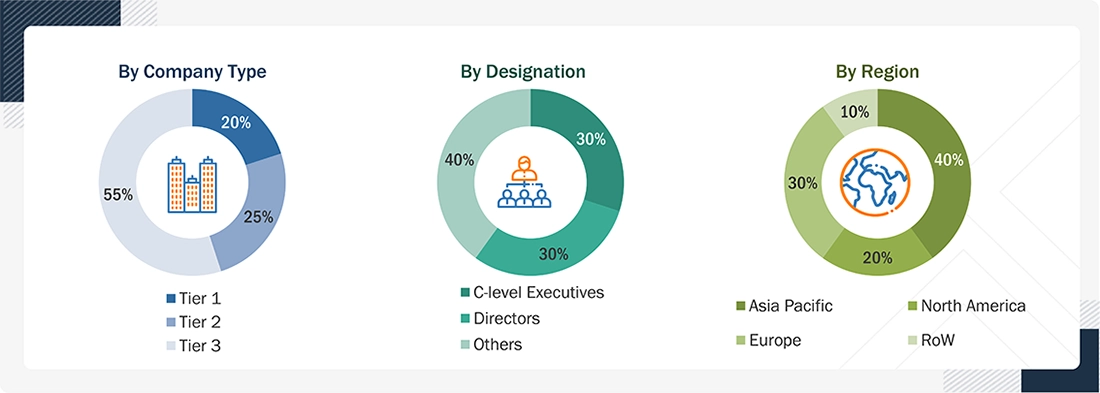
Note: Other designations include technology heads, media analysts, sales managers, marketing managers, and product managers. The three tiers of the companies are based on their total revenues as of 2025 - Tier 1: >USD 1 billion, Tier 2: USD 500 million–1 billion, and Tier 3: <USD 500 million.
To know about the assumptions considered for the study, download the pdf brochure
Market Size Estimation
In the complete market engineering process, top-down and bottom-up approaches and several data triangulation methods were used to estimate and forecast the overall market segments and subsegments listed in this report. Key players in the market were identified through secondary research, and their market shares in the respective regions were determined through primary and secondary research. This entire procedure includes the study of annual and financial reports of the top market players and extensive interviews for key insights (quantitative and qualitative) with industry experts (CEOs, VPs, directors, and marketing executives).
All percentage shares, splits, and breakdowns were determined using secondary sources and verified through primary sources. All the parameters affecting the markets covered in this research study were accounted for, viewed in detail, verified through primary research, and analyzed to obtain the final quantitative and qualitative data. This data was consolidated and supplemented with detailed inputs and analysis from MarketsandMarkets and presented in this report. The following figure represents this study’s overall market size estimation process.
BOTTOM-UP APPROACH
- Identifying the players in the radiation hardened electronics market that influence the global market, along with their offerings
- Analyzing major manufacturers of radiation hardened electronics, studying their portfolios, and understanding several types of products based on their features and functions
- Analyzing trends pertaining to the usage of radiation hardened electronics in end-use industries, such as space, aerospace & defense, nuclear power plants, medical, and others (scientific research and education)
- Tracking ongoing and upcoming developments in the market, such as investments made, R&D activities, product launches, acquisitions, partnerships, agreements, contracts, and expansions, and forecasting the market based on these developments and other critical parameters
- Conducting multiple discussions with key opinion leaders to understand different types of radiation hardened electronic components, manufacturing techniques, product types, applications, and current trends in the market, and analyzing the breakdown of the scope of work carried out by major manufacturing companies
- Arriving at market estimates by analyzing the revenue of these companies generated from different types of components and then combining the same to arrive at the market estimate by region
- Verifying and cross-checking the estimates at every level through discussions with key opinion leaders, such as CXOs, directors, and operations managers, and finally with the domain experts at MarketsandMarkets
- Studying various paid and unpaid sources of information, such as annual reports, press releases, white papers, and databases.
TOP-DOWN APPROACH
- In the top-down approach, the overall market size was used to estimate the size of individual markets (mentioned in the market segmentation) through percentage splits obtained from secondary and primary research.
- For calculating the size of specific market segments, the parent market size was considered when implementing the top-down approach. The bottom-up approach was also implemented for data extracted from secondary research to validate the market size of different segments.
- The market share of each company was estimated to verify the revenue share used in the bottom-up approach earlier. With data triangulation and data validation through primary data, this study determined and confirmed the size of the parent market and each segment.
Radiation Hardened Electronics Market : Top-Down and Bottom-Up Approach
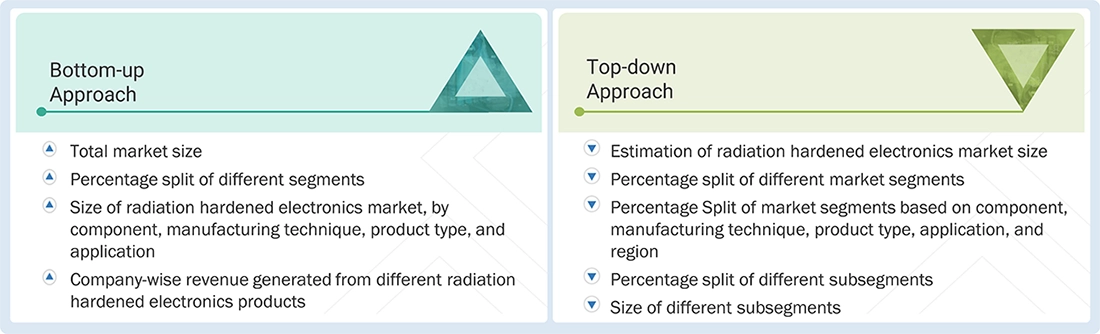
Data Triangulation
After arriving at the overall market size, the market was split into several segments and subsegments using the market size estimation processes explained above. Data triangulation and market breakdown procedures were employed to complete the entire market engineering process and determine each market segment’s and subsegment’s exact statistics. The data was triangulated by studying various factors and trends from the demand and supply sides in the radiation hardened electronics market.
Market Definition
Radiation hardening is the development of electronic components and systems resistant to destruction caused by ionizing radiation (particle radiation and high-energy electromagnetic radiation) occurring in outer space, high-altitude flights, around nuclear reactors, particle accelerators, during nuclear accidents, or nuclear warfare. Most semiconductor electronic components are susceptible to damage by radiation. Radiation hardened components are based on hardened equivalents, with some design and manufacturing variations that reduce their susceptibility to damage by radiation. The ecosystem of the radiation hardened electronics market comprises manufacturers and distributors of radiation hardened components. This market is competitive and diversified, with over 25 companies competing across its value chain to sustain their positions and increase their share. The market is expected to grow significantly in the coming years, owing to the increasing deployment of communication and military satellites in space.
Key Stakeholders
- Associations and Regulatory Authorities
- Government Bodies, Venture Capitalists, and Private Equity Firms
- Original Equipment Manufacturers
- Semiconductor Component Suppliers
- Radiation Hardened Equipment Distributors and Sales Firms
- Software Solution Providers
- Radiation Hardened Electronic Component and System Integrators
- Research Institutes and Organizations
Report Objectives
- To describe and forecast the size of the radiation hardened electronics market, by component, manufacturing technique, product type, and application, in terms of value
- To analyze the material selection and packaging types utilized in the market
- To describe and forecast the market size for various segments in four key regions, namely, North America, Europe, Asia Pacific, and RoW, in terms of value
- To provide detailed information regarding the key drivers, restraints, opportunities, and challenges influencing the growth of the radiation hardened electronics market
- To analyze micromarkets with respect to individual growth trends, prospects, and contribution to the total market
- To analyze the opportunities in the market for various stakeholders by identifying its high-growth segments
- To profile the key players and comprehensively analyze their ranking and core competencies, along with a detailed competitive landscape for market leaders
- To map competitive intelligence based on company profiles, key player strategies, and game-changing developments, such as product launches/developments, partnerships, collaborations, and acquisitions, undertaken in the market
- To understand and analyze the macroeconomic outlook for North America, Europe, Asia Pacific, and RoW regions
- To understand the impact of AI/Gen AI on radiation hardened electronics market
Available customizations:
With the given market data, MarketsandMarkets offers customizations according to the specific requirements of companies. The following customization options are available for the report:
- Detailed analysis and profiling of additional market players based on various blocks of the supply chain
Key Questions Addressed by the Report
What is the current market size of the radiation hardened electronics market?
The market is valued at approximately USD 1.77 billion in 2025 (with ~USD 1.69 billion in 2024).
What is the projected market size by 2030?
The market is expected to reach USD 2.30 billion by 2030.
What is the CAGR of the radiation hardened electronics market?
The market is projected to grow at a CAGR of 5.4% from 2025 to 2030.
What are the key growth drivers of this market?
Growth is driven by increasing satellite launches, ISR (intelligence, surveillance & reconnaissance) activities, and rising investments in defense and space technologies.
Which industries are major users of radiation hardened electronics?
Key industries include space (satellites), aerospace & defense, nuclear power plants, and medical applications.
What are the major market trends?
Trends include adoption of radiation-hardened-by-design (RHBD), increasing use of commercial-off-the-shelf (COTS) components, and development of advanced multicore processors.
Which region dominates the market?
North America holds the largest share, while Asia Pacific is the fastest-growing region due to expanding space programs and defense investments.
Who are the key companies in the market?
Major players include Microchip Technology Inc., BAE Systems, Renesas Electronics Corporation, Infineon Technologies AG, and STMicroelectronics.
What are the key opportunities in the market?
Opportunities include growth in commercial satellite deployment, deep-space exploration, nuclear energy systems, and adoption of cost-effective COTS solutions.
What does the report analysis cover?
The report covers market size, forecasts, segmentation (component, application, product), regional analysis, competitive landscape, and strategic developments across 285 pages and 233 tables.
Fact checked
Personalize This Research
- Triangulate with your Own Data
- Get Data as per your Format and Definition
- Gain a Deeper Dive on a Specific Application, Geography, Customer or Competitor
- Any level of Personalization
Let Us Help You
- What are the Known and Unknown Adjacencies Impacting the Radiation Hardened Electronics Market
- What will your New Revenue Sources be?
- Who will be your Top Customer; what will make them switch?
- Defend your Market Share or Win Competitors
- Get a Scorecard for Target Partners

Custom Market Research Services
We Will Customise The Research For You, In Case The Report Listed Above Does Not Meet With Your Requirements
Get 10% Free CustomisationTESTIMONIALS

Tetsuya Ohhira
Business Development Manager-Technology Business
Nikon Corporation,
Leading Japanese MNC specializing in optics and imaging productswww.nikon.com
MarketsandMarkets™ response
is quick. Their attitude is flexible and positive. Analyst Insights are globally considered and
significant. Client Services quickly respond to our inquiry and demand. Their wide range of global
surveys help us make our strategic plan.
We hope Knowledge Store will be easier to search
for a report.
VP - Marketing & Business Development
Leading Provider of Process Control Solutions
We engaged with MarketsandMarkets on a study to perform an analysis and recommend a Go-To-Market strategy for metrology and process control in the semiconductor market. The study was tailored to our targets and needs with well-defined milestones. Our overall experience with the MarketsandMarkets team was very good throughout the project in all aspects including the analysis methodologies used, the quality and depth of primary and secondary data sets, the professionalism and flexibility of the team and the ability to meet the target schedule and milestones. We want to thank MarketsandMarkets team for a job well done.
Growth opportunities and latent adjacency in Radiation Hardened Electronics Market






Eric
Apr, 2026
Are emerging components such as MRAM and new FPGA/ASIC solutions analyzed for future growth potential?.
Zachary
Apr, 2026
What are the key emerging trends driving future growth (e.g., New Space programs, small satellites, nanosats, AI integration)?.
Sophia
Apr, 2026
Does the report provide ASP trends, pricing evolution, and margin impact for growth forecasting?.