Smart Water Meters Market

Smart Water Meters Market by Technology (Automated Meter Reading [AMR], Automated Metering Infrastructure [AMI]), Meter Type (Ultrasonic Meter, Electromagnetic Meter, Smart Mechanical Meter), Component (Meter & Accessories, IT Solutions, Communications), Application (Water Utilities, Industries), and Region – Global Forecast to 2031




OVERVIEW
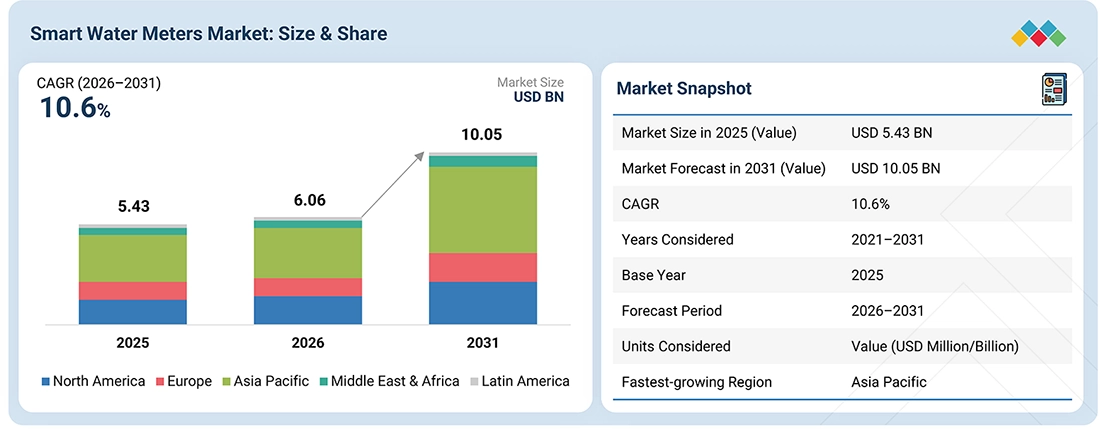
Source: Secondary Research, Interviews with Experts, MarketsandMarkets Analysis
The smart water meters market is projected to grow from USD 6.06 billion in 2026 to USD 10.05 billion by 2031, at a CAGR of 10.6% during the forecast period. The market is being driven by the rising investment in water infrastructure modernization, increasing focus on water conservation and non-revenue water reduction, growing urbanization, and the requirement to improve the efficiency of water distribution systems. Growing use of AMR/AMI systems, IoT-enabled meters, remote monitoring, leak detection, analytics, and digital water management platforms will fuel market growth, as they enable automated meter reading, accurate billing, continuous consumption monitoring, and improved water-loss management.
MARKET SCOPE
| REPORT METRIC | DETAILS |
|---|---|
| Market Size in 2025 (Value) | USD 5.43 BN |
| Market Size in 2026 (Value) | USD 6.06 BN |
| Market Forecast in 2031 (Value) | USD 10.05 BN |
| Growth Rate | CAGR of 10.6% from 2026–2031 |
| Years Considered | 2021–2031 |
| Base Year | 2025 |
| Forecast Period | 2026–2031 |
| Units Considered | Value (USD Million/Billion) |
| Report Coverage | Market size and forecast, company profiling, competitive landscape, market dynamics (drivers, restraints, opportunities, and challenges), technology trends, ecosystem analysis, commercial use cases, and regional analysis |
| Segments Covered |
|
| Regions Covered | North America, South America, Europe, Asia Pacific, Middle East & Africa |
KEY TAKEAWAYS
-
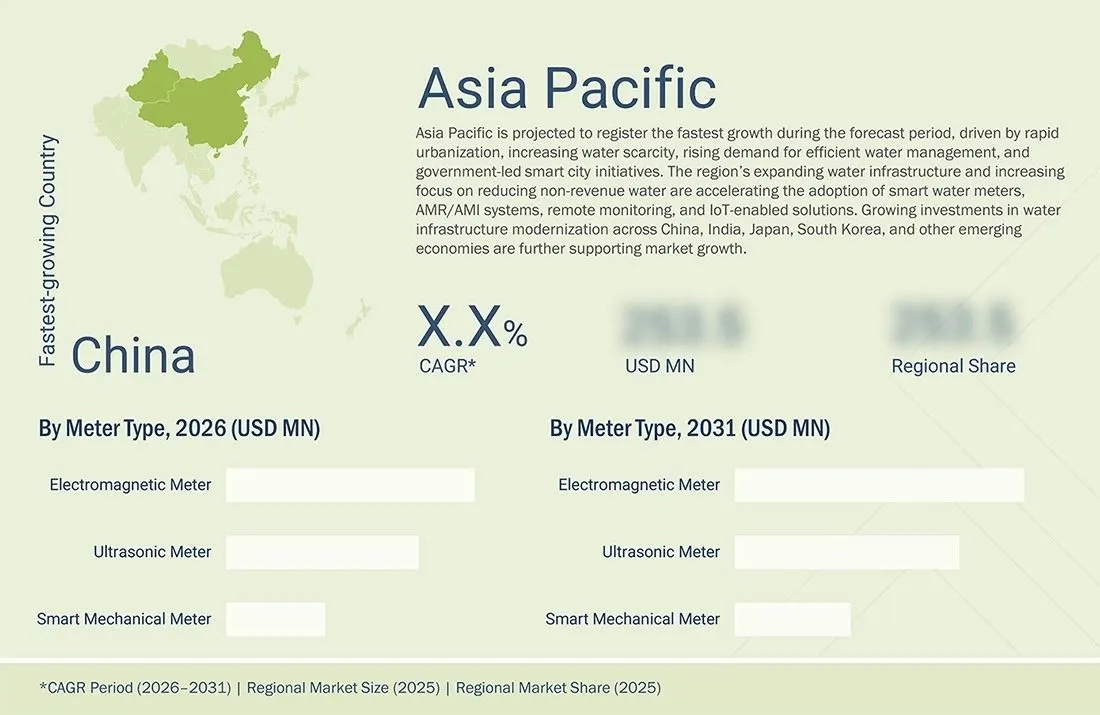
BY REGIONThe Asia Pacific smart water meters market is expected to register the highest CAGR of 11.4% during the forecast period.
-
BY TECHNOLOGYBy technology, the automated meter reading is expected to have the highest CAGR during the forecast period.
-
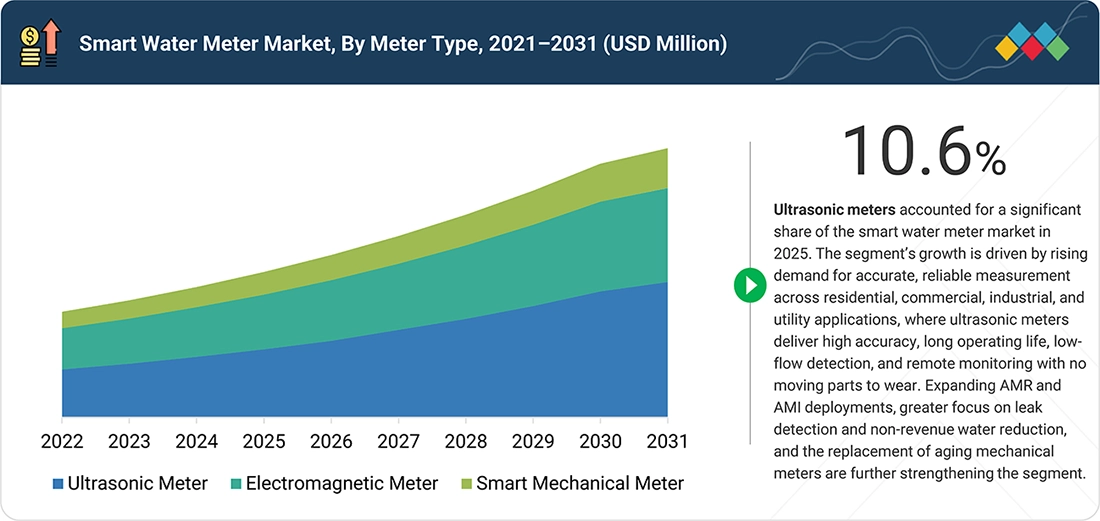
BY METER TYPEBy meter type, Ultrasonic Meter is expected to register the highest CAGR during the forecast period.
-
BY COMPONENTBy component, meter & accessories segment is expected to register the highest CAGR during the forecast period.
-
BY APPLICATIONBy application, Water Utilities segment is expected to register the highest CAGR during the forecast period.
-
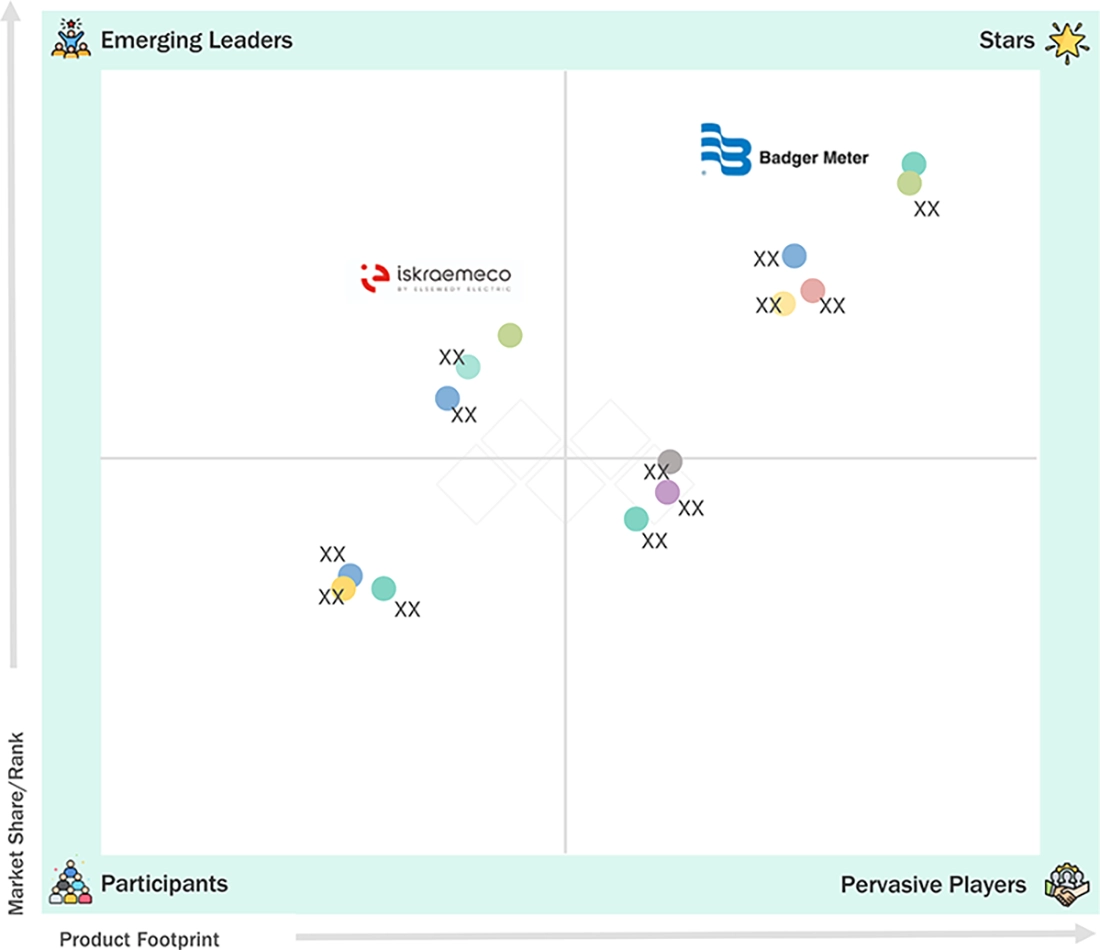
COMPETITIVE LANDSCAPE - KEY PLAYERSBadger Meter Inc, Xylem, and Kamstrup were identified as star players focused on smart water meter market.
-
COMPETITIVE LANDSCAPE - STARTUPS/SMESOlea Edge Analytics and Phyn LLC have distinguished themselves among SMEs and startups due to their strong product portfolio and sound business strategy.
The smart water meter market is projected to grow from USD 6.06 billion in 2026 to USD 10.05 billion by 2031, at a CAGR of 10.6% during the forecast period. The market is being driven by the rising investment in water infrastructure modernization, increasing focus on water conservation and non-revenue water reduction, growing urbanization, and the requirement to improve the efficiency of water distribution systems. Growing use of AMR/AMI systems, IoT-enabled meters, remote monitoring, leak detection, analytics, and digital water management platforms will fuel market growth, as they enable automated meter reading, accurate billing, continuous consumption monitoring, and improved water-loss management.
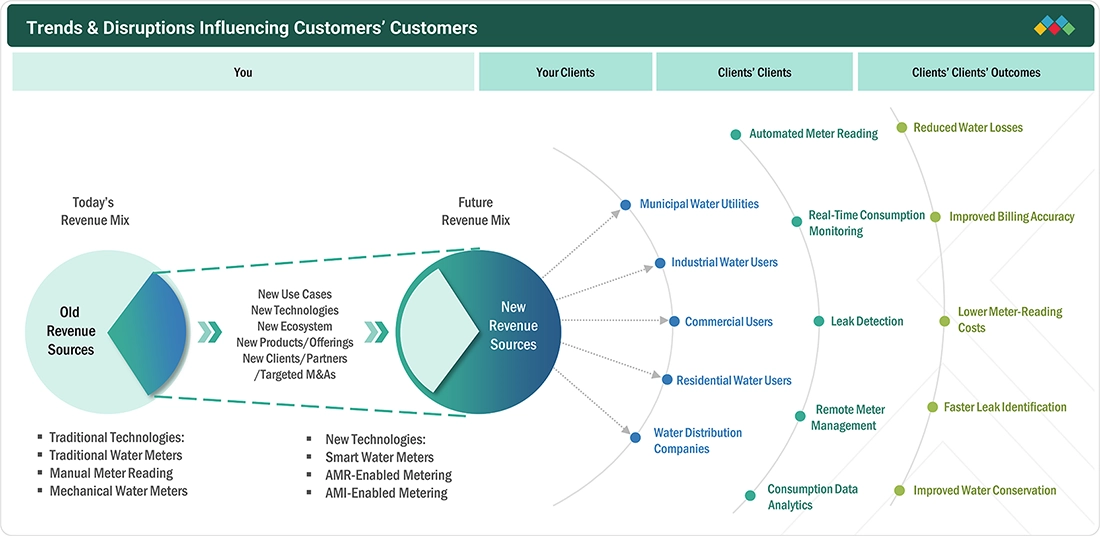
TRENDS & DISRUPTIONS IMPACTING CUSTOMERS' CUSTOMERS
The smart water meter market is projected to grow from USD 6.06 billion in 2026 to USD 10.05 billion by 2031, at a CAGR of 10.6% during the forecast period. The market is expected to grow rapidly during the forecast period due to the increasing emphasis on water conservation, reduction of non-revenue water, aging water infrastructure, and the need to improve the efficiency of water distribution systems. Water utilities and industrial users are increasingly adopting smart metering systems to monitor water consumption, identify leaks, improve billing accuracy, and enable remote meter management. The need to optimize water usage and strengthen distribution network efficiency will further stimulate the adoption of AMR and AMI systems, ultrasonic meters, IoT-enabled monitoring, remote data collection, and water management analytics.
Source: Secondary Research, Interviews with Experts, MarketsandMarkets Analysis
MARKET DYNAMICS

Level
-
Increasing focus on water conservation and reduction of non-revenue water

-
Growing modernization of aging water distribution infrastructure


Level
-
High initial investment and installation costs

-
Complex integration with existing water utility infrastructure


Level
-
Growing adoption of IoT-enabled smart water metering

-
Increasing deployment of AMI and AMR networks


Level
-
Interoperability issues between meters, communication networks, and utility platforms

Source: Secondary Research, Interviews with Experts, MarketsandMarkets Analysis
Driver: Increasing focus on water conservation and reduction of non-revenue water
Smart water meters enable accurate consumption measurement, leak detection, and remote monitoring, helping utilities reduce water losses and improve overall water-use efficiency. Non-revenue water—water that is produced but lost before reaching customers through leaks, theft, or metering inaccuracies—remains one of the largest sources of financial and resource loss for utilities worldwide. By providing continuous, high-resolution consumption data, smart meters allow operators to pinpoint leaks and abnormal usage patterns quickly and act before losses accumulate. Growing regulatory pressure around water conservation and sustainability targets is pushing utilities to adopt these technologies at scale. Together, these factors make water conservation and non-revenue water reduction a primary driver of smart water meter adoption.
Restraint: High initial investment and installation costs
Smart water meter deployment requires investment in meters, communication infrastructure, data management systems, installation, and integration, which can increase upfront costs for utilities. Unlike conventional mechanical meters, smart meters carry additional expenses for network gateways, software platforms, and ongoing data connectivity. For municipal utilities operating under constrained budgets, these initial capital requirements can delay or limit large-scale rollouts. Replacing existing meters across an entire service territory and training staff to manage the new systems add further financial burden. As a result, high initial investment and installation costs remain a significant restraint on market growth, particularly in price-sensitive and developing regions.
Opportunity: Growing adoption of IoT-enabled smart water metering
Integration of IoT connectivity with smart meters enables remote data collection, real-time monitoring, leak detection, and analytics, creating opportunities for wider deployment across utilities and industrial users. As IoT networks and low-power communication technologies such as NB-IoT and LoRaWAN mature, the cost and complexity of connecting large fleets of meters continue to fall. This connectivity supports advanced applications such as predictive maintenance, demand forecasting, and automated billing that extend value well beyond basic meter reading. The expansion of smart city initiatives and digital water management platforms further broadens the addressable market for connected metering solutions. These trends position IoT-enabled smart water metering as a major growth opportunity across both established and emerging markets.
Challenge: Interoperability issues between meters, communication networks, and utility platforms
Utilities often need to integrate smart meters with existing billing, customer information, and asset-management systems, while different communication protocols and legacy systems can increase integration complexity. The absence of universal standards across meter manufacturers, communication networks, and software vendors can lead to compatibility issues and vendor lock-in. Utilities may struggle to combine devices and platforms from multiple suppliers into a single, cohesive system. These challenges can raise implementation costs, lengthen deployment timelines, and complicate long-term system upgrades. Overcoming interoperability barriers between meters, communication networks, and utility platforms therefore remains a key challenge for the market.
SMART WATER METERS MARKET: COMMERCIAL USE CASES ACROSS INDUSTRIES
| COMPANY | USE CASE DESCRIPTION | BENEFITS |
|---|---|---|
 |
Texas Water Utilities deployed Badger Meter’s ORION Cellular endpoints, Recordall meters, and BEACON SaaS platform to modernize water metering across difficult-to-access and rural service areas. The deployment enabled continuous collection of water flow and consumption data through cellular AMI, replacing limitations associated with drive-by meter reading. | The solution provided continuous visibility into water consumption and flow, enabling the utility to identify high-flow conditions and potential leaks remotely. In one rocky, cliffside community, the utility reduced non-revenue water by almost 60%, while also improving operational efficiency and reducing the resources required for field data collection. |
 |
City of Fairmont Utilities, West Virginia, implemented Sensus’s AMI solution to modernize its water metering infrastructure and address non-revenue water. The utility deployed 14,500 Sensus iPERL residential meters, along with commercial meters, FlexNet communication infrastructure, and Sensus software and analytics. The system enabled remote monitoring of water consumption, leaks, inactive accounts, and meter performance across the utility’s service area. | The solution helped the utility achieve more than 99% meter-reading accuracy and save approximately USD 30,000 annually through reduced non-revenue water and improved billing accuracy. The utility also notified nearly 3,000 customers about leaks or continuous water use, helping reduce excess consumption by approximately 25 million gallons per year. |
Logos and trademarks shown above are the property of their respective owners. Their use here is for informational and illustrative purposes only.
MARKET ECOSYSTEM
The smart water meter market operates through a collaborative ecosystem comprising smart water meter manufacturers, meter and component suppliers, communication and IoT providers, software and analytics companies, distributors and system integrators, service providers, water utilities, and end users. Companies such as Itron, Badger Meter, Sensus (Xylem), Diehl Metering, Kamstrup, Landis+Gyr, Neptune Technology Group, Aclara, Arad Group, Zenner, and Honeywell provide smart water meters, AMR/AMI solutions, communication technologies, data management platforms, and integrated water metering solutions. Specialized suppliers support the ecosystem through technologies such as ultrasonic and electromagnetic metering, communication modules, IoT connectivity, leak detection, and smart meter registers, while software and analytics capabilities enable data processing, remote meter reading, consumption monitoring, automated billing, and water-loss management. Distributors, engineering firms, and system integrators support meter installation and integration with existing water infrastructure, while municipal water utilities, industrial facilities, commercial buildings, and other water users drive demand for smart metering solutions across new and existing water distribution networks.
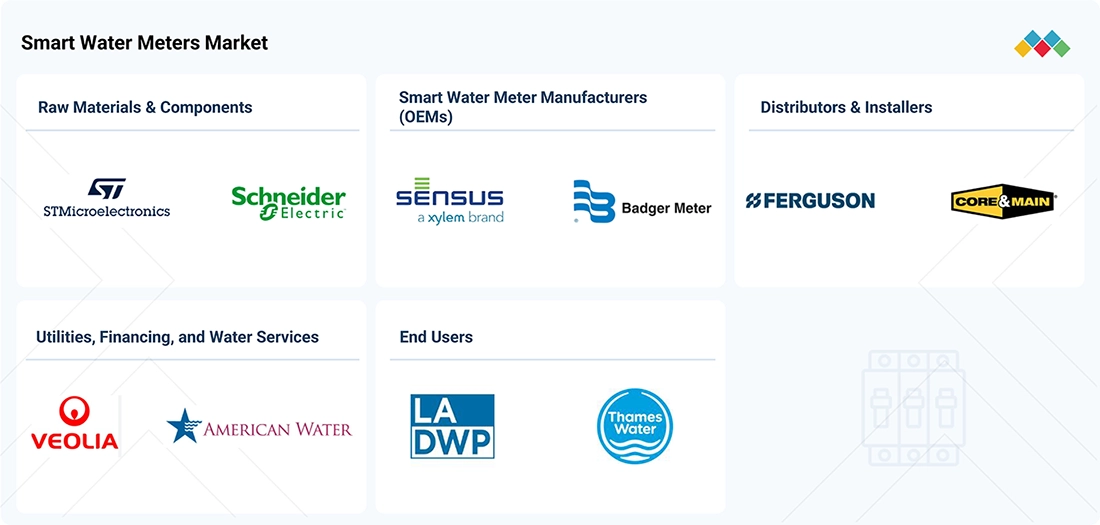
Logos and trademarks shown above are the property of their respective owners. Their use here is for informational and illustrative purposes only.
MARKET SEGMENTS
Source: Secondary Research, Interviews with Experts, MarketsandMarkets Analysis
SMART WATER METERS MARKET, BY TECHNOLOGY
By technology, the automated meter reading (AMR) segment is expected to register the highest CAGR during the forecast period. AMR allows utilities to collect consumption data remotely through drive-by or fixed-network reading, eliminating the need for manual meter checks. Its relatively low cost and ease of retrofitting onto existing meters make it an attractive entry point for utilities beginning their digital transition. This affordability and simplicity are driving rapid adoption, particularly among small and mid-sized utilities and in cost-sensitive regions.
SMART WATER METERS MARKET, BY METER TYPE
By meter type, the ultrasonic meter segment is expected to register the highest CAGR during the forecast period. Ultrasonic meters measure water flow using acoustic waves and have no moving parts, giving them greater accuracy and a longer service life than mechanical meters. Their ability to detect very low flow rates makes them highly effective for leak detection and precise consumption measurement. Declining manufacturing costs and growing utility demand for reliable, maintenance-free devices are accelerating their adoption.
SMART WATER METERS MARKET, BY COMPONENT
By component, the meter & accessories segment is expected to register the highest CAGR during the forecast period. This segment includes the meters themselves along with registers, sensors, valves, and other hardware essential to metering operations. As utilities replace aging mechanical meters and expand their distribution networks, demand for new meters and supporting accessories continues to rise. Large-scale meter replacement programs and new smart-metering deployments are the primary factors driving growth in this segment.
SMART WATER METERS MARKET, BY APPLICATION
By application, the water utilities segment is expected to register the highest CAGR during the forecast period. Water utilities are the largest adopters of smart metering, using it to monitor consumption, detect leaks, improve billing accuracy, and reduce non-revenue water. Mounting regulatory pressure and sustainability targets are pushing utilities to modernize aging infrastructure with connected metering solutions. Government-funded water infrastructure programs and smart city initiatives are further accelerating deployment across this segment.
REGION
Asia Pacific is expected to account for the largest market share during the forecast period
Asia Pacific is projected to register the fastest growth during the forecast period, driven by rapid urbanization, increasing water scarcity, rising demand for efficient water management, and government-led smart city initiatives. The region’s expanding water infrastructure and increasing focus on reducing non-revenue water are accelerating the adoption of smart water meters, AMR/AMI systems, remote monitoring, and IoT-enabled solutions. Growing investments in water infrastructure modernization across China, India, Japan, South Korea, and other emerging economies are further supporting market growth.
SMART WATER METERS MARKET: COMPANY EVALUATION MATRIX
Badger Meter, Inc. is a prominent player in the Smart Water Meter market, offering a comprehensive portfolio of smart water metering and water management solutions for utilities, municipalities, and commercial and industrial customers. The company provides ultrasonic and electromagnetic water meters, ORION AMR and AMI communication solutions, and BEACON software for remote monitoring, data management, and water-use analytics. Its E-Series ultrasonic meters and cellular AMI solutions support accurate measurement, remote data collection, leak identification, and improved water-loss management. Badger Meter is also expanding beyond traditional metering through its BlueEdge suite, strengthening its position in connected water management and broader water-cycle applications.
Source: Secondary Research, Interviews with Experts, MarketsandMarkets Analysis
KEY MARKET PLAYERS
- Badger Meter, Inc. (US)
- Itron, Inc. (US)
- Sensus (Xylem) (US)
- Diehl Metering (Germany)
- Kamstrup (Denmark)
- Landis+Gyr (Switzerland)
- Aclara Technologies (US)
- Neptune Technology Group (US)
- Sagemcom (France)
- Wasion Group (China)
- Arad Group (Israel)
- Zenner International (Germany)
- B METERS (Italy)
- Apator (Poland)
- Iskraemeco (Slovenia)
WHAT IS IN IT FOR YOU: SMART WATER METERS MARKET REPORT CONTENT GUIDE
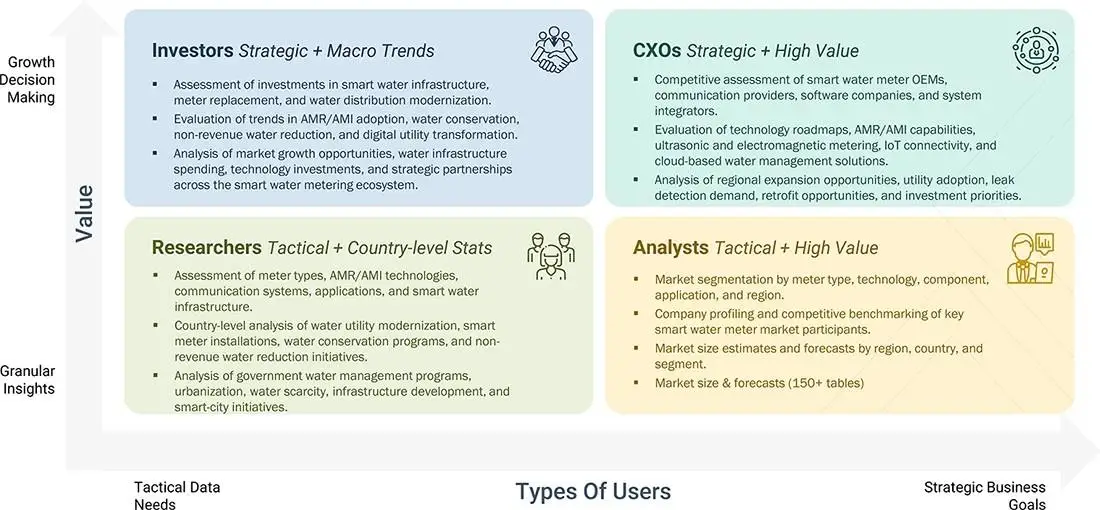
DELIVERED CUSTOMIZATIONS
We have successfully delivered the following deep-dive customizations:
| CLIENT REQUEST | CUSTOMIZATION DELIVERED | VALUE ADDS |
|---|---|---|
| Client requirement for Smart Water Meter report | Market sizing for smart water meter in various countriwes across regions. | Country-wise market attractiveness analysis, competitive landscape overview and installation of smart water meter in high growth economies. |
RECENT DEVELOPMENTS
- January 2025 : Badger Meter acquired SmartCover Systems from XPV Water Partners for USD 185 million. SmartCover provides sensors, software, and related services for real-time monitoring of sewer lines and lift stations. The acquisition expanded Badger Meter’s BlueEdge suite into collection-system monitoring and strengthened its capabilities in real-time water infrastructure monitoring.
- October 2025 : AURELIUS entered into a definitive agreement to acquire Xylem’s water and heat metering assets outside North America. The transaction included Xylem’s international metering business, including products and facilities serving customers primarily in Europe and selected international markets. The business generated approximately USD 250 million in revenue in 2024 and included Sensus International’s smart metering operations. Xylem retained its North American smart metering business.
Table of Contents
 Exclusive indicates content/data unique to MarketsandMarkets and not available with any competitors.
Methodology
The research process for this technical, market-oriented, and commercial study of the smart water meter market involved systematic collection, validation, and analysis of information related to smart water meter technologies. Extensive secondary research was conducted using annual reports, investor presentations, technical papers, regulatory publications, industry databases, company websites, and financial reports to identify key market participants, technology trends, market developments, and competitive strategies. The findings were further validated through primary interviews with executives from smart water meter manufacturers, water utilities providers, distributors, installers, energy companies, and industry experts to assess market estimates, technology adoption, customer requirements, and competitive positioning. Key market players and their market positions were established through a combination of secondary research and primary validation involving senior executives, business development managers, product specialists, and technical experts across the smart water meter ecosystem.
Secondary Research
Several sources were consulted in the secondary research stage to gather the information pertinent to the research. Some of these sources are annual reports, investor presentations, press releases, company websites, technical papers, journals, regulatory publications, official government publications, and credible databases. Publications from various organizations such as the US Environmental Protection Agency (EPA), US Department of Energy (DOE), World Bank, International Water Association (IWA), and United Nations have been referred to for understanding the evolution of smart water metering, water conservation practices, developments in infrastructure, regulations, and technology use. Several aspects of smart water metering, among which are evolution of advanced metering infrastructure, communication technologies, water-loss management, and digital utility systems have been examined. Secondary research was conducted to obtain information about the value chain for smart water meters, major market players in smart water metering, technological advancement, product offerings, market drivers and restraints, application trends, and end-user demand.
Primary Research
During the primary research phase, manufacturers, distributors, installers, building owners, and industry experts were interviewed to obtain qualitative and quantitative insights on the Smart Water Meter Market. Interviews were conducted to validate market estimates, technology adoption, pricing, installation trends, regional demand, competitive positioning, and customer buying criteria. A combination of top-down and bottom-up approaches, supported by data triangulation, was used to estimate and forecast the market across all segments and subsegments. Primary interviews also helped assess adoption drivers and barriers, replacement demand, retrofit requirements, installer availability and emerging technologies. The findings were further validated against company disclosures, government statistics, and industry sources such as the IEA and EHPA to refine market estimates, segment shares, regional forecasts, and competitive assessments.
The following is the breakdown of primary respondents:
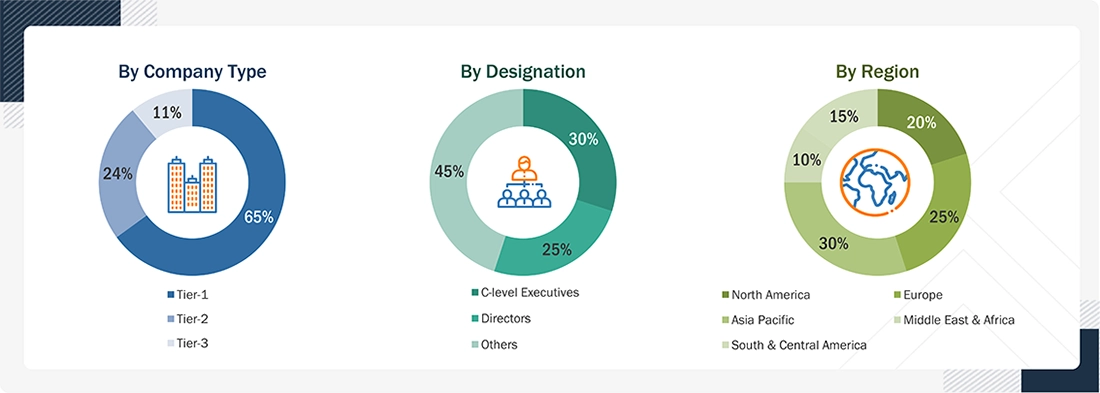
Note: Others include sales managers, engineers, and regional managers.
Tier 1 Company-Revenue > USD 5 billion, Tier 2 Company-Revenue between USD 1 and USD 5 billion, and Tier 3 Company-Revenue < USD 1 billion.
To know about the assumptions considered for the study, download the pdf brochure
Market Size Estimation
Both top-down and bottom-up approaches have been used to estimate and validate the size of the smart water meter market and its dependent submarkets. The key players in the market have been identified through secondary research, and their market shares in the respective regions have been obtained through both primary and secondary research. The research methodology includes the study of the annual and financial reports of the top market players and interviews with industry experts, such as chief executive officers, vice presidents, directors, sales managers, and marketing executives, for key quantitative and qualitative insights related to the smart water meter market.
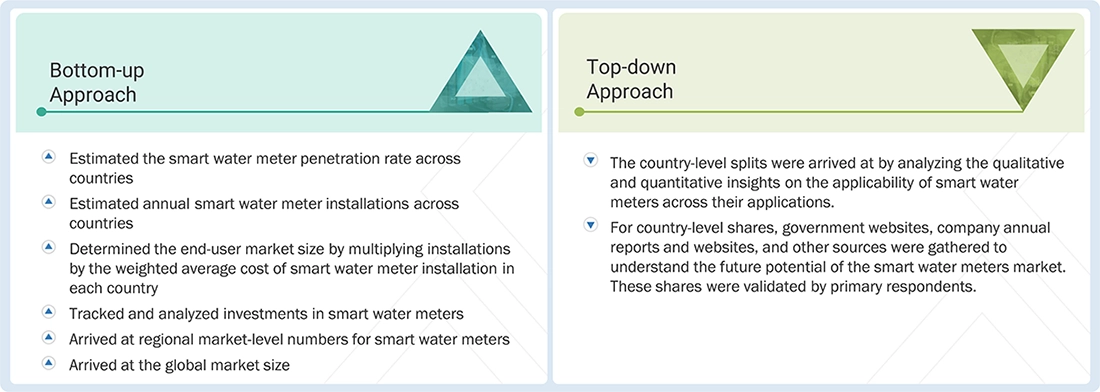
Bottom-up Approach
- Estimating the smart water meter market size across technology, meter type, application, component, and end-user segments by analyzing revenue generated from smart water metering systems and consolidating segment-level estimates to derive the overall market size.
- Mapping leading market participants, including Badger Meter, Inc.; Sensus (Xylem); Diehl Stiftung & Co. KG; Landis+Gyr; Itron, Inc.; Kamstrup; Zenner International; Arad Group; Sagemcom; Wasion Holdings; and other regional and specialized smart water meter manufacturers.
- Collecting segment-wise revenue and product portfolio information from annual reports, investor presentations, company websites, product catalogs, press releases, regulatory filings, and other publicly available disclosures.
- Estimating demand across major smart water meter technologies, including ultrasonic, electromagnetic, and smart mechanical meters, with further assessment of AMR, AMI, IoT connectivity, communication modules, leak detection, and data management solutions based on water utility deployments, infrastructure conditions, metering requirements, and technology adoption trends.
- Estimating market demand across major applications and end users, including Residential, Commercial, Industrial, and Water Utilities applications, while taking into account factors such as water conservation initiatives, non-revenue water reduction, smart-city development, replacement of conventional meters, digitalization of water utilities, deployment of AMI and AMR networks, remote meter reading, automated billing, leak detection, and the emergence of connected water management technologies.
Top-down Approach
- Estimating the overall global smart water meter market by analyzing water consumption, water infrastructure development, urbanization, water conservation initiatives, replacement of conventional meters, and investments in smart water distribution networks.
- Allocating the market across technology (automated meter reading (AMR) and automated metering infrastructure (AMI), meter type (ultrasonic meter, electromagnetic meter, and smart mechanical meter), component (meter & accessories, IT solutions, and communications), and application (water utilities and industries) using regional adoption patterns, smart meter deployment trends, technology penetration, manufacturer portfolios, and industry data.
- Distributing market estimates across North America, Europe, Asia Pacific, South America, and the Middle East & Africa based on regional smart water meter sales, installed base, water infrastructure modernization, government initiatives, water conservation policies, and technology adoption.
- Validating the final market estimates through primary interviews and discussions with smart water meter manufacturers, water utilities, distributors, system integrators, and other channel participants to assess regional sales trends, installation activity, pricing, technology preferences, replacement demand, and deployment patterns, followed by data triangulation to ensure consistency and accuracy.
Global Smart Water Meter Market Size: Bottom-up Approach and Top-down Approach
Data Triangulation
The determination of the size of the overall market comprised the above-described methodology, followed by segmenting the market into several segments and subsegments to conclude the whole market analysis and for obtaining more accurate data regarding the aspects of the market segments and subsegments. When necessary, data triangulation and market segmentation processes were applied in order to conclude the whole market analysis and to get more accurate data regarding all aspects of the market segmentation and sub-segmentation. Data triangulation was carried out on the basis of exploration of various factors from both supply and demand sides of the smart water meter ecosystem, thus including smart water meter sales and installations, technology adoption, revenues and products offered by the manufacturers, government initiatives and policies aimed at water conservation and restoration of constructions, and market developments in the regions.
Market Definition
Smart water meter refers to the devices and technologies used for monitoring, measuring, and managing water use. Smart water metering is made possible through the use of technology-based devices such as ultrasonic meters, electromagnetic meters, smart mechanical meters, automatic meter reading (AMR), automated metering infrastructure (AMI), communication networks, data processing, and remote monitoring. The smart water metering system helps provide real-time measurements of the water consumed, automatic data collection, identification of leakages, remote meter reading, and better billing and utility management. The technological features of smart water monitoring help water utilities cut back on non-revenue water, boost productivity, increase transparency in consumption, and enhance water management.
Key Stakeholders
- Government and research organizations
- Institutional investors and investment banks
- Investors/shareholders
- Environmental research institutes
- Consulting companies in energy & power sector
- Raw materials and component manufacturers
- Manufacturers’ associations
- Manufacturing industry
- Energy efficiency consultancies
- Original equipment manufacturers (OEMs) and system integrators
- Engineering, procurement, and construction (EPC) contractors
- Standardization and testing firms
- Meter data management software providers
- Meter manufacturing companies
- Water-intensive industries
- Water utilities
Report Objectives
- To define, describe, segment, and forecast the smart water meter market, by technology, meter type, component and application in terms of value
- To forecast the market sizes for six major regions, namely North America, Europe, Asia Pacific, South America, the Middle East, and Africa, along with their key countries, in terms of value
- To forecast the smart water meter market by technology and region, in terms of volume
- To provide detailed information regarding key drivers, restraints, opportunities, and challenges influencing the growth of the smart water meter monitoring market
- To provide the supply chain analysis, trends/disruptions impacting customer business, ecosystem analysis, regulatory landscape, patent analysis, case study analysis, technology analysis, key conferences & events, the impact of AI/gen AI, macroeconomic outlook, pricing analysis, porter’s five forces analysis, and regulatory analysis, the impact of 2025 US tariff on the market
- To analyze opportunities for stakeholders in the smart water meter market and draw a competitive landscape of the market
- To benchmark market players using the company evaluation matrix, which analyzes market players on broad categories of business and product strategies adopted by them
- To compare key market players for the market share, product specifications, and applications
- To strategically profile key players and comprehensively analyze their market ranking and core competencies
- To analyze competitive developments, such as contracts, agreements, partnerships, and expansions in the smart water meter market
Available customizations:
With the given market data, MarketsandMarkets offers customizations based on the company’s specific needs. The following customization options are available for the report:
PRODUCT ANALYSIS
- Product Matrix, which provides a detailed comparison of the product portfolio of each company
COMPANY INFORMATION
- Detailed analyses and profiling of additional market players (up to five)
Key Questions Addressed by the Report


Personalize This Research
- Triangulate with your Own Data
- Get Data as per your Format and Definition
- Gain a Deeper Dive on a Specific Application, Geography, Customer or Competitor
- Any level of Personalization
Let Us Help You
- What are the Known and Unknown Adjacencies Impacting the Smart Water Meters Market
- What will your New Revenue Sources be?
- Who will be your Top Customer; what will make them switch?
- Defend your Market Share or Win Competitors
- Get a Scorecard for Target Partners

Custom Market Research Services
We Will Customise The Research For You, In Case The Report Listed Above Does Not Meet With Your Requirements
Get 10% Free CustomisationTESTIMONIALS

Kimberly Murphy
GLOBAL MARKETING DIRECTOR
Bently Nevada,
Leading Condition Monitoring & Asset Protectionwww.bakerhughesds.com/bently-nevada
MarketsandMarkets™ showed consistent rigor for success and relentlessly worked with Bently Nevada stakeholders to positively impact go-to-market strategy. Their proactiveness and flexibility has been instrumental in achieving the objectives to grow our sales pipeline in key industrial markets.

DARRICK HUEBER
Business Development Leader
Nexus Controls LLC,
Leading Manufacturer of Automation System & Electrical Panelswww.bakerhughesds.com/nexus-controls
We partnered with MarketsandMarkets to expand our business further by tapping into new industrial segments. It was critical for us to gather crucial business insights about specific markets to achieve this goal. MarketsandMarkets engagement model and client services helped us provide those insights, it was really impressive and valuable for my business. The team was extremely flexible and helpful.

Mike Schoff
Global Industrial Commercial Strategy Leader
Nexus Controls LLC
Leading Manufacturer of Automation System & Electrical Panelswww.bakerhughesds.com/nexus-controls
We consulted MarketsandMarkets for potential Partner Identification. Overall, it was a good experience. The insights provided through interviews conducted by the team helped us put together the questionnaire required for discussion with the selected partners. Their ability to provide insights through interviews with customers in a timely manner was quite impressive.




Growth opportunities and latent adjacency in Smart Water Meters Market