The study involved major activities in estimating the current size of the artificial lift market. Exhaustive secondary research was done to collect information on the peer and parent markets. The next step was to validate these findings, assumptions, and sizing with industry experts across the value chain through primary research. Both top-down and bottom-up approaches were employed to estimate the total market size. Thereafter, market breakdown and data triangulation were used to estimate the market size of the segments and subsegments.
Secondary Research
This research study on the market involved the use of extensive secondary sources, directories, and databases, such as Hoover’s, Bloomberg, Factiva, IRENA, International Energy Agency, and Statista Industry Journal, to collect and identify information useful for a technical, market-oriented, and commercial study of the market. The other secondary sources included annual reports, press releases & investor presentations of companies, white papers, certified publications, articles by recognized authors, manufacturer associations, trade directories, and databases.
Primary Research
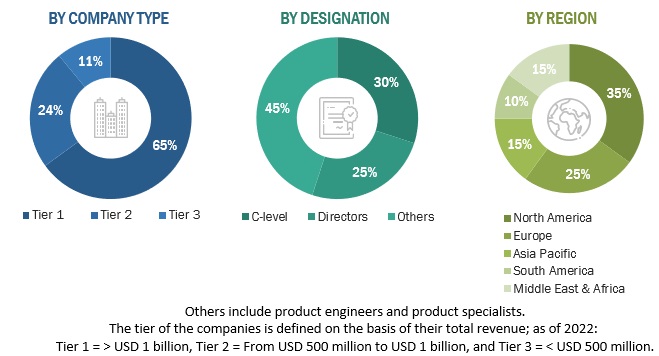
The artificial lift market comprises several stakeholders, such as artificial lift manufacturers, technology providers, and technical support providers in the supply chain. The demand side of this market is characterized by the rising demand for types of artificial lifts such as rod lift systems, electric submersible pumps, progressive cavity pumps, and gas lift systems. The supply side is characterized by rising demand for contracts from the industrial sector and mergers & acquisitions among big players. Various primary sources from both the supply and demand sides of the market were interviewed to obtain qualitative and quantitative information. Following is the breakdown of primary respondents:
To know about the assumptions considered for the study, download the pdf brochure
Market Size Estimation
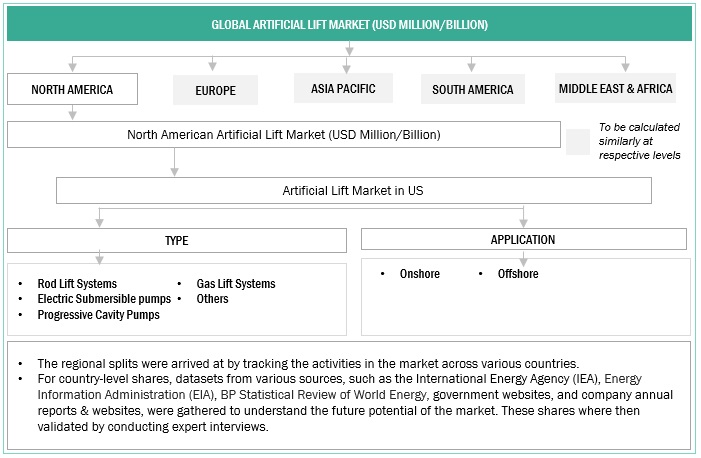
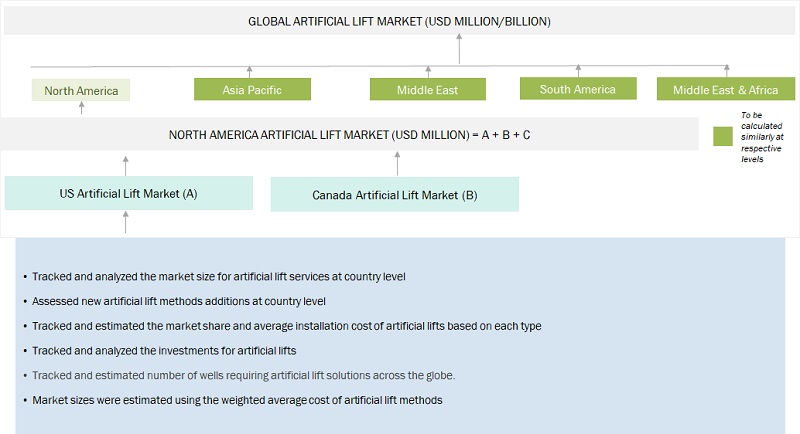
Both top-down and bottom-up approaches were used to estimate and validate the total size of the artificial lift market. These methods were also used extensively to estimate the size of various subsegments in the market. The research methodology used to estimate the market size includes the following:
-
The key players in the industry and market have been identified through extensive secondary research, and their market share has been determined through primary and secondary research.
-
The industry’s value chain and market size, in terms of value, have been determined through both primary and secondary research processes.
-
All percentage shares, splits, and breakdowns have been determined using secondary sources and verified through primary sources.
Artificial Lift Market Size: Top-Down Approach
To know about the assumptions considered for the study, Request for Free Sample Report
Artificial Lift Market Size: Bottom-Up Approach
Data Triangulation
After arriving at the overall market size from the above estimation process, the total market has been split into several segments and subsegments. Data triangulation and market breakdown processes have been employed to complete the overall market engineering process and arrive at the exact statistics for all the segments and sub-segments, wherever applicable. The data has been triangulated by studying various factors and trends from both the demand- and supply sides. Along with this, the market has been validated using both the top-down and bottom-up approaches.
Market Definition
Artificial lift methods are used to increase the pressure within oil & gas reservoirs to increase crude oil production rates from producing wells. These methods are used when the natural drive energy of the reservoir is not strong enough to push the oil to the surface.
The market for artificial lift is defined as the sum of revenues generated by global companies offering artificial lift solutions, such as rod lift systems, gas lift systems, electric submersible pumps (ESPs), and progressive cavity pumps (PCPs). Artificial lifts can be deployed on horizontal and vertical wells for onshore and offshore applications.
Key Stakeholders
-
Artificial Lift Equipment Manufacturers
-
Associations (American Petroleum Institute, Canadian Association of Petroleum Producers, and Others)
-
Drilling Contractors and Production Planning Consultancies
-
Government and Research Organizations
-
Institutional Investors
-
National and Local Government Organizations
-
National Oil Companies (NOCs)
-
Oilfield Service Companies
-
Private E&P Companies
Objectives of the Study
-
To define, describe, segment, and forecast the artificial lift market on the basis of type, mechanism, well type, application, and region, in terms of value
-
To describe and forecast the market for five key regions, namely, North America, Europe, Asia Pacific, South America, and the Middle East & Africa, along with their country-level market sizes, in terms of value
-
To provide detailed information regarding key drivers, restraints, opportunities, and challenges influencing the market’s growth
-
To provide the supply chain analysis, trends/disruptions impacting customers’ businesses, market map, pricing analysis, and regulatory analysis of the market
-
To analyze opportunities for stakeholders and draw a competitive landscape of the market
-
To strategically analyze the ecosystem, tariffs and regulations, patent landscape, trade landscape, Porter’s five forces, and case studies pertaining to the market under study
-
To benchmark market players using the company evaluation matrix, which analyzes market players on broad categories of business and product strategies adopted by them
-
To compare key market players with respect to product specifications and applications
-
To strategically profile key players and comprehensively analyze their market rankings and core competencies
-
To analyze competitive developments, such as contracts & agreements, investments & expansions, mergers & acquisitions, product launches, partnerships, and joint ventures & collaborations, in the market.
Available Customizations:
With the given market data, MarketsandMarkets offers customizations according to the specific requirements of companies. The following customization options are available for the report:
Product Analysis
-
Product Matrix, which provides a detailed comparison of the product portfolio of each company
Company Information
-
Detailed analyses and profiling of additional market players













Growth opportunities and latent adjacency in Artificial Lift Market