US Artificial Intelligence Market | Industry Report, 2032

US Artificial Intelligence (AI) Market by Infrastructure (Compute, Memory, Networking, Storage), Software (Conversational Assistants, No Code/Low Code, BI & Analytics, Developer Platforms), Technology (ML, NLP, Generative AI) - Forecast to 2032




OVERVIEW
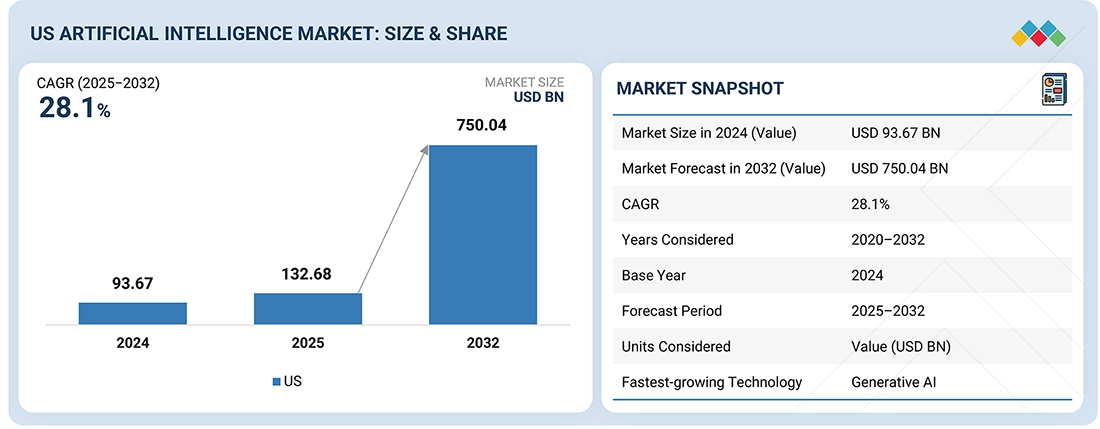
Source: Secondary Research, Interviews with Experts, MarketsandMarkets Analysis
The United States artificial intelligence market was valued at USD 132.68 billion in 2025 and is projected to reach USD 750.04 billion by 2032, registering a CAGR of 28.1%. Market expansion is supported by strong enterprise adoption across sectors such as financial services, healthcare, retail, and technology, where machine learning systems are used to automate processes, analyze large data volumes, and improve operational decision-making. The growing deployment of generative AI applications, language models, and advanced analytics platforms is expanding enterprise use cases, making artificial intelligence a central component of digital transformation strategies in the United States.
KEY TAKEAWAYS
-
By OfferingBy offering, services segment is projected to grow at highest CAGR during forecast period
-
By TechnologyBy technology, the generative AI segment is expected to register the highest CAGR of 40.7% during the forecast period.
-
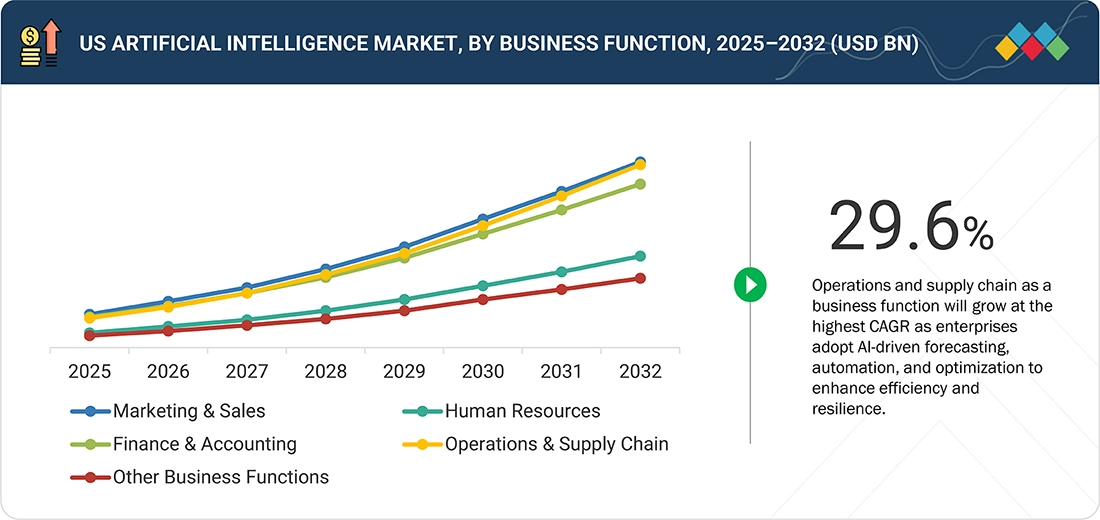
By Business FunctionBy business function, the marketing & sales segment is expected to dominate the market with a share of 27.7% in 2025.
-
By Enterprise ApplicationBy enterprise application, the healthcare & life sciences segment is projected to grow at the fastest rate of 33.4% during the forecast period.
-
Competitive LandscapeGoogle, Microsoft, NVIDIA, Oracle, and AWS were identified as some of the star players in the US AI market, given their strong market share and product footprint.
-
Competitive LandscapeAnthropic, Scale AI, C3.ai, Dialpad, and Appier have distinguished themselves among startups and SMEs by securing strong footholds in the US AI market, underscoring their potential as emerging market leaders.
Federal programs in the United States continue to support artificial intelligence research, workforce development, and national technology competitiveness. These initiatives encourage responsible AI practices, establish standardization frameworks, and promote collaboration between government agencies, universities, and industry participants. At the same time, hyperscalers and major technology companies are expanding the infrastructure required for AI workloads. Investments in high-performance computing systems, specialized AI processors, and cloud-based architectures help support large-scale model training and inference.
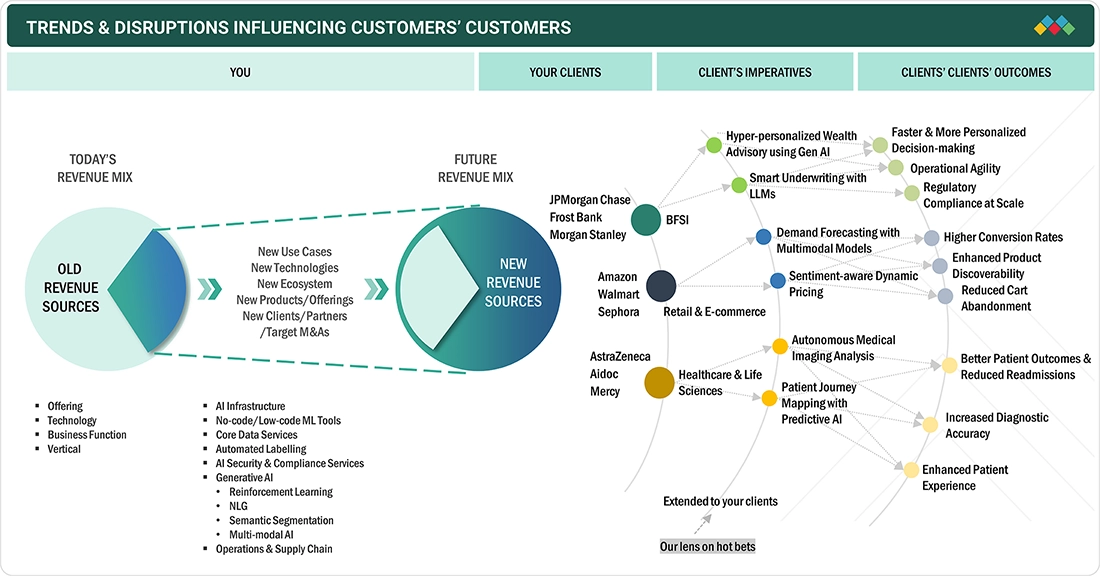
TRENDS & DISRUPTIONS IMPACTING CUSTOMERS' CUSTOMERS
Investment activity continues to support the expansion of AI capabilities in the United States. Government programs fund research initiatives and workforce development related to artificial intelligence. At the same time, large technology companies are expanding computing infrastructure used for AI workloads. This includes high-performance computing environments, specialized processors, and large-scale cloud platforms that support model training and inference.
Source: Secondary Research, Interviews with Experts, MarketsandMarkets Analysis
MARKET DYNAMICS

Level
-
Enterprise-wide acceleration of automation and AI-driven decision intelligence

-
Strong investments in cloud AI infrastructure, advanced computing, and high-performance AI chips by US hyperscalers


Level
-
Data privacy fragmentation across federal and state-level regulations

-
High cost of AI model training, cloud computing, and enterprise-grade integration


Level
-
Increasing enterprise investment in responsible AI, model governance, and compliance aligned with US regulations

-
Increased enterprise spending on generative AI copilots across US knowledge-intensive sectors


Level
-
Scaling governance, model monitoring, and reliability in production AI systems

-
Legacy data architectures and rigid operating models limit scalable AI adoption

Source: Secondary Research, Interviews with Experts, MarketsandMarkets Analysis
Driver: Enterprise-wide acceleration of automation and AI-driven decision intelligence
Artificial intelligence is widely used to automate routine operational tasks. In many companies, machine learning systems assist with fraud detection, supply chain monitoring, financial forecasting, and customer service operations. These tools allow organizations to process information faster and respond more quickly to operational changes.
Restraint: Data privacy fragmentation across federal and state-level regulations
Data privacy regulation remains an important factor influencing AI deployment in the United States. Individual states maintain separate data protection frameworks, which means organizations operating nationwide often deal with multiple compliance obligations. Governance programs, legal oversight, and internal data policies therefore become necessary when deploying AI systems that rely on sensitive information.
Opportunity: Increasing enterprise investment in responsible AI, model governance, and compliance aligned with US regulations
Responsible AI practices have gained attention as machine learning tools influence operational decisions. Companies increasingly evaluate algorithm transparency, fairness, and model explainability. Monitoring systems that track model performance and identify bias are gradually becoming standard components of enterprise AI deployments.
Challenge: Scaling governance, model monitoring, and reliability in production AI systems
Enterprises often face difficulties when moving AI systems from pilot projects into regular operations. Model results can shift as data patterns change, which can lead to issues such as drift or bias. Many organizations still lack mature MLOps practices and real-time monitoring tools. Governance frameworks for AI models are also still evolving. Because of this, companies may encounter operational risks and slower rollout when scaling AI across different business units.
US ARTIFICIAL INTELLIGENCE MARKET: COMMERCIAL USE CASES ACROSS INDUSTRIES
| COMPANY | USE CASE DESCRIPTION | BENEFITS |
|---|---|---|
 |
Mars introduced artificial intelligence into its supply chain operations through a collaboration with Microsoft. Azure Machine Learning was used to run predictive analytics and generate real-time insights for demand forecasting and production planning. | Following the implementation, Mars gained better visibility into demand patterns and supply chain activity. The system helped reduce operational inefficiencies and waste, while also allowing the company to respond more quickly to market changes across its global supply network. |
 |
Perplexity AI collaborated with NVIDIA to improve the performance and efficiency of its large language models. NVIDIA supported the integration of the NeMo framework and optimized the inference stack to enable efficient LLM deployment while managing infrastructure costs. | The collaboration enabled faster inference speeds while lowering compute and energy costs. It also improved model accuracy and scalability, reduced engineering overhead, and streamlined model iteration and deployment workflows. |
 |
Notion worked with OpenAI to add generative AI capabilities to its productivity platform. OpenAI’s large language models power Notion AI's features, including auto-summarization, idea generation, content expansion, and translation. | The integration improved user productivity and creativity by enabling faster content generation and summarization. It also strengthened user engagement and product differentiation through embedded AI functionality within everyday workflows. |
Logos and trademarks shown above are the property of their respective owners. Their use here is for informational and illustrative purposes only.
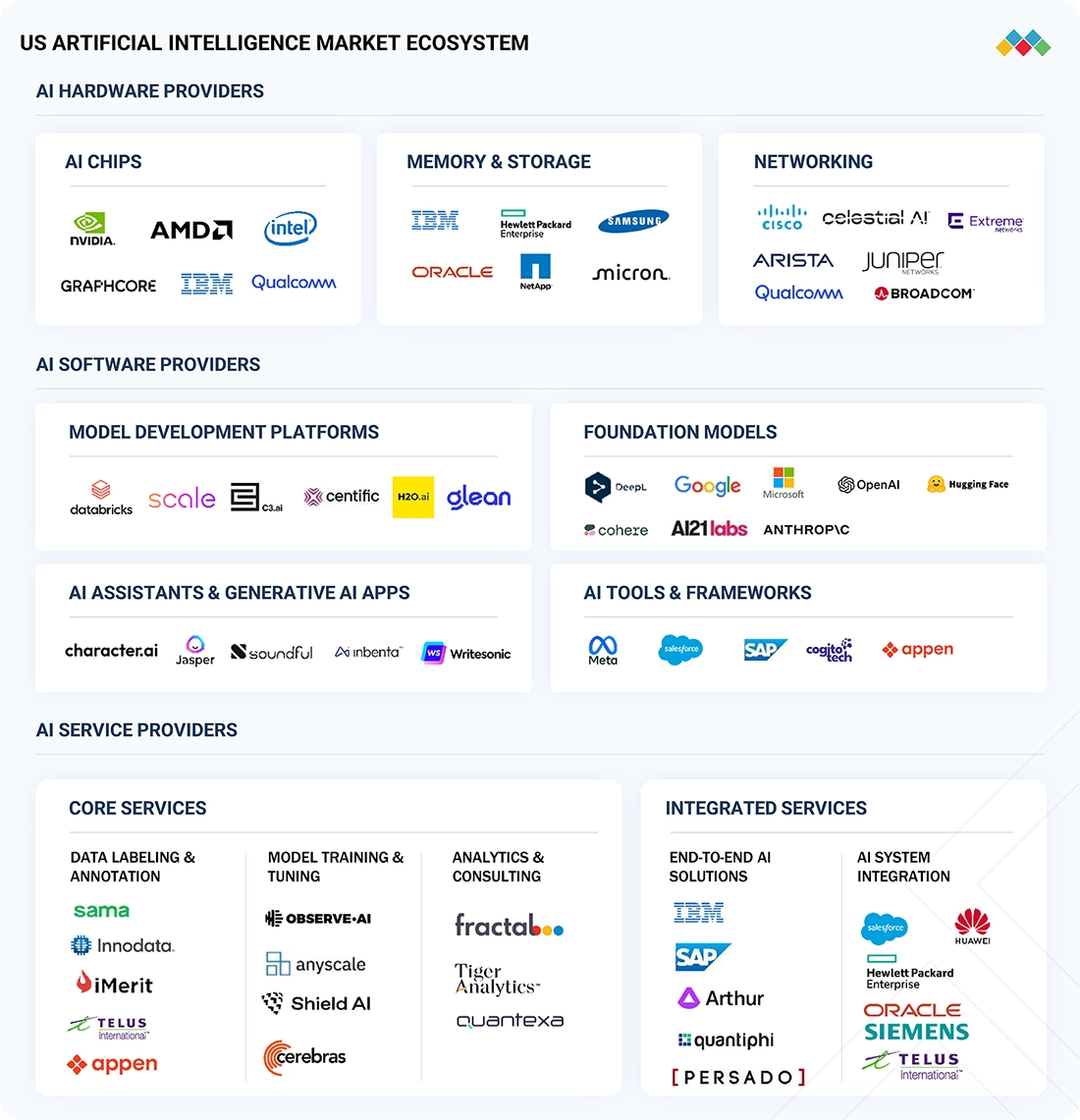
MARKET ECOSYSTEM
The US artificial intelligence ecosystem includes hardware providers, software vendors, and Service providers. Hardware vendors supply processors and computing infrastructure required for AI workloads. Machine learning frameworks, development tools, and data platforms are developed by software providers to support AI applications. Deployment, integration, and data preparation activities are often supported by consulting firms and system integrators.
Logos and trademarks shown above are the property of their respective owners. Their use here is for informational and illustrative purposes only.
MARKET SEGMENTS
Source: Secondary Research, Interviews with Experts, MarketsandMarkets Analysis
US Artificial Intelligence Market, by Offering
Infrastructure represents a significant portion of enterprise spending in the AI market. Training generative AI models and large language systems requires high computing capacity and scalable data environments. Many organizations therefore rely on distributed data platforms, vector databases, and cloud-based machine learning infrastructure.
US Artificial Intelligence Market, by Technology
Generative AI has quickly become one of the fastest expanding segments in the US AI market. Businesses are experimenting with applications such as automated content creation, enterprise assistants, and conversational interfaces. Improvements in large language models continue to expand potential enterprise use cases.
US Artificial Intelligence Market, by Business Function
Marketing and sales teams frequently apply AI tools for customer analysis and campaign optimization. Machine learning models evaluate purchasing behavior and help identify potential customers. These insights support targeted marketing strategies and improved lead conversion.
US Artificial Intelligence Market, by Enterprise Application
Healthcare providers in the United States are increasingly applying artificial intelligence in clinical and research environments. Machine learning models support the analysis of medical images, genomic datasets, and patient records to identify patterns that assist physicians in diagnosis and treatment decisions. AI technologies are also being used in drug discovery programs and in the analysis of clinical trial data to improve research efficiency.
US ARTIFICIAL INTELLIGENCE MARKET: COMPANY EVALUATION MATRIX
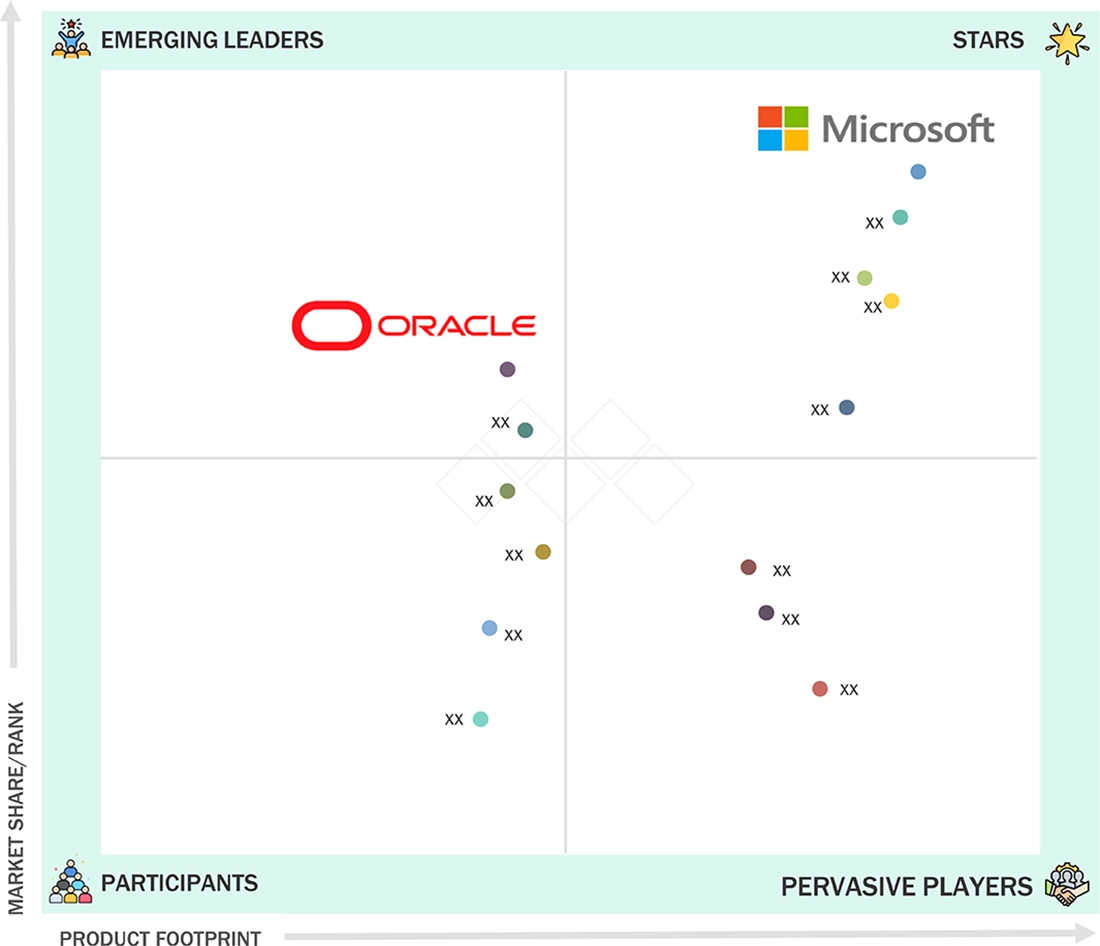
In the US artificial intelligence market competitive landscape, Microsoft appears in the Star category because its Azure platform provides widely used AI development and machine learning tools. Oracle falls in the Emerging Leaders category as the company expands AI capabilities across Oracle Cloud Infrastructure and its enterprise software products.
Source: Secondary Research, Interviews with Experts, MarketsandMarkets Analysis
KEY MARKET PLAYERS
- NVIDIA (US)
- Microsoft (US)
- IBM (US)
- Oracle (US)
- AWS (US)
- Intel (US)
- AMD (US)
- OpenAI (US)
- Google (US)
- H20.ai (US)
- Anthropic (US)
- Scale AI (US)
- Centific (US)
- Innodata (US)
- Cerebras (US)
MARKET SCOPE
| REPORT METRIC | DETAILS |
|---|---|
| Market Size in 2024 (Value) | USD 93.67 Billion |
| Market Size in 2025 (Value) | USD 132.68 Billion |
| Market Forecast in 2032 (Value) | USD 750.04 Billion |
| CAGR | 28.1% |
| Years Considered | 2020–2032 |
| Base Year | 2024 |
| Forecast Period | 2025–2032 |
| Units Considered | USD Billion |
| Report Coverage | Revenue Forecast, Company Ranking, Competitive Landscape, Growth Factors, and Trends |
| Segments Covered |
|
WHAT IS IN IT FOR YOU: US ARTIFICIAL INTELLIGENCE MARKET REPORT CONTENT GUIDE
DELIVERED CUSTOMIZATIONS
We have successfully delivered the following deep-dive customizations:
| CLIENT REQUEST | CUSTOMIZATION DELIVERED | VALUE ADDS |
|---|---|---|
| IT Infrastructure Service Provider |
|
|
| Telecom & Cloud Provider |
|
|
RECENT DEVELOPMENTS
- February 2026 : Microsoft revealed the Maia 200 AI chip, a custom processor designed to handle demanding artificial intelligence tasks in cloud environments. The chip is intended to support large AI models running within Azure infrastructure.
- February 2026 : IBM partnered with Deepgram to integrate advanced speech recognition and voice technologies into the watsonx Orchestrate platform, enabling enterprises to build AI agents capable of real-time voice interaction and transcription
- February 2026 : IBM introduced a new generation of IBM FlashSystem storage powered by agentic AI, designed to automate data management and improve performance for enterprise AI workloads.
- January 2026 : NVIDIA Vera Rubin platform was introduced as a new AI computing architecture aimed at supporting large-scale model training and inference in modern data centers. The system combines advanced GPU, CPU, and networking technologies to improve performance for enterprise AI workloads.
Table of Contents
 Exclusive indicates content/data unique to MarketsandMarkets and not available with any competitors.
Methodology
In the primary research process, a diverse range of stakeholders from both the supply and demand sides of the artificial intelligence ecosystem were interviewed to gather qualitative and quantitative insights specific to this market. From the supply side, key industry experts, such as chief executive officers (CEOs), vice presidents (VPs), marketing directors, technology & innovation directors, and technical leads from vendor companies offering artificial intelligence infrastructure, software & services were consulted. Additionally, system integrators, service providers, and IT service firms that implement and support artificial intelligence were included in the study. On the demand side, input from IT decision-makers, infrastructure managers, and business heads of prominent enterprise end users was collected to understand the user perspectives and adoption challenges within targeted industries.
The primary research ensured that all crucial parameters affecting the US Artificial Intelligence market—from technological advancements and evolving use cases (predictive maintenance, fraud detection, customer service automation, content generation, personalized recommendations, etc.) to regulatory and compliance needs (GDPR, CCPA, Europe AI Act, AIDA, etc.) were considered. Each factor was thoroughly analyzed, verified through primary research, and evaluated to obtain precise quantitative and qualitative data for this market.
Secondary Research
Once the initial phase of market engineering was completed, including detailed calculations for market statistics, segment-specific growth forecasts, and data triangulation, an additional round of primary research was undertaken. This step was crucial for refining and validating critical data points, such as AI offerings (artificial intelligence infrastructure, software & services), industry adoption trends, the competitive landscape, and key market dynamics like demand drivers (growth in adoption of autonomous artificial intelligence, rise of deep learning and machine learning technologies, advancements in computing power and availability of large databases), challenges (lack of transparency and explainability in decision-making process of AI, concerns related to bias and inaccurately generated output, integration challenges and lack of understanding of state-of-the-art systems), and opportunities (advancements in AI-native infrastructure enhancing scalability and performance, expansion of edge AI capabilities for real-time data processing and decision-making, advancements in generative AI to open new avenues for AI-powered content creation).
Primary Research
In the complete market engineering process, the top-down and bottom-up approaches and several data triangulation methods were extensively used to perform the market estimation and market forecast for the overall market segments and subsegments listed in this report. Extensive qualitative and quantitative analysis was performed on the complete market engineering process to record the critical information/insights throughout the report.
Market Size Estimation
To estimate and forecast the US Artificial Intelligence market and its dependent submarkets, both top-down and bottom-up approaches were employed. This multi-layered analysis was further reinforced through data triangulation, incorporating primary and secondary research inputs. The market figures were also validated against the existing MarketsandMarkets repository for accuracy. The following research methodology has been used to estimate the market size:
Data Triangulation
After arriving at the overall market size using the market size estimation processes as explained above, the market was split into several segments and subsegments. To complete the overall market engineering process and arrive at the exact statistics of each market segment and subsegment, data triangulation and market breakup procedures were employed, wherever applicable. The overall market size was then used in the top-down procedure to estimate the size of other individual markets via percentage splits of the market segmentation.
Market Definition
Many theoretical definitions of artificial intelligence center on a machine's capacity to mimic human behavior or carry out tasks that call for intelligence, but given the majority of current applications, artificial intelligence can be described as “systems that employ methods that can gather data and use it to predict, suggest, or make decisions with varying degrees of autonomy and select the best course of action to accomplish particular objectives”. AI systems leverage advanced techniques such as deep learning, reinforcement learning, and probabilistic reasoning to process data, recognize patterns, and make autonomous decisions or provide predictive analytics. These systems are designed to improve over time through iterative training and adaptation, often utilizing large-scale data and high-performance computing infrastructure to optimize performance and accuracy.
Stakeholders
- AI software developers
- AI infrastructure providers
- AI-integrated service providers
- AI training dataset providers
- Core data service providers
- Business analysts
- Cloud service providers
- Consulting service providers
- Enterprise end users
- Distributors and Value-added Resellers (VARs)
- Government agencies
- Independent Software Vendors (ISVs)
- Managed service providers
- Market research and consulting firms
- Support & maintenance service providers
- System Integrators (SIs)/Migration service providers
- Language service providers
- Technology providers
- Academia & research institutions
- Investors & venture capital firms
Report Objectives
- To define, describe, and forecast the US Artificial Intelligence market, by offering, business function, technology, enterprise application, and end user
- To provide detailed information related to major factors (drivers, restraints, opportunities, and industry-specific challenges) influencing the market growth
- To analyze the micro markets with respect to individual growth trends, prospects, and their contribution to the total market
- To analyze the opportunities in the market for stakeholders by identifying the high-growth segments of the US Artificial Intelligence market
- To analyze opportunities in the market and provide details of the competitive landscape for stakeholders and market leaders
- To forecast the market size of segments for five main regions: North America, Europe, Asia Pacific, the Middle East & Africa, and Latin America
- To profile the key players and comprehensively analyze their market ranking and core competencies
- To analyze competitive developments, such as partnerships, product launches, and mergers and acquisitions, in the US Artificial Intelligence market
Available Customizations
With the given market data, MarketsandMarkets offers customizations as per the company’s specific needs. The following customization options are available for the report:
Product Analysis
- Product matrix provides a detailed comparison of the product portfolio of each company
Geographic Analysis as per Feasibility
- Further breakup of the North American market for artificial intelligence
- Further breakup of the European market for artificial intelligence
- Further breakup of the Asia Pacific market for artificial intelligence
- Further breakup of the Middle Eastern & African market for artificial intelligence
- Further breakup of the Latin American market for artificial intelligence
Company Information
- Detailed analysis and profiling of additional market players (up to five)
Key Questions Addressed by the Report
What is the projected size of the US Artificial Intelligence (AI) Market by 2032?
The US Artificial Intelligence (AI) Market is projected to grow from USD 132.68 billion in 2025 to USD 750.04 billion by 2032, registering a CAGR of 28.1% during the forecast period.
What are the key factors driving growth in the US Artificial Intelligence (AI) Market?
Market growth is driven by strong enterprise AI adoption, expanding generative AI applications, increasing investments in cloud-based AI infrastructure, and rising demand for automation and advanced analytics across industries.
Which AI technology segment is expected to grow the fastest in the US Artificial Intelligence (AI) Market?
The Generative AI segment is expected to record the highest growth, with a forecast CAGR of 40.7%, supported by increasing enterprise adoption of AI assistants, large language models, and automated content generation.
Which industry is expected to witness the fastest AI adoption in the US market?
The healthcare & life sciences segment is projected to grow at the fastest rate, fueled by AI applications in medical imaging, clinical decision support, genomics, drug discovery, and clinical research.
Who are the leading companies in the US Artificial Intelligence (AI) Market?
The market features leading technology providers including Google, Microsoft, NVIDIA, Oracle, AWS, IBM, Intel, AMD, OpenAI, H2O.ai, Anthropic, Scale AI, Centific, Innodata, and Cerebras, supported by a rapidly evolving AI ecosystem.


Personalize This Research
- Triangulate with your Own Data
- Get Data as per your Format and Definition
- Gain a Deeper Dive on a Specific Application, Geography, Customer or Competitor
- Any level of Personalization
Let Us Help You
- What are the Known and Unknown Adjacencies Impacting the US Artificial Intelligence (AI) Market
- What will your New Revenue Sources be?
- Who will be your Top Customer; what will make them switch?
- Defend your Market Share or Win Competitors
- Get a Scorecard for Target Partners

Custom Market Research Services
We Will Customise The Research For You, In Case The Report Listed Above Does Not Meet With Your Requirements
Get 10% Free CustomisationTESTIMONIALS






Growth opportunities and latent adjacency in US Artificial Intelligence (AI) Market