



Home Healthcare Market Size, Growth, Share & Trends Analysis
Report Code
MD 1160
Published in
Aug, 2025, By MarketsandMarkets™
Home Healthcare Market by Product (Therapeutic, Testing, Screening, Monitoring, Mobility Care), Service (Nursing, Infusion Therapy, Rehabilitation, Palliative Care), Indication (Cancer, Diabetes, CVD, Respiratory, Wound Care) - Global Forecast to 2030

USD 473.76 Billion
MARKET SIZE, 2030

CAGR 8.9%
(2025-2030)

300
REPORT PAGES

295
MARKET TABLES
OVERVIEW
Source: Secondary Research, Interviews with Experts, MarketsandMarkets Analysis
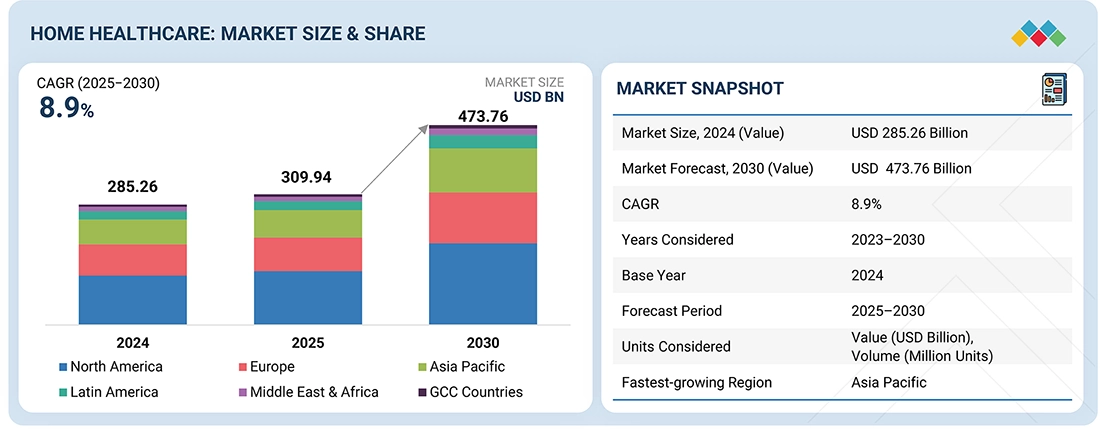
The global home healthcare market is projected to grow from USD 309.94 billion in 2025 to USD 473.76 billion by 2030, registering a strong CAGR of 8.9% during the forecast period. This growth is primarily driven by the expanding elderly population, which is at higher risk for chronic conditions such as hypertension, diabetes, and cardiovascular diseases, thereby increasing the demand for continuous care at home. The widespread adoption of telehealth and remote patient monitoring solutions is enhancing accessibility and convenience, while rising awareness of the importance of early diagnosis and preventive care is further fueling market demand. Moreover, innovations in home healthcare devices are improving ease of use and affordability, supporting greater adoption across both developed and emerging markets.
KEY TAKEAWAYS
-
BY REGIONThe Asia Pacific region is projected to register the highest CAGR during the forecast period. This growth is fueled by a rising prevalence of chronic diseases, an aging population, and increasing healthcare costs, which make home-based care a more practical and cost-effective option.
-
BY PRODUCTThe therapeutic products segment dominates, driven by the rising prevalence of chronic conditions such as kidney disease, sleep disorders, and respiratory illnesses like COPD.
-
BY SERVICESkilled nursing is estimated to account for the largest share, driven by growing demand for professional medical care at home.
-
BY indicationCancer is estimated to account for the largest share, driven by the increasing number of patients needing long-term treatment, palliative care, and symptom management at home.
-
COMPETITIVE LANDSCAPEKey market players have adopted a combination of organic and inorganic strategies, including product launches, partnerships, and acquisitions. Leading companies, such as Fresenius, Abbott, and Linde PLC, have expanded their service offerings and formed strategic collaborations to enhance home healthcare solutions and meet the growing demand for advanced, patient-centric care at home.
The home healthcare market is estimated to experience substantial growth over the coming decade, driven by the increasing elderly population and the rising incidence of chronic diseases. Older adults are particularly vulnerable to conditions such as heart disease, diabetes, arthritis, and respiratory disorders, which often necessitate continuous care and routine monitoring. Moreover, lifestyle changes, poor nutrition, and insufficient physical activity are contributing to a growing prevalence of chronic health issues across all age groups. These factors are fueling demand for personalized, cost-efficient healthcare that can be provided in the comfort of patients’ homes. As a result, home healthcare is becoming a favored solution, delivering convenience, affordability, and an improved quality of life for individuals managing long-term health conditions.
TRENDS & DISRUPTIONS IMPACTING CUSTOMERS' CUSTOMERS
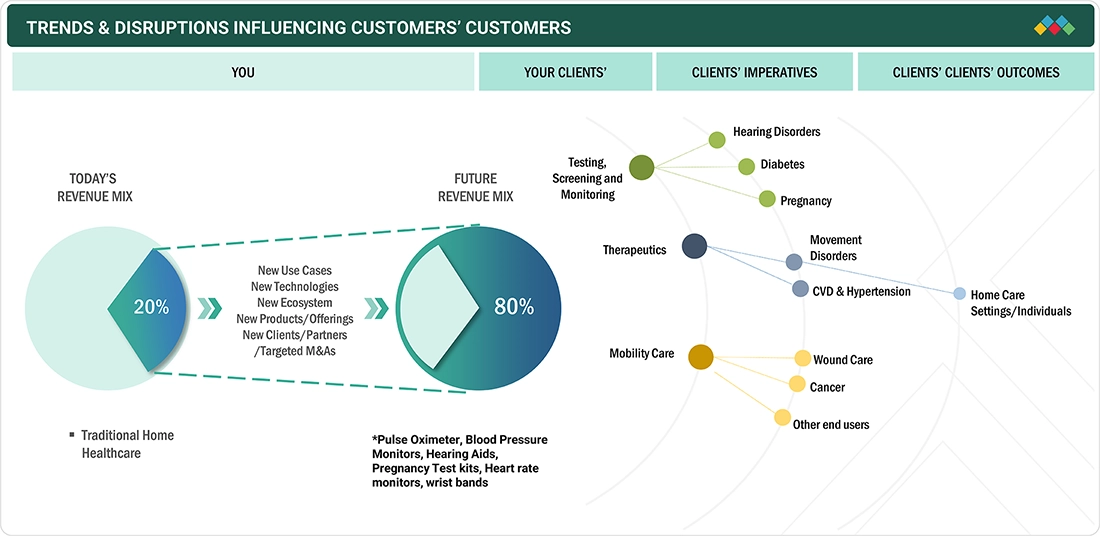
The impact on service providers arises from evolving customer trends and market disruptions. Home healthcare service providers/individuals are the primary clients of home healthcare solution manufacturers. Changes in healthcare delivery models, patient preferences, and technological adoption can directly influence the revenues of both end users and home healthcare product and service providers.
Source: Secondary Research, Interviews with Experts, MarketsandMarkets Analysis
MARKET DYNAMICS

Drivers
Impact
Level
Level
-
Growing elderly population and rising incidence of chronic disease

-
Rapid technological advancements


RESTRAINTS
Impact
Level
Level
-
Changing reimbursement policies

-
Limited insurance Coverage


OPPORTUNITIES
Impact
Level
Level
-
Rising focus on telehealth

-
Growing preference for home-based treatments


CHALLENGES
Impact
Level
Level
-
Shortage of home care workers

-
Lack of supporting infrastructure

Source: Secondary Research, Interviews with Experts, MarketsandMarkets Analysis
Driver: Growing elderly population and rising incidence of chronic disease
The global elderly population, especially those over 85, is set to more than double, driving demand for healthcare services. Home healthcare is increasingly preferred for its ability to reduce hospital visits, lower costs, and provide care at home. Chronic diseases like cardiovascular conditions, cancer, diabetes, and respiratory disorders affect many patients, and home-based care helps manage these illnesses, improve quality of life, and ease the burden on hospitals. Rising geriatric populations and chronic disease prevalence are expected to accelerate global demand for home healthcare and continuous monitoring.
Restraint: Changing reimbursement policies
CMS has revised home healthcare reimbursement through the Patient-Driven Groupings Model, focusing on patient acuity and clinical needs while reducing payment rates, which can impact smaller and rural providers. Value-based programs now emphasize outcomes, social factors, and discharge planning. Durable medical equipment, like home ventilators, is reimbursed on a rental basis, but gaps remain between actual costs and coverage. Reduced reimbursement for diagnostic testing has also slowed technology adoption and delayed accurate diagnoses, creating challenges for patient care.
Opportunity: Rising focus on telehealth
Telehealth is reshaping home healthcare by enabling remote patient monitoring, virtual consultations, and early interventions. Tools like mHealth apps, video consultations, and connected devices allow providers to assess conditions, prescribe treatments, and follow up without in-person visits, improving convenience and reducing costs by shifting care from expensive settings to virtual platforms. Globally, supportive policies and digital infrastructure—such as 5G, high-resolution devices, and electronic health records—are accelerating telehealth adoption, creating new opportunities for providers to enhance care and expand services.
Challenge: Shortage of home care workers
The home healthcare industry is expanding rapidly, driving strong demand for personal care and home health aides. Despite this growth, attracting and retaining workers remains a challenge due to low compensation, making the profession less appealing, especially to younger job seekers. As a result, the supply of qualified home care workers often falls short of demand, posing challenges for providers in delivering consistent, high-quality care.
Home Healthcare Market: COMMERCIAL USE CASES ACROSS INDUSTRIES
| COMPANY | USE CASE DESCRIPTION | BENEFITS |
|---|---|---|
 |
Home dialysis systems (peritoneal dialysis and home hemodialysis) | Improves patient convenience, reduces hospital visits, enhances quality of life, and lowers long-term treatment costs |
 |
Remote cardiac monitoring and glucose monitoring devices for home use | Enables continuous monitoring, supports early detection, empowers self-management of chronic conditions, and improves clinical outcomes |
 |
Home oxygen therapy and respiratory support solutions | Provides reliable long-term respiratory care, increases mobility and independence for patients, and reduces hospital readmissions |
 |
Home-based diagnostic tests (e.g., diabetes and infectious disease self-testing kits) | Facilitates early diagnosis, expands patient access to testing, enhances treatment adherence, and reduces pressure on healthcare facilities |
 |
Home sleep apnea therapy devices, including CPAP and BiPAP systems | Improves sleep quality, reduces cardiovascular risks, enhances patient compliance, and delivers real-time data for remote clinician monitoring |
Logos and trademarks shown above are the property of their respective owners. Their use here is for informational and illustrative purposes only.
MARKET ECOSYSTEM
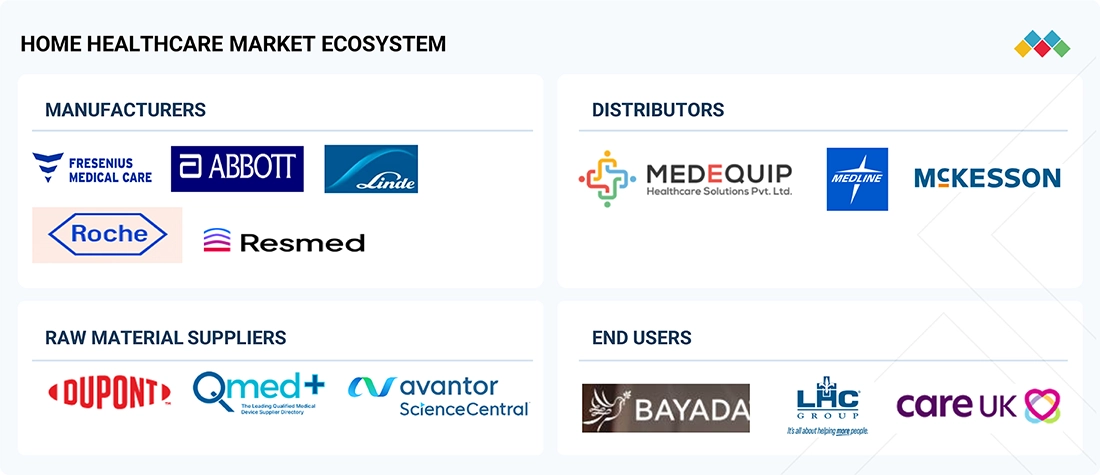
The home healthcare market ecosystem comprises raw material suppliers (DuPont, Qmed, Avantor), device and equipment manufacturers (Fresenius Medical Care AG, Abbott, Linde PLC), and end users (Care UK, LHC Group). Raw materials, including plastics, electronic components, and specialized medical-grade materials, are processed into reliable, high-performance home healthcare devices. End users drive demand for safety, durability, and ease of use, while manufacturers deliver precision-engineered solutions that meet these needs. Collaboration across the value chain is crucial for fostering innovation and driving market growth.
Logos and trademarks shown above are the property of their respective owners. Their use here is for informational and illustrative purposes only.
MARKET SEGMENTS
Source: Secondary Research, Interviews with Experts, MarketsandMarkets Analysis
Home Healthcare Market, by Product
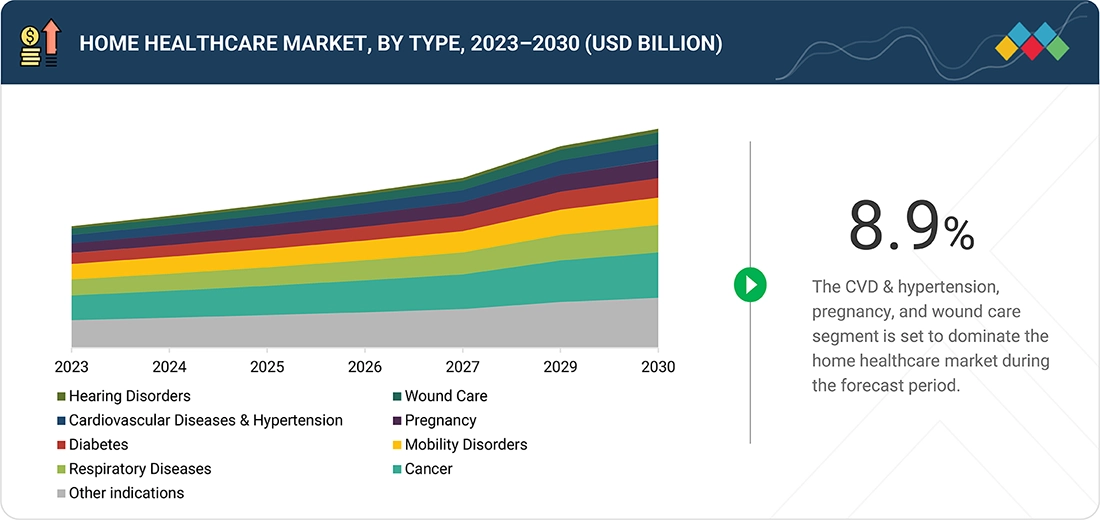
The therapeutic products segment leads, driven by the growing prevalence of chronic diseases like kidney failure, respiratory disorders, cardiovascular conditions, and diabetes. Home-based therapeutic equipment reduces hospital visits, improves patient comfort and compliance, and enhances quality of life. Advances in compact, user-friendly medical devices, along with supportive reimbursement policies, are further boosting adoption, making this segment a key growth driver in the home healthcare market.
Home Healthcare Market, by Service
Skilled nursing services hold the largest share of the home healthcare market, driven by the growing need for professional medical care at home. Licensed nurses provide services such as medication administration, wound care, chronic condition monitoring, and post-surgical support. Rising elderly populations and an increasing number of patients with complex health needs are fueling demand. As healthcare systems emphasize cost-effective, patient-centered care, the shift toward home-based services is accelerating, making skilled nursing a central component of the expanding home healthcare industry.
Home Healthcare Market, by Indication
Among various medical indications, the cancer segment held the largest share of the home healthcare market in 2024, driven by the rising global cancer burden and increasing preference for home-based care. Home oncology services are particularly important for patients in advanced stages or those recovering after treatment. Growing awareness of palliative and supportive care is also encouraging families to opt for at-home services, providing a more personalized and dignified experience for patients.
REGION
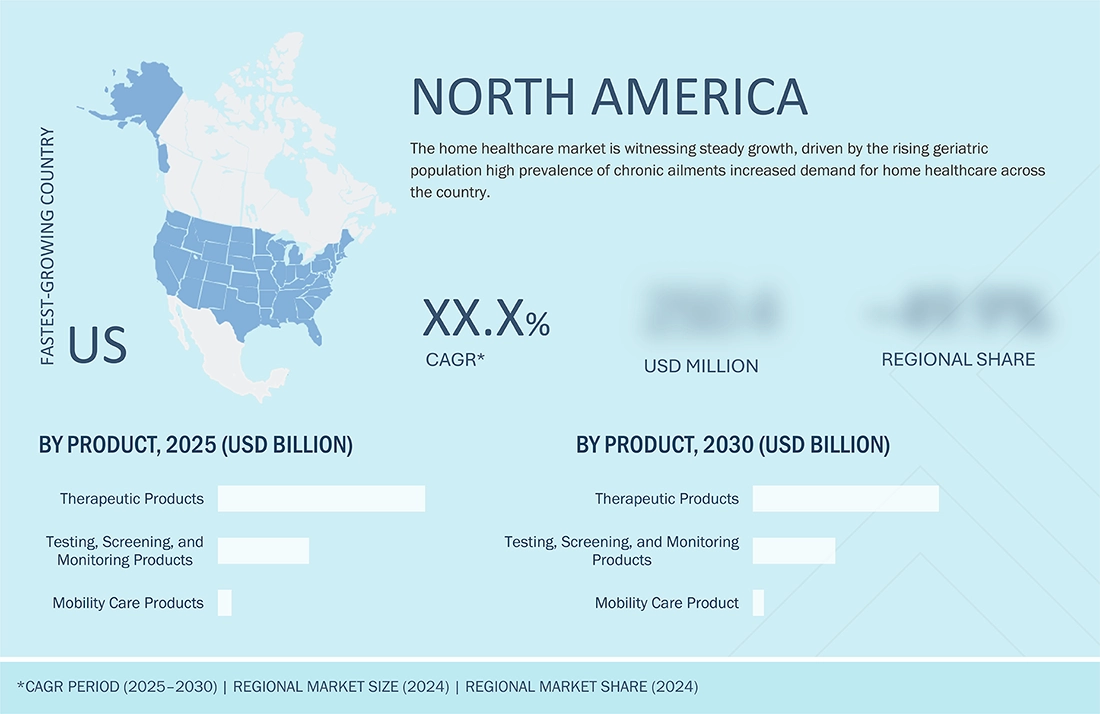
Asia Pacific to be fastest-growing region in global home healthcare market during forecast period
During the forecast period, Asia Pacific is projected to experience the fastest growth in home healthcare, driven by a surge in chronic illnesses, an aging demographic, and escalating healthcare costs, which favor home-based care solutions. Enhanced government initiatives, improved access to rural healthcare, and rising investments in healthcare infrastructure and digital technologies are further boosting the uptake of home healthcare across nations.
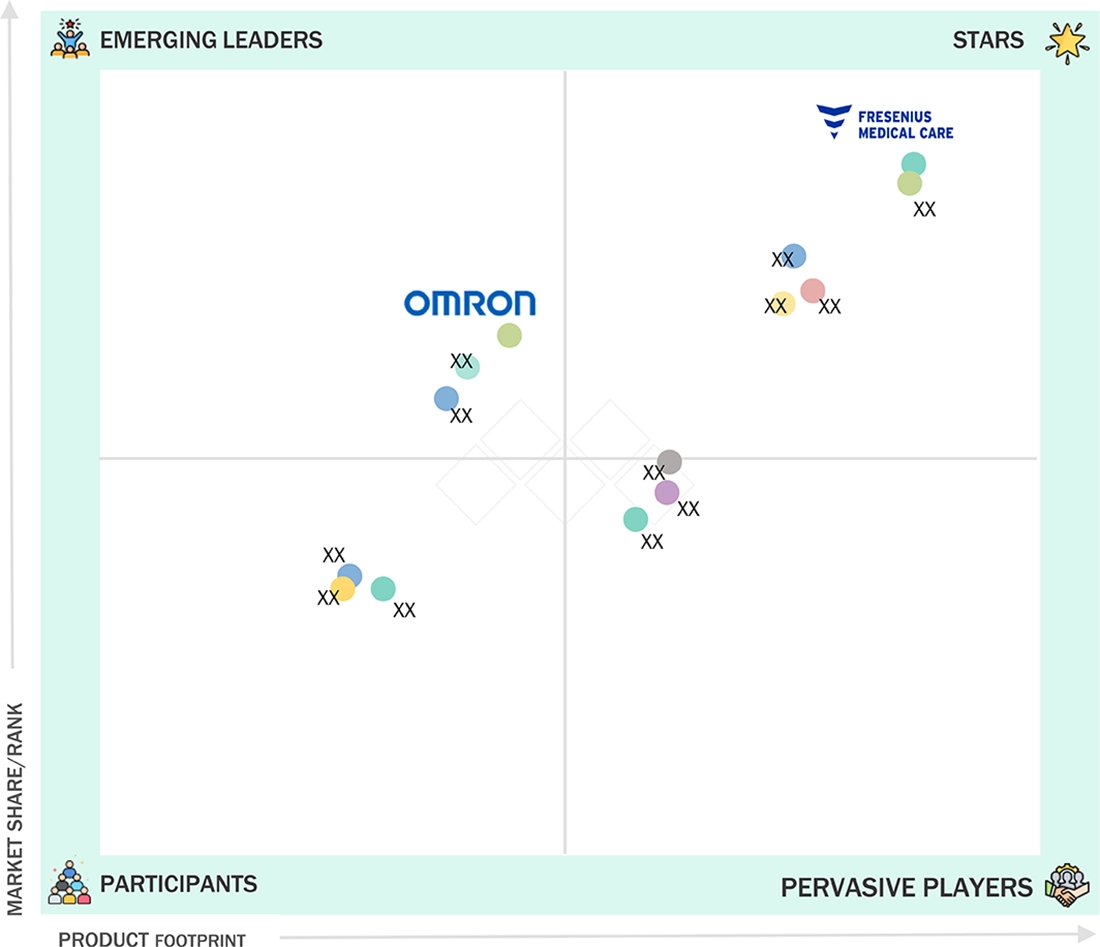
Home Healthcare Market: COMPANY EVALUATION MATRIX
In the home healthcare market matrix, Fresenius Medical Care (Star) leads with a strong market share and a wide-ranging product portfolio, driven by its advanced and reliable home healthcare devices widely adopted in hospitals and home care settings. Omron (Emerging Leader) is gaining recognition with its innovative and specialized home healthcare solutions, strengthening its position through targeted product offerings and technology advancements. While Fresenius dominates through scale and a diverse portfolio, Omron shows significant potential to move toward the leaders’ quadrant as demand for high-quality, user-friendly home healthcare devices continues to grow.
Source: Secondary Research, Interviews with Experts, MarketsandMarkets Analysis
KEY MARKET PLAYERS
- Fresenius Medical Care AG (Germany)
- Abbott (US)
- Linde plc (Ireland)
- F. Hoffmann-La Roche, Ltd. (Switzerland)
- ResMed (US)
- Koninklijke Philips N.V. (Netherlands)
- GE Healthcare (US)
- A&D HOLON Holdings Company, Limited (Japan)
- Convatec Group PLC (UK)
- Amedisys (US)
- OMRON Healthcare Co., Ltd. (Japan)
- Invacare Corporation (US)
- BAYADA Home Health Care (US)
- Drive DeVilbiss Healthcare (UK)
- Sunrise Medical (Germany)
MARKET SCOPE
| REPORT METRIC | DETAILS |
|---|---|
| Market Size, 2024 (Value) | USD 285.26 Billion |
| Market Forecast, 2030 (Value) | USD 473.76 Billion |
| Growth Rate | CAGR of 8.9% from 2025 to 2030 |
| Years Considered | 2023–2030 |
| Base Year | 2024 |
| Forecast Period | 2025–2030 |
| Units Considered | Value (USD Billion), Volume (Million Units) |
| Report Coverage | Revenue Forecast, Company Ranking, Competitive Landscape, Growth Factors, and Trends |
| Segments Covered |
|
| Regional Scope | North America, Europe, Asia Pacific, Latin America, Middle East & Africa, GCC Countries |
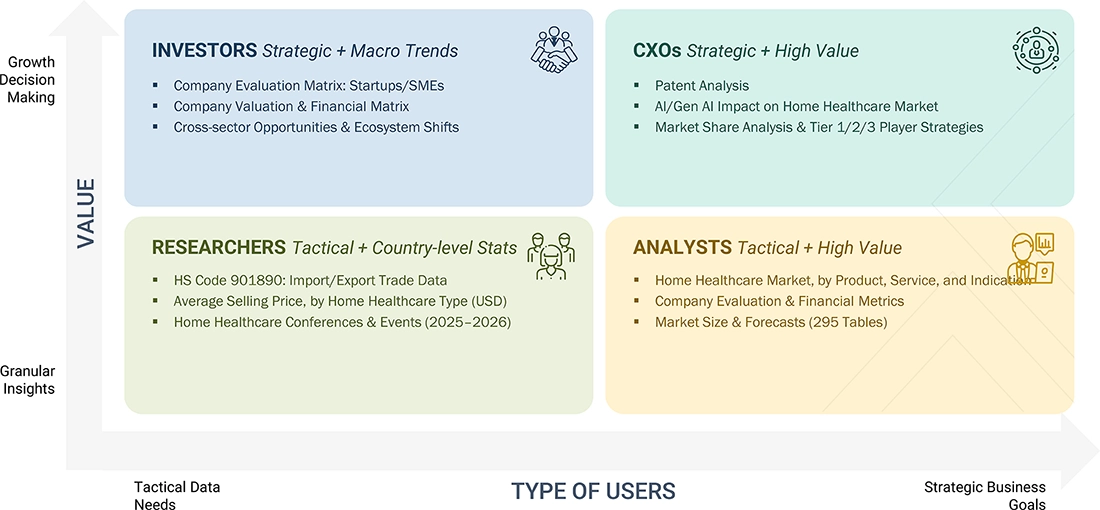
WHAT IS IN IT FOR YOU: Home Healthcare Market REPORT CONTENT GUIDE
DELIVERED CUSTOMIZATIONS
We have successfully delivered the following deep-dive customizations:
| CLIENT REQUEST | CUSTOMIZATION DELIVERED | VALUE ADDS |
|---|---|---|
| Healthcare Leader |
|
|
| Major Player in Home Healthcare |
|
Highlight adoption patterns of home healthcare technologies, end-user preferences, and regulatory impacts on product deployment |
RECENT DEVELOPMENTS
- June 2026: Fresenius Medical Care launched kinexus globally on June 3, 2026, a unified digital platform for home dialysis that integrates remote therapy monitoring and operational workflows. The platform brings together support for peritoneal dialysis and home hemodialysis, enabling healthcare teams to manage both therapies through a single system and support connected, patient-centered care.
- March 2026: Philips published an update on March 31, 2026, describing its transitional-care partnerships that connect hospital care with community and home settings. The initiative focuses on patient monitoring across in-hospital, virtual-care and Hospital-at-Home models, including companion at-home monitoring to support continuity of care and hospital discharge.
- August 2025: Abbott launched the FreeStyle Libre 2 Plus sensor in India on August 21, 2025, expanding its continuous glucose monitoring portfolio for people managing diabetes. The sensor provides automatic glucose readings every minute to a compatible smartphone, without requiring users to scan the sensor, and offers optional high- and low-glucose alarms to support ongoing diabetes monitoring by users and caregivers.
- May 2025: ResMed acquired VirtuOx, an independent diagnostic testing facility, on May 1, 2025, expanding its virtual-care capabilities and access to home-based diagnostic services for sleep, respiratory and cardiac conditions. VirtuOx’s testing platform supports in-home and remote testing, strengthening ResMed’s ability to connect patients, healthcare providers and home medical equipment companies through a more integrated care pathway.
- April 2025: ResMed announced on April 3, 2025, that its NightOwl home sleep apnea test was available across the United States. The FDA-cleared device uses a fingertip sensor to record up to 10 nights of sleep data, which is transmitted remotely to a cloud-based diagnostic platform for physician review. Its digital workflow and integration with ResMed’s myAir app and Somnoware software support home-based obstructive sleep apnea testing and diagnosis.
Table of Contents
 Exclusive indicates content/data unique to MarketsandMarkets and not available with any competitors.
TITLE
PAGE NO
1
INTRODUCTION
28
2
RESEARCH METHODOLOGY
32
3
EXECUTIVE SUMMARY
43
4
PREMIUM INSIGHTS
47
5
MARKET OVERVIEW
Evolving healthcare market driven by tech, aging population, and personalized, cost-effective care demands.
51
5.1
INTRODUCTION
5.2
MARKET DYNAMICS
5.2.1
DRIVERS
5.2.1.1
Growing elderly population and rising incidence of chronic diseases
5.2.1.2
Rapid technological advancements
5.2.1.3
Need for cost-effective healthcare delivery
5.2.1.4
Increased preference for personalized care
5.2.2
RESTRAINTS
5.2.2.1
Changing reimbursement policies
5.2.2.2
Limited insurance coverage
5.2.2.3
Patient safety concerns
5.2.3
OPPORTUNITIES
5.2.3.1
Rising focus on telehealth
5.2.3.2
Growing preference for home-based treatments
5.2.4
CHALLENGES
5.2.4.1
Shortage of home care workers
5.2.4.2
Lack of supporting infrastructure
5.3
TRENDS/DISRUPTIONS IMPACTING CUSTOMER BUSINESS
5.4
PRICING ANALYSIS
5.4.1
AVERAGE SELLING PRICE TREND, BY PRODUCT
5.4.2
AVERAGE SELLING PRICE TREND, BY KEY PLAYER
5.4.3
AVERAGE SELLING PRICE TREND, BY REGION
5.5
VALUE CHAIN ANALYSIS
5.6
SUPPLY CHAIN ANALYSIS
5.7
ECOSYSTEM ANALYSIS
5.8
INVESTMENT AND FUNDING SCENARIO
5.9
TECHNOLOGY ANALYSIS
5.9.1
KEY TECHNOLOGIES
5.9.1.1
Vital sign monitoring devices
5.9.1.2
Wearable devices
5.9.2
COMPLEMENTARY TECHNOLOGIES
5.9.2.1
Health data platforms
5.9.2.2
Medication management system
5.9.3
ADJACENT TECHNOLOGIES
5.9.3.1
Augmented Reality and Virtual Reality (AR/VR)
5.10
PATENT ANALYSIS
5.11
TRADE ANALYSIS
5.11.1
IMPORT DATA (HS CODE 901890)
5.11.2
EXPORT DATA (HS CODE 901890)
5.12
KEY CONFERENCES AND EVENTS, 2025–2026
5.13
REGULATORY LANDSCAPE
5.13.1
REGULATORY ANALYSIS
5.13.1.1
North America
5.13.1.2
Europe
5.13.1.3
Asia Pacific
5.13.2
REGULATORY BODIES, GOVERNMENT AGENCIES, AND OTHER ORGANIZATIONS
5.14
PORTER’S FIVE FORCES ANALYSIS
5.14.1
BARGAINING POWER OF SUPPLIERS
5.14.2
BARGAINING POWER OF BUYERS
5.14.3
THREAT OF NEW ENTRANTS
5.14.4
THREAT OF SUBSTITUTES
5.14.5
INTENSITY OF COMPETITIVE RIVALRY
5.15
KEY STAKEHOLDERS AND BUYING CRITERIA
5.15.1
KEY STAKEHOLDERS IN BUYING PROCESS
5.15.2
BUYING CRITERIA
5.16
IMPACT OF AI ON HOME HEALTHCARE MARKET
5.16.1
INTRODUCTION
5.16.2
MARKET POTENTIAL OF AI IN HOME HEALTHCARE MARKET
5.16.3
AI USE CASES
5.16.4
KEY COMPANIES IMPLEMENTING AI
5.16.5
FUTURE OF AI IN HOME HEALTHCARE MARKET
5.17
ADJACENT MARKETS FOR HOME HEALTHCARE MARKET
5.18
IMPACT OF US TARIFF REGULATION ON HOME HEALTHCARE MARKET
5.18.1
INTRODUCTION
5.18.2
KEY TARIFF RATES
5.18.3
PRICE IMPACT ANALYSIS
5.18.4
KEY IMPACT ON COUNTRY/REGION
5.18.4.1
North America
5.18.4.2
Europe
5.18.4.3
Asia Pacific
5.18.5
IMPACT ON END-USE INDUSTRIES
5.18.5.1
Home healthcare providers
6
HOME HEALTHCARE MARKET, BY PRODUCT
Market Size & Growth Rate Forecast Analysis to 2030 in USD Million and Units | 48 Data Tables
90
6.1
INTRODUCTION
6.2
THERAPEUTIC PRODUCTS
6.2.1
DIALYSIS EQUIPMENT
6.2.1.1
Favorable reimbursement scenario for home dialysis to favor growth
6.2.2
WOUND CARE PRODUCTS
6.2.2.1
Rising geriatric population and subsequent incidence of chronic diseases to amplify growth
6.2.3
IV EQUIPMENT
6.2.3.1
Technological advancements in IV therapy to contribute to growth
6.2.4
SLEEP APNEA THERAPEUTIC DEVICES
6.2.4.1
Increasing patient preference for home-based sleep tests to bolster growth
6.2.5
INSULIN DELIVERY DEVICES
6.2.5.1
High incidence of diabetes to favor growth
6.2.6
OXYGEN DELIVERY SYSTEMS
6.2.6.1
Growing trend of using oxygen therapy for respiratory disorders to propel market
6.2.7
INHALERS
6.2.7.1
High incidence of asthma to stimulate growth
6.2.8
NEBULIZERS
6.2.8.1
Faster relief and longer symptom control to accelerate growth
6.2.9
VENTILATORS
6.2.9.1
Growing use of positive airway pressure devices for sleep apnea therapy to drive market
6.2.10
OTHER THERAPEUTIC PRODUCTS
6.3
TESTING, SCREENING, AND MONITORING PRODUCTS
6.3.1
BLOOD GLUCOSE MONITORS
6.3.1.1
Increasing preference for self-diagnosis to contribute to growth
6.3.2
HEARING AIDS
6.3.2.1
High incidence of hearing impairment to augment growth
6.3.3
ACTIVITY MONITORS & WRISTBANDS
6.3.3.1
Increasing awareness about health and fitness to sustain growth
6.3.4
ECG/EKG DEVICES
6.3.4.1
High prevalence of cardiovascular diseases to support growth
6.3.5
TEMPERATURE MONITORING DEVICES
6.3.5.1
Rising use of digital thermometers for quick and accurate results to aid growth
6.3.6
HEART RATE MONITORS
6.3.6.1
Need for real-time monitoring to advance growth
6.3.7
PULSE OXIMETERS
6.3.7.1
Rising disease incidence and wide usage of pulse oximetry to promote growth
6.3.8
OVULATION & PREGNANCY TEST KITS
6.3.8.1
Privacy, convenience, accessibility, and quick results to facilitate growth
6.3.9
BLOOD PRESSURE MONITORS
6.3.9.1
Growing integration of pressure monitoring devices with digital health platforms to boost market
6.3.10
HIV TEST KITS
6.3.10.1
Increasing number of HIV-infected individuals globally to favor growth
6.3.11
FETAL MONITORING DEVICES
6.3.11.1
Increasing reliance on remote-based care to promote growth
6.3.12
HOLTER & EVENT MONITORS
6.3.12.1
Portability and storage attributes to aid growth
6.3.13
DRUG & ALCOHOL TEST KITS
6.3.13.1
Rise in drug abuse and alcohol consumption to support growth
6.3.14
COAGULATION MONITORING PRODUCTS
6.3.14.1
Rising incidence of deep vein thrombosis, pulmonary embolism, and hemophilia to foster growth
6.3.15
PEAK FLOW METERS
6.3.15.1
High portability and cost-efficiency to increase adoption
6.3.16
COLON CANCER TEST KITS
6.3.16.1
High incidence of colorectal cancer to drive market
6.3.17
EEG DEVICES
6.3.17.1
Wide patient population for epilepsy to fuel market
6.3.18
HOME SLEEP TESTING DEVICES
6.3.18.1
Need for specialized care at home to spur growth
6.3.19
CHOLESTEROL TESTING PRODUCTS
6.3.19.1
Rising obesity levels and cardiovascular incidence to augment growth
6.3.20
HOME HBA1C TEST KITS
6.3.20.1
Increasing recommendations for regular testing and favorable clinical outcomes to aid growth
6.4
MOBILITY CARE PRODUCTS
6.4.1
WHEELCHAIRS
6.4.1.1
Need for patient mobility with less pain and fatigue to fuel market
6.4.2
MOBILITY SCOOTERS
6.4.2.1
Increasing demand for mobility-assisted devices to facilitate growth
6.4.3
WALKERS & ROLLATORS
6.4.3.1
Rising prevalence for gait disorders, osteoarthritis, and other degenerative joint diseases to aid growth
6.4.4
CRUTCHES
6.4.4.1
Increasing use of crutches during post-operative recovery to boost market
6.4.5
CANES
6.4.5.1
Low cost, ease of use, and wide availability to contribute to growth
7
HOME HEALTHCARE MARKET, BY SERVICE
Market Size & Growth Rate Forecast Analysis to 2030 in USD Million | 9 Data Tables
135
7.1
INTRODUCTION
7.2
SKILLED NURSING SERVICES
7.2.1
NEED FOR SPECIFIC PLAN OF CARE TO PROMOTE GROWTH
7.3
REHABILITATION THERAPY SERVICES
7.3.1
RISING DEMAND FOR IN-HOME CARE PERSONNEL TO STIMULATE GROWTH
7.4
HOSPICE & PALLIATIVE CARE SERVICES
7.4.1
INCREASING GERIATRIC POPULATION TO FACILITATE GROWTH
7.5
UNSKILLED CARE SERVICES
7.5.1
HIGHER AFFORDABILITY THAN HOSPITAL OR NURSING HOME SERVICES TO AID GROWTH
7.6
RESPIRATORY THERAPY SERVICES
7.6.1
GROWING PREVALENCE OF RESPIRATORY DISORDERS TO DRIVE MARKET
7.7
INFUSION THERAPY SERVICES
7.7.1
SAFE AND EFFECTIVE ALTERNATIVE TO INPATIENT CARE TO ENCOURAGE GROWTH
7.8
PREGNANCY CARE SERVICES
7.8.1
NEED FOR BETTER MANAGEMENT OF HIGH-RISK PREGNANCIES AND COMPLICATIONS TO ENSURE GROWTH
8
HOME HEALTHCARE MARKET, BY INDICATION
Market Size & Growth Rate Forecast Analysis to 2030 in USD Million | 12 Data Tables
146
8.1
INTRODUCTION
8.2
CANCER
8.2.1
INCREASING PREFERENCE FOR AT-HOME TREATMENT TO EXPEDITE GROWTH
8.3
RESPIRATORY DISEASES
8.3.1
RISING INCIDENCE OF CHRONIC DISEASES TO SUSTAIN GROWTH
8.4
MOBILITY DISORDERS
8.4.1
GROWING GERIATRIC POPULATION TO BOOST MARKET
8.5
PREGNANCY
8.5.1
RISING FOCUS ON BETTER CARE AND MONITORING DURING PREGNANCY TO AID GROWTH
8.6
CARDIOVASCULAR DISEASES & HYPERTENSION
8.6.1
GROWING HEALTH AWARENESS TO DRIVE MARKET
8.7
WOUND CARE
8.7.1
INCREASING NUMBER OF ROAD ACCIDENTS AND TRAUMA INJURIES TO BOLSTER GROWTH
8.8
DIABETES
8.8.1
SHIFT IN CONSUMER PREFERENCE FROM TRADITIONAL TO MULTIFUNCTIONAL BLOOD GLUCOSE METERS TO SPUR GROWTH
8.9
HEARING DISORDERS
8.9.1
WORLDWIDE INCREASE IN HEARING DISABILITIES TO FOSTER GROWTH
8.10
OTHER INDICATIONS
9
HOME HEALTHCARE MARKET, BY REGION
Market Size & Growth Rate Forecast Analysis to 2030 in USD Million | 136 Data Tables
158
9.1
INTRODUCTION
9.2
NORTH AMERICA
9.2.1
MACROECONOMIC OUTLOOK FOR NORTH AMERICA
9.2.2
US
9.2.2.1
Significant demographic change to contribute to growth
9.2.3
CANADA
9.2.3.1
Growing elderly population to drive market
9.3
EUROPE
9.3.1
MACROECONOMIC OUTLOOK FOR EUROPE
9.3.2
GERMANY
9.3.2.1
Increasing demand for healthcare services to bolster growth
9.3.3
UK
9.3.3.1
Aging population and rising patient pool to expedite growth
9.3.4
FRANCE
9.3.4.1
Favorable government support to boost market
9.3.5
ITALY
9.3.5.1
Universal eligibility for home care to favor growth
9.3.6
SPAIN
9.3.6.1
Upsurge in elderly population to accelerate growth
9.3.7
REST OF EUROPE
9.4
ASIA PACIFIC
9.4.1
MACROECONOMIC OUTLOOK FOR ASIA PACIFIC
9.4.2
JAPAN
9.4.2.1
High life expectancy and growing healthcare innovations to fuel market
9.4.3
CHINA
9.4.3.1
Increasing cases of diabetes and diabetic foot ulcers to favor growth
9.4.4
INDIA
9.4.4.1
Rising disposable income and focus on personalized care to spur growth
9.4.5
REST OF ASIA PACIFIC
9.5
LATIN AMERICA
9.5.1
RISING HEALTHCARE NEEDS TO AID GROWTH
9.5.2
MACROECONOMIC OUTLOOK FOR LATIN AMERICA
9.6
MIDDLE EAST & AFRICA
9.6.1
GROWING INVESTMENTS IN HEALTHCARE INFRASTRUCTURE TO PROPEL MARKET
9.6.2
MACROECONOMIC OUTLOOK FOR MIDDLE EAST & AFRICA
9.7
GCC COUNTRIES
9.7.1
DIGITAL TRANSFORMATION AND EXPANDING PUBLIC-PRIVATE PARTNERSHIPS TO FUEL MARKET
9.7.2
MACROECONOMIC OUTLOOK FOR GCC COUNTRIES
10
COMPETITIVE LANDSCAPE
Discover strategic maneuvers and market dominance tactics shaping the competitive landscape in 2024.
258
10.1
OVERVIEW
10.2
KEY PLAYER STRATEGIES/RIGHT TO WIN
10.2.1
OVERVIEW OF STRATEGIES ADOPTED BY KEY PLAYERS
10.3
REVENUE ANALYSIS, 2022–2024
10.4
MARKET SHARE ANALYSIS, 2024
10.5
COMPANY VALUATION AND FINANCIAL METRICS
10.6
BRAND/PRODUCT COMPARISON
10.7
COMPANY EVALUATION MATRIX: KEY PLAYERS, 2024
10.7.1
STARS
10.7.2
EMERGING LEADERS
10.7.3
PERVASIVE PLAYERS
10.7.4
PARTICIPANTS
10.7.5
COMPANY FOOTPRINT: KEY PLAYERS, 2024
10.7.5.1
Company footprint
10.7.5.2
Region footprint
10.7.5.3
Product & service footprint
10.7.5.4
Product footprint
10.7.5.5
End-user footprint
10.8
COMPANY EVALUATION MATRIX: STARTUPS/SMES, 2024
10.8.1
PROGRESSIVE COMPANIES
10.8.2
RESPONSIVE COMPANIES
10.8.3
DYNAMIC COMPANIES
10.8.4
STARTING BLOCKS
10.8.5
COMPETITIVE BENCHMARKING: STARTUPS/SMES, 2024
10.8.5.1
Detailed list of key startups/SMEs
10.8.5.2
Competitive benchmarking of key startups/SMEs
10.9
COMPETITIVE SCENARIO
10.9.1
PRODUCT LAUNCHES AND APPROVALS
10.9.2
DEALS
10.9.3
EXPANSIONS
11
COMPANY PROFILES
In-depth Company Profiles of Leading Market Players with detailed Business Overview, Product and Service Portfolio, Recent Developments, and Unique Analyst Perspective (MnM View)
280
11.1
KEY PLAYERS
11.1.1
FRESENIUS MEDICAL CARE AG
11.1.1.1
Business overview
11.1.1.2
Products/Solutions/Services offered
11.1.1.3
Recent developments
11.1.1.4
MnM view
11.1.2
ABBOTT
11.1.3
LINDE PLC
11.1.4
F. HOFFMANN-LA ROCHE LTD
11.1.5
RESMED
11.1.6
KONINKLIJKE PHILIPS N.V.
11.1.7
GE HEALTHCARE
11.1.8
A&D HOLON HOLDINGS COMPANY, LIMITED
11.1.9
CONVATEC GROUP PLC
11.1.10
AMEDISYS
11.1.11
OMRON HEALTHCARE CO., LTD.
11.2
OTHER PLAYERS
11.2.1
INVACARE CORPORATION
11.2.2
BAYADA HOME HEALTH CARE
11.2.3
DRIVE DEVILBISS HEALTHCARE
11.2.4
SUNRISE MEDICAL
11.2.5
ROMA MEDICAL
11.2.6
CAREMAX REHABILITATION EQUIPMENT CO., LTD.
11.2.7
VITALOGRAPH
11.2.8
ADVITA PFLEGEDIENST GMBH
11.2.9
THE RENAFAN GROUP
11.2.10
CONTEC MEDICAL SYSTEMS CO., LTD.
11.2.11
B. BRAUN SE
11.2.12
BAXTER
11.2.13
MEDLINE INDUSTRIES
11.2.14
ADVIN HEALTH CARE
12
APPENDIX
341
12.1
DISCUSSION GUIDE
12.2
KNOWLEDGESTORE: MARKETSANDMARKETS’ SUBSCRIPTION PORTAL
12.3
CUSTOMIZATION OPTIONS
12.4
RELATED REPORTS
12.5
AUTHOR DETAILS
LIST OF TABLES
TABLE 1
HOME HEALTHCARE MARKET: INCLUSIONS AND EXCLUSIONS
TABLE 2
HOME HEALTHCARE MARKET: RISK ANALYSIS
TABLE 3
GERIATRIC POPULATION, 2022 VS. 2050 (MILLION)
TABLE 4
PRODUCT LAUNCHES BY KEY PLAYERS, 2022–2024
TABLE 5
AVERAGE SELLING PRICING TREND OF HOME HEALTHCARE PRODUCTS, BY TYPE, 2023–2025 (USD)
TABLE 6
AVERAGE SELLING PRICE TREND OF HOME HEALTHCARE PRODUCTS, BY KEY PLAYER, 2023–2025 (USD)
TABLE 7
AVERAGE SELLING PRICE TREND OF HOME HEALTHCARE PRODUCTS, BY REGION, 2023–2025 (USD)
TABLE 8
HOME HEALTHCARE MARKET: ROLE OF COMPANIES IN ECOSYSTEM
TABLE 9
HOME HEALTHCARE MARKET: INNOVATIONS AND PATENT REGISTRATIONS, 2024
TABLE 10
IMPORT DATA FOR HS CODE 901890, BY COUNTRY, 2020–2024 (USD MILLION)
TABLE 11
EXPORT DATA FOR HS CODE 901890, BY COUNTRY, 2020–2024 (USD MILLION)
TABLE 12
HOME HEALTHCARE MARKET: KEY CONFERENCES AND EVENTS, 2025–2026
TABLE 13
US FDA: CLASSIFICATION OF MEDICAL DEVICES
TABLE 14
US: MEDICAL DEVICE REGULATORY APPROVAL PROCESS
TABLE 15
CANADA: MEDICAL DEVICE REGULATORY APPROVAL PROCESS
TABLE 16
JAPAN: CLASSIFICATION OF MEDICAL DEVICES AND REVIEWING BODIES
TABLE 17
CHINA: CLASSIFICATION OF MEDICAL DEVICES
TABLE 18
NORTH AMERICA: REGULATORY BODIES, GOVERNMENT AGENCIES, AND OTHER ORGANIZATIONS
TABLE 19
EUROPE: REGULATORY BODIES, GOVERNMENT AGENCIES, AND OTHER ORGANIZATIONS
TABLE 20
ASIA PACIFIC: REGULATORY BODIES, GOVERNMENT AGENCIES, AND OTHER ORGANIZATIONS
TABLE 21
LATIN AMERICA: REGULATORY BODIES, GOVERNMENT AGENCIES, AND OTHER ORGANIZATIONS
TABLE 22
REST OF THE WORLD: REGULATORY BODIES, GOVERNMENT AGENCIES, AND OTHER ORGANIZATIONS
TABLE 23
HOME HEALTHCARE MARKET: PORTER’S FIVE FORCES ANALYSIS
TABLE 24
INFLUENCE OF STAKEHOLDERS ON BUYING PROCESS OF HOME HEALTHCARE PRODUCTS (%)
TABLE 25
KEY BUYING CRITERIA FOR HOME HEALTHCARE PRODUCTS
TABLE 26
US ADJUSTED RECIPROCAL TARIFF RATES
TABLE 27
HOME HEALTHCARE MARKET, BY PRODUCT, 2023–2030 (USD MILLION)
TABLE 28
KEY THERAPEUTIC PRODUCTS OFFERED
TABLE 29
HOME HEALTHCARE MARKET FOR THERAPEUTIC PRODUCTS, BY TYPE, 2023–2030 (USD MILLION)
TABLE 30
HOME HEALTHCARE MARKET FOR THERAPEUTIC PRODUCTS, BY REGION, 2023–2030 (USD MILLION)
TABLE 31
HOME HEALTHCARE MARKET FOR DIALYSIS EQUIPMENT, BY REGION, 2023–2030 (USD MILLION)
TABLE 32
HOME HEALTHCARE MARKET FOR WOUND CARE PRODUCTS, BY REGION, 2023–2030 (USD MILLION)
TABLE 33
HOME HEALTHCARE MARKET FOR IV EQUIPMENT, BY REGION, 2023–2030 (USD MILLION)
TABLE 34
HOME HEALTHCARE MARKET FOR SLEEP APNEA THERAPEUTIC DEVICES, BY REGION, 2023–2030 (USD MILLION)
TABLE 35
HOME HEALTHCARE MARKET FOR INSULIN DELIVERY DEVICES, BY REGION, 2023–2030 (USD MILLION)
TABLE 36
HOME HEALTHCARE MARKET FOR OXYGEN DELIVERY SYSTEMS, BY REGION, 2023–2030 (USD MILLION)
TABLE 37
HOME HEALTHCARE MARKET FOR INHALERS, BY REGION, 2023–2030 (USD MILLION)
TABLE 38
HOME HEALTHCARE MARKET FOR NEBULIZERS, BY REGION, 2023–2030 (USD MILLION)
TABLE 39
HOME HEALTHCARE MARKET FOR VENTILATORS, BY REGION, 2023–2030 (USD MILLION)
TABLE 40
HOME HEALTHCARE MARKET FOR OTHER THERAPEUTIC PRODUCTS, BY REGION, 2023–2030 (USD MILLION)
TABLE 41
KEY TESTING, SCREENING, AND MONITORING PRODUCTS OFFERED BY MAJOR COMPANIES
TABLE 42
HOME HEALTHCARE MARKET FOR TESTING, SCREENING, AND MONITORING PRODUCTS MARKET, BY TYPE, 2023–2030 (USD MILLION)
TABLE 43
HOME HEALTHCARE MARKET FOR TESTING, SCREENING, AND MONITORING PRODUCTS MARKET, BY TYPE, 2023–2030 (MILLION UNITS)
TABLE 44
HOME HEALTHCARE MARKET FOR TESTING, SCREENING, AND MONITORING PRODUCTS MARKET, BY REGION, 2023–2030 (USD MILLION)
TABLE 45
HOME HEALTHCARE MARKET FOR BLOOD GLUCOSE MONITORS, BY REGION, 2023–2030 (USD MILLION)
TABLE 46
HOME HEALTHCARE MARKET FOR HEARING AIDS, BY REGION, 2023–2030 (USD MILLION)
TABLE 47
HOME HEALTHCARE MARKET FOR ACTIVITY MONITORS & WRISTBANDS, BY REGION, 2023–2030 (USD MILLION)
TABLE 48
HOME HEALTHCARE MARKET FOR ECG/EKG DEVICES, BY REGION, 2023–2030 (USD MILLION)
TABLE 49
HOME HEALTHCARE MARKET FOR TEMPERATURE MONITORING DEVICES, BY REGION, 2023–2030 (USD MILLION)
TABLE 50
HOME HEALTHCARE MARKET FOR HEART RATE MONITORS, BY REGION, 2023–2030 (USD MILLION)
TABLE 51
KEY INNOVATIONS IN PULSE OXIMETERS BY MAJOR COMPANIES
TABLE 52
HOME HEALTHCARE MARKET FOR PULSE OXIMETERS, BY REGION, 2023–2030 (USD MILLION)
TABLE 53
HOME HEALTHCARE MARKET FOR OVULATION & PREGNANCY TEST KITS, BY REGION, 2023–2030 (USD MILLION)
TABLE 54
HOME HEALTHCARE MARKET FOR BLOOD PRESSURE MONITORS, BY REGION, 2023–2030 (USD MILLION)
TABLE 55
NUMBER OF PEOPLE LIVING WITH HIV VS. NEW HIV CASES, BY REGION, 2023
TABLE 56
HOME HEALTHCARE MARKET FOR HIV TEST KITS, BY REGION, 2023–2030 (USD MILLION)
TABLE 57
HOME HEALTHCARE MARKET FOR FETAL MONITORING DEVICES, BY REGION, 2023–2030 (USD MILLION)
TABLE 58
HOME HEALTHCARE MARKET FOR HOLTER & EVENT MONITORS, BY REGION, 2023–2030 (USD MILLION)
TABLE 59
HOME HEALTHCARE MARKET FOR DRUG & ALCOHOL TEST KITS, BY REGION, 2023–2030 (USD MILLION)
TABLE 60
HOME HEALTHCARE MARKET FOR COAGULATION MONITORING PRODUCTS, BY REGION, 2023–2030 (USD MILLION)
TABLE 61
HOME HEALTHCARE MARKET FOR PEAK FLOW METERS, BY REGION, 2023–2030 (USD MILLION)
TABLE 62
HOME HEALTHCARE MARKET FOR COLON CANCER TEST KITS, BY REGION, 2023–2030 (USD MILLION)
TABLE 63
HOME HEALTHCARE MARKET FOR EEG DEVICES, BY REGION, 2023–2030 (USD MILLION)
TABLE 64
HOME HEALTHCARE MARKET FOR HOME SLEEP TESTING DEVICES, BY REGION, 2023–2030 (USD MILLION)
TABLE 65
HOME HEALTHCARE MARKET FOR CHOLESTEROL TESTING PRODUCTS, BY REGION, 2023–2030 (USD MILLION)
TABLE 66
HOME HEALTHCARE MARKET FOR HOME HBA1C TEST KITS, BY REGION, 2023–2030 (USD MILLION)
TABLE 67
KEY MOBILITY CARE PRODUCTS OFFERED BY MAJOR PLAYERS
TABLE 68
HOME HEALTHCARE MARKET FOR MOBILITY CARE PRODUCTS, BY TYPE, 2023–2030 (USD MILLION)
TABLE 69
HOME HEALTHCARE MARKET FOR MOBILITY CARE PRODUCTS, BY REGION, 2023–2030 (USD MILLION)
TABLE 70
HOME HEALTHCARE MARKET FOR WHEELCHAIRS, BY REGION, 2023–2030 (USD MILLION)
TABLE 71
HOME HEALTHCARE MARKET FOR MOBILITY SCOOTERS, BY REGION, 2023–2030 (USD MILLION)
TABLE 72
HOME HEALTHCARE MARKET FOR WALKERS & ROLLATORS, BY REGION, 2023–2030 (USD MILLION)
TABLE 73
HOME HEALTHCARE MARKET FOR CRUTCHES, BY REGION, 2023–2030 (USD MILLION)
TABLE 74
HOME HEALTHCARE MARKET FOR CANES, BY REGION, 2023–2030 (USD MILLION)
TABLE 75
HOME HEALTHCARE SERVICES MARKET, BY TYPE, 2023–2030 (USD MILLION)
TABLE 76
HOME HEALTHCARE SERVICES MARKET, BY REGION, 2023–2030 (USD MILLION)
TABLE 77
HOME HEALTHCARE MARKET FOR SKILLED NURSING SERVICES, BY REGION, 2023–2030 (USD MILLION)
TABLE 78
HOME HEALTHCARE MARKET FOR REHABILITATION THERAPY SERVICES, BY REGION, 2023–2030 (USD MILLION)
TABLE 79
HOME HEALTHCARE MARKET FOR HOSPICE & PALLIATIVE CARE SERVICES, BY REGION, 2023–2030 (USD MILLION)
TABLE 80
HOME HEALTHCARE MARKET FOR UNSKILLED SERVICES, BY REGION, 2023–2030 (USD MILLION)
TABLE 81
HOME HEALTHCARE MARKET FOR RESPIRATORY THERAPY SERVICES, BY REGION, 2023–2030 (USD MILLION)
TABLE 82
HOME HEALTHCARE MARKET FOR INFUSION THERAPY SERVICES, BY REGION, 2023–2030 (USD MILLION)
TABLE 83
HOME HEALTHCARE MARKET FOR PREGNANCY CARE SERVICES, BY REGION, 2023–2030 (USD MILLION)
TABLE 84
HOME HEALTHCARE INDICATIONS MARKET, BY TYPE, 2023–2030 (USD MILLION)
TABLE 85
HOME HEALTHCARE INDICATIONS MARKET, BY REGION, 2023–2030 (USD MILLION)
TABLE 86
INCIDENCE OF CANCER, BY REGION, 2020 VS. 2030 VS. 2040 (MILLION)
TABLE 87
HOME HEALTHCARE MARKET FOR CANCER, BY REGION, 2023–2030 (USD MILLION)
TABLE 88
HOME HEALTHCARE MARKET FOR RESPIRATORY DISEASES, BY REGION, 2023–2030 (USD MILLION)
TABLE 89
HOME HEALTHCARE MARKET FOR MOBILITY DISORDERS, BY REGION, 2023–2030 (USD MILLION)
TABLE 90
HOME HEALTHCARE MARKET FOR PREGNANCY, BY REGION, 2023–2030 (USD MILLION)
TABLE 91
HOME HEALTHCARE MARKET FOR CARDIOVASCULAR DISEASES & HYPERTENSION, BY REGION, 2023–2030 (USD MILLION)
TABLE 92
HOME HEALTHCARE MARKET FOR WOUND CARE, BY REGION, 2023–2030 (USD MILLION)
TABLE 93
HOME HEALTHCARE MARKET FOR DIABETES, BY REGION, 2023–2030 (USD MILLION)
TABLE 94
HOME HEALTHCARE MARKET FOR HEARING DISORDERS, BY REGION, 2023–2030 (USD MILLION)
TABLE 95
HOME HEALTHCARE MARKET FOR OTHER INDICATIONS, BY REGION, 2023–2030 (USD MILLION)
TABLE 96
HOME HEALTHCARE MARKET, BY REGION, 2023–2030 (USD MILLION)
TABLE 97
NORTH AMERICA: KEY MACROECONOMIC INDICATORS
TABLE 98
NORTH AMERICA: HOME HEALTHCARE MARKET, BY COUNTRY, 2023–2030 (USD MILLION)
TABLE 99
NORTH AMERICA: HOME HEALTHCARE MARKET, BY PRODUCT & SERVICE, 2023–2030 (USD MILLION)
TABLE 100
NORTH AMERICA: HOME HEALTHCARE MARKET, BY PRODUCT, 2023–2030 (USD MILLION)
TABLE 101
NORTH AMERICA: HOME HEALTHCARE MARKET FOR THERAPEUTIC PRODUCTS, BY TYPE, 2023–2030 (USD MILLION)
TABLE 102
NORTH AMERICA: HOME HEALTHCARE MARKET FOR TESTING, SCREENING, AND MONITORING PRODUCTS, BY TYPE, 2023–2030 (USD MILLION)
TABLE 103
NORTH AMERICA: HOME HEALTHCARE MARKET FOR MOBILITY CARE PRODUCTS, BY TYPE, 2023–2030 (USD MILLION)
TABLE 104
NORTH AMERICA: HOME HEALTHCARE SERVICES MARKET, BY TYPE, 2023–2030 (USD MILLION)
TABLE 105
NORTH AMERICA: HOME HEALTHCARE INDICATIONS MARKET, BY TYPE, 2023–2030 (USD MILLION)
TABLE 106
US: HOME HEALTHCARE MARKET, BY PRODUCT & SERVICE, 2023–2030 (USD MILLION)
TABLE 107
US: HOME HEALTHCARE MARKET, BY PRODUCT, 2023–2030 (USD MILLION)
TABLE 108
US: HOME HEALTHCARE MARKET FOR THERAPEUTIC PRODUCTS, BY TYPE, 2023–2030 (USD MILLION)
TABLE 109
US: HOME HEALTHCARE MARKET FOR TESTING, SCREENING, AND MONITORING PRODUCTS, BY TYPE, 2023–2030 (USD MILLION)
TABLE 110
US: HOME HEALTHCARE MARKET FOR MOBILITY CARE PRODUCTS, BY TYPE, 2023–2030 (USD MILLION)
TABLE 111
US: HOME HEALTHCARE SERVICES MARKET, BY TYPE, 2023–2030 (USD MILLION)
TABLE 112
US: HOME HEALTHCARE INDICATIONS MARKET, BY TYPE, 2023–2030 (USD MILLION)
TABLE 113
CANADA: HOME HEALTHCARE MARKET, BY PRODUCT & SERVICE, 2023–2030 (USD MILLION)
TABLE 114
CANADA: HOME HEALTHCARE MARKET, BY PRODUCT, 2023–2030 (USD MILLION)
TABLE 115
CANADA: HOME HEALTHCARE MARKET FOR THERAPEUTIC PRODUCTS, BY TYPE, 2023–2030 (USD MILLION)
TABLE 116
CANADA: HOME HEALTHCARE MARKET FOR TESTING, SCREENING, AND MONITORING PRODUCTS, BY TYPE, 2023–2030 (USD MILLION)
TABLE 117
CANADA: HOME HEALTHCARE MARKET FOR MOBILITY CARE PRODUCTS, BY TYPE, 2023–2030 (USD MILLION)
TABLE 118
CANADA: HOME HEALTHCARE SERVICES MARKET, BY TYPE, 2023–2030 (USD MILLION)
TABLE 119
CANADA: HOME HEALTHCARE INDICATIONS MARKET, BY TYPE, 2023–2030 (USD MILLION)
TABLE 120
EUROPE: KEY MACROECONOMIC INDICATORS
TABLE 121
EUROPE: HOME HEALTHCARE MARKET, BY COUNTRY, 2023–2030 (USD MILLION)
TABLE 122
EUROPE: HOME HEALTHCARE MARKET, BY PRODUCT & SERVICE, 2023–2030 (USD MILLION)
TABLE 123
EUROPE: HOME HEALTHCARE MARKET, BY PRODUCT, 2023–2030 (USD MILLION)
TABLE 124
EUROPE: HOME HEALTHCARE MARKET FOR THERAPEUTIC PRODUCTS, BY TYPE, 2023–2030 (USD MILLION)
TABLE 125
EUROPE: HOME HEALTHCARE MARKET FOR TESTING, SCREENING, AND MONITORING PRODUCTS, BY TYPE, 2023–2030 (USD MILLION)
TABLE 126
EUROPE: HOME HEALTHCARE MARKET FOR MOBILITY CARE PRODUCTS, BY TYPE, 2023–2030 (USD MILLION)
TABLE 127
EUROPE: HOME HEALTHCARE SERVICES MARKET, BY TYPE, 2023–2030 (USD MILLION)
TABLE 128
EUROPE: HOME HEALTHCARE INDICATIONS MARKET, BY TYPE, 2023–2030 (USD MILLION)
TABLE 129
GERMANY: HOME HEALTHCARE MARKET, BY PRODUCT & SERVICE, 2023–2030 (USD MILLION)
TABLE 130
GERMANY: HOME HEALTHCARE MARKET, BY PRODUCT, 2023–2030 (USD MILLION)
TABLE 131
GERMANY: HOME HEALTHCARE MARKET FOR THERAPEUTIC PRODUCTS, BY TYPE, 2023–2030 (USD MILLION)
TABLE 132
GERMANY: HOME HEALTHCARE MARKET FOR TESTING, SCREENING, AND MONITORING PRODUCTS, BY TYPE, 2023–2030 (USD MILLION)
TABLE 133
GERMANY: HOME HEALTHCARE MARKET FOR MOBILITY CARE PRODUCTS, BY TYPE, 2023–2030 (USD MILLION)
TABLE 134
GERMANY: HOME HEALTHCARE SERVICES MARKET, BY TYPE, 2023–2030 (USD MILLION)
TABLE 135
GERMANY: HOME HEALTHCARE INDICATIONS MARKET, BY TYPE, 2023–2030 (USD MILLION)
TABLE 136
UK: HOME HEALTHCARE MARKET, BY PRODUCT & SERVICE, 2023–2030 (USD MILLION)
TABLE 137
UK: HOME HEALTHCARE MARKET, BY PRODUCT, 2023–2030 (USD MILLION)
TABLE 138
UK: HOME HEALTHCARE MARKET FOR THERAPEUTIC PRODUCTS, BY TYPE, 2023–2030 (USD MILLION)
TABLE 139
UK: HOME HEALTHCARE MARKET FOR TESTING, SCREENING, AND MONITORING PRODUCTS, BY TYPE, 2023–2030 (USD MILLION)
TABLE 140
UK: HOME HEALTHCARE MARKET FOR MOBILITY CARE PRODUCTS, BY TYPE, 2023–2030 (USD MILLION)
TABLE 141
UK: HOME HEALTHCARE SERVICES MARKET, BY TYPE, 2023–2030 (USD MILLION)
TABLE 142
UK: HOME HEALTHCARE INDICATIONS MARKET, BY TYPE, 2023–2030 (USD MILLION)
TABLE 143
FRANCE: HOME HEALTHCARE MARKET, BY PRODUCT & SERVICE, 2023–2030 (USD MILLION)
TABLE 144
FRANCE: HOME HEALTHCARE MARKET, BY PRODUCT, 2023–2030 (USD MILLION)
TABLE 145
FRANCE: HOME HEALTHCARE MARKET FOR THERAPEUTIC PRODUCTS, BY TYPE, 2023–2030 (USD MILLION)
TABLE 146
FRANCE: HOME HEALTHCARE MARKET FOR TESTING, SCREENING, AND MONITORING PRODUCTS, BY TYPE, 2023–2030 (USD MILLION)
TABLE 147
FRANCE: HOME HEALTHCARE MARKET FOR MOBILITY CARE PRODUCTS, BY TYPE, 2023–2030 (USD MILLION)
TABLE 148
FRANCE: HOME HEALTHCARE SERVICES MARKET, BY TYPE, 2023–2030 (USD MILLION)
TABLE 149
FRANCE: HOME HEALTHCARE INDICATIONS MARKET, BY TYPE, 2023–2030 (USD MILLION)
TABLE 150
ITALY: HOME HEALTHCARE MARKET, BY PRODUCT & SERVICE, 2023–2030 (USD MILLION)
TABLE 151
ITALY: HOME HEALTHCARE MARKET, BY PRODUCT, 2023–2030 (USD MILLION)
TABLE 152
ITALY: HOME HEALTHCARE MARKET FOR THERAPEUTIC PRODUCTS, BY TYPE, 2023–2030 (USD MILLION)
TABLE 153
ITALY: HOME HEALTHCARE MARKET FOR TESTING, SCREENING, AND MONITORING PRODUCTS, BY TYPE, 2023–2030 (USD MILLION)
TABLE 154
ITALY: HOME HEALTHCARE MARKET FOR MOBILITY CARE PRODUCTS, BY TYPE, 2023–2030 (USD MILLION)
TABLE 155
ITALY: HOME HEALTHCARE SERVICES MARKET, BY TYPE, 2023–2030 (USD MILLION)
TABLE 156
ITALY: HOME HEALTHCARE INDICATIONS MARKET, BY TYPE, 2023–2030 (USD MILLION)
TABLE 157
SPAIN: HOME HEALTHCARE MARKET, BY PRODUCT & SERVICE, 2023–2030 (USD MILLION)
TABLE 158
SPAIN: HOME HEALTHCARE MARKET, BY PRODUCT, 2023–2030 (USD MILLION)
TABLE 159
SPAIN: HOME HEALTHCARE MARKET FOR THERAPEUTIC PRODUCTS, BY TYPE, 2023–2030 (USD MILLION)
TABLE 160
SPAIN: HOME HEALTHCARE MARKET FOR TESTING, SCREENING, AND MONITORING PRODUCTS, BY TYPE, 2023–2030 (USD MILLION)
TABLE 161
SPAIN: HOME HEALTHCARE MARKET FOR MOBILITY CARE PRODUCTS, BY TYPE, 2023–2030 (USD MILLION)
TABLE 162
SPAIN: HOME HEALTHCARE SERVICES MARKET, BY TYPE, 2023–2030 (USD MILLION)
TABLE 163
SPAIN: HOME HEALTHCARE INDICATIONS MARKET, BY TYPE, 2023–2030 (USD MILLION)
TABLE 164
REST OF EUROPE: HOME HEALTHCARE MARKET, BY PRODUCT & SERVICE, 2023–2030 (USD MILLION)
TABLE 165
REST OF EUROPE: HOME HEALTHCARE MARKET, BY PRODUCT, 2023–2030 (USD MILLION)
TABLE 166
REST OF EUROPE: HOME HEALTHCARE MARKET FOR THERAPEUTIC PRODUCTS, BY TYPE, 2023–2030 (USD MILLION)
TABLE 167
REST OF EUROPE: HOME HEALTHCARE MARKET FOR TESTING, SCREENING, AND MONITORING PRODUCTS, BY TYPE, 2023–2030 (USD MILLION)
TABLE 168
REST OF EUROPE: HOME HEALTHCARE MARKET FOR MOBILITY CARE PRODUCTS, BY TYPE, 2023–2030 (USD MILLION)
TABLE 169
REST OF EUROPE: HOME HEALTHCARE SERVICES MARKET, BY TYPE, 2023–2030 (USD MILLION)
TABLE 170
REST OF EUROPE: HOME HEALTHCARE INDICATIONS MARKET, BY TYPE, 2023–2030 (USD MILLION)
TABLE 171
ASIA PACIFIC: KEY MACROECONOMIC INDICATORS
TABLE 172
ASIA PACIFIC: HOME HEALTHCARE MARKET, BY COUNTRY, 2023–2030 (USD MILLION)
TABLE 173
ASIA PACIFIC: HOME HEALTHCARE MARKET, BY PRODUCT & SERVICE, 2023–2030 (USD MILLION)
TABLE 174
ASIA PACIFIC: HOME HEALTHCARE MARKET, BY PRODUCT, 2023–2030 (USD MILLION)
TABLE 175
ASIA PACIFIC: HOME HEALTHCARE MARKET FOR THERAPEUTIC PRODUCTS, BY TYPE, 2023–2030 (USD MILLION)
TABLE 176
ASIA PACIFIC: HOME HEALTHCARE MARKET FOR TESTING, SCREENING, AND MONITORING PRODUCTS, BY TYPE, 2023–2030 (USD MILLION)
TABLE 177
ASIA PACIFIC: HOME HEALTHCARE MARKET FOR MOBILITY CARE PRODUCTS, BY TYPE, 2023–2030 (USD MILLION)
TABLE 178
ASIA PACIFIC: HOME HEALTHCARE SERVICES MARKET, BY TYPE, 2023–2030 (USD MILLION)
TABLE 179
ASIA PACIFIC: HOME HEALTHCARE INDICATIONS MARKET, BY TYPE, 2023–2030 (USD MILLION)
TABLE 180
JAPAN: HOME HEALTHCARE MARKET, BY PRODUCT & SERVICE, 2023–2030 (USD MILLION)
TABLE 181
JAPAN: HOME HEALTHCARE MARKET, BY PRODUCT, 2023–2030 (USD MILLION)
TABLE 182
JAPAN: HOME HEALTHCARE MARKET FOR THERAPEUTIC PRODUCTS, BY TYPE, 2023–2030 (USD MILLION)
TABLE 183
JAPAN: HOME HEALTHCARE MARKET FOR TESTING, SCREENING, AND MONITORING PRODUCTS, BY TYPE, 2023–2030 (USD MILLION)
TABLE 184
JAPAN: HOME HEALTHCARE MARKET FOR MOBILITY CARE PRODUCTS, BY TYPE, 2023–2030 (USD MILLION)
TABLE 185
JAPAN: HOME HEALTHCARE SERVICES MARKET, BY TYPE, 2023–2030 (USD MILLION)
TABLE 186
JAPAN: HOME HEALTHCARE INDICATIONS MARKET, BY TYPE, 2023–2030 (USD MILLION)
TABLE 187
CHINA: HOME HEALTHCARE MARKET, BY PRODUCT & SERVICE, 2023–2030 (USD MILLION)
TABLE 188
CHINA: HOME HEALTHCARE MARKET, BY PRODUCT, 2023–2030 (USD MILLION)
TABLE 189
CHINA: HOME HEALTHCARE MARKET FOR THERAPEUTIC PRODUCTS, BY TYPE, 2023–2030 (USD MILLION)
TABLE 190
CHINA: HOME HEALTHCARE MARKET FOR TESTING, SCREENING, AND MONITORING PRODUCTS, BY TYPE, 2023–2030 (USD MILLION)
TABLE 191
CHINA: HOME HEALTHCARE MARKET FOR MOBILITY CARE PRODUCTS, BY TYPE, 2023–2030 (USD MILLION)
TABLE 192
CHINA: HOME HEALTHCARE SERVICES MARKET, BY TYPE, 2023–2030 (USD MILLION)
TABLE 193
CHINA: HOME HEALTHCARE INDICATIONS MARKET, BY TYPE, 2023–2030 (USD MILLION)
TABLE 194
INDIA: HOME HEALTHCARE MARKET, BY PRODUCT & SERVICE, 2023–2030 (USD BILLION)
TABLE 195
INDIA: HOME HEALTHCARE MARKET, BY PRODUCT, 2023–2030 (USD MILLION)
TABLE 196
INDIA: HOME HEALTHCARE MARKET FOR THERAPEUTIC PRODUCTS, BY TYPE, 2023–2030 (USD MILLION)
TABLE 197
INDIA: HOME HEALTHCARE MARKET FOR TESTING, SCREENING, AND MONITORING PRODUCTS, BY TYPE, 2023–2030 (USD MILLION)
TABLE 198
INDIA: HOME HEALTHCARE MARKET FOR MOBILITY CARE PRODUCTS, BY TYPE, 2023–2030 (USD MILLION)
TABLE 199
INDIA: HOME HEALTHCARE SERVICES MARKET, BY TYPE, 2023–2030 (USD MILLION)
TABLE 200
INDIA: HOME HEALTHCARE INDICATIONS MARKET, BY TYPE, 2023–2030 (USD MILLION)
TABLE 201
REST OF ASIA PACIFIC: HOME HEALTHCARE MARKET, BY PRODUCT & SERVICE, 2023–2030 (USD BILLION)
TABLE 202
REST OF ASIA PACIFIC: HOME HEALTHCARE MARKET, BY PRODUCT, 2023–2030 (USD MILLION)
TABLE 203
REST OF ASIA PACIFIC: HOME HEALTHCARE MARKET FOR THERAPEUTIC PRODUCTS, BY TYPE, 2023–2030 (USD MILLION)
TABLE 204
REST OF ASIA PACIFIC: HOME HEALTHCARE MARKET FOR TESTING, SCREENING, AND MONITORING PRODUCTS, BY TYPE, 2023–2030 (USD MILLION)
TABLE 205
REST OF ASIA PACIFIC: HOME HEALTHCARE MARKET FOR MOBILITY CARE PRODUCTS, BY TYPE, 2023–2030 (USD MILLION)
TABLE 206
REST OF ASIA PACIFIC: HOME HEALTHCARE SERVICES MARKET, BY TYPE, 2023–2030 (USD MILLION)
TABLE 207
REST OF ASIA PACIFIC: HOME HEALTHCARE INDICATIONS MARKET, BY TYPE, 2023–2030 (USD MILLION)
TABLE 208
LATIN AMERICA: KEY MACROECONOMIC INDICATORS
TABLE 209
LATIN AMERICA: HOME HEALTHCARE MARKET, BY PRODUCT & SERVICE, 2023–2030 (USD BILLION)
TABLE 210
LATIN AMERICA: HOME HEALTHCARE MARKET, BY PRODUCT, 2023–2030 (USD MILLION)
TABLE 211
LATIN AMERICA: HOME HEALTHCARE MARKET FOR THERAPEUTIC PRODUCTS, BY TYPE, 2023–2030 (USD MILLION)
TABLE 212
LATIN AMERICA: HOME HEALTHCARE MARKET FOR TESTING, SCREENING, AND MONITORING PRODUCTS, BY TYPE, 2023–2030 (USD MILLION)
TABLE 213
LATIN AMERICA: HOME HEALTHCARE MARKET FOR MOBILITY CARE PRODUCTS, BY TYPE, 2023–2030 (USD MILLION)
TABLE 214
LATIN AMERICA: HOME HEALTHCARE SERVICES MARKET, BY TYPE, 2023–2030 (USD MILLION)
TABLE 215
LATIN AMERICA: HOME HEALTHCARE INDICATIONS MARKET, BY TYPE, 2023–2030 (USD MILLION)
TABLE 216
MIDDLE EAST & AFRICA: KEY MACROECONOMIC INDICATORS
TABLE 217
MIDDLE EAST & AFRICA: HOME HEALTHCARE MARKET, BY PRODUCT & SERVICE, 2023–2030 (USD BILLION)
TABLE 218
MIDDLE EAST & AFRICA: HOME HEALTHCARE MARKET, BY PRODUCT, 2023–2030 (USD MILLION)
TABLE 219
MIDDLE EAST & AFRICA: HOME HEALTHCARE MARKET FOR THERAPEUTIC PRODUCTS, BY TYPE, 2023–2030 (USD MILLION)
TABLE 220
MIDDLE EAST & AFRICA: HOME HEALTHCARE MARKET FOR TESTING, SCREENING, AND MONITORING PRODUCTS, BY TYPE, 2023–2030 (USD MILLION)
TABLE 221
MIDDLE EAST & AFRICA: HOME HEALTHCARE MARKET FOR MOBILITY CARE PRODUCTS, BY TYPE, 2023–2030 (USD MILLION)
TABLE 222
MIDDLE EAST & AFRICA: HOME HEALTHCARE SERVICES MARKET, BY TYPE, 2023–2030 (USD MILLION)
TABLE 223
MIDDLE EAST & AFRICA: HOME HEALTHCARE INDICATIONS MARKET, BY TYPE, 2023–2030 (USD MILLION)
TABLE 224
GCC COUNTRIES: KEY MACROECONOMIC INDICATORS
TABLE 225
GCC COUNTRIES: HOME HEALTHCARE MARKET, BY PRODUCT & SERVICE, 2023–2030 (USD BILLION)
TABLE 226
GCC COUNTRIES: HOME HEALTHCARE MARKET, BY PRODUCT, 2023–2030 (USD MILLION)
TABLE 227
GCC COUNTRIES: HOME HEALTHCARE MARKET FOR THERAPEUTIC PRODUCTS, BY TYPE, 2023–2030 (USD MILLION)
TABLE 228
GCC COUNTRIES: HOME HEALTHCARE MARKET FOR TESTING, SCREENING, AND MONITORING PRODUCTS, BY TYPE, 2023–2030 (USD MILLION)
TABLE 229
GCC COUNTRIES: HOME HEALTHCARE MARKET FOR MOBILITY CARE PRODUCTS, BY TYPE, 2023–2030 (USD MILLION)
TABLE 230
GCC COUNTRIES: HOME HEALTHCARE SERVICES MARKET, BY TYPE, 2023–2030 (USD MILLION)
TABLE 231
GCC COUNTRIES: HOME HEALTHCARE INDICATIONS MARKET, BY TYPE, 2023–2030 (USD MILLION)
TABLE 232
HOME HEALTHCARE MARKET: OVERVIEW OF STRATEGIES ADOPTED BY KEY PLAYERS, JANUARY 2022–JUNE 2025
TABLE 233
HOME HEALTHCARE MARKET: DEGREE OF COMPETITION, 2024 (%)
TABLE 234
HOME HEALTHCARE MARKET: REGION FOOTPRINT
TABLE 235
HOME HEALTHCARE MARKET: PRODUCT & SERVICE FOOTPRINT
TABLE 236
HOME HEALTHCARE MARKET: PRODUCT FOOTPRINT
TABLE 237
HOME HEALTHCARE MARKET: END-USER FOOTPRINT
TABLE 238
HOME HEALTHCARE MARKET: DETAILED LIST OF KEY STARTUPS/SMES
TABLE 239
HOME HEALTHCARE MARKET: COMPETITIVE BENCHMARKING OF KEY STARTUPS/SMES, 2024
TABLE 240
HOME HEALTHCARE MARKET: PRODUCT LAUNCHES AND APPROVALS, JANUARY 2022–JUNE 2025
TABLE 241
HOME HEALTHCARE MARKET: DEALS, JANUARY 2022–JUNE 2025
TABLE 242
HOME HEALTHCARE MARKET: EXPANSIONS, JANUARY 2022–JUNE 2025
TABLE 243
FRESENIUS MEDICAL CARE AG: COMPANY OVERVIEW
TABLE 244
FRESENIUS MEDICAL CARE AG: PRODUCTS/SOLUTIONS/SERVICES OFFERED
TABLE 245
FRESENIUS MEDICAL CARE AG: PRODUCT LAUNCHES AND APPROVALS, JANUARY 2022–JUNE 2025
TABLE 246
FRESENIUS MEDICAL CARE AG: DEALS, JANUARY 2022–JUNE 2025
TABLE 247
FRESENIUS MEDICAL CARE AG: EXPANSIONS, JANUARY 2022–JUNE 2025
TABLE 248
ABBOTT: COMPANY OVERVIEW
TABLE 249
ABBOTT: PRODUCTS/SOLUTIONS/SERVICES OFFERED
TABLE 250
ABBOTT: PRODUCT LAUNCHES AND APPROVALS, JANUARY 2022–JUNE 2025
TABLE 251
ABBOTT: DEALS, JANUARY 2022–JUNE 2025
TABLE 252
ABBOTT: EXPANSIONS, JANUARY 2022–JUNE 2025
TABLE 253
LINDE PLC: COMPANY OVERVIEW
TABLE 254
LINDE PLC: PRODUCTS/SOLUTIONS/SERVICES OFFERED
TABLE 255
F. HOFFMANN-LA ROCHE LTD: COMPANY OVERVIEW
TABLE 256
F. HOFFMAN-LA ROCHE LTD: PRODUCTS/SOLUTIONS/SERVICES OFFERED
TABLE 257
F. HOFFMAN-LA ROCHE LTD: PRODUCT LAUNCHES AND APPROVALS, JANUARY 2022–JUNE 2025
TABLE 258
RESMED: COMPANY OVERVIEW
TABLE 259
RESMED: PRODUCTS/SOLUTIONS/SERVICES OFFERED
TABLE 260
RESMED: PRODUCT LAUNCHES AND APPROVALS, JANUARY 2022–JUNE 2025
TABLE 261
RESMED: DEALS, JANUARY 2022–JUNE 2025
TABLE 262
KONINKLIJKE PHILIPS N.V.: COMPANY OVERVIEW
TABLE 263
KONINKLIJKE PHILIPS N.V.: PRODUCTS/SOLUTIONS/SERVICES OFFERED
TABLE 264
KONINKLIJKE PHILIPS N.V.: PRODUCT LAUNCHES AND APPROVALS, JANUARY 2022–JUNE 2025
TABLE 265
KONINKLIJKE PHILIPS N.V.: DEALS, JANUARY 2022–JUNE 2025
TABLE 266
GE HEALTHCARE: COMPANY OVERVIEW
TABLE 267
GE HEALTHCARE: PRODUCTS/SOLUTIONS/SERVICES OFFERED
TABLE 268
GE HEALTHCARE: DEALS, JANUARY 2022–JUNE 2025
TABLE 269
A&D HOLON HOLDINGS COMPANY, LIMITED: COMPANY OVERVIEW
TABLE 270
A&D HOLON HOLDINGS COMPANY, LIMITED: PRODUCTS/SOLUTIONS/SERVICES OFFERED
TABLE 271
CONVATEC GROUP PLC: COMPANY OVERVIEW
TABLE 272
CONVATEC GROUP PLC: PRODUCTS/SOLUTIONS/SERVICES OFFERED
TABLE 273
CONVATEC GROUP PLC: PRODUCT LAUNCHES AND APPROVALS, JANUARY 2022–JUNE 2025
TABLE 274
CONVATEC GROUP PLC: DEALS, JANUARY 2022–JUNE 2025
TABLE 275
CONVATEC GROUP PLC: EXPANSIONS, JANUARY 2022–JUNE 2025
TABLE 276
AMEDISYS: COMPANY OVERVIEW
TABLE 277
AMEDISYS: PRODUCTS/SOLUTIONS/SERVICES OFFERED
TABLE 278
AMEDISYS: DEALS, JANUARY 2022–JUNE 2025
TABLE 279
OMRON HEALTHCARE CO., LTD.: COMPANY OVERVIEW
TABLE 280
OMRON HEALTHCARE CO., LTD.: PRODUCTS/SOLUTIONS/SERVICES OFFERED
TABLE 281
OMRON HEALTHCARE CO., LTD.: DEALS, JANUARY 2022–JUNE 2025
TABLE 282
INVACARE CORPORATION: COMPANY OVERVIEW
TABLE 283
BAYADA HOME HEALTH CARE: COMPANY OVERVIEW
TABLE 284
DRIVE DEVILBISS HEALTHCARE: COMPANY OVERVIEW
TABLE 285
SUNRISE MEDICAL: COMPANY OVERVIEW
TABLE 286
ROMA MEDICAL: COMPANY OVERVIEW
TABLE 287
CAREMAX REHABILITATION EQUIPMENT CO., LTD.: COMPANY OVERVIEW
TABLE 288
VITALOGRAPH: COMPANY OVERVIEW
TABLE 289
ADVITA PFLEGEDIENST GMBH: COMPANY OVERVIEW
TABLE 290
THE RENAFAN GROUP: COMPANY OVERVIEW
TABLE 291
CONTEC MEDICAL SYSTEMS CO., LTD.: COMPANY OVERVIEW
TABLE 292
B. BRAUN SE: COMPANY OVERVIEW
TABLE 293
BAXTER: COMPANY OVERVIEW
TABLE 294
MEDLINE INDUSTRIES: COMPANY OVERVIEW
TABLE 295
ADVIN HEALTH CARE: COMPANY OVERVIEW
LIST OF FIGURES
FIGURE 1
HOME HEALTHCARE MARKET SEGMENTATION AND REGIONAL SCOPE
FIGURE 2
HOME HEALTHCARE MARKET: RESEARCH DESIGN
FIGURE 3
BREAKDOWN OF PRIMARY INTERVIEWS: BY COMPANY TYPE, DESIGNATION, AND REGION
FIGURE 4
BOTTOM-UP APPROACH: COMPANY REVENUE ESTIMATION APPROACH
FIGURE 5
CAGR PROJECTIONS: SUPPLY-SIDE ANALYSIS
FIGURE 6
HOME HEALTHCARE MARKET: TOP-DOWN APPROACH
FIGURE 7
DATA TRIANGULATION METHODOLOGY
FIGURE 8
HOME HEALTHCARE MARKET: PARAMETRIC ASSUMPTIONS
FIGURE 9
HOME HEALTHCARE MARKET, BY PRODUCT & SERVICE, 2025 VS. 2030 (USD BILLION)
FIGURE 10
HOME HEALTHCARE MARKET, BY PRODUCT, 2025 VS. 2030 (USD BILLION)
FIGURE 11
HOME HEALTHCARE MARKET, BY SERVICE, 2025 VS. 2030 (USD BILLION)
FIGURE 12
HOME HEALTHCARE MARKET, BY INDICATION, 2025 VS. 2030 (USD BILLION)
FIGURE 13
HOME HEALTHCARE MARKET: GEOGRAPHICAL SNAPSHOT
FIGURE 14
GROWING ELDERLY POPULATION AND HIGH INCIDENCE OF CHRONIC DISEASES TO DRIVE MARKET
FIGURE 15
JAPAN TO REGISTER HIGHEST GROWTH DURING FORECAST PERIOD
FIGURE 16
ASIA PACIFIC TO LEAD MARKET DURING FORECAST PERIOD
FIGURE 17
DEVELOPED MARKETS TO HAVE LARGER SHARE DURING FORECAST PERIOD
FIGURE 18
HOME HEALTHCARE MARKET: DRIVERS, RESTRAINTS, OPPORTUNITIES, AND CHALLENGES
FIGURE 19
HOME HEALTHCARE MARKET: TRENDS AND DISRUPTIONS IMPACTING CUSTOMER BUSINESS
FIGURE 20
HOME HEALTHCARE MARKET: VALUE CHAIN ANALYSIS
FIGURE 21
HOME HEALTHCARE MARKET: SUPPLY CHAIN ANALYSIS
FIGURE 22
HOME HEALTHCARE MARKET: ECOSYSTEM ANALYSIS
FIGURE 23
HOME HEALTHCARE MARKET: INVESTMENT AND FUNDING SCENARIO, 2020–2024
FIGURE 24
HOME HEALTHCARE MARKET: PATENT ANALYSIS, JANUARY 2015–DECEMBER 2024
FIGURE 25
CANADA: APPROVAL PROCESS FOR MEDICAL DEVICES
FIGURE 26
EUROPE: CE APPROVAL PROCESS FOR MEDICAL DEVICES
FIGURE 27
HOME HEALTHCARE MARKET: PORTER’S FIVE FORCES ANALYSIS
FIGURE 28
INFLUENCE OF STAKEHOLDERS ON BUYING PROCESS OF HOME HEALTHCARE PRODUCTS
FIGURE 29
KEY BUYING CRITERIA FOR HOME HEALTHCARE PRODUCTS
FIGURE 30
AI USE CASES
FIGURE 31
ADJACENT MARKETS FOR HOME HEALTHCARE MARKET
FIGURE 32
NORTH AMERICA: HOME HEALTHCARE MARKET SNAPSHOT
FIGURE 33
ASIA PACIFIC: HOME HEALTHCARE MARKET SNAPSHOT
FIGURE 34
HOME HEALTHCARE MARKET: REVENUE SHARE ANALYSIS OF TOP FIVE PLAYERS, 2022–2024 (USD MILLION)
FIGURE 35
HOME HEALTHCARE MARKET SHARE ANALYSIS, 2024 (%)
FIGURE 36
EV/EBITDA OF KEY VENDORS, 2025
FIGURE 37
YEAR-TO-DATE (YTD) PRICE TOTAL RETURN AND 5-YEAR STOCK BETA OF KEY VENDORS
FIGURE 38
HOME HEALTHCARE MARKET: BRAND/PRODUCT COMPARISON
FIGURE 39
HOME HEALTHCARE MARKET: COMPANY EVALUATION MATRIX (KEY PLAYERS), 2024
FIGURE 40
HOME HEALTHCARE MARKET: COMPANY FOOTPRINT
FIGURE 41
HOME HEALTHCARE MARKET: COMPANY EVALUATION MATRIX (STARTUPS/SMES), 2024
FIGURE 42
FRESENIUS MEDICAL CARE AG: COMPANY SNAPSHOT (2024)
FIGURE 43
ABBOTT: COMPANY SNAPSHOT (2024)
FIGURE 44
LINDE PLC: COMPANY SNAPSHOT (2024)
FIGURE 45
F. HOFFMANN-LA ROCHE LTD: COMPANY SNAPSHOT (2024)
FIGURE 46
RESMED: COMPANY SNAPSHOT (2024)
FIGURE 47
KONINKLIJKE PHILIPS N.V.: COMPANY SNAPSHOT (2024)
FIGURE 48
GE HEALTHCARE: COMPANY SNAPSHOT (2024)
FIGURE 49
A&D HOLON HOLDINGS COMPANY, LIMITED: COMPANY SNAPSHOT (2024)
FIGURE 50
CONVATEC GROUP PLC: COMPANY SNAPSHOT (2024)
FIGURE 51
AMEDISYS: COMPANY SNAPSHOT (2024)
FIGURE 52
OMRON HEALTHCARE CO., LTD.: COMPANY SNAPSHOT (2024)
Methodology
This study involved the extensive use of both primary and secondary sources. The research process involved the study of various factors affecting the industry to identify the segmentation types, industry trends, key players, competitive landscape, fundamental market dynamics, and key player strategies.
Secondary Research
The secondary research process involves the widespread use of secondary sources, directories, databases (such as Bloomberg Businessweek, Factiva, and D&B Hoovers), white papers, annual reports, investor presentations, SEC filings of companies and publications from government sources [such as National Institutes of Health (NIH), US FDA, US Census Bureau, World Health Organization (WHO), , Global Burden of Disease Study, and Centers for Medicare and Medicaid Services (CMS) were referred to identify and collect information for the global home healthcare market study. It was also used to obtain important information about the key players and market classification & segmentation according to industry trends to the bottom-most level, and key developments related to market and technology perspectives. A database of the key industry leaders was also prepared using secondary research.
Primary Research
In the primary research process, various sources from both the supply and demand sides were interviewed to obtain qualitative and quantitative information for this report. The primary sources from the supply side include industry experts such as CEOs, vice presidents, marketing and sales directors, technology & innovation directors, and related key executives from various key companies and organizations in the home healthcare market. The primary sources from the demand side include home healthcare service providers and home users. Primary research was conducted to validate the market segmentation, identify key players in the market, and gather insights on key industry trends & key market dynamics.
A breakdown of the primary respondents is provided below:
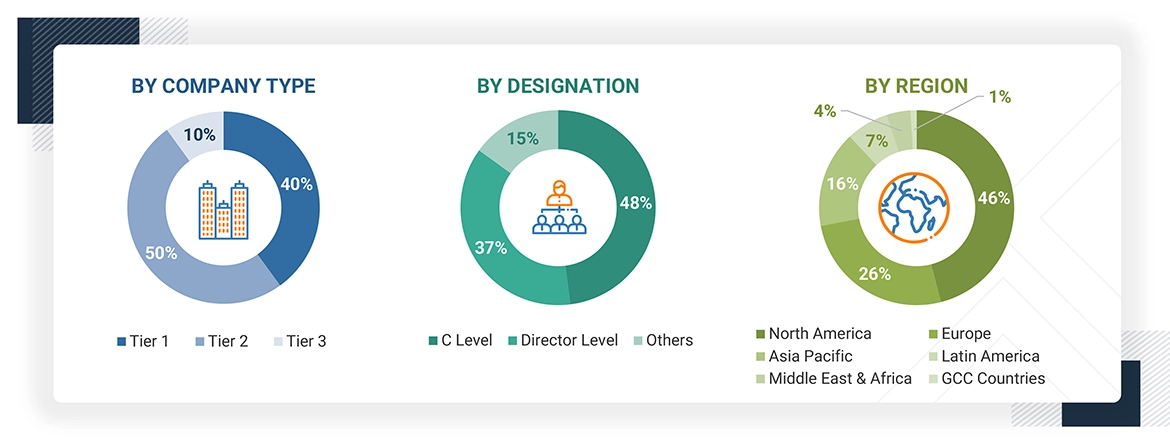
*C-level primaries include CEOs, CFOs, COOs, and VPs.
*Other designations include sales managers, marketing managers, business development managers, product managers, distributors, and suppliers.
Note: Companies are classified into tiers based on their total revenue. As of 2023, Tier 1 = >USD 10.00 billion, Tier 2 = USD 1.00 billion to USD 10.00 billion, and Tier 3 = < USD 1.00 billion.
Source: MarketsandMarkets Analysis
To know about the assumptions considered for the study, download the pdf brochure
Market Size Estimation
For the global market value, annual revenues were calculated based on the revenue mapping of major product manufacturers and OEMs active in the global home healthcare market. All the major service providers were identified at the global and/or country/regional level. Revenue mapping for the respective business segments/subsegments was done for the major players. Also, the global home healthcare market was split into various segments and sub-segments based on:
- List of major players operating in the product market at the regional and/or country level
- Product mapping of home healthcare providers at the regional and/or country level
- Mapping of annual revenue generated by listed major players from home healthcare (or the nearest reported business unit/product category)
- Extrapolation of the revenue mapping of the listed major players to derive the global market value of the respective segments/subsegments
- Summation of the market value of all segments/subsegments to arrive at the global home healthcare market
The above-mentioned data was consolidated and added with detailed inputs and analysis from MarketsandMarkets and presented in this report.
Market Size Estimation (Bottom-up Approach & Top-down Approach)
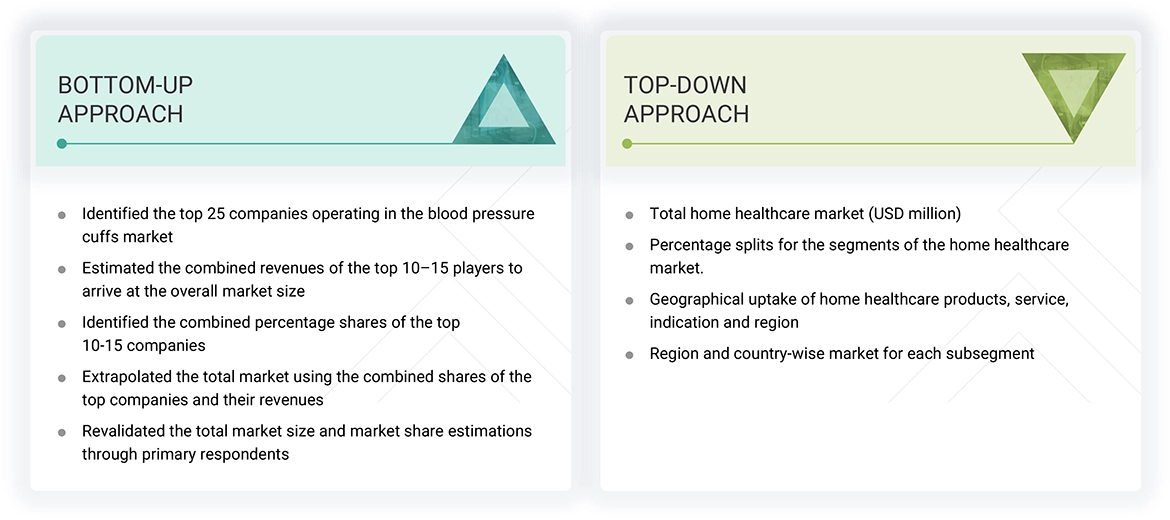
Data Triangulation
After arriving at the overall size of the global home healthcare market through the above-mentioned methodology, this market was split into several segments and subsegments. The data triangulation and market breakdown procedures were employed, wherever applicable, to complete the overall market engineering process and arrive at the exact market value data for the key segments and subsegments. The extrapolated market data was triangulated by studying various macro indicators and regional trends from both demand- and supply-side participants.
Market Definition
Home healthcare refers to the medical attention, care, and support provided to patients at their residences by licensed healthcare workers, such as nurses, home health aides, and personal care aides. The home healthcare market includes products and services that can be set up remotely at a patient’s home.
Stakeholders
- Home Healthcare Equipment Manufacturers
- Home Healthcare Service Providers
- Home Health Software Vendors
- Nursing Service Providers
- Wound Care Product Manufacturers
- Pregnancy Care Product Manufacturers and Service Providers
- Supportive Care Product Manufacturers and Service Providers
- Diagnostic Companies
- Research & Development (R&D) Companies
- Business Research and Consulting Service Providers
- Medical Research Laboratories
- Venture Capitalists
Report Objectives
- To define, describe, segment, and forecast the global home healthcare market by product, service, indication, and region
- To provide detailed information regarding the major factors influencing the market growth (such as drivers, restraints, opportunities, and challenges)
- To analyze the micromarkets with respect to individual growth trends, prospects, and contributions to the overall home healthcare market
- To analyze market opportunities for stakeholders and provide details of the competitive landscape for key players
- To forecast the size of the market segments with respect to five regions: North America, Europe, the Asia Pacific, Latin America, Middle East & Africa, and GCC Countries
- To profile the key players and comprehensively analyze their product portfolios, market positions, and core competencies
- To track and analyze company developments such as acquisitions, product launches & approvals, and expansions
- To benchmark players within the market using the proprietary “Competitive Leadership Mapping” framework, which analyzes market players on various parameters within the broad categories of business and product strategy
Key Questions Addressed by the Report
Which are the top industry players in the home healthcare market?
The key players in this market are Fresenius Medical Care AG (Germany), Abbott (US), Linde plc (Ireland), F. Hoffmann-La Roche, Ltd. (Switzerland), ResMed (US), Koninklijke Philips N.V. (Netherlands), GE Healthcare (US), A&D HOLON Holdings Company, Limited, Convatec Group PLC (UK), Amedisys (US), OMRON Healthcare Co., Ltd. (Japan).
What are some of the major drivers for this market?
Recent trends significantly shaping the home healthcare market include the rapid growth of the aging population, the increasing prevalence of chronic diseases, and the rising demand for affordable and accessible healthcare solutions. As the global elderly population expands, there is a greater need for continuous medical support to manage age-related health conditions such as heart disease, arthritis, diabetes, and respiratory disorders. At the same time, healthcare systems worldwide are under pressure to reduce costs without compromising the quality of care. Home healthcare has emerged as a practical solution, offering personalized medical services in the comfort of patients' homes, helping reduce hospital visits, lower treatment costs, and improve patient outcomes. These trends are collectively driving the demand for home-based medical care, technologies, and professional support services.
What are the major products used in home healthcare?
The home healthcare market is segmented into testing, screening, and monitoring products; therapeutic products; and mobility care products. The therapeutic products accounted for the largest share of the home healthcare market in 2024.
What are the major indications of the home healthcare market?
This report contains the following indication segments: cancer, respiratory diseases, mobility disorders, cardiovascular diseases and hypertension, pregnancy, wound care, diabetes, hearing disorders, and other indications.
Which region is lucrative for the global home healthcare market?
The Asia Pacific region is anticipated to experience the fastest growth in the home healthcare market during the forecast period. The growing demand for high-quality, patient-centered healthcare services is encouraging the adoption of home-based care solutions. In addition, increasing healthcare expenditures, favorable government policies, and greater public awareness about the benefits of home monitoring and early intervention are further accelerating market expansion. These factors are collectively boosting the demand for a wide range of home healthcare products and services across the region.
Fact checked
Personalize This Research
- Triangulate with your Own Data
- Get Data as per your Format and Definition
- Gain a Deeper Dive on a Specific Application, Geography, Customer or Competitor
- Any level of Personalization
Let Us Help You
- What are the Known and Unknown Adjacencies Impacting the Home Healthcare Market
- What will your New Revenue Sources be?
- Who will be your Top Customer; what will make them switch?
- Defend your Market Share or Win Competitors
- Get a Scorecard for Target Partners

Custom Market Research Services
We Will Customise The Research For You, In Case The Report Listed Above Does Not Meet With Your Requirements
Get 10% Free CustomisationTESTIMONIALS

JAYANT RAJPUROHIT
Director of Market Insights, Data and Analytics
SFI Health,
Leading Pharmaceutical Companywww.sfihealth.com/

We at SFI Health approached MarketsandMarkets for an Opportunity Assessment on "Incidence and Prevalence of Focus Indications" as we wanted to know the most attractive HCPs like Physician, Functional MD, Naturopath and Pharmacist. The project was critical for us to ensure our focus on the right target which would enable sustainable growth and profitability for SFI Health. The business insights provided exceeded our expectations and we were extremely impressed. The team at MarketsandMarkets is highly professional and detail oriented and very well understood our business needs. MarketsandMarkets offers a unique combination of expertise and dedicated engagement model. We identified 2 new products to be launched in coming months, based on the research findings provided by MarketsandMarkets. We are happy with the services and would strongly recommend MarketsandMarkets to my peers in the industry.

BEATRIZ DE LA CALLE
Head of Commercial Analytics
Qualicaps,
Leading Pharmaceutical Companywww.qualicaps.com/

We partnered with MarketsandMarkets for an assessment study on hard empty capsules. The team was extremely professional in understanding our business requirements and we received timely responses to all our queries. The market intelligence and the recommendations has met our business requirements. We were extremely impressed to see the final study results; it really exceeded our expectations. The market intelligence offered by MarketsandMarkets, and clarity on next steps will help us achieve our business objective for the Year 2021. We are happy with the services and would strongly recommend MarketsandMarkets to my peers in the industry.

Bob Williams,
Senior Director Business Development & Innovation
Bracco Diagnostics Inc.,
Italian Multinational in life sciences sector and a World Leader in imaging diagnosticsimaging.bracco.com/us-en
We were pleased with targeted insights that MarketsandMarkets identified from a custom study on the 'Radiation Dose Management Solutions Market'. Your team identified and characterized the market participants as well as underlying trends accurately. This study was useful to Bracco in formulating business strategies for our dose monitoring product lines and we thank MarketsandMarkets for the job well done.
Cody Coonradt,
Market Development and Strategy Manager
3M Health Information Systems,
Leader in Health care Coding, Payment & Analytics Solutions.www.3m.com/3M/en_US/health-information-systems-us
The value for our organization comes from three things: depth of research, specificity of segments and being easy to work with. As important as the first two are, the third can't be underestimated. MarketsandMarkets, maybe more than any other research vendor, wants to know what is top of mind for our team and what big questions we are grappling to answer.
Their customer first approach and high value engagement model, have given us great analysis and excellent value for money
- US Home Healthcare Market
- Canada Home Healthcare Market
- UK Home Healthcare Market
- Germany Home Healthcare Market
- France Home Healthcare Market
- Italy Home Healthcare Market
- Spain Home Healthcare Market
- China Home Healthcare Market
- Japan Home Healthcare Market
- India Home Healthcare Market
- GCC Countries Home Healthcare Market
Growth opportunities and latent adjacency in Home Healthcare Market






Olivia
Jun, 2026
After reviewing the Home Healthcare Market insights, I see a strong business case for providers to expand decentralized care models as aging populations and cost pressures continue to shift demand away from traditional hospital settings..
Ethan
Jun, 2026
From a strategic standpoint, the Home Healthcare Market highlights how technology integration, especially remote monitoring and digital health platforms, is becoming essential for improving patient outcomes while maintaining operational efficiency..
Sophia
Jun, 2026
Looking at the broader landscape, my takeaway from the Home Healthcare Market is that reimbursement frameworks and regional policy variations will play a decisive role in how quickly service providers can scale sustainably..
Matthew
Mar, 2022
Which is the fastest growing market of Home Healthcare Market?.
Mark
Mar, 2022
Can you enlighten us with your market intelligence to grow and sustain in Home Healthcare Market?.
Donald
Mar, 2022
What are the growth estimates for Home Healthcare Market till 2026?.