



3D Printing Market Size, Share & Trends
Report Code
SE 2936
Published in
Jul, 2026, By MarketsandMarkets™
3D Printing Market Size, Share, Growth & Trends by Offering (Printers, Materials, Software, Services), Technology (Fused Deposition Modeling, Stereolithography), and Process (Powder Bed Fusion, Vat Photopolymerization) - Global Forecast to 2032

USD 31.77 BN
MARKET SIZE, 2032

CAGR 11.6%
(2026-2032)

361
REPORT PAGES

277
MARKET TABLES
3D PRINTING MARKET OVERVIEW
According to Marketsandmarkets, the global 3D printing market size is projected to grow from USD 16.43 billion in 2026 to USD 31.77 billion by 2032, growing at a CAGR of 11.6% from 2026 to 2032. Rising adoption of additive manufacturing across aerospace & defense, healthcare, automotive, and industrial manufacturing is driving the demand for 3D printing solutions globally.
REPORT SCOPE
| REPORT METRIC | DETAILS |
|---|---|
| Market Size in 2025 (Value) | USD 15.62 Billion |
| Market Size in 2026 (Value) | USD 16.43 Billion |
| Market Forecast in 2032 (Value) | USD 31.77 Billion |
| CAGR | 11.6% |
| Years Considered | 2022–2032 |
| Base Year | 2025 |
| Forecast Period | 2026–2032 |
| Units Considered | Value (USD Billion), Volume (Thousand Units) |
| Report Coverage | Revenue Forecast, Company Ranking, Competitive Landscape, Growth Factors, and Trends |
| Top Companies |
|
| Growth Drivers |
|
| Segments Covered |
|
| Regions Covered | North America, Europe, Asia Pacific and RoW |
KEY TAKEAWAYS
-
BY REGIONNorth America accounted for a 36.8 % of the market share in 2025.
-
BY OFFERINGServices dominated the offering segment by capturing a share of 36.1% in 2025.
-
BY TECHNOLOGYBy Technology, Stereolithography technology is expected to register the highest CAGR of 14.2% in the 3D printing market during the forecast period.
-
BY PROCESSBy Process, the powder bed fusion process is projected to experience the highest growth rate in the 3D printing during the forecast period.
-
BY APPLICATIONBy Application, the functional part manufacturing application is expected to record a significant CAGR in the 3D printing market from 2026 to 2032.
-
BY VERTICALBy Vertical, Automotive vertical is expected to capture the largest share of the 3D printing market in 2026.
-
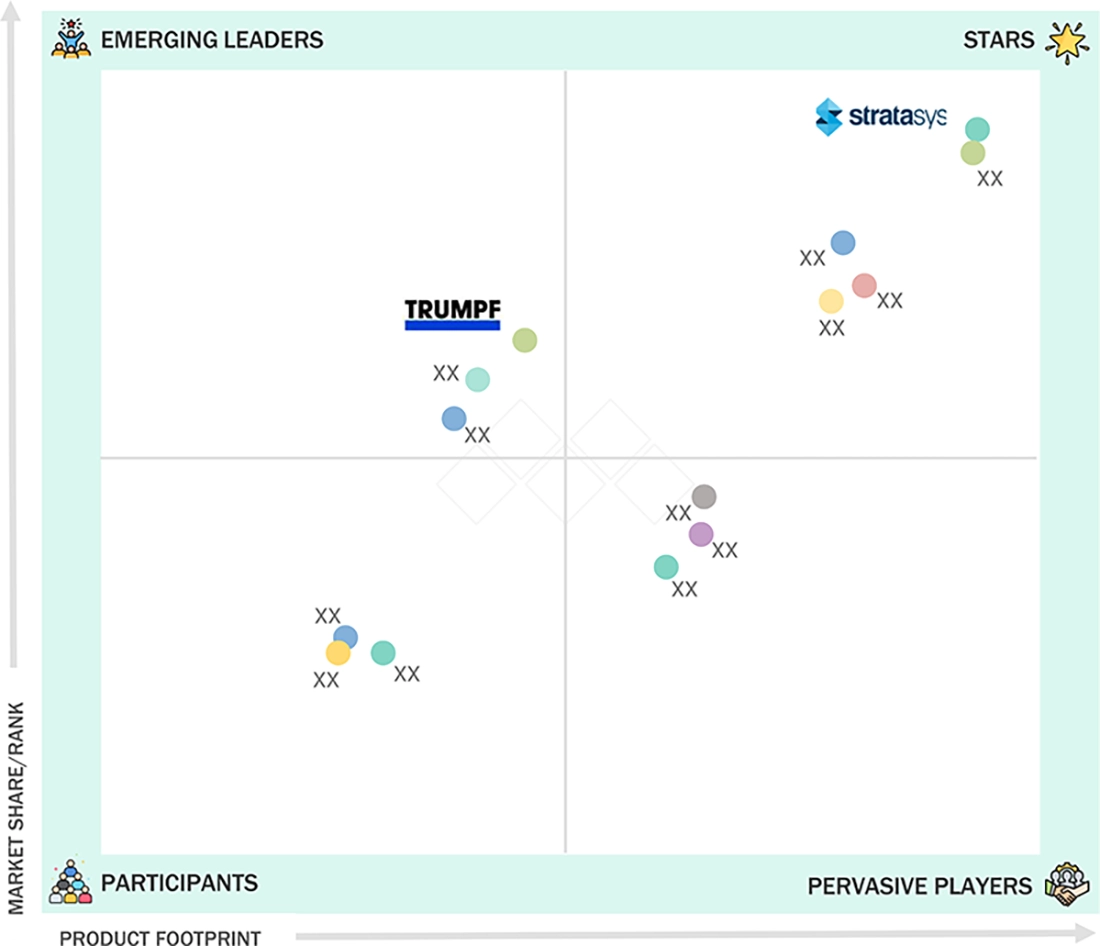
COMPETITIVE LANDSCAPE (KEY PLAYERS)Stratasys; 3D Systems, Inc.; and GE Aerospace among others were identified as star players in the 3D printing market due to their strong market share and extensive product footprint.
-
COMPETITIVE LANDSCAPE (STARTUPS/SMES)TRUMPF and Renishaw plc., among others, have distinguished themselves among startups and SMEs by securing strong footholds in specialized niche areas, underscoring their potential as emerging market leaders in the 3D printing market.
The 3D print market is witnessing significant growth due to the increasing adoption of additive manufacturing across industries and the rising demand for customized, lightweight, and high-performance components. Organizations are increasingly deploying advanced 3D printing technologies, such as fused deposition modeling, selective laser sintering, and stereolithography, to improve manufacturing efficiency, design flexibility, and production precision. Additionally, growing investments in industrial automation, advanced materials, and digital manufacturing technologies, along with the expansion of applications across aerospace & defense, automotive, healthcare, and consumer goods, are further accelerating the growth of the global 3D printing industry.
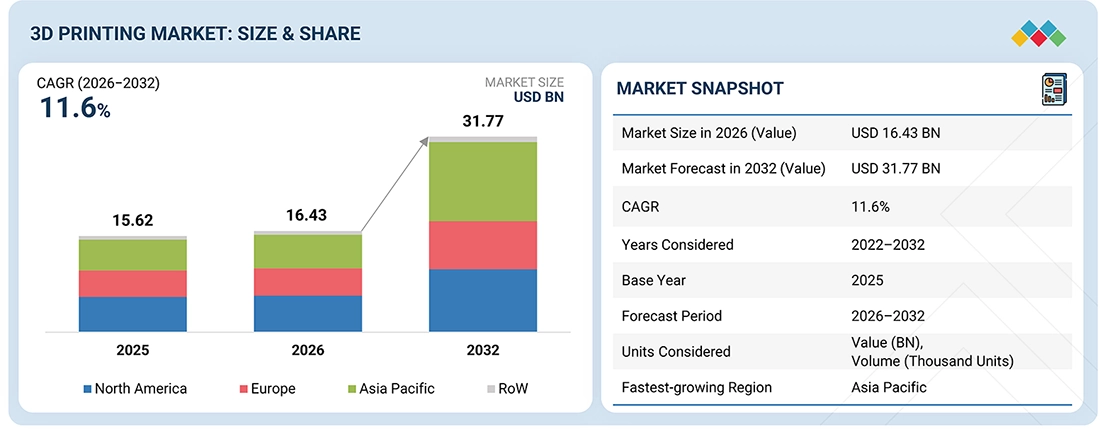
Source: Secondary Research, Interviews with Experts, MarketsandMarkets Analysis
TRENDS & DISRUPTIONS IMPACTING CUSTOMERS' CUSTOMERS
The impact on consumers' business in the 3D printed market stems from evolving manufacturing requirements and rapid advancements in additive manufacturing technologies. Automotive, aerospace & defense, healthcare, consumer goods, industrial manufacturing, and construction companies are the primary end users of 3D printing. Shifts toward digital manufacturing, industrial 3D printing, bioprinting, automated 3D printing, advanced printing materials, and hybrid additive-subtractive manufacturing are directly influencing product development, production efficiency, and business competitiveness across these industries. These developments are driving the adoption of 3D printing technologies, creating new revenue opportunities and shaping the long-term growth trajectory of the global 3D print market.
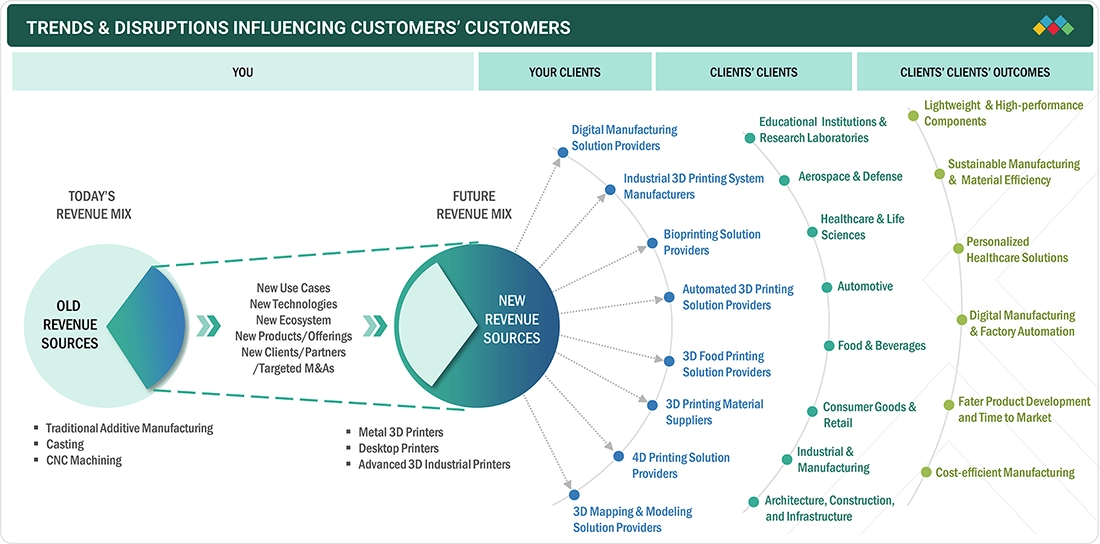
Source: Secondary Research, Interviews with Experts, MarketsandMarkets Analysis
3D PRINTING MARKET DYNAMICS

Drivers
Impact
Level
Level
-
Ease in manufacturing customized products

-
Adoption of sustainable manufacturing practices


RESTRAINTS
Impact
Level
Level
-
Lack of standardized testing methods to verify mechanical properties of 3D printing materials and high raw material costs

-
Inadequate design and process control data due to lack of printing material specifications


OPPORTUNITIES
Impact
Level
Level
-
Use of recycled and bio-based printing materials

-
Advancements in printing technologies, materials, and workforce skill development


CHALLENGES
Impact
Level
Level
-
Ensuring consistent quality of final 3D-printed product with repeatable and stable production processes

-
Shortage of skilled professionals in additive manufacturing

Source: Secondary Research, Interviews with Experts, MarketsandMarkets Analysis
Driver: Ease in manufacturing customized products
In the current consumer goods market, where customers' choices are often limited to model, color, and size, 3D printing enables the production of highly customized products with complex designs tailored to individual preferences. By eliminating the need for specialized tooling and simplifying design modifications, manufacturers can rapidly develop and produce personalized products with minimal additional cost or lead time. Furthermore, 3D printing reduces the time required for design iteration and programming, accelerating production and enabling faster delivery of customized parts to end users.
Restraint: Lack of standardized testing methods to verify mechanical properties of 3D printing materials and high raw material cost
The absence of standardized testing and certification methods for validating the mechanical properties of 3D printing materials creates inconsistencies in part quality, performance, and reliability across different materials and printing processes. This challenge is further compounded by the high cost of specialized raw materials, such as metal powders and engineering-grade polymers, which increases production costs and limits the adoption of 3D printing, particularly for cost-sensitive applications and small- and medium-sized enterprises.
Opportunity: Use of recycled and bio-based printing materials
The growing adoption of recycled and bio-based materials is advancing sustainable additive manufacturing by reducing material waste, lowering carbon emissions, and decreasing reliance on virgin resources. Continuous innovations in sustainable feedstocks and recyclable materials are enabling manufacturers to meet environmental regulations and corporate sustainability goals while supporting the broader adoption of eco-friendly 3D printing technologies across industries.
Challenge: Shortage of skilled professionals in additive manufacturing
The shortage of skilled professionals capable of designing, operating, and maintaining advanced additive manufacturing systems hinders the widespread adoption of 3D printing technologies. Limited expertise in design optimization, material selection, process validation, and post-processing reduces operational efficiency, increases production costs, and slows the integration of additive manufacturing into large-scale industrial applications.
3D PRINTING MARKET SIZE, SHARE & TRENDS: COMMERCIAL USE CASES ACROSS INDUSTRIES
| COMPANY | USE CASE DESCRIPTION | BENEFITS |
|---|---|---|
 |
Swinburne University of Technology collaborated with Renishaw to improve the performance of its Formula SAE electric race car. Renishaw utilized metal additive manufacturing to redesign wheel centers using titanium instead of aluminum and optimized the components through finite element analysis (FEA). The solution reduced component weight while maintaining structural integrity and improving rotational efficiency. | The solution achieved a 20% reduction in wheel weight and a 75% reduction in rotational inertia, resulting in improved acceleration, braking performance, and vehicle handling | It also demonstrated the advantages of additive manufacturing in lightweight electric vehicle development |
|
|
Linex Manufacturing, a division of Linamar Corporation, required a precise inspection solution for automotive components located outside the measuring range of its Equator gauge. Renishaw designed and manufactured a customized titanium stylus using metal powder bed fusion with an internal lattice structure to improve stiffness while reducing weight. | The custom stylus significantly improved inspection accuracy, rigidity, and repeatability for complex automotive components | Its durable single-piece design enhanced long-term inspection performance and enabled Linex to expand its quality inspection capabilities |
 |
Alex Degnes partnered with Protolabs to manufacture a high-performance aluminum engine cylinder using Direct Metal Laser Sintering (DMLS) technology. Additive manufacturing enabled the production of intricate internal cooling channels and lightweight honeycomb structures that were not achievable using conventional casting methods. | The DMLS-produced engine component provided excellent mechanical strength, thermal performance, and dimensional accuracy while enabling complex geometries | The solution supported the development of a high-performance engine designed for competitive speed record applications |
 |
PepsiCo adopted Nexa3D's NXE 400 3D printer and Henkel Loctite xPEEK147 material to manufacture tooling inserts for bottle blow molding. The hybrid tooling approach combined additively manufactured inserts with conventional molds to accelerate product development and reduce manufacturing costs. | The solution reduced tooling development time from 4 weeks to 48 hours and lowered mold costs from USD 10,000 to USD 350 per set | PepsiCo achieved approximately 96% cost savings, faster design validation, and improved production efficiency |
|
|
Lalaland Production and Design implemented Nexa3D's Selective Laser Sintering (SLS) technology with thermoplastic copolyester (TPC) material to accelerate footwear midsole development. The solution enabled rapid prototyping, eliminated tooling requirements, and supported customized lattice-based designs for improved product performance. | The solution reduced midsole production time from 26 hours to 3 hours and shortened the product development cycle from 18–24 weeks to 4 weeks | It also enabled mass customization, reduced manufacturing costs, and improved overall production flexibility |
Logos and trademarks shown above are the property of their respective owners. Their use here is for informational and illustrative purposes only.
DESKTOP 3D PRINTING MARKET
The desktop 3D printing market is witnessing steady growth as businesses, educational institutions, and individual users adopt affordable additive manufacturing solutions. The market’s share is expanding with increasing demand for rapid prototyping, customized products, and small-batch production. Key trends include the integration of AI, cloud-based printing, advanced materials, and user-friendly software. Growing adoption across healthcare, automotive, education, and consumer applications is supporting market growth. Improved print quality, faster production, and lower equipment costs are further driving adoption. These trends are expected to create new opportunities and accelerate the growth of the desktop 3D print market.
MARKET ECOSYSTEM
The 3D printed market size ecosystem comprises 3D printer providers, material suppliers, software providers, service providers, research institutions, and end users. Technology providers deliver advanced additive manufacturing solutions, including industrial 3D printers, specialized materials, and design software, to support high-precision and efficient production. Material suppliers and service providers are driving the adoption of metal, polymer, ceramic, and composite printing technologies, while manufacturers across industries are increasingly utilizing additive manufacturing to improve product development, enable mass customization, and enhance production efficiency.
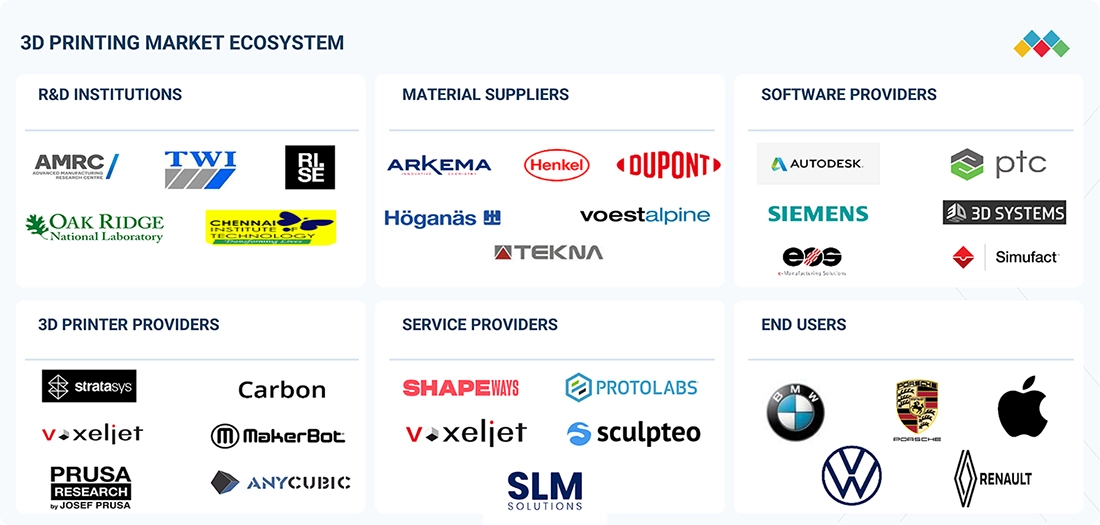
Logos and trademarks shown above are the property of their respective owners. Their use here is for informational and illustrative purposes only.
3D PRINTING MARKET SEGMENTS
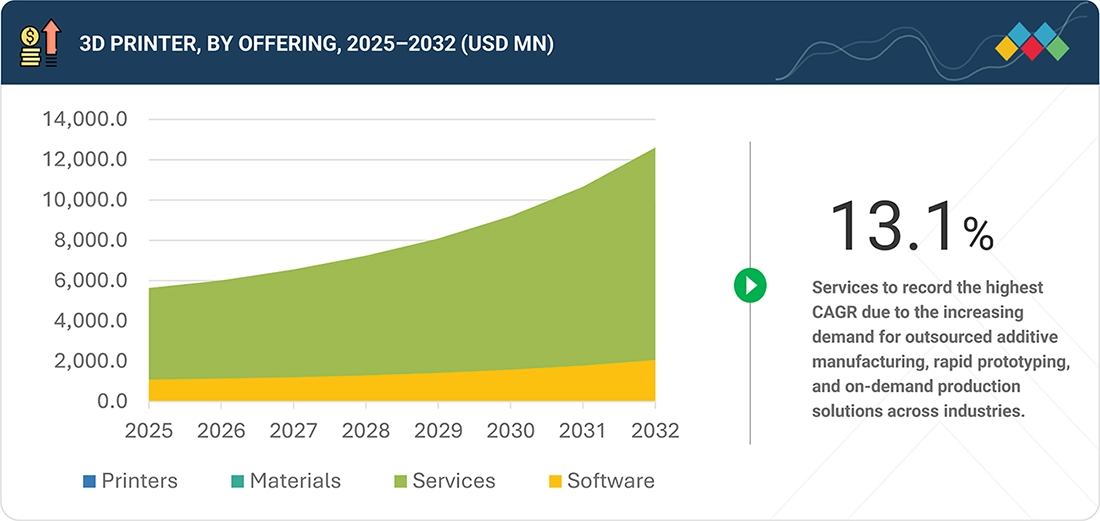
Source: Secondary Research, Interviews with Experts, MarketsandMarkets Analysis
3D Print Market, By Offering
Service offerings hold the largest market share due to the increasing demand for outsourced additive manufacturing, design optimization, post-processing, and on-demand production services across diverse industrial applications.
3D Printer Market, By Technology
Fused deposition modeling holds the largest market share due to its cost-effectiveness, ease of use, wide material compatibility, and extensive adoption for rapid prototyping and functional part production across industries.
3D Printed Market, By Application
Functional part manufacturing applications hold the largest market share due to the increasing adoption of additive manufacturing for end-use production, lightweight components, and high-performance industrial applications across multiple industries.
3D Printer Market, By Process
The powder bed fusion process holds the largest market share due to its ability to produce highly complex, high-precision, and high-strength components with excellent material efficiency for industrial applications.
3D Printed Market, By Vertical
The automotive vertical holds the largest market share due to the increasing adoption of 3D printing for rapid prototyping, tooling, lightweight components, and customized part production to improve manufacturing efficiency and accelerate vehicle development.
REGION
Asia Pacific to be fastest-growing region in 3D printing market size during forecast period
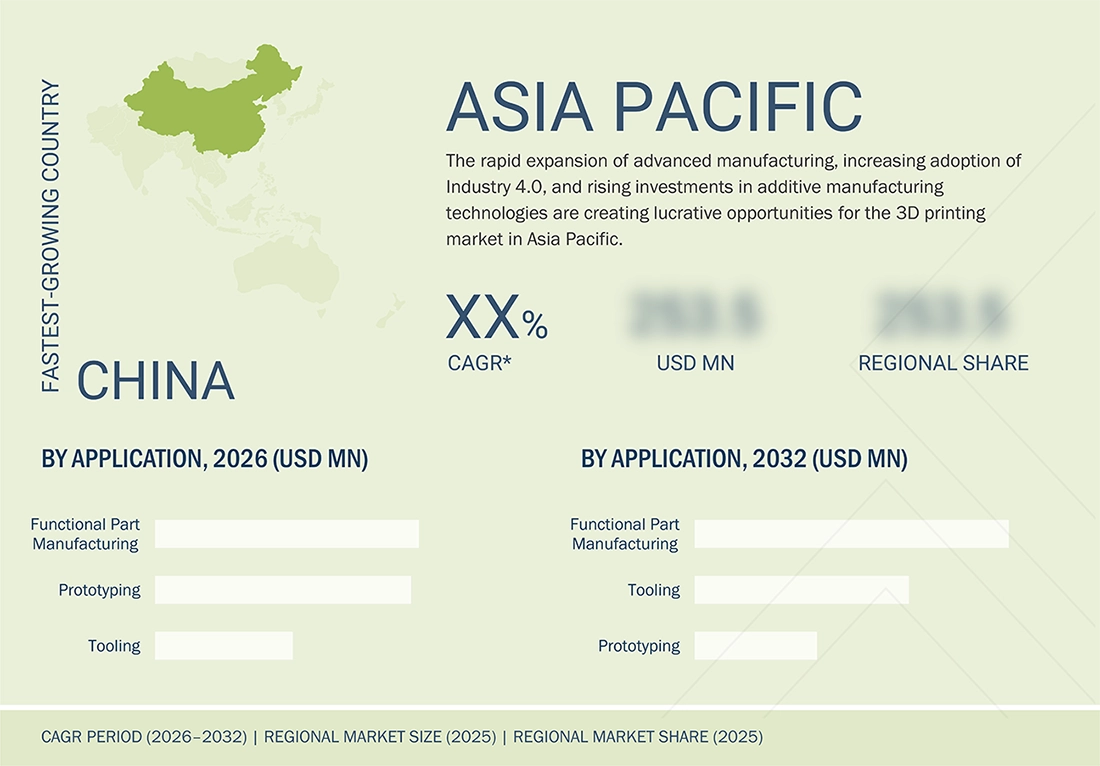
Asia Pacific is expected to grow at the highest CAGR in the 3D print market due to the rapid expansion of advanced manufacturing, increasing industrial automation, and growing adoption of additive manufacturing technologies across industries. Countries such as China, Japan, South Korea, Singapore, and India are making significant investments in industrial 3D printing, advanced materials, and digital manufacturing to strengthen domestic production capabilities and support innovation. Additionally, the increasing adoption of 3D printing across automotive, aerospace & defense, healthcare, electronics, and consumer goods industries, along with supportive government initiatives promoting Industry 4.0 and smart manufacturing, is accelerating the adoption of additive manufacturing solutions across the region.
3D PRINTING MARKET SIZE, SHARE & TRENDS: COMPANY EVALUATION MATRIX
In the 3D printing market matrix, Stratasys Ltd. (US) (Star) leads with a strong market presence and a broad portfolio of industrial additive manufacturing solutions across polymer and multi-material 3D printing applications. TRUMPF (Germany) (Emerging Leader) is strengthening its position through continuous advancements in metal additive manufacturing technologies and expanding industrial production capabilities. While Stratasys Ltd. maintains its leadership through an extensive product portfolio and global customer base, TRUMPF continues to enhance its market presence by increasing investments in industrial metal 3D printing and advanced manufacturing solutions.
Source: Secondary Research, Interviews with Experts, MarketsandMarkets Analysis
KEY MARKET PLAYERS - TOP 3D PRINTING COMPANIES
- Stratasys (US)
- EOS GmbH (Belgium)
- HP Development Company, L.P. (US)
- 3D Systems, Inc. (US)
- GE Aerospace (US)
- Materialise (Belgium)
- Nano Dimension (US)
- voxeljet AG (Germany)
- SLM Solutions (Germany)
- Renishaw (UK)
WHAT IS IN IT FOR YOU: 3D PRINTING MARKET SIZE, SHARE & TRENDS REPORT CONTENT GUIDE
DELIVERED CUSTOMIZATIONS
We have successfully delivered the following deep-dive customizations:
| CLIENT REQUEST | CUSTOMIZATION DELIVERED | VALUE ADDS |
|---|---|---|
| Automotive Manufacturer | Competitive benchmarking of additive manufacturing technologies, lightweight component production strategies, and material adoption trends for prototyping and end-use parts |
|
| Aerospace & Defense Company | Regional demand analysis for metal 3D printing, component qualification trends, and advanced material adoption for lightweight and high-performance applications |
|
| Healthcare & Medical Device Manufacturer | Evaluation of patient-specific implant manufacturing, biocompatible material adoption, regulatory trends, and medical 3D printing applications |
|
| 3D Printer & Material Manufacturer | Supply-demand analysis for industrial 3D printers, printing materials, and technology adoption trends, along with competitive landscape and partnership assessment |
|
RECENT DEVELOPMENTS
- August 2026 : U.S. Navy introduced new technical standards to accelerate metal additive manufacturing across submarine construction, maintenance, overhaul, and repair. The framework creates a repeatable pathway for replacing traditional cast and wrought components with qualified 3D-printed metal parts. The approach reduces redundant engineering reviews, drawing changes, and first-article testing, helping speed deployment. Additive manufacturing is expected to address supply-chain constraints, part obsolescence, and production bottlenecks across the submarine fleet. The initiative supports higher industrial throughput and faster submarine production while maintaining stringent safety and quality requirements.
- August 2026 : University of Nebraska at Omaha (UNO) received an $8 million National Science Foundation award to establish the Nebraska Center for 3D Innovation (NE3D). The center will advance 3D-printed healthcare technologies across prosthetics, antimicrobial materials, and patient-specific anatomical models. NE3D will combine AI, medical imaging, biomechanics, and additive manufacturing to develop personalized healthcare solutions. The initiative brings together universities, healthcare organizations, education partners, and industry to accelerate research and workforce development. The center positions UNO and Nebraska as a growing hub for next-generation, patient-specific 3D-printed medical innovation.
- August 2026 : University of Notre Dame researchers developed a hybrid 3D bioprinting method to create blood capillary networks at near-cellular scales. The approach combines conventional printing with a machine-learning-assisted technique to produce hierarchical channels that can be endothelialized. 3D-printed capillary networks could improve nutrient and oxygen delivery in engineered tissues and support more viable organ-scale constructs. The technology addresses a major challenge in regenerative medicine by enabling finer, interconnected vascular structures. The breakthrough could accelerate 3D bioprinting applications in tissue engineering, drug testing, and future organ transplantation.
- August 2026 : U.S. Navy released new technical requirements to accelerate the adoption of metal additive manufacturing across submarine construction, maintenance, overhaul, and repair. The framework creates a streamlined pathway for replacing traditional cast and wrought components with qualified 3D-printed metal parts. Additive Manufacturing can reduce engineering reviews, supply-chain delays, part obsolescence, and production bottlenecks. The technology is already being used on USS Washington and USS Nevada, with components performing in deep-sea operations. The initiative positions 3D printing as a scalable tool to increase submarine industrial capacity while maintaining stringent safety and quality standards.
- August 2026 : Washington State University (WSU) researchers used AI to identify viable 3D-printing parameters for the aerospace-grade GRCop-42 copper alloy. The AI-guided approach narrowed more than 100 million possible configurations to just 40 experiments, producing six successful prints. The team successfully printed GRCop-42 at 500 watts, enabling use with more widely available commercial 3D printers. The approach could reduce energy use, equipment costs, material waste, and testing time for metal additive manufacturing. The breakthrough could make advanced 3D printing more accessible to universities, small laboratories, and manufacturers.
Table of Contents
 Exclusive indicates content/data unique to MarketsandMarkets and not available with any competitors.
TITLE
PAGE NO
1
INTRODUCTION
29
2
EXECUTIVE SUMMARY
35
3
PREMIUM INSIGHTS
40
4
MARKET OVERVIEW
3D printing market thrives on sustainability, innovation, and strategic investments despite standardization challenges.
44
4.1
INTRODUCTION
4.2
MARKET DYNAMICS
4.2.1
DRIVERS
4.2.1.1
EASE IN MANUFACTURING OF CUSTOMIZED PRODUCTS
4.2.1.2
GROWING FOCUS ON SUSTAINABLE MANUFACTURING PRACTICES
4.2.1.3
INCREASING GOVERNMENT-LED INVESTMENTS IN 3D PRINTING PROJECTS
4.2.1.4
AVAILABILITY OF VARIOUS INDUSTRIAL-GRADE 3D PRINTING MATERIALS
4.2.1.5
HIGH DEMAND FOR LIGHTWEIGHT YET DURABLE PARTS IN AEROSPACE & DEFENSE VERTICAL
4.2.2
RESTRAINTS
4.2.2.1
LACK OF STANDARDIZED TESTING METHODS TO VERIFY MECHANICAL PROPERTIES OF 3D PRINTING MATERIALS AND HIGH RAW MATERIAL COSTS
4.2.2.2
INADEQUATE DESIGN AND PROCESS CONTROL DATA DUE TO LACK OF PRINTING MATERIAL SPECIFICATIONS
4.2.3
OPPORTUNITIES
4.2.3.1
RAPID ADVANCEMENTS IN PRINTING TECHNOLOGIES AND MATERIALS AND DEVELOPMENT OF KNOWLEDGE AND SKILL PROGRESSION FRAMEWORKS
4.2.3.2
EMERGING APPLICATIONS OF 3D PRINTING TECHNOLOGY IN AUTOMOTIVE, PRINTED ELECTRONICS, JEWELRY, AND EDUCATION VERTICALS
4.2.3.3
GROWING USE OF RECYCLED AND BIO-BASED PRINTING MATERIALS
4.2.4
CHALLENGES
4.2.4.1
ENSURING CONSISTENT QUALITY OF FINAL 3D-PRINTED PRODUCTS WITH REPEATABLE AND STABLE PRODUCTION PROCESSES
4.2.4.2
SHORTAGE OF SKILLED PROFESSIONALS IN ADDITIVE MANUFACTURING
4.3
INTERCONNECTED MARKETS AND CROSS-SECTOR OPPORTUNITIES
4.4
STRATEGIC MOVES BY TIER 1/2/3 PLAYERS
5
INDUSTRY TRENDS
Navigate industry shifts with strategic insights from competitive forces and evolving 3D printing economics.
60
5.1
INTRODUCTION
5.2
PORTER’S FIVE FORCES ANALYSIS
5.2.1
THREAT OF NEW ENTRANTS
5.2.2
THREAT OF SUBSTITUTES
5.2.3
BARGAINING POWER OF SUPPLIERS
5.2.4
BARGAINING POWER OF BUYERS
5.2.5
INTENSITY OF COMPETITIVE RIVALRY
5.3
MACROECONOMIC OUTLOOK
5.3.1
INTRODUCTION
5.3.2
GDP TRENDS AND FORECAST
5.3.3
TRENDS IN GLOBAL HEALTHCARE INDUSTRY
5.4
VALUE CHAIN ANALYSIS
5.4.1
RESEARCH AND DEVELOPMENT ENGINEERS
5.4.2
MATERIAL AND SOFTWARE PROVIDERS
5.4.3
MANUFACTURERS
5.4.4
SERVICE PROVIDERS
5.4.5
END-USER INDUSTRIES
5.4.6
AFTER-SALES SERVICE PROVIDERS
5.5
ECOSYSTEM ANALYSIS
5.6
PRICING ANALYSIS
5.6.1
PRICE RANGE OF 3D PRINTERS OFFERED BY KEY PLAYERS
5.6.2
AVERAGE SELLING PRICE TREND OF 3D PRINTERS, BY REGION
5.7
TRADE ANALYSIS
5.7.1
IMPORT SCENARIO (HS CODE 847790)
5.7.2
EXPORT SCENARIO (HS CODE 847790)
5.8
KEY CONFERENCES AND EVENTS, 2026–2027
5.9
TRENDS/DISRUPTIONS IMPACTING CUSTOMER BUSINESS
5.10
INVESTMENT AND FUNDING SCENARIO
5.11
CASE STUDY ANALYSIS
5.11.1
SWINBURNE UNIVERSITY COLLABORATED WITH RENISHAW TO ENHANCE ELECTRIC CARS’ PERFORMANCE
5.11.2
LINAMAR CORPORATION ENHANCED INSPECTION PRECISION USING RENISHAW’S CUSTOM ADDITIVELY MANUFACTURED STYLUS
5.11.3
PROTOLABS’ DMLS SERVICE HELPED ALEX DEGNES ADDRESS TWO-STROKE ENGINE SPEED RECORD CHALLENGE
5.11.4
PEPSICO ACHIEVED RAPID TOOLING DEVELOPMENT, DURABILITY, AND COST REDUCTION USING NXE 400 3D PRINTER
5.11.5
LALALAND PRODUCTION AND DESIGN REVOLUTIONIZED FOOTWEAR MANUFACTURING USING NEXA3D’S SLS PRINTER
5.12
IMPACT OF 2025 US TARIFF – 3D PRINTING INDUSTRY
5.12.1
INTRODUCTION
5.12.2
PRICE IMPACT ANALYSIS
5.12.3
IMPACT ON COUNTRIES/REGIONS
5.12.3.1
US
5.12.3.2
EUROPE
5.12.3.3
ASIA PACIFIC
5.12.4
IMPACT ON VERTICALS
5.12.4.1
AUTOMOTIVE
5.12.4.2
AEROSPACE & DEFENSE
5.12.4.3
HEALTHCARE
5.12.4.4
ARCHITECTURE & CONSTRUCTION
5.12.4.5
CONSUMER PRODUCTS
5.12.4.6
EDUCATION
5.12.4.7
INDUSTRIAL
5.12.4.8
ENERGY
5.12.4.9
PRINTED ELECTRONICS
5.12.4.10
JEWELRY
5.12.4.11
FOOD & CULINARY
6
TECHNOLOGICAL ADVANCEMENTS, AI-DRIVEN IMPACT, PATENTS, INNOVATIONS, AND FUTURE APPLICATIONS
AI-driven 3D printing innovations redefine market potential and future technological applications.
82
6.1
KEY EMERGING TECHNOLOGIES
6.1.1
HYBRID MANUFACTURING
6.1.2
MELD PROCESS
6.2
COMPLEMENTARY TECHNOLOGIES
6.2.1
3D BIOPRINTING AND TISSUE ENGINEERING
6.2.2
IOT INTEGRATION AND CONNECTIVITY
6.3
ADJACENT TECHNOLOGIES
6.3.1
COMPUTER NUMERICAL CONTROL MACHINING
6.3.2
INJECTION MOLDING
6.4
TECHNOLOGY ROADMAP
6.5
PATENT ANALYSIS
6.6
FUTURE APPLICATIONS
6.7
IMPACT OF AI ON 3D PRINTING INDUSTRY
6.7.1
TOP USE CASES AND MARKET POTENTIAL
6.7.2
BEST PRACTICES IN 3D PRINTING
6.7.3
CASE STUDIES OF AI IMPLEMENTATION IN 3D PRINTING MARKET
6.7.4
INTERCONNECTED ECOSYSTEM AND IMPACT ON MARKET PLAYERS
6.7.5
CLIENTS’ READINESS TO ADOPT AI IN 3D PRINTING INDUSTRY
6.7.6
SUCCESS STORIES AND REAL-WORLD APPLICATIONS
6.7.6.1
MATERIALISE NV (BELGIUM) – AI-DRIVEN BUILD PREPARATION AND MANUFACTURING AUTOMATION
6.7.6.2
BAMBU LAB RELEASED PRINTMON MAKER, A NEW AI-POWERED 3D MODEL GENERATOR
7
TECHNOLOGICAL LANDSCAPE
Identify key technological gaps and industry needs to enhance additive manufacturing efficiency and scalability.
93
7.1
PROGRESS ANALYSIS BY CORE TECHNOLOGY
7.1.1
POWDER BED FUSION: CURRENT PERFORMANCE AND SCALING CHALLENGES
7.1.2
DIRECTED ENERGY DEPOSITION: MATERIAL VERSATILITY AND PART SIZE
7.1.3
BINDER JETTING: COST EFFICIENCY AND MATERIAL DENSITY
7.1.4
EMERGING TECHNOLOGIES: METAL EXTRUSION, COLD SPRAY, AND OTHER NEXT-GENERATION PROCESSES
7.2
SYSTEMATIC ASSESSMENT OF CAPABILITY BOUNDARIES
7.2.1
MATERIAL LIMITATIONS
7.2.2
FEATURE RESOLUTION AND PART SIZE LIMITATIONS
7.2.3
BUILD SPEED AND THROUGHPUT CONSTRAINTS
7.2.4
REPEATABILITY, QUALITY CONTROL, AND CERTIFICATION GAPS
7.3
IDENTIFICATION OF TECHNOLOGICAL SHORTCOMINGS AND ACTUAL INDUSTRY NEEDS
7.3.1
NEED FOR OPEN-SOURCE PARAMETER OPTIMIZATION
7.3.2
NEED FOR IN SITU MONITORING AND CLOSED-LOOP CONTROL
7.3.3
NEED FOR POST-PROCESSING AUTOMATION
8
REGULATORY LANDSCAPE
Navigate global 3D printing regulations with detailed insights into regional standards and agencies.
98
8.1
INTRODUCTION
8.1.1
REGULATORY BODIES, GOVERNMENT AGENCIES, AND OTHER ORGANIZATIONS
8.1.2
STANDARDS RELATED TO 3D PRINTING
9
CUSTOMER LANDSCAPE AND BUYER BEHAVIOR
Discover unmet needs and cost advantages driving 3D printing adoption across key verticals.
104
9.1
KEY STAKEHOLDERS INVOLVED IN BUYING PROCESS AND THEIR EVALUATION CRITERIA
9.1.1
KEY STAKEHOLDERS IN BUYING PROCESS
9.1.2
BUYING CRITERIA
9.2
ADOPTION BARRIERS AND INTERNAL CHALLENGES
9.3
UNMET NEEDS FROM VARIOUS VERTICALS
9.4
COMPARATIVE TOTAL COST OF OWNERSHIP ANALYSIS
9.4.1
METAL ADDITIVE MANUFACTURING VS. TRADITIONAL MANUFACTURING
9.4.2
COST BREAKDOWN BY MATERIAL, EQUIPMENT, AND LABOR
10
3D PRINTING MARKET, BY OFFERING
Market Size & Growth Rate Forecast Analysis to 2032 in USD Million and Units | 50 Data Tables
112
10.1
INTRODUCTION
10.2
PRINTERS
10.2.1
DESKTOP PRINTERS
10.2.1.1
INCREASED ADOPTION OF DESKTOP PRINTERS IN SCHOOLS AND UNIVERSITIES TO DRIVE MARKET
10.2.2
INDUSTRIAL PRINTERS
10.2.2.1
DEMAND FOR GENERATING CONCEPT MODELS, PRECISION AND FUNCTIONAL PROTOTYPES, AND MASTERING PATTERNS AND MOLDS TO DRIVE MARKET
10.3
MATERIALS
10.3.1
PLASTICS
10.3.1.1
THERMOPLASTICS
10.3.1.1.1
VERSATILITY OF THERMOPLASTICS IN 3D PRINTING TO FUEL DEMAND
10.3.1.1.2
ACRYLONITRILE BUTADIENE STYRENE
10.3.1.1.3
POLYLACTIC ACID
10.3.1.1.4
NYLON
10.3.1.1.5
OTHER THERMOPLASTICS
10.3.1.2
PHOTOPOLYMERS
10.3.1.2.1
RISING USE OF PHOTOPOLYMERS IN ELECTRONICS, HEALTHCARE, PACKAGING, AND CONSUMER PRODUCTS VERTICALS TO FUEL MARKET
10.3.2
METALS
10.3.2.1
STEEL
10.3.2.1.1
CAPABILITY OF STAINLESS STEEL TO STRENGTHEN 3D-PRINTED MODELS TO DRIVE DEMAND
10.3.2.2
ALUMINUM
10.3.2.2.1
RISING ADOPTION OF ALUMIDE TO BUILD COMPLEX MODELS, SMALL SERIES OF MODELS, AND FUNCTIONAL MODELS TO PROPEL MARKET
10.3.2.3
TITANIUM
10.3.2.3.1
GROWING USE OF TITANIUM POWDER TO MAKE MODELS STRONG AND PRECISE TO FOSTER MARKET GROWTH
10.3.2.4
NICKEL
10.3.2.4.1
INCREASING DEMAND FOR METAL ALLOYS IN AEROSPACE & DEFENSE INDUSTRY TO DRIVE MARKET
10.3.2.5
OTHER METALS
10.3.3
CERAMICS
10.3.3.1
GROWTH IN ADOPTION OF CERAMICS IN PRINTING HOME DECOR AND TABLEWARE PRODUCTS TO DRIVE DEMAND
10.3.4
OTHER MATERIALS
10.3.4.1
WAX
10.3.4.2
LAYWOOD
10.3.4.3
PAPER
10.3.4.4
BIOCOMPATIBLE MATERIALS
10.3.5
3D PRINTING MARKET FOR MATERIALS, BY FORM
10.3.5.1
FILAMENT
10.3.5.1.1
AVAILABILITY OF GENERAL PLASTICS IN FILAMENT FORM FOR 3D PRINTING APPLICATIONS TO DRIVE DEMAND
10.3.5.2
POWDER
10.3.5.2.1
USE OF METAL POWDERS IN AEROSPACE & DEFENSE AND JEWELRY AND FASHION DESIGN VERTICALS TO PROPEL MARKET
10.3.5.3
LIQUID
10.3.5.3.1
DIVERSITY OF LIQUID MATERIALS IN 3D PRINTING TECHNOLOGY USED IN VARIOUS VERTICALS TO DRIVE MARKET
10.4
SOFTWARE
10.4.1
DESIGN
10.4.1.1
INCREASING INSTALLATION OF DESIGN SOFTWARE TO CREATE DRAWINGS OF PARTS AND ASSEMBLIES TO FUEL MARKET
10.4.2
INSPECTION
10.4.2.1
DEVELOPMENT OF INSPECTION SOFTWARE TO ENSURE COMPLIANCE OF PROTOTYPES WITH REQUIRED SPECIFICATIONS TO FUEL MARKET GROWTH
10.4.3
PRINTING
10.4.3.1
USE OF PRINTING SOFTWARE TO ANALYZE PRECISION IN PRINTER FUNCTIONING TO DRIVE MARKET
10.4.4
SCANNING
10.4.4.1
IMPLEMENTATION OF SCANNING SOFTWARE TO CREATE DIGITAL MODELS AND IMPROVE DESIGNS OF PHYSICAL OBJECTS TO FUEL MARKET
10.5
SERVICES
10.5.1
CUSTOMIZATION AND ON-DEMAND MANUFACTURING IN 3D PRINTING TO DRIVE DEMAND
11
3D PRINTING MARKET, BY APPLICATION
Market Size & Growth Rate Forecast Analysis to 2032 in USD Million | 14 Data Tables
149
11.1
INTRODUCTION
11.2
PROTOTYPING
11.2.1
REDUCTION IN MATERIAL WASTAGE AND OPERATIONAL COSTS USING 3D PRINTING IN MANUFACTURING PROTOTYPE MODELS TO DRIVE DEMAND
11.3
TOOLING
11.3.1
GROWING USE OF 3D PRINTING IN MANUFACTURING COMPLEX COMPONENTS AND TOOLS ON LARGE SCALE TO DRIVE MARKET
11.4
FUNCTIONAL PARTS MANUFACTURING
11.4.1
ADVANCEMENTS IN PRINTING TECHNOLOGY FOR HIGH-VOLUME PRODUCTION OF MECHANICALLY FUNCTIONAL PARTS TO DRIVE MARKET
12
3D PRINTING MARKET, BY PROCESS
Market Size & Growth Rate Forecast Analysis to 2032 in USD Million | 3 Data Tables
158
12.1
INTRODUCTION
12.2
POWDER BED FUSION
12.2.1
INCREASING APPLICATIONS ACROSS VARIOUS VERTICALS TO DRIVE MARKET
12.3
VAT PHOTOPOLYMERIZATION
12.3.1
ADVANCEMENTS IN VAT PHOTOPOLYMERIZATION PROCESS FOR HIGH-PERFORMANCE 3D PRINTING APPLICATIONS TO DRIVE DEMAND
12.4
BINDER JETTING
12.4.1
COMPATIBILITY WITH VARIOUS MATERIALS AND HIGH PRODUCTION SPEED TO DRIVE DEMAND
12.5
MATERIAL EXTRUSION
12.5.1
SIMPLE PRINTING TECHNIQUE TO FUEL DEMAND
12.6
MATERIAL JETTING
12.6.1
RISING ADOPTION TO REDUCE MATERIAL WASTAGE TO DRIVE MARKET
12.7
OTHER PROCESSES
13
3D PRINTING, BY TECHNOLOGY
Market Size & Growth Rate Forecast Analysis to 2032 in USD Million | 2 Data Tables
166
13.1
INTRODUCTION
13.2
FUSED DEPOSITION MODELING
13.2.1
HIGH USE IN AEROSPACE & DEFENSE VERTICAL TO DRIVE MARKET
13.3
STEREOLITHOGRAPHY
13.3.1
ABILITY TO DIRECTLY PRINT SOFT ANATOMICAL, CONCEPT, AND ARCHITECTURAL MODELS TO DRIVE DEMAND
13.4
SELECTIVE LASER SINTERING
13.4.1
RISING ADOPTION TO DEVELOP PARTS WITH JOINTS, SNAP FITS, AND LIVING HINGES TO FUEL MARKET
13.5
POLYJET PRINTING/MULTIJET PRINTING
13.5.1
INCREASED ADOPTION TO DEVELOP HIGHLY ACCURATE MODELS WITH INTRICATE DETAILS AND COMPLEX GEOMETRIES TO FUEL MARKET GROWTH
13.6
ELECTRON BEAM MELTING
13.6.1
HIGH DEMAND IN AEROSPACE & DEFENSE AND AUTOMOTIVE VERTICALS FOR PRODUCING HIGH-DENSITY PARTS TO DRIVE MARKET
13.7
DIGITAL LIGHT PROCESSING
13.7.1
POTENTIAL TO DEVELOP PRECISE PARTS WITH SMOOTH SURFACE FINISHING TO DRIVE DEMAND
13.8
DIRECT METAL LASER SINTERING
13.8.1
INCREASING USE TO DEVELOP DURABLE AND HEAT-RESISTANT COMPONENTS TO DRIVE MARKET
13.9
OTHER TECHNOLOGIES
14
3D PRINTING INDUSTRY, BY VERTICAL
Market Size & Growth Rate Forecast Analysis to 2032 in USD Million | 61 Data Tables
177
14.1
INTRODUCTION
14.2
AUTOMOTIVE
14.2.1
ADOPTION OF ADDITIVE MANUFACTURING FOR PROTOTYPING PROJECTS TO FUEL MARKET GROWTH
14.3
AEROSPACE & DEFENSE
14.3.1
INCREASED INVESTMENTS BY ESTABLISHED PLAYERS IN DEVELOPMENT OF 3D-PRINTED MODELS FOR NEW APPLICATIONS TO PROPEL MARKET
14.4
HEALTHCARE
14.4.1
RAPID ADVANCEMENTS IN 3D PRINTING TECHNOLOGY FOR MEDICAL DEVICES, DENTISTRY, AND PROSTHETICS APPLICATIONS TO DRIVE MARKET
14.5
ARCHITECTURE & CONSTRUCTION
14.5.1
RISING USE TO UNDERSTAND ABSTRACT CONCEPTS TO FUEL MARKET GROWTH
14.6
CONSUMER PRODUCTS
14.6.1
GROWING USE OF DESKTOP OR PERSONAL PRINTERS BY HOBBYISTS, ENTREPRENEURS, AND SMALL BUSINESSES TO FUEL MARKET GROWTH
14.7
EDUCATION
14.7.1
ENHANCEMENT OF LEARNING AND ENGAGEMENT ACROSS VARIOUS SUBJECTS USING 3D PRINTING TO DRIVE DEMAND
14.8
INDUSTRIAL
14.8.1
INCREASING APPLICATIONS OF ADDITIVE MANUFACTURING IN TOOLING, SPECIAL MACHINERY MANUFACTURING, AND ROBOTICS TO DRIVE MARKET
14.9
ENERGY
14.9.1
RISING USE OF 3D PRINTING TECHNOLOGY IN SMALL-SCALE MANUFACTURING AND REPAIR ACTIVITIES TO FUEL MARKET GROWTH
14.10
PRINTED ELECTRONICS
14.10.1
RISING ADOPTION OF 3D PRINTING TECHNOLOGY TO PRINT ELECTRONIC DEVICES TO DRIVE MARKET
14.11
JEWELRY
14.11.1
RISING ADOPTION OF 3D PRINTING TECHNOLOGY TO DESIGN CUSTOMIZED JEWELRY WITH PRECISION AND SPEED TO PROPEL MARKET
14.12
FOOD & CULINARY
14.12.1
EMERGING TREND OF 3D FOOD PRINTING TO DRIVE MARKET
14.13
OTHER VERTICALS
15
3D PRINTING MARKET, BY REGION
Comprehensive coverage of 9 Regions with country-level deep-dive of 14 Countries | 36 Data Tables.
213
15.1
INTRODUCTION
15.2
NORTH AMERICA
15.2.1
US
15.2.1.1
GOVERNMENT-LED INITIATIVES TO FOSTER INNOVATION AND BOOST ADOPTION OF 3D PRINTING TECHNOLOGY TO ACCELERATE MARKET GROWTH
15.2.2
CANADA
15.2.2.1
EXPANDING AUTOMOTIVE AND HEALTHCARE VERTICALS TO FUEL MARKET GROWTH
15.2.3
MEXICO
15.2.3.1
FOCUS OF COMPANIES AND UNIVERSITIES TO INCREASE AWARENESS ABOUT BENEFITS OF 3D PRINTING TECHNOLOGY TO DRIVE MARKET
15.3
EUROPE
15.3.1
UK
15.3.1.1
GOVERNMENT-LED FUNDING FOR RESEARCH INITIATIVES AIMED AT IMPROVING EFFICIENCY, RELIABILITY, AND SCALABILITY OF 3D PRINTING PROCESSES TO DRIVE MARKET
15.3.2
GERMANY
15.3.2.1
INCREASING DEMAND FOR 3D PRINTING TECHNOLOGY FROM AUTOMOBILE COMPANIES TO PROPEL MARKET
15.3.3
FRANCE
15.3.3.1
GROWING USE OF 3D PRINTING TECHNOLOGY IN IMPLANT AND PROSTHETIC MANUFACTURING TO DRIVE MARKET
15.3.4
ITALY
15.3.4.1
CONTINUOUS PRODUCT LAUNCHES BY LEADING 3D PRINTER MANUFACTURING COMPANIES TO DRIVE MARKET
15.3.5
SPAIN
15.3.5.1
FOCUS OF PRIVATE COMPANIES ON INVESTING IN 3D PRINTING-RELATED INNOVATIONS TO EXPEDITE MARKET GROWTH
15.3.6
REST OF EUROPE
15.4
ASIA PACIFIC
15.4.1
JAPAN
15.4.1.1
INCREASING CONSTRUCTION ACTIVITIES TO ACCELERATE DEMAND
15.4.2
CHINA
15.4.2.1
FOCUS OF GLOBAL MARKET PLAYERS ON STRENGTHENING FOOTPRINTS IN CHINA TO DRIVE MARKET
15.4.3
INDIA
15.4.3.1
LARGE PRESENCE OF 3D PRINTING COMPANIES TO BOOST MARKET GROWTH
15.4.4
SOUTH KOREA
15.4.4.1
INCREASING APPLICATIONS OF 3D PRINTING IN CONSTRUCTION VERTICAL TO DRIVE MARKET
15.4.5
REST OF ASIA PACIFIC
15.5
ROW
15.5.1
SOUTH AMERICA
15.5.1.1
GROWING ADOPTION OF 3D PRINTING TECHNOLOGY IN CONSTRUCTION ACTIVITIES AND SPARE PART MANUFACTURING TO DRIVE MARKET
15.5.2
AFRICA
15.5.2.1
INCREASING INNOVATIONS IN CONSTRUCTION AND EDUCATION VERTICALS USING 3D PRINTING TECHNOLOGY TO FUEL DEMAND
15.5.3
MIDDLE EAST
15.5.3.1
GCC COUNTRIES
15.5.3.1.1
UAE AND SAUDI ARABIA ARE IMPORTANT MARKETS IN REGION
15.5.3.2
REST OF MIDDLE EAST
16
COMPETITIVE LANDSCAPE
Analyze strategic maneuvers and financial metrics defining market dominance and emerging leaders.
251
16.1
OVERVIEW
16.2
KEY PLAYER STRATEGIES/RIGHT TO WIN, JANUARY 2022–JUNE 2026
16.3
REVENUE ANALYSIS, 2021–2025
16.4
MARKET SHARE ANALYSIS, 2025
16.5
COMPANY VALUATION AND FINANCIAL METRICS
16.6
BRAND COMPARISON
16.7
COMPANY EVALUATION MATRIX: KEY PLAYERS, 2025
16.7.1
STARS
16.7.2
EMERGING LEADERS
16.7.3
PERVASIVE PLAYERS
16.7.4
PARTICIPANTS
16.7.5
COMPANY FOOTPRINT: KEY PLAYERS, 2025
16.7.5.1
OVERALL FOOTPRINT
16.7.5.2
REGION FOOTPRINT
16.7.5.3
OFFERING FOOTPRINT
16.7.5.4
TECHNOLOGY FOOTPRINT
16.7.5.5
APPLICATION FOOTPRINT
16.7.5.6
VERTICAL FOOTPRINT
16.8
COMPANY EVALUATION MATRIX: STARTUPS/SMES, 2025
16.8.1
PROGRESSIVE COMPANIES
16.8.2
RESPONSIVE COMPANIES
16.8.3
DYNAMIC COMPANIES
16.8.4
STARTING BLOCKS
16.8.5
COMPETITIVE BENCHMARKING OF KEY STARTUPS/SMES, 2025
16.8.5.1
DETAILED LIST OF KEY STARTUPS/SMES
16.8.5.2
COMPETITIVE BENCHMARKING OF KEY STARTUPS/SMES
16.9
COMPETITIVE SCENARIO
16.9.1
PRODUCT LAUNCHES
16.9.2
DEALS
16.9.3
EXPANSIONS
16.9.4
OTHER DEVELOPMENTS
17
COMPANY PROFILES
In-depth Company Profiles of Leading Market Players with detailed Business Overview, Product and Service Portfolio, Recent Developments, and Unique Analyst Perspective (MnM View)
274
17.1
KEY PLAYERS
17.1.1
STRATASYS
17.1.1.1
BUSINESS OVERVIEW
17.1.1.2
PRODUCTS/SOLUTIONS/SERVICES OFFERED
17.1.1.3
RECENT DEVELOPMENTS
17.1.1.3.1
PRODUCT LAUNCHES
17.1.1.3.2
DEALS
17.1.1.3.3
OTHER DEVELOPMENTS
17.1.1.4
MNM VIEW
17.1.1.4.1
KEY STRENGTHS/RIGHT TO WIN
17.1.1.4.2
STRATEGIC CHOICES
17.1.1.4.3
WEAKNESSES/COMPETITIVE THREATS
17.1.2
EOS GMBH
17.1.3
HP DEVELOPMENT COMPANY, L.P.
17.1.4
3D SYSTEMS, INC.
17.1.5
GE AEROSPACE
17.1.6
MATERIALISE
17.1.7
NANO DIMENSION
17.1.8
VOXELJET AG
17.1.9
SLM SOLUTIONS (ACQUIRED BY NIKON INDIA PVT. LTD.)
17.1.10
RENISHAW PLC
17.2
OTHER PLAYERS
17.2.1
PROTO LABS, INC.
17.2.2
OPTOMEC, INC.
17.2.3
PRODWAYS GROUP
17.2.4
ULTIMAKER
17.2.5
TIERTIME
17.2.6
HÖGANÄS AB
17.2.7
UNIONTECH
17.2.8
TRUMPF
17.2.9
FORMLABS
17.2.10
CARBON, INC.
17.2.11
NANOVOXEL
17.2.12
RAPID SHAPE GMBH
17.2.13
MARK3D UK LIMITED
17.2.14
ZRAPID TECH
17.2.15
SPEE3D
18
RESEARCH METHODOLOGY
349
18.1
RESEARCH DATA
18.1.1
SECONDARY AND PRIMARY RESEARCH
18.1.2
SECONDARY DATA
18.1.2.1
KEY SECONDARY SOURCES
18.1.2.2
KEY DATA FROM SECONDARY SOURCES
18.1.3
PRIMARY DATA
18.1.3.1
PRIMARY INTERVIEWS WITH EXPERTS
18.1.3.2
BREAKDOWN OF PRIMARIES
18.1.3.3
KEY DATA FROM PRIMARY SOURCES
18.1.3.4
KEY INDUSTRY INSIGHTS
18.2
MARKET SIZE ESTIMATION
18.2.1
TOP-DOWN APPROACH
18.2.1.1
APPROACH TO DERIVE MARKET SIZE USING TOP-DOWN ANALYSIS (SUPPLY SIDE)
18.2.2
BOTTOM-UP APPROACH
18.2.2.1
APPROACH TO DERIVE MARKET SIZE USING BOTTOM-UP ANALYSIS (DEMAND SIDE)
18.3
DATA TRIANGULATION
18.4
RESEARCH ASSUMPTIONS
18.5
RISK ASSESSMENT
18.6
RESEARCH LIMITATIONS
19
APPENDIX
361
19.1
DISCUSSION GUIDE
19.2
KNOWLEDGESTORE: MARKETSANDMARKETS’ SUBSCRIPTION PORTAL
19.3
CUSTOMIZATION OPTIONS
19.4
RELATED REPORTS
19.5
AUTHOR DETAILS
LIST OF TABLES
TABLE 1
3D PRINTING: INCLUSIONS AND EXCLUSIONS
TABLE 2
LIMITATIONS
TABLE 3
GOVERNMENT-LED FUNDING FOR 3D PRINTING PROJECTS
TABLE 4
STRATEGIC FOCUS OF TIER-1/2/3 PLAYERS
TABLE 5
3D PRINTING: IMPACT OF PORTER’S FIVE FORCES
TABLE 6
GDP PERCENTAGE CHANGE, BY KEY COUNTRY, 2021–2030
TABLE 7
ROLE OF COMPANIES IN 3D PRINTING ECOSYSTEM
TABLE 8
PRICE RANGE OF 3D PRINTERS OFFERED BY KEY PLAYERS, BY TYPE, 2025 (USD)
TABLE 9
AVERAGE SELLING PRICE TREND OF DESKTOP 3D PRINTERS, BY REGION, 2022–2025 (USD)
TABLE 10
AVERAGE SELLING PRICE TREND OF INDUSTRIAL 3D PRINTERS, BY REGION, 2021–2024 (USD)
TABLE 11
IMPORT DATA FOR HS CODE 847790-COMPLIANT PRODUCTS, BY COUNTRY, 2021–2025 (USD MILLION)
TABLE 12
EXPORT DATA FOR HS CODE 847790-COMPLIANT PRODUCTS, BY COUNTRY, 2021–2025 (USD MILLION)
TABLE 13
3D PRINTING: KEY CONFERENCES AND EVENTS, 2026–2027
TABLE 14
SWINBURNE UNIVERSITY AND RENISHAW COLLABORATE TO IMPROVE ELECTRIC VEHICLE PERFORMANCE
TABLE 15
LINAMAR CORPORATION AND RENISHAW COLLABORATE TO ENHANCE ROBOT INSPECTION PRECISION USING A CUSTOM ADDITIVELY MANUFACTURED STYLUS
TABLE 16
PROTOLABS AND ALEX DEGNES COLLABORATE TO ADVANCE TWO-STROKE ENGINE DEVELOPMENT USING DMLS TECHNOLOGY
TABLE 17
PEPSICO LEVERAGES NEXA3D'S NXE 400 3D PRINTER TO ACCELERATE RAPID TOOLING DEVELOPMENT
TABLE 18
LALALAND PRODUCTION AND DESIGN LEVERAGES NEXA3D'S SLS TECHNOLOGY TO REVOLUTIONIZE FOOTWEAR MANUFACTURING
TABLE 19
EVOLUTION OF 3D PRINTING TECHNOLOGIES
TABLE 20
LIST OF APPLIED/GRANTED PATENTS RELATED TO MARKET, FEBRUARY 2025–FEBRUARY 2026
TABLE 21
FUTURE APPLICATIONS
TABLE 22
TOP USE CASES AND MARKET POTENTIAL
TABLE 23
3D PRINTING MARKET: CASE STUDIES RELATED TO AI IMPLEMENTATION
TABLE 24
INTERCONNECTED ECOSYSTEM AND IMPACT ON MARKET PLAYERS
TABLE 25
NORTH AMERICA: REGULATORY BODIES, GOVERNMENT AGENCIES, AND OTHER ORGANIZATIONS
TABLE 26
EUROPE: REGULATORY BODIES, GOVERNMENT AGENCIES, AND OTHER ORGANIZATIONS
TABLE 27
ASIA PACIFIC: REGULATORY BODIES, GOVERNMENT AGENCIES, AND OTHER ORGANIZATIONS
TABLE 28
REST OF THE WORLD: REGULATORY BODIES, GOVERNMENT AGENCIES, AND OTHER ORGANIZATIONS
TABLE 29
NORTH AMERICA: SAFETY STANDARDS FOR 3D PRINTING
TABLE 30
EUROPE: SAFETY STANDARDS FOR 3D PRINTING
TABLE 31
ASIA PACIFIC: SAFETY STANDARDS FOR 3D PRINTING
TABLE 32
ROW: SAFETY STANDARDS FOR 3D PRINTING
TABLE 33
INFLUENCE OF STAKEHOLDERS ON BUYING PROCESS FOR TOP 3 VERTICALS (%)
TABLE 34
KEY BUYING CRITERIA FOR TOP 3 VERTICALS
TABLE 35
3D PRINTING MARKET: UNMET NEEDS, BY VERTICAL
TABLE 36
COMPARATIVE TCO ANALYSIS: METAL ADDITIVE MANUFACTURING VS. TRADITIONAL MANUFACTURING (CASTING, CNC MACHINING)
TABLE 37
ILLUSTRATIVE COST BREAKDOWN OF TOTAL COST OF OWNERSHIP FOR INDUSTRIAL 3D PRINTING
TABLE 38
3D PRINTING MARKET, BY OFFERING, 2022–2025 (USD MILLION)
TABLE 39
3D PRINTING MARKET, BY OFFERING, 2026–2032 (USD MILLION)
TABLE 40
PRINTERS: MARKET, BY TYPE, 2022–2025 (USD MILLION)
TABLE 41
PRINTERS: MARKET, BY TYPE, 2026–2032 (USD MILLION)
TABLE 42
PRINTERS: MARKET, BY TYPE, 2022–2025 (THOUSAND UNITS)
TABLE 43
PRINTERS: 3D PRINTING MARKET, BY TYPE, 2026–2032 (THOUSAND UNITS)
TABLE 44
PRINTERS: MARKET, BY APPLICATION, 2022–2025 (USD MILLION)
TABLE 45
PRINTERS: MARKET, BY APPLICATION, 2026–2032 (USD MILLION)
TABLE 46
PRINTERS: 3D PRINTING MARKET, BY VERTICAL, 2022–2025 (USD MILLION)
TABLE 47
PRINTERS: MARKET, BY VERTICAL, 2026–2032 (USD MILLION)
TABLE 48
PRINTERS: MARKET, BY REGION, 2022–2025 (USD MILLION)
TABLE 49
PRINTERS: 3D PRINTING MARKET, BY REGION, 2026–2032 (USD MILLION)
TABLE 50
DESKTOP PRINTERS: MARKET, BY APPLICATION, 2022–2025 (USD MILLION)
TABLE 51
DESKTOP PRINTERS: MARKET, BY APPLICATION, 2026–2032 (USD MILLION)
TABLE 52
INDUSTRIAL PRINTERS: 3D PRINTING MARKET, BY APPLICATION, 2022–2025 (USD MILLION)
TABLE 53
INDUSTRIAL PRINTERS: MARKET, BY APPLICATION, 2026–2032 (USD MILLION)
TABLE 54
MATERIALS: 3D PRINTING MARKET, BY TYPE, 2022–2025 (USD MILLION)
TABLE 55
MATERIALS: MARKET, BY TYPE, 2026–2032 (USD MILLION)
TABLE 56
MATERIALS: 3D PRINTING MARKET, BY APPLICATION, 2022–2025 (USD MILLION)
TABLE 57
MATERIALS: MARKET, BY APPLICATION, 2026–2032 (USD MILLION)
TABLE 58
MATERIALS: MARKET, BY VERTICAL, 2022–2025 (USD MILLION)
TABLE 59
MATERIALS: 3D PRINTING MARKET, BY VERTICAL, 2026–2032 (USD MILLION)
TABLE 60
MATERIALS: MARKET, BY REGION, 2022–2025 (USD MILLION)
TABLE 61
MATERIALS: MARKET, BY REGION, 2026–2032 (USD MILLION)
TABLE 62
PLASTICS: 3D PRINTING MARKET, BY TYPE, 2022–2025 (USD MILLION)
TABLE 63
PLASTICS: MARKET, BY TYPE, 2026–2032 (USD MILLION)
TABLE 64
THERMOPLASTICS: 3D PRINTING MARKET, BY TYPE, 2022–2025 (USD MILLION)
TABLE 65
THERMOPLASTICS: MARKET, BY TYPE, 2026–2032 (USD MILLION)
TABLE 66
TECHNICAL SPECIFICATIONS OF ACRYLONITRILE BUTADIENE STYRENE
TABLE 67
TECHNICAL SPECIFICATIONS OF POLYLACTIC ACID
TABLE 68
TECHNICAL SPECIFICATIONS OF NYLON
TABLE 69
TECHNICAL SPECIFICATIONS OF POLYPROPYLENE
TABLE 70
TECHNICAL SPECIFICATIONS OF POLYCARBONATE
TABLE 71
TECHNICAL SPECIFICATIONS OF POLYVINYL ALCOHOL
TABLE 72
METALS: 3D PRINTING MARKET, BY TYPE, 2022–2025 (USD MILLION)
TABLE 73
METALS: MARKET, BY TYPE, 2026–2032 (USD MILLION)
TABLE 74
SOFTWARE: 3D PRINTING MARKET, BY APPLICATION, 2022–2025 (USD MILLION)
TABLE 75
SOFTWARE: MARKET, BY APPLICATION, 2026–2032 (USD MILLION)
TABLE 76
SOFTWARE: MARKET, BY VERTICAL, 2022–2025 (USD MILLION)
TABLE 77
SOFTWARE: MARKET, BY VERTICAL, 2026–2032 (USD MILLION)
TABLE 78
SOFTWARE: MARKET, BY REGION, 2022–2025 (USD MILLION)
TABLE 79
SOFTWARE: MARKET, BY REGION, 2026–2032 (USD MILLION)
TABLE 80
SERVICES: 3D PRINTING MARKET, BY TYPE, 2022–2025 (USD MILLION)
TABLE 81
SERVICES: MARKET, BY TYPE, 2026–2032 (USD MILLION)
TABLE 82
SERVICES: MARKET, BY APPLICATION, 2022–2025 (USD MILLION)
TABLE 83
SERVICES: MARKET, BY APPLICATION, 2026–2032 (USD MILLION)
TABLE 84
SERVICES: MARKET, BY VERTICAL, 2022–2025 (USD MILLION)
TABLE 85
SERVICES: MARKET, BY VERTICAL, 2026–2032 (USD MILLION)
TABLE 86
SERVICES: MARKET, BY REGION, 2022–2025 (USD MILLION)
TABLE 87
SERVICES: MARKET, BY REGION, 2026–2032 (USD MILLION)
TABLE 88
3D PRINTING MARKET, BY APPLICATION, 2022–2025 (USD MILLION)
TABLE 89
MARKET, BY APPLICATION, 2026–2032 (USD MILLION)
TABLE 90
PROTOTYPING: 3D PRINTING MARKET, BY OFFERING, 2022–2025 (USD MILLION)
TABLE 91
PROTOTYPING: MARKET, BY OFFERING, 2026–2032 (USD MILLION)
TABLE 92
PROTOTYPING: MARKET, BY REGION, 2022–2025 (USD MILLION)
TABLE 93
PROTOTYPING: MARKET, BY REGION, 2026–2032 (USD MILLION)
TABLE 94
TOOLING: 3D PRINTING MARKET, BY OFFERING, 2022–2025 (USD MILLION)
TABLE 95
TOOLING: MARKET, BY OFFERING, 2026–2032 (USD MILLION)
TABLE 96
TOOLING: MARKET, BY REGION, 2022–2025 (USD MILLION)
TABLE 97
TOOLING: MARKET, BY REGION, 2026–2032 (USD MILLION)
TABLE 98
FUNCTIONAL PARTS MANUFACTURING: 3D PRINTING MARKET, BY OFFERING, 2022–2025 (USD MILLION)
TABLE 99
FUNCTIONAL PARTS MANUFACTURING: MARKET, BY OFFERING, 2026–2032 (USD MILLION)
TABLE 100
FUNCTIONAL PARTS MANUFACTURING: MARKET, BY REGION, 2022–2025 (USD MILLION)
TABLE 101
FUNCTIONAL PARTS MANUFACTURING: MARKET, BY REGION, 2026–2032 (USD MILLION)
TABLE 102
CLASSIFICATION OF 3D PRINTING PROCESSES BASED ON TECHNOLOGY AND MATERIAL
TABLE 103
3D PRINTING MARKET, BY PROCESS, 2022–2025 (USD MILLION)
TABLE 104
MARKET, BY PROCESS, 2026–2032 (USD MILLION)
TABLE 105
MARKET, BY TECHNOLOGY, 2022–2025 (USD MILLION)
TABLE 106
MARKET, BY TECHNOLOGY, 2026–2032 (USD MILLION)
TABLE 107
3D PRINTING MARKET, BY VERTICAL, 2022–2025 (USD MILLION)
TABLE 108
MARKET, BY VERTICAL, 2026–2032 (USD MILLION)
TABLE 109
CASE STUDY: TOYOTA PARTNERED WITH STRATASYS TO ACHIEVE AERODYNAMIC EXCELLENCE USING NEO SLA 3D PRINTER
TABLE 110
AUTOMOTIVE: 3D PRINTING MARKET, BY OFFERING, 2022–2025 (USD MILLION)
TABLE 111
AUTOMOTIVE: MARKET, BY OFFERING, 2026–2032 (USD MILLION)
TABLE 112
AUTOMOTIVE: MARKET, BY REGION, 2022–2025 (USD MILLION)
TABLE 113
AUTOMOTIVE: MARKET, BY REGION, 2026–2032 (USD MILLION)
TABLE 114
CASE STUDY: TITAL GMBH ENHANCED INVESTMENT CASTING PROCESS USING POLYMETHYL METHACRYLATE (PMMA) PATTERNS PRODUCED BY VOXELJET AG
TABLE 115
AEROSPACE & DEFENSE: 3D PRINTING MARKET, BY OFFERING, 2022–2025 (USD MILLION)
TABLE 116
AEROSPACE & DEFENSE: MARKET, BY OFFERING, 2026–2032 (USD MILLION)
TABLE 117
AEROSPACE & DEFENSE: MARKET, BY REGION, 2022–2025 (USD MILLION)
TABLE 118
AEROSPACE & DEFENSE: MARKET, BY REGION, 2026–2032 (USD MILLION)
TABLE 119
CASE STUDY: EGAN DENTAL LABORATORY PARTNERED WITH RENISHAW FOR DIGITAL TRANSFORMATION OF REMOVABLE PARTIAL DENTURE MANUFACTURING
TABLE 120
HEALTHCARE: 3D PRINTING MARKET, BY OFFERING, 2022–2025 (USD MILLION)
TABLE 121
HEALTHCARE: MARKET, BY OFFERING, 2026–2032 (USD MILLION)
TABLE 122
HEALTHCARE: MARKET, BY REGION, 2022–2025 (USD MILLION)
TABLE 123
HEALTHCARE: MARKET, BY REGION, 2026–2032 (USD MILLION)
TABLE 124
CASE STUDY: WITHWORKS PARTNERED WITH KTC TO TRANSFORM ARCHITECTURE FOR GALLERIA GWANGGYO PROJECT WITH 3D PRINTING FOR ARCHITECTURAL STRUCTURAL ELEMENTS
TABLE 125
ARCHITECTURE & CONSTRUCTION: 3D PRINTING MARKET, BY OFFERING, 2022–2025 (USD MILLION)
TABLE 126
ARCHITECTURE & CONSTRUCTION: MARKET, BY OFFERING, 2026–2032 (USD MILLION)
TABLE 127
ARCHITECTURE & CONSTRUCTION: MARKET, BY REGION, 2022–2025 (USD MILLION)
TABLE 128
ARCHITECTURE & CONSTRUCTION: MARKET, BY REGION, 2026–2032 (USD MILLION)
TABLE 129
CASE STUDY: WILSON SPORTING GOODS REVOLUTIONIZED PRODUCT DEVELOPMENT USING FIM 3D PRINTING TECHNOLOGY
TABLE 130
CONSUMER PRODUCTS: 3D PRINTING MARKET, BY OFFERING, 2022–2025 (USD MILLION)
TABLE 131
CONSUMER PRODUCTS: MARKET, BY OFFERING, 2026–2032 (USD MILLION)
TABLE 132
CONSUMER PRODUCTS: MARKET, BY REGION, 2022–2025 (USD MILLION)
TABLE 133
CONSUMER PRODUCTS: NARKET, BY REGION, 2026–2032 (USD MILLION)
TABLE 134
CASE STUDY: ORIGIN LABS, PART OF PENN STATE’S INNOVATION HUB, BRIDGED GAP BETWEEN ACADEMIA AND INDUSTRY BY OFFERING ADVANCED MANUFACTURING TO STUDENTS, FACULTY, AND LOCAL COMMUNITY
TABLE 135
EDUCATION: 3D PRINTING MARKET, BY OFFERING, 2022–2025 (USD MILLION)
TABLE 136
EDUCATION: MARKET, BY OFFERING, 2026–2032 (USD MILLION)
TABLE 137
EDUCATION: MARKET, BY REGION, 2022–2025 (USD MILLION)
TABLE 138
EDUCATION: MARKET, BY REGION, 2026–2032 (USD MILLION)
TABLE 139
CASE STUDY: MARKFORGED 3D PRINTERS REVOLUTIONIZED AUTOMATION AND ROBOTICS AT ACTIVE8 ROBOTS
TABLE 140
INDUSTRIAL: 3D PRINTING MARKET, BY OFFERING, 2022–2025 (USD MILLION)
TABLE 141
INDUSTRIAL: MARKET, BY OFFERING, 2026–2032 (USD MILLION)
TABLE 142
INDUSTRIAL: MARKET, BY REGION, 2022–2025 (USD MILLION)
TABLE 143
INDUSTRIAL: MARKET, BY REGION, 2026–2032 (USD MILLION)
TABLE 144
CASE STUDY: GE RENEWABLE ENERGY AND PARTNERS DEVELOPED GROUNDBREAKING APPROACH USING 3D PRINTING TO OVERCOME TRADITIONAL CONSTRAINTS IN WIND ENERGY INDUSTRY
TABLE 145
ENERGY: 3D PRINTING MARKET, BY OFFERING, 2022–2025 (USD MILLION)
TABLE 146
ENERGY: MARKET, BY OFFERING, 2026–2032 (USD MILLION)
TABLE 147
ENERGY: MARKET, BY REGION, 2022–2025 (USD MILLION)
TABLE 148
ENERGY: MARKET, BY REGION, 2026–2032 (USD MILLION)
TABLE 149
CASE STUDY: OPTOMEC ADVANCED ANTENNA MANUFACTURING USING AEROSOL JET PRINTING
TABLE 150
PRINTED ELECTRONICS: 3D PRINTING MARKET, BY OFFERING, 2022–2025 (USD MILLION)
TABLE 151
PRINTED ELECTRONICS: MARKET, BY OFFERING, 2026–2032 (USD MILLION)
TABLE 152
PRINTED ELECTRONICS: MARKET, BY REGION, 2022–2025 (USD MILLION)
TABLE 153
PRINTED ELECTRONICS: MARKET, BY REGION, 2026–2032 (USD MILLION)
TABLE 154
CASE STUDY: IMMACULATE CREATIONS ENHANCED EFFICIENCY OF JEWELRY DESIGN AND MANUFACTURING USING MATERIALISE SOFTWARE
TABLE 155
JEWELRY: 3D PRINTING MARKET, BY OFFERING, 2022–2025 (USD MILLION)
TABLE 156
JEWELRY: MARKET, BY OFFERING, 2026–2032 (USD MILLION)
TABLE 157
JEWELRY: MARKET, BY REGION, 2022–2025 (USD MILLION)
TABLE 158
JEWELRY: MARKET, BY REGION, 2026–2032 (USD MILLION)
TABLE 159
CASE STUDY: PEPSICO REVOLUTIONIZED PACKAGING USING NEXA3D’S NXE 400 3D PRINTER AND XPEEK147 MATERIAL
TABLE 160
FOOD & CULINARY: 3D PRINTING MARKET, BY OFFERING, 2022–2025 (USD MILLION)
TABLE 161
FOOD & CULINARY: MARKET, BY OFFERING, 2026–2032 (USD MILLION)
TABLE 162
FOOD & CULINARY: MARKET, BY REGION, 2022–2025 (USD MILLION)
TABLE 163
FOOD & CULINARY: MARKET, BY REGION, 2026–2032 (USD MILLION)
TABLE 164
OTHER VERTICALS: 3D PRINTING MARKET, BY OFFERING, 2022–2025 (USD MILLION)
TABLE 165
OTHER VERTICALS: MARKET, BY OFFERING, 2026–2032 (USD MILLION)
TABLE 166
OTHER VERTICALS: MARKET, BY REGION, 2022–2025 (USD MILLION)
TABLE 167
OTHER VERTICALS: MARKET, BY REGION, 2026–2032 (USD MILLION)
TABLE 168
3D PRINTING MARKET, BY REGION, 2022–2025 (USD MILLION)
TABLE 169
MARKET, BY REGION, 2026–2032 (USD MILLION)
TABLE 170
NORTH AMERICA: 3D PRINTING MARKET, BY COUNTRY, 2022–2025 (USD MILLION)
TABLE 171
NORTH AMERICA: MARKET, BY COUNTRY, 2026–2032 (USD MILLION)
TABLE 172
NORTH AMERICA: MARKET, BY OFFERING, 2022–2025 (USD MILLION)
TABLE 173
NORTH AMERICA: MARKET, BY OFFERING, 2026–2032 (USD MILLION)
TABLE 174
NORTH AMERICA: MARKET, BY APPLICATION, 2022–2025 (USD MILLION)
TABLE 175
NORTH AMERICA: MARKET, BY APPLICATION, 2026–2032 (USD MILLION)
TABLE 176
NORTH AMERICA: MARKET, BY VERTICAL, 2022–2025 (USD MILLION)
TABLE 177
NORTH AMERICA: MARKET, BY VERTICAL, 2026–2032 (USD MILLION)
TABLE 178
EUROPE: 3D PRINTING MARKET, BY COUNTRY, 2022–2025 (USD MILLION)
TABLE 179
EUROPE: MARKET, BY COUNTRY, 2026–2032 (USD MILLION)
TABLE 180
EUROPE: MARKET, BY OFFERING, 2022–2025 (USD MILLION)
TABLE 181
EUROPE: MARKET, BY OFFERING, 2026–2032 (USD MILLION)
TABLE 182
EUROPE: MARKET, BY APPLICATION, 2022–2025 (USD MILLION)
TABLE 183
EUROPE: MARKET, BY APPLICATION, 2026–2032 (USD MILLION)
TABLE 184
EUROPE: MARKET, BY VERTICAL, 2022–2025 (USD MILLION)
TABLE 185
EUROPE: MARKET, BY VERTICAL, 2026–2032 (USD MILLION)
TABLE 186
ASIA PACIFIC: 3D PRINTING MARKET, BY COUNTRY, 2022–2025 (USD MILLION)
TABLE 187
ASIA PACIFIC: MARKET, BY COUNTRY, 2026–2032 (USD MILLION)
TABLE 188
ASIA PACIFIC: MARKET, BY OFFERING, 2022–2025 (USD MILLION)
TABLE 189
ASIA PACIFIC: ARKET, BY OFFERING, 2026–2032 (USD MILLION)
TABLE 190
ASIA PACIFIC: MARKET, BY APPLICATION, 2022–2025 (USD MILLION)
TABLE 191
ASIA PACIFIC: MARKET, BY APPLICATION, 2026–2032 (USD MILLION)
TABLE 192
ASIA PACIFIC: MARKET, BY VERTICAL, 2022–2025 (USD MILLION)
TABLE 193
ASIA PACIFIC: MARKET, BY VERTICAL, 2026–2032 (USD MILLION)
TABLE 194
ROW: 3D PRINTING MARKET, BY REGION, 2022–2025 (USD MILLION)
TABLE 195
ROW: MARKET, BY REGION, 2026–2032 (USD MILLION)
TABLE 196
ROW: MARKET, BY OFFERING, 2022–2025 (USD MILLION)
TABLE 197
ROW: MARKET, BY OFFERING, 2026–2032 (USD MILLION)
TABLE 198
ROW: MARKET, BY APPLICATION, 2022–2025 (USD MILLION)
TABLE 199
ROW: MARKET, BY APPLICATION, 2026–2032 (USD MILLION)
TABLE 200
ROW: MARKET, BY VERTICAL, 2022–2025 (USD MILLION)
TABLE 201
ROW: MARKET, BY VERTICAL, 2026–2032 (USD MILLION)
TABLE 202
MIDDLE EAST: 3D PRINTING MARKET, BY COUNTRY, 2022–2025 (USD MILLION)
TABLE 203
MIDDLE EAST: MARKET, BY COUNTRY, 2026–2032 (USD MILLION)
TABLE 204
MARKET: OVERVIEW OF STRATEGIES ADOPTED BY KEY PLAYERS, JANUARY 2022–JUNE 2026
TABLE 205
3D PRINTING MARKET: DEGREE OF COMPETITION, 2025
TABLE 206
MARKET: REGION FOOTPRINT
TABLE 207
3D PRINTING MARKET: OFFERING FOOTPRINT
TABLE 208
MARKET: TECHNOLOGY FOOTPRINT
TABLE 209
3D PRINTING MARKET: APPLICATION FOOTPRINT
TABLE 210
MARKET: VERTICAL FOOTPRINT
TABLE 211
3D PRINTING MARKET: DETAILED LIST OF KEY STARTUP/SMES, 2025
TABLE 212
3D PRINTING MARKET: COMPETITIVE BENCHMARKING OF KEY STARTUPS/SMES, 2025 (1/2)
TABLE 213
MARKET: COMPETITIVE BENCHMARKING OF KEY STARTUPS/SMES, 2025 (2/2)
TABLE 214
MARKET: PRODUCT LAUNCHES, JANUARY 2022–JUNE 2026
TABLE 215
3D PRINTING MARKET: DEALS JANUARY 2022–JUNE 2026
TABLE 216
3D PRINTING MARKET: EXPANSIONS, JANUARY 2022–JUNE 2026
TABLE 217
3D PRINTING MARKET: OTHER DEVELOPMENTS, JANUARY 2022–JUNE 2026
TABLE 218
STRATASYS: COMPANY OVERVIEW
TABLE 219
STRATASYS: PRODUCTS/SOLUTIONS/SERVICES OFFERED
TABLE 220
STRATASYS: PRODUCT LAUNCHES
TABLE 221
STRATASYS: DEALS
TABLE 222
STRATASYS: OTHER DEVELOPMENTS
TABLE 223
EOS GMBH: COMPANY OVERVIEW
TABLE 224
EOS GMBH: PRODUCTS/SOLUTIONS/SERVICES OFFERED
TABLE 225
EOS GMBH: PRODUCT LAUNCHES
TABLE 226
EOS GMBH: DEALS
TABLE 227
EOS GMBH: EXPANSIONS
TABLE 228
HP DEVELOPMENT COMPANY, L.P.: COMPANY OVERVIEW
TABLE 229
HP DEVELOPMENT COMPANY, L.P.: PRODUCTS/SOLUTIONS/SERVICES OFFERED
TABLE 230
HP DEVELOPMENT COMPANY, L.P.: PRODUCT LAUNCHES
TABLE 231
HP DEVELOPMENT COMPANY, L.P.: DEALS
TABLE 232
HP DEVELOPMENT COMPANY, L.P.: OTHER DEVELOPMENTS
TABLE 233
3D SYSTEMS, INC.: COMPANY OVERVIEW
TABLE 234
3D SYSTEMS, INC.: PRODUCTS/SOLUTIONS/SERVICES OFFERED
TABLE 235
3D SYSTEMS, INC.: PRODUCT LAUNCHES
TABLE 236
3D SYSTEMS, INC.: DEALS
TABLE 237
3D SYSTEMS, INC.: OTHER DEVELOPMENTS
TABLE 238
GE AEROSPACE: COMPANY OVERVIEW
TABLE 239
GE AEROSPACE: PRODUCTS/SOLUTIONS/SERVICES OFFERED
TABLE 240
GE AEROSPACE: PRODUCT LAUNCHES
TABLE 241
MATERIALISE: COMPANY OVERVIEW
TABLE 242
MATERIALISE: PRODUCTS/SOLUTIONS/SERVICES OFFERED
TABLE 243
MATERIALISE: PRODUCT LAUNCHES
TABLE 244
MATERIALISE: DEALS
TABLE 245
MATERIALISE: EXPANSIONS
TABLE 246
NANO DIMENSION: COMPANY OVERVIEW
TABLE 247
NANO DIMENSION: PRODUCTS/SOLUTIONS/SERVICES OFFERED
TABLE 248
NANO DIMENSION: PRODUCT LAUNCHES
TABLE 249
NANO DIMENSION: DEALS
TABLE 250
VOXELJET AG: COMPANY OVERVIEW
TABLE 251
VOXELJET AG: PRODUCTS/SOLUTIONS/SERVICES OFFERED
TABLE 252
VOXELJET AG: PRODUCT LAUNCHES
TABLE 253
VOXELJET AG: DEALS
TABLE 254
VOXELJET AG: OTHER DEVELOPMENTS
TABLE 255
SLM SOLUTIONS: COMPANY OVERVIEW
TABLE 256
SLM SOLUTIONS: PRODUCTS/SOLUTIONS/SERVICES OFFERED
TABLE 257
SLM SOLUTIONS: DEALS
TABLE 258
RENISHAW PLC: COMPANY OVERVIEW
TABLE 259
RENISHAW PLC: PRODUCTS/SOLUTIONS/SERVICES OFFERED
TABLE 260
RENISHAW PLC: DEALS
TABLE 261
PROTO LABS, INC.: COMPANY OVERVIEW
TABLE 262
OPTOMEC, INC.: COMPANY OVERVIEW
TABLE 263
PRODWAYS GROUP: COMPANY OVERVIEW
TABLE 264
ULTIMAKER: COMPANY OVERVIEW
TABLE 265
TIERTIME: COMPANY OVERVIEW
TABLE 266
HÖGANÄS AB: COMPANY OVERVIEW
TABLE 267
UNIONTECH: COMPANY OVERVIEW
TABLE 268
TRUMPF: COMPANY OVERVIEW
TABLE 269
FORMLABS: COMPANY OVERVIEW
TABLE 270
CARBON, INC.: COMPANY OVERVIEW
TABLE 271
NANOVOXEL: COMPANY OVERVIEW
TABLE 272
RAPID SHAPE GMBH: COMPANY OVERVIEW
TABLE 273
MARK3D UK LIMITED: COMPANY OVERVIEW
TABLE 274
ZRAPID TECH: COMPANY OVERVIEW
TABLE 275
SPEE3D: COMPANY OVERVIEW
TABLE 276
KEY SECONDARY SOURCES
TABLE 277
PRIMARY INTERVIEWS WITH EXPERTS
LIST OF FIGURES
FIGURE 1
3D PRINTING MARKET SEGMENTATION AND REGIONAL SCOPE
FIGURE 2
DURATION COVERED
FIGURE 3
MARKET SCENARIO
FIGURE 4
3D PRINTING MARKET, 2022–2032
FIGURE 5
MAJOR STRATEGIES ADOPTED BY KEY PLAYERS IN MARKET, JANUARY 2022–JUNE 2026
FIGURE 6
DISRUPTIVE TRENDS IMPACTING GROWTH OF MARKET
FIGURE 7
HIGH-GROWTH SEGMENTS IN 3D PRINTING MARKET, 2026–2032
FIGURE 8
ASIA PACIFIC TO REGISTER HIGHEST CAGR DURING FORECAST PERIOD
FIGURE 9
RISING DEMAND FOR CUSTOMIZED, LIGHTWEIGHT, AND COMPLEX COMPONENTS TO DRIVE ADOPTION OF ADVANCED 3D PRINTING TECHNOLOGIES
FIGURE 10
SERVICES SEGMENT TO ACCOUNT FOR LARGEST MARKET SHARE IN 2026
FIGURE 11
FUNCTIONAL PARTS MANUFACTURING TO ACCOUNT FOR LARGEST MARKET SHARE IN 2032
FIGURE 12
POWDER BED FUSION TO ACCOUNT FOR LARGEST MARKET SHARE IN (2026-2032)
FIGURE 13
SELECTIVE LASER SINTERING SEGMENT TO REGISTER HIGHEST GROWTH DURING FORECAST PERIOD
FIGURE 14
AUTOMOTIVE SEGMENT TO DOMINATE MARKET DURING FORECAST PERIOD
FIGURE 15
CHINA TO REGISTER HIGHEST CAGR IN GLOBAL MARKET DURING FORECAST PERIOD
FIGURE 16
3D PRINTING MARKET: DRIVERS, RESTRAINTS, OPPORTUNITIES, AND CHALLENGES
FIGURE 17
IMPACT ANALYSIS: DRIVERS
FIGURE 18
IMPACT ANALYSIS: RESTRAINTS
FIGURE 19
IMPACT ANALYSIS: OPPORTUNITIES
FIGURE 20
IMPACT ANALYSIS: CHALLENGES
FIGURE 21
3D PRINTING MARKET: PORTER'S FIVE FORCES ANALYSIS
FIGURE 22
MARKET: VALUE CHAIN ANALYSIS
FIGURE 23
MARKET: ECOSYSTEM ANALYSIS
FIGURE 24
PRICE RANGE OF 3D PRINTERS, BY KEY PLAYER, 2025
FIGURE 25
AVERAGE SELLING PRICE TREND OF DESKTOP 3D PRINTERS, BY REGION, 2022–2025 (USD)
FIGURE 26
AVERAGE SELLING PRICE TREND OF INDUSTRIAL 3D PRINTERS, BY REGION, 2022–2025 (USD)
FIGURE 27
IMPORT DATA FOR HS CODE 847790-COMPLIANT PRODUCTS FOR TOP FIVE COUNTRIES, 2021–2025
FIGURE 28
EXPORT DATA FOR HS CODE 847790-COMPLIANT PRODUCTS FOR TOP FIVE COUNTRIES, 2021–2025
FIGURE 29
TRENDS AND DISRUPTIONS IMPACTING CUSTOMER BUSINESS
FIGURE 30
INVESTMENT AND FUNDING SCENARIO, 2021–2025
FIGURE 31
MARKET: PATENT ANALYSIS, 2016–2025
FIGURE 32
DECISION-MAKING FACTORS IN 3D PRINTING MARKET
FIGURE 33
INFLUENCE OF STAKEHOLDERS ON BUYING PROCESS FOR TOP 3 VERTICALS
FIGURE 34
KEY BUYING CRITERIA FOR TOP 3 VERTICALS
FIGURE 35
ADOPTION BARRIERS AND INTERNAL CHALLENGES
FIGURE 36
SERVICES SEGMENT TO RECORD HIGHEST CAGR IN MARKET DURING FORECAST PERIOD
FIGURE 37
FUNCTIONAL PARTS MANUFACTURING SEGMENT TO REGISTER HIGHEST CAGR DURING FORECAST PERIOD
FIGURE 38
POWDER BED FUSION SEGMENT TO DOMINATE MARKET DURING FORECAST PERIOD
FIGURE 39
FUSED DEPOSITION MODELING SEGMENT TO ACCOUNT FOR LARGEST MARKET SHARE DURING FORECAST PERIOD
FIGURE 40
AUTOMOTIVE VERTICAL TO WITNESS HIGHEST GROWTH IN MARKET DURING FORECAST PERIOD
FIGURE 41
ASIA PACIFIC TO REGISTER HIGHEST CAGR IN MARKET DURING FORECAST PERIOD
FIGURE 42
NORTH AMERICA: 3D PRINTING MARKET SNAPSHOT
FIGURE 43
CANADA TO REGISTER HIGHEST CAGR IN NORTH AMERICAN MARKET DURING FORECAST PERIOD
FIGURE 44
EUROPE: 3D PRINTING MARKET SNAPSHOT
FIGURE 45
FRANCE TO REGISTER HIGHEST CAGR IN EUROPEAN MARKET DURING FORECAST PERIOD
FIGURE 46
ASIA PACIFIC: 3D PRINTING MARKET SNAPSHOT
FIGURE 47
CHINA TO REGISTER HIGHEST CAGR IN ASIA PACIFIC MRKET DURING FORECAST PERIOD
FIGURE 48
MIDDLE EAST TO REGISTER HIGHEST CAGR IN ROW MARKET DURING FORECAST PERIOD
FIGURE 49
3D PRINTING MARKET: REVENUE ANALYSIS OF KEY PLAYERS, 2021–2025
FIGURE 50
MARKET SHARE ANALYSIS OF KEY PLAYERS OFFERING 3D PRINTING, 2025
FIGURE 51
COMPANY VALUATION
FIGURE 52
FINANCIAL METRICS (EV/EBITDA)
FIGURE 53
BRAND COMPARISON
FIGURE 54
3D PRINTING MARKET: COMPANY EVALUATION MATRIX (KEY PLAYERS), 2025
FIGURE 55
MARKET: COMPANY OVERALL FOOTPRINT, 2025
FIGURE 56
3D PRINTING MARKET: COMPANY EVALUATION MATRIX (STARTUPS/SMES), 2025
FIGURE 57
STRATASYS: COMPANY SNAPSHOT
FIGURE 58
HP DEVELOPMENT COMPANY, L.P.: COMPANY SNAPSHOT
FIGURE 59
3D SYSTEMS, INC.: COMPANY SNAPSHOT
FIGURE 60
GE AEROSPACE: COMPANY SNAPSHOT
FIGURE 61
MATERIALISE: COMPANY SNAPSHOT
FIGURE 62
RENISHAW PLC: COMPANY SNAPSHOT
FIGURE 63
3D PRINTING MARKET: RESEARCH DESIGN
FIGURE 64
SECONDARY AND PRIMARY RESEARCH
FIGURE 65
KEY DATA FROM SECONDARY SOURCES
FIGURE 66
BREAKDOWN OF PRIMARIES, BY COMPANY TYPE, DESIGNATION, AND REGION
FIGURE 67
KEY DATA FROM PRIMARY SOURCES
FIGURE 68
KEY INSIGHTS FROM INDUSTRY EXPERTS
FIGURE 69
3D PRINTING MARKET: PROCESS FLOW OF MARKET SIZE ESTIMATION
FIGURE 70
MARKET SIZE ESTIMATION METHODOLOGY: TOP-DOWN APPROACH
FIGURE 71
MARKET SIZE ESTIMATION METHODOLOGY: APPROACH 1 (SUPPLY SIDE)
FIGURE 72
MARKET SIZE ESTIMATION METHODOLOGY: APPROACH 2 (SUPPLY SIDE)
FIGURE 73
MARKET SIZE ESTIMATION METHODOLOGY: BOTTOM-UP APPROACH
FIGURE 74
DATA TRIANGULATION
Methodology
The research process for this technical, market-oriented, and commercial study of the 3D printing market included systematic gathering, recording, and analysis of data about companies operating in the market. It involved the extensive use of secondary sources, directories, and databases (Factiva, Oanda) to identify and collect relevant information. In-depth interviews were conducted with various primary respondents, including experts from core and related industries and preferred manufacturers, to obtain and verify critical qualitative and quantitative information, as well as to assess the growth prospects of the market. Key players in the 3D printing market were identified through secondary research, and their market rankings were determined through primary and secondary research. This included studying annual reports of top players and interviewing key industry experts, such as CEOs, directors, and marketing executives.
Secondary Research
In the secondary research process, various secondary sources were referred to for identifying and collecting information relevant to this study. Secondary sources include annual reports, press releases, and investor presentations of companies; white papers, certified publications, and articles from recognized authors; directories; and databases. Secondary research was mainly conducted to obtain key information about the supply of the industry; a total pool of key players; segmentation of the market according to industry trends, geographic markets, and key developments from market- and technology-oriented perspectives.
Primary Research
In the primary research process, primary sources from the supply and demand sides were interviewed to obtain qualitative and quantitative information for this report. Primary sources from the supply side included experts, such as CEOs, vice presidents, marketing directors, technology and innovation directors, subject-matter experts, consultants, and related key executives from major companies and organizations operating in the 3D printing market.
After the complete market engineering process (market statistics calculations, market breakdown, market size estimations, market forecasting, and data triangulation), extensive primary research was conducted to gather information and verify and validate the critical market numbers.
Several primary interviews were conducted with experts from the demand and supply sides across four major regions—North America, Europe, Asia Pacific, and RoW. Approximately 25% of the primary interviews were conducted with the demand side and 75% with the supply side. This primary data was collected through questionnaires, emails, and telephonic interviews.
BREAKDOWN OF PRIMARY INTERVIEW PARTICIPANTS
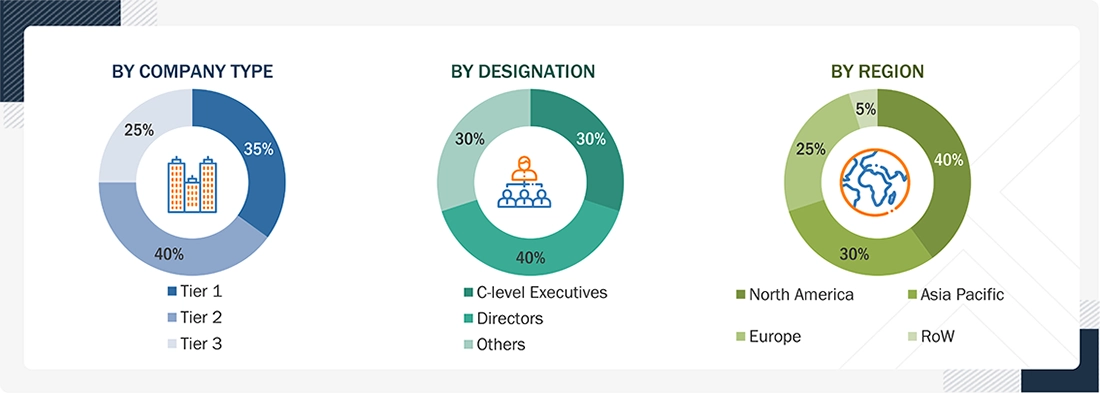
Notes: Tier 1 companies include market players with revenues above USD 500 million; tier 2 companies earn revenues between USD 100 million and USD 500 million; and tier 3 companies earn revenues up to USD 100 million.
Other designations include sales, marketing, and product managers.
To know about the assumptions considered for the study, download the pdf brochure
Market Size Estimation
In the complete market estimation process, the top-down and bottom-up approaches were used, along with several data triangulation methods, to estimate and forecast the size of the market and its segments and subsegments listed in the report. Extensive qualitative and quantitative analyses were carried out on the complete market engineering process to list the key information/insights pertaining to the 3D printing market.
Key players in the 3D printing market were identified through secondary research, and their rankings in the respective regions were determined through primary and secondary research. This entire procedure involved the study of the annual and financial reports of top players and interviews with industry experts, such as chief executive officers, vice presidents, directors, and marketing executives, for quantitative and qualitative insights. All percentage shares, splits, and breakdowns were determined using secondary sources and verified through primary sources. All parameters that affect the markets covered in this research study were accounted for, viewed in extensive detail, verified through primary research, and analyzed to obtain the final quantitative and qualitative data. This data was consolidated and enhanced with detailed inputs and analysis from MarketsandMarkets and presented in this report.
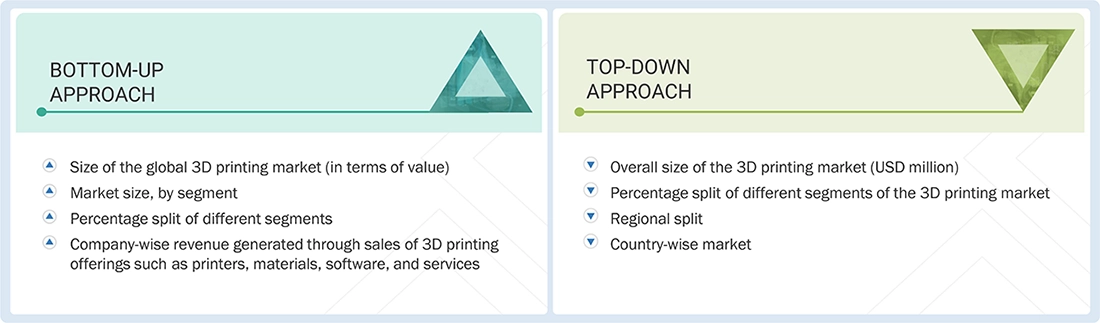
BOTTOM-UP APPROACH
- Identifying the entities in the 3D printing market influencing the entire market, along with the related players, including material, printer, software, and service providers
- Analyzing major manufacturers of 3D printing offerings, studying their portfolios, and understanding different types of printers, including desktop and industrial ones
- Analyzing the trends pertaining to the use of different types of 3D printers for different kinds of applications, technologies, and processes
- Tracking the ongoing and upcoming market developments, such as investments made, R&D activities, government support, product launches, collaborations, and partnerships, and forecasting the market based on these developments and other critical parameters
- Carrying out multiple discussions with key opinion leaders to understand the different types of printers and materials, services, verticals, technologies, and recent trends in the market, thereby analyzing the breakup of the scope of work carried out by major companies
- Arriving at the market estimates by analyzing revenues of the companies generated from each type of printer, material, software, and service, and then combining the same to get the market estimate
- Segmenting the overall market into various other market segments
- Verifying and cross-checking the estimate at every level from the discussion with key opinion leaders, such as CXOs, directors, and operations managers, and finally with the domain experts in MarketsandMarkets
- Studying various paid and unpaid sources of information, such as annual reports, press releases, white papers, and databases
TOP-DOWN APPROACH
- Focusing initially on top-line investments and expenditures being made in the ecosystems of the 3D printing market
- Calculating the market size considering the revenues generated by players through the sales of 3D printers, materials, software, and services
- Further segmenting on the basis of the mapping usage of 3D printing for different applications and verticals
- Building and developing the information related to the revenues generated by players through offerings
- Conducting multiple on-field discussions with key opinion leaders across major companies involved in the development of 3D printing technology
- Estimating the geographic split using secondary sources based on various factors, such as the number of players in a specific country and region, the role of major players in the market for the development of innovative products, adoption and penetration rates in a particular country for various verticals, government support, investments, and others
3D Printing Market : Top-Down and Bottom-Up Approach
Data Triangulation
After arriving at the overall size of the 3D printing market from the estimation process explained above, the market was split into several segments and subsegments. The data triangulation and market breakdown procedures were employed (wherever applicable) to complete the overall market engineering process and arrive at the exact statistics for all segments and subsegments. The data was triangulated by studying various factors and trends from both the demand and supply sides. The size of the 3D printing market was validated using both top-down and bottom-up approaches.
Market Definition
Three-dimensional (3D) printing is the process of building a real 3D object from a digital model by joining thin layers of materials (which might be in solid, powder, or liquid forms), usually layer-upon-layer in horizontal cross-section, unlike subtractive manufacturing methods. It is also known as additive manufacturing (AM) or freeform fabrication. 3D printing is the most common term in the consumer markets, while AM is mostly used in the industrial markets. 3D printing is used for prototyping, tooling, and functional part manufacturing. The manufactured functional parts are used in various verticals, such as automotive, aerospace, healthcare, jewelry, education, tooling, consumer goods, and art & architecture.
Key Stakeholders
- 3D printing product and solution providers
- 3D printing-related service providers
- 3D printing material and accessory providers
- 3D printing consulting companies
- 3D printing assembly companies
- 3D printing software providers
- 3D printing-related associations, organizations, forums, and alliances
- Government and corporate offices
- Venture capitalists, private equity firms, and startup companies
- Distributors and traders
- End users willing to know more about 3D printing technologies and the latest technological developments in the 3D printing market
Report Objectives
- To define, describe, and forecast the 3D printing market based on offering, process, technology, application, vertical, and region
- To forecast the market size, in terms of value, for various segments, with respect to four main regions—North America, Europe, Asia Pacific, and Rest of the World (RoW)
- To forecast the market size for printer types, in terms of volume
- To provide detailed information regarding the major factors influencing the growth of the 3D printing market (drivers, restraints, opportunities, and challenges)
- To provide trends/disruptions impacting customers’ businesses, value chain analysis, ecosystem analysis, investment and funding scenario, case study analysis, key conferences and events, patent analysis, technology analysis, average selling price (ASP) analysis, Porter’s five forces analysis, key stakeholders and buying criteria, and regulations pertaining to the market
- To strategically analyze micromarkets with respect to individual growth trends, prospects, and contributions to the total market
- To analyze opportunities for the stakeholders by identifying high-growth segments of the 3D printing market
- To benchmark players within the market using the proprietary Company Evaluation Matrix framework, which analyzes market players on various parameters within the broad categories of market rank and product offerings
- To strategically profile the key players and comprehensively analyze their market shares and core competencies and provide a detailed competitive landscape for market leaders
- To analyze competitive developments such as partnerships, collaborations, agreements, joint ventures, mergers and acquisitions, expansions, and product launches in the 3D printing market
Available customizations:
With the market data given, MarketsandMarkets offers customizations according to the company’s specific needs. The following customization options are available for the report:
Company Information
- Detailed analysis and profiling of additional market players (up to 7)
Key Questions Addressed by the Report
What is the current size of the global 3D printing market?
The global 3D printing market is projected to reach USD 16.43 billion in 2026.
How large is the 3D printing market expected to become by 2032?
The market is projected to reach USD 31.77 billion by 2032, growing at a CAGR of 11.6% from 2026 to 2032.
What are the major trends shaping the 3D printing industry?
Key trends include digital manufacturing, industrial 3D printing, bioprinting, automated 3D printing, advanced printing materials, and hybrid additive-subtractive manufacturing.
What are the main growth drivers for the 3D printing market?
Major growth drivers include increasing demand for customized products, reduced tooling requirements, faster prototyping, design flexibility, cost-effective small-batch production, and sustainable manufacturing.
Which companies are the key players in the 3D printing market?
Key players include Stratasys, EOS GmbH, HP Development Company, 3D Systems, GE Aerospace, Materialise, Nano Dimension, voxeljet, SLM Solutions, and Renishaw.
Which offering segment dominates the 3D printing market?
Services accounted for the largest share of the offering segment, representing 36.1% of the market in 2025.
Which 3D printing technology is expected to grow fastest?
Stereolithography (SLA) is expected to register the highest CAGR among the covered technologies, at 14.2% during the forecast period.
Which region held the largest share of the 3D printing market?
North America accounted for the largest regional share, representing 36.8% of the market in 2025.
Which industry vertical is expected to hold the largest share of the 3D printing market?
The automotive industry is expected to account for the largest share of the 3D printing market in 2026, driven by increasing adoption for prototyping, tooling, lightweight components, and customized parts.
What does the 3D printing market report analyze?
The report analyzes the market by offering, technology, process, application, vertical, and region, along with the competitive landscape, growth drivers, trends, opportunities, restraints, and challenges.
Fact checked
Personalize This Research
- Triangulate with your Own Data
- Get Data as per your Format and Definition
- Gain a Deeper Dive on a Specific Application, Geography, Customer or Competitor
- Any level of Personalization
Let Us Help You
- What are the Known and Unknown Adjacencies Impacting the 3D Printing Market
- What will your New Revenue Sources be?
- Who will be your Top Customer; what will make them switch?
- Defend your Market Share or Win Competitors
- Get a Scorecard for Target Partners

Custom Market Research Services
We Will Customise The Research For You, In Case The Report Listed Above Does Not Meet With Your Requirements
Get 10% Free CustomisationTESTIMONIALS

Tetsuya Ohhira
Business Development Manager-Technology Business
Nikon Corporation,
Leading Japanese MNC specializing in optics and imaging productswww.nikon.com
MarketsandMarkets™ response
is quick. Their attitude is flexible and positive. Analyst Insights are globally considered and
significant. Client Services quickly respond to our inquiry and demand. Their wide range of global
surveys help us make our strategic plan.
We hope Knowledge Store will be easier to search
for a report.
VP - Marketing & Business Development
Leading Provider of Process Control Solutions
We engaged with MarketsandMarkets on a study to perform an analysis and recommend a Go-To-Market strategy for metrology and process control in the semiconductor market. The study was tailored to our targets and needs with well-defined milestones. Our overall experience with the MarketsandMarkets team was very good throughout the project in all aspects including the analysis methodologies used, the quality and depth of primary and secondary data sets, the professionalism and flexibility of the team and the ability to meet the target schedule and milestones. We want to thank MarketsandMarkets team for a job well done.
- US 3D Printing Market
- Canada 3D Printing Market
- Mexico 3D Printing Market
- Germany 3D Printing Market
- UK 3D Printing Market
- France 3D Printing Market
- Spain 3D Printing Market
- Italy 3D Printing Market
- Rest Of Europe 3D Printing Market
- China 3D Printing Market
- Japan 3D Printing Market
- South Korea 3D Printing Market
- India 3D Printing Market
- Rest Of Asia Pacific 3D Printing Market
- GCC 3D Printing Market
- Rest Of Middle East 3D Printing Market
Growth opportunities and latent adjacency in 3D Printing Market






Erin
Nov, 2016
SWOT analysis Porter's 5 Forces Barriers to Entry. I am a student and cannot afford to buy the full report on 3d printing, your help is appreciated! .
Miguel
Dec, 2016
Interested in finding out about Food and Biomedical printing market. Please send me a cost for the report..
Alejandro
May, 2019
Wish to have a better understanding of the markets and trends for 3D Printing and how they will influence the local Mexican market, needs of plastic materials according to the main markets and growth..
Pete
Jan, 2014
I am interested in knowing the below information- Market sizes, segmentation, and estimated growth. Variety of Healthcare and Building/Industrial product and service categories..
Alexander
Apr, 2026
How is the adoption of 3D printing technology transforming industries such as automotive, healthcare, aerospace, and construction in terms of cost, efficiency, and customization?.
Christopher
Apr, 2026
What role does artificial intelligence play in improving quality control, defect detection, and process optimization in the 3D printing market?.
Willy
Apr, 2026
How does 3D printing contribute to sustainability, including waste reduction, energy efficiency, and supply chain optimization in modern manufacturing?.
sushant
Apr, 2022
To understand the trajectory of consumer adoption of 3d printing services. Opportunities in consumer side vs B2B segment. .
utkarsh
Apr, 2019
We want to emerge in 3D prototyping industry and want to know the market size and opportunity..
Roy
Sep, 2019
I am looking for an up to date global market reports on 3D printing and conventional injection molding. Can you provide a free sample for reference?.
Marc
Jun, 2019
We are planning to set up an R&D ALM technology platform in Vernon France. I need some market figures to substantiate our claim that Additive manufacturing is a disruptive technology that will affect all manufacturing..
Maximilian
Jun, 2014
We are looking for the 3D printing healthcare market in particular. I want to ask how much the healthcare chapter would cost and whether it would be possible to buy it separate from the rest of the report. We are looking for the market size of the 3D printing healthcare market (some numbers, growth rates etc.). If you could contact me tomorrow right away that would be more than awesome..
Heddy
May, 2019
I am a communication and marketing intern at IMCD. I would like to request a pdf brochure of 3D printing as part of my assignment..
william
Mar, 2019
I am writing a report as part of my part time degree at university, as part of the business side of the degree. I have to write a report on a business. I have chosen a 3D printing business and require information regarding the growth of the market and sustainability etc..
Josef
Apr, 2019
I am very interested in how you have developed its 3D printing report - about 5 years ago I didn't have such a good experience with one of your reports..
Natalia
Nov, 2015
I'm interested on this chapters: 5.4.2 Market Restraints 5.4.2.1 Issues Related to Material Availability, Cost, Quality, Development & Validation, Standardization, and Characterization 5.4.2.1.1 Material Availability & Cost 5.4.2.1.2 Material Development & Validation 5.4.2.1.3 Material Standardization & Characterization 5.4.2.1.4 Material Quality 5.4.2.2 Lack of Standardized Equipment and Process Control .
Nirmal
Jun, 2016
I am currently studying my MBA. I am writing a thesis on the 3d printing industry. Due to my budget constraints, is there any possibility of getting the market info on the filaments section as well as market data on the paints that could be applied to 3D printed objects ( DIY 3d printed object paints)? Any information would be really helpful..
Fahima
May, 2019
We are a team that research about Holographic 3D printing. We need some help about product development, potential customer segment, SLA 3D printing limitations, Resin or photo polymer. Please provide a pdf brochure of the report..
Alexey
Apr, 2019
There is the need for researching market of 3D-Printing of our time for developing new technologies which improves product of 3D-printers. Can I get a pdf brochure of 3D printing report?.
Matthew
Nov, 2017
I would be particularly interested in the information related to the applications of 3D printing in the healthcare setting.
Helena
Apr, 2016
I am interested in the following - 1. Applications of 3D printing, especially in medicine. 2. Expected social changes induced by 3D printing. .
Adam
Feb, 2014
I am interested in what the report has to say about the market for 3D printers that print metal for a project I am working on..
Sandra
Aug, 2014
I am doing some research into the competitive landscape of 3D printing and would be grateful if you can clarify whether your report has some of the data I am looking for . Primarily, I am looking for: - Total 3D Printing market segmented by technology (revenue and units) - Each technology segmented by company (e.g. how what % of the total FDM market revenue was Strategy) - Total 3D Printing market segmented by company (revenue and units) - Competitive offering analysis by company? I know your table of contents mentions some of the above, but if you can confirm which of the above you have that would be great..
Harb
Sep, 2019
Trying to learn about both technologies and market size related Metal Additive Manufacturing industry. Any more information will be helpful..
Harb
Sep, 2019
Trying to learn about both technologies and market size related Metal Additive Manufacturing industry. Any more information will be helpful..
Max
Sep, 2019
I am writing content for 3D Printed Talent's new website and would like to gain valuable statistics on the AM industry, in particular the employment aspects. From reading the abstract there is a lot here that is relevant to my needs..
jorge
Jan, 2016
Can I get more information about the emerging technologies and trends in the 3D printing market?.
Carlos
Nov, 2013
I am interested in the following chapters of the 3d printing report: SLS and EBM (metal additive manufacturing) in medical sector, mainly orthopedic applications, USA, rest of America, EU, Asia-Pacific, ROW..
Meike
Mar, 2016
I'm interested in the size of EBM market as for this technology vacuum is needed. It would be very helpful if you could send me a sample of this report..
Dan
Mar, 2020
I am studying the 3D Printing market and would like to know the market size for the US. Also, is there a secondary market for used equipment?.
Antonio
Jun, 2019
I am currently working on a project to define the overall strategy for HP MJP in the US. I would like access to this information on 3d printing to get a overall view and do a benchmark analysis about the opportunities we might have in the US..
Nicole
Feb, 2019
Do you provide the 3D printing report only for specific chapters? I am interested in the Application and Geography chapter of the report..
Anthony
Dec, 2018
I'm doing a broad research on the 3D printing market and therefore I'm interested in your 230 pages document about it..
Antonio
Dec, 2019
I am doing a market research and benchmark analysis in order to define the 3D printing strategy for HP in Latam. Can you share a PDF copy of this report?.
Michael
Dec, 2014
I am looking for the following information: Market Size and Number of Machines (Projection) for 3D Printing concepts that use Energy Curing (UV). Preferably specific to Polymer-Type concepts.
Joffrey
Nov, 2013
I'm interested in theses chapters: 4. 3D Printing Market Overview 7. 3D Printing Market By Application 9. Competitive Landscape.
Kavitha
Nov, 2015
I am looking to have analysis of the market in Middle-East 1. Advanced manufacturing (with a specific focus on 3D printing) 2. Applied mechanics 3. Automotive: Smart Materials, Adaptive Structures and Intelligent Systems 4. Bioengineering: Nano engineering for Medicine and Biology 5. Design engineering 6. Energy: Renewable, Solar, Sustainability, Transition 7. Gas Turbines 8. Hydraulic fracturing 9. Mechatronics .
Prabir
Nov, 2015
Material Characterization and Component qualification. Interested in seeing samples of chapter 3, and sections 5.3, 7.4, 7.5, and 8.3 of 3D printing market report.
Yasser
Nov, 2014
Thank you for sending a free sample of the most economical 3D printers market in The UK and GCC countries.
Giulia
Oct, 2015
I am interested in knowing the areas of interest of major companies operating with 3D printing technology, in particular fashion and fabric development..
rania
Oct, 2014
In addition to the list above, I am interested in information about the 3d printing services market, bureaus sales and competition, service bureaus challenges for getting clients, opportunities for providing services etc..
Nikolai
Sep, 2017
We provides prototyping, 3D printing, and manufacturing services for its PCB design and 3D modeling. We are interested in this report on 3D printing and would like to get more information about the same..
Jörg
Sep, 2019
Is it possible to have a sample of the 3D printing report to see if it is suitable for us?.
chinthaka
Sep, 2016
I have an interest to know the said , hence send me necessary details for me to commence with the requirements. Will it cost more than $ 5000 ? Request details of all type of printing by 3 D system. .
Daniel
Sep, 2014
I am specifically interested in 3D/FDM substrate markets by polymer type and converter or producer of filament..
Frederik
Sep, 2019
I'm writing my bachelor thesis about the impact of 3D-Printing on the existing supply chains and I would like to ask if I can get a free copy of the report "3D Printing Market by Offering (Printer, Material, Software, Service), Process (Binder Jetting, Direct Energy Deposition, Material Extrusion, Material Jetting, Powder Bed Fusion), Application, Vertical, Technology, and Geography - Global Forecast to 2024". If you need any further information don't hesitate to contact me..
Malek
Aug, 2019
We are opening a new line of 3d printing and additive manufacturing in the Middle East especially in Lebanon. Can I get a free sample of this report?.
Andreas
Aug, 2014
I am interested in 3D printing market data concerning thermoplastics material use. More concretely, I am interested in polyolefin (polypropylene, polyethylene). Do you have any market data that breaks down the thermoplastics used? In addition, do you have information about further trends in this regard?.
Pratyaksh
Aug, 2019
I am interested in the following - 1. Scalability with Additive Manufacturing 2. Durability of materials as far as industrial-grade fasteners are concerned 3. Supply side considerations..
Manolo
Aug, 2019
We are about to carry out a market scouting 2019 for additional 3D manufacturers and service providers both for metallic and non-metallic. A market scouting was already carried out in 2016 and we want to get an update..
Andy
Jul, 2014
We have 3D printers which make sand moldings to produce metal castings in short lead time. I would like to have the market size and volume for prototyping parts in industrial and energy industries..
Bradley
Jul, 2016
Is it possible to purchase just the following tables from the report? Table 69 Market, By Service, 2014–2022 (USD Million) Table 70 3D Printing Services Market, By Technology, 2014–2022 (USD Million) Table 71 3D Printing Services Market, By Vertical, 2014–2022 (USD Million) Table 72 3D Printing Services Market, By Application, 2014–2022 (USD Million) Table 73 3D Printing Services Market, By Region, 2014-2022.
Anthony
Jul, 2019
I'm looking for the biggest players in the 3D consumer printing materials market because I may be interested in selling 3D consumer printing materials..
Dipl.-Ing..Feyyaz
Jun, 2016
I am a PHD student and my topic of research is related to 3D printing. Do you provide a free sample of this report?.
Markus
May, 2019
As a board member of a start-up company I would like to get a high-level overview about the 3D printing market, in particular about the North America and Europe regions..
Cornelius
May, 2019
Wanting to find some statistics for projected growth of the 3D printing market, both in general and with regards to specific technologies, as well as key growth industries. .
R.VISHNUVARDHAN
May, 2017
We are interested to continue with your support for our research on 3D-printing. Our institute is entitled with well furnished "RESEARCH AND DEVELOPMENT CENTER" . We are expecting a sample of 'PLA, Aluminum filament from you. If it gives better result than the earlier one's, we are ready to get all the filaments from your company..
Dr.
May, 2017
We are interested to step forward with your support to do our research on 3D-printing, our institute is entitled with well furnished "RESEARCH AND DEVELOPMENT CENTER" we are expecting a sample of 'CARBON FIBER OR Aluminum filament from you. If it gives better result than the earlier one's, we are ready to get all the filaments from your company..
Dr.
May, 2017
We are interested to step forward with your support to do our research on 3D-printing, our institute is entitled with well furnished "RESEARCH AND DEVELOPMENT CENTER" we are expecting a sample of 'CARBON FIBER OR Aluminum filament from you. If it gives better result than the earlier one's, we are ready to get all the filaments from your company..
User
Apr, 2020
kindly provide some sales strategy for 3d printer sales.
Keaton
Apr, 2019
Looking to start a business in the 3D printing market and need information about the market as a whole to determine whether or not the business plan is viable..
Sarah
Apr, 2019
I am a graduate student working on a marketing plan for an additive manufacturing company. Do you provide free samples of reports?.
Sarah
Apr, 2019
Searching for detailed information on the additive manufacturing market to assess the viability of a new market entrant. Having access to your extensive research as soon as possible would be extremely helpful. .
rakesh
Apr, 2015
I want to explore the 3D printing Market, different technology, different applications, limitations of process machines and materials. Also, I want to know the global forecast especially Indian market. Economics of 3D printing..
Volker
Apr, 2014
Do you provide only country specific data for 3D printing report?.
jochen
Mar, 2019
I am involved in development of polymers for SLA, DLP, Polymer Solutions, create new application Areas and optimize characteristics of 3D printed object towards longer lifetime and stability/reliability. Please provide a sample for this report..
Jorge
Mar, 2016
I want to know the potential for 3d Printing and services in Colombia, South America. I am looking for partnerships..
Dmitry
Feb, 2018
We have task in university course to write short article about market share of 3D printing. Can you share some information?.
Roberto
Feb, 2019
I'm currently studying the market of 3D printing in Puerto Rico and the United States and I want to know the number of people uses 3D Printing for hobby or home use. .
Tim
Feb, 2019
I oversee the world's first additive manufacturing & design graduate program and teach 3D printing/additive manufacturing courses. I want to make sure that our courses and graduates are aligned to meet the demands that you (and others) are forecasting. Can I get a sample of the report?.
Rushana
Jan, 2018
I want to know more about 3D printing technology and latest technological developments in the 3D printing market..