Data center Laminated Busbar Market

Data Center Laminated Busbar Market by Conductor Material (Copper, Aluminum, Hybrid), Data Center Type (Hyperscale, Colocation, Enterprise), Current Rating, Application, and Region - Global Forecast to 2031


OVERVIEW
Source: Secondary Research, Interviews with Experts, MarketsandMarkets Analysis
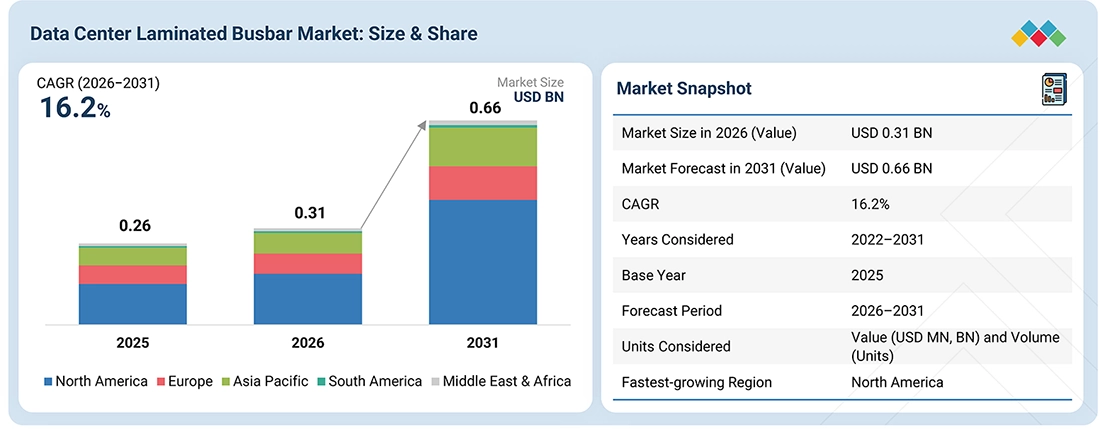
The data center laminated busbar market is valued at USD 0.26 in 2025, is estimated at USD 0.31 in 2026, and is projected to reach USD 0.66 by 2031, growing at a 16.2% CAGR. This growth is driven by the pace of AI and hyperscale data center construction, which is increasing the power equipment each facility needs. Rack power density is rising well above conventional levels. Hence, operators need compact, low-loss ways to carry higher currents in limited space. Laminated busbars offer lower impedance, better heat spreading, and a smaller footprint than cable-based connections. The shift toward higher-voltage DC power architectures and the wider use of silicon carbide and gallium nitride power semiconductors are adding demand for low-inductance, well-insulated power paths in power conversion stages. Operators are also moving to modular, prefabricated power systems and open rack standards, which favor engineered, repeatable busbar assemblies and shorten deployment times. Together with a growing focus on efficiency and uptime, these factors are lifting both the volume and the value of busbar content per facility through 2031.
KEY TAKEAWAYS
-
BY REGIONNorth America is the fastest-growing region in the data center laminated busbar market, registering a CAGR of 19.6% during the forecast period.
-
BY CONDUCTOR TYPEThe copper segment holds the largest share of 74.0% of the overall market in 2025.
-
BY DATA CENTER TYPEThe hyperscale segment is the fastest-growing data center type in the overall market during the forecasted period.
-
BY CURRENT RATINGThe above 3,000 A segment is projected to register the highest CAGR during the forecast period.
-
BY APPLICATIONThe switchgear & power distribution segment is estimated to be the largest application of the data center laminated busbar market in 2025.
-
COMPETITIVE LANDSCAPE - KEY PLAYERSMersen (France) and Amphenol IPC (US) are star players due to their established manufacturing capabilities, extensive laminated busbar portfolios, and proven solutions for data center power distribution, including server racks, UPS systems, and power distribution units (PDUs).
-
COMPETITIVE LANDSCAPE - STARTUPS/SMESBaknor (Canada) and Xiamen Apollo Stamping Welding Technology Co., Ltd. (China) are considered SMEs and emerging players due to their specialized busbar manufacturing capabilities, customized product offerings, and narrower market presence compared with established global players.
The market is seeing several new trends. Manufacturers are developing liquid-cooled busbar designs that combine power distribution and thermal management in a single assembly, and they are increasingly integrating busbars with capacitors and cooling elements into complete power modules. Product development is moving toward high-ampacity designs for megawatt-class AI racks and toward insulation systems suited to higher-voltage DC distribution. Aluminum and hybrid conductor designs are gaining attention as a way to manage copper price volatility and reduce weight. Alignment with open rack specifications is becoming a key factor in qualifying with hyperscale customers, and hyperscale operators are emerging as the main source of incremental demand, with power conversion systems among the fastest-growing applications.
TRENDS & DISRUPTIONS IMPACTING CUSTOMERS' CUSTOMERS
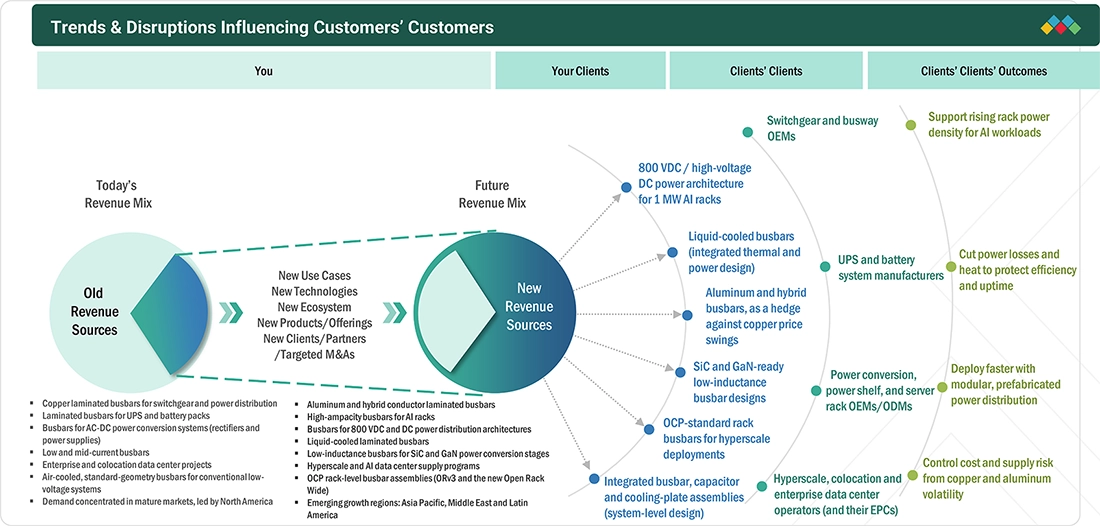
The data center laminated busbar market is being influenced by rising power demand from artificial intelligence (AI), high-performance computing, and hyperscale data centers. As server racks require more power within limited space, data center operators are increasingly focused on compact, high-current power distribution solutions that improve space utilization and support reliable power delivery. This is creating demand for laminated busbars with higher current-carrying capacity, low-inductance designs, and effective thermal performance. At the same time, the need to improve energy efficiency and manage heat is encouraging manufacturers to develop busbars that integrate more effectively with power conversion equipment, uninterruptible power supply (UPS) systems, and advanced cooling infrastructure. Changes in power distribution architectures and the expansion of modular data center designs are also influencing customer requirements. Emerging high-voltage DC architectures, including 800 VDC, are creating opportunities for specialized laminated busbars, although adoption remains at an early stage and varies across applications. Data center operators also expect suppliers to provide reliable products, consistent quality, shorter delivery times, and designs that can be scaled as capacity expands. However, fluctuations in copper and aluminum prices, customization costs, and stringent electrical and thermal performance requirements create challenges for manufacturers. Companies that combine efficient production, material optimization, and flexible product designs will be better positioned to meet evolving customer needs.
Source: Secondary Research, Interviews with Experts, MarketsandMarkets Analysis
MARKET DYNAMICS

Level
-
Rising Rack Power Density from AI and Hyperscale Data Center Buildout

-
Increasing Adoption of High-Voltage DC Power Distribution Architectures


Level
-
Copper and Aluminum Price Volatility

-
High Cost of Custom, Low-Volume Laminated Busbar Manufacturing


Level
-
Development of High-Ampacity Laminated Busbars for Megawatt-Class AI Racks

-
Integration of Laminated Busbars with Capacitors and Liquid-Cooling Assemblies


Level
-
Managing Heat and Current Density at Multi-Kiloampere Ratings

-
Moving from Custom Engineering to Scalable Volume Production

Source: Secondary Research, Interviews with Experts, MarketsandMarkets Analysis
Rising Rack Power Density from AI and Hyperscale Data Center Buildout
AI training and inference workloads are pushing rack power well beyond the levels that traditional enterprise data centers were designed for. Hyperscale operators are building new campuses around accelerated computing, and each rack now draws far more current than a conventional server rack. That current has to be carried inside very little space, which makes laminated busbars attractive. Their stacked, insulated conductors carry high currents with lower losses and a smaller footprint than cable bundles. As rack power heads toward the megawatt class, more busbar content is needed per rack, so demand grows with every new AI deployment.
Copper and Aluminum Price Volatility
Conductor metal is the highest single cost in a laminated busbar. As a result, swings in copper and aluminum prices flow directly into supplier margins and customer pricing. Hyperscale buyers usually negotiate large programs over long horizons, making it hard for manufacturers to pass through sudden metal cost increases. Price uncertainty also complicates quoting and inventory decisions and pushes some buyers to reconsider material choices. Manufacturers can partly hedge with metal-indexed contracts or with aluminum and hybrid designs, but those add engineering effort. Volatility therefore persistently drags on profitability and buyers’ willingness to commit early.
Development of High-Ampacity Laminated Busbars for Megawatt-Class AI Racks
As AI racks move toward the megawatt class, the power path inside the rack has to carry currents far beyond what earlier busbar designs handled. This opens a premium segment for suppliers that can deliver very high current capacity with controlled temperature rise, tight tolerances and compliance with open rack standards. Success here depends on thicker or multi-conductor structures, better thermal paths and robust insulation. Early movers that qualify designs with hyperscalers and server makers can lock in multi-year programs and move up the value chain from components to engineered power-distribution assemblies.
Managing Heat and Current Density at Multi-Kiloampere Ratings
At very high currents, resistive losses generate substantial heat in a small volume, and laminated structures with insulation between conductors can trap that heat. Temperature rise then limits current capacity, degrades insulation over time and threatens reliability in a facility that cannot afford downtime. Designers must balance conductor cross-section, insulation material, airflow or liquid cooling, and connection quality, since terminations are often the hottest points. Meeting these requirements without making the busbar bulky or costly is a hard engineering problem, and it will define which suppliers can serve the next generation of AI racks.
DATA CENTER LAMINATED BUSBAR MARKET: COMMERCIAL USE CASES ACROSS INDUSTRIES
| COMPANY | USE CASE DESCRIPTION | BENEFITS |
|---|---|---|
 |
Developed a two-conductor laminated busbar for distributing 48 V DC power to eight server blades in a large server system. The design incorporates blind-mate power connectors and monitoring cable assemblies. | Supports power distribution to eight server blades | Enables compact backplane integration | Simplifies power connections through blind-mate connectors | Supports power-system monitoring |
 |
Developed liquid-cooled busbars for AI data center cabinets, installed vertically at the rear of the racks to distribute power between power supply units, servers, GPUs, and other electrical components. The company reported nearly 1,000 sets delivered for commercial deployment in July 2026. | Improved heat dissipation | Reduced power transmission losses | Enabled modular cabinet-level power distribution | Supported reliable, continuous AI server operation |
 |
Designed and manufactured precision-engineered busbars for a global social media platform's data center operations. The project involved copper sourcing, prototype development, electrical testing, electroplating, quality control, and a traceable global supply chain. | 20% total cost saving | Reduced assembly times | Zero non-conforming components reported | Improved manufacturing consistency | More reliable global supply chain |
Logos and trademarks shown above are the property of their respective owners. Their use here is for informational and illustrative purposes only.
MARKET ECOSYSTEM
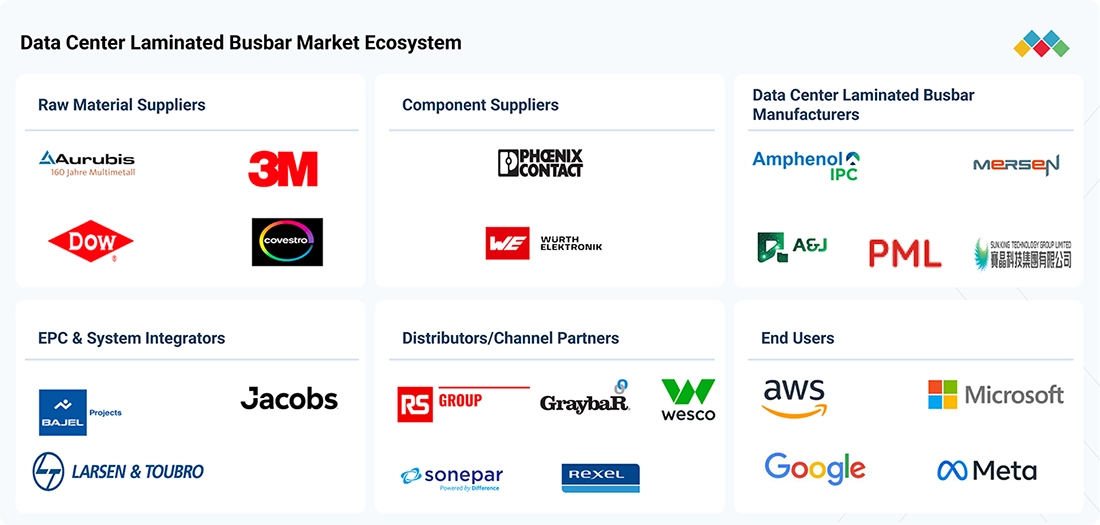
The data center laminated busbar market ecosystem includes raw material suppliers, component suppliers, laminated busbar manufacturers, EPCs and system integrators, distributors/channel partners, and end users. Aurubis (Germany) and 3M (US) supply materials used across industrial and electrical applications, while TE Connectivity (Ireland) and Phoenix Contact (Germany) provide electrical and connectivity components. Key laminated busbar manufacturers include Amphenol IPC (US) and Mersen (France), which develop power distribution solutions for server and data center applications. In the EPC and system integration segment, Larsen & Toubro (India) and Jacobs (US) support infrastructure and engineering projects. RS Group (UK) and Graybar (US) operate as distributors of electrical and industrial products, connecting manufacturers with customers. Principal end users include Amazon Web Services (US) and Microsoft (US), which operate large data center infrastructures and need reliable, efficient power distribution systems.
Logos and trademarks shown above are the property of their respective owners. Their use here is for informational and illustrative purposes only.
MARKET SEGMENTS
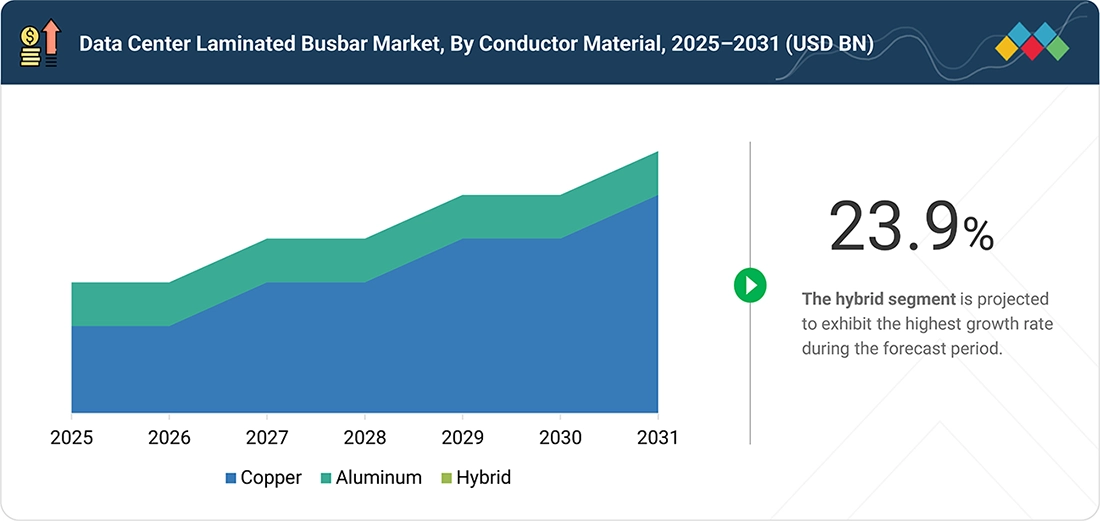
Source: Secondary Research, Interviews with Experts, MarketsandMarkets Analysis
Data center laminated busbar market, by conductor material
Copper holds the largest share of the data center laminated busbar market in 2025, mainly because its electrical and thermal properties suit the demands of high-density data center power distribution. Copper’s high conductivity allows busbars to carry large currents with lower resistive losses and less heat. It also allows thinner, more compact conductor layers, which matters in space-constrained switchgear, power conversion systems, UPS units, and rack-level power shelves. Its good thermal conductivity and mechanical strength support reliable performance under sustained high loads, a critical requirement for facilities where downtime is costly. Copper is also the long-established conductor in laminated busbar manufacturing. As a result, mature production processes, plating and termination practices, and customer qualification histories are already in place. This makes copper the lower-risk choice for equipment makers and data center operators designing for reliability. Copper remains the default choice for high-performance applications, even as aluminum and hybrid conductors gain interest as ways to manage cost and weight.
Data center laminated busbar market, by data center type
Hyperscale accounted for the largest share of the data center laminated busbar market in 2025. These operators build the largest facilities and deploy the most power-dense infrastructure. Hyperscale campuses are designed around AI and cloud workloads, which require higher rack power, more compact power distribution, and greater efficiency than typical enterprise or colocation sites. These facilities use large volumes of power equipment, including switchgear, power conversion systems, UPS and battery systems, and rack-level power shelves, all of which use laminated busbars. Hyperscale operators also build repeatable, standardized designs and place large, multi-site orders, giving busbar manufacturers scale and visibility across production runs. Their purchasing is closely tied to open rack standards and advanced power architectures. They are often the first to adopt higher-current, liquid-cooled and higher-voltage DC busbar designs. Their capacity-expansion plans and technical specifications therefore shape both the volume and the direction of demand, while colocation and enterprise facilities typically follow with smaller, more varied deployments.
Data center laminated busbar market, by current rating
The 250–1,000 A current rating segment accounted for the largest share of the data center laminated busbar market in 2025 because it covers the current levels at which most data center power equipment operates. Laminated busbars are used mainly inside equipment such as power conversion systems, UPS & battery modules, power shelves and rack- and row-level distribution, and the internal power paths typically fall within this mid-current range. Busbars rated below 250 A suit smaller, lower-power connections that make up a modest share of the content, while very high-current designs are limited to the largest feeders and a smaller number of specialized AI deployments. The mid-range also offers a practical balance of current capacity, size, thermal performance, and cost, so it can be produced in repeatable designs and larger volumes than the custom, high-ampacity assemblies. Equipment makers can standardize these ratings across many product platforms, supporting consistent demand from hyperscale, colocation and enterprise customers. As a result, this rating stays the volume core of the market even as higher-ampacity designs grow faster with rising AI rack power.
Data center laminated busbar market, by application
The switchgear and power distribution segment accounted for the largest share of the data center laminated busbar market in 2025. This segment forms the primary path through which power enters and is distributed across a facility. Every data center, regardless of size or type, needs medium- and low-voltage switchgear, switchboards, and distribution panels to receive utility power, protect circuits, and route electricity to critical loads. These assemblies carry high currents in tight enclosures, so they rely heavily on laminated busbars for compact layouts, low impedance, reliable connections and better heat dissipation than cable-based alternatives. The application also benefits from its breadth. It is present in new builds, capacity expansions and retrofits, and across hyperscale, colocation, and enterprise sites, which gives it a wider and steadier demand base than more specialized applications. Switchgear and distribution equipment is also built to well-established standards and qualification practices, which favors proven busbar designs and supports repeat orders. As data center capacity grows and operators prioritize modular, prefabricated power distribution, this application keeps the largest share of busbar content, even as power conversion and DC distribution grow in importance.
REGION
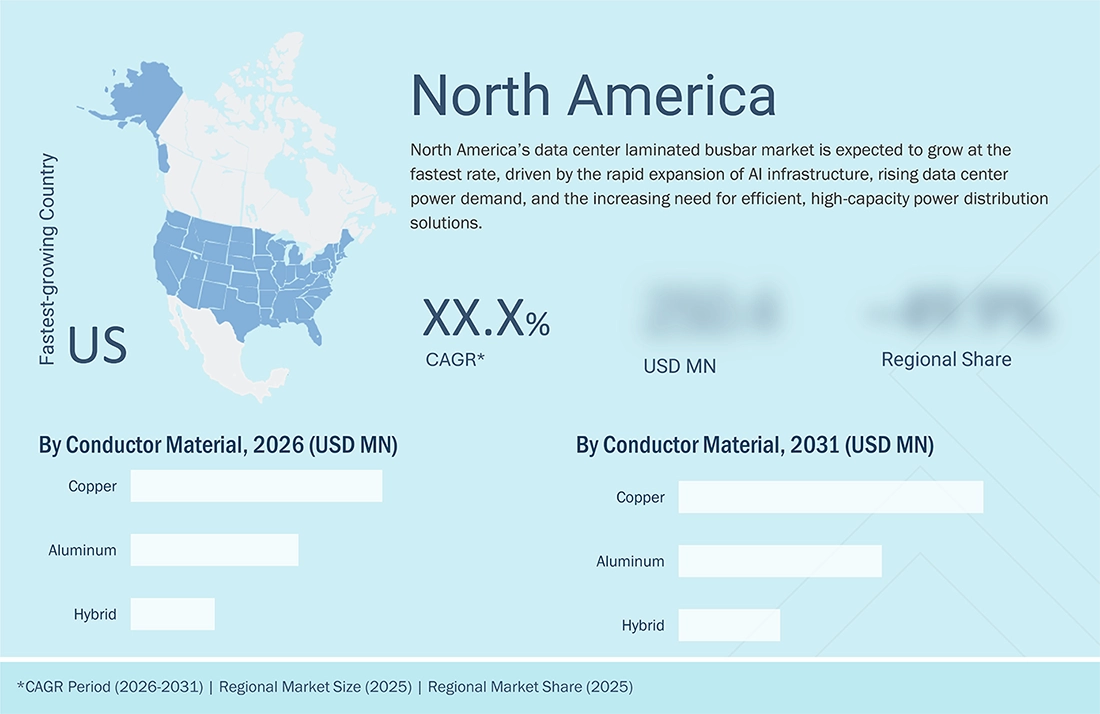
North America to register highest CAGR in data center laminated busbar market during forecast period
North America is the fastest-growing region in the data center laminated busbar market, driven by the scale and pace of AI and hyperscale data center buildout across the US and Canada. Large cloud and AI operators are committing to new campuses and capacity expansions, and each new facility needs high-density power distribution built around switchgear, power conversion systems, UPS and battery systems, and rack-level power shelves, all of which use laminated busbars. The region is also an early adopter of next-generation power architectures, including higher-current, liquid-cooled and higher-voltage DC designs. A strong base of data center equipment makers, power electronics manufacturers, and busbar suppliers shortens design cycles and supports close collaboration with hyperscale customers. Efforts to secure local manufacturing and shorter supply chains for critical electrical equipment further support regional demand. Together, these factors position North America to grow faster than other regions through 2031.
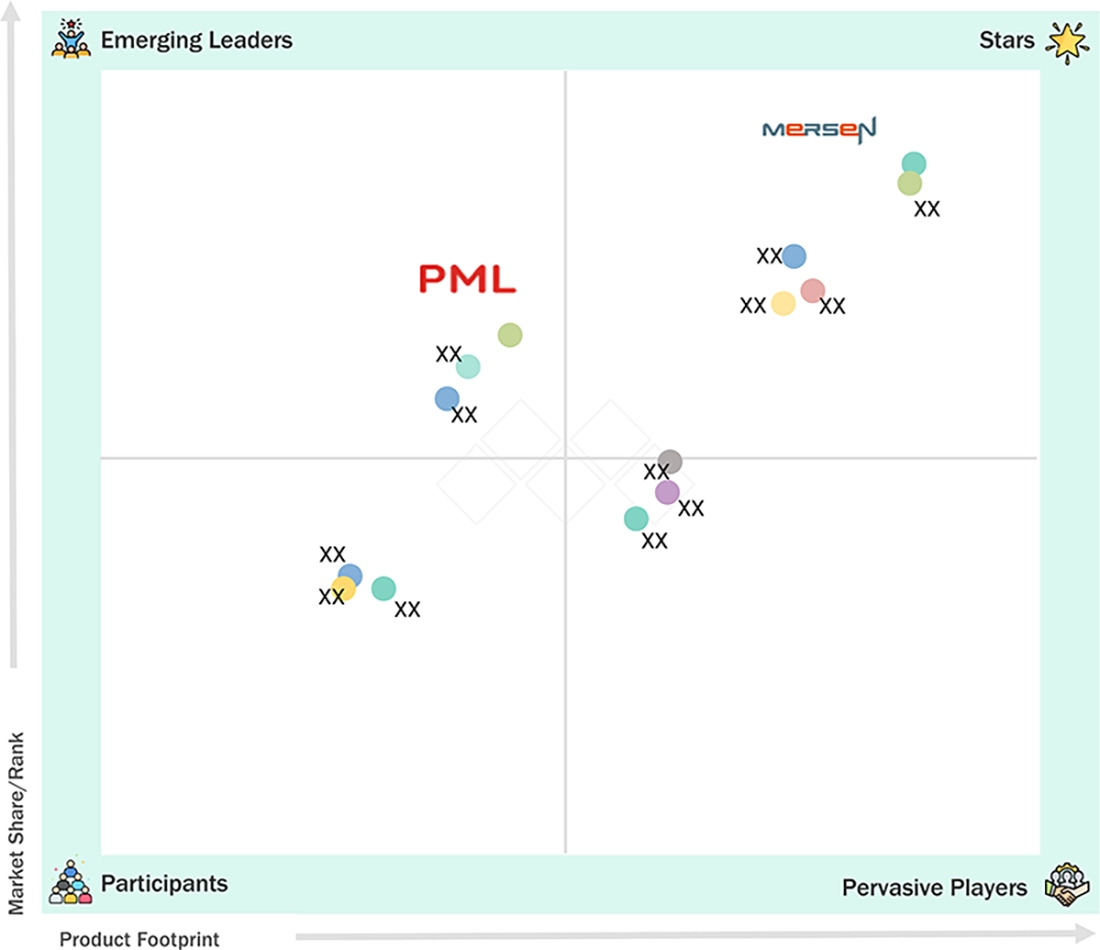
DATA CENTER LAMINATED BUSBAR MARKET: COMPANY EVALUATION MATRIX
Mersen (France) is a star player in the data center laminated busbar market, supported by established power distribution solutions, broad connectivity capabilities, and products designed for data center power distribution. This position reflects its ability to meet the evolving power requirements of server and data center infrastructure. Permanent Magnets Limited (India) is positioned as an Emerging Leader, with specialized laminated busbar and electrical component capabilities serving applications such as server racks and backup power systems. Its focused product portfolio supports its market position, although its overall competitive position is comparatively narrow.
Source: Secondary Research, Interviews with Experts, MarketsandMarkets Analysis
KEY MARKET PLAYERS
- Mersen (France)
- Amphenol IPC (US)
- Rogers Corporation (US)
- Methode Electronics, Inc. (US)
- SUN.KING Technology Group Limited (China)
- A&J Link Technology (Suzhou) Co., Ltd. (China)
- Permanent Magnets Limited (India)
- Dongguan Leixun New Energy Technology Co., Ltd. (China)
- Zhejiang RHI Electric Co., Ltd. (China)
- Storm Power Components (US)
- TE Connectivity (Ireland)
- Tuling (China)
- GRL (China)
- Astrolkwx (Netherlands)
- Baknor (Canada)
- Apollo Electronic Components (Xiamen) Co., Ltd. (China)
- Xiamen Apollo Stamping Welding Technology CO., Ltd. (China)
- EAE Electric (Turkey)
- Shanghai Eagtop Electronic Technology Co., Ltd. (China)
- Wuxi GRT Technology Co., Ltd. (China)
- Busbar Manufacturer (China)
- Carsai Precision Parts (China)
- MGiTALY (Italy)
- Exceltek International Co., Ltd. (China)
- DRAmetal (China)
MARKET SCOPE
| REPORT METRIC | DETAILS |
|---|---|
| Market Size in 2025 (Value) | USD 0.26 Billion |
| Market Size in 2026 (Value) | USD 0.31 Billion |
| Market Forecast in 2031 (Value) | USD 0.66 Billion |
| Growth Rate | 16.2% |
| Years Considered | 2022–2031 |
| Base Year | 2025 |
| Forecast Period | 2026–2031 |
| Units Considered | Value (USD Million, Billion), Volume (Units) |
| Report Coverage | Revenue forecast, company ranking, competitive landscape, growth factors, and trends |
| Segments Covered |
|
| Regions Covered | North America, Europe, Asia Pacific, Middle East & Africa, South America |
WHAT IS IN IT FOR YOU: DATA CENTER LAMINATED BUSBAR MARKET REPORT CONTENT GUIDE
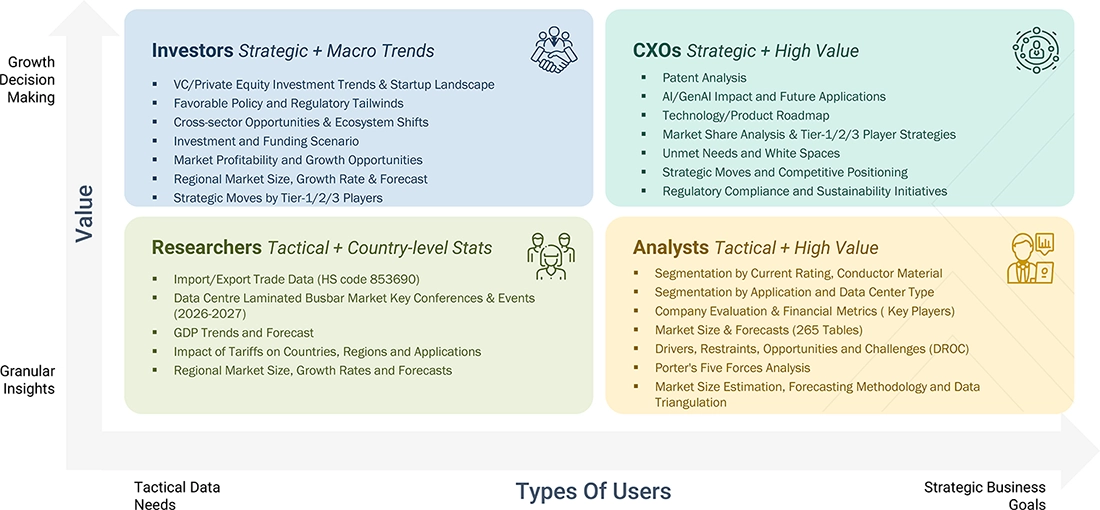
DELIVERED CUSTOMIZATIONS
We have successfully delivered the following deep-dive customizations:
| CLIENT REQUEST | CUSTOMIZATION DELIVERED | VALUE ADDS |
|---|---|---|
| Competitive landscape assessment of the data center laminated busbar market | Competitive overview; key player strategies and right-to-win analysis; revenue analysis of key market players; market share analysis; brand/product comparison; company evaluation matrix covering Stars, Emerging Leaders, Pervasive Players, and Participants; company and regional footprint analysis; conductor material, data center type, current rating, and application footprint analysis | Provides a structured view of the competitive environment, compares key players’ market positions and product offerings, highlights strategic strengths and competitive differentiation, and supports assessment of companies’ positioning across key market segments and regions |
RECENT DEVELOPMENTS
- June 2026 : Mersen introduced a new generation of high-performance square-body fuses at PCIM Europe 2026, designed for AC and DC applications. The new range targets data centers, power conversion systems, and renewable energy applications, with a compact design that saves space and provides reliable electrical protection. Mersen also showcased its broader power distribution, busbar, and thermal-management solutions for data center infrastructure.
- April 2023 : Amphenol Corporation acquired the North American cable and related services businesses of RFS Technologies, strengthening its portfolio of high-performance interconnect solutions and expanding its capabilities across telecommunications and other high-reliability electrical applications.
Table of Contents
 Exclusive indicates content/data unique to MarketsandMarkets and not available with any competitors.
Methodology
The research process for this technical, market-oriented, and commercial study of the data center laminated busbar market included systematic gathering, recording, and analysis of data about companies operating in the market. It involved the extensive use of secondary sources, directories, and databases (Factiva, Oanda) to identify and collect relevant information. In-depth interviews were conducted with various primary respondents, including experts from core and related industries and preferred manufacturers, to obtain and verify critical qualitative and quantitative information, as well as to assess the growth prospects of the market. Key players in the data center laminated busbar market were identified through secondary research, and their market rankings were determined through primary and secondary research. This included studying annual reports of top players and interviewing key industry experts, such as CEOs, directors, and marketing executives.
Secondary Research
In the secondary research process, various secondary sources were referred to for identifying and collecting information relevant to this study. Secondary sources include annual reports, press releases, and investor presentations of companies; white papers, certified publications, and articles from recognized authors; directories; and databases. Secondary research was mainly conducted to obtain key information about the supply of the industry; a total pool of key players; segmentation of the market according to industry trends, geographic markets, and key developments from market- and technology-oriented perspectives.
Primary Research
During the primary research phase, various key sources from the demand side and supply side have been interviewed to gather qualitative and quantitative data for this report. Throughout the comprehensive market engineering process, a combination of top-down and bottom-up approaches, along with multiple data triangulation methods, has been extensively employed to estimate market sizes and forecast all segments and subsegments outlined in this report. Extensive qualitative and quantitative analyses have been undertaken to ensure the integrity of the market engineering process, providing key insights throughout the report. Following completion of the market engineering process, which involved calculations of market statistics, breakdowns, size estimates, forecasts, and data triangulation, thorough primary research has been conducted to gather, verify, and validate critical data points. Primary research has also been conducted to identify market segments, industry trends, and the competitive landscape in the data center laminated busbar market.
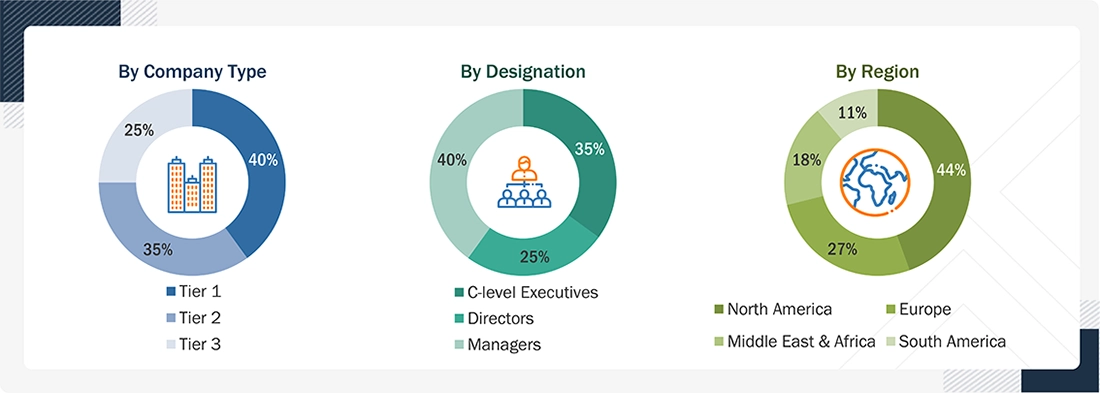
Note: Managers include sales managers, production managers, and regional managers.
Tier 1 company: revenue >USD 5 billion; tier 2 company: revenue between USD 1 and USD 5 billion; and tier 3 company: revenue <USD 1 billion in 2025
To know about the assumptions considered for the study, download the pdf brochure
Market Size Estimation
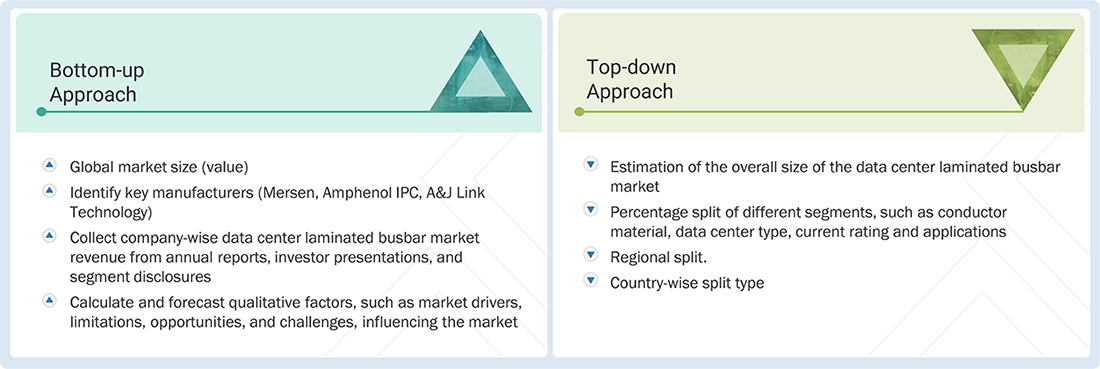
The estimation and validation of the data center laminated busbar market size have been conducted using a bottom-up approach and top-down approach. These approaches were rigorously employed to ascertain the dimensions of multiple subsegments within the market. The research process comprises the following key stages.
Bottom-up Approach
- Global market size (value)
- Identify key manufacturers (Mersen, Amphenol IPC, A&J Link Technology)
- Collect company-wise data center laminated busbar market revenue from annual reports, investor presentations, and segment disclosures
- Calculate and forecast qualitative factors, such as market drivers, limitations, opportunities, and challenges, influencing the market
Top-down Approach
- Estimation of the overall size of the data center laminated busbar market
- Percentage split of different segments, such as conductor material, data center type, current rating, and applications
- Regional split
- Country-wise split type
Data Center Laminated Busbar Market Size: Bottom-up Approach and Top-down Approach
Data Triangulation
The process of determining the overall market size involved the methodologies described earlier, followed by segmenting the market into multiple segments and subsegments. To finalize the comprehensive market analysis and obtain precise statistics for each market segment and subsegment, data triangulation and market segmentation techniques were applied, as appropriate. Data triangulation was accomplished by examining various factors and trends from both the demand and supply perspectives within the ecosystem of the data center laminated busbar market.
Market Definition
A data center laminated busbar is a multilayer power conductor made of thin, flat conductive layers, usually copper or aluminum, separated by thin dielectric insulation and bonded into a single rigid or semi-flexible assembly. Positive and negative conductors are placed closely together and carry opposing currents, which cancel much of their magnetic field. This lowers inductance and electrical losses, reduces voltage spikes and electromagnetic interference, and improves heat spreading compared with cables or conventional discrete busbars. In data centers, laminated busbars distribute high currents inside power-dense equipment such as switchgear, power conversion systems, UPS and battery systems, power shelves and rack-level DC distribution, where compactness, reliability, and efficiency are critical. They are typically engineered for a specific customer design, with tailored layer structures, terminations, plating and insulation, and sometimes integrated with capacitors, connectors, or cooling elements.
This study covers the global data center laminated busbar market, with values and forecasts through 2031. The market is segmented by conductor material (copper, aluminum and hybrid), data center type (hyperscale, colocation and enterprise) and current rating (up to 250 A, 250 to 1,000 A, 1,001 to 3,000 A and above 3,000 A). It is also segmented by application: switchgear and power distribution, power conversion systems, UPS and battery packs, DC power distribution, and other data center electrical equipment. Geographically, the study covers North America, Europe, Asia Pacific, the Middle East and Africa, and South America. The report also analyzes the competitive landscape, key technology trends, patents, and the market drivers, restraints, opportunities and challenges shaping growth through 2031.
Key Stakeholders
- Copper and aluminum producers and suppliers
- Dielectric insulation film and epoxy/powder coating suppliers
- Plating and surface treatment providers
- Capacitor, connector, and cold-plate suppliers
- Metal fabrication and stamping service providers
- Laminated busbar manufacturers
- Custom busbar and power distribution assembly specialists
- Contract manufacturers and EMS providers
- Switchgear and power distribution equipment OEMs
- UPS and battery system manufacturers
- Power conversion, power shelf, and server rack OEMs/ODMs
- Liquid cooling and thermal management system providers
- Prefabricated and modular data center builders
- Hyperscale cloud operators
- Colocation data center providers
- Enterprise data center owners and operators
- AI and GPU cloud service providers
- Data center developers and EPC contractors
- Electrical design consultants and engineering firms
- Distributors and channel partners
- Open Compute Project (OCP)
- Standards bodies (IEC, UL and IEEE)
- Regional electrical and energy-efficiency regulators
- Data center and power electronics industry associations
- Power semiconductor makers (SiC and GaN)
- Research institutes and universities
- Investors, private equity and strategic acquirers
Report Objectives
- To define, describe, analyze, and forecast the data center laminated busbar market based on conductor material, data center type, current rating, application, and region
- To describe and forecast the market for five key regions: North America, Europe, Asia Pacific, South America, and the Middle East & Africa, along with their country-level market sizes, in terms of value and volume
- To forecast the data center laminated busbar market, by region, in terms of volume
- To give comprehensive details regarding the main factors, obstacles, opportunities, and sector-specific difficulties impacting the expansion of the data center laminated busbar market
- To systematically examine the market for data center laminated busbar in terms of each segment's contributions to the market, growth trends, and prospects
- To provide value chain analysis, trends/disruptions impacting customer business, market maps, ecosystem analysis, sustainability and regulatory landscape, pricing analysis, patent analysis, case study analysis, technology analysis, key conferences and events, Porter's five forces analysis, macroeconomic outlook, customer landscape & buyer behavior, regulatory analysis, and AI/Gen AI impact on the market
- To conduct a strategic analysis of micromarkets1 concerning their respective growth trends, planned expansions, and market share contributions
- To sketch a competitive environment for market participants and assess the potential for stakeholders in the data center laminated busbar business
- To benchmark players within the market using the company evaluation quadrant, which analyzes market players on various parameters within the broad categories of business and product strategies
- To compare key market players for market share, product specifications, and applications
- To strategically profile key players and comprehensively analyze their market ranking and core competencies2
- To track and analyze competitive developments in the data center laminated busbar market, such as contracts, agreements, investments, expansions, product launches, partnerships, and acquisitions
Available customizations:
With the given market data, MarketsandMarkets offers customizations based on the company's specific needs. The following customization options are available for the report:
PRODUCT ANALYSIS
- Product Matrix, which provides a detailed comparison of the product portfolio of each company
COMPANY INFORMATION
- Detailed analyses and profiling of additional market players (up to 5)


Personalize This Research
- Triangulate with your Own Data
- Get Data as per your Format and Definition
- Gain a Deeper Dive on a Specific Application, Geography, Customer or Competitor
- Any level of Personalization
Let Us Help You
- What are the Known and Unknown Adjacencies Impacting the Data Center Laminated Busbar Market
- What will your New Revenue Sources be?
- Who will be your Top Customer; what will make them switch?
- Defend your Market Share or Win Competitors
- Get a Scorecard for Target Partners

Custom Market Research Services
We Will Customise The Research For You, In Case The Report Listed Above Does Not Meet With Your Requirements
Get 10% Free CustomisationTESTIMONIALS

Kimberly Murphy
GLOBAL MARKETING DIRECTOR
Bently Nevada,
Leading Condition Monitoring & Asset Protectionwww.bakerhughesds.com/bently-nevada

MarketsandMarkets™ showed consistent rigor for success and relentlessly worked with Bently Nevada stakeholders to positively impact go-to-market strategy. Their proactiveness and flexibility has been instrumental in achieving the objectives to grow our sales pipeline in key industrial markets.

DARRICK HUEBER
Business Development Leader
Nexus Controls LLC,
Leading Manufacturer of Automation System & Electrical Panelswww.bakerhughesds.com/nexus-controls

We partnered with MarketsandMarkets to expand our business further by tapping into new industrial segments. It was critical for us to gather crucial business insights about specific markets to achieve this goal. MarketsandMarkets engagement model and client services helped us provide those insights, it was really impressive and valuable for my business. The team was extremely flexible and helpful.

Mike Schoff
Global Industrial Commercial Strategy Leader
Nexus Controls LLC
Leading Manufacturer of Automation System & Electrical Panelswww.bakerhughesds.com/nexus-controls
We consulted MarketsandMarkets for potential Partner Identification. Overall, it was a good experience. The insights provided through interviews conducted by the team helped us put together the questionnaire required for discussion with the selected partners. Their ability to provide insights through interviews with customers in a timely manner was quite impressive.



Growth opportunities and latent adjacency in Data Center Laminated Busbar Market