Europe Dietary Supplements Market

Europe Dietary Supplements Market by Type (Botanicals, Vitamins, Minerals, Amino Acids, Enzymes, Probiotics), Mode of Application (Tablets, Capsules, Gummies/Chewables), Distribution Channel, Target Consumer, Function, Countries - Forecast to 2030




OVERVIEW
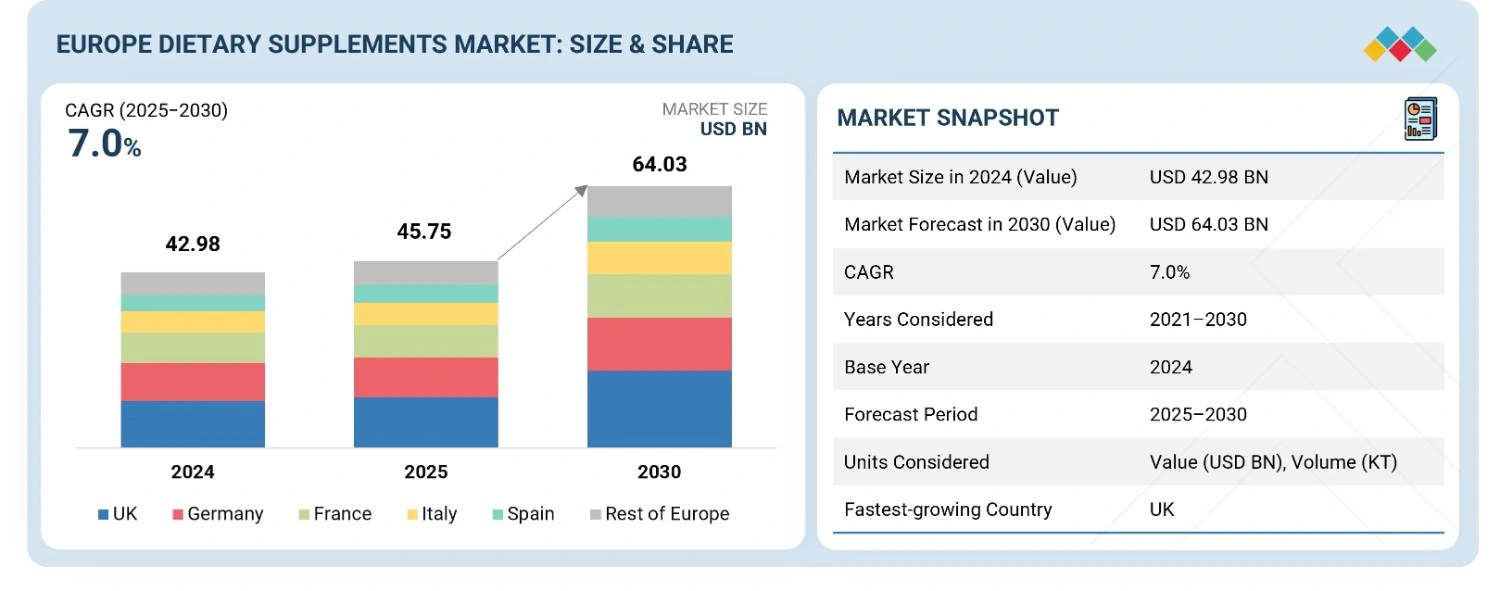
Source: Secondary Research, Interviews with Experts, MarketsandMarkets Analysis
The Europe dietary supplements market is projected to reach USD 64.03 billion by 2030 from USD 45.75 billion in 2025, at a CAGR of 7.0% from 2025 to 2030. The growth of this market is driven by consumer shift toward preventive & holistic health, high adoption of plant-based, organic & natural supplements, and expansion of pharmacies & drugstore chains as primary sales channels.
KEY TAKEAWAYS
-
BY COUNTRYThe UK is estimated to account for 27.0% of the Europe dietary supplements market in 2025.
-
BY TYPEBy type, the vitamins segment is expected to register a significant CAGR of 7.8%.
-
BY TARGET CONSUMERBy target consumer, the adults segment is projected to grow at the highest rate from 2025 to 2030.
-
BY FUNCTIONBy function, the gut health segment is estimated to dominate the market.
-
BY MODE OF APPLICATIONBy mode of application, the tablets segment is estimated to hold a significant market share.
-
COMPETITIVE LANDSCAPE - KEY PLAYERSNestle, Abbott, and Otsuka Holdings Co., Ltd were among the companies identified as star players in the Europe dietary supplements market, given their strong market share and product footprint.
-
COMPETITIVE LANDSCAPE - STARTUPSSanotact GMBH, Inpharma S.P.A., and Nutrilo GMBH, among others, have distinguished themselves among contract manufacturers and SMEs by securing strong footholds in specialized niche areas, underscoring their potential as emerging market leaders.
The Europe dietary supplements market is expected to grow at a rapid rate as consumers are increasingly preferring plant-based, organic, non-GMO, and “free-from” formulations, prompting manufacturers to offer clean-label products.
TRENDS & DISRUPTIONS IMPACTING CUSTOMERS' CUSTOMERS
The impact on consumers' business emerges from customer trends or disruptions. Hotbets are new, emerging types of supplements, targeting end users who are clients of dietary supplement manufacturers. Shifts, which are changing trends or disruptions, will impact the revenues of end users, thus affecting the revenues of hotspots and further the revenues of dietary supplement manufacturers.
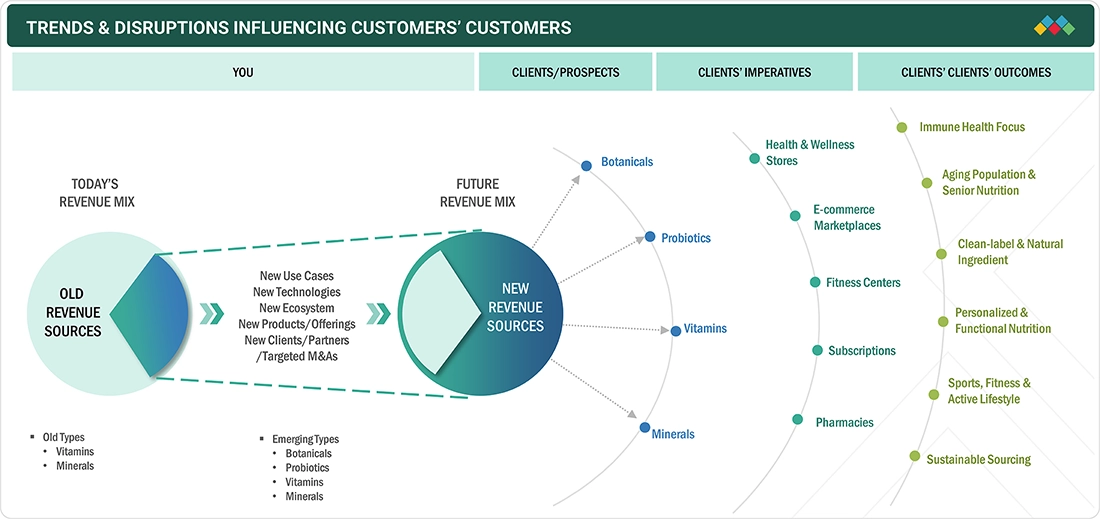
Source: Secondary Research, Interviews with Experts, MarketsandMarkets Analysis
MARKET DYNAMICS

Level
-
High adoption of plant-based organic & natural supplements

-
Expansion of pharmacies & drugstore chains as primary sales channels


Level
-
High product compliance & registration costs

-
Limited approval for novel ingredients & functional claims


Level
-
Expansion in personalized & genomic-based nutrition

-
Rising demand for sustainable & eco-friendly supplement formats


Level
-
Consumer caution toward claims and evidence-based validation

-
Rising raw material costs & supply chain pressure

Source: Secondary Research, Interviews with Experts, MarketsandMarkets Analysis
Driver: High adoption of plant-based organic & natural supplements
European consumers increasingly prefer clean-label, plant-based, and organic formulations, fueling demand for natural supplements across vitamins, minerals, and functional products.
Restraint: High product compliance & registration costs
Stringent EU regulations, including EFSA approval and national registration requirements, increase time and cost for product launches, limiting smaller players’ market entry.
Opportunity: Expansion in personalized & genomic-based nutrition
Growing interest in customized nutrition solutions, including DNA- and biomarker-based supplements, presents opportunities for differentiated products targeting individual health needs.
Challenge: Consumer caution toward claims & evidence-based validation
European consumers demand scientific proof and transparency, creating challenges for companies making functional or health claims without robust clinical validation.
europe-dietary-supplements-market: COMMERCIAL USE CASES ACROSS INDUSTRIES
| COMPANY | USE CASE DESCRIPTION | BENEFITS |
|---|---|---|
 |
Launch of orodispersible-film (ODF) supplements across new European countries | Provides a more convenient, user-friendly dosage form (no water, easy administration), especially beneficial for people with difficulty swallowing (elderly, children, busy users). |
 |
Introduction of new own-brand sports nutrition line, “TriActive,” with ~16 products designed for everyday use, combining protein, vitamins, minerals, joint support components, and other performance/recovery-oriented ingredients, marketed for body, mind, and muscle support | Meets rising consumer demand for holistic sports & wellness nutrition (not just basic vitamins), integrating recovery, performance, and general wellness. |
 |
Introduction of new “Sidevit” line of Sucrosomial vitamins (D3 & B12), first shown at CPHI Milan 2024 | Improved bioavailability and absorption of vitamins, meaning better efficacy compared to conventional forms, an advantage for consumers needing reliable nutrient uptake. |
Logos and trademarks shown above are the property of their respective owners. Their use here is for informational and illustrative purposes only.
MARKET ECOSYSTEM
The Europe dietary supplements ecosystem is categorized into manufacturers, regulatory bodies, and end-use companies. The market is a dynamic and rapidly expanding ecosystem characterized by diverse stakeholders and innovative products. Established companies and agile startups are central to this market, and they develop dietary supplement products.
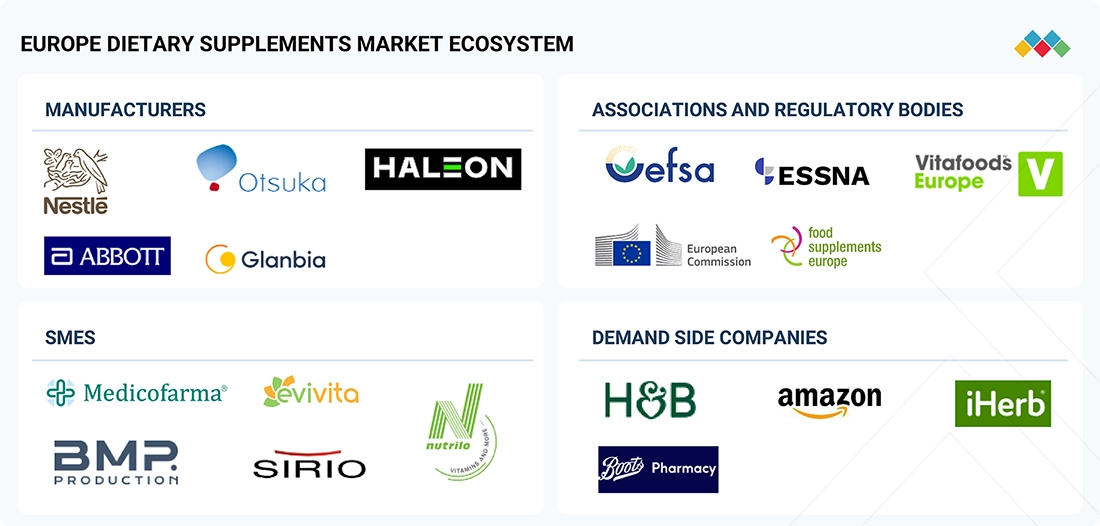
Logos and trademarks shown above are the property of their respective owners. Their use here is for informational and illustrative purposes only.
MARKET SEGMENTS
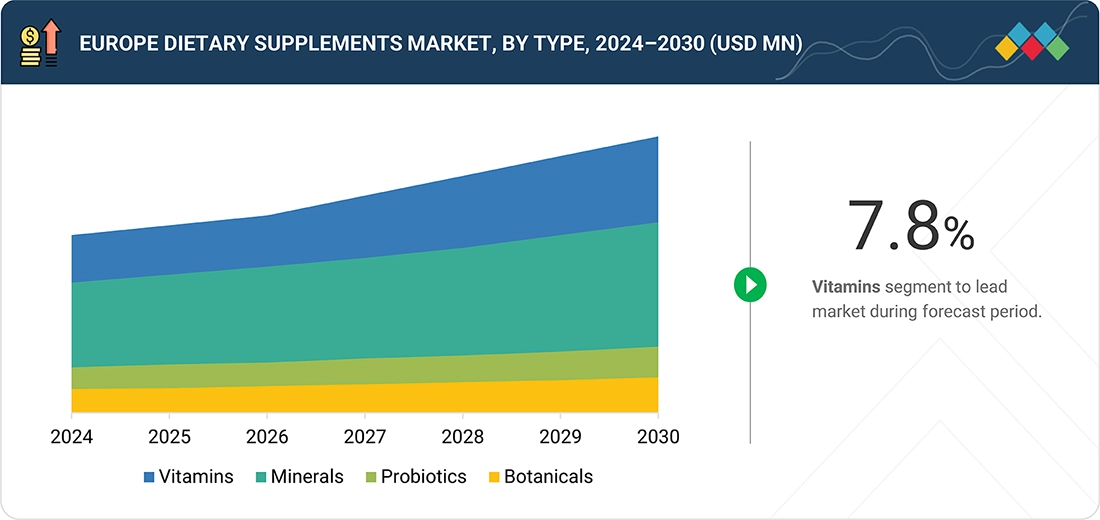
Source: Secondary Research, Interviews with Experts, MarketsandMarkets Analysis
Europe Dietary Supplements Market, By Type
The vitamins segment is expected to dominate the market, as Europe has a large and growing elderly population with specific nutritional requirements (bone, joint, heart, and cognitive health), which vitamins help address.
Europe Dietary Supplements Market, By Target Consumer
The adults segment holds a significant market share as adults in Europe are the most proactive segment investing in preventive health, immunity support, energy, stress management, and overall wellness, driving higher supplement consumption.
Europe Dietary Supplements Market, By Function
The gut health segment is projected to grow at a significant rate as consumers increasingly view gut health as the foundation of overall wellness, driving fast adoption across all age groups, from adults to seniors.
Europe Dietary Supplements Market, By Mode of Application
The capsules segment holds a significant market share as capsules help protect sensitive ingredients (probiotics, herbs, omega oils, vitamins) from oxidation and environmental exposure better than tablets or powders.
REGION
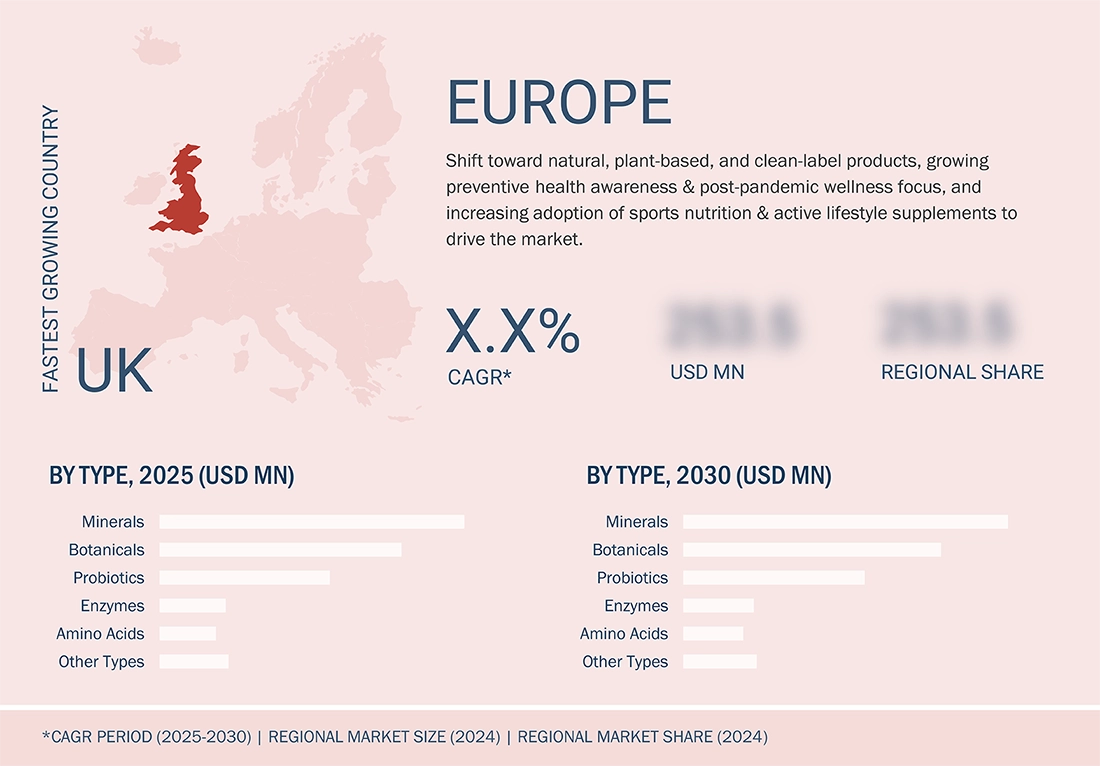
UK to be fastest-growing country in Europe dietary supplements market during forecast period
The UK dietary supplements market is expected to register the highest CAGR during the forecast period, due to a strong consumer shift toward proactive health management, with increased daily use of vitamins, minerals, immunity boosters, and lifestyle-health supplements.
europe-dietary-supplements-market: COMPANY EVALUATION MATRIX
In the Europe dietary supplements market matrix, Nestle and Abbott (Stars) lead with a strong market share and extensive product footprint for human health, driven by their strong geographical presence, significant formulation and distribution capabilities, and strong ties with distribution channels. Life Sanotact GMBH (Emerging Leader) is gaining visibility with its specialized dietary supplement offerings, strengthening its position through specific product offerings.
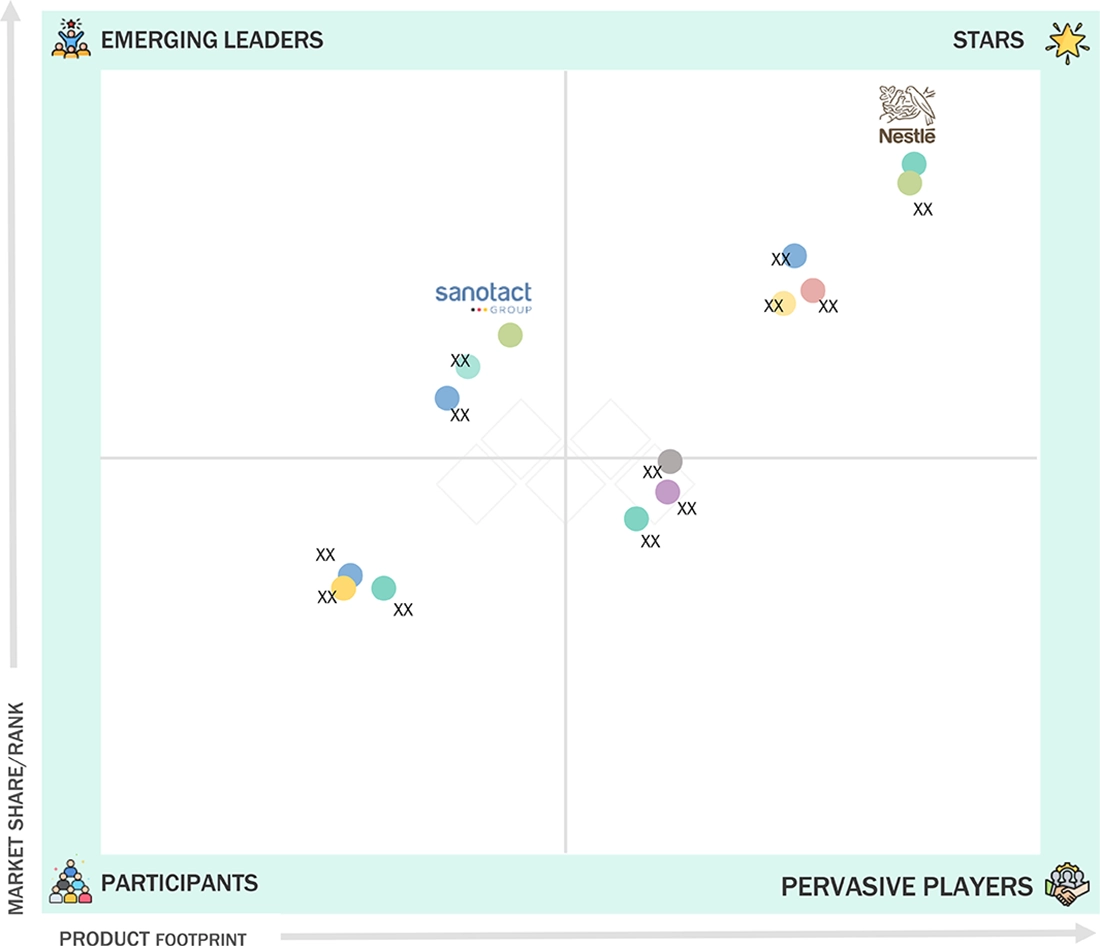
Source: Secondary Research, Interviews with Experts, MarketsandMarkets Analysis
KEY MARKET PLAYERS
- Nestlé (Switzerland)
- Abbott (US)
- Haleon Group of Companies (UK)
- Otsuka Holdings Co., Ltd. (Japan)
- Glanbia plc (Ireland)
- Bayer AG (Germany)
- Perrigo Company plc (Ireland)
- Amway Corp (US)
- Arkopharma (France)
- BioGaia (Sweden)
MARKET SCOPE
| REPORT METRIC | DETAILS |
|---|---|
| Market Size in 2024 (Value) | USD 42.98 Billion |
| Market Forecast in 2030 (Value) | USD 64.03 Million |
| Growth Rate | CAGR of 7.0% from 2025 to 2030 |
| Years Considered | 2021–2030 |
| Base Year | 2024 |
| Forecast Period | 2025–2030 |
| Units Considered | Value (USD Billion), Volume (KT) |
| Report Coverage | Revenue Forecast, Company Ranking, Competitive Landscape, Growth Factors, and Trends |
| Segments Covered |
|
| Countries Covered | Germany, UK, France, Italy, Spain, Rest of Europe |
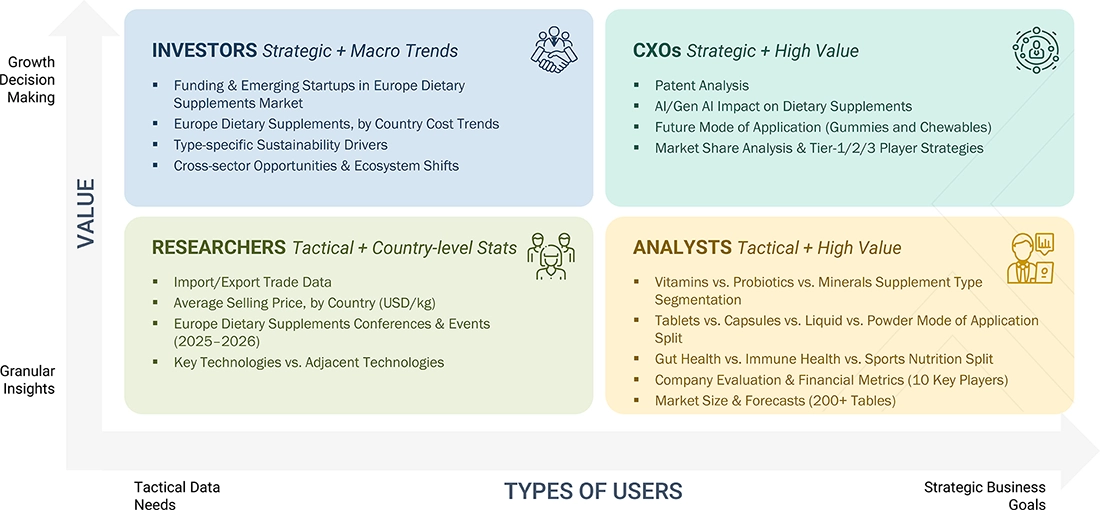
WHAT IS IN IT FOR YOU: europe-dietary-supplements-market REPORT CONTENT GUIDE
DELIVERED CUSTOMIZATIONS
We have successfully delivered the following deep-dive customizations:
| CLIENT REQUEST | CUSTOMIZATION DELIVERED | VALUE ADDS |
|---|---|---|
| UK-based Dietary Supplement Manufacturers |
|
|
| Dietary Supplement, Mode of Application Segment Assessment |
|
|
RECENT DEVELOPMENTS
- August 2025 : IBSA started offering food supplements (iron + folic acid, vitamin D3, vitamin B12) in “orodispersible film” format, ultra-thin films that dissolve in saliva without the need for water. These films are now becoming available not only in Italy/Switzerland but also being expanded to countries including Spain, the UK, Germany, Poland, the Czech Republic, Slovakia, Hungary, and Austria.
- December 2024 : Holland & Barrett introduced a new own-brand sports nutrition line named “TriActive,” with ~16 products designed for everyday use, combining protein, vitamins, minerals, joint support components, and other performance/recovery-oriented ingredients, marketed for body, mind & muscle support.
- November 2024 : PharmaNutra S.p.A. introduced a new “Sidevit” line of Sucrosomial vitamins (D3 & B12), first shown at CPHI Milan 2024
Table of Contents
 Exclusive indicates content/data unique to MarketsandMarkets and not available with any competitors.
Methodology
The study involved two major approaches in estimating the current size of the Europe Dietary Supplements Market. Exhaustive secondary research was done to collect information on the market, peer, and parent markets. The next step was to validate these findings, assumptions, and sizing with industry experts across the value chain through primary research. Both top-down and bottom-up approaches were employed to estimate the complete market size. After that, market breakdown and data triangulation were used to estimate the market size of segments and subsegments.
Secondary Research
This research study involved the extensive use of secondary sources—directories and databases such as Bloomberg Businessweek and Factiva—to identify and collect information useful for a technical, market-oriented, and commercial study of the market.
In the secondary research process, various sources such as annual reports, press releases & investor presentations of companies, white papers, food journals, certified publications, articles from recognized authors, directories, and databases were referred to identify and collect information.
Secondary research was mainly used to obtain key information about the industry’s supply chain, the total pool of key players, and market classification and segmentation as per the industry trends to the bottom-most level, regional markets, and key developments from both market- and technology-oriented perspectives.
Primary Research
Extensive primary research was conducted after obtaining information regarding the Europe Dietary Supplements Market scenario through secondary research. Primary data was collected through questionnaires, emails, and telephonic interviews. The primary sources from the supply side included various industry experts, such as Chief X Officers (CXOs), Vice Presidents (VPs), Directors from business development, marketing, research, and development teams, and related key executives from distributors and key opinion leaders. Primary interviews were conducted to gather insights such as market statistics, data on revenue collected from the products and services, market breakdowns, market size estimations, market forecasting, and data triangulation. Primary research also helped in understanding the various trends related to dietary supplements by type, mode of application, target consumer, distribution channel, function, and region. Stakeholders from the demand side, such as food and beverage companies and health and personal care companies who are using dietary supplements, were interviewed to understand the buyer’s perspective on the suppliers, products, and their current usage of dietary supplements and the outlook of their business which will affect the overall market.
Market Size Estimation
Both the top-down and bottom-up approaches were used to estimate and validate the total size of the Europe Dietary Supplements Market. These approaches were also used extensively to determine the size of various subsegments in the market. The research methodology used to estimate the market size includes the following details:
- The key players in the industry and the overall markets were identified through extensive secondary research.
- All shares, splits, and breakdowns were determined using secondary sources and verified through primary sources.
- All possible parameters that affect the market covered in this research study were accounted for, viewed in extensive detail, verified through primary research, and analyzed to obtain final quantitative and qualitative data.
- The research included the study of reports, reviews, and newsletters of top market players, along with extensive interviews for opinions from leaders, such as CEOs, directors, and marketing executives.
Data Triangulation
After arriving at the overall market size from the estimation process explained above, the total market was split into several segments and subsegments. The data triangulation and market breakdown procedures were employed, wherever applicable, to estimate the overall Europe Dietary Supplements Market and arrive at the exact statistics for all segments and subsegments. The data was triangulated by studying various factors and trends from the demand and supply sides. The market size was also validated using both the top-down and bottom-up approaches.
Market Definition
According to the National Institute on Aging (NIA) [a part of the National Institutes of Health (NIH)], “Dietary supplements are substances you might use to add nutrients to your diet or to lower your risk of health problems such as osteoporosis or arthritis. Dietary supplements come in the form of pills, capsules, powders, gel tabs, extracts, or liquids. They might contain vitamins, minerals, fiber, amino acids, herbs other plants, or enzymes. Sometimes, the ingredients in dietary supplements are added to foods, including drinks.”
Stakeholders
- Manufacturers of food products, beverages, and dietary supplements
- Manufacturers of nutraceutical ingredients
- Intermediary suppliers, such as traders and distributors of nutraceutical products
- Government, research organizations, and institutions
- World Health Organization (WHO)
- Codex Alimentarius Commission (CAC)
- Associations, regulatory bodies, and other industry-related bodies:
- Food and Agriculture Organization (FAO)
- United States Department of Agriculture (USDA)
- Food Safety Council (FSC)
- Food and Drug Administration (FDA)
- European Food Safety Authority (EFSA)
- Food Standards Australia New Zealand (FSANZ)
- Dietary Supplement Health and Education Act (DSHEA)
- Internal Probiotics Association
- Indian Health Foods and Dietary Supplements Association (INHADSA)
Report Objectives
- To determine and project the size of the Europe Dietary Supplements Market with respect to the type, mode of application, target consumer, distribution channel, function, and regions in terms of value over five years, ranging from 2024 to 2029.
- To identify the attractive opportunities in the market by determining the largest and fastest-growing segments across regions
- To provide detailed information about the key factors influencing market growth (drivers, restraints, opportunities, and challenges)
- To analyze the opportunities in the market for stakeholders and provide details of the competitive landscape for market leaders.
- To analyze the micro-markets with respect to individual growth trends, prospects, and their contribution to the total market.
- To identify and profile the key players in the Europe Dietary Supplements Market.
- To understand the competitive landscape and identify the major growth strategies adopted by players across the key regions.
Available Customizations
With the given market data, MarketsandMarkets offers customizations according to company-specific scientific needs.
The following customization options are available for the report:
Product Analysis
- Product Matrix, which gives a detailed comparison of the product portfolio of each company.
Company Information
- Detailed analyses and profiling of additional market players (up to five)


Personalize This Research
- Triangulate with your Own Data
- Get Data as per your Format and Definition
- Gain a Deeper Dive on a Specific Application, Geography, Customer or Competitor
- Any level of Personalization
Let Us Help You
- What are the Known and Unknown Adjacencies Impacting the Europe Dietary Supplements Market
- What will your New Revenue Sources be?
- Who will be your Top Customer; what will make them switch?
- Defend your Market Share or Win Competitors
- Get a Scorecard for Target Partners

Custom Market Research Services
We Will Customise The Research For You, In Case The Report Listed Above Does Not Meet With Your Requirements
Get 10% Free CustomisationTESTIMONIALS

Business Innovation Director
US Based Leading Agribusiness,
Food and Ingredients ManufacturerI highly appreciate the team's efficiency for a well conducted study that helped us clarify some blind spots in food and agricultural niche markets. Although compiling information for B2B markets is very difficult, the MnM team pulled out the task successfully. The quality of research, level of insights, and responsiveness of team were commendable.






Growth opportunities and latent adjacency in Europe Dietary Supplements Market