
Rest Of Asia Pacific 3D Printing Filament Market (2025-2030)

The Rest Of Asia Pacific 3D Printing Filament Market was valued at $48.6 Million in 2025 and projected to reach to $91.8 Million by 2030, representing a compound annual growth rate of 13.6%. Rest Of Asia Pacific's 3D printing filament market is positioned for substantial growth over the forecast period, driven by increasing industrialization and technology adoption across the region.


| Market Size in | USD 26.32 MN |
| Market Forecast in | |
| CAGR | |
| Forecast Period | |
| Units Considered | Value (USD MN) |
Rest Of Asia Pacific 3D Printing Filament Market Trends and Insights
- The region is experiencing robust growth driven by increasing adoption of additive manufacturing across manufacturing, healthcare, and consumer sectors.
- Rest Of Asia Pacific is projected to expand substantially, reaching USD 91.8 million by 2030, reflecting a compound annual growth rate of 13.6% over the forecast period. The growth trajectory in Rest Of Asia Pacific is supported by rising investments in industrial automation, expanding prototyping capabilities, and growing awareness of 3D printing technologies among small and medium enterprises.
- Rest Of Asia Pacific's market expansion is further accelerated by improving supply chain infrastructure and declining filament costs, making 3D printing more accessible to diverse end-user segments. Rest Of Asia Pacific demonstrates strong potential for market consolidation and innovation, with local manufacturers increasingly competing alongside established global players.
- The region's favorable demographic trends and manufacturing renaissance position Rest Of Asia Pacific as a critical growth engine within the broader Asia Pacific 3D printing filament ecosystem through 2030..
Key Market Statistics
- CAGR (2025-2030) 13.6% CAGR
- Market Size, 2025 ~USD 48.6 Million
- Forecast, 2030 ~USD 91.8 Million
- Country Rest Of Asia Pacific
Rest Of Asia Pacific 3D Printing Filament Market Overview
Rapid Market Expansion :
Rest Of Asia Pacific's 3D printing filament market is projected to grow from USD 48.6 million in 2025 to USD 91.8 million by 2030, representing a robust 13.6% CAGR, outpacing many mature markets in the region.
Manufacturing Sector Adoption :
Increasing adoption of additive manufacturing in Rest Of Asia Pacific's industrial sector is driving demand for high-quality filaments, with manufacturers seeking cost-effective production solutions and rapid prototyping capabilities.
Healthcare & Consumer Growth :
Healthcare applications and consumer 3D printing adoption are emerging as key growth drivers in Rest Of Asia Pacific, with medical device manufacturers and hobbyists fueling demand for specialized and commodity filament materials.
Emerging Market Potential :
Rest Of Asia Pacific represents a significant emerging market opportunity with untapped potential in developing economies, where infrastructure investments and technology adoption are accelerating additive manufacturing adoption.
Rest Of Asia Pacific 3D Printing Filament Market Dynamics
- Manufacturing sectors in emerging economies are rapidly integrating additive manufacturing into production workflows, creating sustained demand for diverse filament materials and specifications.
- The healthcare and consumer segments are also expanding, with medical device manufacturers and DIY enthusiasts driving market diversification. The region's growth trajectory is supported by improving supply chain infrastructure, rising investments in manufacturing technology, and growing awareness of additive manufacturing benefits.
- As economies in Rest Of Asia Pacific continue to develop, the adoption of 3D printing filaments is expected to accelerate, with local manufacturers and international players competing to capture market share.
- This emerging market presents significant opportunities for suppliers willing to invest in regional distribution and localized product offerings..
Market Ecosystem
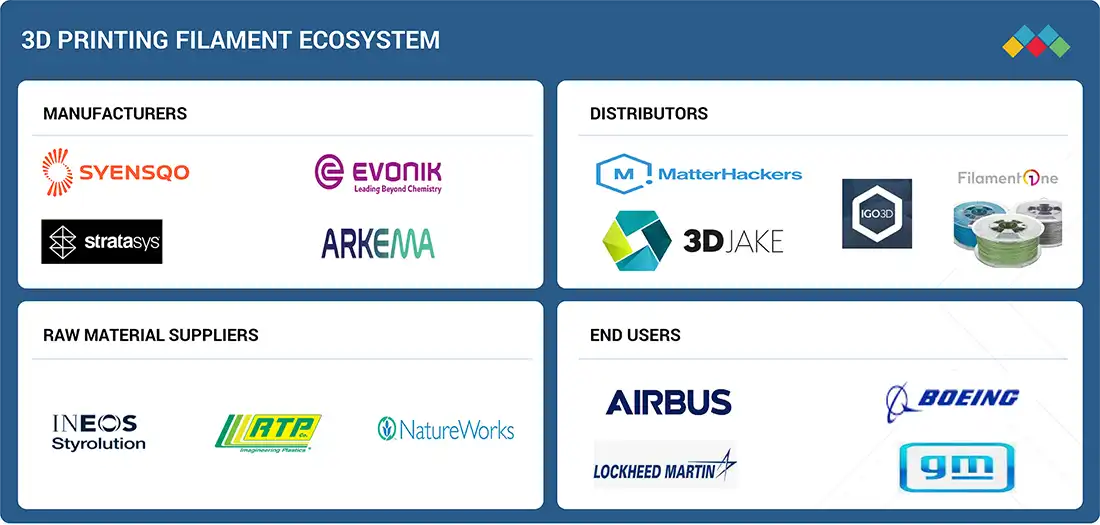
3D Printing Filament Market: COMMERCIAL USE CASES ACROSS INDUSTRIES
| COMPANY | USE CASE DESCRIPTION | BENEFITS |
|---|---|---|
 |
Uses carbon fiber-reinforced filaments and ABS for prototyping, jigs, and lightweight auto parts | Faster prototyping, 90%-time reduction in tool production, and lightweighting for fuel efficiency |
 |
Employs high-performance PEEK and ULTEM filaments for aircraft interior components and tooling | High strength-to-weight ratio, reduced part count, and compliance with aerospace standards |
 |
Uses medical-grade PLA/PETG for surgical guides, dental models, and patient-specific devices | Customized medical solutions, reduced lead times, and lower production costs |
 |
Produces customized footwear midsoles and design prototypes using flexible TPU filaments | Mass customization, improved performance design, and consumer personalization |
Logos and trademarks shown above are the property of their respective owners. Their use here is for informational and illustrative purposes only.
Related Ecosystem
Fibers And Composites
- Polyetheretherketone (PEEK)
- Polyphenylene Sulfide (PPS)
- Epoxy Resin
- Polycarbonate
- Polyester Resin
- Toray Industries, Inc.
- Teijin Limited
- Sgl carbon se
- Hexcel Corporation
- Solvay sa
Key Takeaways
- Rest Of Asia Pacific's 3D printing filament market will nearly double from USD 48.6 million (2025) to USD 91.8 million (2030), driven by industrial adoption and cost reduction.
- Rest Of Asia Pacific exhibits a 13.6% CAGR, outpacing global maturity trends and reflecting strong regional demand for additive manufacturing solutions.
- Rest Of Asia Pacific's growth is fueled by SME adoption, manufacturing modernization, and expanding applications in healthcare, automotive, and consumer goods sectors.
- Rest Of Asia Pacific presents significant opportunities for both established filament manufacturers and emerging regional players seeking market penetration.
3D Printing Filament Market Report Scope
| Report Metric | Details |
|---|---|
| Base Year | 2025 |
| Fastest Growing Segment | CERAMICS (Type) |
| Forecast Period | 2025-2030 |
| Growth Rate | CAGR of 18.8% from 2025 to 2030 |
| Largest Segment | PLASTICS (Type) |
| Market Size Base Year (Billions) | ~USD 1.77 (2025) |
| Revenue Forecast (Billions) | ~USD 4.2 (2030) |
| Segments Covered | Type, End-Use Industry |
Rest Of Asia Pacific 3D Printing Filament Market Report Segmentation
2 segment dimensions are covered across the global market.
By Type
- Abs
- Alumina
- Aluminum
- Ceramics
- Copper
- Metals
- Other Ceramic Types
- Other Metal Types
- Other Plastic Types
- Other Types
- Pa
- Pla
- Plastics
- Stainless Steel
- Tpe
- Zirconia
By End-Use Industry
- Aerospace & Defense
- Automotive
- Consumer Goods
- Medical & Dental
- Other End-Use Industries
Target Audience
- 3D Printing Filament Manufacturers : Manufacturers need Rest Of Asia Pacific market data to identify growth opportunities, plan regional expansion, and develop localized product portfolios for emerging economies with rising additive manufacturing adoption.
- Industrial Equipment Suppliers : Equipment suppliers require market insights to understand filament demand drivers in Rest Of Asia Pacific's manufacturing sector, enabling complementary product offerings and strategic partnerships with regional customers.
- Investment & Private Equity Firms : Investors need detailed regional market analysis to evaluate acquisition targets, assess growth potential, and make informed capital deployment decisions in Rest Of Asia Pacific's emerging additive manufacturing sector.
- Distribution & Logistics Companies : Distributors require market forecasts and sector analysis for Rest Of Asia Pacific to optimize inventory management, plan warehouse locations, and develop efficient supply chains for growing filament demand.
- Healthcare & Manufacturing OEMs : OEMs in healthcare and manufacturing need regional market intelligence to source reliable filament suppliers, plan production strategies, and capitalize on additive manufacturing adoption trends in Rest Of Asia Pacific.
Reasons to Buy this Report
- Regional Market Sizing & Forecasts : Obtain precise market valuation for Rest Of Asia Pacific (USD 48.6M in 2025) with detailed 5-year forecasts to USD 91.8M by 2030, enabling accurate business planning and investment decisions specific to this emerging region.
- Competitive Landscape Intelligence : Understand market dynamics, competitive positioning, and growth opportunities unique to Rest Of Asia Pacific, identifying gaps and emerging players in this high-growth region with 13.6% CAGR potential.
- Sector-Specific Insights : Access detailed analysis of manufacturing, healthcare, and consumer segment adoption patterns in Rest Of Asia Pacific, enabling targeted product development and market entry strategies for each vertical.
- Investment & Expansion Strategy : Leverage regional growth projections and market trends to inform capital allocation, facility expansion, and partnership decisions in Rest Of Asia Pacific's rapidly developing additive manufacturing ecosystem.
- Supply Chain Optimization : Identify distribution opportunities and supply chain requirements specific to Rest Of Asia Pacific's emerging markets, supporting localized manufacturing and logistics planning for filament suppliers.
Frequently asked questions
What is the current market size of 3D printing filament in Rest Of Asia Pacific?
Rest Of Asia Pacific's 3D printing filament market is valued at USD 48.6 million in 2025 and is expected to grow to USD 91.8 million by 2030.
What is the projected growth rate for Rest Of Asia Pacific's 3D printing filament market?
Rest Of Asia Pacific's market is projected to grow at a compound annual growth rate (CAGR) of 13.6% from 2025 to 2030.
Which industries are driving demand for 3D printing filament in Rest Of Asia Pacific?
Rest Of Asia Pacific's demand is primarily driven by manufacturing, healthcare, automotive, consumer goods, and prototyping sectors increasingly adopting additive manufacturing technologies.
What factors are contributing to market growth in Rest Of Asia Pacific?
Rest Of Asia Pacific's growth is supported by declining filament costs, improved supply chain infrastructure, SME adoption, industrial automation investments, and expanding 3D printing awareness.
How competitive is the 3D printing filament market in Rest Of Asia Pacific?
Rest Of Asia Pacific features a competitive landscape with both established global manufacturers and emerging regional players, creating opportunities for innovation and market consolidation.
RESEARCH METHODOLOGY
The study involves two major activities in estimating the current market size for the 3D printing filament market. Exhaustive secondary research was done to collect information on the market, peer market, and parent market. The next step was to validate these findings, assumptions, and sizing with industry experts across the value chain through primary research. Both top-down and bottom-up approaches were employed to estimate the complete market size. After that, market breakdown and data triangulation were used to estimate the market size of segments and subsegments.
Secondary Research
Secondary sources referred to for this research study include financial statements of companies offering 3D printing filament products and information from various trade, business, and professional associations. Secondary research has been used to obtain critical information about the industry’s value chain, the pool of key players, market classification, and segmentation according to industry trends to the bottom-most level and regional markets. Secondary data was collected and analyzed to arrive at the overall size of the 3D printing filament market, which was validated by primary respondents.
Primary Research
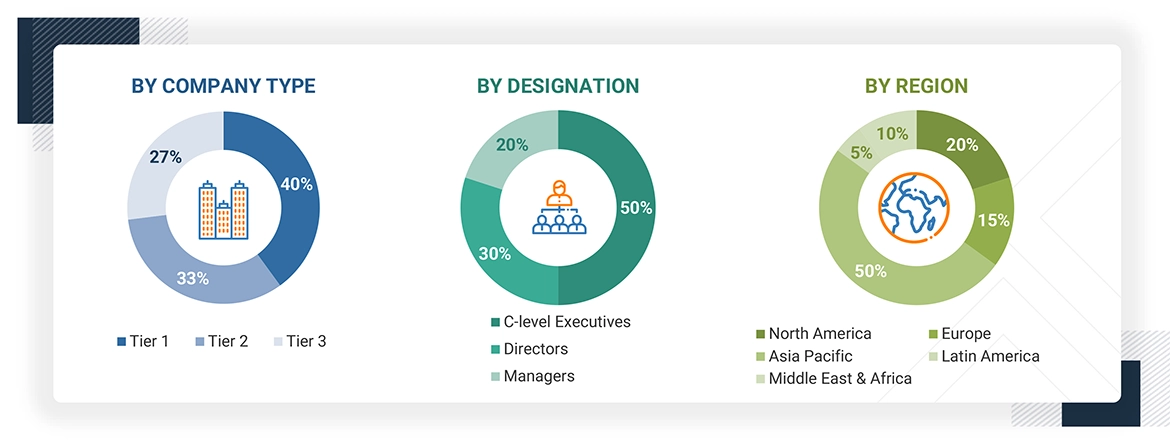
Extensive primary research was conducted after obtaining information regarding the 3D printing filament market scenario through secondary research. Several interviews with experts were conducted with market experts from both the demand and supply sides across the major countries of Asia Pacific, Europe, North America, the Middle East & Africa, and South America. Primary data was collected through questionnaires, emails, and telephonic interviews. The primary sources from the supply side included various industry experts, such as Chief X Officers (CXOs), Vice Presidents (VPs), Directors from business development, marketing, product development/innovation teams, and related key executives from 3D printing filament industry vendors, system integrators, component providers, distributors, and key opinion leaders. Interviews with experts were conducted to gather insights, such as market statistics, data on revenue collected from the products and services, market breakdowns, market size estimations, market forecasting, and data triangulation. Primary research also helped in understanding the various trends related to type, operating temperature, manufacturing process, end-use industries, and region. Stakeholders from the demand side, such as CIOs, CTOs, CSOs, and installation teams of the customers/end users who are using 3D printing filament products were interviewed to understand the buyers’ perspectives on the suppliers, products, component providers, their current usage of 3D printing filaments, and outlook of their business which will affect the overall market.
Breakdown of Interviews with Experts
To know about the assumptions considered for the study, download the pdf brochure
Market Size Estimation
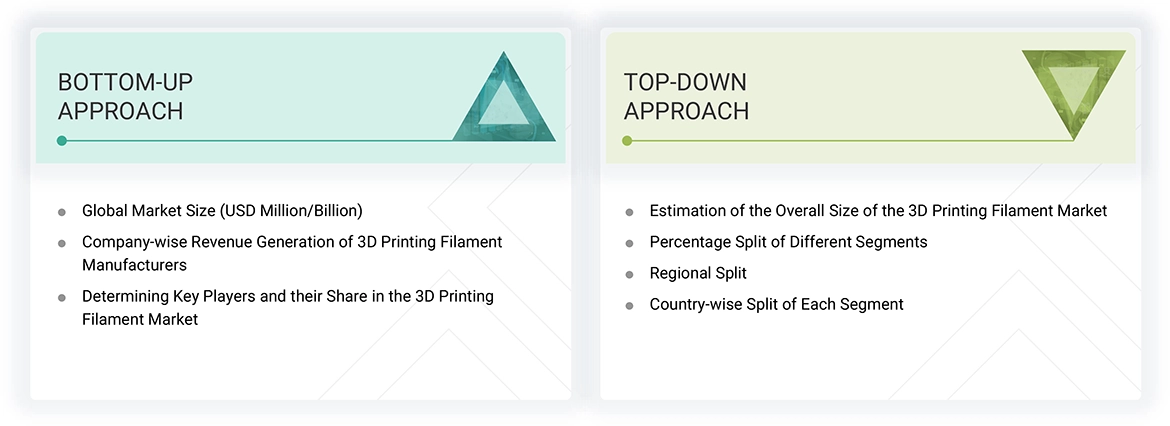
The research methodology used to estimate the size of the 3D printing filament market includes the following details: The market sizing was undertaken from the demand side. The market was upsized based on procurements and modernization in 3D printing filament products in different end-use industries at a regional level. Such procurements provide information on the demand aspects of the 3D printing filament industry for each end-use industry. For each end-use industry, all possible segments of the 3D printing filament market were integrated and mapped.
Data Triangulation
After arriving at the overall size from the market size estimation process explained above, the total market was split into several segments and subsegments. The data triangulation and market breakdown procedures explained below were implemented, wherever applicable, to complete the overall market engineering process and arrive at the exact statistics for various market segments and subsegments. The data was triangulated by studying various factors and trends from the demand and supply sides. Along with this, the market size was validated using both the top-down and bottom-up approaches.
Market Definition
3D printing filament serves as the feedstock material utilized in Fused Deposition Modeling (FDM), which is among the most commonly used 3D printing techniques. It is presented in the form of a lengthy, continuous strand that is coiled on a spool and heated to be extruded layer by layer, creating three-dimensional objects. These filaments come in various types of materials, each suited to different industrial and creative applications. The market study includes plastics (such as PLA, ABS, PETG, Nylon, and PEEK), widely employed for prototyping, functional components, and consumer items due to their adaptability and user-friendliness. Metal-filled filaments include (like stainless steel or titanium) Ceramic-based filaments that integrate materials, such as zirconia and alumina, are used in applications requiring high temperature, insulation, or resistance to abrasion. This variety of filament types enables sectors, such as aerospace & defense, automotive, medical & dental, and consumer goods to leverage 3D printing for a broad spectrum of production, prototyping, and design needs.
Stakeholders
- 3D Printing Filament Manufacturers
- 3D Printing Filament Suppliers
- Raw Material Suppliers
- End-use Industries
- Government Bodies
- Universities, Governments, and Research Organizations
- Research and Consulting Firms
- R&D Institutions
- Investment Banks and Private Equity Firms
- Magnet and 3D Printing Filament Associations
Report Objectives
- To define, describe, and forecast the 3D printing filament market size in terms of volume and value
- To provide detailed information regarding key factors, such as drivers, restraints, opportunities, and challenges influencing market growth
- To analyze and project the global 3D printing filament market by type, operating temperature, manufacturing process, end-use industry, and region
- To forecast the market size concerning five main regions (along with country-level data), namely, Asia Pacific, Europe, North America, the Middle East & Africa, and South America, and analyze the significant region-specific trends
- To strategically analyze micromarkets with respect to individual growth trends, prospects, and contributions of the submarkets to the overall market
- To analyze the market opportunities and the competitive landscape for stakeholders and market leaders
- To assess recent market developments and competitive strategies, such as acquisitions, agreements, contracts, and product developments/launches, to draw the competitive landscape
- To strategically profile key market players and comprehensively analyze their core competencies
Get the Full 3D Printing Filament Market Report
Full forecast, segment splits, and company analysis for all 3D Printing Filament Market.
- Canada 3D Printing Filament Market
- US 3D Printing Filament Market
- Germany 3D Printing Filament Market
- UK 3D Printing Filament Market
- France 3D Printing Filament Market
- Italy 3D Printing Filament Market
- Spain 3D Printing Filament Market
- Netherlands 3D Printing Filament Market
- China 3D Printing Filament Market
- Japan 3D Printing Filament Market
- South Korea 3D Printing Filament Market
- India 3D Printing Filament Market
- Australia 3D Printing Filament Market
- Mexico 3D Printing Filament Market
- Brazil 3D Printing Filament Market
- South Africa 3D Printing Filament Market
- Rest Of Europe 3D Printing Filament Market
- Rest Of Latin America 3D Printing Filament Market
- GCC Countries 3D Printing Filament Market
- -Rest Of GCC Countries 3D Printing Filament Market
Need a Tailored Report?
Customize this report to your needs
Get 10% FREE Customization
Customize This Report
