
Asia Pacific Image Sensor Market (2026-2031)

The Asia Pacific Image Sensor Market was valued at $11592 Million in 2026 and projected to reach to $18602.9 Million by 2031, representing a compound annual growth rate of 8.2%. Asia Pacific's image sensor market is positioned for robust expansion, growing from USD 11,592.0 million in 2026 to USD 18,602.9 million by 2031.


| Market Size in | USD 26.32 MN |
| Market Forecast in | |
| CAGR | |
| Forecast Period | |
| Units Considered | Value (USD MN) |
Asia Pacific Image Sensor Market Trends and Insights
- The region's growth is driven by rapid smartphone proliferation, increasing adoption of advanced camera technologies in consumer electronics, and rising demand from automotive and industrial applications.
- Asia Pacific's 8.2% compound annual growth rate outpaces the global average, reflecting the region's dominance in electronics manufacturing and consumer technology innovation. The Asia Pacific image sensor market benefits from strong semiconductor infrastructure, competitive manufacturing ecosystems, and substantial investments in emerging technologies such as artificial intelligence and autonomous vehicles.
- Key markets within Asia Pacific, including China, Japan, South Korea, and India, are accelerating the deployment of high-resolution sensors across smartphones, surveillance systems, and IoT devices.
- Between 2026 and 2031, Asia Pacific is expected to consolidate its position as the world's largest image sensor market, supported by continuous technological advancement and expanding end-user applications across multiple industries..
Key Market Statistics
- CAGR (2026-2031) 8.2% CAGR
- Market Size, 2026 ~USD 11592 Million
- Forecast, 2031 ~USD 18602.9 Million
- Geography Asia Pacific
Asia Pacific Image Sensor Market Overview
China's Market Dominance :
China leads Asia Pacific's image sensor market with USD 7,635.4 million in 2026, driven by massive smartphone manufacturing, surveillance system deployment, and emerging autonomous vehicle technologies across the region.
India's Rapid Growth Trajectory :
India represents a high-growth opportunity with USD 4,862.1 million market size in 2026, fueled by increasing smartphone penetration, growing middle-class consumer base, and expanding manufacturing capabilities in electronics.
Japan's Premium Technology Hub :
Japan commands USD 3,261.8 million in 2026, leveraging its advanced semiconductor expertise, strong automotive sector integration, and leadership in high-resolution imaging sensor development for premium applications.
Regional 8.2% CAGR Outpaces Global Growth :
Asia Pacific's 8.2% CAGR (2026-2031) exceeds the global 7.7% rate, reflecting the region's accelerating digital transformation, IoT adoption, and increasing investment in next-generation imaging technologies across consumer and industrial sectors.
Asia Pacific Image Sensor Market Dynamics
- This growth trajectory is underpinned by the region's dominance in smartphone manufacturing, particularly in China and India, coupled with rising demand for advanced camera capabilities in mid-range and budget devices.
- The automotive sector's shift toward autonomous driving and advanced driver-assistance systems (ADAS) is creating substantial demand for high-performance imaging sensors across the region. Key growth catalysts include increasing adoption of multi-camera smartphone configurations, expansion of surveillance and security infrastructure, and growing industrial automation applications.
- Japan's continued innovation in sensor technology, combined with China's manufacturing scale and India's emerging consumer market, creates a compelling growth narrative.
- The region's 8.2% CAGR reflects sustained investment in R&D, competitive pricing dynamics, and the integration of AI-powered imaging solutions across consumer electronics, automotive, and industrial verticals..
Market Ecosystem

IMAGE SENSORS MARKET SIZE, SHARE AND TRENDS: COMMERCIAL USE CASES ACROSS INDUSTRIES
| COMPANY | USE CASE DESCRIPTION | BENEFITS |
|---|---|---|
 |
Sony manufactures complementary metal-oxide-semiconductor (CMOS) image sensors. These components are utilized in smartphones, digital cameras, and automotive systems to capture continuous visual data. | Provides high-resolution visual input | Supports low-light data capture | Enables multi-camera device configurations | Integrates into compact electronic hardware |
 |
Samsung develops image sensors for mobile devices, automotive applications, and consumer electronics. These sensors process visual information for automated and user-controlled electronic systems. | Integrates small pixel architectures | Processes high-speed video capture | Limits operational power consumption | Supports fast autofocus mechanisms |
 |
OMNIVISION supplies digital imaging components, including advanced CMOS sensors. These are integrated into medical diagnostic equipment, automotive safety systems, and security surveillance cameras. | Delivers specific medical imaging functionality | Supports autonomous vehicle environmental mapping | Enables accurate facial recognition security | Maintains operational stability in variable lighting |
 |
STMicroelectronics produces 3D depth sensors and global shutter image sensors. These specific components are applied in industrial automation, machine robotics, and smart consumer devices. | Captures accurate spatial depth metrics | Inspects fast-moving objects without image distortion | Integrates directly into machine vision equipment | Operates efficiently in low-power electronic assemblies |
 |
Semiconductor Components Industries, LLC (onsemi) manufactures intelligent sensing hardware. These sensors function within automotive advanced driver-assistance systems (ADAS) and industrial quality inspection lines. | Captures high dynamic range (HDR) visual data | Mitigates LED flicker in automotive safety applications | Supports continuous automated production monitoring | Functions reliably across extreme temperature variations |
Logos and trademarks shown above are the property of their respective owners. Their use here is for informational and illustrative purposes only.
Related Ecosystem
Automotive Advance Technologies
- Battery Electric Vehicle (BEV)
- Light Commercial Vehicles (LCVs)
- Fuel Cell Electric Vehicle (FCEV)
- Hybrid Electric Vehicle (HEV)
- Internal Combustion Engine (ICE)
- BOSCH LIMITED
- Continental ag
- Visteon Corporation
- DENSO Corporation
- ZF FRIEDRICHSHAFEN AG
Sensors And Control
- Sensors
- Image Sensors
- Temperature Sensors
- Pressure Sensors
- Flow Sensors
- BAUMER ELECTRIC AG
- HONEYWELL INTERNATIONAL INC.
- Stmicroelectronics
- Lenovo
- Texas Instruments Incorporated
Key Takeaways
- Asia Pacific image sensor market valued at USD 11,592.0 million in 2026, expanding to USD 18,602.9 million by 2031 at 8.2% CAGR.
- Asia Pacific's growth rate of 8.2% exceeds the global CAGR of 7.7%, positioning the region as the fastest-growing image sensor market.
- Smartphone demand, automotive camera integration, and surveillance applications are primary growth drivers across Asia Pacific.
- Asia Pacific's advanced manufacturing ecosystem and semiconductor infrastructure support sustained market expansion through 2031.
Image Sensor Market Report Scope
| Report Metric | Details |
|---|---|
| Base Year | 2026 |
| Fastest Growing Segment | INDUSTRIAL (Application) |
| Forecast Period | 2026–2031 |
| Growth Rate | CAGR of 7.7% from 2026 to 2031 |
| Largest Segment | AREA SCAN (Array Type) |
| Market Size Base Year (Billions) | ~USD 23.72 (2026) |
| Revenue Forecast (Billions) | ~USD 34.37 (2031) |
| Segments Covered | Type, Processing Technique, Spectrum, Application, Array Type, Resolution |
Asia Pacific Image Sensor Market Report Segmentation
6 segment dimensions are covered across the global market.
By Type
- Ccd
- Cmos
- Other Types
By Processing Technique
- 2D
- 3D
By Spectrum
- Infrared
- Visible
By Application
- Aerospace & Defense
- Automotive
- Commercial
- Consumer Electronics
- Industrial
- Medical & Life Sciences
- Security & Surveillance
By Array Type
- Area Scan
- Line Scan
By Resolution
- 1.3 To 3 Mp
- 12 To 16 Mp
- 5 To 10 Mp
- Above 16 Mp
- Vga
Target Audience
- Semiconductor Manufacturers : Require detailed Asia Pacific market data to optimize production capacity, identify regional demand hotspots in China and India, and develop localized product portfolios aligned with regional consumer preferences and automotive requirements.
- Smartphone OEMs & Camera Module Suppliers : Need country-specific insights to source image sensors competitively, understand multi-camera adoption trends, and plan supply chain strategies across Asia Pacific's dominant smartphone manufacturing hubs.
- Automotive Tier-1 Suppliers : Require market intelligence on ADAS and autonomous vehicle imaging sensor demand across Asia Pacific, particularly in China and Japan, to support vehicle electrification and safety system integration roadmaps.
- Investment & Private Equity Firms : Need comprehensive Asia Pacific market analysis to evaluate acquisition targets, assess growth potential in emerging markets like India, and identify strategic investment opportunities in imaging technology companies.
- Industrial & IoT Solution Providers : Require regional market forecasts to understand surveillance, robotics, and industrial automation imaging sensor demand, enabling product development and market expansion strategies across Asia Pacific's rapidly growing industrial sectors.
Key Companies in the Asia Pacific Image Sensor Market
| Company | HQ | Ownership | Strongest segments |
|---|---|---|---|
| MELEXIS NV | Belgium | Public Company | Magnetic and inductive position sensors (including latch, switch, speed),Other sensors (current, pressure, temperature, optical, tire monitoring, time-of-flight),Embedded motor drivers and actuators (motor, fan, pump, pre-drivers), |
| TRUMPF GROUP | Germany | Private Company | Sheet and pipe machine tools (cutting, punching, welding systems),Industrial lasers (CO2, disk, fiber, diode, ultrashort pulse, marking),Services, software, and automation solutions, |
| TOSHIBA CORPORATION | Japan | Private Company | Energy Systems & Solutions,Infrastructure Systems & Solutions,Building Solutions, |
| TOWER SEMICONDUCTOR LTD | Israel | Public Company | Mixed-Signal and RF CMOS Platforms,SiGe and SiPho,CMOS Image Sensors and Non-Imaging Sensors, |
| SOITEC | France | Public Company | CONNECT RF-SOI for smartphone front-end,Power-SOI and Auto Smartsic,FD-SOI (CONNECT FD-SOI, AUTO FD-SOI, PD-SOI), |
| X-FAB | Belgium | Public Company | Automotive analog/mixed-signal ICs,Industrial and medical ICs and sensors,MEMS and sensor wafers, |
| LENOVO | China | Public Company | Small form factor and desktop PCs as signage controllers,Dedicated media players and embedded systems,Thin clients for signage networks, |
| SAMSUNG | South Korea | Public Company | Smartphones, tablets, wearables, and IT/mobile communications,Consumer electronics: TVs, audio, and home appliances,Semiconductors, memory, and foundry (Device Solutions), |
| OMNIVISION | United States | Private Company | Mobile (smartphones, tablets, notebooks, webcams),Automotive,Security and Surveillance, |
| STMICROELECTRONICS | Netherlands | Public Company | Analog products, MEMS and Sensors (AM&S),Power and Discrete products (P&D),Embedded Processing (EMP), |
| SEMICONDUCTOR COMPONENTS INDUSTRIES, LLC | United States | Private Company | SiC power devices and modules,Automotive analog, sensors, and motor control,Industrial and cloud power management, |
| GALAXYCORE SHANGHAI LIMITED CORPORATION | China | Public Company | CMOS image sensors,Display driver ICs,Other (trade, real estate, ancillary), |
| HAMAMATSU PHOTONICS K.K. | Japan | Public Company | Electron Tube (photomultiplier tubes, phototubes, radiation and X-ray sensors),Opto-Semiconductor (photodiodes, APDs, SPADs, MPPCs, IR/UV sensors),Imaging and Measurement Instruments (cameras, X-ray systems, spectrometers, software), |
| INFINEON TECHNOLOGIES AG | Germany | Public Company | Automotive (MCUs, power, sensors, transceivers),Green Industrial Power (IGBTs, SiC discretes/modules),Power & Sensor Systems (MOSFETs, GaN, sensors, USB, RF), |
| CANON INC. | Japan | Public Company | Printing Business Unit,Imaging Business Unit,Medical Business Unit, |
| TELEDYNE TECHNOLOGIES INCORPORATED | United States | Public Company | Digital Imaging (visible, IR, UV, X-ray, MEMS, semiconductors),Instrumentation (monitoring, control, test, connectivity),Aerospace and Defense Electronics, |
| PIXART IMAGING INC. | Taiwan | Public Company | Optical mouse, tracking, and finger navigation sensors,Optical encoders and motion tracking for industrial/automation,Ambient light, proximity, gesture, distance, and multi-object tracking sensors, |
| PIXELPLUS | South Korea | Public Company | Security and surveillance image sensors,Automotive and mobility sensors,IoT, home appliances, and consumer devices, |
| HIMAX TECHNOLOGIES, INC. | Taiwan | Public Company | Large-panel display driver ICs (TV, PC monitor, laptop),Mobile and tablet display driver ICs,Automotive display and related ICs, |
| SHARP CORPORATION | Japan | Public Company | Smart Life & Energy (appliances, air treatment, solar, storage),Smart Office (MFPs, displays, POS, PCs, solutions),Universal Network (TVs, AV, mobile, consumer IT), |
| GPIXEL MICROELECTRONICS INC. | China | Industrial machine vision CMOS sensors,Scientific and medical imaging sensors,Security and surveillance imaging, |
MELEXIS NV
Melexis NV is a Belgian semiconductor company founded in 1988 that employs approximately 2,000 people. Operating as a public company, it specializes in microelectronics solutions for automotive and industrial applications.
TRUMPF GROUP
TRUMPF Group is a German manufacturing company established in 1923 with 18,303 employees. As a private company, it is a global leader in machine tools, lasers, and industrial technology.
TOSHIBA CORPORATION
Toshiba Corporation is a Japanese conglomerate founded in 1875 with over 106,000 employees. Operating as a private company, it operates across multiple sectors including electronics, energy, and infrastructure.
TOWER SEMICONDUCTOR LTD
Tower Semiconductor Ltd is an Israeli semiconductor manufacturer founded in 1993 with 5,613 employees. As a public company, it provides specialty semiconductor foundry services and analog/mixed-signal solutions.
SOITEC
Soitec is a French semiconductor company founded in 1992 with 1,961 employees. As a public company, it designs and manufactures engineered substrates for the semiconductor industry.
X-FAB
X-FAB is a Belgian semiconductor foundry established in 1992 with 4,300 employees. Operating as a public company, it provides analog and mixed-signal semiconductor manufacturing services.
LENOVO
Lenovo is a Chinese technology company founded in 1984 operating as a public company. It is a global leader in personal computers, servers, and other computing devices.
SAMSUNG
Samsung is a South Korean conglomerate founded in 1969 with 128,735 employees. As a public company, it operates across electronics, semiconductors, telecommunications, and other industries.
OMNIVISION
OmniVision is a United States-based semiconductor company founded in 1995 with 2,176 employees. Operating as a private company, it specializes in imaging sensors and semiconductor solutions.
STMICROELECTRONICS
STMicroelectronics is a Dutch semiconductor manufacturer founded in 1987 with 48,000 employees. As a public company, it designs and manufactures a broad range of semiconductor products.
SEMICONDUCTOR COMPONENTS INDUSTRIES, LLC
Semiconductor Components Industries, LLC is a United States semiconductor company founded in 1999 with 9,570 employees. Operating as a private company, it manufactures analog and mixed-signal semiconductors.
GALAXYCORE SHANGHAI LIMITED CORPORATION
GalaxyCORE Shanghai Limited Corporation is a Chinese semiconductor company founded in 2003 with 2,364 employees. As a public company, it specializes in image sensor design and development.
HAMAMATSU PHOTONICS K.K.
Hamamatsu Photonics K.K. is a Japanese optoelectronics company founded in 1953 with 6,601 employees. As a public company, it manufactures photonic sensors, light sources, and related products.
INFINEON TECHNOLOGIES AG
Infineon Technologies AG is a German semiconductor manufacturer founded in 1952 with 56,500 employees. As a public company, it produces semiconductors for automotive, industrial, and consumer applications.
CANON INC.
Canon Inc. is a Japanese multinational corporation founded in 1933 with 165,547 employees. As a public company, it manufactures imaging and optical products including cameras, printers, and semiconductors.
TELEDYNE TECHNOLOGIES INCORPORATED
Teledyne Technologies Incorporated is a United States technology company founded in 1960 with 15,800 employees. As a public company, it operates across digital imaging, instrumentation, and aerospace sectors.
PIXART IMAGING INC.
PixArt Imaging Inc. is a Taiwanese semiconductor company founded in 1998 with 163 employees. As a public company, it specializes in optical and motion sensing semiconductor solutions.
PIXELPLUS
PixelPlus is a South Korean semiconductor company founded in 2000 operating as a public company. It focuses on image sensor and semiconductor technology development.
HIMAX TECHNOLOGIES, INC.
Himax Technologies, Inc. is a Taiwanese semiconductor company founded in 2001 with 2,200 employees. As a public company, it designs and manufactures display drivers and multimedia semiconductors.
SHARP CORPORATION
Sharp Corporation is a Japanese electronics manufacturer founded in 1912 with 34,549 employees. As a public company, it produces displays, semiconductors, and consumer electronics.
GPIXEL MICROELECTRONICS INC.
GPixel Microelectronics Inc. is a Chinese semiconductor company founded in 2012. It specializes in image sensor design and development for various applications.
Countries within Asia Pacific - compare and drill down
| Country | 2025 size (native) |
|---|---|
| China | USD 7635.4 Million |
| Japan | USD 3261.8 Million |
| India | USD 4862.1 Million |
| Rest Of Asia Pacific | USD 2843.5 Million |
Country market size visualization
Reasons to Buy this Report
- Country-Level Market Granularity : Access detailed market sizing for China (USD 7,635.4M), India (USD 4,862.1M), and Japan (USD 3,261.8M), enabling precise market entry strategies and competitive positioning within Asia Pacific's largest image sensor economies.
- High-Growth Opportunity Identification : Leverage the 8.2% regional CAGR to identify emerging opportunities in India and Southeast Asia, where smartphone penetration and industrial automation are accelerating demand for cost-effective imaging solutions.
- Sector-Specific Demand Insights : Understand Asia Pacific's unique demand drivers across smartphones, automotive ADAS, surveillance systems, and industrial IoT applications, enabling targeted product development and go-to-market strategies.
- Competitive Landscape Intelligence : Benchmark against regional leaders and understand market dynamics in China's manufacturing ecosystem, Japan's technology innovation, and India's emerging competitive advantages in the global image sensor supply chain.
- 2031 Forecast Planning : Plan long-term investments and capacity expansion with confidence using the USD 18,602.9 million 2031 forecast, supporting strategic decisions in manufacturing, R&D, and market development across Asia Pacific.
Frequently asked questions
What is the current size of the Asia Pacific image sensor market?
The Asia Pacific image sensor market is valued at USD 11,592.0 million in 2026 and is projected to reach USD 18,602.9 million by 2031.
What is the CAGR for the Asia Pacific image sensor market?
Asia Pacific's image sensor market is expected to grow at a compound annual growth rate of 8.2% from 2026 to 2031.
Which countries drive the Asia Pacific image sensor market?
Key markets within Asia Pacific include China, Japan, South Korea, and India, which lead in smartphone manufacturing, automotive applications, and surveillance technology deployment.
What are the primary applications for image sensors in Asia Pacific?
Primary applications in Asia Pacific include smartphones, automotive cameras, surveillance systems, industrial imaging, and IoT devices.
How does Asia Pacific's growth compare to the global image sensor market?
Asia Pacific's 8.2% CAGR outpaces the global average of 7.7%, making it the fastest-growing region for image sensors through 2031.
RESEARCH METHODOLOGY
The research process for this study involved the systematic gathering, recording, and analysis of data on customers and companies operating in the image sensor market. This process involved the extensive use of secondary sources, directories, and databases (Factiva and Oanda) to identify and collect valuable information for the comprehensive, technical, market-oriented, and commercial study of the image sensor market. In-depth interviews were conducted with primary respondents, including experts from core and related industries, as well as preferred manufacturers, to obtain and verify critical qualitative and quantitative information and assess growth prospects. Key players in the image sensor market were identified through secondary research, and their market rankings were determined through a combination of primary and secondary research. This research involved studying the annual reports of top players and conducting interviews with key industry experts, including CEOs, directors, and marketing executives.Die-level image sensor market – counts only the CMOS/CCD sensor semiconductor (Sony, Samsung, onsemi, OmniVision, etc.).Camera module market includes the sensor plus lens, actuator (OIS/AF), IR filter, PCB, packaging, and module assembly.Imaging system market – may also include ISP, optics, software, and related components.
Secondary Research
Various sources were utilized in the secondary research process to identify and collect information relevant to this study. These include company annual reports, press releases, investor presentations, white papers, technology journals, certified publications, articles by recognized authors, directories, and databases.
Secondary research was primarily used to gather key information on the industry’s value chain, the total pool of market players, market classification by industry trends at the most detailed level, regional markets, and key developments from both market- and technology-oriented perspectives.
Primary Research
Primary research was also conducted to identify the segmentation types, key players, competitive landscape, and key market dynamics, including drivers, restraints, opportunities, challenges, and industry trends, as well as the key strategies adopted by players operating in the image sensor market. Extensive qualitative and quantitative analyses were conducted across the complete market engineering process to present key information and insights throughout the report.
Extensive primary research was conducted following the acquisition of knowledge about the image sensor market scenarios through secondary research. Several primary interviews were conducted with experts from the demand side (application and region) and the supply side (type, processing technique, spectrum, array type, and resolution) across four major geographic regions: North America, Europe, Asia Pacific, and the Rest of the World (RoW). Approximately 60% and 40% of the primary interviews were conducted from the supply and demand sides, respectively. These primary data were collected through questionnaires, emails, and telephonic interviews.
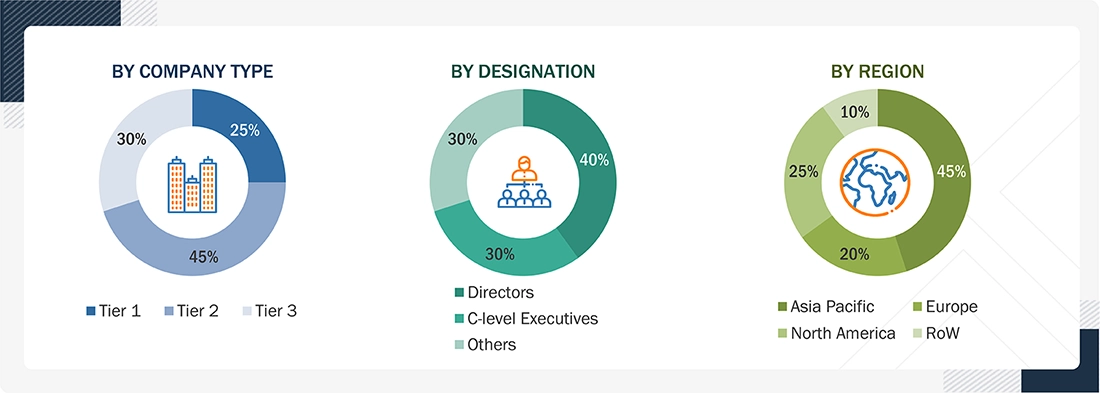
Note: The three tiers of companies have been defined based on their total/segmental revenue as of 2025: Tier 1 = > USD 1 billion, Tier 2 = USD 1 billion–USD 500 million, and Tier 3 = < USD 500 million. Other designations include sales, marketing, and product managers.
To know about the assumptions considered for the study, download the pdf brochure
Market Size Estimation
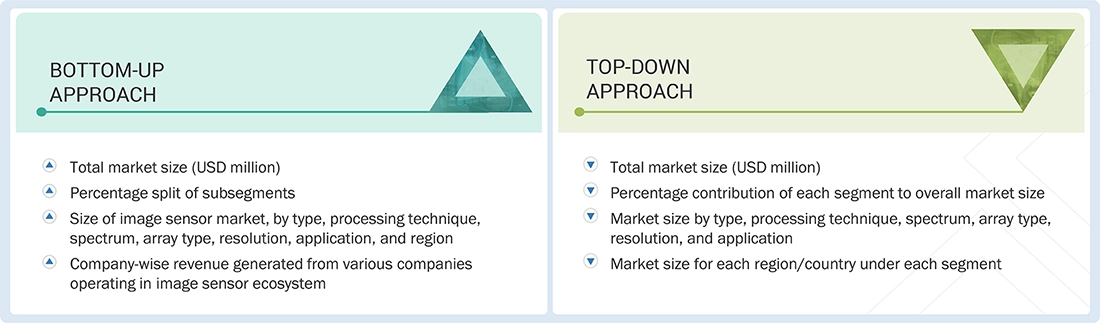
In the complete market engineering process, top-down and bottom-up approaches, along with several data triangulation methods, were used to estimate and validate the size of the image sensor market and various other dependent submarkets. Key players in the market were identified through secondary research, and their market share in each region was determined through a combination of primary and secondary research. This research methodology involved analyzing the annual and financial reports of the top players and conducting interviews with experts (including CEOs, VPs, directors, and marketing executives) to gather key insights (both quantitative and qualitative).
All percentage shares, splits, and breakdowns were determined using secondary sources and verified through primary sources. All possible parameters affecting the markets covered in this study were accounted for, examined in detail, verified through primary research, and analyzed to obtain final quantitative and qualitative data. This data was consolidated and supplemented with detailed inputs and analysis from MarketsandMarkets and presented in this report.The market size presented in this report represents the global image sensor semiconductor market and includes revenues generated from CMOS and CCD image sensor devices supplied by semiconductor manufacturers. The estimates exclude downstream camera module assembly, lenses, actuators, and other imaging system components unless explicitly stated. As a result, market values may differ from studies that measure the camera module market or broader imaging system ecosystem.
Image Sensors Market : Top-Down and Bottom-Up Approach
Data Triangulation
After determining the overall market size through the estimation process, as explained above, the total market was divided into several segments and subsegments. To complete the overall market engineering process and obtain precise statistics for all segments and subsegments, the data triangulation procedure was employed, as applicable. The data was triangulated by studying various factors and trends from the demand and supply sides. Additionally, the market was validated using both top-down and bottom-up approaches.
Market Definition
Image sensors are electronic photosensitive devices that convert optical images into electronic signals. When the light strikes the lenses of camera modules, image sensors convert that light into electric signals and transmit them to image processing units. These units convert electric signals to digital images. Image sensors comprise millions of photodiodes and act as image receivers in digital imaging equipment. They are widely used in digital cameras, camera modules, and other imaging devices.
Key Stakeholders
- Raw material suppliers
- Original equipment manufacturers (OEMs)
- Original design manufacturers (ODM) and technology solution providers
- Research institutes
- Image sensor manufactures
- Image sensor forums, alliances, and associations
- Governments and financial institutions
- Analysts and strategic business planners
Report Objectives
- Raw material suppliers
- Original equipment manufacturers (OEMs)
- Original design manufacturers (ODM) and technology solution providers
- Research institutes
- Image sensor manufactures
- Image sensor forums, alliances, and associations
- Governments and financial institutions
- Analysts and strategic business planners
Available customizations:
With the given market data, MarketsandMarkets offers customizations according to the company’s specific needs. The following customization options are available for the report:
Get the Full Image Sensor Market Report
Full forecast, segment splits, and company analysis for all Image Sensor Market.
- US Image Sensor Market
- Canada Image Sensor Market
- Mexico Image Sensor Market
- France Image Sensor Market
- Germany Image Sensor Market
- UK Image Sensor Market
- China Image Sensor Market
- Japan Image Sensor Market
- India Image Sensor Market
- Rest Of Europe Image Sensor Market
- Rest Of Asia Pacific Image Sensor Market
- Rest Of Middle East Image Sensor Market
- Saudi Arabia Image Sensor Market
- UAE Image Sensor Market
- Argentina Image Sensor Market
- Brazil Image Sensor Market
- Rest Of South America Image Sensor Market
Need a Tailored Report?
Customize this report to your needs
Get 10% FREE Customization
Customize This Report
