
Germany AVAS Market (2024-2029)

The Germany AVAS Market was valued at $1241 Million in 2024 and projected to reach to $3245 Million by 2029, representing a compound annual growth rate of 17.4%. Germany's AVAS market is poised for sustained expansion through 2029, supported by increasingly stringent EU safety regulations and consumer preference for advanced vehicle technologies.


| Market Size in | USD 26.32 MN |
| Market Forecast in | |
| CAGR | |
| Forecast Period | |
| Units Considered | Value (USD MN) |
Germany AVAS Market Trends and Insights
- This represents a compound annual growth rate of 17.4%, significantly outpacing global market expansion.
- Germany's automotive sector, driven by stringent EU safety regulations and consumer demand for advanced vehicle technologies, is positioning the country as a key hub for AVAS innovation and deployment. The German market benefits from the region's strong manufacturing base, technological expertise, and regulatory environment that mandates safety features in new vehicles.
- Germany's commitment to autonomous driving development and smart mobility solutions continues to accelerate AVAS adoption across passenger and commercial vehicle segments.
- By 2029, Germany is expected to solidify its position as Europe's leading AVAS market, reflecting both domestic demand and export opportunities throughout the continent..
Key Market Statistics
- CAGR (2024-2029) 17.4% CAGR
- Market Size, 2024 ~USD 1241 Million
- Forecast, 2029 ~USD 3245 Million
- Country Germany
Germany AVAS Market Overview
Exceptional Growth Trajectory :
Germany's AVAS market is expanding at 17.4% CAGR, nearly 3x faster than the global rate of 6.4%, driven by EU regulatory mandates and premium automotive manufacturing leadership.
Market Valuation Surge :
The market is projected to grow from $1,241 million in 2024 to $3,245 million by 2029, representing a 162% increase over five years as safety technology adoption accelerates.
EU Regulatory Compliance :
Stringent European safety standards and mandatory ADAS requirements are propelling German OEMs to integrate advanced driver assistance systems across vehicle portfolios.
Premium Automotive Leadership :
Germany's dominance in luxury and premium vehicle manufacturing positions it as a key market for high-end AVAS technologies and innovation deployment.
Germany AVAS Market Dynamics
- The country's established automotive manufacturing base, combined with strong R&D capabilities from leading OEMs, creates a favorable environment for AVAS adoption and innovation.
- Premium vehicle segments are driving early adoption, while mid-market vehicles are expected to follow as costs decline and regulatory requirements tighten. The competitive landscape will intensify as both established German manufacturers and international players invest heavily in autonomous driving capabilities.
- Government initiatives promoting vehicle safety and connected mobility, alongside growing consumer awareness of accident prevention benefits, will sustain market momentum.
- By 2029, AVAS integration is expected to become standard across most new vehicle models, with Germany maintaining its position as a technology innovation hub for the European market..
Market Ecosystem
Related Ecosystem
Automotive Electronics And Electrical Equipment
- Battery Electric Vehicle (BEV)
- Light Commercial Vehicles (LCVs)
- Fuel Cell Electric Vehicle (FCEV)
- Sensors
- Hybrid Electric Vehicle (HEV)
- BOSCH LIMITED
- DENSO Corporation
- Continental ag
- Panasonic Holdings Corporation
- Texas Instruments Incorporated
Key Takeaways
- Germany's AVAS market will grow from $1,241M (2024) to $3,245M (2029), a 17.4% CAGR far exceeding global growth rates.
- Germany's stringent EU safety regulations and advanced automotive manufacturing base drive rapid AVAS adoption and innovation.
- Germany is positioned as Europe's leading AVAS market, leveraging technological expertise and autonomous driving development initiatives.
- Strong domestic demand combined with export opportunities positions Germany as a critical hub for AVAS technology deployment through 2029.
AVAS Market Report Scope
| Report Metric | Details |
|---|---|
| Base Year | 2024 |
| Fastest Growing Segment | FCEV (Propulsion Type) |
| Forecast Period | 2024-2029 |
| Growth Rate | CAGR of 6.4% from 2024 to 2029 |
| Largest Segment | OEM (Sales Channel) |
| Market Size Base Year (Billions) | ~USD 1.17 (2024) |
| Revenue Forecast (Billions) | ~USD 1.6 (2029) |
| Segments Covered | Electric 2-Wheeler, Sales Channel, Mounting Position, Propulsion Type, Vehicle Type |
Germany AVAS Market Report Segmentation
5 segment dimensions are covered across the global market.
By Electric 2-Wheeler
- E-Motorcycle
- E-Scooter/Moped
By Sales Channel
- OEM
By Mounting Position
- Integrated
- Separated
By Propulsion Type
- Bev
- Fcev
- Phev
By Vehicle Type
- Commercial Vehicle
- Passenger Car
Target Audience
- Automotive OEMs : German and international vehicle manufacturers need market intelligence to optimize AVAS feature integration, align with EU regulations, and compete in Germany's premium vehicle segments.
- Tier-1 Suppliers : Component and system suppliers require detailed demand forecasts and technology trends to plan production capacity, R&D investments, and supply chain strategies for German OEM partnerships.
- Investment & Private Equity Firms : Investors evaluating automotive technology opportunities need Germany-specific market data to assess growth potential, identify acquisition targets, and evaluate portfolio company performance.
- Technology & Software Companies : ADAS software developers and autonomous driving startups need market insights to understand German adoption rates, regulatory requirements, and partnership opportunities with established OEMs.
- Consulting & Strategy Firms : Management consultants advising automotive clients require Germany market analysis to develop go-to-market strategies, competitive positioning recommendations, and technology roadmap guidance.
Reasons to Buy this Report
- Market-Specific Growth Intelligence : Access detailed analysis of Germany's 17.4% CAGR trajectory, significantly outpacing global trends, enabling precise investment and expansion decisions in Europe's largest automotive market.
- Regulatory Landscape Insights : Understand how EU safety mandates and German compliance requirements are reshaping AVAS adoption, helping stakeholders navigate regulatory complexities and capitalize on compliance-driven demand.
- Competitive Positioning Data : Gain intelligence on German OEM strategies, premium segment dominance, and technology deployment patterns to benchmark competitive positioning and identify market entry opportunities.
- Forecast-Driven Strategy Planning : Leverage 2029 market projections ($3,245M) to develop long-term product roadmaps, supply chain strategies, and partnership frameworks aligned with Germany's accelerating AVAS adoption.
- Investment Decision Support : Make informed capital allocation decisions with comprehensive market sizing, growth drivers, and segment analysis specific to Germany's high-growth AVAS ecosystem.
Frequently asked questions
What is the current size of Germany's AVAS market?
Germany's AVAS market was valued at $1,241 million in 2024, making it a significant segment within Europe's automotive technology landscape.
What is the projected AVAS market size for Germany by 2029?
Germany's AVAS market is forecast to reach $3,245 million by 2029, representing more than 160% growth over the five-year period.
Why is Germany's AVAS market growing faster than the global average?
Germany's 17.4% CAGR exceeds the global 6.4% rate due to stringent EU safety regulations, advanced manufacturing capabilities, and significant investment in autonomous driving technologies.
What factors are driving AVAS adoption in Germany?
Key drivers include mandatory EU safety standards, consumer demand for advanced vehicle features, Germany's leadership in automotive innovation, and government support for autonomous vehicle development.
How does Germany's AVAS market compare to other European countries?
Germany leads Europe's AVAS market due to its strong automotive manufacturing base, technological expertise, and regulatory environment that prioritizes vehicle safety and innovation.
RESEARCH METHODOLOGY
The study involved four major activities in estimating the current size of the AVAS market. Exhaustive secondary research was done to collect information on the market, the peer market, and the child markets. The next step was to validate these findings, assumptions, and sizing with the industry experts across value chains through primary research. The top-down and bottom-up approaches were employed to estimate the complete market size. Thereafter, market breakdown and data triangulation processes were used to estimate the market size of segments and subsegments.
Secondary Research
In the secondary research process, various secondary sources such as company annual reports/presentations, press releases, industry association publications [for example, International Organization of Motor Vehicle Manufacturers (OICA), National Highway Traffic Safety Administration (NHTSA), International Energy Association (IEA)], articles, directories, technical handbooks, trade websites, technical articles, and databases (for example, Marklines, and Factiva) have been used to identify and collect information useful for an extensive commercial study of the global AVAS market.
Primary Research
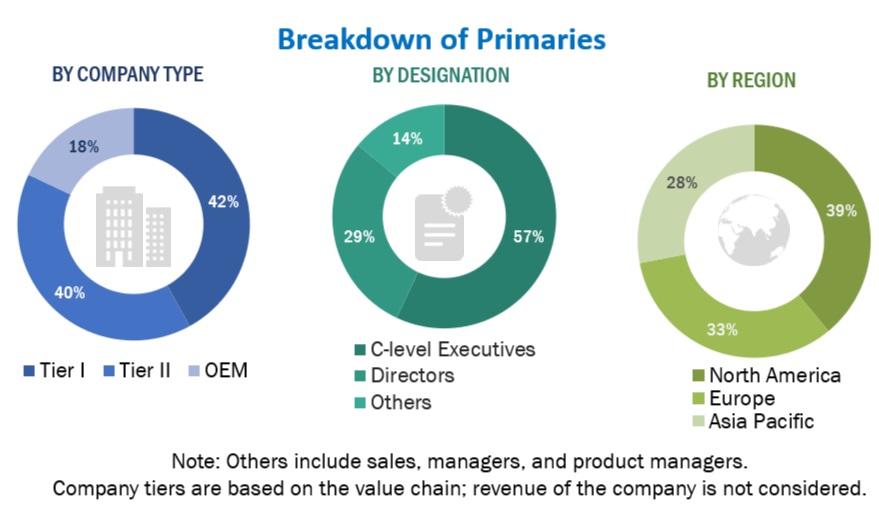
Extensive primary research was conducted after acquiring an understanding of the AVAS market scenario through secondary research. Several primary interviews were conducted with market experts from both the demand (automotive OEMs) and supply (AVAS providers) sides across major regions, namely, North America, Europe, and Asia Pacific. Approximately 23% and 77% of primary interviews were conducted from the demand and supply sides, respectively. Primary data was collected through questionnaires, emails, and telephonic interviews.
In the canvassing of primaries, various departments within organizations, such as sales, operations, and marketing, were covered to provide a holistic viewpoint in the report. After interacting with industry experts, brief sessions were also conducted with highly experienced independent consultants to reinforce the findings from primaries. This, along with the in-house subject matter experts’ opinions, led to the findings described in the remainder of this report.
To know about the assumptions considered for the study, download the pdf brochure
Market Size Estimation
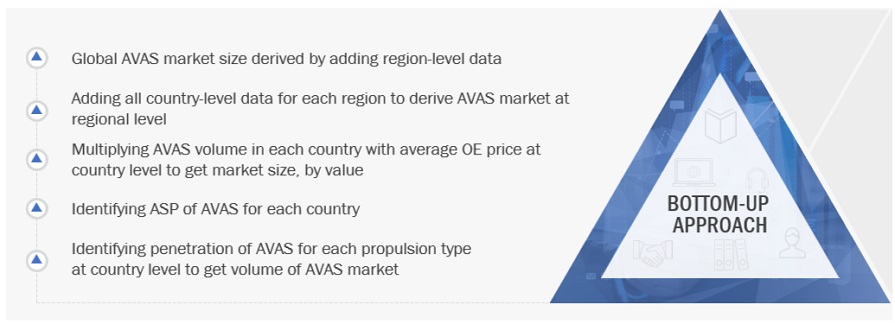
The bottom-up approach was used to estimate and validate the size of the AVAS market. This method was also used extensively to estimate the size of various subsegments in the market. The research methodology used to estimate the market size includes the following:
- The key players in the industry and markets have been identified through extensive secondary research.
- The industry’s supply chain and market size, in terms of volume, have been determined through primary and secondary research processes.
All percentage shares, splits, and breakdowns have been determined using secondary sources and verified through primary sources.
To know about the assumptions considered for the study, Request for Free Sample Report
Market Size Validation
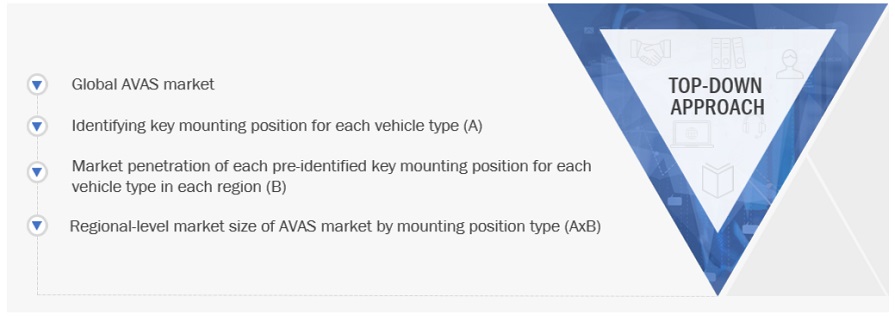
The top-down approach has been used to estimate and validate the size of the AVAS market by mounting position type in terms of volume and value. The top-down approach has been used to estimate and validate the size of the market. In this approach, the global market is bifurcated into mounting position type based on the penetration of each mounting position, which will give the volume of the market by mounting position at the regional level. Further, multiplying the volume by ASP results in the market for mounting position type by value.
Data Triangulation
After arriving at the overall market size—using the market size estimation processes as explained above—the market was split into several segments and subsegments. To complete the overall market engineering process and arrive at the exact statistics of each market segment and subsegment, data triangulation, and market breakdown procedures were employed, wherever applicable. The data was triangulated by studying various factors and trends from both the demand and supply sides.
Market Definition
An AVAS is a sound emitting device assembled in pure electric vehicles and hybrid electric vehicles that produce a lower level sound than traditional ICE vehicles—whenever the vehicle is operating at a low speed—to warn pedestrians and other vulnerable road commuters about the vehicle's presence. Also, the sound rises and drops in pitch to signal whether the vehicle is accelerating or decelerating, respectively.
List of Key Stakeholders
- Acoustic consultants
- Associations, forums, and alliances related to electric vehicles
- Automobile manufacturers
- Automotive sensor manufacturers
- Automotive software providers
- Autonomous vehicle manufacturers
- AVAS manufacturers
- EV component manufacturers
- EV distributors and retailers
- EV manufacturers
- Government agencies and policy makers
Report Objectives
- To analyze and forecast the acoustic vehicle alerting system (AVAS) market in terms of value (USD million) and volume (thousand units) from 2024 to 2030
-
To segment the market by vehicle type, mounting position, propulsion type, sales channel, electric 2-wheeler, and region
- To segment and forecast the market size by value and volume based on vehicle type (passenger car and commercial vehicle)
- To segment and forecast the market size by value and volume based on mounting position (separated and integrated)
- To segment and forecast the market size by value and volume based on propulsion type {battery electric vehicle (BEV), plug-in hybrid electric vehicle (PHEV), and fuel cell electric vehicle (FCEV)}
- To segment and forecast the market size by value and volume based on sales channel (OEM and aftermarket)
- To segment and forecast the market size by value and volume based on electric 2-wheeler (E-scooter/E-moped and E-motorcycle)
- To segment and forecast the market by value and volume based on region (Asia Pacific, Europe, and North America)
- To provide detailed information about the factors influencing the market growth (drivers, challenges, restraints, and opportunities)
- To strategically analyze the market with respect to individual growth trends, prospects, and contributions to the total market
-
To study the following with respect to the market
- Value Chain Analysis
- Ecosystem Analysis
- Technology Analysis
- Case Study Analysis
- Patent Analysis
- Tariff and Regulatory Landscape
- Average Selling Price Analysis
- Key stakeholders and Buying Criteria
-
To strategically profile the key players and comprehensively analyze their market share and core competencies
- To analyze the opportunities for stakeholders and the competitive landscape for market leaders
- To track and analyze competitive developments such as deals, product launches/developments, expansions, and other activities undertaken by the key industry participants
Available Customizations
With the given market data, MarketsandMarkets offers customizations in accordance with the company’s specific needs.
- AVAS market, by electric 2-wheeler, at country level
- AVAS market, by propulsion type, at country level
- Profiling of additional market players (up to 3)
Get the Full AVAS Market Report
Full forecast, segment splits, and company analysis for all AVAS Market.
Need a Tailored Report?
Customize this report to your needs
Get 10% FREE Customization
Customize This Report
