
US Agricultural Robots Market (2025-2030)

The US Agricultural Robots Market was valued at $4334.3 Million in 2025 and projected to reach to $14491 Million by 2030, representing a compound annual growth rate of 27.3%. The US agricultural robots market is positioned for sustained expansion through 2030, driven by technological innovation and structural market pressures.


| Market Size in | USD 26.32 MN |
| Market Forecast in | |
| CAGR | |
| Forecast Period | |
| Units Considered | Value (USD MN) |
US Agricultural Robots Market Trends and Insights
- This represents a compound annual growth rate of 27.3%, significantly outpacing global trends.
- The US market is driven by advanced farming technologies, labor shortages, and increasing adoption of precision agriculture across major crop-producing regions. In 2025, the US leads North America in agricultural robotics deployment, with autonomous systems gaining traction in row-crop farming, livestock management, and specialty agriculture.
- By 2030, the US market is expected to nearly triple in value as farmers increasingly invest in robotic solutions to enhance productivity and reduce operational costs.
- The growth trajectory reflects strong demand for autonomous tractors, weeding robots, and harvesting systems tailored to US agricultural practices. The US agricultural robots market benefits from substantial R&D investment, supportive regulatory frameworks, and a mature farm equipment ecosystem.
- Continued mechanization of labor-intensive tasks and integration with digital farming platforms position the US as a critical growth engine for the global agricultural robotics industry through 2030..
Key Market Statistics
- CAGR (2025-2030) 27.3% CAGR
- Market Size, 2025 ~USD 4334.3 Million
- Forecast, 2030 ~USD 14491 Million
- Country US
US Agricultural Robots Market Overview
Explosive Growth Trajectory :
The US agricultural robots market is projected to grow from $4,334.3 million in 2025 to $14,491.0 million by 2030, representing a 27.3% CAGR that significantly exceeds global growth rates of 26%.
Labor Shortage Solutions :
Acute agricultural labor shortages across US farming regions are accelerating robot adoption, with autonomous systems addressing workforce gaps in harvesting, planting, and crop monitoring operations.
Precision Agriculture Adoption :
Major US crop-producing regions are rapidly integrating precision agriculture technologies, with robotic systems enabling data-driven farming, reduced input costs, and improved crop yields.
Advanced Technology Infrastructure :
The US market benefits from strong technological capabilities, substantial R&D investments, and favorable regulatory environments supporting the deployment of autonomous farming equipment.
US Agricultural Robots Market Dynamics
- Labor scarcity in rural areas continues to incentivize automation investments, while precision agriculture adoption creates demand for intelligent robotic systems.
- Major agricultural states are witnessing increased deployment of autonomous harvesters, weeding robots, and drone-based monitoring solutions.
- Government support for agricultural modernization and declining robot costs further accelerate market penetration across small and large-scale farming operations..
Market Ecosystem
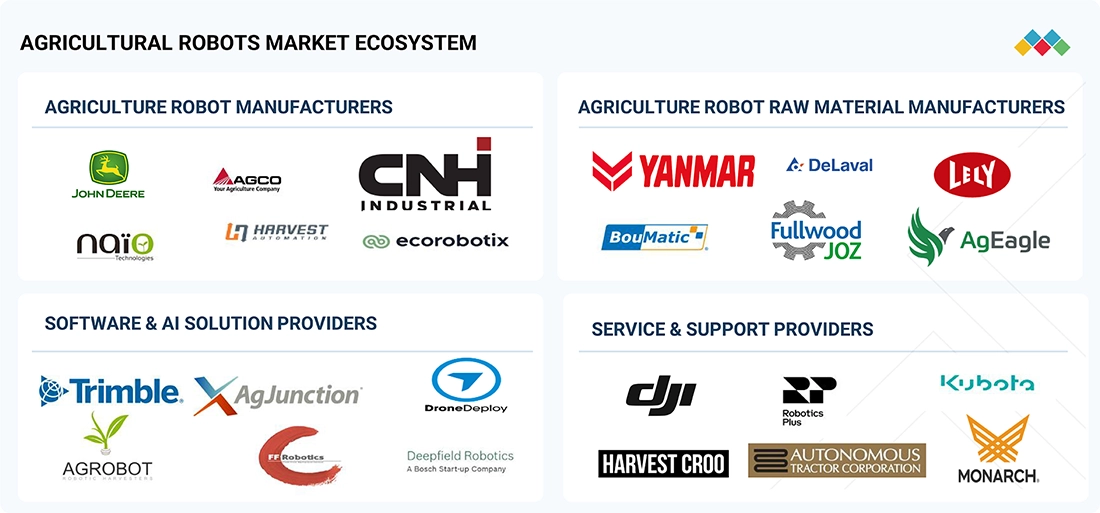
Agricultural Robots Market: COMMERCIAL USE CASES ACROSS INDUSTRIES
| COMPANY | USE CASE DESCRIPTION | BENEFITS |
|---|---|---|
 |
Deployment of autonomous tractors and planters for row crops | Increases operational efficiency, reduces labor costs, and improves precision planting |
 |
Use of robotic harvesters and crop pickers in cereals and vegetables | Minimizes crop loss, reduces reliance on seasonal labor, and enables faster harvest cycles |
 |
Autonomous weed control robots for large-scale cereal and vegetable farms | Reduces herbicide usage, lowers environmental impact, and ensures precise weed management |
 |
Drone-based crop monitoring and spraying for high-value fruits and vegetables | Enables targeted nutrient and pesticide application, improves yield, and reduces chemical wastage |
 |
Greenhouse and indoor robotic solutions for seeding, transplanting, and harvesting | Increases planting and harvesting precision, reduces labor, and optimizes crop growth conditions |
Logos and trademarks shown above are the property of their respective owners. Their use here is for informational and illustrative purposes only.
Related Ecosystem
Farm Equipment And Irrigation
- Sensors
- Hydroponics
- Aeroponics
- Camera Systems
- Global Positioning System (GPS)
- MSK FARM MACHINERY CORPORATION
- MITSUBISHI AGRICULTURAL MACHINERY
- MITSUBISHI CHEMICAL AGRI DREAM
- RIVULIS IRRIGATION
- AGCO Corporation
Precision Agriculture
- Sensors
- Global Positioning System (GPS)
- Camera Systems
- Data Services
- Platform as A Service (PaaS)
- MSK FARM MACHINERY CORPORATION
- MITSUBISHI AGRICULTURAL MACHINERY
- MITSUBISHI CHEMICAL AGRI DREAM
- Trimble Inc.
- Mitsui & Co., Ltd.
Drones And Robotics
- Sensors
- Articulated Robots
- Cartesian Robots
- Scara Robots
- Actuators
- ABB India Limited
- KUKA AG
- MOMENTIVE PERFORMANCE MATERIALS INC.
- Fanuc Corporation
- STAUBLI INTERNATIONAL AG
Key Takeaways
- The US agricultural robots market will grow from $4.3B in 2025 to $14.5B by 2030, driven by a 27.3% CAGR.
- Labor shortages and rising operational costs are accelerating US farmer adoption of autonomous and robotic systems.
- The US market benefits from advanced R&D infrastructure, regulatory support, and integration with precision agriculture platforms.
- By 2030, the US is expected to account for a substantial share of North American agricultural robotics demand.
Agricultural Robots Market Report Scope
| Report Metric | Details |
|---|---|
| Base Year | 2025 |
| Fastest Growing Segment | UNMANNED AERIAL VEHICLES (Robot Type) |
| Forecast Period | 2025–2030 |
| Growth Rate | CAGR of 26% from 2025 to 2030 |
| Largest Segment | FARM PRODUCE (End Use) |
| Market Size Base Year (Billions) | ~USD 17.72 (2025) |
| Revenue Forecast (Billions) | ~USD 56.26 (2030) |
| Segments Covered | Robot Type, Offering, Type, Application, Farming Environment, Farm Size, End Use, Farm Produce, Sub-Type, Farming Environment 2020–2024 |
US Agricultural Robots Market Report Segmentation
10 segment dimensions are covered across the global market.
By Robot Type
- Automated Harvesting Systems
- Driverless Tractors
- Milking Robots
- Unmanned Aerial Vehicles
By Offering
- Hardware
- Services
- Software
- Software & Services
By Type
- AI And Data Analytics
- Automated Milking Rotary System
- Automation & Control
- Communication & Others
- Fixed-Wing Drones
- Fruit Picking Robots
- Fully Autonomous Tractors
- Grain Harvesting Systems
- Hybrid Drones
- Maintenance & Support
- Managed Services
- Multi-Rotor Drones
- Multi-Stall/Box System
- On-Cloud
- On-Premise
- Semi-Autonomous Tractors
- Sensing & Monitoring
- Single-Stall/Box System
- System Integration & Consulting
- Vegetable Harvesting Robots
By Application
- Dairy & Livestock Management
- Field & Crop Management
- Harvest Management
- Inventory & Supply Chain Management
- Soil & Irrigation Management
- Weather Tracking & Forecasting
By Farming Environment
- Indoor
- Outdoor
By Farm Size
- Large-Sized Farms
- Large-Sized Farms (>500 Ha)
- Mid-Sized Farms
- Mid-Sized Farms (100–500 Ha)
- Small-Sized Farms
- Small-Sized Farms (<100 Ha)
By End Use
- Dairy & Livestock
- Farm Produce
By Farm Produce
- Cereals & Grains
- Fruits & Vegetables
- Oilseeds & Pulses
By Sub-Type
- Berries
- Citrus Fruits
- Corn
- Leafy Vegetables
- Other Cereals & Grains
- Other Fruits And Vegetables
- Other Oilseeds & Pulses
- Pome Fruits
- Rice
- Root And Tuber Vegetables
- Soybean
- Sunflower
- Wheat
By Farming Environment 2020–2024
- Indoor
- Outdoor
Target Audience
- Agricultural Equipment Manufacturers : Need US-specific market data to develop localized robotic solutions, understand regional farming practices, and position products against competitors in America's high-growth automation market.
- Venture Capital & Private Equity Firms : Require validated US market forecasts and growth metrics to identify promising agritech startups, evaluate investment returns, and allocate capital to high-potential robotics ventures.
- Farm Operators & Agricultural Cooperatives : Need market insights to make informed automation investment decisions, understand ROI timelines, and identify which robotic solutions best address their specific labor and productivity challenges.
- Technology & Software Companies : Seek US market intelligence to develop AI, IoT, and data analytics solutions for agricultural robots, understand customer needs, and identify partnership opportunities with equipment manufacturers.
- Government & Policy Advisors : Require comprehensive US market data to inform agricultural policy, support rural development initiatives, and understand technology adoption trends for regulatory and funding decisions.
Key Companies in the US Agricultural Robots Market
| Company | HQ | Ownership | Strongest segments |
|---|---|---|---|
| MITSUI & CO., LTD. | Japan | Public Company | Energy & LNG (incl. oil, coal, uranium, carbon solutions),Mobility, Digital & Infrastructure (power, logistics, aviation, shipping),Chemicals (gas/basic chemicals, performance monomers, materials), |
| VOITH | Germany | Private Company | Voith Hydro (turbines, generators, automation, services),Voith Paper (paper machines, components, services),Voith Turbo (drives, couplings, braking, mobility systems), |
| DEERE & COMPANY | United States | Public Company | Production and Precision Agriculture,Small Agriculture and Turf,Construction and Forestry, |
| CNH INDUSTRIAL NV | United Kingdom | Public Company | Agriculture equipment and precision solutions,Construction equipment,Financial Services (Banco CNH and related), |
| AGCO CORPORATION | United States | Public Company | Row-crop and utility tractors,Harvesting equipment (combines, balers, forage),Implements and application equipment, |
| TRIMBLE INC. | United States | Public Company | Construction lifecycle software and field solutions,Positioning and correction services (RTX, VRSNow, xFill),Transportation and logistics platforms (TMS, Transporeon, MAPS), |
| EAGLENXT | United States | Public Company | eBee TAC, eBee X, eBee VISION and other UAV platforms,MicaSense and other sensor solutions (Altum-PT, RedEdge-P family),Ground Control and related software/services, |
| KUBOTA CORPORATION | Japan | Public Company | Agricultural machinery and implements,Construction machinery (mini excavators, loaders, CTLs, SSLs),Engines and industrial machinery, |
MITSUI & CO., LTD.
Mitsui & Co., Ltd. is a public company founded in 1947 and based in Japan, with 55,463 employees.
VOITH
Voith is a private company founded in 1867 and based in Germany, with 23,224 employees.
DEERE & COMPANY
Deere & Company is a public company founded in 1837 and based in the United States, with 73,100 employees.
CNH INDUSTRIAL NV
CNH Industrial NV is a public company founded in 1842 and based in the United Kingdom, with 34,197 employees.
AGCO CORPORATION
AGCO Corporation is a public company founded in 1990 and based in the United States, with 22,000 employees.
TRIMBLE INC.
Trimble Inc. is a public company founded in 1978 and based in the United States, with 11,500 employees.
EAGLENXT
EagleNxt is a public company founded in 2010 and based in the United States, with 59 employees.
KUBOTA CORPORATION
Kubota Corporation is a public company founded in 1890 and based in Japan, with 52,503 employees.
Reasons to Buy this Report
- Market Size & Growth Validation : Quantified US market data with precise valuations ($4.3B to $14.5B) and 27.3% CAGR enables accurate business planning, investment decisions, and competitive benchmarking specific to the American agricultural sector.
- Regional Opportunity Identification : Understand which US agricultural regions are leading robot adoption, identify high-potential markets for product launches, and target sales efforts toward states with greatest automation demand.
- Competitive Landscape Intelligence : Gain insights into US-specific market dynamics, competitor positioning, and technology adoption patterns to inform product development, pricing strategies, and market entry approaches.
- Investment & Funding Decisions : Leverage comprehensive US market forecasts to justify capital allocation, secure investor confidence, and identify acquisition or partnership opportunities within the rapidly expanding American agritech ecosystem.
- Strategic Planning & Risk Mitigation : Access detailed US market trends to anticipate regulatory changes, labor market shifts, and technology adoption curves, enabling proactive strategy adjustments and risk management.
Frequently asked questions
What is the current size of the US agricultural robots market in 2025?
The US agricultural robots market is valued at $4,334.3 million in 2025, with strong growth momentum expected through 2030.
What is the projected size of the US agricultural robots market by 2030?
The US market is forecast to reach $14,491.0 million by 2030, representing nearly a threefold increase from 2025 levels.
What is the CAGR for the US agricultural robots market?
The US agricultural robots market is growing at a compound annual growth rate of 27.3% from 2025 to 2030.
What factors are driving growth in the US agricultural robots market?
Key drivers include labor shortages, rising operational costs, precision agriculture adoption, advanced R&D capabilities, and supportive regulatory frameworks in the US.
Which types of agricultural robots are most in demand in the US?
The US market shows strong demand for autonomous tractors, weeding robots, harvesting systems, and livestock management robots tailored to US farming operations.
RESEARCH METHODOLOGY
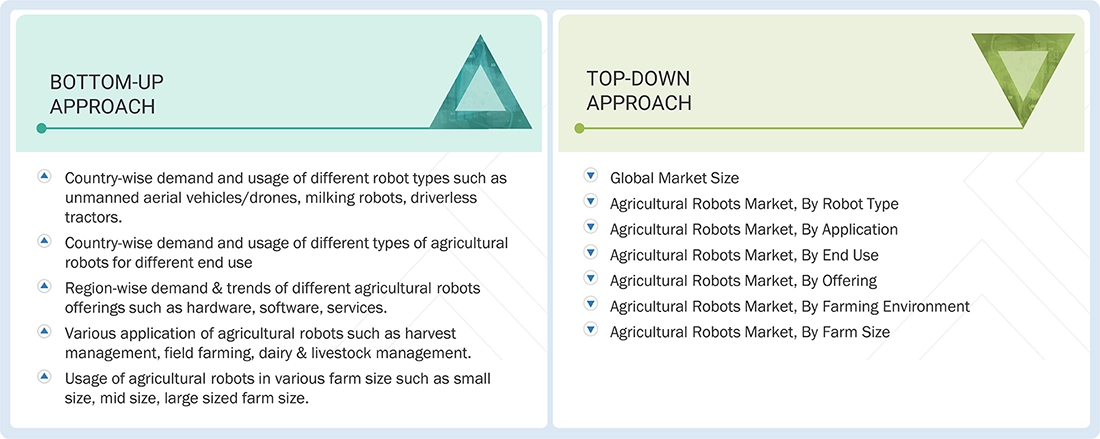
The study employed two primary approaches to estimate the current size of the agricultural robots market. Exhaustive secondary research was conducted to gather information on the market, peer markets, and parent markets. The next step was to validate these findings, assumptions, and sizing with industry experts across the value chain through primary research. Both top-down and bottom-up approaches were employed to estimate the complete market size. Following this, market breakdown and data triangulation were employed to determine the market size of each segment and its subsegments.
Secondary Research
This research study extensively utilized secondary sources, including directories and databases such as Bloomberg Businessweek and Factiva, to identify and collect information relevant to a technical, market-oriented, and commercial study of the market.
In the secondary research process, various sources, including annual reports, press releases & investor presentations of companies, white papers, food journals, certified publications, articles by recognized authors, directories, and databases, were consulted to identify and collect information.
Secondary research was primarily used to gather key information about the industry’s supply chain, the total pool of key players, and market classification and segmentation according to industry trends, down to the most granular level, including regional markets and key developments from both market- and technology-oriented perspectives.
Primary Research
Extensive primary research was conducted after obtaining information regarding the agricultural robots market scenario through secondary research. Several primary interviews were conducted with market experts from both the demand and supply sides across major countries of North America, Europe, Asia Pacific, South America, and the Rest of the World. Primary data was collected through questionnaires, emails, and telephonic interviews. The primary sources from the supply side included various industry experts, such as CXOs, VPs, Directors from business development, marketing, research, and development teams, and related key executives from distributors and key opinion leaders. Primary interviews were conducted to gather insights, including market statistics, revenue data from products and services, market breakdowns, market size estimations, market forecasting, and data triangulation. Primary research also helped in understanding the various trends related to agricultural robot technology, applications, end uses, farming environments, offerings, farm sizes, and regions. Stakeholders from the demand side, including research institutions and universities, agrochemical distributors and retailers, and food processing companies, were interviewed to understand the buyer’s perspective on suppliers, products, and their current usage of agricultural robots, as well as their outlook for the business, which will impact the overall market.
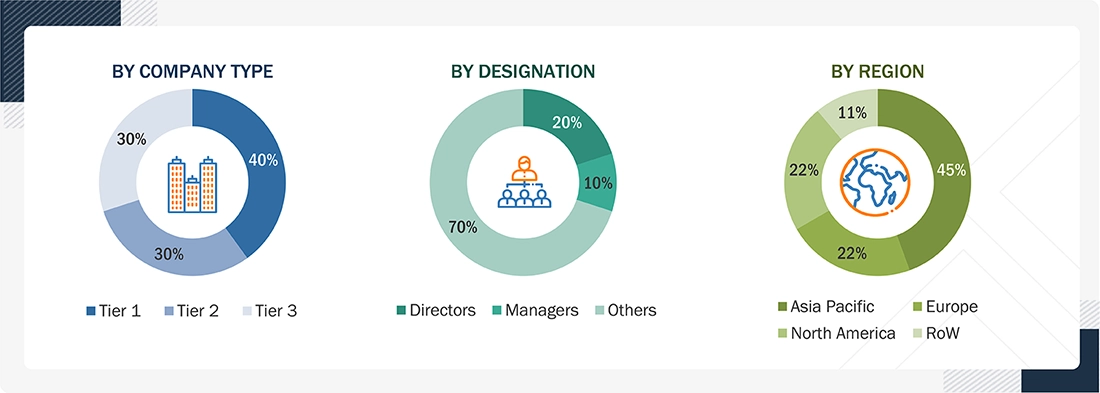
Note: The three tiers of the companies are defined based on their total revenues in 2022 or 2023, as per the availability of financial data: Tier 1: Revenue > USD 1 billion; Tier 2: USD 100 million = Revenue = USD 1 billion; Tier 3: Revenue < USD 100 million.
To know about the assumptions considered for the study, download the pdf brochure
|
COMPANY NAME |
DESIGNATION |
|
Deere & Company (US) |
General Manager |
|
DJI (China) |
Sales Manager |
|
CNH Industries NV (US) |
Manager |
|
AGCO Corporation (US) |
Sales Manager |
|
Delaval (Sweden) |
Marketing Manager |
Market Size Estimation
Both the top-down and bottom-up approaches were used to estimate and validate the total size of the agricultural robots market. These approaches were also used extensively to determine the size of various market segments. The research methodology used to estimate the market size includes the following details:
- The key players in the industry and the overall markets were identified through extensive secondary research.
- All shares, splits, and breakdowns were determined using secondary sources and verified through primary sources.
- All possible parameters that affect the market covered in this research study were accounted for, viewed in extensive detail, verified through primary research, and analyzed to obtain final quantitative and qualitative data.
- The research included the study of reports, reviews, and newsletters of top market players, along with extensive interviews for opinions from leaders, such as CEOs, directors, and marketing executives.
Agricultural Robots Market : Top-Down and Bottom-Up Approach
Data Triangulation
After determining the overall market size through the estimation process explained above, the total market was divided into several segments and subsegments. The data triangulation and market breakdown procedures were employed, wherever applicable, to estimate the overall agricultural robots market and arrive at the exact statistics for all segments and subsegments. The data was triangulated by studying various factors and trends from the demand and supply sides. The market size was also validated using both the top-down and bottom-up approaches.
Market Definition
The agricultural robots market refers to the market for automated and robotic technologies designed to perform agricultural tasks with minimal human intervention. It encompasses a wide range of equipment and systems, including autonomous tractors, drones (UAVs), robotic harvesters, milking robots, planting and seeding machines, weeding robots, and soil and irrigation monitoring systems. These technologies aim to enhance productivity, efficiency, and precision in farming operations while reducing labor dependency and operational costs. The market also includes software platforms, AI-driven analytics, and IoT-enabled solutions that support decision-making, resource optimization, and sustainable agricultural practices across crop farming, livestock management, and greenhouse operations.
Stakeholders
- Farmers and agribusinesses that adopt robots to boost productivity and reduce labor costs
- Equipment manufacturers that produce autonomous tractors, drones, and robotic harvesters
- Traders, distributors, and suppliers in the agricultural robots market
- Technology providers delivering AI, IoT, GPS, sensors, and farm software
- Government bodies promoting adoption through policies, subsidies, and initiatives
- Investors funding agritech startups and robotics innovations
- Research institutions developing robotic and precision farming technologies
Report Objectives
- To determine and project the size of the agricultural robots market with respect to the robot type, application, end use, farming environment, offering, farm size, and region in terms of value over five years, ranging from 2025 to 2030
- To identify the attractive opportunities in the market by determining the largest and fastest-growing segments across regions
- To provide detailed information about the key factors influencing market growth (drivers, restraints, opportunities, and challenges)
- To analyze the opportunities in the market for stakeholders and provide details of the competitive landscape for market leaders
- To analyze the micromarkets with respect to individual growth trends, prospects, and their contribution to the total market
- To identify and profile the key players in the agricultural robots market
- To understand the competitive landscape and identify the major growth strategies adopted by players across the key regions
Available Customizations
With the given market data, MarketsandMarkets offers customizations according to company-specific scientific needs.
The following customization options are available for the report:
Product Analysis
- Product Matrix, which provides a detailed comparison of each company's product portfolio.
Geographic Analysis as per Feasibility
With the given market data, MarketsandMarkets offers customizations according to company-specific scientific needs.
- Further breakdown of the market in the Rest of Europe, by country
- Further breakdown of the market in the Rest of the Asia Pacific, by country
- Further breakdown of the market in the Rest of South America, by country
Company Information
- Detailed analyses and profiling of additional market players (up to five)
Get the Full Agricultural Robots Market Report
Full forecast, segment splits, and company analysis for all Agricultural Robots Market.
- Canada Agricultural Robots Market
- Mexico Agricultural Robots Market
- France Agricultural Robots Market
- Germany Agricultural Robots Market
- Italy Agricultural Robots Market
- Netherlands Agricultural Robots Market
- UK Agricultural Robots Market
- China Agricultural Robots Market
- India Agricultural Robots Market
- Japan Agricultural Robots Market
- South Korea Agricultural Robots Market
- Australia Agricultural Robots Market
- Brazil Agricultural Robots Market
- Argentina Agricultural Robots Market
Need a Tailored Report?
Customize this report to your needs
Get 10% FREE Customization
Customize This Report
