
Bahrain AI In Education Market (2024-2029)

The Bahrain AI In Education Market was valued at $4.5 Million in 2024 and projected to reach to $12.6 Million by 2029, representing a compound annual growth rate of 18.6%. Bahrain's AI in Education market is poised for substantial expansion through 2029, driven by government modernization policies and increasing institutional recognition of AI's transformative potential in learning outcomes.


| Market Size in | USD 26.32 MN |
| Market Forecast in | |
| CAGR | |
| Forecast Period | |
| Units Considered | Value (USD MN) |
Bahrain AI In Education Market Trends and Insights
- This expansion reflects Bahrain's strategic commitment to digital transformation in the education sector, driven by government initiatives and increasing adoption of intelligent learning platforms.
- Bahrain is positioning itself as a regional hub for educational technology innovation, with investments in AI-powered personalized learning solutions and administrative automation. The forecast period through 2029 demonstrates Bahrain's accelerating momentum in integrating artificial intelligence across educational institutions.
- Bahrain's market growth outpaces global averages, indicating strong local demand for adaptive learning systems, intelligent tutoring platforms, and data-driven educational analytics.
- Educational institutions in Bahrain are increasingly recognizing AI's potential to enhance student outcomes and operational efficiency, creating sustained demand for innovative solutions throughout the forecast period..
Key Market Statistics
- CAGR (2024-2029) 18.6% CAGR
- Market Size, 2024 ~USD 4.5 Million
- Forecast, 2029 ~USD 12.6 Million
- Country Bahrain
Bahrain AI In Education Market Overview
Strong Market Valuation :
Bahrain's AI in Education market reached $4.5 million in 2024, with projections to grow to $12.6 million by 2029, demonstrating significant investment potential in the Gulf region's education technology sector.
Above-Global Growth Rate :
At 18.6% CAGR, Bahrain's market growth outpaces the global average of 17.5%, indicating accelerated digital adoption and government prioritization of AI-driven educational solutions.
Government Digital Transformation :
Bahrain's strategic commitment to digital transformation in education, supported by government initiatives, is driving institutional adoption of intelligent learning platforms across schools and universities.
Emerging EdTech Hub :
As a progressive Gulf nation, Bahrain is positioning itself as a regional leader in educational technology, attracting EdTech vendors and creating opportunities for AI-powered learning solutions.
Bahrain AI In Education Market Dynamics
- The nation's strategic geographic position and economic diversification efforts create a favorable environment for EdTech adoption.
- Educational institutions are progressively integrating intelligent tutoring systems, adaptive learning platforms, and AI-powered assessment tools to enhance student engagement and personalized learning experiences.
- This trajectory reflects broader Gulf Cooperation Council trends toward knowledge-based economies and digital education infrastructure development..
Market Ecosystem
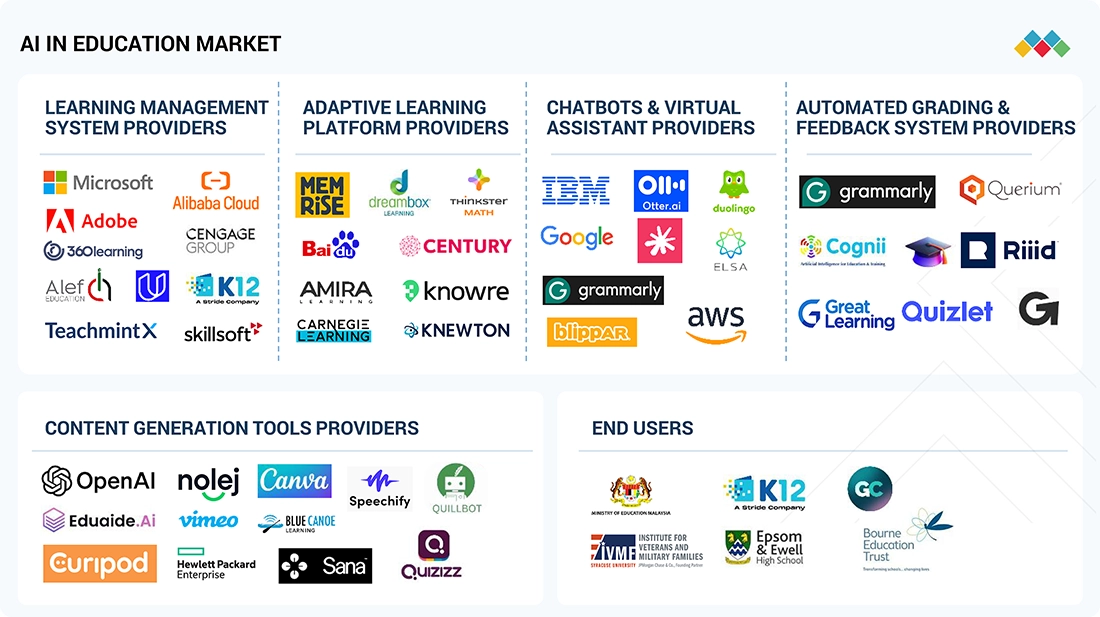
AI In Education Market: COMMERCIAL USE CASES ACROSS INDUSTRIES
| COMPANY | USE CASE DESCRIPTION | BENEFITS |
|---|---|---|
 |
GetCourse leveraged Alibaba Cloud’s Elastic Compute and Object Storage Services to enhance scalability, streamline operations, and ensure reliable performance for its rapidly expanding online education platform. | Alibaba Cloud delivered cost efficiency, flexible scaling, and responsive support, improving platform stability, operational agility, and user experience across GetCourse’s growing online education network. |
 |
Epsom and Ewell High School implemented Century Tech’s AI-powered adaptive learning platform to personalize education, reduce teacher workload, and improve student engagement through automated assessments and data-driven insights. | Century Tech enabled personalized learning, reduced administrative workload, and enhanced classroom engagement while equipping teachers with actionable analytics to deliver targeted support and improve overall learning outcomes. |
 |
Malaysia’s Ministry of Education adopted Google Cloud solutions, integrating Google Workspace and BigQuery to unify platforms, enhance digital access, and enable data-driven insights for improved learning outcomes nationwide. | Google Cloud improved digital accessibility, strengthened collaboration, and streamlined administration, empowering educators with real-time analytics to enhance teaching efficiency and student engagement across Malaysia’s education system. |
 |
Stride utilized Amazon Bedrock’s stable diffusion models to develop the Legend Library app, enabling K–12 students to create AI-generated stories and images for improved reading comprehension and engagement. | Amazon Bedrock empowered Stride to deliver secure, high-quality, and interactive learning experiences through Generative AI, enhancing content quality, ensuring data privacy, and accelerating innovation in digital education. |
Logos and trademarks shown above are the property of their respective owners. Their use here is for informational and illustrative purposes only.
Related Ecosystem
Analytics
- Natural Language Processing (NLP)
- Machine Learning
- Supply Chain Management
- Predictive Analytics
- Image Sensors
- International Business Machines Corporation
- MICROSOFT CORPORATION
- Oracle Corporation
- SAP SE
Software And Services
- Natural Language Processing (NLP)
- Machine Learning
- Supply Chain Management
- Predictive Analytics
- Image Sensors
- International Business Machines Corporation
- MICROSOFT CORPORATION
- Oracle Corporation
- SAP SE
- Amazon.com, Inc.
Cloud Computing
- Software as A Service (SaaS)
- Natural Language Processing (NLP)
- Platform as A Service (PaaS)
- Machine Learning
- Supply Chain Management
- International Business Machines Corporation
- MICROSOFT CORPORATION
- Oracle Corporation
- Amazon.com, Inc.
Key Takeaways
- Bahrain's AI in Education market is valued at $4.5 million in 2024 and will reach $12.6 million by 2029, growing at 18.6% CAGR.
- Bahrain's market growth rate exceeds the global average of 17.5%, reflecting strong regional demand and government digital transformation initiatives.
- Bahrain is investing heavily in adaptive learning platforms and intelligent tutoring systems to enhance educational outcomes across institutions.
- The forecast period shows Bahrain consolidating its position as a regional leader in educational technology adoption and innovation.
AI In Education Market Report Scope
| Report Metric | Details |
|---|---|
| Base Year | 2024 |
| Fastest Growing Segment | HEALTHCARE& LIFE SCIENCES (Vertical) |
| Forecast Period | 2024-2029 |
| Growth Rate | CAGR of 17.5% from 2024 to 2029 |
| Largest Segment | MARKETING & SALES (Business Function) |
| Market Size Base Year (Billions) | ~USD 2.21 (2024) |
| Revenue Forecast (Billions) | ~USD 4.95 (2029) |
| Segments Covered | Offering, Software Type, Deployment Mode, Service, Academic Application, Institutional Application, Technology, End User, Institutional End User, Business Function, Vertical, Delivery Mode, Organization Size, Deployment Type, Application Area, User Type |
Bahrain AI In Education Market Report Segmentation
16 segment dimensions are covered across the global market.
By Offering
- Hardware
- Services
- Software
- Solutions
By Software Type
- Adaptive Learning Platforms
- Automated Grading & Feedback Systems
- Chatbots And Virtual Assistants
- Content Generation Tools
- Gamified Learning Platforms
- Intelligent Tutoring Systems
- Learning Management Systems (Lms)
- Other Software Types
- Plagiarism Detection Tools
By Deployment Mode
- Cloud
- On-Premises
By Service
- Admission Services
- Custom AI Platform Development
- Data Analytics Consulting
- Instructional Services
- Other Services
- Professional Development Programs
By Academic Application
- Gamification & Engagement
- Grading & Assessment Management
- Language Translation & Support
- Personalized Learning & Content Management
- Plagiarism Detection & Academic Integrity
- Predictive Analysis
- Student Support & Service
By Institutional Application
- Administrative Process Automation
- Alumni Engagement & Retention Analysis
- Resource Allocation & Financial Planning
- Student Enrollment & Detection Analysis
- Student Enrolment & Detection Analysis
- Workforce Alignment & Skills Mapping
By Technology
- Computer Vision
- Context-Aware AI
- Generative AI
- Machine Learning
- Natural Language Processing
- Other AI Technologies
By End User
- Academic
- Institutional
By Institutional End User
- Edtech Companies
- Government Education Departments
- Higher Education
- K-12
- Other Institutional End Users
- Research Firms & Ngo
- Skill Development & Corporate Training Centers
By Business Function
- Cybersecurity
- Finance & Accounting
- Human Resources
- Marketing & Sales
- Operations
By Vertical
- Agriculture
- Automotive, Transportation & Logistics
- Bfsi
- Energy & Utilities
- Government & Defense
- Healthcare& Life Sciences
- It/Ites
- Manufacturing
- Media & Entertainment
- Other Verticals
- Retail & Ecommerce
- Telecommunications
By Delivery Mode
- Blended Learning
- Distance Learning
- Instructor-Led Training
By Organization Size
- Large Enterprises
- Smes
By Deployment Type
- Cloud
- On-Premises
By Application Area
- Content Management
- Corporate Training & Development
- Course Management
- Onboarding & Orientation
- Other Application Areas
- Professional Certification & Compliance
- User Management
By User Type
- Academic Users
- Corporate Users
- Government& Non-Profit Organization
BAHRAIN: AI IN EDUCATION MARKET, BY END USER, 2024–2030
| Segment | 2024 | 2025 | 2026 | 2027 | 2028 | 2029 | 2030 | CAGR (%) |
|---|---|---|---|---|---|---|---|---|
| ACADEMIC | 0.6 | 0.7 | 0.7 | 0.9 | 1 | 1.2 | 1.3 | 13.6 |
| INSTITUTIONAL | 3.3 | 3.9 | 4.4 | 5.4 | 6.6 | 8.3 | 10 | 20.5 |
| TOTAL | 3.9 | 4.6 | 5.1 | 6.3 | 7.6 | 9.5 | 11.3 | 19.7 |
Target Audience
- EdTech Vendors & Solution Providers : Evaluate Bahrain as a strategic market entry point, understand local demand for AI learning platforms, and identify partnership opportunities with educational institutions and government bodies.
- Investment & Private Equity Firms : Assess investment viability in Bahrain's high-growth AI education sector, benchmark returns against regional markets, and identify acquisition targets in the emerging EdTech ecosystem.
- Educational Institutions & Administrators : Benchmark institutional AI adoption trends in Bahrain, understand peer implementation strategies, and evaluate intelligent learning solutions aligned with government digital transformation mandates.
- Government & Policy Makers : Inform education technology policy development, assess market readiness for AI integration, and align digital transformation initiatives with demonstrated market growth and institutional capacity.
- Market Research & Consulting Firms : Incorporate Bahrain-specific market data into regional analyses, support client advisory services with localized insights, and develop comprehensive Gulf education technology market assessments.
Reasons to Buy this Report
- Market-Specific Growth Data : Access precise valuation metrics and forecasts exclusive to Bahrain's market, enabling accurate investment planning and competitive positioning in this high-growth Gulf education technology segment.
- Government Initiative Insights : Understand Bahrain's specific digital transformation policies and institutional adoption drivers that differentiate this market from broader regional trends, informing strategic market entry decisions.
- Competitive Landscape Analysis : Identify key players, market gaps, and opportunities within Bahrain's emerging AI education ecosystem to develop targeted go-to-market strategies and partnership approaches.
- Regional Expansion Blueprint : Leverage Bahrain market intelligence as a pilot for broader Gulf expansion, understanding localized adoption patterns, regulatory requirements, and institutional procurement preferences.
- Investment Decision Support : Make data-driven investment and resource allocation decisions backed by Bahrain-specific market dynamics, growth trajectories, and emerging opportunities in intelligent learning solutions.
Frequently asked questions
What is the current size of Bahrain's AI in Education market?
Bahrain's AI in Education market was valued at $4.5 million in 2024 and is expected to grow to $12.6 million by 2029.
What is the projected growth rate for Bahrain's AI in Education market?
Bahrain's AI in Education market is projected to grow at a compound annual growth rate (CAGR) of 18.6% from 2024 to 2029.
How does Bahrain's market growth compare to global trends?
Bahrain's AI in Education market CAGR of 18.6% exceeds the global average of 17.5%, indicating stronger regional adoption and investment momentum.
What are the primary drivers of growth in Bahrain's AI in Education market?
Growth in Bahrain is driven by government digital transformation initiatives, increasing institutional adoption of adaptive learning platforms, and demand for intelligent tutoring solutions.
What solutions are gaining traction in Bahrain's education sector?
Bahrain's institutions are increasingly adopting AI-powered personalized learning systems, intelligent tutoring platforms, and data-driven educational analytics tools.
RESEARCH METHODOLOGY
The study involved major activities in estimating the current market size for the AI in education market. Exhaustive secondary research was done to collect information on the AI in education market. The next step was to validate these findings, assumptions, and sizing with industry experts across the value chain using primary research. Different approaches, such as top-down and bottom-up, were employed to estimate the total market size. After that, the market breakup and data triangulation procedures were used to estimate the market size of the segments and subsegments of the AI in education market.
Secondary Research
The market for the companies offering AI in education solutions is arrived at by secondary data available through paid and unpaid sources, analyzing the product portfolios of the major companies in the ecosystem, and rating the companies by their performance and quality. Various sources were referred to in the secondary research process to identify and collect information for this study. The secondary sources include annual reports, press releases, investor presentations of companies, white papers, journals, certified publications, and articles from recognized authors, directories, and databases.
In the secondary research process, various secondary sources were referred to for identifying and collecting information related to the study. Secondary sources included annual reports, press releases, and investor presentations of AI in education vendors, forums, certified publications, and whitepapers. The secondary research was used to obtain critical information on the industry’s value chain, the total pool of key players, market classification, and segmentation from the market and technology-oriented perspectives.
Primary Research
In the primary research process, various primary sources from both the supply and demand sides were interviewed to obtain qualitative and quantitative information for this report. The primary sources from the supply side included industry experts, such as Chief Executive Officers (CEOs), Vice Presidents (VPs), marketing directors, technology and innovation directors, and related key executives from various key companies and organizations operating in the AI in education market. After the complete market engineering (calculations for market statistics, market breakdown, market size estimations, market forecasting, and data triangulation), extensive primary research was conducted to gather information and verify and validate the critical numbers arrived at. Primary research was also conducted to identify the segmentation types, industry trends, competitive landscape of AI in education solutions offered by various market players, and key market dynamics, such as drivers, restraints, opportunities, challenges, industry trends, and key player strategies. In the complete market engineering process, the top-down and bottom-up approaches were extensively used, along with several data triangulation methods, to perform the market estimation and market forecasting for the overall market segments and subsegments listed in this report. Extensive qualitative and quantitative analysis was performed on the complete market engineering process to list the key information/insights throughout the report.
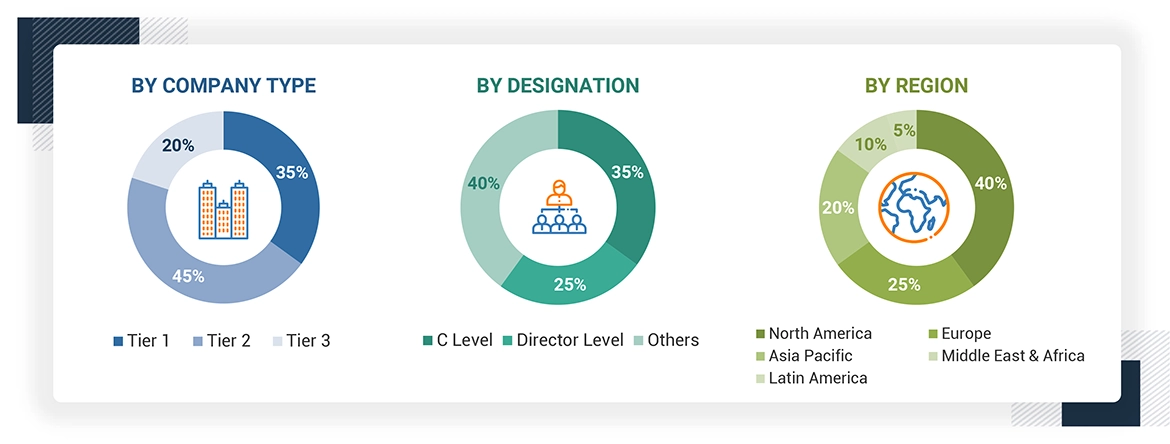
Note: Tier 1 companies account for annual revenue of >USD 10 billion; tier 2 companies’ revenue ranges
between USD 1 and 10 billion; and tier 3 companies’ revenue ranges between USD 500 million–USD
1 billion
To know about the assumptions considered for the study, download the pdf brochure
Market Size Estimation
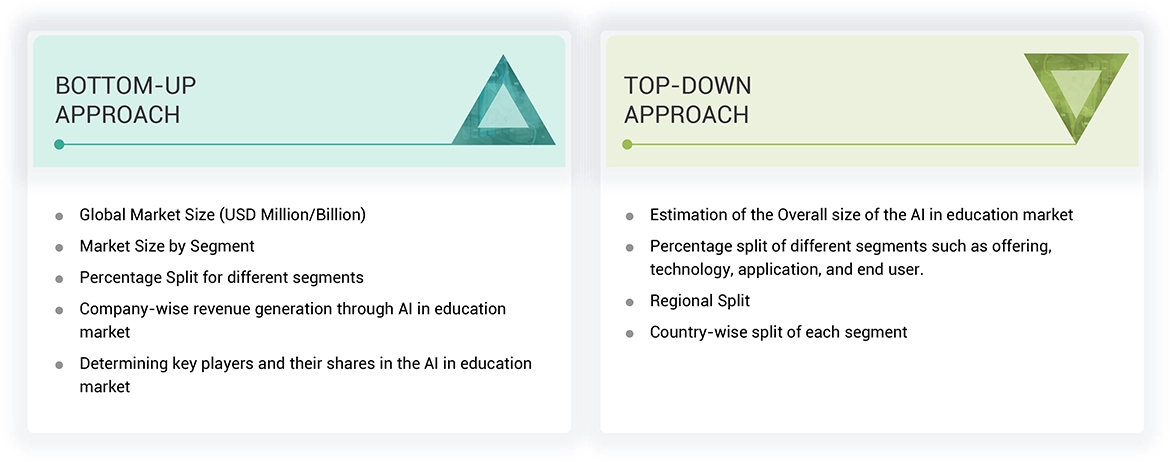
Both top-down and bottom-up approaches were used to estimate and validate the total size of the cell culture market. These methods were also used extensively to estimate the size of various subsegments in the market. The research methodology used to estimate the market size includes the following:
AI In Education Market : Top-Down and Bottom-Up Approach
Data Triangulation
After arriving at the overall market size using the market size estimation processes explained above, the market was split into various segments and subsegments. The data triangulation and market breakup procedures were employed, wherever applicable, to complete the overall market engineering process and arrive at the exact statistics of each market segment and subsegment. The data was triangulated by studying various factors and trends from both the demand and supply sides.
Market Definition
AI in education refers to the deployment of underlying technologies such as discriminative machine learning, deep learning, NLP and generative AI to enhance the efficiency and efficacy of pedagogy and learning experience. It involves implementation of AI-based software across educational institutions to bolster and streamline administrative and operational processes and systems. From an academic perspective, this involves incorporation of AI-based platforms that can help tailor personalized learning modules and experiences to assist educational instructors to gauge, track and efficiently improve learning outcomes.
Stakeholders
- AI in education software developers
- AI in education service vendors
- Educators
- LMS Providers
- Instructors
- Government Educational Institutions
- Research Academic Firms
- Distributors and Value-added Resellers (VARs)
- Independent Software Vendors (ISV)
- Managed service providers
- Support & maintenance service providers
- System Integrators (SIs)/migration service providers
- OEMs
- Technology providers
Report Objectives
- To define, describe, and predict the AI in education market by offering (software by type, services, and deployment mode), application, end users, and region
- To provide detailed information related to major factors (drivers, restraints, opportunities, and industry-specific challenges) influencing the market growth
- To analyze the micro markets with respect to individual growth trends, prospects, and their contributions to the total market
- To analyze the opportunities in the market for stakeholders by identifying the high-growth segments of the AI in education market
- To analyze opportunities in the market and provide details of the competitive landscape for stakeholders and market leaders
- To forecast the market size of five main regions: North America, Europe, Asia Pacific, the Middle East & Africa, and Latin America
- To profile key players and comprehensively analyze their market rankings and core competencies
- To analyze competitive developments, such as partnerships, new product launches, and mergers & acquisitions, in the AI in education market
- To analyze the impact of the recession across all regions in the AI in education market
Available Customizations
With the given market data, MarketsandMarkets offers customizations as per your company’s specific needs. The following customization options are available for the report:
Product Analysis
- Product quadrant, which gives a detailed comparison of the product portfolio of each company.
Geographic Analysis as per Feasibility
Further breakup of the North American AI in education market
- Further breakup of the European AI in education market
- Further breakup of the Asia Pacific AI in education market
- Further breakup of the Middle Eastern & African AI in education market
- Further breakup of the Latin America AI in education market
Company Information
- Detailed analysis and profiling of additional market players (up to five)
Get the Full AI In Education Market Report
Full forecast, segment splits, and company analysis for all AI In Education Market.
- US AI In Education Market
- Canada AI In Education Market
- UK AI In Education Market
- Germany AI In Education Market
- France AI In Education Market
- Italy AI In Education Market
- Spain AI In Education Market
- China AI In Education Market
- Japan AI In Education Market
- India AI In Education Market
- South Korea AI In Education Market
- UAE AI In Education Market
- Kuwait AI In Education Market
- Brazil AI In Education Market
- Mexico AI In Education Market
- Argentina AI In Education Market
- Rest Of Europe AI In Education Market
- Anz AI In Education Market
- Asean Countries AI In Education Market
- Rest Of Asia Pacific AI In Education Market
- Rest Of Latin America AI In Education Market
- Indonesia AI In Education Market
- Malaysia AI In Education Market
- Rest Of Asean AI In Education Market
- Singapore AI In Education Market
- Ksa AI In Education Market
- Rest Of The Middle East AI In Education Market
Need a Tailored Report?
Customize this report to your needs
Get 10% FREE Customization
Customize This Report
