
Asia Pacific AI in Oncology Market (2024-2029)

The Asia Pacific AI in Oncology Market was valued at $550.6 Million in 2024 and projected to reach to $2741.2 Million by 2029, representing a compound annual growth rate of 30.7%. The Asia Pacific AI in Oncology market is positioned for exceptional growth, expanding from USD 550.6 million in 2024 to USD 2,741.2 million by 2029.


| Market Size in | USD 26.32 MN |
| Market Forecast in | |
| CAGR | |
| Forecast Period | |
| Units Considered | Value (USD MN) |
Asia Pacific AI in Oncology Market Trends and Insights
- Asia Pacific's accelerating adoption of artificial intelligence in cancer diagnosis, treatment planning, and drug discovery reflects the region's growing healthcare infrastructure investments and rising cancer incidence rates.
- The 30.7% compound annual growth rate underscores Asia Pacific's position as a high-growth market, driven by increasing government support for digital health initiatives and expanding partnerships between technology firms and oncology centers across the region. Asia Pacific's market momentum is fueled by a combination of factors unique to the region, including a large patient population, emerging economies investing heavily in healthcare modernization, and growing awareness of AI's clinical benefits in oncology.
- Between 2024 and 2029, Asia Pacific is expected to capture significant market share as countries like China, India, Japan, and South Korea advance their AI-enabled cancer care capabilities.
- The region's competitive landscape is intensifying, with both multinational AI vendors and local innovators establishing footholds to meet the surging demand for intelligent oncology solutions..
Key Market Statistics
- CAGR (2024-2029) 30.7% CAGR
- Market Size, 2024 ~USD 550.6 Million
- Forecast, 2029 ~USD 2741.2 Million
- Geography Asia Pacific
Asia Pacific AI in Oncology Market Overview
Rapid Market Expansion :
Asia Pacific's AI in Oncology market is growing at 30.7% CAGR, outpacing the global rate of 29.4%, driven by increasing cancer prevalence and healthcare digitalization across the region.
China & India Leadership :
China (USD 869.7M) and India (USD 463.3M) are key growth engines, leveraging large patient populations, expanding healthcare infrastructure, and government support for AI adoption in cancer care.
Japan's Advanced Market :
Japan represents a mature AI oncology market at USD 858.7M, with strong adoption of precision medicine, robotic surgery integration, and AI-driven diagnostic tools in established healthcare systems.
Infrastructure Investment Surge :
Rising healthcare expenditure, government initiatives, and partnerships between tech companies and hospitals are accelerating AI implementation in diagnosis, treatment planning, and drug discovery across Asia Pacific.
Asia Pacific AI in Oncology Market Dynamics
- This trajectory reflects the region's commitment to modernizing cancer care through artificial intelligence, supported by increasing healthcare budgets, growing cancer incidence rates, and digital health infrastructure development.
- Countries like China, India, and Japan are leading adoption through government-backed initiatives and private sector investments. Key drivers include rising awareness of early cancer detection benefits, shortage of oncologists in developing nations, and AI's proven efficacy in improving diagnostic accuracy and treatment outcomes.
- The region's younger tech-savvy population and expanding middle class are creating favorable conditions for AI adoption.
- Strategic partnerships between international tech firms and regional healthcare providers are accelerating market penetration, positioning Asia Pacific as a critical growth market for AI oncology solutions through 2029..
Market Ecosystem
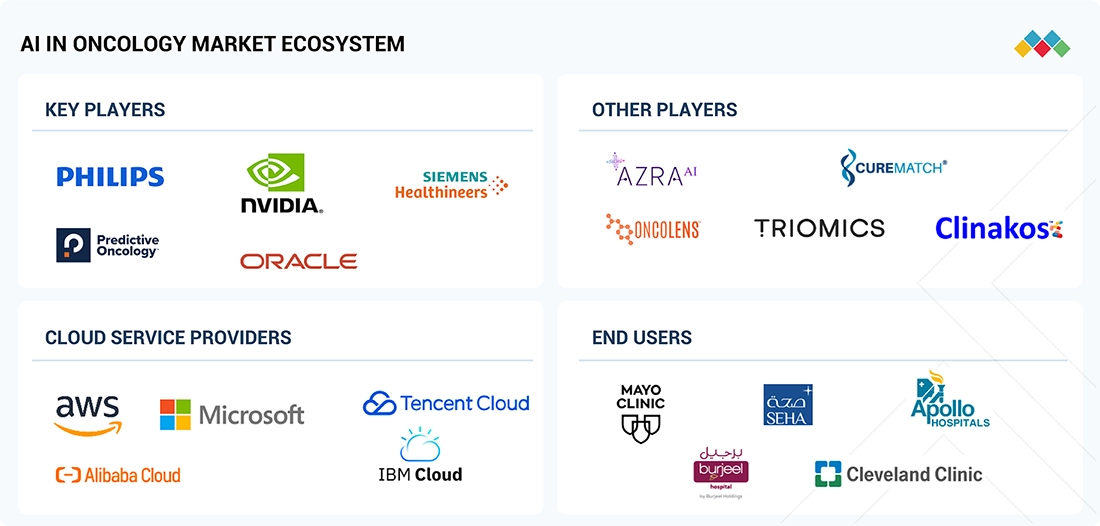
AI IN ONCOLOGY MARKET: GROWTH, SIZE, SHARE, AND TRENDS: COMMERCIAL USE CASES ACROSS INDUSTRIES
| COMPANY | USE CASE DESCRIPTION | BENEFITS |
|---|---|---|
 |
AI models for oncology imaging that support tumor detection, segmentation, radiomics analysis, and multi-modal decision-support using high-performance GPUs | Enhances accuracy in tumor identification, accelerates image interpretation, supports precision oncology, and reduces radiologist workload. |
 |
AI-powered oncology imaging and digital pathology tools integrated into cloud platforms to improve cancer detection, triaging, and clinical workflows. | Improves early cancer detection, streamlines oncology reporting, enhances clinical decision-making, and optimizes hospital workflow efficiency. |
 |
AI-enabled oncology imaging platforms and radiotherapy planning tools that support tumor contouring, treatment simulation, and predictive modelling. | Accelerates treatment planning, improves tumor segmentation accuracy, reduces manual contouring effort, and enhances radiotherapy precision. |
 |
AI-driven digital pathology and biomarker analysis tools for cancer diagnosis, tumor grading, and molecular profiling. | Improves diagnostic consistency, accelerates pathology workflows, supports personalized treatment decisions, and reduces manual review burden. |
 |
AI platform for oncology drug discovery that predicts targets, designs novel molecules, and optimizes candidates using deep learning and generative AI. | Shortens oncology drug development timelines, enhances hit discovery efficiency, reduces R&D cost, and supports next-generation precision therapeutics. |
Logos and trademarks shown above are the property of their respective owners. Their use here is for informational and illustrative purposes only.
Related Ecosystem
Healthcare Analytics
- Machine Learning
- Natural Language Processing (NLP)
- Blood Pressure Monitors
- Computed Tomography (CT)
- Magnetic Resonance Imaging (MRI)
- Oracle Corporation
- PHILIPS HEALTHCARE
- Siemens healthineers
- Zensar Technologies Limited
- EPIC SYSTEMS CORPORATION
Healthcare It
- Computed Tomography (CT)
- Machine Learning
- Magnetic Resonance Imaging (MRI)
- Natural Language Processing (NLP)
- Predictive Analytics
- CERNER CORPORATION
- PHILIPS HEALTHCARE
- Oracle Corporation
- GE HealthCare Technologies Inc.
- Siemens healthineers
Key Takeaways
- Asia Pacific's AI in Oncology Market is projected to grow from USD 550.6 million in 2024 to USD 2,741.2 million by 2029, representing a 30.7% CAGR.
- Asia Pacific is emerging as a high-growth region due to rising cancer prevalence, government digital health investments, and healthcare infrastructure modernization.
- Asia Pacific's market is driven by increasing adoption of AI for diagnostic imaging, treatment planning, and personalized medicine across major economies.
- Asia Pacific's competitive environment is expanding with both global AI vendors and regional players competing to capture market share in oncology solutions.
AI in Oncology Market Report Scope
| Report Metric | Details |
|---|---|
| Base Year | 2024 |
| Fastest Growing Segment | DEEP LEARNING (Type) |
| Forecast Period | 2024-2029 |
| Growth Rate | CAGR of 29.4% from 2024 to 2029 |
| Largest Segment | SOLID TUMORS (Cancer Type) |
| Market Size Base Year (Billions) | ~USD 2.45 (2024) |
| Revenue Forecast (Billions) | ~USD 8.9 (2029) |
| Segments Covered | Technology, Type, Application, Cancer Type, End User, Player Type, Deployment Model |
Asia Pacific AI in Oncology Market Report Segmentation
7 segment dimensions are covered across the global market.
By Technology
- Computer Vision
- Context-Aware Processing & Computing
- Image Analysis
- Machine Learning
- Natural Language Processing
- Natural Language Processing (Nlp)
By Type
- Adaptive Trial Design & Monitoring
- AI-Guided Drug Delivery
- Brain Tumors
- Breast Cancer
- Candidate Selection & Validation
- Chemotherapy
- Clinical Trial Optimization
- Colorectal Cancer
- Combination & Dose Optimization
- Computed Tomography
- Computed Tomography (Ct)
- Deep Learning
- Digital Pathology & Histopathology
- Genetic Risk Prediction
- Hit Identification & Prioritization
- Hit-To-Lead Identification/Lead Generation
- Hospitals & Clinics
- Imaging & Radiology
- Immunotherapy
- Intraoperative Guidance & Robotics
- Intraoperative Guidance And Robotics
- Laboratories & Diagnostic Centers
- Lead Optimization
- Leukemia
- Liquid Biopsy & Biomarker Detection
- Long-Term Prediction
- Lung Cancer
- Lymphoma
- Magnetic Resonance Imaging (Mri)
- Mammography
- Mental Health & Support Systems
- Multiple Myeloma
- Nuclear Imaging
- Other Healthcare Providers
- Other Hematologic Malignancies
- Other Hematological Malignancies
- Other Imaging Modalities
- Other Machine Learning Technologies
- Other Solid Tumors
- Other Tumors
- Others Healthcare Providers
- Patient Education & Empowerment
- Personalized Treatment Planning
- Postoperative Analysis & Recovery
- Precision Medicine & Genomic Analysis
- Preclinical Testing
- Predictive Modeling For Human Trials
- Predictive Modelling For Human Trials
- Predictive Models For Treatment Response
- Preoperative Imaging & 3D Modeling
- Preoperative Imaging And 3D Modeling
- Prostate Cancer
- Radiation Therapy
- Radiomics & Radiogenomics
- Radiomics And Radiogenomics
- Recurrence Monitoring
- Reinforcement Learning
- Remote Patient Monitoring
- Specialty Centers
- Supervised Learning
- Surgical Planning & Assistance
- Symptom Management & Virtual Assistance
- Target Identification & Validation
- Targeted Therapy
- Treatment Recommendation Systems
- Ultrasound
- Unsupervised Learning
- X-Ray Imaging
By Application
- Data Management & Analytics
- Diagnosis & Early Detection
- Drug Development
- Drug Discovery
- Other Applications
- Patient Engagement & Remote Monitoring
- Post Treatment Surveillance & Survivorship Care
- Post-Treatment Surveillance & Survivorship Care
- Treatment Planning & Personalization
By Cancer Type
- Hematologic Malignancies
- Hematological Malignancies
- Other Cancer Types
- Other Cancers
- Others Cancer Types
- Solid Tumors
By End User
- Academic & Research Institutions
- Government & Regulatory Agencies
- Healthcare Payers
- Healthcare Providers
- Medical Device/ Equipment Companies
- Medical Device/Equipment Companies
- Other End Users
- Pharmaceutical & Biotechnology Companies
By Player Type
- Business Process Service Providers
- Integrated Suite/Platform Providers
- Niche/Point Solution Providers
- Technology Providers
By Deployment Model
- Cloud-Based Model
- Hybrid Model
- On-Premises Model
Target Audience
- Healthcare Technology Companies : AI and software vendors need Asia Pacific market data to develop region-specific oncology solutions, understand local regulatory requirements, and identify partnership opportunities with hospitals and healthcare providers.
- Pharmaceutical & Biotech Firms : Drug developers and biotech companies require insights into AI-driven drug discovery adoption, clinical trial optimization, and precision medicine trends in Asia Pacific to accelerate R&D and market launch strategies.
- Hospital & Healthcare Systems : Healthcare providers and oncology centers need market intelligence on AI implementation best practices, ROI benchmarks, and technology selection criteria to enhance diagnostic accuracy and treatment outcomes in Asia Pacific.
- Investment & Private Equity Firms : Investors seeking Asia Pacific healthcare opportunities require detailed market sizing, growth forecasts, and competitive analysis to identify acquisition targets, funding opportunities, and portfolio companies in AI oncology.
- Government & Policy Makers : Healthcare regulators and government agencies need market data to inform policy decisions, healthcare infrastructure investments, and digital health initiatives supporting AI adoption in cancer care across Asia Pacific.
Countries within Asia Pacific - compare and drill down
| Country | 2025 size (native) |
|---|---|
| China | USD 869.7 Million |
| India | USD 463.3 Million |
| Japan | USD 858.7 Million |
| Rest Of Asia Pacific | USD 549.5 Million |
Country market size visualization
Reasons to Buy this Report
- Regional Market Segmentation : Gain detailed insights into Asia Pacific's fastest-growing oncology AI markets, including country-level analysis of China, India, Japan, and emerging markets with specific growth trajectories and adoption patterns.
- Competitive Landscape Intelligence : Understand regional competitive dynamics, key players' strategies in Asia Pacific, partnership ecosystems, and market consolidation trends specific to the region's unique healthcare regulatory environment.
- Investment & Expansion Opportunities : Identify high-potential markets and sub-segments within Asia Pacific for market entry, expansion, or partnership, with data-driven recommendations based on regional growth forecasts and infrastructure readiness.
- Regulatory & Reimbursement Insights : Access Asia Pacific-specific regulatory frameworks, government initiatives, reimbursement policies, and healthcare spending patterns that influence AI oncology adoption across different countries.
- Strategic Decision Support : Make informed business decisions with Asia Pacific market forecasts, trend analysis, and competitive benchmarking to optimize product development, pricing, and go-to-market strategies for the region.
Frequently asked questions
What is the current size of the Asia Pacific AI in Oncology Market?
The Asia Pacific AI in Oncology Market was valued at USD 550.6 million in 2024 and is expected to grow to USD 2,741.2 million by 2029.
What is the projected growth rate for Asia Pacific's AI in Oncology Market?
Asia Pacific's AI in Oncology Market is projected to grow at a compound annual growth rate (CAGR) of 30.7% from 2024 to 2029.
Which countries are driving growth in Asia Pacific's AI in Oncology Market?
Major growth drivers in Asia Pacific include China, India, Japan, and South Korea, which are investing heavily in healthcare digitalization and AI-enabled cancer care solutions.
What are the primary applications of AI in Asia Pacific's oncology market?
Key applications in Asia Pacific include diagnostic imaging analysis, treatment planning optimization, drug discovery acceleration, and personalized medicine development for cancer patients.
What factors are accelerating AI adoption in Asia Pacific's oncology sector?
Asia Pacific's growth is driven by rising cancer incidence, government support for digital health, healthcare infrastructure investments, and increasing partnerships between technology companies and oncology institutions.
RESEARCH METHODOLOGY
The study involved significant activities to estimate the current size of the AI in oncology. Exhaustive secondary research was done to collect information on the AI in oncology market. The next step was to validate these findings, assumptions, and sizing with industry experts across the value chain using primary research. Different approaches, such as top-down and bottom-up, were employed to estimate the total market size. After that, the market breakup and data triangulation procedures were used to estimate the market size of the segments and subsegments of the AI in oncology market.
Secondary Research
This research study involved the wide use of secondary sources, directories, and databases such as Dun & Bradstreet, Bloomberg Businessweek, and Factiva; white papers, annual reports, and companies’ house documents; investor presentations; and the SEC filings of companies. The market for the companies offering AI in oncology solutions is arrived at by secondary data available through paid and unpaid sources, analyzing the product portfolios of the major companies in the ecosystem, and rating the companies by their performance and quality. Various sources were referred to in the secondary research process to identify and collect information for this study. The secondary sources include annual reports, press releases, investor presentations of companies, white papers, journals, certified publications, and articles from recognized authors, directories, and databases.
Various secondary sources were referred to in the secondary research process to identify and collect information related to the study. These sources included annual reports, press releases, investor presentations of AI in oncology vendors, forums, certified publications, and whitepapers. The secondary research was used to obtain critical information on the industry’s value chain, the total pool of key players, market classification, and segmentation from the market and technology-oriented perspectives.
Primary Research
In the primary research process, various primary sources from both the supply and demand sides were interviewed to obtain qualitative and quantitative information for this report. The primary sources from the supply side included industry experts, such as Chief Executive Officers (CEOs), Vice Presidents (VPs), marketing directors, technology and innovation directors, and related key executives from various key companies and organizations operating in the AI in oncology market.
After the complete market engineering (calculations for market statistics, market breakdown, market size estimations, market forecasting, and data triangulation), extensive primary research was conducted to gather information and verify and validate the critical numbers arrived at. Primary research was also undertaken to identify the segmentation types, industry trends, competitive landscape of AI in oncology solutions offered by various market players, and key market dynamics, such as drivers, restraints, opportunities, challenges, industry trends, and key player strategies.
In the complete market engineering process, the top-down and bottom-up approaches and several data triangulation methods were extensively used to perform the market estimation and market forecasting for the overall market segments and subsegments listed in this report. Extensive qualitative and quantitative analysis was performed on the complete market engineering process to list the key information/insights throughout the report.
Breakdown of Primary Participants:
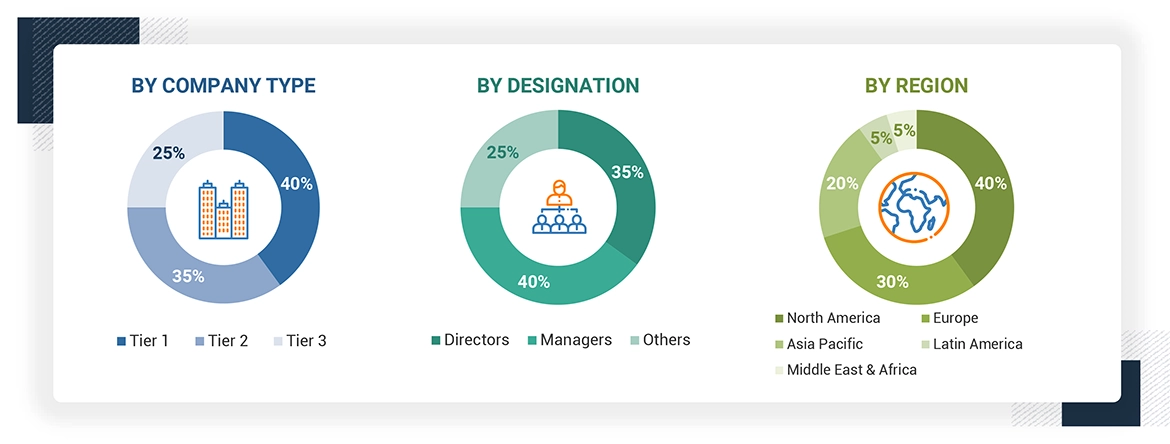
Note 1: Others include sales managers, marketing managers, and product managers.
Note 2: Tiers of companies are defined based on their total revenues in 2023. Tier 1 = >USD 1 billion, Tier 2 = USD 500 million to USD 1 billion, and Tier 3 = < USD 500 million.
To know about the assumptions considered for the study, download the pdf brochure
Market Size Estimation
Both top-down and bottom-up approaches were used to estimate and validate the total size of the AI in oncology. These methods were also used extensively to estimate the size of various subsegments in the market. The research methodology used to estimate the market size includes the following:
- The key players in the industry and markets have been identified through extensive secondary research.
- The industry’s supply chain and market size, in terms of value, have been determined through primary and secondary research processes.
- All percentage shares, splits, and breakdowns have been determined using secondary sources and verified through primary sources.
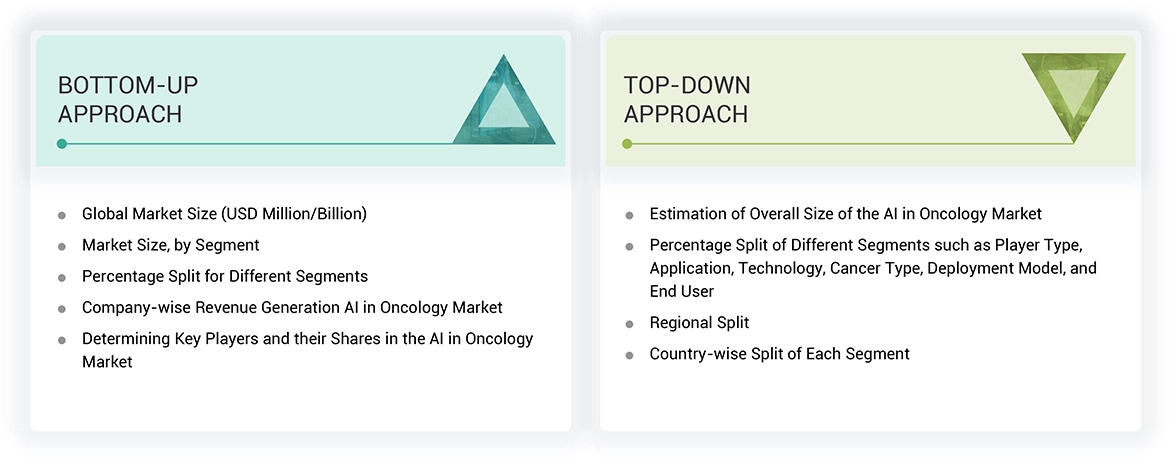
Data Triangulation
After arriving at the overall market size using the market size estimation processes explained above, the market was split into several segments and subsegments. The data triangulation and market breakup procedures were employed, wherever applicable, to complete the overall market engineering process and arrive at the exact statistics of each market segment and subsegment. The data was triangulated by studying various factors and trends from both the demand and supply sides.
Market Definition
AI I in oncology is the utilization of AI tools such as machine learning, natural language processing, and computer vision, among others to analyze genomic data and large gene mutations that are unique to an individual’s cancer profile. These AI tools are adopted by various end-users including labs, research centers, hospitals, and biotechnology & pharmaceuticals, among others to address the global cancer burden and the need for precision medicine in oncology.
Further, AI boosts the speed and accuracy of cancer diagnosis and screening. The major developments include:
- Pathologists can detect malignancy in prostate biopsy photos with the help of FDA-approved AI software.
- AI quickly analyzes medical pictures, such as mammograms, increasing radiologists' productivity and enhancing risk assessment and detection of breast cancer.
- Deep learning is used by NCI scientists to automatically detect precancerous cervical lesions as part of their efforts to improve cervical and prostate cancer screening.
Stakeholders
- Clinical/Physician Centers
- AI Providers
- Clinical Research Organizations
- Pharmaceutical/Biopharmaceutical Companies
- Research and Development (R&D) Companies
- Business Research and Consulting Service Providers
- Medical Research Laboratories
- Academic Medical Centers/Universities/Hospitals
- Government Agencies
- Regulatory Agencies
- Clinical Researchers
- Clinical Research Organizations
- Accountable Care Organizations
- Investors and Venture Capitalists
Report Objectives
- To define, describe, and forecast the AI in oncology market based on player type, application, cancer type, technology, deployment model, end user, and region
- To provide detailed information about the major factors (drivers, opportunities, restraints, and challenges) influencing the growth of the market
- To analyze opportunities for stakeholders by identifying the high-growth segments of the market
- To forecast the size of the market segments with respect to five main regions: North America, Europe, Asia Pacific, the Middle East & Africa, and Latin America
- To analyze subsegments of the market with respect to individual growth trends, prospects, and contributions to the overall market
- To profile the key players and comprehensively analyze their market sizes and core competencies
- To track and analyze competitive developments such as acquisitions, collaborations, agreements, mergers, product launches & updates, partnerships, expansions, and other recent developments in the market globally
Get the Full AI in Oncology Market Report
Full forecast, segment splits, and company analysis for all AI in Oncology Market.
- Canada AI in Oncology Market
- US AI in Oncology Market
- Germany AI in Oncology Market
- UK AI in Oncology Market
- France AI in Oncology Market
- Italy AI in Oncology Market
- Spain AI in Oncology Market
- China AI in Oncology Market
- India AI in Oncology Market
- Japan AI in Oncology Market
- Brazil AI in Oncology Market
- Mexico AI in Oncology Market
- Rest Of Europe AI in Oncology Market
- Rest Of Asia Pacific AI in Oncology Market
- Rest Of Latin America AI in Oncology Market
- GCC Countries AI in Oncology Market
Need a Tailored Report?
Customize this report to your needs
Get 10% FREE Customization
Customize This Report
