
GCC Countries Air Insulated Switchgear Market (2024-2029)

The GCC Countries Air Insulated Switchgear Market was valued at $1930 Million in 2024 and projected to reach to $2460 Million by 2029, representing a compound annual growth rate of 5.0%. The GCC Countries Air Insulated Switchgear Market is poised for steady growth through 2029, driven by the region's commitment to energy infrastructure development and grid modernization.


| Market Size in | USD 26.32 MN |
| Market Forecast in | |
| CAGR | |
| Forecast Period | |
| Units Considered | Value (USD MN) |
GCC Countries Air Insulated Switchgear Market Trends and Insights
- GCC Countries' robust energy infrastructure investments and rising electricity demand are driving adoption of air insulated switchgear across utility and industrial segments.
- The region's focus on grid modernization and renewable energy integration is accelerating switchgear deployment throughout 2024-2029. GCC Countries benefit from substantial capital expenditure in power generation and transmission networks, supported by government initiatives and private sector participation.
- Air insulated switchgear remains the preferred technology in GCC Countries due to its reliability, cost-effectiveness, and proven performance in high-temperature desert environments.
- Market growth in GCC Countries is underpinned by expanding petrochemical facilities, desalination plants, and urban electrification projects that require dependable switchgear solutions..
Key Market Statistics
- CAGR (2024-2029) 5.0% CAGR
- Market Size, 2024 ~USD 1930 Million
- Forecast, 2029 ~USD 2460 Million
- Country GCC Countries
GCC Countries Air Insulated Switchgear Market Overview
Market Valuation :
The GCC Countries Air Insulated Switchgear Market is valued at USD 1,930 million in 2024, with projected growth to USD 2,460 million by 2029, representing a steady 5% CAGR aligned with global expansion rates.
Infrastructure Investment Drivers :
GCC nations' substantial investments in energy infrastructure modernization and grid expansion initiatives are accelerating the adoption of air insulated switchgear across utility and industrial applications.
Electricity Demand Growth :
Rising electricity consumption driven by population growth, urbanization, and economic diversification in GCC countries is creating sustained demand for reliable switchgear solutions in power distribution networks.
Segment Expansion :
Both utility-scale and industrial segment adoption of air insulated switchgear is increasing across GCC countries, supported by renewable energy integration and industrial capacity expansion projects.
GCC Countries Air Insulated Switchgear Market Dynamics
- Increasing electricity demand from rapid urbanization and industrial growth across Saudi Arabia, UAE, Qatar, and other GCC nations is propelling switchgear adoption.
- The region's focus on reliability and efficiency in power distribution systems supports continued market expansion. Government initiatives promoting renewable energy integration and smart grid technologies are creating additional opportunities for advanced air insulated switchgear solutions.
- Strategic investments in transmission and distribution infrastructure, coupled with industrial sector growth, will sustain the 5% CAGR through 2029.
- GCC countries' emphasis on energy security and infrastructure resilience ensures robust demand for high-performance switchgear equipment..
Market Ecosystem
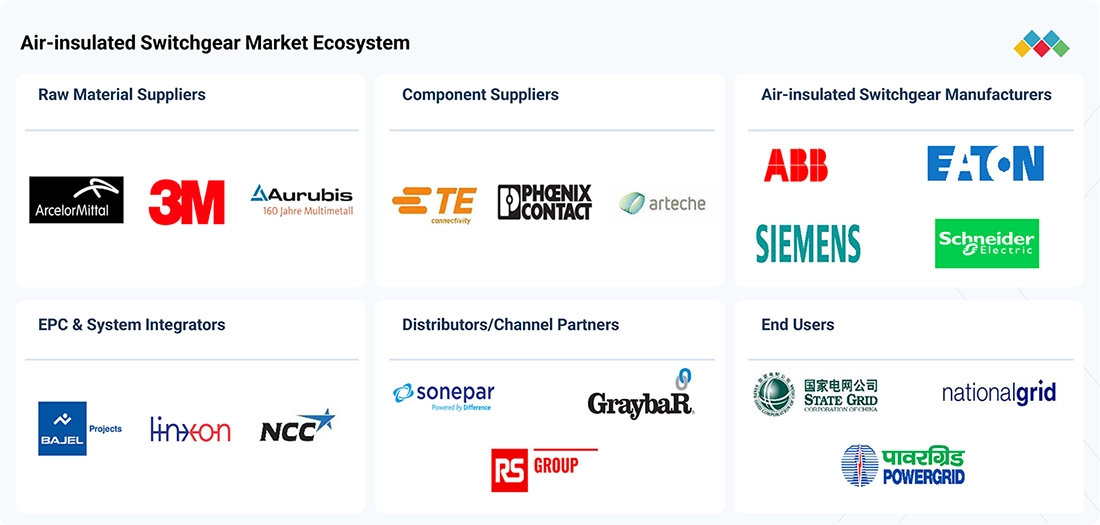
AIR-INSULATED SWITCHGEAR MARKET: COMMERCIAL USE CASES ACROSS INDUSTRIES
| COMPANY | USE CASE DESCRIPTION | BENEFITS |
|---|---|---|
 |
NCC was awarded a contract by Energinet to construct a 400 kV air-insulated switchgear (AIS) substation at Ringsbjerg in Zealand, Denmark, along with an expansion of the existing Bjäverskov substation. The project includes new 400 kV cable connections and is scheduled for completion in 2029. | Expands high-voltage transmission capacity in Zealand | Supports the integration and transmission of increasing renewable electricity generation | Strengthens the regional electricity grid to meet rising electrification requirements | Provides infrastructure that can be expanded to accommodate future power demand |
 |
Bajel Projects was awarded an EPC contract by Maharashtra State Electricity Transmission Company Limited (MSETCL) to develop a 400/220 kV AIS substation at Saswad, Maharashtra, India. The greenfield substation will include two 500 MVA transformers, a 125 MVAr bus reactor, and associated 400 kV and 220 kV transmission infrastructure. The project is scheduled for execution within 23 months. | Increases power transmission and evacuation capacity in the Pune region | Strengthens Maharashtra's high-voltage transmission infrastructure | Improves grid connectivity and reliability | Supports increasing electricity demand from industrial and urban development | Provides capacity for future expansion of the transmission network |
 |
Linxon was selected by Svenska kraftnät to develop a 10-bay, 400 kV AIS substation at Degerträsk, Sweden. The project forms part of Sweden's Fossil-Free Upper Norrland initiative and will provide grid infrastructure for H2 Green Steel's planned green steel facility near Boden. The substation is designed to support the large electricity requirements of the energy-intensive steel production facility. | Enables grid connection for large-scale green steel production | Supports industrial electrification and the transition toward fossil-free manufacturing | Provides high-voltage infrastructure for electricity-intensive industrial loads | Strengthens the transmission network in northern Sweden | Supports the development of Sweden's low-carbon industrial ecosystem |
Logos and trademarks shown above are the property of their respective owners. Their use here is for informational and illustrative purposes only.
Related Ecosystem
Power Infrastructure
- Geographical Information System (GIS)
- Cogeneration
- Battery Electric Vehicle (BEV)
- Cellular Network
- Fuel Cell
- ABB India Limited
- Siemens ag
- SCHNEIDER ELECTRIC SE
- General Electric Company
- Eaton Corporation plc
Key Takeaways
- GCC Countries Air Insulated Switchgear Market is valued at USD 1,930 million in 2024 and will reach USD 2,460 million by 2029.
- GCC Countries is experiencing a steady 5.0% CAGR driven by grid modernization and renewable energy integration initiatives.
- Air insulated switchgear technology is preferred in GCC Countries for its reliability and suitability in high-temperature desert climates.
- GCC Countries' petrochemical, desalination, and urban electrification projects are key growth catalysts for switchgear demand through 2029.
Air Insulated Switchgear Market Report Scope
| Report Metric | Details |
|---|---|
| Base Year | 2024 |
| Fastest Growing Segment | MEDIUM (Voltage) |
| Forecast Period | 2024-2029 |
| Growth Rate | CAGR of 5% from 2024 to 2029 |
| Largest Segment | INDOOR (Installation) |
| Market Size Base Year (Billions) | ~USD 67.3 (2024) |
| Revenue Forecast (Billions) | ~USD 85.9 (2029) |
| Segments Covered | Voltage, Installation, Application |
GCC Countries Air Insulated Switchgear Market Report Segmentation
3 segment dimensions are covered across the global market.
By Voltage
- High
- Low
- Medium
By Installation
- Indoor
- Outdoor
By Application
- Commercial & Residential
- Commercial & Residential Users
- Industrial
- Industries
- Transmission & Distribution
- Transmission & Distribution Utilities
- Transportation
Target Audience
- Utility Companies & Grid Operators : GCC utility operators need detailed market intelligence to plan switchgear procurement, grid modernization investments, and infrastructure upgrades aligned with regional electricity demand growth.
- Equipment Manufacturers & Suppliers : Switchgear manufacturers require GCC-specific market data to identify growth opportunities, assess competitive positioning, and develop localized product strategies for the region.
- Industrial & Commercial Operators : Industrial facilities and commercial enterprises in GCC countries need market insights to evaluate switchgear solutions for facility upgrades and operational efficiency improvements.
- Investment & Consulting Firms : Financial analysts and management consultants require GCC market forecasts to support investment decisions, M&A strategies, and business development recommendations in the energy sector.
- Government & Policy Makers : GCC government agencies and energy regulators need market analysis to inform infrastructure planning, renewable energy integration policies, and grid modernization initiatives.
Reasons to Buy this Report
- GCC-Specific Market Sizing : Access precise market valuation data for GCC Countries with 2024 baseline (USD 1,930M) and 2029 forecasts (USD 2,460M), enabling accurate regional investment and expansion planning.
- Infrastructure Investment Insights : Understand how GCC nations' energy infrastructure modernization programs and grid expansion initiatives are creating switchgear demand across utility and industrial segments.
- Regional Growth Drivers : Identify key demand catalysts specific to GCC countries including rising electricity consumption, urbanization trends, and renewable energy integration strategies driving market expansion.
- Competitive Positioning : Benchmark your business against GCC market dynamics and develop targeted strategies for utility companies, industrial operators, and equipment suppliers operating in the region.
- Forecast-Based Planning : Leverage 5-year growth projections aligned with GCC economic development to make informed decisions on market entry, capacity investments, and product development initiatives.
Frequently asked questions
What is the market size of Air Insulated Switchgear in GCC Countries?
The Air Insulated Switchgear Market in GCC Countries was valued at USD 1,930 million in 2024 and is forecast to reach USD 2,460 million by 2029.
What is the CAGR for Air Insulated Switchgear in GCC Countries?
GCC Countries' Air Insulated Switchgear Market is growing at a CAGR of 5.0% from 2024 to 2029.
Why is air insulated switchgear preferred in GCC Countries?
Air insulated switchgear is preferred in GCC Countries due to its cost-effectiveness, reliability, and proven performance in high-temperature desert environments.
What are the main drivers of growth in GCC Countries' switchgear market?
Key growth drivers in GCC Countries include grid modernization, renewable energy integration, petrochemical expansion, desalination projects, and urban electrification initiatives.
Which sectors are driving demand for switchgear in GCC Countries?
Utility, industrial, petrochemical, desalination, and renewable energy sectors are the primary demand drivers for air insulated switchgear in GCC Countries.
RESEARCH METHODOLOGY
The research process for this technical, market-oriented, and commercial study of the air-insulated switchgear market involved systematically gathering, recording, and analyzing data on companies operating in the market. It involved the extensive use of secondary sources, directories, and databases (Factiva, OANDA) to identify and collect relevant information. In-depth interviews were conducted with various primary respondents, including experts from core and related industries and preferred manufacturers, to obtain and verify critical qualitative and quantitative information, as well as to assess the growth prospects of the market. Key players in the air-insulated switchgear market were identified through secondary research, and their market rankings were determined through primary and secondary research. This included studying annual reports of top players and interviewing key industry experts, such as CEOs, directors, and marketing executives.
Secondary Research
In the secondary research process, various secondary sources were referred to for identifying and collecting information relevant to this study. Secondary sources include annual reports, press releases, and investor presentations of companies; white papers, certified publications, and articles from recognized authors; directories; and databases. Secondary research mainly focused on gathering key information about industry supply, the total pool of key players, and market segmentation by industry trends, geographic markets, and key developments from market- and technology-oriented perspectives.
Primary Research
During the primary research phase, various key sources from the demand side and supply side have been interviewed to gather qualitative and quantitative data for this report. Throughout the market engineering process, a combination of top-down and bottom-up approaches, along with multiple data triangulation methods, has been used to estimate market sizes and forecast all segments and subsegments outlined in this report. Extensive qualitative and quantitative analyses have been undertaken to ensure the integrity of the market engineering process, providing key insights throughout the report. Following completion of the market engineering process, which involved calculations of market statistics, breakdowns, size estimates, forecasts, and data triangulation, thorough primary research has been conducted to gather, verify, and validate critical data points. Primary research has also been conducted to identify market segments, industry trends, and the competitive landscape in the air-insulated switchgear market.
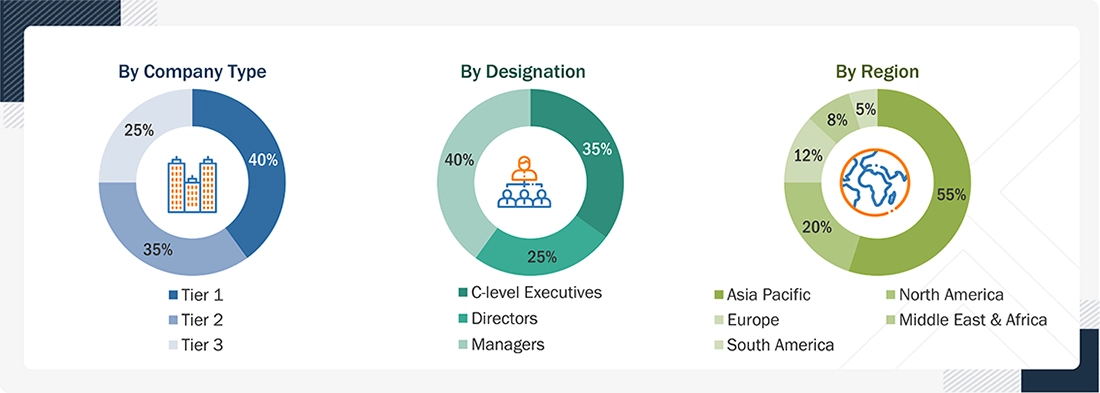
Note: Managers include sales managers, production managers, and regional managers.
Tier 1 company: revenue >USD 5 billion; tier 2 company: revenue between USD 1 and USD 5 billion; and tier 3 company: revenue <USD 1 billion in 2025
To know about the assumptions considered for the study, download the pdf brochure
Market Size Estimation
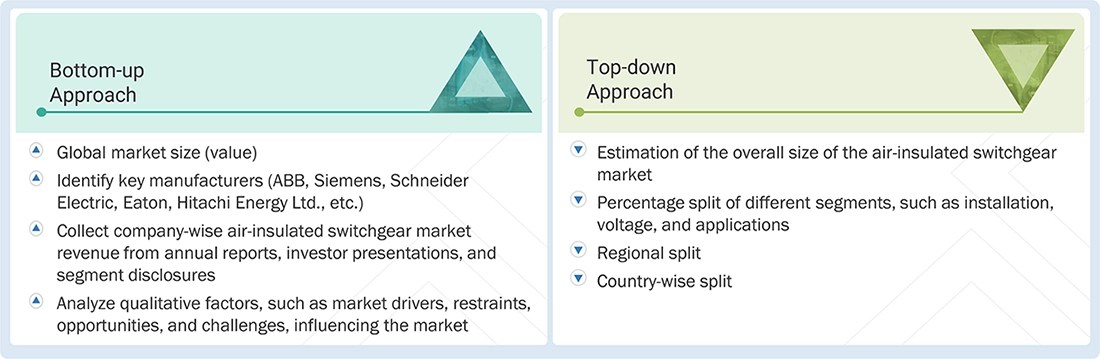
The estimation and validation of the air-insulated switchgear market size were conducted using bottom-up and top-down approaches. These approaches were used to determine the size of multiple subsegments within the market. The research process comprises the following key stages.
Bottom-up Approach
- Determining the overall value of the air-insulated switchgear market
- Mapping leading players in the industry, such as Siemens, Schneider Electric, ABB, Eaton, Mitsubishi Electric, and TOSHIBA CORPORATION
- Gathering segment-specific revenue data for these companies from annual reports, investor presentations, and public disclosures
- Considering key qualitative inputs, including market drivers, restraints, opportunities, and challenges, in the forecasting process
Top-down Approach
- Assessing the total size of the air-insulated switchgear market
- Breaking this down by segment, covering installation, voltage, and applications
- Allocating market share across regions
- Further refining figures down to individual country-level estimates
Air-Insulated Switchgear Market: Top-Down and Bottom-Up Approach
Data Triangulation
The process of determining the overall market size involved the methodologies described earlier, followed by segmenting the market into multiple segments and subsegments. To finalize the comprehensive market analysis and obtain precise statistics for each market segment and subsegment, data triangulation and market segmentation techniques were applied, as appropriate. Data triangulation was accomplished by examining factors and trends from both the demand and supply perspectives within the air-insulated switchgear market ecosystem.
Market Definition
Air-insulated switchgear is a category of electrical switching and protection equipment that uses ambient air, rather than a pressurized gas such as SF6, as the primary medium to insulate and isolate live conductors within a substation or distribution network. Comprising circuit breakers, disconnectors, busbars, current and voltage transformers, and associated protective relays, AIS is engineered to safely control the flow of electricity, interrupt fault currents, and isolate sections of a network for maintenance or emergency response, all while relying on the natural insulating properties of open air combined with carefully calculated clearance distances between components. This reliance on air, rather than an enclosed gas medium, gives AIS a larger physical footprint than its gas-insulated counterpart, but it also makes the equipment simpler to manufacture, easier to maintain using conventional tools and techniques, and considerably lower in upfront installed cost, which has sustained its position as the standard choice across utility, industrial, and commercial power infrastructure for well over a century.
This report examines the global air-insulated switchgear market through a structure designed to capture how demand actually forms and moves across the industry. By voltage, the market is segmented into low voltage (up to 1 kV), medium voltage (2–36 kV), and high voltage (above 36 kV), reflecting the distinct engineering requirements and buyer bases that separate distribution-level equipment from bulk transmission infrastructure. By installation, the analysis distinguishes indoor from outdoor deployments, a divide that speaks directly to how environmental exposure and space availability shape purchasing decisions. The application segmentation spans transmission and distribution, industrial, commercial and residential, transportation, and other end users, including marine and offshore installations, capturing the full breadth of settings in which AIS is specified today. Geographically, the study covers North America, Europe, Asia Pacific, South America, and the Middle East and Africa, allowing the analysis to reflect how regulatory pressure, grid investment cycles, and industrialization patterns vary meaningfully from one region to the next. Together, this framework provides a complete and commercially useful picture of where AIS demand originates, how it is evolving, and which parts of the market are positioned to grow fastest through the forecast period.
Key Stakeholders
- Raw Material Suppliers
- Component Manufacturers
- Switchgear Manufacturers / OEMs
- EPC Contractors
- System Integrators / Panel Builders
- Distributors / Electrical Wholesalers
- Transmission & Distribution Utilities
- Renewable Energy Developers
- Power Generation Companies
- Industrial End Users
- Data Center Operators
- Commercial & Residential Users
- Water & Wastewater Operators
- Transportation Sector
- Marine & Offshore Operators
- Standards Organizations
- Testing & Certification Bodies
- Government & Regulatory Authorities
- Environmental Regulators
- Engineering & Technical Consultants
- Digital & Automation Technology Providers
- Service & Maintenance Providers
- Retrofit & Modernization Providers
- Logistics Providers
- Financial Institutions & Project Financiers
- Insurance & Risk Assessment Companies
- Recycling & End-of-Life Providers
- Industry Associations
Report Objectives
- To define, describe, analyze, and forecast the air-insulated switchgear market based on installation, voltage, application, and region
- To describe and forecast the market for five key regions: North America, Europe, Asia Pacific, South America, and the Middle East & Africa, along with their country-level market sizes, in terms of value and volume
- To forecast the air-insulated switchgear market, by region, in terms of volume
- To provide comprehensive details on the main factors, obstacles, opportunities, and sector-specific challenges affecting the expansion of the air-insulated switchgear market
- To systematically examine the market for air-insulated switchgear in terms of each segment's contributions to the market, growth trends, and prospects
- To provide value chain analysis, trends/disruptions impacting customer business, market maps, ecosystem analysis, sustainability and regulatory landscape, pricing analysis, patent analysis, case study analysis, technology analysis, key conferences and events, Porter’s five forces analysis, macroeconomic outlook, customer landscape & buyer behavior, regulatory analysis, and AI/Gen AI impact on the market
- To conduct a strategic analysis of micromarkets1 concerning their respective growth trends, planned expansions, and market share contributions
- To sketch the competitive environment for market participants and assess opportunities for stakeholders in the air-insulated switchgear business
- To benchmark players in the market using the company evaluation quadrant, which analyzes market players across various parameters within broad categories of business and product strategies
- To strategically profile key players and comprehensively analyze their market ranking and core competencies
- To track and analyze competitive developments in the air-insulated switchgear market, such as contracts, agreements, investments, expansions, product launches, partnerships, and acquisitions
Available customizations:
With the given market data, MarketsandMarkets offers customizations based on the company’s specific needs. The following customization options are available for the report:
Product Analysis
- Product Matrix, which provides a detailed comparison of the product portfolio of each company
Company Information
-
Detailed analyses and profiling of additional market players (up to 5)
Country Information
-
Additional country-level analysis of the dermatology devices market
Get the Full Air Insulated Switchgear Market Report
Full forecast, segment splits, and company analysis for all Air Insulated Switchgear Market.
- China Air Insulated Switchgear Market
- India Air Insulated Switchgear Market
- Japan Air Insulated Switchgear Market
- Australia Air Insulated Switchgear Market
- Germany Air Insulated Switchgear Market
- UK Air Insulated Switchgear Market
- Italy Air Insulated Switchgear Market
- France Air Insulated Switchgear Market
- Spain Air Insulated Switchgear Market
- Canada Air Insulated Switchgear Market
- Mexico Air Insulated Switchgear Market
- US Air Insulated Switchgear Market
- South Africa Air Insulated Switchgear Market
- Brazil Air Insulated Switchgear Market
- Argentina Air Insulated Switchgear Market
- Rest Of Europe Air Insulated Switchgear Market
- Rest Of Asia Pacific Air Insulated Switchgear Market
- Rest Of South America Air Insulated Switchgear Market
Need a Tailored Report?
Customize this report to your needs
Get 10% FREE Customization
Customize This Report
