
Japan Aircraft Battery Market (2025-2030)

The Japan Aircraft Battery Market was valued at $44.8 Million in 2025 and projected to reach to $68.8 Million by 2030, representing a compound annual growth rate of 9.0%. Japan's aircraft battery market is poised for sustained growth through 2030, driven by modernization of regional aircraft fleets and investments in next-generation aerospace technologies.


| Market Size in | USD 26.32 MN |
| Market Forecast in | |
| CAGR | |
| Forecast Period | |
| Units Considered | Value (USD MN) |
Japan Aircraft Battery Market Trends and Insights
- Japan's aerospace sector, driven by domestic aircraft manufacturers and increasing regional air traffic, is a significant contributor to this expansion.
- The market in Japan benefits from the country's advanced manufacturing capabilities and strong investment in next-generation aircraft technologies. The growth trajectory in Japan reflects rising demand for lightweight, high-performance battery systems essential for modern commercial and regional aircraft.
- Japan's commitment to sustainable aviation and electrification initiatives further supports market expansion through 2030.
- Key players in Japan's aerospace industry are increasingly adopting advanced battery solutions to meet regulatory standards and operational efficiency requirements, positioning Japan as a critical hub for aircraft battery innovation in the Asia Pacific region..
Key Market Statistics
- CAGR (2025-2030) 9.0% CAGR
- Market Size, 2025 ~USD 44.8 Million
- Forecast, 2030 ~USD 68.8 Million
- Country Japan
Japan Aircraft Battery Market Overview
Market Valuation :
Japan's aircraft battery market is valued at $44.8 million in 2025, with projections reaching $68.8 million by 2030, demonstrating robust growth potential in the regional aerospace sector.
Strong CAGR Performance :
The Japanese market exhibits a 9.0% CAGR from 2025-2030, outpacing the global average of 8.3%, indicating accelerated adoption and investment in advanced battery technologies within Japan's aerospace industry.
Advanced Manufacturing Capabilities :
Japan's aerospace sector leverages world-class manufacturing expertise and precision engineering, positioning domestic battery manufacturers as competitive suppliers for both regional and international aircraft platforms.
Regional Air Traffic Growth :
Increasing regional air traffic and expansion of domestic aircraft fleets drive demand for reliable, high-performance aircraft batteries, supported by Japan's strategic focus on aerospace innovation and sustainability.
Japan Aircraft Battery Market Dynamics
- Domestic manufacturers are increasingly focusing on lithium-ion and advanced battery solutions to meet stringent aviation safety standards and environmental regulations.
- The market benefits from Japan's strong engineering ecosystem, government support for aerospace development, and growing partnerships with international aircraft manufacturers.
- Emerging opportunities in electric and hybrid-electric aircraft development present additional growth vectors for battery suppliers in the region..
Market Ecosystem
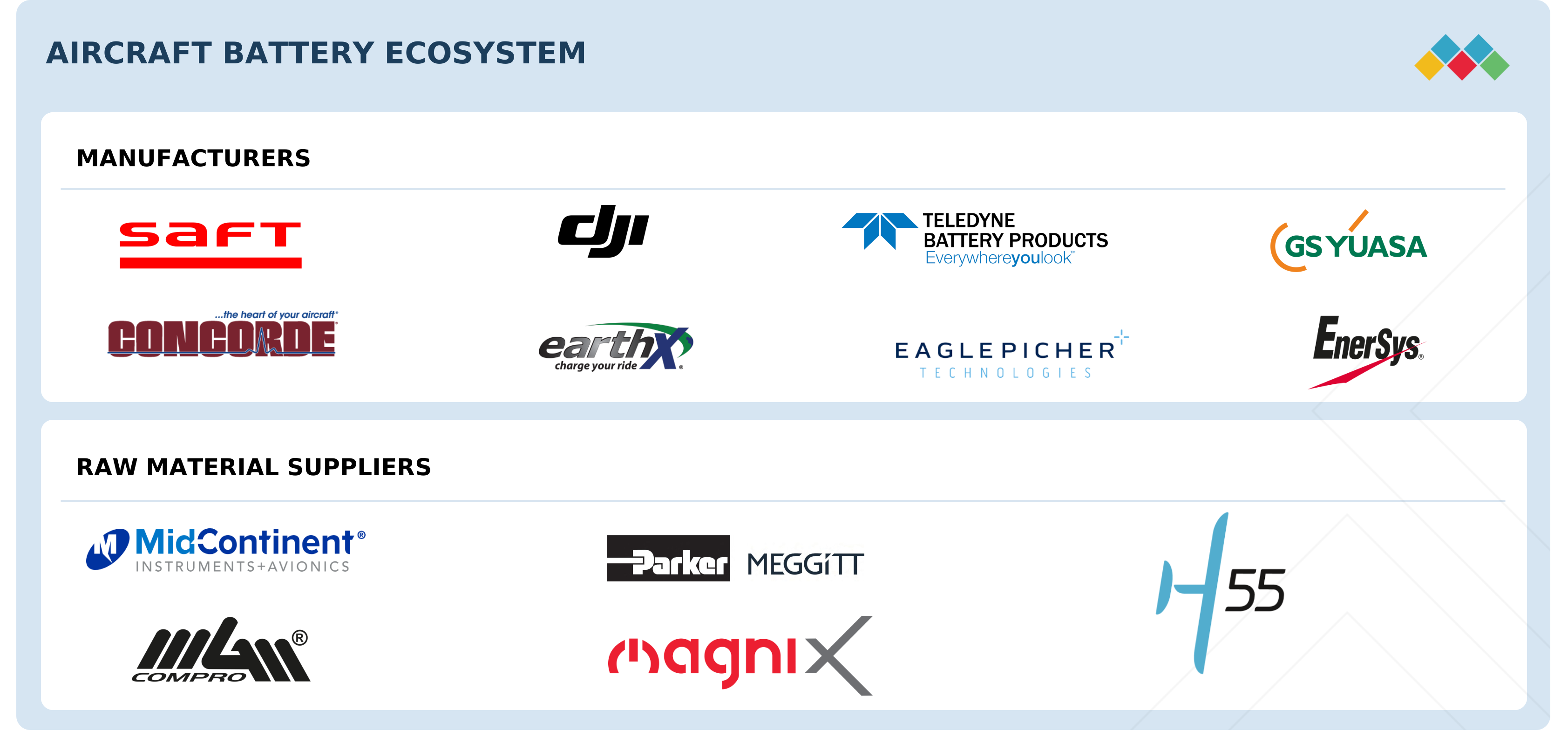
aircraft battery market: COMMERCIAL USE CASES ACROSS INDUSTRIES
| COMPANY | USE CASE DESCRIPTION | BENEFITS |
|---|---|---|
 |
Lithium-ion aviation batteries for Airbus A350 | Provides higher energy density, faster recharge, and extended lifecycle with advanced BMS for improved safety and efficiency |
 |
VRLA batteries for general aviation | Ensures reliable starter/backup power with low-maintenance sealed design, reducing leakage risks and operational downtime |
 |
Battery pack for Rolls-Royce "Spirit of Innovation" | Achieves record-breaking all-electric flight speeds with 6,000-cell pack and advanced cooling for safe, high-power propulsion |
 |
Lithium polymer batteries for UAVs | Enables extended endurance, high-discharge performance, and rapid charging with intelligent monitoring for defense and commercial UAVs |
 |
Lithium-ion battery packs for Boeing 787 Dreamliner | Powers auxiliary and backup systems with high reliability, proven safety certifications, and long operational service life |
 |
Proprietary high-voltage battery packs for eVTOL aircraft | Powers all-electric air taxis with >200-mile range and high cycle life, balancing fast charging, safety, and energy density for urban air mobility |
Logos and trademarks shown above are the property of their respective owners. Their use here is for informational and illustrative purposes only.
Related Ecosystem
Aviation
- Narrow Body Aircraft
- Wide Body Aircraft
- Military Helicopters
- Special Mission Aircraft
- Fighter Aircraft
- HONEYWELL INTERNATIONAL INC.
- COLLINS AEROSPACE
- Thales group
- Safran group
- HEICO Corporation
Battery And Wireless Charging
- Nickel-Cadmium Battery
- Battery Electric Vehicle (BEV)
- Energy Harvesting
- Hybrid Electric Vehicle (HEV)
- Smart Cards
- Panasonic Holdings Corporation
- MOMENTIVE PERFORMANCE MATERIALS INC.
- Lg corp
- FDK Corporation
- Samsung
Key Takeaways
- Japan's aircraft battery market is valued at $44.8 million in 2025 and is expected to reach $68.8 million by 2030, growing at a 9.0% CAGR.
- Japan's advanced manufacturing infrastructure and aerospace expertise drive demand for high-performance battery systems in the region.
- Sustainability initiatives and electrification trends in Japan's aviation sector accelerate adoption of next-generation battery technologies.
- Japan's strategic position in Asia Pacific makes it a key market for aircraft battery innovation and supply chain development.
Aircraft Battery Market Report Scope
| Report Metric | Details |
|---|---|
| Base Year | 2025 |
| Fastest Growing Segment | AIR TAXI (Advanced Air Mobility) |
| Forecast Period | 2025-2030 |
| Growth Rate | CAGR of 8.3% from 2025 to 2030 |
| Largest Segment | CONVENTIONAL AIRCRAFT (Propulsion Technology) |
| Market Size Base Year (Billions) | ~USD 1.61 (2025) |
| Revenue Forecast (Billions) | ~USD 2.4 (2030) |
| Segments Covered | Battery Chemistry, Type, Battery Component, Energy Density, Power Capacity, Application, Propulsion Technology, Lift Technology, Point Of Sale, Platform, Commercial Aviation, Business & General Aviation, Military Aviation, Unmanned Aerial Vehicle, Advanced Air Mobility |
Japan Aircraft Battery Market Report Segmentation
15 segment dimensions are covered across the global market.
By Battery Chemistry
- Lead Acid-Based
- Lithium-Based
- Nickel-Based
By Type
- Flooded Lead Acid
- Lithium Ion
- Lithium Metal
- Lithium Metal Oxide
- Lithium Polymer
- Lithium Sulfur
- Nickel Cadmium
- Nickel Metal Hydride
- Sealed Lead Acid
By Battery Component
- Battery Cell
- Battery Management System
- Enclosure & Connector
- Thermal Management System
By Energy Density
- 100-300 Wh/Kg
- <100 Wh/Kg
- >300 Wh/Kg
By Power Capacity
- <20 Ah
- >20 Ah
By Application
- Auxiliary Power Unit
- Emergency Power
- Main Starter
- Propulsion
By Propulsion Technology
- Conventional Aircraft
- Electric Aircraft
- Hybrid Aircraft
- More Electric Aircraft
By Lift Technology
- Ctol
- Stol
- Vtol
By Point Of Sale
- Aftermarket
- OEM
By Platform
- Advanced Air Mobility
- Business & General Aviation
- Commercial Aviation
- Military Aviation
- Unmanned Aerial Vehicle
By Commercial Aviation
- Helicopter
- Narrow-Body Aircraft
- Regional Transport Aircraft
- Wide-Body Aircraft
By Business & General Aviation
- Business Jet
- Light Aircraft
By Military Aviation
- Fighter Aircraft
- Military Helicopter
- Special Mission Aircraft
- Transport Aircraft
By Unmanned Aerial Vehicle
- Fixed-Wing
- Hybrid
- Rotary-Wing
By Advanced Air Mobility
- Air Ambulance & Medical Emergency Vehicle
- Air Shuttle & Air Metro
- Air Taxi
- Cargo Air Vehicle
- Personal Air Vehicle
Target Audience
- Aircraft Battery Manufacturers : Manufacturers need Japan-specific market data to assess growth opportunities, understand local competition, and develop targeted strategies for expanding presence in this high-performing aerospace market.
- Aerospace OEMs & Suppliers : Aircraft manufacturers and tier-1 suppliers require detailed market insights to optimize battery sourcing strategies, evaluate Japanese supplier capabilities, and plan fleet modernization initiatives.
- Investment & Private Equity Firms : Investors seeking aerospace sector exposure need comprehensive Japan market analysis to identify acquisition targets, assess growth potential, and make informed capital allocation decisions in the region.
- Government & Policy Makers : Japanese government agencies and policymakers require market intelligence to support aerospace industry development initiatives, regulatory frameworks, and strategic technology advancement programs.
- Technology & R&D Organizations : Research institutions and technology developers need market forecasts and trend analysis to align innovation roadmaps with Japan's aerospace battery requirements and emerging technology demands.
Reasons to Buy this Report
- Market-Specific Growth Data : Access detailed Japan-focused market sizing and forecasts with 9% CAGR, enabling precise investment decisions and strategic planning tailored to the Japanese aerospace sector's unique dynamics.
- Competitive Landscape Intelligence : Understand Japan's advanced manufacturing capabilities and identify key domestic and international competitors operating in the regional market, supporting competitive positioning strategies.
- Regional Demand Drivers : Gain insights into Japan-specific factors including regional air traffic expansion, domestic aircraft fleet modernization, and regulatory requirements shaping battery technology adoption.
- Technology & Innovation Trends : Discover emerging battery technologies and innovation initiatives within Japan's aerospace ecosystem, including electric and hybrid-electric aircraft development opportunities.
- Strategic Partnership Opportunities : Identify potential collaboration and supply chain opportunities with Japanese manufacturers, OEMs, and aerospace suppliers to establish market presence in this high-growth region.
Frequently asked questions
What is the current size of Japan's aircraft battery market?
Japan's aircraft battery market is valued at $44.8 million in 2025 and is projected to grow to $68.8 million by 2030.
What is the growth rate of Japan's aircraft battery market?
Japan's aircraft battery market is expected to grow at a compound annual growth rate (CAGR) of 9.0% from 2025 to 2030.
What factors are driving growth in Japan's aircraft battery market?
Growth in Japan's aircraft battery market is driven by advanced manufacturing capabilities, increasing regional air traffic, sustainability initiatives, and the adoption of electrification technologies in aviation.
Which aircraft types benefit most from battery innovations in Japan?
Commercial aircraft, regional aircraft, and next-generation electric aircraft platforms are the primary beneficiaries of battery innovations in Japan's aerospace sector.
How does Japan's market compare to the global aircraft battery market?
Japan's aircraft battery market grows at 9.0% CAGR, outpacing the global market growth rate of 8.3%, reflecting Japan's strong aerospace manufacturing base and innovation focus.
RESEARCH METHODOLOGY
This research study used secondary sources, directories, and databases, such as Hoovers, Bloomberg Businessweek, and Factiva, to identify and collect relevant information on the aircraft battery market. Primary sources included industry experts from the core and related industries, preferred suppliers, manufacturers, solution providers, technology developers, alliances, and organizations related to all segments of the industry’s value chain. All primary sources were interviewed to obtain and verify critical qualitative and quantitative information and assess the prospects of the aircraft battery market. A deductive approach, also known as the top-down approach, was used to forecast the market size of different market segments.
Secondary Research
The ranking of companies operating in the aircraft battery market was based on secondary data made available through paid and unpaid sources, the analysis of product portfolios of the major companies in the market, and rating them based on their performance and quality. These data points were further validated by primary sources.
Secondary sources referred to for this research study on the aircraft battery market included government sources, such as corporate filings that included annual reports, investor presentations, and financial statements, and trade, business, and professional associations. Secondary data was collected and analyzed to determine the overall market size, which was further validated by various primary respondents.
Primary Research
Extensive primary research was conducted after obtaining information about the current scenario of the aircraft battery market through secondary research. Several primary interviews were conducted with market experts from the demand and supply sides across North America, Europe, Asia Pacific, the Middle East, Latin America, and Africa to obtain qualitative and quantitative information on the market. Primary data was collected through questionnaires, emails, and telephonic interviews. Primary sources from the supply side included industry experts, such as vice presidents, directors, regional managers, technology providers, product development teams, distributors, and end users.
Primary interviews were conducted to gather insights, such as market statistics, data on revenue collected from the products, market breakdowns, market size estimations, market forecasting, and data triangulation. Primary research also helped us understand the trends related to battery chemistry, battery components, energy density, power capacity, application, propulsion technology, lift technology, point of sale, platform, and region. Demand-side stakeholders, such as CXOs, production managers, engineers, and installation teams of end users of aircraft batteries, were interviewed to understand the buyer’s perspective on the suppliers, products, service providers, and their current usage and future outlook of their business, which could affect the aircraft battery market.
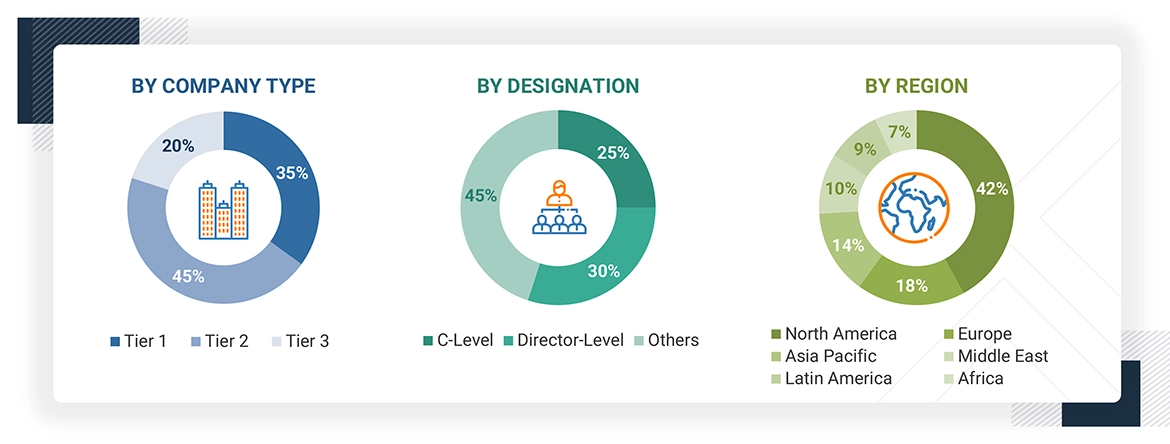
Note 1: The tier of companies has been defined based on their total revenue as of 2024.
Note 2: Tier 1 = > USD 1 billion, Tier 2 = USD 100 million to USD 1 billion, and Tier 3 = < USD 100 million
Note 3: C-level designations include CEO, COO, and CTO.
Note 4: Others include sales, marketing, and product managers.
To know about the assumptions considered for the study, download the pdf brochure
Market Size Estimation
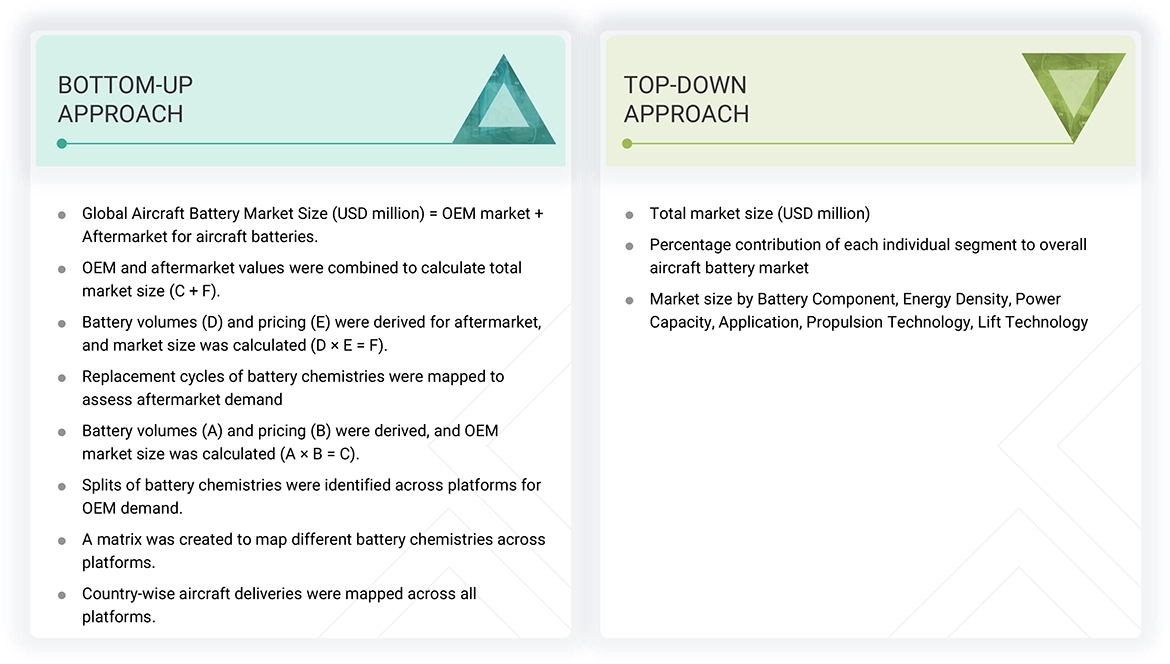
The top-down and bottom-up approaches were used to estimate and validate the size of the aircraft battery market. The research methodology used to estimate the market size includes the following details:
- Key players were identified through secondary research, and their market ranking was determined through primary and secondary research. This included a study of annual and financial reports of the top market players and extensive interviews of leaders, including CEOs, directors, and marketing executives.
- All percentage shares, splits, and breakdowns were determined using secondary sources and verified through primary sources. All possible parameters that affect the markets covered in this research study were accounted for, viewed in extensive detail, verified through primary research, and analyzed to obtain the final quantitative and qualitative data. This data was consolidated, enhanced with detailed inputs, analyzed by MarketsandMarkets, and presented in this report.
Aircraft Battery Market : Top-Down and Bottom-Up Approach
Data Triangulation
After arriving at the size of the aircraft battery market from the market size estimation process explained above, the total market was split into several segments and subsegments. To complete the overall market engineering process and arrive at the exact statistics for the market segments and subsegments, the market breakdown and data triangulation procedures were implemented, wherever applicable. The data was triangulated by studying various factors from the demand and supply sides. In addition, the market size was validated using both the top-down and bottom-up approaches.
Market Definition
An aircraft battery is an onboard electrochemical source that converts chemical energy into electrical energy for aircraft use. At the pack level, it comprises four essential components: the electrochemical cells that generate power, a battery management system (BMS) that ensures safe operation and balancing, thermal management systems that regulate heat and maintain performance, and enclosures with connectors that provide mechanical protection and integration with aircraft systems. This configuration delivers a certified and reliable power source designed to meet the stringent safety and performance requirements of aviation.
Aircraft batteries perform multiple critical functions, including powering pre-flight checks, starting auxiliary power units and engines, and supplying emergency or essential backup power to avionics and flight-control systems in the event of primary generation loss. In unmanned aerial vehicles (UAVs) and advanced air mobility (AAM) platforms such as eVTOLs, they also serve as a primary propulsion source. The principal chemistries in service are lead–acid, nickel-based, and lithium-based. Lead–acid and nickel technologies are long established across transport and business aircraft, while lithium-based systems are increasingly adopted for their higher energy density, subject to aviation certification standards.
Key Stakeholders
- Aircraft Battery Manufacturers
- Subcomponent Manufacturers
- Technology Support Providers
- Research Bodies
- System Integrators
- Aircraft Manufacturers
- Airline Operators
- Defense Organizations
Report Objectives
- To define, describe, and forecast the aircraft battery market based on battery chemistry, battery component, energy density, power capacity, application, propulsion technology, lift technology, point of sale, platform, and region
- To forecast the size of various segments of the market across North America, Europe, Asia Pacific, the Middle East, Latin America, and Africa
- To identify and analyze the drivers, restraints, opportunities, and challenges influencing the growth of the market
- To identify industry trends, market trends, and technology trends currently prevailing in the aircraft battery market
- To provide an overview of the regulatory landscape with respect to aircraft battery regulations across regions
- To analyze micromarkets1 with respect to individual growth trends, prospects, and their contribution to the overall market
- To analyze opportunities in the market for stakeholders by identifying key market trends
- To profile key market players and comprehensively analyze their market share and core competencies
- To evaluate the degree of competition in the market by analyzing recent developments, such as contracts, agreements, and acquisitions adopted by leading market players
- To identify detailed financial positions, key products, and unique selling points of leading companies in the market
- To provide a detailed competitive landscape of the market, along with market share analysis and revenue analysis of key players
Customization Options
MarketsandMarkets also offers customizations to meet the specific needs of companies. The following customization options are available for the report:
Product Analysis
- Product matrix, which gives a detailed comparison of the product portfolio of each company
Regional Analysis
- Further breakdown of the market segments at the country level
Company Information
- Detailed analysis and profiling of additional market players (up to 5)
Get the Full Aircraft Battery Market Report
Full forecast, segment splits, and company analysis for all Aircraft Battery Market.
- Nigeria Aircraft Battery Market
- GCC Aircraft Battery Market
- Canada Aircraft Battery Market
- US Aircraft Battery Market
- UK Aircraft Battery Market
- Germany Aircraft Battery Market
- France Aircraft Battery Market
- Spain Aircraft Battery Market
- Italy Aircraft Battery Market
- China Aircraft Battery Market
- India Aircraft Battery Market
- South Korea Aircraft Battery Market
- Australia Aircraft Battery Market
- Brazil Aircraft Battery Market
- Mexico Aircraft Battery Market
- Israel Aircraft Battery Market
- Turkey Aircraft Battery Market
- South Africa Aircraft Battery Market
Need a Tailored Report?
Customize this report to your needs
Get 10% FREE Customization
Customize This Report
