
Qatar Aircraft Cabin Interiors Market (2026-2031)

The Qatar Aircraft Cabin Interiors Market was valued at $325.7 Million in 2026 and projected to reach to $363.6 Million by 2031, representing a compound annual growth rate of 2.22%. Qatar's aircraft cabin interiors market is poised for steady expansion through 2031, supported by Qatar Airways' aggressive fleet modernization strategy and the nation's role as a critical Middle Eastern aviation gateway.


| Market Size in | USD 26.32 MN |
| Market Forecast in | |
| CAGR | |
| Forecast Period | |
| Units Considered | Value (USD MN) |
Qatar Aircraft Cabin Interiors Market Trends and Insights
- Qatar's strategic position as a major aviation hub in the Middle East, anchored by Qatar Airways' extensive fleet modernization initiatives, drives steady demand for premium cabin interior solutions.
- The market in Qatar reflects moderate but consistent growth, supported by the nation's investment in aircraft acquisition and cabin refurbishment programs. During the forecast period from 2026 to 2031, Qatar's cabin interiors market will benefit from ongoing fleet expansion and the replacement of aging aircraft with next-generation models featuring advanced interior technologies.
- Qatar Airways' commitment to maintaining a competitive premium cabin experience sustains procurement of high-quality seating, lighting, and galley systems.
- While Qatar's market growth rate of 2.22% remains below the global average of 5.39%, the country's concentrated aviation sector and strategic airline operations provide a stable foundation for cabin interior suppliers targeting the Middle Eastern region..
Key Market Statistics
- CAGR (2026-2031) 2.22% CAGR
- Market Size, 2026 ~USD 325.7 Million
- Forecast, 2031 ~USD 363.6 Million
- Country Qatar
Qatar Aircraft Cabin Interiors Market Overview
Qatar Airways Fleet Modernization :
Qatar Airways' continuous fleet expansion and cabin refurbishment programs drive significant demand for premium interior solutions, positioning Qatar as a key market for cabin retrofit and new aircraft deliveries.
Regional Aviation Hub Status :
Qatar's strategic location as the Middle East's premier aviation hub supports sustained investment in aircraft cabin upgrades, with Doha serving as a major connectivity center for international carriers.
Steady Growth Trajectory :
The market is projected to grow from USD 325.7 million in 2026 to USD 363.6 million by 2031 at a CAGR of 2.22%, reflecting consistent demand despite moderate growth compared to global rates.
Premium Cabin Focus :
Qatar's emphasis on luxury travel experiences and first-class amenities creates strong demand for high-end cabin interior components, seating systems, and in-flight entertainment solutions.
Qatar Aircraft Cabin Interiors Market Dynamics
- The market's 2.22% CAGR reflects consistent but measured growth, driven by premium cabin retrofits and new aircraft deliveries.
- While growth rates lag the global average of 5.39%, Qatar's focus on luxury travel experiences and operational excellence ensures sustained investment in high-quality interior solutions.
- Future opportunities lie in sustainable cabin materials, advanced IFE systems, and ergonomic seating innovations tailored to long-haul operations..
Market Ecosystem
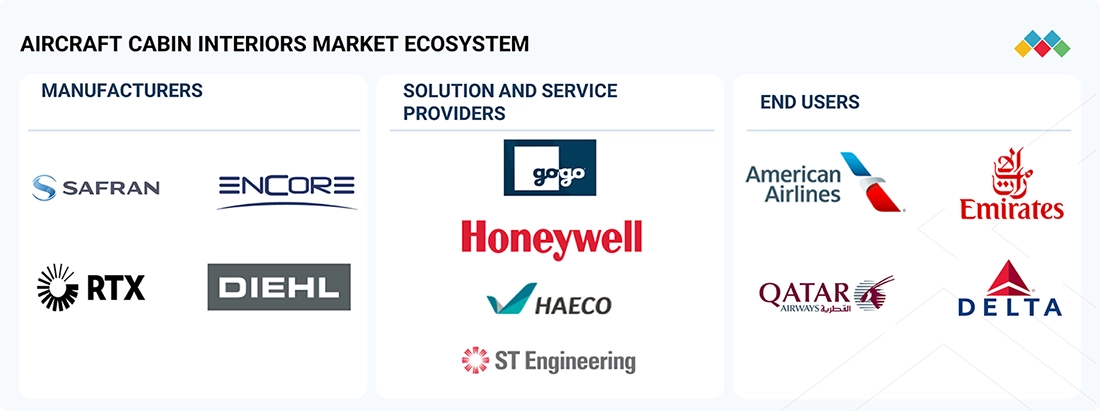
AIRCRAFT CABIN INTERIORS MARKET SIZE, SHARE, TRENDS ANALYSIS: COMMERCIAL USE CASES ACROSS INDUSTRIES
| COMPANY | USE CASE DESCRIPTION | BENEFITS |
|---|---|---|
 |
Development and supply of lightweight aircraft seating, cabin monuments, galleys, lavatories, and cabin equipment for commercial and business aircraft | Reduces aircraft weight, enhances passenger comfort, improves fuel efficiency, and supports airline cabin modernization programs |
 |
Integration of advanced aircraft cabin systems, intelligent lighting, connectivity solutions, and cabin management technologies through Collins Aerospace | Improves passenger experience, enhances cabin operational efficiency, supports connected aircraft, and simplifies cabin management |
 |
Development of aircraft cabin lighting, overhead stowage bins, lavatories, sidewall panels, and integrated cabin systems for next-generation aircraft | Optimizes cabin space utilization, reduces maintenance requirements, improves passenger comfort, and supports lightweight aircraft interiors |
 |
Deployment of advanced in-flight entertainment and connectivity (IFEC) solutions, cabin digital platforms, and passenger engagement technologies | Enhances passenger connectivity and entertainment, increases ancillary revenue opportunities, and improves the overall in-flight experience |
 |
Development of connected cabin technologies, wireless cabin management systems, environmental controls, and aircraft connectivity solutions | Enables predictive maintenance, improves cabin operational efficiency, enhances passenger comfort, and reduces airline operating costs |
Logos and trademarks shown above are the property of their respective owners. Their use here is for informational and illustrative purposes only.
Related Ecosystem
Key Takeaways
- Qatar's aircraft cabin interiors market is valued at USD 325.7 million in 2026 and will grow to USD 363.6 million by 2031 at a 2.22% CAGR.
- Qatar Airways' fleet modernization and premium cabin positioning drive consistent demand for advanced cabin interior components and systems.
- Qatar's market growth rate of 2.22% is moderate compared to the global CAGR of 5.39%, reflecting a mature but stable aviation sector.
- Strategic aircraft acquisitions and cabin refurbishment programs in Qatar support steady procurement of seating, lighting, and galley solutions through 2031.
Aircraft Cabin Interiors Market Report Scope
| Report Metric | Details |
|---|---|
| Base Year | 2026 |
| Fastest Growing Segment | PASSENGER EVTOL AIRCRAFT (Platform) |
| Forecast Period | 2026-2031 |
| Growth Rate | CAGR of 5.39% from 2026 to 2031 |
| Largest Segment | OEM (End User) |
| Market Size Base Year (Billions) | ~USD 29.23 (2026) |
| Revenue Forecast (Billions) | ~USD 38 (2031) |
| Segments Covered | Type, Aircraft Seating Type, Class, End User, Device Type, Solution Type, Solution, Platform, Insert Type, Material, Alloy Type, Fiber-Reinforced Composites Type |
Qatar Aircraft Cabin Interiors Market Report Segmentation
12 segment dimensions are covered across the global market.
By Type
- Aircraft Cabin Lighting
- Aircraft Cabin Monuments
- Aircraft Cabin Windows & Shades
- Aircraft Galley
- Aircraft Interior Panels
- Aircraft Lavatory
- Aircraft Monuments
- Aircraft Panels
- Aircraft Seating
- Aircraft Stowage Bins
- Aircraft Windows And Window Shades
- Cabin Crew Seats
- Ceiling & Wall Lights
- Ceiling Panels
- Electric Galley Inserts
- Floor Panels
- Floor Path Lighting Strips
- Galley Inserts And Equipment
- Galley Monuments
- In-Flight Connectivity
- In-Flight Entertainment
- In-Flight Entertainment & Connectivity
- In-Flight Connectivity
- In-Flight Entertainment
- In-Flight Entertainment & Connectivity
- Monuments
- Non-Electric Galley Inserts
- Other Monuments
- Partition And Dividers
- Passenger Seats
- Pivot Bins
- Reading Lights
- Reusable Liquid Flush
- Shelf Bins
- Side Panels
- Signage Lights
- Task Lights
- Translating Bins
- Vacuum Flush
- Window Shades
- Windows
By Aircraft Seating Type
- Cabin Crew Seats
- Passenger Seats
By Class
- Business Class
- Economy Class
- First Class
- Premium Economy Class
By End User
- Aftermarket
- Mro
- OEM
By Device Type
- Non-Portable Devices
- Portable Devices
By Solution Type
- Wired
- Wireless
By Solution
- Wired
- Wireless
By Platform
- Business Jet
- Narrow-Body Aircraft
- Narrow-Body Aircraft
- Passenger Evtol Aircraft
- Regional Transport Aircraft
- Wide-Body Aircraft
- Wide-Body Aircraft
By Insert Type
- Electric
- Non-Electric
By Material
- Alloys
- Fiber-Reinforced Composites
- Other Materials
- Textiles & Leather
- Thermoplastics
- Thermosets
- Thermosets, Elastomers & Polymeric Foams
By Alloy Type
- Aluminum Alloy
- Steel Alloy
By Fiber-Reinforced Composites Type
- Aramid
- Carbon
- Glass
Target Audience
- Aircraft Interior Manufacturers : Suppliers of cabin seating, galleys, lavatories, and IFE systems need Qatar-specific demand forecasts and Qatar Airways procurement insights to optimize production planning and sales strategies.
- Aviation Service Providers : MRO facilities and cabin retrofit specialists require detailed market data on Qatar's modernization cycles and maintenance schedules to capture aftermarket service and upgrade opportunities.
- Investment & Private Equity Firms : Investors evaluating aerospace supply chain opportunities need Qatar market analysis to assess growth potential, identify acquisition targets, and evaluate regional expansion strategies.
- Airlines & Fleet Operators : Regional and international carriers operating in Qatar need competitive benchmarking data on cabin interior standards and cost-benefit analyses for fleet modernization decisions.
- Consulting & Strategy Firms : Business consultants advising aerospace clients require Qatar-specific market intelligence to support client strategy development, market entry planning, and competitive positioning recommendations.
Reasons to Buy this Report
- Qatar Airways-Specific Insights : Gain detailed intelligence on Qatar Airways' fleet modernization roadmap, cabin upgrade cycles, and procurement strategies to identify direct business opportunities with the region's dominant carrier.
- Regional Market Positioning : Understand Qatar's unique position within the Middle Eastern aviation ecosystem and how regional dynamics influence cabin interior demand, competitive landscape, and supplier relationships.
- Growth Opportunity Identification : Identify high-potential segments within Qatar's market, including premium seating, advanced IFE systems, and sustainable materials, with specific revenue forecasts and investment timelines.
- Competitive Landscape Analysis : Access comprehensive competitor mapping specific to Qatar, including market share distribution, supplier partnerships, and strategic positioning of key cabin interior manufacturers and service providers.
- Strategic Market Entry Planning : Develop informed market entry or expansion strategies for Qatar with localized data on regulatory requirements, procurement processes, and partnership opportunities with regional stakeholders.
Frequently asked questions
What is the current size of Qatar's aircraft cabin interiors market?
Qatar's aircraft cabin interiors market is valued at USD 325.7 million in 2026 and is expected to grow to USD 363.6 million by 2031.
What is the CAGR for Qatar's aircraft cabin interiors market?
Qatar's aircraft cabin interiors market is growing at a compound annual growth rate (CAGR) of 2.22% from 2026 to 2031.
What drives demand for cabin interiors in Qatar?
Demand in Qatar is primarily driven by Qatar Airways' fleet modernization initiatives, aircraft acquisitions, and the airline's commitment to premium cabin experiences.
How does Qatar's market growth compare to global trends?
Qatar's CAGR of 2.22% is below the global average of 5.39%, reflecting a more mature and stable aviation market concentrated around Qatar Airways.
Which cabin interior components are most in demand in Qatar?
Seating systems, advanced lighting solutions, and galley equipment are among the most sought-after cabin interior components in Qatar's market.
RESEARCH METHODOLOGY
The study followed four main steps to estimate the size of the aircraft cabin interiors market. Secondary research was conducted to collect data on aircraft cabin interior systems, aircraft deliveries, cabin retrofit programs, airline fleet modernization, passenger experience trends, and aircraft production activities across major countries. These findings were validated through primary interviews with aircraft OEMs, cabin interior manufacturers, airlines, MRO service providers, and industry experts. The research analyzed aircraft production, fleet expansion, retrofit activities, airline investments, and technological advancements to assess market demand. Market estimates were then segmented by type, platform, material, and end user. Data triangulation was applied to validate the final figures for each segment and subsegment.
Secondary Research
Secondary research was conducted to build the foundation for this study. Data was collected from aircraft industry reports, aviation publications, aircraft OEMs, airline companies, cabin interior manufacturers, and regulatory organizations related to aircraft cabin interiors. Company information was reviewed through annual reports, product documents, press releases, and investor presentations of aircraft cabin interior manufacturers and aviation companies. The study also examined industry articles, white papers, and research studies related to aircraft seating, cabin lighting, in-flight entertainment, connectivity systems, galleys, lavatories, and lightweight cabin materials. Additional insights were gathered from aviation associations and industry platforms to analyze market trends, technology developments, airline fleet modernization, and aircraft cabin upgrade activities.
Primary Research
Primary research was conducted after key insights from secondary analysis were identified. The study team engaged with executives from aircraft OEMs, airlines, aircraft cabin interior manufacturers, MRO service providers, and industry experts involved in the aircraft cabin interiors market. Discussions included cabin system suppliers, seating manufacturers, in-flight entertainment providers, cabin lighting companies, material suppliers, and aviation stakeholders across major markets. Interviews were conducted through calls and written correspondence to validate market size estimates, production trends, customer requirements, and cabin modernization strategies. These inputs helped refine perspectives on competition, technology development, supply chain activities, and investment trends while improving overall data accuracy.
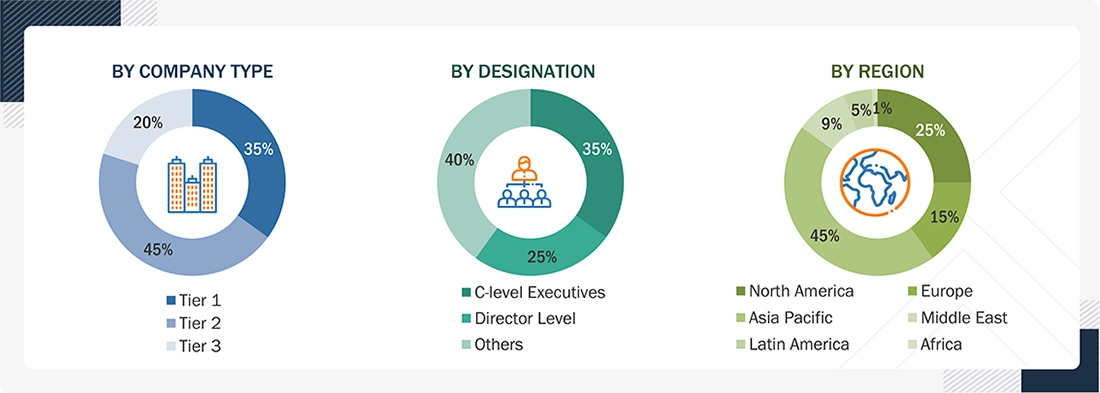
To know about the assumptions considered for the study, download the pdf brochure
Market Size Estimation
The top-down and bottom-up methods were used to estimate and validate the size of the aircraft cabin interiors market. The research process involved several steps to ensure accuracy.
- Key companies active in the aircraft cabin interiors market were identified through secondary research. Their market share was evaluated using a combination of primary inputs and published data. This included reviewing annual reports, financial disclosures, certification updates, and public filings from various organizations. Interviews were also conducted with industry participants such as company executives, program managers, operators, infrastructure providers, and aviation experts. These inputs were used to validate assumptions and refine market size estimates across regions.
- All percentage shares, segment splits, and market breakdowns were first developed using secondary information. These values were then verified through primary discussions with industry participants.
- The analysis evaluated key factors shaping the aircraft cabin interiors market, including defense spending trends, aircraft cabin interiors procurement programs, autonomous technology developments, payload integration capabilities, and surveillance requirements. Each factor was assessed through primary research and used to develop both quantitative and qualitative market estimates for this report.
Aircraft Cabin Interiors Market : Top-Down and Bottom-Up Approach
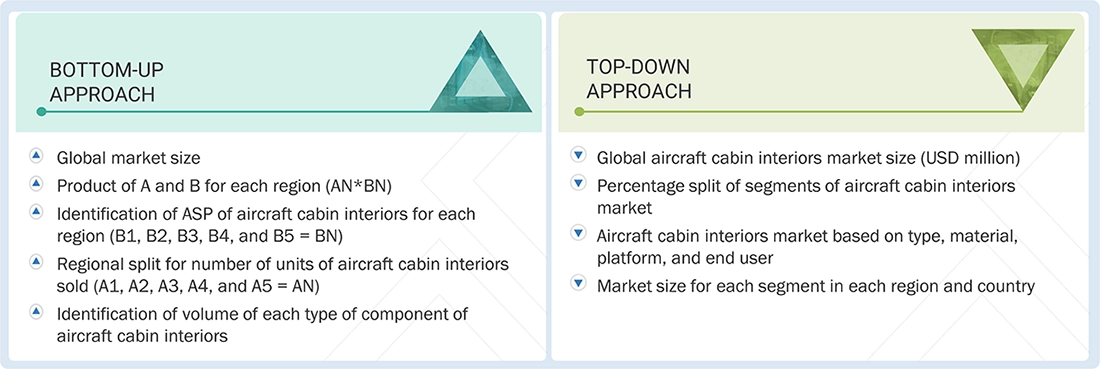
Data Triangulation
After determining the overall market size, the total market was divided into multiple segments and subsegments. The data triangulation and market breakdown procedures described below were carried out, where applicable, to complete the overall market analysis and determine the estimated market figures for the segments and subsegments. The data was triangulated by examining various factors and trends from both demand and supply sides. Additionally, the market size was validated using the top-down and bottom-up approaches.
Market Definition
Aircraft cabin interiors refer to the components and design elements that make up the interior of an aircraft, including:
- Aircraft Seating
- In-Flight Entertainment & Connectivity
- Aircraft Cabin Lighting
- Aircraft Galley
- Aircraft Lavatory
- Aircraft Cabin Windows & Shades
- Aircraft Stowage Bins
- Aircraft Interior Panels
- Aircraft Cabin Monuments
The design of aircraft cabin interiors is a complex process that involves balancing passenger comfort, safety regulations, weight and space constraints, and aesthetics. Cabin interiors are designed to provide a comfortable and enjoyable experience for passengers while meeting strict safety standards set by aviation authorities like the FAA and EASA.
Key Stakeholders
- Airlines investing in aircraft cabin modernization and passenger experience improvement programs
- Aircraft cabin interior manufacturers producing seating, lighting, galleys, lavatories, and cabin equipment
- OEMs integrating cabin interior systems into new aircraft programs
- In-flight entertainment and connectivity (IFEC) providers supplying onboard entertainment and communication solutions
- Cabin material suppliers providing lightweight composites, fabrics, foams, and interior components
- Aircraft seating manufacturers developing economy, premium economy, business, and first-class seating systems
- Maintenance, repair, and overhaul (MRO) service providers supporting cabin retrofit, refurbishment, and maintenance activities
- Aircraft leasing companies investing in cabin upgrades to improve fleet value and passenger appeal
- Government aviation authorities responsible for aircraft cabin safety standards and certification requirements
- Research institutions and aviation associations supporting cabin technology innovation and material development
Report Objectives
- To define, describe, and forecast the size of the aircraft cabin interiors market based on type, platform, material, and end user
- To forecast the size of market segments with respect to key countries in the following regions: North America, Europe, Asia Pacific, the Middle East, Latin America, and Africa
- To identify and analyze drivers, restraints, opportunities, and challenges influencing the growth of the market
- To identify industry trends, market trends, and technology trends currently prevailing in the market
- To provide an overview of the regulatory landscape with respect to global aircraft cabin interiors market regulations
- To analyze micromarkets with respect to individual growth trends, prospects, and their contribution to the overall market
- To analyze opportunities in the market for stakeholders by identifying key market trends
- To profile key market players and comprehensively analyze their market share and core competencies
- To analyze the degree of competition in the market by identifying growth strategies, such as agreements, acquisitions, partnerships, collaborations, and product launches, adopted by leading market players
- To identify detailed financial positions, key products, and unique selling points of leading market players
Available customizations:
MarketsandMarkets offers the following customizations for this market report:
- Additional country-level analysis of the aircraft cabin interiors market
- Profiling of other market players (up to five)
Product Analysis
- Product matrix, which provides a detailed comparison of the product portfolio of each company in the aircraft cabin interiors market
Get the Full Aircraft Cabin Interiors Market Report
Full forecast, segment splits, and company analysis for all Aircraft Cabin Interiors Market.
- Canada Aircraft Cabin Interiors Market
- US Aircraft Cabin Interiors Market
- UK Aircraft Cabin Interiors Market
- France Aircraft Cabin Interiors Market
- Germany Aircraft Cabin Interiors Market
- Italy Aircraft Cabin Interiors Market
- Spain Aircraft Cabin Interiors Market
- China Aircraft Cabin Interiors Market
- India Aircraft Cabin Interiors Market
- Japan Aircraft Cabin Interiors Market
- South Korea Aircraft Cabin Interiors Market
- Australia Aircraft Cabin Interiors Market
- UAE Aircraft Cabin Interiors Market
- Saudi Arabia Aircraft Cabin Interiors Market
- Brazil Aircraft Cabin Interiors Market
- Mexico Aircraft Cabin Interiors Market
- South Africa Aircraft Cabin Interiors Market
- Rest Of Europe Aircraft Cabin Interiors Market
- Rest Of Asia Pacific Aircraft Cabin Interiors Market
- Rest Of Latin America Aircraft Cabin Interiors Market
- Rest Of Middle East Aircraft Cabin Interiors Market
- Rest Of Africa Aircraft Cabin Interiors Market
Need a Tailored Report?
Customize this report to your needs
Get 10% FREE Customization
Customize This Report
