
South Korea Aircraft Fuel Systems Market (2025-2030)

The South Korea Aircraft Fuel Systems Market was valued at $169.8 Million in 2025 and projected to reach to $202 Million by 2030, representing a compound annual growth rate of 3.5%. South Korea's aircraft fuel systems market is positioned for steady growth through 2030, driven by the nation's strategic investments in aerospace manufacturing and defence modernization.


| Market Size in | USD 26.32 MN |
| Market Forecast in | |
| CAGR | |
| Forecast Period | |
| Units Considered | Value (USD MN) |
South Korea Aircraft Fuel Systems Market Trends and Insights
- South Korea's aerospace and defence sector is increasingly investing in advanced fuel system technologies to enhance aircraft efficiency and safety standards.
- The market in South Korea is driven by rising demand from both commercial aviation operators and military modernization programmes, supported by the country's robust manufacturing capabilities and technological expertise in aerospace components..
Key Market Statistics
- CAGR (2025-2030) 3.5% CAGR
- Market Size, 2025 ~USD 169.8 Million
- Forecast, 2030 ~USD 202 Million
- Country South Korea
South Korea Aircraft Fuel Systems Market Overview
Market Valuation Growth :
South Korea's aircraft fuel systems market is valued at USD 169.8 million in 2025, with projections to reach USD 202.0 million by 2030, representing a robust 3.5% CAGR outpacing the global average of 2.7%.
Advanced Technology Investment :
South Korea's aerospace and defence sector is increasingly investing in next-generation fuel system technologies to enhance aircraft efficiency, reduce emissions, and meet stringent international safety standards.
Regional Aerospace Expansion :
The growth is driven by South Korea's expanding commercial and military aircraft manufacturing capabilities, including domestic programs and partnerships with international aerospace OEMs.
Regulatory Compliance Focus :
Stricter environmental regulations and fuel efficiency mandates in South Korea are accelerating the adoption of innovative fuel system solutions across both commercial and defence aviation sectors.
South Korea Aircraft Fuel Systems Market Dynamics
- The country's focus on developing indigenous aircraft platforms and upgrading existing military fleets creates sustained demand for advanced fuel system technologies.
- South Korea's commitment to environmental sustainability and fuel efficiency standards aligns with global aviation trends, encouraging manufacturers to adopt cutting-edge fuel management systems.
- The market will benefit from increased collaboration between domestic aerospace companies and international OEMs, fostering technology transfer and innovation in fuel system design and manufacturing capabilities..
Market Ecosystem
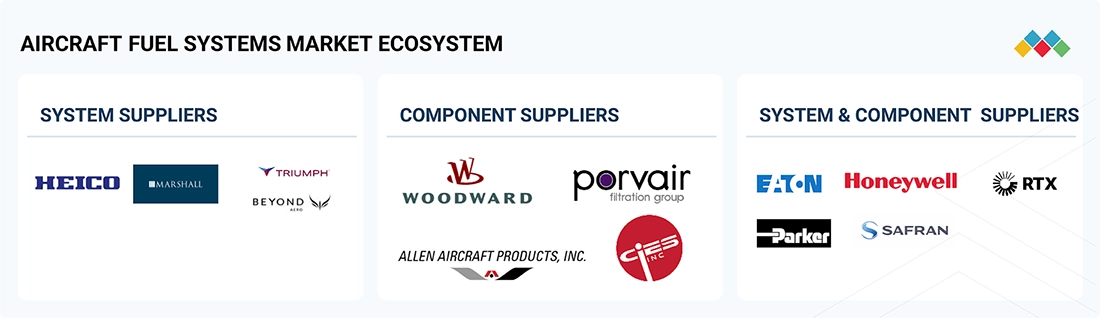
Aircraft Fuel Systems Market: COMMERCIAL USE CASES ACROSS INDUSTRIES
| COMPANY | USE CASE DESCRIPTION | BENEFITS |
|---|---|---|
 |
Developed hydrogen-electric propulsion fuel and thermal management solutions under the HEROPS consortium. | Enhances propulsion efficiency, prevents leaks, and supports future hydrogen-powered aircraft standards. |
 |
Redesigned lighter nacelle components for Airbus A350 to improve fuel system performance. | Reduces aircraft weight and emissions while increasing fuel efficiency and operational range. |
 |
Introduced crashworthy external fuel systems (CEFS) for UH-60 helicopters. | Improves survivability, reduces fuel spillage risk, and increases mission endurance without compromising safety. |
Logos and trademarks shown above are the property of their respective owners. Their use here is for informational and illustrative purposes only.
Related Ecosystem
Aviation
- Narrow Body Aircraft
- Wide Body Aircraft
- Military Helicopters
- Special Mission Aircraft
- Fighter Aircraft
- HONEYWELL INTERNATIONAL INC.
- COLLINS AEROSPACE
- Thales group
- Safran group
- HEICO Corporation
Key Takeaways
- South Korea's aircraft fuel systems market is valued at USD 169.8 million in 2025 with a projected value of USD 202.0 million by 2030.
- South Korea demonstrates a 3.5% CAGR, outpacing the global average of 2.7%, indicating stronger regional growth momentum.
- South Korea's aerospace sector benefits from advanced manufacturing capabilities and increasing defence modernization investments.
- South Korea's market growth is supported by both commercial aviation expansion and military aircraft upgrade programmes through 2030.
Aircraft Fuel Systems Market Report Scope
| Report Metric | Details |
|---|---|
| Base Year | 2025 |
| Fastest Growing Segment | HYBRID-ELECTRIC ENGINE (Engine Type) |
| Forecast Period | 2025–2030 |
| Growth Rate | CAGR of 2.7% from 2025 to 2030 |
| Largest Segment | CONVENTIONAL ENGINES (Engine Type) |
| Market Size Base Year (Billions) | ~USD 10.18 (2025) |
| Revenue Forecast (Billions) | ~USD 11.63 (2030) |
| Segments Covered | System, Subtype, Technology, Engine Type, Conventional Engine, Aircraft Type, Commercial Aviation, Business & General Aviation, Military Aviation, Point Of Sale, Type |
South Korea Aircraft Fuel Systems Market Report Segmentation
11 segment dimensions are covered across the global market.
By System
- Fuel Control & Monitoring Systems
- Fuel Indication Systems
- Fuel Supply & Distribution Systems
- Fuel Tank Inerting Systems
- Other Systems
By Subtype
- Fuel Actuators
- Fuel Control Units
- Fuel Filters/Fuel Strainers
- Fuel Flow Meters
- Fuel Injectors/Fuel Nozzles
- Fuel Lines & Hoses
- Fuel Pumps
- Fuel Sensors
- Fuel Valves
By Technology
- Gravity Feed Systems
- Pressurized Feed Systems
- Pump Feed Systems
By Engine Type
- Conventional Engines
- Hybrid-Electric Engine
By Conventional Engine
- Piston Engines
- Turbofan
- Turboprop
- Turboshaft
By Aircraft Type
- Business & General Aviation
- Business Jets
- Commercial Aviation
- Fighter Aircraft
- Helicopters
- Light Aircraft
- Military Aviation
- Military Helicopters
- Military Uavs
- Narrow-Body Aircraft
- Regional Transport Aircraft
- Special Mission Aircraft
- Transport Aircraft
- Wide-Body Aircraft
By Commercial Aviation
- Helicopters
- Narrow-Body Aircraft
- Regional Transport Aircraft
- Wide-Body Aircraft
By Business & General Aviation
- Business Jets
- Light Aircraft
By Military Aviation
- Fighter Aircraft
- Military Helicopters
- Military Uav
- Special Mission Aircraft
- Transport Aircraft
By Point Of Sale
- Aftermarket
- OEM
- Oems
By Type
- Fuel Actuators
- Fuel Control Units
- Fuel Filters/Fuel Strainers
- Fuel Flow Meters
- Fuel Injectors/Fuel Nozzles
- Fuel Lines & Hoses
- Fuel Pumps
- Fuel Sensors
- Fuel Valves
Target Audience
- Aerospace OEMs & Suppliers : South Korean and international aircraft manufacturers and fuel system component suppliers need market intelligence to identify growth opportunities, assess competitive positioning, and plan product development strategies for the Korean market.
- Defence & Military Procurement : South Korean military and defence procurement agencies require detailed market analysis to evaluate fuel system technologies for aircraft modernization programs and ensure alignment with national defence capabilities.
- Investment & Private Equity Firms : Investors targeting the South Korean aerospace and defence sector need comprehensive market data to evaluate investment opportunities, assess growth potential, and identify acquisition targets in the fuel systems supply chain.
- Government & Policy Makers : South Korean government agencies and policy makers need market insights to develop aerospace industry strategies, support domestic manufacturing capabilities, and align regulations with market growth opportunities.
- Technology & Consulting Firms : Aerospace consultants and technology firms require South Korea-specific market data to advise clients on market trends, competitive dynamics, and strategic positioning within the regional aircraft fuel systems sector.
Key Companies in the South Korea Aircraft Fuel Systems Market
| Company | HQ | Ownership | Strongest segments |
|---|---|---|---|
| HINDUSTAN AERONAUTICS LIMITED | India | Public Company | Military aircraft (fixed-wing),Helicopters (utility and combat),Engines and powerplants (manufacture and MRO), |
| HANWHA CORPORATION | South Korea | Public Company | Defense systems and munitions,Explosives and industrial chemicals,Photovoltaic and solar materials, |
| MOOG INC | United States | Public Company | Military Aircraft,Commercial Aircraft,Space and Defense, |
| ROCKWELL COLLINS INC | United States | Private Company | Commercial Systems (avionics, cabin management, sensors, training),Government Systems (communications, navigation, EW, targeting, simulation),Interior Systems (seats, galleys, cabin equipment, services), |
| ALTRAN | France | Private Company | Engineering & R&D Services,Organization & IT Systems Consulting, |
| PARKER HANNIFIN CORPORATION | United States | Public Company | Diversified Industrial – Motion & Control (hydraulics, pneumatics, electromechanical),Diversified Industrial – Filtration, Fluid Conveyance, and Thermal Management,Sealing, Adhesives, and EMI Shielding, |
| RTX | United States | Public Company | Collins Aerospace (avionics, interiors, mission systems, aftermarket),Pratt & Whitney (commercial and military engines, MRO),Raytheon (sensors, effectors, C2, space solutions), |
| EATON CORPORATION | Ireland | Public Company | Electrical Americas,Electrical Global,Aerospace, |
| SAFRAN | France | Public Company | Aerospace Propulsion,Aircraft Equipment, Defense and Aerosystems,Aircraft Interiors, |
| WOODWARD | United States | Public Company | Aerospace OEM hardware (pumps, metering units, actuators, valves, nozzles, sensors),Aerospace aftermarket MRO and services,Industrial controls and hardware (actuators, valves, pumps, ignition, sensors), |
| TRIUMPH GROUP | United States | Private Company | Systems & Support – actuation, hydraulics, and landing gear systems,Systems & Support – engine and fuel systems,Systems & Support – electronic controls, cyber-protected controllers, and MRO, |
| HONEYWELL INTERNATIONAL INC. | United States | Public Company | Industrial Automation,Building Automation,Energy and Sustainability Solutions (UOP and related), |
| CRANE COMPANY | United States | Public Company | Aerospace & Advanced Technologies,Process Valves and Related Products,Pumps and Systems, |
| AMETEK INC. | United States | Public Company | Process and analytical instruments,Aerospace and defense sensors, power, and embedded systems,Power quality, test and measurement, and laboratory instruments, |
| CIES INC. | France | Public Company | Plaster-based systems and ceilings,Insulation solutions,Mortars and construction chemicals, |
| HEICO CORPORATION | United States | Public Company | Jet engine and aircraft replacement parts,MRO and overhaul services,Aerospace insulation and specialty components, |
HINDUSTAN AERONAUTICS LIMITED
Hindustan Aeronautics Limited is an Indian public company founded in 1940 that employs 22,033 people. The company operates as a major aerospace and defense manufacturer in India.
HANWHA CORPORATION
Hanwha Corporation is a South Korean public company established in 1952 with 3,493 employees. The company operates across multiple industrial sectors.
MOOG INC
Moog Inc is a United States-based public company founded in 1951 with 13,500 employees. The company specializes in aerospace and defense systems.
ROCKWELL COLLINS INC
Rockwell Collins Inc is a private company established in the United States in 1933 and employs 31,200 people. The company operates in the aerospace and defense industry.
ALTRAN
Altran is a French private company founded in 1970 with 50,124 employees. The company provides engineering and technology consulting services.
PARKER HANNIFIN CORPORATION
Parker Hannifin Corporation is a United States-based public company founded in 1917 with 57,950 employees. The company manufactures motion and control technologies for industrial and aerospace applications.
RTX
RTX is a United States public company established in 1934 with 180,000 employees. The company operates as a major aerospace, defense, and security technology provider.
EATON CORPORATION
Eaton Corporation is a public company founded in 1911 with 97,303 employees, headquartered in Ireland. The company provides power management solutions across multiple industries.
SAFRAN
Safran is a French public company founded in 1896 with 103,710 employees. The company is a major aerospace, defense, and security technology provider.
WOODWARD
Woodward is a United States public company founded in 1870 with 10,200 employees. The company manufactures control systems and components for aerospace and industrial applications.
TRIUMPH GROUP
Triumph Group is a private company established in the United States in 1993 with 3,696 employees. The company operates in the aerospace and defense sectors.
HONEYWELL INTERNATIONAL INC.
Honeywell International Inc is a United States public company founded in 1885 with 101,000 employees. The company provides diversified technology and manufacturing solutions across aerospace, building, and industrial sectors.
CRANE COMPANY
Crane Company is a United States public company founded in 1855 with 7,100 employees. The company manufactures engineered products for aerospace, defense, and industrial markets.
AMETEK INC.
AMETEK Inc is a United States public company founded in 1930 with 22,500 employees. The company manufactures electronic instruments and electromechanical devices for industrial and aerospace applications.
CIES INC.
CIES Inc is a French public company founded in 1665 with 158,616 employees. The company operates across multiple industrial and commercial sectors.
HEICO CORPORATION
HEICO Corporation is a United States public company founded in 1957 with 11,100 employees. The company supplies aerospace and defense products and services.
Reasons to Buy this Report
- Market-Specific Sizing & Forecasts : Access precise valuation data for South Korea's aircraft fuel systems market with detailed 2025-2030 projections, enabling accurate budget allocation and investment planning specific to this high-growth regional market.
- Competitive Landscape Intelligence : Identify key South Korean and international players operating in the fuel systems sector, understand their market positioning, and discover partnership and acquisition opportunities within the Korean aerospace ecosystem.
- Growth Driver Analysis : Understand the unique factors driving South Korea's 3.5% CAGR, including domestic aircraft programs, military modernization initiatives, and regulatory compliance requirements specific to the Korean market.
- Technology & Innovation Trends : Gain insights into advanced fuel system technologies being adopted in South Korea, including efficiency improvements, environmental compliance solutions, and indigenous aerospace development initiatives.
- Strategic Market Entry Guidance : Develop informed market entry strategies for South Korea with localized insights on regulatory frameworks, industry partnerships, supply chain dynamics, and customer preferences in the Korean aerospace sector.
Frequently asked questions
What is the current size of South Korea's aircraft fuel systems market?
South Korea's aircraft fuel systems market is valued at USD 169.8 million in 2025.
What is the projected market size for South Korea by 2030?
South Korea's aircraft fuel systems market is projected to reach USD 202.0 million by 2030.
What is the CAGR for South Korea's aircraft fuel systems market?
South Korea's aircraft fuel systems market is expected to grow at a CAGR of 3.5% from 2025 to 2030.
How does South Korea's growth rate compare to the global market?
South Korea's CAGR of 3.5% exceeds the global CAGR of 2.7%, demonstrating stronger regional growth potential.
What factors are driving growth in South Korea's aircraft fuel systems market?
Growth in South Korea is driven by commercial aviation expansion, military modernization programmes, and advanced aerospace manufacturing capabilities.
RESEARCH METHODOLOGY
This research study extensively uses secondary sources, directories, and databases, such as Hoovers, Bloomberg Businessweek, and Factiva, to identify and collect relevant information on the aircraft fuel systems market. Primary sources included industry experts from the core and related industries, preferred suppliers, manufacturers, solution providers, technology developers, alliances, and organizations related to all segments of the industry’s value chain. All primary sources have been interviewed to obtain and verify critical qualitative and quantitative information and assess the prospects of the aircraft fuel systems market. A deductive approach, the top-down approach, has been used to forecast the size of different market segments.
Secondary Research
The ranking of companies operating in the aircraft fuel systems market has been arrived at based on secondary data made available through paid and unpaid sources, the analysis of product portfolios of major companies in the market, and rating them based on their performance and quality. Primary sources have further validated these data points.
Secondary sources that were referred to for this research study on the Aircraft Fuel Secondary sources for this research study include government sources, such as corporate filings, annual reports, investor presentations, and financial statements of trade, business, and professional associations. Secondary data has been collected and analyzed to determine the overall market size, which various primary respondents have further validated.
Primary Research
Extensive primary research has been conducted after obtaining information about the aircraft fuel systems market scenario through secondary research. Several primary interviews have been conducted with market experts from the demand and supply sides across various regions: North America, Europe, Asia Pacific, Latin America, and Africa. Approximately 40% of the primary interviews have been from the demand side, while 60% have been from the supply side. This primary data has been collected through questionnaires, emails, and telephonic interviews.
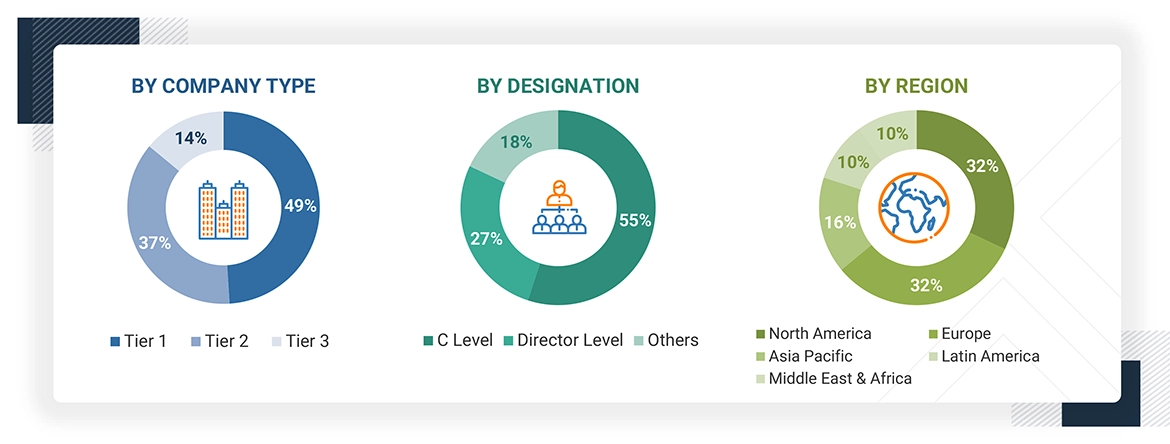
Note: C-level executives include the CEO, COO, and CTO, among others.
Others include sales managers, marketing managers, and product managers.
Tiers of companies have been defined based on their total revenue as of 2024: Tier 1 = > USD 1 billion, Tier 2 = USD 100 million to USD 1 billion, and Tier 3 = < USD 100 million
To know about the assumptions considered for the study, download the pdf brochure
Market Size Estimation
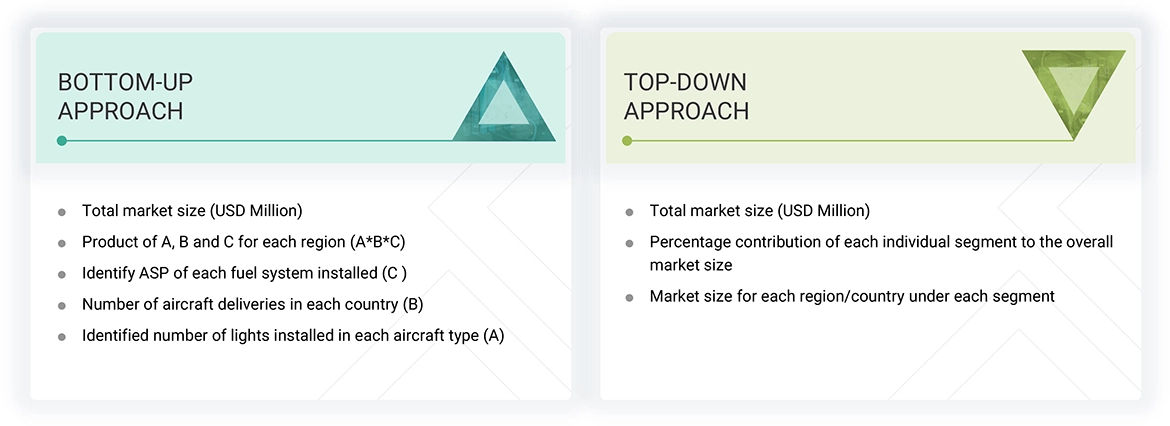
Both top-down and bottom-up approaches have been used to estimate and validate the aircraft fuel systems market size. The figures below represent the overall market size estimation process employed for this study on the aircraft fuel systems market. The key players in the market have been identified through extensive secondary research. This includes the study of annual and financial reports of the top market players and extensive interviews with leaders, including chief executive officers (CEOs), directors, and marketing executives of leading companies operating in the market. All percentage shares, splits, and breakdowns have been determined using secondary sources and verified through primary sources.
All possible parameters that affect the aircraft fuel systems market and its segments covered in this research study have been viewed in extensive detail, verified through primary research, and analyzed to obtain the final quantitative and qualitative data. This data has been consolidated, enhanced with detailed inputs, analyzed, and presented in this report.
Aircraft Fuel Systems Market : Top-Down and Bottom-Up Approach
Data Triangulation
After arriving at the size of the aircraft fuel systems market from the market size estimation process explained above, the total market has been split into several segments and subsegments. To complete the overall market engineering process and arrive at the exact statistics for the market segments and subsegments, the market breakdown and data triangulation procedures have been implemented, wherever applicable. The data has been triangulated by studying various factors from the demand and supply sides. In addition, the market size has been validated using the top-down and bottom-up approaches.
Market Definition
The aircraft fuel system is designed to provide an uninterrupted flow of clean fuel from the fuel tanks to the engine. The fuel must be available to the engine under all conditions of engine power, altitude, attitude, and during all approved flight maneuvers. Fuel systems differ significantly from aircraft to aircraft due to the relative size and complexity of the aircraft in which they are installed. In the most basic form, a fuel system will consist of a single gravity-feed fuel tank with the associated fuel line connecting it to the aircraft engine.
Key Stakeholders
- Aircraft Fuel Systems Manufacturers
- Aircraft Fuel Systems Wholesalers, Retailers, and Distributors
- Subcomponent Manufacturers
- Technology Support Providers
- Research Bodies
- System Integrators
- Aircraft Manufacturers
- Airline Operators
- Defense Organizations
Report Objectives
- To define, describe, and forecast the aircraft fuel systems market based on system, technology, aircraft type, engine type, point of sale, and region
- To forecast sizes of various segments of the market with respect to major regions: North America, Europe, Asia Pacific, the Middle East, and Rest of the World, along with key countries in each of these regions
- To identify and analyze the drivers, restraints, opportunities, and challenges influencing the growth of the market
- To identify industry trends, market trends, and technology trends currently prevailing in the aircraft fuel systems market
- To provide an overview of the regulatory landscape with respect to aircraft fuel systems regulations across regions
- To analyze micromarkets with respect to individual growth trends, prospects, and their contribution to the overall market
- To analyze opportunities in the market for stakeholders by identifying key market trends
- To profile key market players and comprehensively analyze their market shares and core competencies
- To evaluate the degree of competition in the market by analyzing recent developments such as contracts, agreements, and acquisitions reported by leading market players
- To identify detailed financial positions, key products, and unique selling points of leading companies in the market
- To provide a detailed competitive landscape of the market, along with market share analysis and revenue analysis of key players
Available Customizations
Along with the market data, MarketsandMarkets offers customizations to meet the specific needs of companies. The following customization options are available for the report:
Product Analysis
- Product matrix, which gives a detailed comparison of the product portfolio of each company
Regional Analysis
- Further breakdown of the market segments at the country level
Company Information
- Detailed analysis and profiling of additional market players (up to 5)
Get the Full Aircraft Fuel Systems Market Report
Full forecast, segment splits, and company analysis for all Aircraft Fuel Systems Market.
- Canada Aircraft Fuel Systems Market
- US Aircraft Fuel Systems Market
- UK Aircraft Fuel Systems Market
- France Aircraft Fuel Systems Market
- Germany Aircraft Fuel Systems Market
- Italy Aircraft Fuel Systems Market
- Spain Aircraft Fuel Systems Market
- UAE Aircraft Fuel Systems Market
- Saudi Arabia Aircraft Fuel Systems Market
- Israel Aircraft Fuel Systems Market
- Turkey Aircraft Fuel Systems Market
- Australia Aircraft Fuel Systems Market
- China Aircraft Fuel Systems Market
- India Aircraft Fuel Systems Market
- Japan Aircraft Fuel Systems Market
- Rest Of Asia Pacific Aircraft Fuel Systems Market
Need a Tailored Report?
Customize this report to your needs
Get 10% FREE Customization
Customize This Report
