
Asia Pacific Ground Support Equipment Market (2024-2029)

The Asia Pacific Ground Support Equipment Market was valued at $915.2 Million in 2024 and projected to reach to $1498.1 Million by 2029, representing a compound annual growth rate of 10.4%. The Asia Pacific Ground Support Equipment Market is poised for sustained expansion through 2029, driven by unprecedented growth in commercial aviation, rising passenger traffic, and substantial government investments in airport modernization.


| Market Size in | USD 26.32 MN |
| Market Forecast in | |
| CAGR | |
| Forecast Period | |
| Units Considered | Value (USD MN) |
Asia Pacific Ground Support Equipment Market Trends and Insights
- Asia Pacific's 10.4% compound annual growth rate significantly outpaces the global average of 3.9%, driven by rapid aviation sector expansion, increasing airport infrastructure investments, and rising aircraft fleet modernization across the region.
- This accelerated growth reflects Asia Pacific's strategic importance as a global aviation hub and the region's commitment to enhancing operational efficiency in aerospace support services. Key drivers propelling Asia Pacific's Ground Support Equipment Market include surging air traffic demand, expansion of low-cost carrier networks, and substantial government investments in airport modernization initiatives.
- Asia Pacific's emerging economies are prioritizing fleet upgrades and ground infrastructure development to support growing passenger volumes and cargo operations.
- The region's competitive manufacturing landscape and increasing adoption of advanced GSE technologies position Asia Pacific as a critical growth engine for the global market through 2029..
Key Market Statistics
- CAGR (2024-2029) 10.4% CAGR
- Market Size, 2024 ~USD 915.2 Million
- Forecast, 2029 ~USD 1498.1 Million
- Geography Asia Pacific
Asia Pacific Ground Support Equipment Market Overview
Exceptional Growth Trajectory :
Asia Pacific's Ground Support Equipment Market is expanding at 10.4% CAGR, more than 2.6x faster than the global average of 3.9%, reflecting the region's accelerating aerospace infrastructure development and modernization initiatives.
China's Market Dominance :
China leads Asia Pacific with $131.4 million in market size, driven by rapid domestic aviation expansion, increasing aircraft fleet modernization, and substantial investments in airport infrastructure across major hubs.
Strategic Regional Hubs :
UAE ($130.3M) and Singapore ($55.4M) emerge as critical regional centers for ground support equipment, leveraging their positions as international aviation gateways and maintenance hubs for the Asia Pacific region.
Emerging Market Opportunities :
India ($27.7M) and Japan ($27.6M) present significant growth opportunities as both nations expand their aviation sectors, modernize existing fleets, and invest in next-generation airport infrastructure and maintenance facilities.
Asia Pacific Ground Support Equipment Market Dynamics
- China's dominance, combined with emerging opportunities in India and Southeast Asia, positions the region as a critical growth engine for the global aerospace sector.
- The region's 10.4% CAGR reflects structural tailwinds including fleet expansion, aging equipment replacement cycles, and increasing adoption of advanced ground support technologies. Key growth catalysts include rising middle-class populations driving air travel demand, regional airline fleet expansions, and strategic investments in maintenance, repair, and overhaul (MRO) facilities.
- The market's trajectory from $915.2 million (2024) to $1,498.1 million (2029) underscores Asia Pacific's pivotal role in global aerospace growth, with particular momentum in China, UAE, and emerging South Asian markets..
Market Ecosystem
Related Ecosystem
Airport Systems
- Antennas
- Sensors
- Aeronautical Information Management (AIM)
- Digital Signage
- Face Recognition
- Thales group
- SYSTRA LTD.
- Idaho Strategic Resources, Inc.
- HONEYWELL INTERNATIONAL INC.
- Leidos Holdings, Inc.
Key Takeaways
- Asia Pacific Ground Support Equipment Market will grow from $915.2M (2024) to $1,498.1M (2029) at a 10.4% CAGR, outpacing global growth.
- Asia Pacific's rapid aviation expansion and airport infrastructure investments are primary catalysts for accelerated GSE market demand.
- Emerging economies in Asia Pacific are driving fleet modernization and ground equipment upgrades to support rising air traffic volumes.
- Asia Pacific's competitive manufacturing ecosystem and technology adoption position the region as a global market growth leader through 2029.
Ground Support Equipment Market Report Scope
| Report Metric | Details |
|---|---|
| Base Year | 2024 |
| Fastest Growing Segment | AUTONOMOUS (Autonomy) |
| Forecast Period | 2024-2029 |
| Growth Rate | CAGR of 3.9% from 2024 to 2029 |
| Largest Segment | COMMERCIAL (Platform) |
| Market Size Base Year (Billions) | ~USD 6.11 (2024) |
| Revenue Forecast (Billions) | ~USD 7.4 (2029) |
| Segments Covered | Platform, Commercial Platform, Commercial Passenger Handling Platform, Commercial Cargo Handling Platform, Commercial Aircraft Handling Platform, Military Platform, Point Of Sale, Equipment Type, Type, Power Source, Autonomy, Ownership, Platform 2024-2029 |
Asia Pacific Ground Support Equipment Market Report Segmentation
13 segment dimensions are covered across the global market.
By Platform
- Commercial
- Military
By Commercial Platform
- Aircraft Handling
- Cargo Handling
- Passenger Handling
By Commercial Passenger Handling Platform
- Cabin Service Vehicles
- Lavatory Vehicles
- Passenger Boarding Bridges
- Passenger Busses/Shuttles
- Passenger Handling
- Passenger Stairs
By Commercial Cargo Handling Platform
- Baggage Tractors
- Belt Loaders/Conveyors
- Cargo/Container Loaders
- Container Pallet Transporters/Loaders
- Forklifts
By Commercial Aircraft Handling Platform
- Deicers
- Ground Power Units
- Hydrant Fuel Systems
- Pre-Conditioned Air Units
- Pushback Aircraft Tractors
By Military Platform
- Aircraft Tow Tractors
- Cargo Loaders
- Deicers
- Ground Power Units
- Pre-Conditioned Air Units
By Point Of Sale
- Equipment
- Maintenance
- Maintenance Services
By Equipment Type
- New Demand
- Replacement
By Type
- Access Stands
- Engine Stands
- Fixed
- Landing Gear Fixtures
- Mobile
- Tow Bars
By Power Source
- Electric
- Hybrid
- Non-Electric
By Autonomy
- Autonomous
- Conventional/Manned
- Remotely Operated
By Ownership
- Airline
- Airport
- Gse Lessor
- Gse Service Provider/Operator
By Platform 2024-2029
- Commercial
- Military
Target Audience
- Aerospace Equipment Manufacturers : Manufacturers need Asia Pacific market intelligence to identify growth opportunities, plan production capacity, and develop region-specific product strategies for the fastest-growing aerospace market globally.
- Airport Operators & Infrastructure Developers : Airport authorities and infrastructure investors require detailed market forecasts to plan ground support equipment procurement, modernization programs, and maintenance facility investments across Asia Pacific.
- Aviation Service Providers & MRO Operators : Maintenance, repair, and overhaul service providers need regional market data to guide equipment investments, facility expansion, and service capability development in high-growth Asia Pacific markets.
- Private Equity & Strategic Investors : Investment firms evaluating aerospace sector opportunities require Asia Pacific market analysis to identify acquisition targets, assess growth potential, and structure investment theses in the region.
- Government & Policy Makers : Aviation authorities and government agencies need market intelligence to inform infrastructure planning, regulatory frameworks, and strategic investments in regional aviation sector development.
Countries within Asia Pacific - compare and drill down
| Country | 2025 size (native) |
|---|---|
| China | USD 131.4 Million |
| Japan | USD 27.6 Million |
| India | USD 27.7 Million |
| Saudi Arabia | USD 68.7 Million |
| UAE | USD 130.3 Million |
| Turkey | USD 127.4 Million |
| Iran | USD 25.7 Million |
| Singapore | USD 55.4 Million |
| Rest Of Asia Pacific | USD 17.1 Million |
Country market size visualization
Reasons to Buy this Report
- Regional Market Segmentation : Gain detailed insights into Asia Pacific's fastest-growing aerospace market with country-level analysis of China, UAE, Singapore, India, and Japan, enabling precise market entry and expansion strategies.
- Competitive Positioning Intelligence : Understand market dynamics across Asia Pacific's key aviation hubs and identify competitive opportunities in emerging markets outpacing global growth rates by 2.6x.
- Investment Decision Support : Access comprehensive forecasts through 2029 to support capital allocation decisions, facility planning, and partnership strategies in the region's high-growth aerospace sector.
- Supply Chain Optimization : Identify critical regional markets and distribution hubs (UAE, Singapore) to optimize supply chain networks and enhance market penetration across Asia Pacific's aviation ecosystem.
- Growth Opportunity Mapping : Leverage detailed market sizing and CAGR analysis to prioritize expansion into high-potential markets including India, Japan, and Southeast Asia's emerging aviation centers.
Frequently asked questions
What is the current size of the Asia Pacific Ground Support Equipment Market?
The Asia Pacific Ground Support Equipment Market was valued at $915.2 million in 2024 and is projected to reach $1,498.1 million by 2029.
What is the growth rate for Asia Pacific's Ground Support Equipment Market?
Asia Pacific's Ground Support Equipment Market is expected to grow at a compound annual growth rate (CAGR) of 10.4% from 2024 to 2029.
Why is Asia Pacific's GSE market growing faster than the global average?
Asia Pacific's 10.4% CAGR outpaces the global 3.9% rate due to rapid aviation expansion, airport modernization investments, and fleet upgrades across emerging economies in the region.
What are the primary drivers of growth in Asia Pacific's Ground Support Equipment Market?
Key drivers include surging air traffic demand, low-cost carrier network expansion, government airport modernization initiatives, and increasing aircraft fleet modernization across Asia Pacific.
Which countries in Asia Pacific are leading GSE market growth?
Emerging economies across Asia Pacific are driving growth through substantial investments in airport infrastructure, fleet expansion, and ground equipment modernization to support rising passenger and cargo volumes.
RESEARCH METHODOLOGY
This research study on the Ground Support Equipment market involved the extensive use of secondary sources, directories, and databases such as Hoovers, Bloomberg BusinessWeek, and Factiva to identify and collect information relevant to the market. Primary sources included industry experts, service providers, manufacturers, solution providers, technology developers, alliances, and organizations related to all segments of this industry's value chain. In-depth interviews with primary respondents, including key industry participants, subject matter experts, industry consultants, and C-level executives, were conducted to obtain and verify critical qualitative and quantitative information about the Ground Support Equipment market and assess the market's growth prospects.
Secondary Research
The market share of companies in the Ground Handling Equipment market was determined using the secondary data acquired through paid and unpaid sources and analyzing the product portfolios of major companies operating in the market. These companies were rated based on the performance and quality of their products. Primary sources further validated these data points.
Secondary sources referred to for this research study on the Aircraft Ground Equipment market included government sources, such as, International Air Transport Association (IATA), Airport Council International (ACI), International Civil Aviation Organization (ICAO) and federal and state governments of various countries; corporate filings, such as annual reports, investor presentations, and financial statements; and trade, business, and professional associations; among others. Secondary data was collected and analyzed to determine the overall size of the Ground Support Equipment market, which primary respondents further validated.
Primary Research
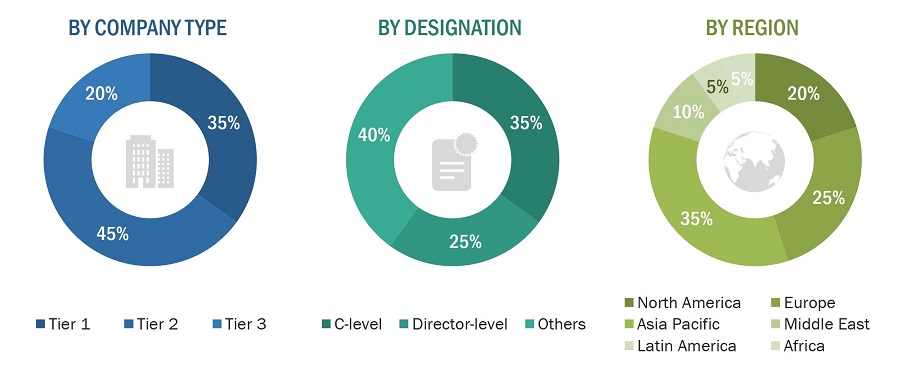
Extensive primary research was conducted after acquiring information regarding the Ground Support Equipment market scenario through secondary research. Several primary interviews were conducted with market experts from both the demand and supply sides across major countries of North America, Europe, Asia Pacific, the Middle East, Africa and Latin America. Primary data was collected through questionnaires, emails, and telephonic interviews.
To know about the assumptions considered for the study, download the pdf brochure
Market Size Estimation
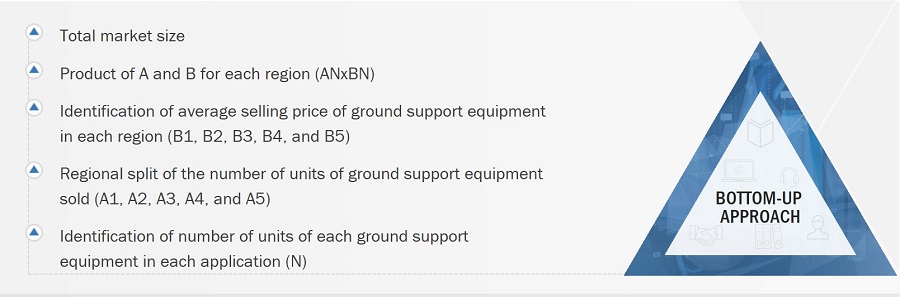
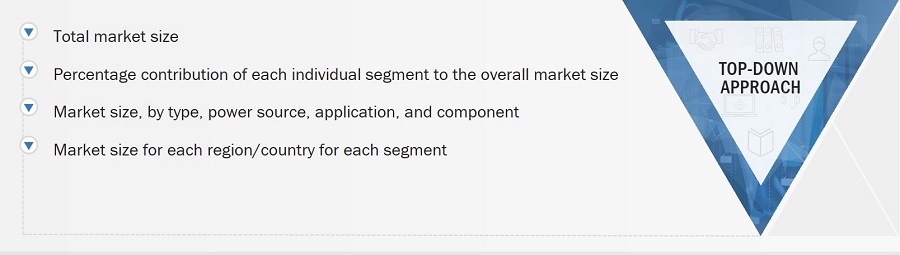
- Both top-down and bottom-up approaches were used to estimate and validate the size of the Ground Support Equipment market.
- Key players were identified through secondary research, and their market ranking was determined through primary and secondary research. This included a study of annual and financial reports of the top market players and extensive interviews of leaders, including CEOs, directors, and marketing executives.
- All percentage shares, splits, and breakdowns were determined using secondary sources and verified through primary sources. All possible parameters that affect the markets covered in this research study were accounted for, viewed in extensive detail, verified through primary research, and analyzed to obtain the final quantitative and qualitative data. This data was consolidated, enhanced with detailed inputs, analyzed by MarketsandMarkets, and presented in this report.
Market size estimation methodology: Bottom-up Approach
Market size estimation methodology: Top-Down Approach
Data triangulation
After arriving at the overall size of the Ground Support Equipment market from the market size estimation process explained above, the total market was split into several segments and subsegments. Wherever applicable, data triangulation and market breakdown procedures explained below were implemented to complete the overall market engineering process and arrive at the exact statistics for various market segments and subsegments. The data was triangulated by studying various factors and trends from both the demand and supply sides. Additionally, the market size was validated using both top-down and bottom-up approaches.
Market Definition
Ground Support Equipment (GSE) market encompasses all equipment, machinery, and vehicles used to support aircraft operations on the ground. This includes a wide range of specialized equipment designed to facilitate various tasks such as aircraft maintenance, loading and unloading of cargo and passengers, refueling, towing, de-icing, and general ground handling activities. GSE plays a critical role in ensuring the efficiency, safety, and smooth operation of airports and airlines worldwide. The market includes both new equipment sales as well as aftermarket services such as maintenance, repair, and spare parts.
Ground support equipment also includes various equipment used at hangars and workshops for the maintenance, repair, and overhaul (MRO) of aircraft and aero engines. The GSE in this category comprises access stands, engine stands, landing gear fixtures, and tow bars.
Stakeholders
Various stakeholders of the market are listed below:
- Manufacturers of GSE
- Original Equipment Manufacturers (OEMs) and Service Providers
- Manufacturers and Suppliers of Subcomponents
- Retailers, Wholesalers, and Distributors of GSE
- Providers of MRO Services
- Providers of Technology Support
- Logistical Partners and Transporters
- Providers of Solutions and Software
- Airport Authorities and Airlines
Report Objectives
- To define, describe, segment, and forecast the size of the ground support equipment (GSE) market based on point of sale, platform, type, power source, autonomy, ownership, and region
- To independently forecast the market size for GSE maintenance, repair, and overhaul (MRO) /hangar equipment
- To understand the structure of the GSE market by identifying its various segments and subsegments
- To forecast the size of the various segments with respect to six major regions, namely, North America, Europe, Asia Pacific, the Middle East, Latin America, and Africa, along with the major countries in each of these regions
- To identify and analyze key drivers, restraints, opportunities, and challenges that influence the growth of the market
- To provide an overview of the tariff and regulatory landscape for the adoption of greener ground support equipment across regions
- To strategically analyze the micromarkets1 with respect to individual growth trends, prospects, and their contribution to the overall market
- To analyze opportunities in the market for stakeholders by identifying key market trends
- To analyze the degree of competition in the market by identifying key growth strategies, such as acquisitions, new product launches, new service launches, contracts, and partnerships, adopted by leading market players
- To provide a detailed competitive landscape of the ground support equipment market, along with a ranking analysis, market share analysis, and revenue analysis of key players
- To profile key market players and comprehensively analyze their market shares and core competencies2.
- To identify detailed financial positions, key products, and unique selling points of leading companies in the market
1Micromarkets are referred to as the segments and subsegments of the Aircraft Seating market considered in the scope of the report.
2Core competencies of companies were captured in terms of their key developments and key strategies adopted to sustain their positions in the market.
Available Customizations
Along with the market data, MarketsandMarkets offers customizations as per the specific needs of companies. The following customization options are available for the report:
Product Analysis
- Product matrix, which gives a detailed comparison of the product portfolio of each company.
Regional Analysis
- Further breakdown of the market segments at the country level
Company Information
- Detailed analysis and profiling of additional market players (up to 5)
Get the Full Ground Support Equipment Market Report
Full forecast, segment splits, and company analysis for all Ground Support Equipment Market.
- Canada Ground Support Equipment Market
- US Ground Support Equipment Market
- UK Ground Support Equipment Market
- Germany Ground Support Equipment Market
- France Ground Support Equipment Market
- Russia Ground Support Equipment Market
- Spain Ground Support Equipment Market
- Netherlands Ground Support Equipment Market
- China Ground Support Equipment Market
- Japan Ground Support Equipment Market
- India Ground Support Equipment Market
- Saudi Arabia Ground Support Equipment Market
- UAE Ground Support Equipment Market
- Turkey Ground Support Equipment Market
- Iran Ground Support Equipment Market
- Brazil Ground Support Equipment Market
- Colombia Ground Support Equipment Market
- Mexico Ground Support Equipment Market
- Argentina Ground Support Equipment Market
- South Africa Ground Support Equipment Market
- Ethiopia Ground Support Equipment Market
- Rest Of Europe Ground Support Equipment Market
- Sweden Ground Support Equipment Market
- Rest Of Asia Pacific Ground Support Equipment Market
- Singapore Ground Support Equipment Market
- Rest Of Latin America Ground Support Equipment Market
- Rest Of Africa Ground Support Equipment Market
Need a Tailored Report?
Customize this report to your needs
Get 10% FREE Customization
Customize This Report
