
Asia Pacific Aircraft Heat Exchanger Market (2025-2030)

The Asia Pacific Aircraft Heat Exchanger Market was valued at $1253.4 Million in 2025 and projected to reach to $1604.7 Million by 2030, representing a compound annual growth rate of 5.1%. The Asia Pacific aircraft heat exchanger market is positioned for robust expansion, driven by unprecedented growth in commercial aviation across emerging economies and sustained military modernization programs.


| Market Size in | USD 26.32 MN |
| Market Forecast in | |
| CAGR | |
| Forecast Period | |
| Units Considered | Value (USD MN) |
Asia Pacific Aircraft Heat Exchanger Market Trends and Insights
- Asia Pacific represents a critical growth region for aerospace thermal management solutions, driven by rising commercial aviation demand, increasing military modernization programs, and expanding aircraft manufacturing capacity across the region.
- The market in Asia Pacific is benefiting from growing fleet expansion in countries such as China, India, and Southeast Asia, where air travel demand continues to accelerate. Asia Pacific's aircraft heat exchanger market is characterized by heightened competition among global and regional suppliers seeking to capitalize on the region's aerospace growth trajectory.
- Between 2025 and 2030, Asia Pacific is expected to witness significant investments in advanced thermal management technologies, driven by stricter environmental regulations and the need for improved fuel efficiency in commercial and military aircraft.
- The region's strategic importance in global aerospace supply chains positions Asia Pacific as a key market for heat exchanger manufacturers and OEMs..
Key Market Statistics
- CAGR (2025-2030) 5.1% CAGR
- Market Size, 2025 ~USD 1253.4 Million
- Forecast, 2030 ~USD 1604.7 Million
- Geography Asia Pacific
Asia Pacific Aircraft Heat Exchanger Market Overview
China Dominates Regional Market :
China leads the Asia Pacific aircraft heat exchanger market with USD 735.9 million in 2025, driven by rapid commercial aviation expansion and indigenous aircraft manufacturing programs including the C919 and ARJ21 platforms.
India's Emerging Aerospace Sector :
India represents a high-growth opportunity with USD 297.4 million market size, supported by increasing domestic aircraft production, MRO expansion, and military modernization initiatives across defense platforms.
5.1% CAGR Outpaces Global Growth :
Asia Pacific's 5.1% CAGR significantly exceeds the global 4.1% rate, reflecting accelerated aviation demand, rising defense budgets, and regional aircraft manufacturing capacity development through 2030.
Strategic Regional Manufacturing Hubs :
Japan (USD 224.5M) and South Korea (USD 198.6M) serve as advanced manufacturing and technology centers, while Australia (USD 148.2M) supports regional MRO and defense applications in the Indo-Pacific region.
Asia Pacific Aircraft Heat Exchanger Market Dynamics
- China's aerospace manufacturing ecosystem and India's growing defense capabilities create substantial demand for advanced thermal management solutions.
- Regional airlines are expanding fleets to meet rising passenger traffic, while governments invest heavily in indigenous aircraft development and military upgrades. By 2030, the region's market is projected to reach USD 1,604.7 million, reflecting increasing adoption of next-generation heat exchanger technologies for fuel efficiency and environmental compliance.
- Strategic partnerships between regional manufacturers and global OEMs, coupled with rising aftermarket demand for MRO services, will further accelerate market penetration across Asia Pacific's diverse aerospace ecosystem..
Market Ecosystem

Aircraft Heat Exchanger: COMMERCIAL USE CASES ACROSS INDUSTRIES
| COMPANY | USE CASE DESCRIPTION | BENEFITS |
|---|---|---|
 |
Develops lightweight, high-performance heat exchangers for electric propulsion and avionics systems using advanced simulation and brazing technologies | Enhances cooling efficiency and structural durability while reducing weight and ensuring reliable operation in electric aircraft |
 |
Designs additively manufactured heat exchangers for battery thermal management in eVTOL and advanced air mobility platforms | Delivers high thermal uniformity and weight reduction, improving battery performance and energy efficiency in electric aircraft |
 |
Engineers cryogenic loop heat pipes for thermal control in space and aerospace instrumentation | Ensures stable, passive cooling performance under extreme temperatures and zero-gravity conditions with high reliability |
 |
Produces replacement heat exchangers for legacy aircraft through reverse engineering and brazed construction processes | Minimizes aircraft downtime and maintenance costs while ensuring continued operational reliability of aging fleets |
Logos and trademarks shown above are the property of their respective owners. Their use here is for informational and illustrative purposes only.
Related Ecosystem
Aviation
- Narrow Body Aircraft
- Wide Body Aircraft
- Military Helicopters
- Special Mission Aircraft
- Fighter Aircraft
- HONEYWELL INTERNATIONAL INC.
- COLLINS AEROSPACE
- Thales group
- Safran group
- HEICO Corporation
Key Takeaways
- Asia Pacific aircraft heat exchanger market grows from USD 1,253.4M (2025) to USD 1,604.7M (2030) at 5.1% CAGR
- Asia Pacific's growth rate outpaces the global CAGR of 4.1%, reflecting accelerating regional aerospace demand
- Asia Pacific is driven by commercial fleet expansion, military modernization, and manufacturing capacity growth in China, India, and Southeast Asia
- Asia Pacific market benefits from regulatory pressures for fuel efficiency and advanced thermal management technologies through 2030
Aircraft Heat Exchanger Market Report Scope
| Report Metric | Details |
|---|---|
| Base Year | 2025 |
| Fastest Growing Segment | ADVANCED AIR MOBILITY (Platform) |
| Forecast Period | 2025–2030 |
| Growth Rate | CAGR of 4.1% from 2025 to 2030 |
| Largest Segment | NON-ELECTRIC (Architecture) |
| Market Size Base Year (Billions) | ~USD 5.28 (2025) |
| Revenue Forecast (Billions) | ~USD 6.45 (2030) |
| Segments Covered | Point Of Sale, Platform, Design, Medium, Material, Architecture, Application |
Asia Pacific Aircraft Heat Exchanger Market Report Segmentation
7 segment dimensions are covered across the global market.
By Point Of Sale
- Aftermarket
- OEM
By Platform
- Advanced Air Mobility
- Business & General Aviation
- Commercial Aviation
- Military Aviation
- Uav
By Design
- Plate Fin
- Tube Fin
By Medium
- Air-To-Air
- Air-To-Liquid
- Liquid-To-Air
- Liquid-To-Liquid
By Material
- Aluminum
- Nickel Alloy
- Stainless Steel
- Titanium
By Architecture
- Electric
- Non-Electric
By Application
- Avionics/Electronic Pod Cooling
- Bleed Air
- Engine System
- Environmental Control System
- Hydraulic Cooling
Target Audience
- OEM Aerospace Manufacturers : Identify regional production opportunities and supply chain partnerships in China, India, and Japan to support aircraft assembly programs and secure competitive positioning in Asia Pacific's expanding manufacturing base.
- Heat Exchanger Component Suppliers : Understand country-specific demand patterns and growth rates to optimize distribution networks, establish local manufacturing facilities, and capture market share across high-growth segments.
- Defense & Military Procurement : Assess modernization budgets and military aircraft upgrade programs across Asia Pacific nations to identify government contracts and long-term supply agreements for thermal management systems.
- MRO Service Providers : Leverage market data to expand aftermarket service capabilities, establish regional maintenance hubs, and capitalize on growing fleet maintenance demand across commercial and military aviation sectors.
- Investment & Private Equity Firms : Evaluate acquisition targets and investment opportunities in Asia Pacific aerospace suppliers, leveraging regional growth forecasts and country-level market dynamics to maximize portfolio returns.
Key Companies in the Asia Pacific Aircraft Heat Exchanger Market
| Company | HQ | Ownership | Strongest segments |
|---|---|---|---|
| ROLLS-ROYCE HOLDINGS PLC. | United Kingdom | Public Company | Engine-mounted heat exchangers (oil, fuel, and air systems),ECS and bleed air heat exchangers,Avionics/pod and hydraulic cooling heat exchangers, |
| HEICO | United States | Public Company | Plate-Fin Heat Exchangers,Tube-Fin Heat Exchangers,ECS Applications, |
| NORSK HYDRO ASA | Norway | Public Company | Plate-Fin Heat Exchanger Aluminum Inputs,Tube-Fin Heat Exchanger Aluminum Inputs,Recycled and Low-Carbon Aluminum for Heat Exchangers, |
| ALTRAN | France | Private Company | Plate-Fin Design & ECS Integration,Engine & Bleed Air Thermal Management,Avionics/Pod & Hydraulic Cooling, |
| CYIENT | India | Public Company | Plate-Fin Heat Exchanger Engineering & Integration,Tube-Fin and Ancillary Heat Exchanger Design,ECS and Cabin Environmental Systems, |
| HONEYWELL INTERNATIONAL INC. | United States | ||
| RTX | United States | Public Company | Plate-Fin Heat Exchangers,Tube-Fin Heat Exchangers,ECS Applications, |
| SAFRAN | France | Public Company | Plate-Fin Heat Exchangers,Tube-Fin Heat Exchangers,ECS Applications, |
| LIEBHERR GROUP | Switzerland | Private Company | Plate-Fin Heat Exchangers,Tube-Fin Heat Exchangers,ECS Applications, |
| PARKER HANNIFIN CORPORATION | United States | Public Company | Plate-Fin Heat Exchangers,Tube-Fin Heat Exchangers,ECS Applications, |
| AMETEK, INC. | United States | Public Company | Plate-Fin Heat Exchangers,Tube-Fin Heat Exchangers,ECS and Cabin Environmental Cooling, |
| BOYD CORPORATION | Canada | Public Company | Plate-Fin Heat Exchangers,Tube-Fin Heat Exchangers,ECS and Cabin Environmental Applications, |
| TAT TECHNOLOGIES LTD. | United States | Public Company | Plate-Fin Heat Exchangers (OEM),Tube-Fin Heat Exchangers (OEM),MRO for Heat Transfer Components, |
| SUMITOMO PRECISION PRODUCTS CO., LTD. | Japan | Private Company | Plate-Fin Heat Exchangers,Tube-Fin Heat Exchangers,ECS Applications, |
| JAMCO CORPORATION | Japan | Private Company | Plate-Fin Design,Tube-Fin Design,ECS Application, |
| TRIUMPH GROUP | United States | Private Company | Plate-Fin Heat Exchangers,Tube-Fin Heat Exchangers,ECS Applications, |
ROLLS-ROYCE HOLDINGS PLC.
Rolls-Royce Holdings PLC is a United Kingdom-based public company founded in 1884 with 43,162 employees. The company operates as a major industrial manufacturer serving aerospace, defense, and power generation sectors.
HEICO
HEICO is a United States-based public company founded in 1957 with 11,100 employees. The company specializes in aerospace and defense products and services.
NORSK HYDRO ASA
Norsk Hydro ASA is a Norway-based public company founded in 1905 with 32,786 employees. The company is a major integrated aluminum and energy producer.
ALTRAN
Altran is a France-based private company founded in 1970 with 50,124 employees. The company provides engineering and technology consulting services.
CYIENT
Cyient is an India-based public company founded in 1991 with 12,049 employees. The company offers engineering, design, and technology services.
HONEYWELL INTERNATIONAL INC.
Honeywell International Inc. is a United States-based company that operates across aerospace, building technologies, performance materials, and safety solutions.
RTX
RTX is a United States-based public company founded in 1934 with 180,000 employees. The company is a major aerospace and defense contractor.
SAFRAN
Safran is a France-based public company founded in 1896 with 103,710 employees. The company is a leading supplier of aerospace propulsion, equipment, and defense systems.
LIEBHERR GROUP
Liebherr Group is a Switzerland-based private company founded in 1949 with 54,609 employees. The company manufactures construction equipment, mining equipment, and aerospace components.
PARKER HANNIFIN CORPORATION
Parker Hannifin Corporation is a United States-based public company founded in 1917 with 57,950 employees. The company manufactures motion and control technologies for industrial and aerospace applications.
AMETEK, INC.
AMETEK, Inc. is a United States-based public company founded in 1930 with 22,500 employees. The company manufactures electronic instruments and electromechanical devices.
BOYD CORPORATION
Boyd Corporation is a Canada-based public company founded in 1990 with 13,424 employees. The company manufactures thermal management and engineered materials solutions.
TAT TECHNOLOGIES LTD.
TAT Technologies Ltd. is a United States-based public company founded in 1969 with 659 employees. The company provides aerospace and defense technology solutions.
SUMITOMO PRECISION PRODUCTS CO., LTD.
Sumitomo Precision Products Co., Ltd. is a Japan-based private company founded in 1939 with 1,694 employees. The company manufactures precision machinery and aerospace components.
JAMCO CORPORATION
Jamco Corporation is a Japan-based private company founded in 1949 with 2,723 employees. The company manufactures aircraft interior components and systems.
TRIUMPH GROUP
Triumph Group is a United States-based private company founded in 1993 with 3,696 employees. The company manufactures aerospace components and systems.
Countries within Asia Pacific - compare and drill down
| Country | 2025 size (native) |
|---|---|
| China | USD 735.9 Million |
| India | USD 297.4 Million |
| Japan | USD 224.5 Million |
| South Korea | USD 198.6 Million |
| Australia | USD 148.2 Million |
Country market size visualization
Reasons to Buy this Report
- Country-Level Market Granularity : Access detailed market sizing for China (USD 735.9M), India (USD 297.4M), Japan (USD 224.5M), South Korea (USD 198.6M), and Australia (USD 148.2M) to identify high-potential investment and expansion opportunities.
- Outpacing Global Growth Trajectory : Capitalize on Asia Pacific's 5.1% CAGR, which exceeds global growth at 4.1%, providing superior market expansion potential and competitive advantages in the fastest-growing aerospace region.
- Strategic Regional Insights : Understand China's manufacturing dominance, India's emerging aerospace ecosystem, and Japan's advanced technology leadership to develop targeted go-to-market strategies and partnership frameworks.
- Defense & Commercial Dual Drivers : Leverage comprehensive analysis of military modernization programs and commercial aviation expansion across the region to diversify revenue streams and secure long-term contracts.
- 2025-2030 Forecast Precision : Plan capital investments and production capacity with confidence using detailed projections showing growth from USD 1,253.4M to USD 1,604.7M, enabling data-driven strategic decision-making.
Frequently asked questions
What is the market size of aircraft heat exchangers in Asia Pacific in 2025?
The Asia Pacific aircraft heat exchanger market is valued at USD 1,253.4 million in 2025.
What is the projected market size for Asia Pacific aircraft heat exchangers by 2030?
Asia Pacific's aircraft heat exchanger market is projected to reach USD 1,604.7 million by 2030.
What is the CAGR for the Asia Pacific aircraft heat exchanger market?
The Asia Pacific aircraft heat exchanger market is expected to grow at a CAGR of 5.1% from 2025 to 2030.
How does Asia Pacific's growth compare to the global aircraft heat exchanger market?
Asia Pacific's CAGR of 5.1% exceeds the global CAGR of 4.1%, indicating faster regional growth driven by commercial aviation expansion and military modernization.
What are the primary drivers of growth in the Asia Pacific aircraft heat exchanger market?
Key drivers include rising commercial aviation demand, military modernization programs, expanding aircraft manufacturing capacity, and regulatory requirements for fuel efficiency and thermal management innovation.
RESEARCH METHODOLOGY
The study involved four major activities in estimating the current size of the aircraft heat exchanger market. Exhaustive secondary research was done to collect information on the aircraft heat exchanger market, its adjacent markets, and its parent market. The next step was to validate these findings, assumptions, and sizing with industry experts across the value chain through primary research. Demand-side analysis was conducted to estimate the overall market size. After that, market breakdown and data triangulation procedures were employed to estimate the sizes of various segments and subsegments within the aircraft heat exchanger market.
Secondary Research
During the secondary research process, various sources were consulted to identify and collect information for this study. The secondary sources included government sources, such as SIPRI; corporate filings, including annual reports, press releases, and investor presentations from companies; white papers, journals, and certified publications; and articles from recognized authors, directories, and databases.
Primary Research
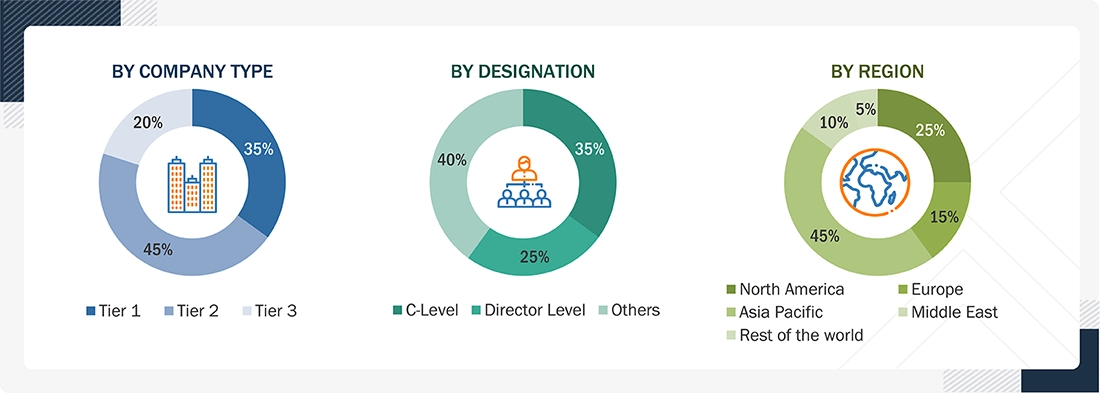
Extensive primary research was conducted after acquiring information regarding the aircraft heat exchanger market scenario through secondary research. Several primary interviews were conducted with market experts from the demand and supply sides across major countries of North America, Europe, Asia Pacific, the Middle East, Africa, and Latin America. Primary data was collected through questionnaires, emails, and telephonic interviews.
To know about the assumptions considered for the study, download the pdf brochure
Market Size Estimation
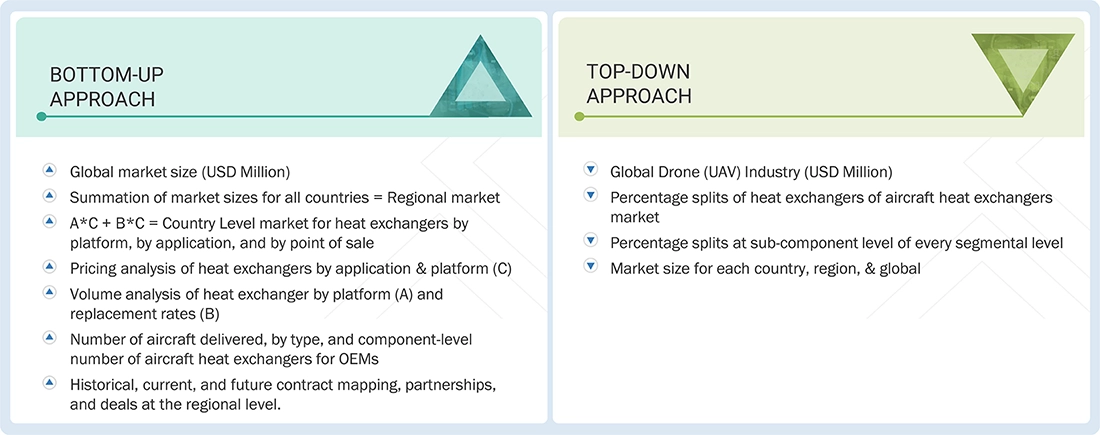
The top-down and bottom-up approaches were used to estimate and validate the size of the aircraft heat exchanger market. The research methodology used to estimate the size of the market included the following details:
- Key players in the aircraft heat exchanger market were identified through secondary research, and their market shares were determined through a combination of primary and secondary research. This included a study of the annual and financial reports of the top market players, as well as extensive interviews with leaders, including directors, engineers, marketing executives, and other key stakeholders of leading companies operating in the market.
- All percentage shares, splits, and breakdowns were determined using secondary sources and verified through primary sources.
- All possible parameters that affect the markets covered in this research study were accounted for, viewed in extensive detail, verified through primary research, and analyzed to obtain the final quantitative and qualitative data on the aircraft heat exchanger market. This data was consolidated, enhanced with detailed inputs, analyzed by MarketsandMarkets, and presented in this report.
Aircraft Heat Exchanger Market: Top-Down and Bottom-Up Approach
Data Triangulation
After determining the overall market size, the total market was divided into several segments and subsegments. The data triangulation and market breakdown procedures explained below were implemented, wherever applicable, to complete the overall market engineering process and arrive at the estimated market numbers for the market segments and subsegments. The data was triangulated by studying various factors and trends from the demand and supply sides. Additionally, the market size was validated using top-down and bottom-up approaches.
Market Definition
A heat exchanger is a device that enables efficient heat transfer between two or more fluids or between a solid object and a fluid. Heat exchangers are typically made of materials, such as aluminum, carbon steel, copper, stainless steel, and nickel alloys, among others. In aircraft, these exchangers transfer heat from the engine’s oil system to warm cold fuel and prevent the formation of ice from suspended water, which could freeze at high altitudes and cause blockage.
Aircraft heat exchangers also play a crucial role in aircraft environmental control systems, maintaining the required temperature in both the cabin and the flight deck. They are also used to cool hydraulics, auxiliary power units, gearboxes, and various other components.
Key Stakeholders
- Raw Material Suppliers
- Heat Exchanger Manufacturers
- Aircraft System Manufacturers
- System Integrators
- Technology Support Providers
- Distributors and Component Suppliers
- Maintenance, Repair, and Overhaul (MRO) Companies
- Government and Regulatory Agencies
- Research and Development Organizations
Report Objectives
- To define, describe, and forecast the aircraft heat exchanger market based on application, design, medium, material, architecture, point of sale, platform, and region
- To forecast the size of different segments of the market with respect to North America, Europe, Asia Pacific, the Middle East, Africa, and Latin America
- To identify and analyze the drivers, restraints, opportunities, and challenges influencing the growth of the market
- To identify industry trends, market trends, and technology trends currently prevailing in the market
- To analyze micro markets with respect to individual growth trends, prospects, and their contribution to the overall market
- To analyze the degree of competition in the market by analyzing recent developments adopted by leading market players
- To provide a detailed competitive landscape of the market, along with a ranking analysis of key players, and an analysis of startup companies in the market
- To strategically profile the key market players and comprehensively analyze their core competencies
- To provide a detailed competitive landscape of the electric ship market, along with a market share analysis and revenue analysis of key players
Customization Options
MarketsandMarkets offers the following customizations for this market report:
- Additional country-level analysis of the aircraft heat exchanger market
- Profiling of other market players (up to 5)
Product Analysis
- Product matrix, which provides a detailed comparison of the product portfolio of each company in the aircraft heat exchanger market
Get the Full Aircraft Heat Exchanger Market Report
Full forecast, segment splits, and company analysis for all Aircraft Heat Exchanger Market.
- Germany Aircraft Heat Exchanger Market
- France Aircraft Heat Exchanger Market
- Spain Aircraft Heat Exchanger Market
- Italy Aircraft Heat Exchanger Market
- China Aircraft Heat Exchanger Market
- India Aircraft Heat Exchanger Market
- Japan Aircraft Heat Exchanger Market
- Australia Aircraft Heat Exchanger Market
- South Korea Aircraft Heat Exchanger Market
- Brazil Aircraft Heat Exchanger Market
- Mexico Aircraft Heat Exchanger Market
- Israel Aircraft Heat Exchanger Market
- Turkey Aircraft Heat Exchanger Market
- South Africa Aircraft Heat Exchanger Market
- Nigeria Aircraft Heat Exchanger Market
- GCC Aircraft Heat Exchanger Market
- Canada Aircraft Heat Exchanger Market
- US Aircraft Heat Exchanger Market
- UK Aircraft Heat Exchanger Market
Need a Tailored Report?
Customize this report to your needs
Get 10% FREE Customization
Customize This Report
