
Australia Airport Information System Market (2024-2029)

The Australia Airport Information System Market was valued at $196.5 Million in 2024 and projected to reach to $240.5 Million by 2029, representing a compound annual growth rate of 3.4%. Australia's Airport Information System market is poised for steady growth as major airports invest in digital infrastructure to meet rising passenger volumes and operational demands.


| Market Size in | USD 26.32 MN |
| Market Forecast in | |
| CAGR | |
| Forecast Period | |
| Units Considered | Value (USD MN) |
Australia Airport Information System Market Trends and Insights
- Australia's aviation sector is increasingly investing in modernized information systems to enhance operational efficiency, passenger experience, and safety compliance across its major airports.
- The growth trajectory reflects Australia's commitment to upgrading airport infrastructure and adopting advanced digital technologies to meet rising passenger volumes and international aviation standards. The Australian market is driven by ongoing capital investments in airport modernization, particularly at major hubs serving domestic and international routes.
- Australia's geographic isolation and reliance on air transport for connectivity underscore the importance of robust airport information systems.
- Between 2024 and 2029, Australia is expected to see steady adoption of integrated platforms that streamline baggage handling, flight operations, and passenger information services.
- This moderate but consistent growth reflects Australia's mature aviation market and the strategic importance of maintaining competitive airport infrastructure in the Asia-Pacific region..
Key Market Statistics
- CAGR (2024-2029) 3.4% CAGR
- Market Size, 2024 ~USD 196.5 Million
- Forecast, 2029 ~USD 240.5 Million
- Country Australia
Australia Airport Information System Market Overview
Market Valuation :
Australia's Airport Information System market is valued at USD 196.5 million in 2024, with projected growth to USD 240.5 million by 2029, driven by modernization initiatives across major aviation hubs.
Growth Trajectory :
The Australian market is experiencing a 3.4% CAGR, slightly below the global average of 4%, reflecting steady but measured investment in airport infrastructure and digital transformation.
Operational Modernization :
Australian airports are prioritizing upgraded information systems to enhance operational efficiency, reduce delays, and improve real-time passenger communication across terminals and ground operations.
Regulatory Compliance :
Increasing focus on safety compliance and international aviation standards is driving adoption of advanced Airport Information Systems across Sydney, Melbourne, Brisbane, and Perth airports.
Australia Airport Information System Market Dynamics
- The modernization of systems at key hubs like Sydney Airport and Melbourne Airport is expected to drive market expansion through 2029.
- Increasing emphasis on passenger experience, real-time information delivery, and integrated ground operations will fuel demand for advanced AIS solutions.
- Government support for aviation infrastructure development and compliance with international safety standards will further accelerate market adoption across regional and major airports throughout the country..
Market Ecosystem
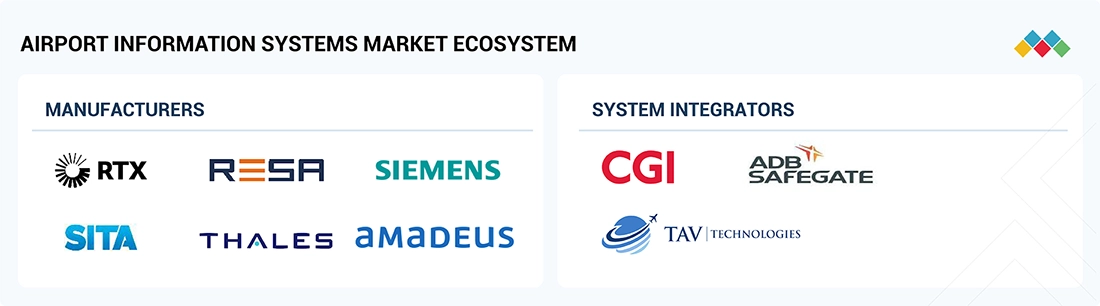
AIRPORT INFORMATION SYSTEM MARKET SIZE, SHARE AND TRENDS, 2025 TO 2030: COMMERCIAL USE CASES ACROSS INDUSTRIES
| COMPANY | USE CASE DESCRIPTION | BENEFITS |
|---|---|---|
 |
Deployed biometrics to replace manual ID checks at key touchpoints. | Reduced processing time, improved passenger flow, enhanced security. |
 |
Implemented self-service kiosks, facial recognition, and RFID for passenger and baggage handling. | Lower congestion, faster check-in, improved staff productivity. |
 |
Adopted AI-powered analytics to manage peak-hour congestion and resource allocation. | Reduced wait times, optimized operations, maintained service quality. |
 |
Executed a digital transformation integrating big data, AI, and IoT to modernize operations. | Improved efficiency, better resource management, reduced mishandling and costs. |
 |
Migrated GIS and operational data systems to AWS cloud. | Increased scalability, reduced costs, improved uptime, enhanced operational efficiency. |
Logos and trademarks shown above are the property of their respective owners. Their use here is for informational and illustrative purposes only.
Related Ecosystem
Airport Systems
- Antennas
- Sensors
- Aeronautical Information Management (AIM)
- Digital Signage
- Face Recognition
- SYSTRA LTD.
- Thales group
- HONEYWELL INTERNATIONAL INC.
- Idaho Strategic Resources, Inc.
- Leidos Holdings, Inc.
Key Takeaways
- Australia's Airport Information System market is valued at USD 196.5 million in 2024 and will reach USD 240.5 million by 2029 at a 3.4% CAGR.
- Australia's mature aviation sector drives steady demand for modernized airport information systems to improve operational efficiency and passenger services.
- Major Australian airports are investing in integrated digital platforms to enhance baggage handling, flight operations, and real-time passenger information.
- Australia's geographic position and reliance on air transport make robust airport information systems critical for maintaining competitive regional connectivity.
Airport Information System Market Report Scope
| Report Metric | Details |
|---|---|
| Base Year | 2024 |
| Fastest Growing Segment | BAGGAGE & CARGO HANDLING SOFTWARE (Cargo & Baggage Management) |
| Forecast Period | 2024–2029 |
| Growth Rate | CAGR of 4% from 2024 to 2029 |
| Largest Segment | PASSENGER-CENTRIC SYSTEMS (Type) |
| Market Size Base Year (Billions) | ~USD 4.24 (2024) |
| Revenue Forecast (Billions) | ~USD 5.36 (2029) |
| Segments Covered | Implementation, Type, Application, Cargo & Baggage Management, Flight Operations, Airport Digital Signage & Display System, Security & Surveillance, Resource Management, Airside Operations, Financial & Revenue Management, Passenger Processing, Departure Control System |
Australia Airport Information System Market Report Segmentation
12 segment dimensions are covered across the global market.
By Implementation
- New Installation
- Upgrades & Modernization
By Type
- Airport Operational Support Systems
- Passenger-Centric Systems
By Application
- Airside Operations
- Cargo & Baggage Management
- Financial & Revenue Management
- Flight Operations
- Passenger Processing
- Resource Management
- Security & Surveillance
By Cargo & Baggage Management
- Automated Storage & Retrieval System (Asrs) Software
- Automated Storage And Retrieval System (Asrs) Software
- Baggage & Cargo Handling And Tracking Software
- Baggage & Cargo Handling Software
- Baggage Reconciliation Software
By Flight Operations
- Airport Digital Signage & Display System
- Airport Digital Signage & Display Systems
- Airport Digital Signage And Display System
- Airport Operational Database (Aodb)
- Gate Management Software
- –Digital Signage
- –Flight Information Display System (Fids)
By Airport Digital Signage & Display System
- Digital Signage
- Flight Information Display System (Fids)
By Security & Surveillance
- Access Control System
- Biometric Access System
- Cctv Surveillance System
- Passenger Screening System
- Perimeter Intrusion Detection System
By Resource Management
- Airside Vehicle Tracking Software
- Resource Allocation Software
- Staff Scheduling Software
By Airside Operations
- Airport Collaborative Decision-Making Software
- Automatic Terminal Information System
- Ground Handling Software
By Financial & Revenue Management
- Aeronautical Billing Software
- Airport Revenue Analysis Software
- Non-Aeronautical Billing Software
By Passenger Processing
- Biometric Identification System
- Biometric Identification Systems
- Departure Control System (Dcs)
- Passenger Flow Management Software
- –Common Use Passenger Processing System (Cupps)
- –Common Use Sel-Service (Cuss) Kiosk
By Departure Control System
- Common Use Passenger Processing System (Cupps)
- Common Use Self-Service (Cuss) Kiosk
AUSTRALIA: AIRPORT INFORMATION SYSTEMS MARKET, BY APPLICATION, 2024–2030
| Segment | 2024 | 2025 | 2026 | 2027 | 2028 | 2029 | 2030 | CAGR (%) |
|---|---|---|---|---|---|---|---|---|
| AIRSIDE OPERATIONS | 33.7 | 34.5 | 36.3 | 37.3 | 38.1 | 39.4 | 41.7 | 3.6 |
| CARGO & BAGGAGE MANAGEMENT | 38.4 | 39.6 | 41.8 | 43.3 | 44.4 | 46.2 | 49.2 | 4.2 |
| FINANCIAL & REVENUE MANAGEMENT | 7.8 | 8 | 8.4 | 8.6 | 8.8 | 9.2 | 9.7 | 3.7 |
| FLIGHT OPERATIONS | 35.8 | 36.4 | 37.8 | 38.6 | 39.1 | 40.1 | 42 | 2.7 |
| PASSENGER PROCESSING | 53.9 | 54.9 | 57.3 | 58.7 | 59.6 | 61.3 | 64.5 | 3 |
| RESOURCE MANAGEMENT | 5.7 | 5.9 | 6.1 | 6.3 | 6.4 | 6.6 | 7 | 3.4 |
| SECURITY & SURVEILLANCE | 21.1 | 21.6 | 22.8 | 23.5 | 24.1 | 24.9 | 26.4 | 3.8 |
| TOTAL | 196.5 | 200.9 | 210.5 | 216.3 | 220.6 | 227.8 | 240.5 | 3.4 |
Target Audience
- Airport Operators & Authorities : Australian airport management teams need market data to justify AIS investments, benchmark against peers, and plan technology upgrades aligned with passenger growth projections.
- Technology Solution Providers : AIS vendors and software companies require Australia-specific market intelligence to identify growth opportunities, tailor solutions to local requirements, and develop targeted sales strategies.
- Investment & Private Equity Firms : Investors evaluating opportunities in Australian aviation infrastructure need detailed market sizing and growth forecasts to assess portfolio companies and identify acquisition targets.
- Government & Regulatory Bodies : Aviation authorities and government agencies use market data to inform policy decisions, infrastructure funding allocations, and compliance framework development for airport operations.
- Consulting & Strategic Planning Teams : Management consultants advising airport clients require Australia-specific market insights to develop business strategies, competitive positioning, and digital transformation roadmaps.
Key Companies in the Australia Airport Information System Market
| Company | HQ | Ownership | Strongest segments |
|---|---|---|---|
| WNS GLOBAL SERVICES | India | Private Company | Banking/Financial Services and Insurance BPM,Travel, Shipping/Logistics, and Utilities BPM,Manufacturing/Retail/Consumer, Hi-tech/Professional Services, and Procurement BPM, |
| AMADEUS IT GROUP SA | Spain | Public Company | Air Distribution (GDS and related services),Air IT Solutions (Altéa, New Skies, and airline platforms),Hospitality & Other Solutions, |
| INDRA | Spain | Public Company | Defense (radars, C2, air defense, simulators, UAS, land vehicles, shipboard systems),Air Traffic (ATM systems, equipment, ATC training),Mobility (ticketing, tolling, rail signaling, transport information and control), |
| RTX | United States | Public Company | Collins Aerospace systems and services,Pratt & Whitney commercial and military engines,Raytheon sensors, C2, and defense solutions, |
| SIEMENS AG | Germany | Public Company | Digital Industries (automation, PLM, industrial software),Smart Infrastructure (electrification, buildings, grid),Mobility (rail systems, automation, services), |
| THALES | France | Public Company | Defence & Security Systems (air defence, C4ISR, EW, protection),Aerospace & Avionics (civil and military, ATM, IFEC),Digital Identity & Security (banking, IAM, biometrics, secure IoT), |
| CGI INC. | Canada | Public Company | Managed IT and Business Process Services,Application Services (DevSecOps, modernization, QA),Systems Integration (data, AI, cloud, IoT, API), |
| NEC CORPORATION | Japan | Public Company | Systems Integration, Managed Services, and DX Consulting,Telecom Networks and Carrier Software (Core, RAN, Optical, Submarine, Netcracker),Enterprise IT Platforms (Cloud, ERP, PLM, MasterScope, WebOTX, SaaS), |
| HONEYWELL INTERNATIONAL, INC. | United States | Public Company | Industrial Automation,Building Automation,Energy and Sustainability Solutions (UOP and related), |
WNS GLOBAL SERVICES
WNS GLOBAL SERVICES is an Indian business process management company founded in 1998 with 66,085 employees. As a private company, it delivers outsourcing and professional services to clients globally.
AMADEUS IT GROUP SA
AMADEUS IT GROUP SA is a Spanish travel technology company founded in 1987 with 20,605 employees. Listed as a public company, it operates a global distribution system for the travel and tourism industry.
INDRA
INDRA is a Spanish technology and consulting company founded in 1921 with 62,689 employees. Listed as a public company, it provides IT solutions and services across defense, transportation, and digital sectors.
RTX
RTX is an American aerospace and defense company founded in 1934 with 180,000 employees. Listed as a public company, it manufactures advanced technologies and systems for commercial and military applications.
SIEMENS AG
SIEMENS AG is a German multinational conglomerate founded in 1847 with 310,312 employees. Listed as a public company, it operates across electrification, automation, and digitalization sectors globally.
THALES
THALES is a French aerospace, defense, and security company founded in 1893 with 82,111 employees. Listed as a public company, it provides advanced technologies and services for critical infrastructure and transportation.
CGI INC.
CGI INC. is a Canadian information technology consulting company founded in 1976 with 94,000 employees. Listed as a public company, it provides IT and business consulting services to government and commercial clients worldwide.
NEC CORPORATION
NEC CORPORATION is a Japanese information technology and electronics company founded in 1899 with 101,800 employees. Listed as a public company, it provides IT solutions, telecommunications, and semiconductor products globally.
HONEYWELL INTERNATIONAL, INC.
HONEYWELL INTERNATIONAL, INC. is an American multinational conglomerate founded in 1885 with 101,000 employees. Listed as a public company, it manufactures advanced materials, aerospace systems, and building technologies.
Reasons to Buy this Report
- Market-Specific Sizing : Access precise valuation data for Australia's AIS market (USD 196.5M in 2024) with detailed 5-year forecasts to support investment decisions and business planning in the region.
- Competitive Landscape Analysis : Understand key players, market share distribution, and competitive positioning specific to Australian airports, enabling strategic partnerships and market entry strategies.
- Growth Driver Identification : Identify Australia-specific growth catalysts including regulatory requirements, airport expansion projects, and passenger volume trends driving AIS adoption across the country.
- Regional Investment Insights : Gain actionable intelligence on capital expenditure patterns, technology preferences, and modernization priorities at major Australian airports including Sydney, Melbourne, and Brisbane.
- Risk & Opportunity Assessment : Evaluate market risks, regulatory challenges, and emerging opportunities specific to Australia's aviation sector to optimize resource allocation and minimize market entry risks.
Frequently asked questions
What is the current size of Australia's Airport Information System market?
Australia's Airport Information System market is valued at USD 196.5 million in 2024.
What is the projected market size for Australia by 2029?
Australia's Airport Information System market is forecast to reach USD 240.5 million by 2029.
What is the growth rate of Australia's Airport Information System market?
Australia's Airport Information System market is expected to grow at a compound annual growth rate of 3.4% from 2024 to 2029.
What are the main drivers of growth in Australia's airport information systems sector?
Growth in Australia is driven by airport modernization initiatives, increasing passenger volumes, digital transformation investments, and the need to maintain competitive infrastructure in the Asia-Pacific region.
Which Australian airports are leading investments in information systems?
Major Australian airports including Sydney, Melbourne, Brisbane, and Perth are investing in integrated airport information systems to enhance operational efficiency and passenger experience.
RESEARCH METHODOLOGY
This research study involved the extensive use of secondary sources, directories, and databases, such as D&B Hoovers, Bloomberg Businessweek, and Factiva, to identify and collect information relevant to the Aircraft Information System market. Primary sources included industry experts from the core and related industries, as well as preferred suppliers, manufacturers, solution providers, technology developers, alliances, and organizations related to all the segments of this industry’s value chain. All primary sources were interviewed to obtain and verify critical qualitative and quantitative information and assess prospects for market growth during the forecast period.
Secondary Research
The share of companies in the Airport information Systems market was determined using secondary data made available through paid and unpaid sources and analyzing product portfolios of major companies in the Airport Information Systems market. These companies were rated based on the performance and quality of their products. These data points were further validated by primary sources.
Secondary sources referred to for this research study on the Airport information Systems market included financial statements of companies offering and developing Airport information Systems and information from various trade, business, and professional associations, among others. Secondary data was collected and analyzed to determine the total size of the Airport Informations Systems market, which primary respondents further validated.
Primary Research
Extensive primary research was conducted after obtaining information about the current scenario of the Airport information Systems market through secondary research. Several primary interviews were conducted with market experts from the demand and supply sides across North America, Europe, Asia Pacific, the Middle East, and Afrca. This primary data was collected through questionnaires, emails, and telephonic interviews. In the primary research process, varied primary sources from the supply and demand sides were interviewed to get qualitative and quantitative information on the market. Primary sources from the supply side include different industry experts like vice presidents, directors, regional managers, technology providers, product development teams, distributors, and end users.
Primary research has been done through interviews to get information that includes market statistics, revenue collection data from the products and services, and market breakups, size estimations, market forecasting, and data triangulation. Through primary research, the trends of technology, application, platform, and region were also understood. Demand-side stakeholders, such as CXOs, production managers, engineers, and installation teams of end users of Airport information Systems, were interviewed to understand the buyer’s perspective on the suppliers, products, service providers, and their current usage and future outlook of their business, which could affect the Airport information Systems market.
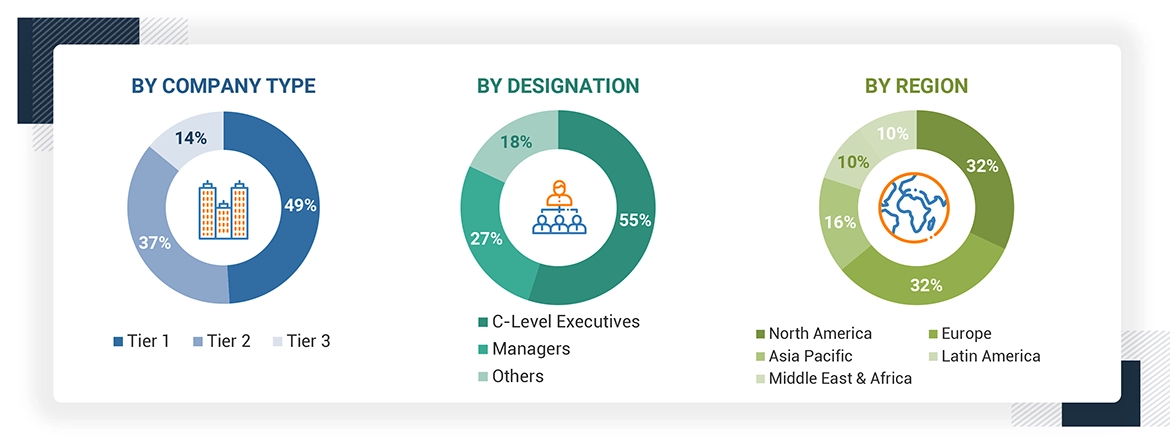
Note: C-level Executives include the CEO, COO, and CTO, among others.
*Others include Sales Managers, Marketing Managers, and Product Managers. The tiers of the companies have been defined based on their total revenue as of 2022. Tier 1 = > USD 1 billion, Tier 2 = USD 100 million to USD 1 billion, and Tier 3 = < USD 100 million
To know about the assumptions considered for the study, download the pdf brochure
Market Size Estimation
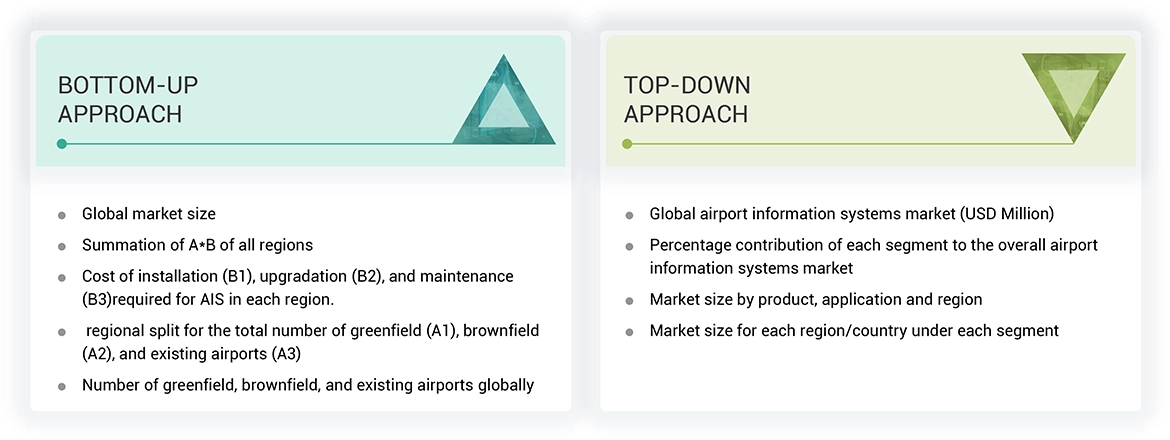
Both top-down and bottom-up approaches were used to estimate and validate the size of the Airport Information Systems market. The research methodology used to estimate the market size includes the following details:
- Key players were identified through secondary research, and their market ranking was determined through primary and secondary research. This included a study of annual and financial reports of the top market players and extensive interviews of leaders, including CEOs, directors, and marketing executives.
- All percentage shares, splits, and breakdowns were determined using secondary sources and verified through primary sources. All possible parameters that affect the markets covered in this research study were accounted for, viewed in extensive detail, verified through primary research, and analyzed to obtain the final quantitative and qualitative data. This data was consolidated, enhanced with detailed inputs, analyzed by MarketsandMarkets, and presented in this report.
Airport Information System Market : Top-Down and Bottom-Up Approach
Data Triangulation
After arriving at the overall size of the Airport information Systems market from the market size estimation process explained above, the total market was split into several segments and subsegments. To complete the overall market engineering process and arrive at the exact statistics for various market segments and sub-segments, the data triangulation and market breakdown procedures explained below were implemented, wherever applicable. The data was triangulated by studying various factors and trends from both the demand and supply sides. The market size was also validated using both the top-down and bottom-up approaches.
Market Definition
The Airport Information Systems (AIS) market focuses on technologies that streamline and optimize airport operations, integrating software, hardware, and real-time data for efficient passenger processing, flight management, resource allocation, and security. Key components like Departure Control Systems (DCS), Airport Operational Databases (AODB), and Flight Information Display Systems (FIDS) enhance decision-making, operational efficiency, and passenger experiences. AIS supports applications in baggage handling, airside management, and dynamic revenue optimization while fostering collaboration among airlines, air traffic control, airport authorities, and ground handlers. AIS solutions are vital for smarter, more connected airport ecosystems by addressing congestion, improving security, and enabling sustainable practices.
Key Stakeholders
Various stakeholders of the market are listed below:
- Systems Manufacturers
- Software Developers of Airport Information Systems
- Service providers
- Airport Authorities
- Airport Staff
- Regulatory Bodies
Report Objectives
- To define, describe, and forecast the airport information systems market based on technology, application, type, implementation, and region.
- To forecast sizes of various segments of the market with respect to major regions, namely, North America, Europe, Asia Pacific, Middle East and Rest of the World along with key countries in each of these regions.
- To identify and analyze the drivers, restraints, opportunities, and challenges influencing the growth of the airport information systems market.
- To identify industry trends, market trends, and technology trends currently prevailing in the airport information systems market
- To provide an overview of the regulatory landscape with respect to airport information systems regulations across regions.
- To analyze micromarkets with respect to individual growth trends, prospects, and their contribution to the overall market
- To analyze opportunities in the market for stakeholders by identifying key market trends
- To profile key market players and comprehensively analyze their market shares and core competencies
- To analyze the degree of competition in the airport information systems market by analyzing recent developments such as contracts, agreements, expansions, and new product launches adopted by leading market players
- To identify detailed financial positions, key products, and unique selling points of leading companies in the market
- To provide a detailed competitive landscape of the market, along with market ranking analysis, market share analysis, and revenue analysis of key players
Available Customizations
Along with the market data, MarketsandMarkets offers customizations according to the specific requirements of companies. The following customization options are available for the report:
Product Analysis
- Product matrix, which gives a detailed comparison of the product portfolio of each company.
Regional Analysis
- Further breakdown of the market segments at the country level
Company Information
- Detailed analysis and profiling of additional market players (up to 5)
Get the Full Airport Information System Market Report
Full forecast, segment splits, and company analysis for all Airport Information System Market.
- Canada Airport Information System Market
- US Airport Information System Market
- UK Airport Information System Market
- France Airport Information System Market
- Germany Airport Information System Market
- Netherlands Airport Information System Market
- China Airport Information System Market
- India Airport Information System Market
- Japan Airport Information System Market
- Singapore Airport Information System Market
- UAE Airport Information System Market
- Saudi Arabia Airport Information System Market
- Brazil Airport Information System Market
- Mexico Airport Information System Market
- South Africa Airport Information System Market
- Middle East Airport Information System Market
- Rest Of Europe Airport Information System Market
- Rest Of Asia Pacific Airport Information System Market
- Rest Of World Airport Information System Market
Need a Tailored Report?
Customize this report to your needs
Get 10% FREE Customization
Customize This Report
