
France Protein Alternatives Market (2024-2029)

The France Protein Alternatives Market was valued at $924.3 Million in 2024 and projected to reach to $1581.1 Million by 2029, representing a compound annual growth rate of 11.3%. France's protein alternatives market is poised for significant expansion through 2029, driven by evolving consumer preferences toward sustainable and health-conscious food choices.


| Market Size in | USD 26.32 MN |
| Market Forecast in | |
| CAGR | |
| Forecast Period | |
| Units Considered | Value (USD MN) |
France Protein Alternatives Market Trends and Insights
- This 11.3% compound annual growth rate reflects France's strong consumer shift toward plant-based and alternative protein products, driven by health consciousness, environmental concerns, and dietary diversity.
- France is positioning itself as a key European hub for protein innovation, with both established food manufacturers and emerging startups capitalizing on the growing demand for sustainable protein sources. The French market benefits from a sophisticated consumer base that values quality, sustainability, and nutritional transparency.
- France's regulatory environment and food safety standards support premium product positioning, enabling local and international brands to command higher price points for alternative proteins.
- By 2029, France is expected to capture an increasingly significant share of Europe's protein alternatives sector, driven by expanding retail distribution, foodservice adoption, and consumer education initiatives across the country..
Key Market Statistics
- CAGR (2024-2029) 11.3% CAGR
- Market Size, 2024 ~USD 924.3 Million
- Forecast, 2029 ~USD 1581.1 Million
- Country France
France Protein Alternatives Market Overview
Market Valuation :
France's protein alternatives market reached $924.3 million in 2024, with projections to grow to $1,581.1 million by 2029, representing a robust 11.3% CAGR that outpaces the global average of 9.9%.
Consumer Shift Drivers :
French consumers are increasingly adopting plant-based and alternative proteins driven by health consciousness, environmental sustainability concerns, and growing dietary diversity preferences across urban and suburban populations.
Regional Leadership Position :
France is establishing itself as a key European hub for protein alternatives innovation, leveraging strong culinary traditions and consumer openness to premium plant-based food products and sustainable protein solutions.
Growth Trajectory :
The 11.3% CAGR demonstrates France's accelerating market momentum, with expanding distribution channels, increasing retail shelf space, and growing foodservice adoption of alternative protein products across the country.
France Protein Alternatives Market Dynamics
- The market's 11.3% CAGR reflects strong momentum in plant-based meat substitutes, dairy alternatives, and innovative protein sources gaining traction among French consumers seeking nutritional diversity and environmental responsibility. The French market benefits from established food manufacturing expertise, premium positioning of alternative proteins, and increasing integration into mainstream retail and foodservice channels.
- Strategic investments in product innovation, coupled with growing awareness campaigns and regulatory support for sustainable food systems, will continue to propel market growth and establish France as a leading European market for protein alternatives..
Market Ecosystem
Related Ecosystem
Proteins Vitamins And Minerals
- Dairy Products
- Bakery Products
- Porcine
- Enzymatic Hydrolysis
- Hyaluronic Acid
- AZELIS HOLDINGS SA
- Archer-Daniels-Midland Company
- Glanbia plc
- Amway
- DSM FIRMMENICH
Key Takeaways
- France's protein alternatives market is valued at $924.3 million in 2024 and is projected to reach $1,581.1 million by 2029, representing an 11.3% CAGR.
- France demonstrates above-global growth momentum, with its 11.3% CAGR outpacing the global average of 9.9%, indicating strong regional market dynamics.
- France's premium consumer base and stringent food safety standards position the country as a leader in high-quality, sustainable protein alternatives across Europe.
- Expanding retail distribution, foodservice integration, and consumer awareness campaigns are driving accelerated adoption of alternative proteins throughout France.
Protein Alternatives Market Report Scope
| Report Metric | Details |
|---|---|
| Base Year | 2024 |
| Fastest Growing Segment | ONLINE (Distribution Channel) |
| Forecast Period | 2024-2029 |
| Growth Rate | CAGR of 9.9% from 2024 to 2029 |
| Largest Segment | PLANT PROTEIN (Source) |
| Market Size Base Year (Billions) | ~USD 15.72 (2024) |
| Revenue Forecast (Billions) | ~USD 25.2 (2029) |
| Segments Covered | Source, Type, Nature, Form, Application, Subtype, Distribution Channel |
France Protein Alternatives Market Report Segmentation
7 segment dimensions are covered across the global market.
By Source
- Algae
- Bacteria
- Beans & Seeds
- Canola, Rice, Oats, And Potatoes
- Crickets
- Fungi
- Insect Protein
- Locusts
- Mealworms
- Microbial Protein
- Other Insect Proteins
- Other Microbial Proteins
- Other Plant Proteins
- Pea
- Plant Protein
- Soy
- Wheat
By Type
- Algae
- Bacteria
- Beans & Seeds
- Canola, Rice, Oats, And Potatoes
- Concentrates
- Crickets
- Fungi
- Isolates
- Locusts
- Mealworms
- Other Insect Protein
- Other Insect Proteins
- Other Microbial Proteins
- Other Plant Protein
- Other Plant Proteins
- Peas
- Soy
- Textured
- Wheat
By Nature
- Conventional
- Organic
By Form
- Dry
- Liquid
- Wet
By Application
- Animal Feed
- Food & Beverages
- Pet Food
By Subtype
- Aquaculture
- Cat Food
- Convenience Foods
- Dairy Alternatives
- Dog Food
- Functional Food
- Meat Alternatives
- Other Pet Food
- Poultry
- Protein Supplements
- Ruminants
- Swine
By Distribution Channel
- Offline
- Online
Target Audience
- Food & Beverage Manufacturers : Manufacturers seeking to enter or expand in the French protein alternatives market need detailed market sizing, competitive positioning, and consumer preference data to optimize product development and market entry strategies.
- Retail & Distribution Companies : Retailers and distributors require France-specific market insights to identify growth opportunities, optimize shelf allocation, negotiate supplier partnerships, and meet evolving consumer demand for alternative proteins.
- Investment & Private Equity Firms : Investors evaluating opportunities in France's protein alternatives sector need comprehensive market analysis, growth projections, and competitive intelligence to assess investment potential and portfolio company performance.
- Strategic Consultants & Advisors : Consulting firms advising clients on market entry, expansion, or portfolio optimization in France require detailed market data, trend analysis, and regional insights to develop credible strategic recommendations.
- Government & Policy Organizations : Policy makers and government agencies developing food sustainability initiatives need market intelligence on France's protein alternatives sector to inform regulatory frameworks and support strategic industry development.
Reasons to Buy this Report
- Market-Specific Growth Data : Access detailed France-specific market sizing, historical performance, and 5-year forecasts with precise valuation metrics ($924.3M to $1,581.1M) to inform strategic planning and investment decisions.
- Competitive Landscape Intelligence : Understand France's unique competitive dynamics, key market players, distribution channels, and retail positioning strategies specific to the French protein alternatives sector.
- Consumer Behavior Insights : Gain actionable intelligence on French consumer preferences, purchasing patterns, dietary trends, and motivations driving adoption of plant-based and alternative protein products in the French market.
- Regional Market Differentiation : Identify France-specific opportunities and challenges distinct from broader European markets, including regulatory environment, cultural factors, and regional growth drivers affecting market expansion.
- Strategic Entry & Expansion Planning : Develop informed go-to-market strategies, partnership opportunities, and expansion roadmaps tailored to France's market dynamics, consumer segments, and distribution infrastructure.
Frequently asked questions
What is the current size of France's protein alternatives market?
France's protein alternatives market was valued at $924.3 million in 2024 and is expected to grow to $1,581.1 million by 2029.
What is the projected growth rate for France's protein alternatives market?
France's protein alternatives market is projected to grow at a compound annual growth rate (CAGR) of 11.3% from 2024 to 2029.
How does France's growth rate compare to the global market?
France's 11.3% CAGR exceeds the global protein alternatives market CAGR of 9.9%, indicating stronger regional growth momentum.
What factors are driving growth in France's protein alternatives market?
Growth in France is driven by increasing health consciousness, environmental sustainability concerns, dietary diversity preferences, and expanding retail and foodservice distribution channels.
What is the market value increase for France between 2024 and 2029?
France's protein alternatives market is expected to increase by $656.8 million, growing from $924.3 million in 2024 to $1,581.1 million in 2029.
RESEARCH METHODOLOGY
The study involved two major approaches in estimating the current size of the protein alternatives market. Exhaustive secondary research was done to collect information on the market, peer, and parent markets. The next step was to validate these findings, assumptions, and sizing with industry experts across the value chain through primary research. Both top-down and bottom-up approaches were employed to estimate the complete market size. After that, market breakdown and data triangulation were used to estimate the market size of segments and subsegments.
Secondary Research
This research study involved the extensive use of secondary sources—directories and databases such as Bloomberg Businessweek and Factiva—to identify and collect information useful for a technical, market-oriented, and commercial study of the market.
In the secondary research process, various sources such as annual reports, press releases & investor presentations of companies, white papers, food journals, certified publications, articles from recognized authors, directories, and databases were referred to identify and collect information.
Secondary research was mainly used to obtain key information about the industry’s supply chain, the total pool of key players, and market classification and segmentation as per the industry trends to the bottom-most level, regional markets, and key developments from both market- and technology-oriented perspectives.
Primary Research
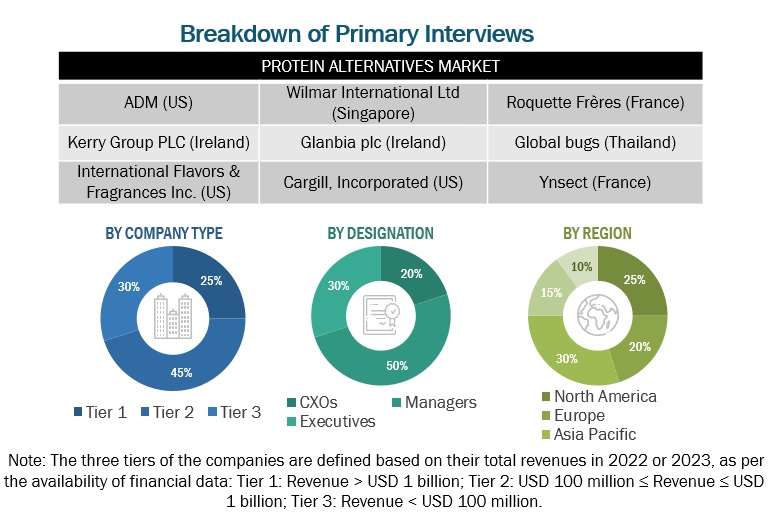
Extensive primary research was conducted after obtaining information regarding the protein alternatives market scenario through secondary research. Several primary interviews were conducted with market experts from both the demand and supply sides across major countries of North America, Europe, Asia Pacific, South America, and the Rest of the World. Primary data was collected through questionnaires, emails, and telephonic interviews. The primary sources from the supply side included various industry experts, such as Chief X Officers (CXOs), Vice Presidents (VPs), Directors from business development, marketing, research, and development teams, and related key executives from distributors and key opinion leaders. Primary interviews were conducted to gather insights such as market statistics, data on revenue collected from the products and services, market breakdowns, market size estimations, market forecasting, and data triangulation. Primary research also helped in understanding the various trends related to protein alternatives sources, application, form, nature, production process (qualitative) and region. Stakeholders from the demand side, such as processed food and functional food products manufacturers, were interviewed to understand the buyer’s perspective on the suppliers, products, and their current usage of protein alternatives and the outlook of their business, which will affect the overall market.
To know about the assumptions considered for the study, download the pdf brochure
|
COMPANY NAME |
designation |
|
ADM (US) |
General Manager |
|
Cargill Incorporated (US) |
Sales Manager |
|
International Flavors & Fragrances Inc. (US) |
Manager |
|
Ingredion (US) |
Head of processing department |
|
Roquette Frères (France) |
Marketing Manager |
|
Wilmar International Ltd. (Singapore) |
Sales Executive |
Protein Alternatives Market Size Estimation
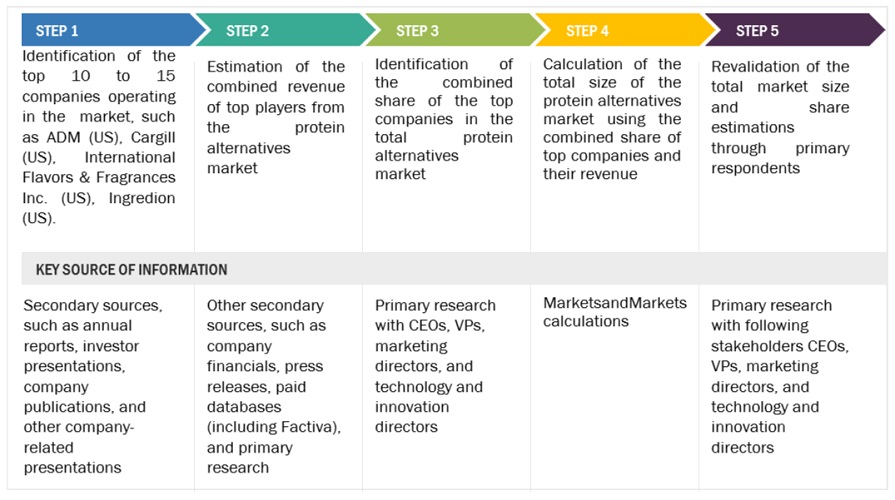
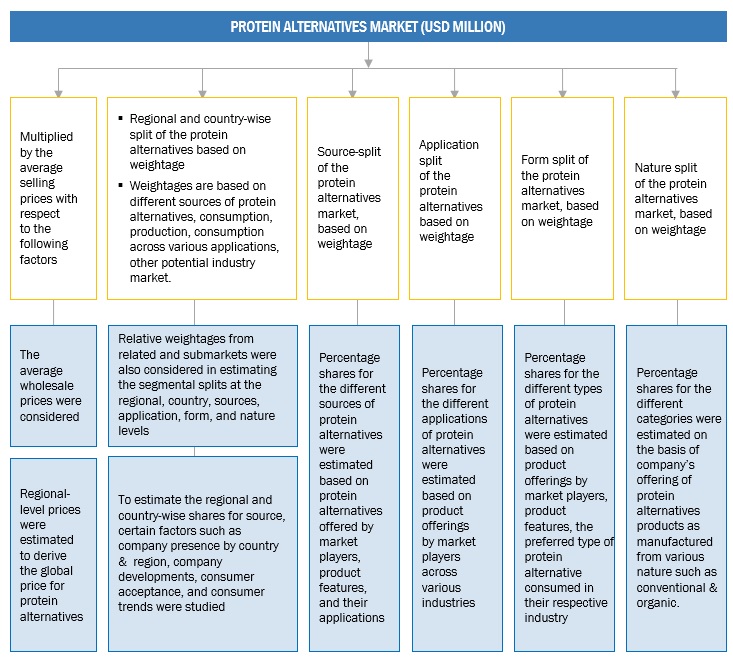
Both the top-down and bottom-up approaches were used to estimate and validate the total size of the protein alternatives market. These approaches were also used extensively to determine the size of various subsegments in the market. The research methodology used to estimate the market size includes the following details:
- The key players in the industry and the overall markets were identified through extensive secondary research.
- All shares, splits, and breakdowns were determined using secondary sources and verified through primary sources.
- All possible parameters that affect the market covered in this research study were accounted for, viewed in extensive detail, verified through primary research, and analyzed to obtain final quantitative and qualitative data.
- The research included the study of reports, reviews, and newsletters of top market players, along with extensive interviews for opinions from leaders, such as CEOs, directors, and marketing executives.
Global Protein Alternatives Market: Supply-side analysis.
To know about the assumptions considered for the study, Request for Free Sample Report
Global Protein Alternatives Market: Top-Down Approach.
Data Triangulation
After arriving at the overall market size from the estimation process explained above, the total market was split into several segments and subsegments. The data triangulation and market breakdown procedures were employed, wherever applicable, to estimate the overall protein alternatives market and arrive at the exact statistics for all segments and subsegments. The data was triangulated by studying various factors and trends from the demand and supply sides. The market size was also validated using both the top-down and bottom-up approaches.
Market Definition
According to GFI, alternative proteins are proteins produced from plants or animal cells, or by way of fermentation. These innovative foods are designed to taste the same as or better than conventional animal products while costing the same or less. Compared to conventionally produced proteins, alternative proteins require fewer inputs, such as land and water, and generate far fewer negative externalities, such as greenhouse gas emissions and pollution.
Plant protein refers to the derivation of protein from plant-based sources, such as pulses, grains, and seeds. Different sources of plant-based protein include soy, wheat, pea, canola, oats, rice, and potato. Proteins are polymers of amino acids, which are used in various applications for their nutritional and functional properties. Their potential to increase the nutritional level and the resultant healthy diet makes them one of the key ingredients in both the food and feed industries.
According to the US Agency for International Development (USAID), “Soy protein concentrates (SPC), and soy protein isolates (SPI) are processed food ingredients produced from wholly defatted soy meal through a water extraction process. The resulting concentrates and isolates contain 65%-90% protein, respectively, and are used as ingredients to enrich other food products.”.
According to the European Food Information Council (EUFIC), insects have the potential to produce less greenhouse gas (GHG) emissions and use fewer resources as compared to conventional sources such as plant and animal proteins. Proteins derived from insects, either through consumption of the whole of the insects or through extraction processes, are termed insect proteins. Insect-based protein is considered a viable alternative source for protein, majorly in food and feed applications. Like animal proteins, insects are rich in proteins and essential amino acids, which are easily digestible compared to plant-based proteins.
According to National Center for Biotechnology Information (NCBI), Microbial proteins, commonly known as single-cell proteins (SCP), are derived from several species of microorganisms but are most commonly derived from microalgae, fungi, yeast, or bacteria.
Key Stakeholders
- Food & beverage manufacturers, suppliers, and processors
- Research & development institutions
- Traders & retailers
- Distributors, importers, and exporters
-
Regulatory bodies
- Organizations such as the Food and Drug Administration (FDA), United States Department of Agriculture (USDA), European Food Safety Agency (EFSA), EUROPA, and Food Safety Australia and New Zealand (FSANZ)
- Government agencies
- Intermediary suppliers
- Universities and industry bodies
- End users
- Insect protein and other protein feed ingredient manufacturers
- Insect farmers and field experts
- Feed and feed additive manufacturers
- Food processors and ingredient manufacturers
- Food safety agencies such as the Food and Drug Administration (FDA) and the European Food Information Council (EUFIC)
- Commercial research & development (R&D) institutions and financial institutions
- Importers and exporters of alternative proteins
- Traders, distributors, and suppliers
- Government organizations, research organizations, and consulting firms
Report Objectives
Market Intelligence
- To determine and project the size of the protein alternatives market with respect to the source, form, nature, application, production process (qualitative) and regions in terms of value and volume over five years, ranging from 2024 to 2029.
- To identify the attractive opportunities in the market by determining the largest and fastest-growing segments across regions
- To provide detailed information about the key factors influencing market growth (drivers, restraints, opportunities, and challenges)
- To analyze the opportunities in the market for stakeholders and provide details of the competitive landscape for market leaders.
- To analyze the micro-markets with respect to individual growth trends, prospects, and their contribution to the total market.
- To identify and profile the key players in the protein alternatives market.
- To understand the competitive landscape and identify the major growth strategies adopted by players across the key regions.
Available Customizations:
With the given market data, MarketsandMarkets offers customizations according to company-specific scientific needs.
The following customization options are available for the report:
Product Analysis
- Product Matrix, which gives a detailed comparison of the product portfolio of each company.
Geographic Analysis
With the given market data, MarketsandMarkets offers customizations according to company-specific scientific needs.
- Further breakdown of the European protein alternatives market into key countries.
- Further breakdown of the Rest of Asia Pacific protein alternatives market into key countries.
Company Information
- Detailed analyses and profiling of additional market players (up to five)
Get the Full Protein Alternatives Market Report
Full forecast, segment splits, and company analysis for all Protein Alternatives Market.
- US Protein Alternatives Market
- Canada Protein Alternatives Market
- Mexico Protein Alternatives Market
- Germany Protein Alternatives Market
- UK Protein Alternatives Market
- Italy Protein Alternatives Market
- Netherlands Protein Alternatives Market
- China Protein Alternatives Market
- Japan Protein Alternatives Market
- India Protein Alternatives Market
- Malaysia Protein Alternatives Market
- Thailand Protein Alternatives Market
- Brazil Protein Alternatives Market
- Argentina Protein Alternatives Market
- Rest Of Europe Protein Alternatives Market
- Rest Of Asia Pacific Protein Alternatives Market
- Rest Of South America Protein Alternatives Market
Need a Tailored Report?
Customize this report to your needs
Get 10% FREE Customization
Customize This Report
