
Rest Of Asia Pacific Augmented Reality Navigation Market (2024-2029)

The Rest Of Asia Pacific Augmented Reality Navigation Market was valued at $34.6 Million in 2024 and projected to reach to $179.8 Million by 2029, representing a compound annual growth rate of 39.0%. Rest Of Asia Pacific's AR Navigation Market is poised for transformative growth through 2029, driven by converging technological and demographic factors.


| Market Size in | USD 26.32 MN |
| Market Forecast in | |
| CAGR | |
| Forecast Period | |
| Units Considered | Value (USD MN) |
Rest Of Asia Pacific Augmented Reality Navigation Market Trends and Insights
- Rest Of Asia Pacific's market growth is driven by increasing smartphone penetration, rising demand for location-based services, and growing adoption of AR-enabled navigation solutions across automotive and consumer applications.
- The region's 39.0% compound annual growth rate reflects strong momentum in emerging economies where digital infrastructure investment and consumer technology adoption are accelerating. Rest Of Asia Pacific is positioned as a high-growth market within the broader Asia Pacific region, supported by expanding logistics networks, e-commerce integration, and smart city initiatives.
- Between 2024 and 2029, Rest Of Asia Pacific will see significant investment in AR navigation platforms from both regional and global technology providers.
- The market's trajectory underscores the region's strategic importance in the global semiconductor and electronics ecosystem, with localized solutions tailored to diverse geographic and regulatory environments..
Key Market Statistics
- CAGR (2024-2029) 39.0% CAGR
- Market Size, 2024 ~USD 34.6 Million
- Forecast, 2029 ~USD 179.8 Million
- Country Rest Of Asia Pacific
Rest Of Asia Pacific Augmented Reality Navigation Market Overview
Explosive Growth Trajectory :
Rest Of Asia Pacific's AR Navigation Market is expanding at 39% CAGR, significantly outpacing traditional navigation solutions. The market is projected to grow from USD 34.6 million in 2024 to USD 179.8 million by 2029, reflecting strong regional adoption momentum.
Smartphone Penetration Driver :
Rapid smartphone adoption across emerging economies in Rest Of Asia Pacific is fueling AR navigation demand. Increasing mobile internet accessibility and affordable device availability are enabling mass-market penetration of AR-enabled navigation applications.
Location-Based Services Surge :
Growing demand for location-based services in Rest Of Asia Pacific is accelerating AR navigation adoption. Consumers increasingly seek real-time, contextual navigation experiences for urban mobility, tourism, and logistics applications across the region.
Automotive & Consumer App Integration :
AR navigation solutions are rapidly integrating into automotive systems and consumer applications across Rest Of Asia Pacific. OEMs and app developers are prioritizing AR-enhanced navigation to differentiate offerings and improve user experience in this competitive market.
Rest Of Asia Pacific Augmented Reality Navigation Market Dynamics
- The region's young, tech-savvy population combined with expanding 4G/5G infrastructure creates ideal conditions for AR navigation adoption.
- Emerging economies are leapfrogging traditional navigation technologies, directly embracing AR solutions for enhanced user experiences. Key growth catalysts include increasing vehicle sales, urbanization, and e-commerce logistics demands requiring advanced navigation capabilities.
- Strategic investments by technology companies and local startups are accelerating innovation and market penetration.
- The competitive landscape will intensify as regional players develop localized AR navigation solutions tailored to Rest Of Asia Pacific's unique geographic and cultural requirements..
Market Ecosystem
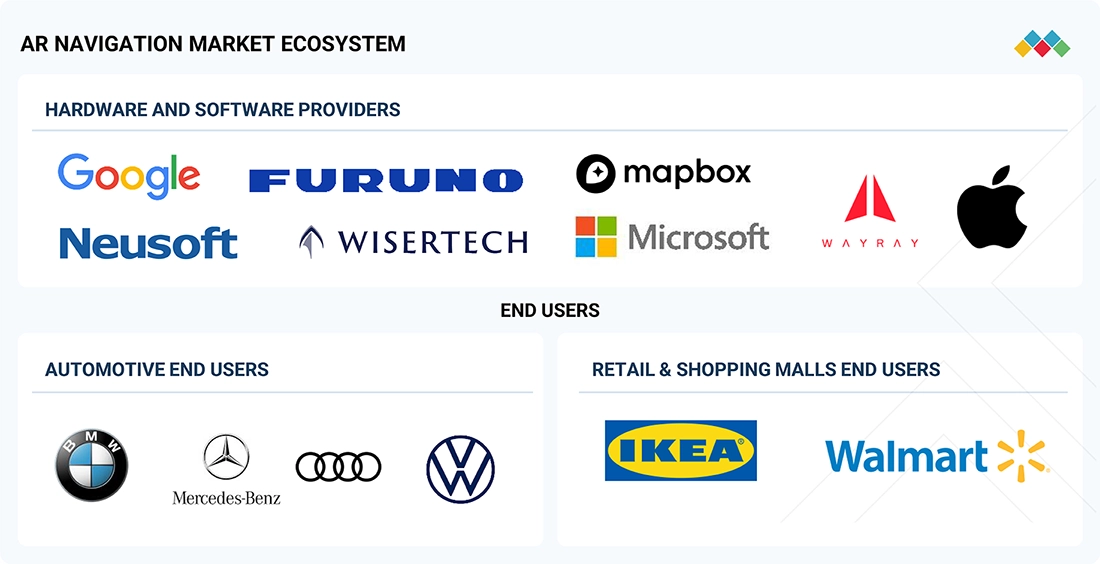
AUGMENTED REALITY NAVIGATION MARKET SIZE, SHARE & TRENDS: COMMERCIAL USE CASES ACROSS INDUSTRIES
| COMPANY | USE CASE DESCRIPTION | BENEFITS |
|---|---|---|
 |
Integrates AR navigation through Google Maps using smartphone-based AR overlays, visual positioning systems (VPS), and AI-driven environment recognition to guide users in walking, cycling, and indoor navigation. | Improved situational awareness, reduced navigation errors in urban canyons, enhanced user experience with intuitive 3D directions, and faster route decision-making. |
 |
Uses ARKit-powered AR navigation across Apple Maps with real-time spatial mapping, LiDAR-based environment understanding, and immersive turn-by-turn guidance for pedestrians and vehicle users. | Highly accurate and stable AR overlays, seamless integration with iOS devices, safer hands-free navigation, and enhanced accessibility through precise spatial guidance. |
 |
Deploys AR navigation via HoloLens and Azure Spatial Anchors to support enterprise, industrial, and campus-based indoor/outdoor navigation with persistent digital wayfinding markers. | Increased worker productivity, reduced downtime in complex facilities, improved safety in industrial environments, and scalable navigation for large enterprises. |
 |
Develops holographic AR head-up display (HUD) navigation systems for automotive OEMs using full windshield-projected AR graphics that adapt to driving conditions and real-time vehicle data. | Hands-free and distraction-free driving guidance, improved road safety, deeper driver engagement, and premium in-car experience supporting OEM differentiation. |
 |
Provides AR-powered in-vehicle navigation systems integrated with digital cockpits and ADAS platforms using on-road object recognition, lane-level guidance, and contextual alerts. | Enhanced driver safety, precise lane-level navigation, smoother driving decisions, and robust integration with vehicle infotainment ecosystems. |
Logos and trademarks shown above are the property of their respective owners. Their use here is for informational and illustrative purposes only.
Related Ecosystem
Augmented Virtual Reality
- Sensors
- Virtual Reality Devices
- Augmented Reality
- Virtual Reality
- Augmented Reality Devices
- MICROSOFT CORPORATION
- Lenovo
- VIVITEK CORPORATION
- Apple Inc.
Display Technology
- Augmented Reality
- Liquid Crystal Display (LCD)
- Sensors
- Virtual Reality Devices
- Liquid Crystal on Silicon (LCOS)
- VIVITEK CORPORATION
- Samsung
- Lenovo
- Panasonic Holdings Corporation
- Lg corp
Automotive Advance Technologies
- Battery Electric Vehicle (BEV)
- Light Commercial Vehicles (LCVs)
- Fuel Cell Electric Vehicle (FCEV)
- Hybrid Electric Vehicle (HEV)
- Internal Combustion Engine (ICE)
- BOSCH LIMITED
- Continental ag
- Visteon Corporation
- DENSO Corporation
- ZF FRIEDRICHSHAFEN AG
Key Takeaways
- Rest Of Asia Pacific's AR Navigation Market will grow from USD 34.6M (2024) to USD 179.8M (2029) at a 39.0% CAGR.
- Rest Of Asia Pacific is driven by smartphone adoption, e-commerce logistics, and smart city infrastructure development.
- Rest Of Asia Pacific represents a high-growth opportunity for AR navigation vendors targeting emerging Asian markets.
- Rest Of Asia Pacific's market expansion is supported by regional tech investment and localized solution deployment.
Augmented Reality Navigation Market Report Scope
| Report Metric | Details |
|---|---|
| Base Year | 2024 |
| Fastest Growing Segment | ROUTING & NAVIGATION (Application) |
| Forecast Period | 2024-2029 |
| Growth Rate | CAGR of 40.3% from 2024 to 2029 |
| Largest Segment | SOFTWARE (Offering) |
| Market Size Base Year (Billions) | ~USD 1.16 (2024) |
| Revenue Forecast (Billions) | ~USD 6.33 (2029) |
| Segments Covered | Offering, Type, End-Use Industry, Application, Device Type |
Rest Of Asia Pacific Augmented Reality Navigation Market Report Segmentation
5 segment dimensions are covered across the global market.
By Offering
- Devices
- Software
By Type
- Ar Cloud
- Ar Sdks
- Hmd
- Hud
- Indoor
- Mapping & Localization Software
- Navigation Apps
- Outdoor
By End-Use Industry
- Airports & Transportation
- Automotive
- Consumer
- Government
- Healthcare
- Retail & Shopping Malls
- Transportation & Airport
By Application
- Asset Tracking
- Real-Time Location Data Management
- Reverse Geocoding
- Routing & Navigation
By Device Type
- Hmd
- Hud
Target Audience
- Technology & Software Companies : AR navigation software developers and tech companies need Rest Of Asia Pacific market data to identify expansion opportunities, understand regional competition, and develop localized solutions for automotive and consumer segments in this high-growth market.
- Automotive OEMs & Suppliers : Vehicle manufacturers and automotive suppliers require detailed market intelligence on AR navigation adoption in Rest Of Asia Pacific to inform product development, integration strategies, and competitive positioning in regional automotive markets.
- Investment & Private Equity Firms : Investors and PE firms need comprehensive market analysis of Rest Of Asia Pacific's AR navigation sector to identify investment opportunities, assess portfolio company growth potential, and evaluate regional market attractiveness and risk profiles.
- Mobile App Developers & Publishers : App developers and digital publishers need Rest Of Asia Pacific market insights to understand consumer demand for AR navigation features, monetization opportunities, and regional user preferences to optimize app development and marketing strategies.
- Logistics & Enterprise Solutions Providers : Enterprise software and logistics companies require market data on AR navigation adoption in Rest Of Asia Pacific to develop location-based solutions, assess commercial opportunities, and understand enterprise customer requirements in the region.
Reasons to Buy this Report
- Regional Market Sizing & Forecasting : Obtain precise market valuation data specific to Rest Of Asia Pacific with detailed 5-year forecasts. Understand market dynamics, growth drivers, and revenue projections to inform strategic planning and investment decisions in this high-growth region.
- Competitive Landscape Intelligence : Gain insights into regional competitors, market players, and emerging startups in Rest Of Asia Pacific's AR navigation ecosystem. Identify partnership opportunities, acquisition targets, and competitive positioning strategies tailored to regional market conditions.
- Localized Consumer Insights : Access detailed analysis of Rest Of Asia Pacific consumer preferences, adoption patterns, and use cases for AR navigation. Understand regional variations in demand across automotive, consumer apps, and enterprise applications to optimize product-market fit.
- Technology & Infrastructure Assessment : Evaluate 4G/5G deployment, smartphone penetration, and digital infrastructure readiness across Rest Of Asia Pacific. Assess technological enablers and barriers to AR navigation adoption to identify market entry opportunities and expansion strategies.
- Strategic Growth Opportunities : Identify high-potential segments, geographic hotspots, and emerging use cases within Rest Of Asia Pacific. Develop data-driven go-to-market strategies, partnership frameworks, and investment priorities aligned with regional growth trajectories and market gaps.
Frequently asked questions
What is the market size of AR Navigation in Rest Of Asia Pacific in 2024?
Rest Of Asia Pacific's Augmented Reality Navigation Market is valued at USD 34.6 million in 2024.
What is the projected market size for Rest Of Asia Pacific by 2029?
Rest Of Asia Pacific's AR Navigation Market is forecast to reach USD 179.8 million by 2029.
What is the CAGR for Rest Of Asia Pacific's AR Navigation Market?
Rest Of Asia Pacific's market is expected to grow at a compound annual growth rate of 39.0% from 2024 to 2029.
What are the primary growth drivers in Rest Of Asia Pacific?
Rest Of Asia Pacific's growth is driven by increasing smartphone penetration, e-commerce expansion, logistics digitalization, and smart city initiatives across emerging economies.
How does Rest Of Asia Pacific compare to the global AR Navigation Market?
Rest Of Asia Pacific's 39.0% CAGR is competitive with the global market's 40.3% CAGR, positioning the region as a key growth contributor within Asia Pacific.
RESEARCH METHODOLOGY
The research report includes four major activities, estimating the size of the augmented reality navigation market. Secondary research has been done to gather important information about the market and peer markets. To validate the findings, assumptions, and sizing through primary research with industry experts across the supply chain is the next step. Both bottom-up and top-down approaches have been used to estimate the market size. After this, the market breakdown and data triangulation have been adopted to estimate the market sizes of segments and sub-segments
Secondary Research
For estimating the revenues of the augmented reality navigation providing companies around the world, the secondary data were collected from paid and free online sources. Sample sources for secondary research include government body publications, companies’ annual reports, financial statements and trade/professional association publications. This data contributes to establish the market size that in turn was verified during the primary research.
Secondary research approach is used to obtain key insights about the supply chain of the industry to identify key players and to prevail trends with regards to different instruments, sampling methods, applications, and geographical area. Also, the market and the technology trends were monitored during the study.
Primary Research
In the primary research phase, a variety of industry experts were interviewed to gather qualitative and quantitative insights about the market across four key regions: North America, Europe, Asia Pacific and RoW (the Middle East, Africa, and South America). These experts included CEOs, vice presidents, marketing directors, technology and innovation directors, subject-matter experts (SMEs), consultants and other key executives from leading companies and organizations in the augmented reality navigation market.
Market engineering process entailed calculations for breakdowns, market statistics, forecasting, size estimations, and data triangulation. Extensive primary research was conducted to collect, verify, and validate critical numerical data. This primary research results in identifying segmentation types, industry trends, competitive landscapes, key players, and market dynamics such as drivers, restraints, opportunities, and challenges. Additionally, it sought to understand the key strategies adopted by market players.
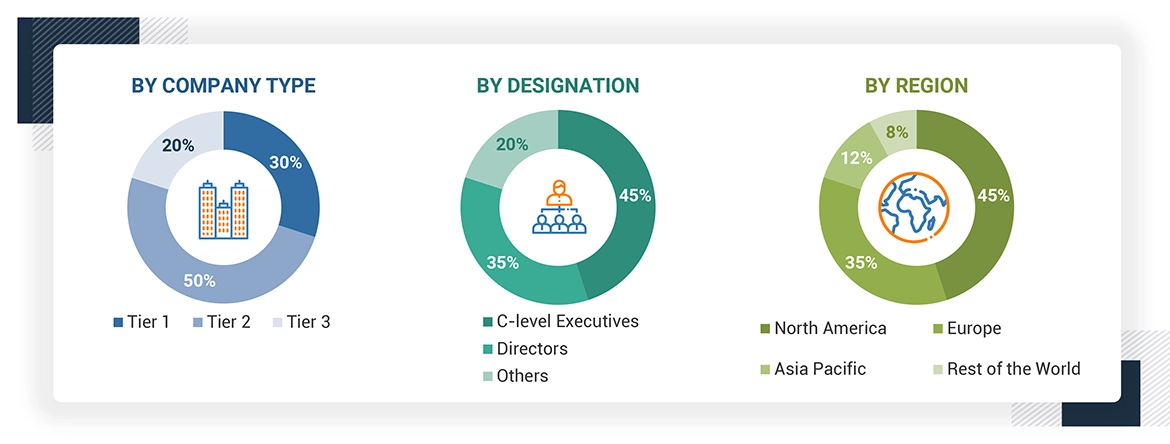
Note: Others” includes sales, marketing, and product managers
To know about the assumptions considered for the study, download the pdf brochure
Market Size Estimation
The top-down and bottom-up approaches were extensively employed in the market engineering process. Various data triangulation methods were utilized to forecast and estimate the market segments and subsegments covered in the report. Multiple qualitative and quantitative analyses were conducted during the market engineering process to extract key insights throughout the report.
Secondary research helped identify key players in the augmented reality navigation market. Their revenues were determined through a combination of primary and secondary research, analyzed both geographically and by market segment, using financial statements and annual reports. Insights were further enriched through interviews with CEOs, VPs, directors, and marketing executives.
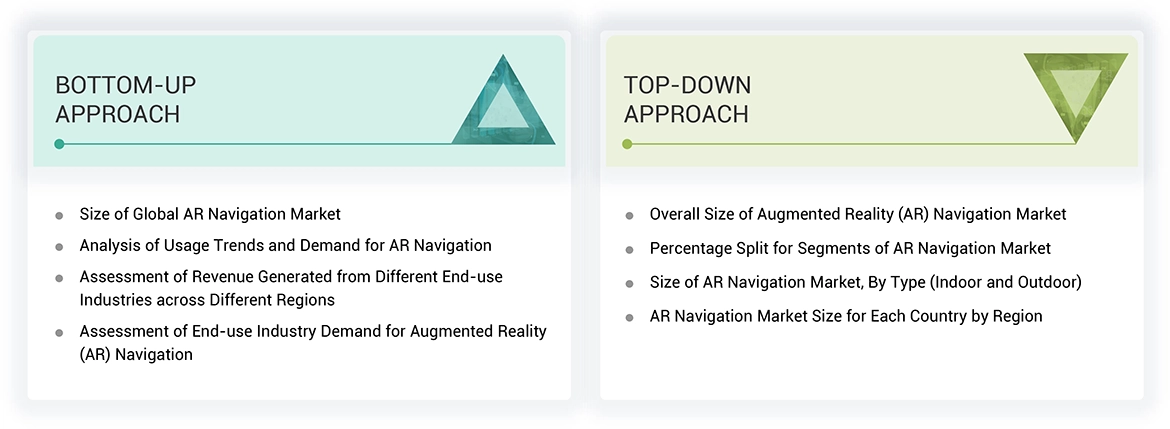
Bottom-Up Approach
The market shares were estimated using this combined research approach. The data was then consolidated and supplemented with detailed inputs and analysis from MarketsandMarkets and presented in the report.
The bottom-up approach was employed to arrive at the overall size of the augmented reality navigation market from the calculations based on the revenues of the key players and their shares in the market. Key players in augmented reality navigation market, including Google LLC (US), Apple Inc. (US), Microsoft (US), WayRay AG (Switzerland), and Neusoft Corporation (China) were studied. The market size estimations were carried out considering the market size of their augmented reality navigation offerings.
Top-Down Approach
In the top-down approach, the overall market size was utilized to forecast the size of individual markets, using percentage splits derived from both secondary and primary research. The most relevant parent market size was employed to calculate specific market segments.
The revenue shares calculated earlier in the bottom-up approach were verified by identifying and estimating the market share of each company. This study determined and confirmed the overall parent market size and individual market sizes through data triangulation and validation with primary sources.
Augmented Reality (AR) Navigation Market : Top-Down and Bottom-Up Approach
Data Triangulation
After determining the overall market size through the estimation process, the total market was divided into various segments and subsegments. To finalize the market engineering process and obtain precise statistics for all segments and subsegments, data triangulation was employed. This involved analyzing various factors and trends from both the demand and supply sides. Additionally, the market was validated using both top-down and bottom-up approaches.
Market Definition
Augmented reality navigation is an innovative solution that incorporates real-time positioning with virtual data overlay onto the physical world for an improved navigation experience. The prominent goal of augmented reality navigation technology is to enhance the user’s navigation experience by overlaying digital information such as directional arrows, points of interest and real-time data to user onscreen through a device’s camera view. Augmented reality navigation software, HUD and HMDs are the major offerings of augmented reality navigation market. Augmented reality navigation depends on sensors, cameras, and algorithms to track the movement of the user and provide real-time navigation guidance. Augmented reality navigation operates in both indoor and outdoor areas. This technology helps to navigate in complex locations such as retail stores & shopping malls, airports, healthcare, museums & cultural institutions and many others. Real-time location data management, routing & navigation, asset tracking, reverse geocoding, emergency & safety, interactive training & simulation are the key applications of augmented reality navigation.
The market for extended reality spans across multiple sectors such as games and entertainment, healthcare, education, retail, automotive, and industrial training, among others. It serves for various purposes including training and simulation, teamwork done through the internet, going on virtual tours, playing computer games, surgeries, etc. This shifts the paradigm on the way people perceive and use technology, while it is as well embraced by businesses for the purpose of enhancing productivity, developing customer relationships and optimizing processes.
Key Stakeholders
- Raw material suppliers
- Original equipment manufacturers (OEMs)
- Augmented reality device manufacturer
- Software and technology providers
- Standardization and testing firms
- Government bodies such as regulatory authorities and policymakers
- Research organizations
- Technology investors
Report Objectives
- To define, describe, and forecast the augmented reality navigation market by offering, type, application, end-users, and region in terms of value.
- To define, analyze, and forecast the augmented reality navigation market by device in terms of volume.
- To forecast the market for various segments with respect to 4 main regions—North America, Europe, Asia Pacific, and the Rest of the World (RoW), in terms of value.
- To provide detailed information regarding the drivers, restraints, opportunities, and challenges that influence the growth of the market.
- To provide a detailed overview of the augmented reality navigation value chain, along with industry trends, technology trends, use cases, regulatory landscape, and Porter’s five forces.
- To strategically analyze the micromarkets with respect to individual growth trends, prospects, and contributions to the total market.
- To analyze market ecosystem; trends/disruptions impacting customer’s business; technology analysis; pricing analysis; key stakeholders & buying criteria; case study analysis; trade analysis; patent analysis; key conferences & events, 2024–2025; regulations related to the augmented reality navigation market; and investment and funding scenario.
- To analyze the opportunities in the market for stakeholders by identifying high-growth segments and detailing the competitive landscape for market players.
- To strategically profile key players and comprehensively analyze their market rankings, core competencies, company valuation and financial metrics, and product/brand comparison, along with detailing the competitive landscape for the market leaders.
- To analyze the competitive developments such as product launches, partnerships, collaborations and acquisitions, and research and development (R&D) carried out by market players
- To map the competitive intelligence based on company profiles, key player strategies, and game-changing developments, such as product developments, collaborations, and acquisitions
- To benchmark players within the market using the proprietary competitive leadership mapping framework, which analyzes market players on various parameters within the broad categories of business strategy excellence and strength of product portfolio
Available Customizations
With the given market data, MarketsandMarkets offers customizations according to the specific requirements of companies. The following customization options are available for the report:
Country-wise Information for Asia Pacific
- Detailed analysis and profiling of additional market players (up to five)
Get the Full Augmented Reality Navigation Market Report
Full forecast, segment splits, and company analysis for all Augmented Reality Navigation Market.
- US Augmented Reality Navigation Market
- Canada Augmented Reality Navigation Market
- Mexico Augmented Reality Navigation Market
- Germany Augmented Reality Navigation Market
- UK Augmented Reality Navigation Market
- France Augmented Reality Navigation Market
- Rest Of Europe Augmented Reality Navigation Market
- China Augmented Reality Navigation Market
- Japan Augmented Reality Navigation Market
- India Augmented Reality Navigation Market
- South Korea Augmented Reality Navigation Market
- GCC Countries Augmented Reality Navigation Market
- Rest Of Middle East Augmented Reality Navigation Market
Need a Tailored Report?
Customize this report to your needs
Get 10% FREE Customization
Customize This Report
