
Thailand Artificial Intelligence in Manufacturing Market (2025-2030)

The Thailand Artificial Intelligence in Manufacturing Market was valued at $156.4 Million in 2025 and projected to reach to $700.7 Million by 2030, representing a compound annual growth rate of CAGR 35.0%. Thailand's AI in Manufacturing market is poised for exceptional growth through 2030, driven by the country's strategic importance as a regional manufacturing center and government initiatives supporting Industry 4.0 adoption.


| Market Size in | USD 26.32 MN |
| Market Forecast in | |
| CAGR | |
| Forecast Period | |
| Units Considered | Value (USD MN) |
Thailand Artificial Intelligence in Manufacturing Market Trends and Insights
- This robust growth trajectory reflects Thailand's strategic positioning as a regional manufacturing hub and increasing adoption of AI-driven automation across semiconductor and electronics production facilities.
- Thailand's market growth is driven by government initiatives promoting Industry 4.0, rising labor costs incentivizing automation, and foreign direct investment in advanced manufacturing technologies. The forecast period from 2025 to 2030 represents a critical transformation phase for Thailand's manufacturing sector.
- Thailand is witnessing accelerated deployment of machine learning algorithms, predictive maintenance systems, and computer vision technologies across production lines.
- Key drivers include Thailand's competitive advantages in electronics assembly, growing partnerships with global technology leaders, and substantial investments in AI infrastructure and skilled workforce development. Thailand's AI in Manufacturing Market demonstrates strong momentum as enterprises recognize productivity gains and cost efficiencies.
- By 2030, Thailand is expected to solidify its position as a leading AI-enabled manufacturing destination in Southeast Asia, with widespread integration of intelligent systems across quality control, supply chain optimization, and process automation..
Key Market Statistics
- CAGR (2025-2030) CAGR 35.0%
- Market Size, 2025 ~USD 156.4 Million
- Forecast, 2030 ~USD 700.7 Million
- Country Thailand
Thailand Artificial Intelligence in Manufacturing Market Overview
Market Valuation Growth :
Thailand's AI in Manufacturing market is valued at USD 156.4 million in 2025, with projections reaching USD 700.7 million by 2030, representing a 35% CAGR and demonstrating exceptional market momentum.
Regional Manufacturing Hub Status :
Thailand's established position as Southeast Asia's premier manufacturing hub is driving accelerated AI adoption across semiconductor and electronics production facilities, attracting both domestic and international investments.
Automation Adoption Surge :
Increasing implementation of AI-driven automation technologies in Thai manufacturing plants is enhancing operational efficiency, reducing production costs, and improving product quality across the semiconductor and electronics sectors.
Strategic Industry Alignment :
Thailand's semiconductor and electronics industry is actively integrating AI solutions for predictive maintenance, quality control, and supply chain optimization, positioning the country as a competitive manufacturing destination.
Thailand Artificial Intelligence in Manufacturing Market Dynamics
- The semiconductor and electronics sectors are leading this transformation, with manufacturers increasingly deploying AI technologies to enhance productivity and competitiveness.
- Investment in AI infrastructure, coupled with a skilled workforce and favorable business environment, will continue to attract multinational corporations and local enterprises seeking to modernize their operations.
- This growth trajectory positions Thailand as a critical hub for AI-enabled manufacturing innovation in Southeast Asia..
Market Ecosystem
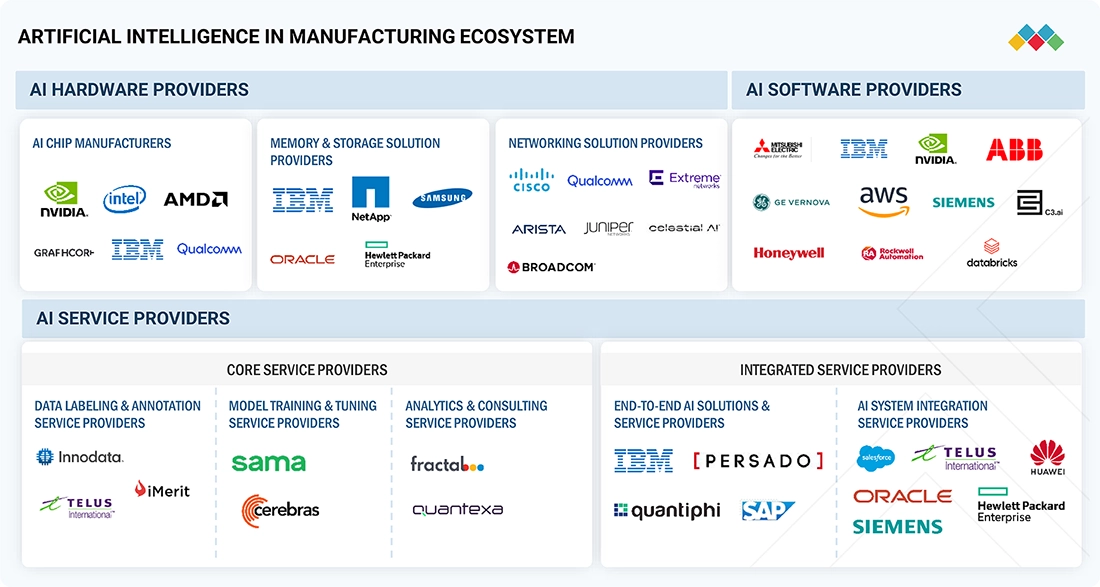
Artificial Intelligence in Manufacturing Market Share: COMMERCIAL USE CASES ACROSS INDUSTRIES
| COMPANY | USE CASE DESCRIPTION | BENEFITS |
|---|---|---|
 |
Transitioned from inefficient manual inspections to GE Vernova’s risk-based operational monitoring system for improved asset visibility | Improved monitoring efficiency | Reduced risks, prevented shutdowns | Saved USD 1M | Enabled proactive high-quality maintenance recommendations |
 |
Implemented AI-guided assistant to simplify connector selection, automate prototyping, and accelerate design using Microsoft Azure and Siemens tools | Reduced configuration time 95% | Enabled instant prototyping | Improved sales efficiency | Boosted innovation by freeing engineers for high-value tasks |
 |
Adopted Siemens NX CAM and digital tools to automate CNC operations, standardize processes, and improve collaboration across teams | Reduced scrap rate below 1% | Boosted productivity | Accelerated design cycles | Improved accuracy | Optimized skilled labor utilization |
 |
Mitsubishi Motors Corporation partnered with IBM Consulting to implement SAP S/4HANA, modernize core processes, integrate operations, and enhance real-time decision-making | Reduced inefficiencies | Automated workflows | Improved visibility | Enhanced collaboration | Boosted scalability | Strengthened long-term competitive growth potential |
 |
Shell International B.V. partnered with C3.ai to deploy predictive maintenance, using ML models on 10,000+ assets with Azure-based analytics pipelines | Generated 15M daily predictions | Reduced downtime | Improved safety | Saved millions | Optimized reliability | Supported net-zero 2050 goals |
Logos and trademarks shown above are the property of their respective owners. Their use here is for informational and illustrative purposes only.
Related Ecosystem
Industrial Iot
- Sensors
- Pressure Sensors
- Flow Sensors
- Gas Sensors
- Image Sensors
- Siemens ag
- ABB India Limited
- HONEYWELL INTERNATIONAL INC.
- Emerson Electric Co.
- SCHNEIDER ELECTRIC SE
Information System And Analytics
- Machine Learning
- Natural Language Processing (NLP)
- Sensors
- Software as A Service (SaaS)
- Data Loss Prevention (DLP)
- International Business Machines Corporation
- MICROSOFT CORPORATION
- Amazon.com, Inc.
- Oracle Corporation
Key Takeaways
- Thailand's AI in Manufacturing Market is valued at USD 156.4 million in 2025, with a projected CAGR of 35.0% through 2030.
- Thailand is expected to reach USD 700.7 million in market size by 2030, representing a 348% increase from the base year.
- Thailand's growth is fueled by Industry 4.0 adoption, automation investments, and semiconductor/electronics sector expansion.
- Thailand is positioned as a critical AI-enabled manufacturing hub in Asia Pacific, attracting regional and global technology investments.
Artificial Intelligence in Manufacturing Market Report Scope
| Report Metric | Details |
|---|---|
| Base Year | 2025 |
| Fastest Growing Segment | GENERATIVE AI (Technology) |
| Forecast Period | 2025-2030 |
| Growth Rate | CAGR of 35.3% from 2025 to 2030 |
| Largest Segment | SOFTWARE (Offering) |
| Market Size Base Year (Billions) | ~USD 34.19 (2025) |
| Revenue Forecast (Billions) | ~USD 155.04 (2030) |
| Segments Covered | Offering, Hardware Type, Software Type, Deployment Type, Ai Platform Type, Service Type, Technology, Machine Learning Type, Application, Context-Aware Computing Type, Industry |
Thailand Artificial Intelligence in Manufacturing Market Report Segmentation
11 segment dimensions are covered across the global market.
By Offering
- Hardware
- Services
- Software
By Hardware Type
- Memory Devices
- Network Devices
- Processors
By Software Type
- AI Platforms
- AI Solutions
By Deployment Type
- Cloud-Based
- On-Premises
By Ai Platform Type
- Application Programming Interface
- Machine Learning Framework
By Service Type
- Deployment & Integration
- Support & Maintenance
By Technology
- Computer Vision
- Context-Aware Computing
- Generative AI
- Machine Learning
- Natural Language Processing
By Machine Learning Type
- Deep Learning
- Reinforcement Learning
- Supervised Learning
- Unsupervised Learning
By Application
- Cybersecurity
- Field Services
- Industrial Robots
- Inventory Optimization
- Predictive Maintenance & Machinery Inspection
- Production Planning
- Quality Control
- Reclamation
By Context-Aware Computing Type
- Device Context
- User Context
By Industry
- Automotive
- Energy & Power
- Food & Beverages
- Metals & Heavy Machinery
- Other Industries
- Pharmaceuticals
- Semiconductor & Electronics
THAILAND: ARTIFICIAL INTELLIGENCE IN MANUFACTURING MARKET, BY INDUSTRY, 2025–2030
| Segment | 2025 | 2026 | 2027 | 2028 | 2029 | 2030 | CAGR (%) |
|---|---|---|---|---|---|---|---|
| AUTOMOTIVE | 43.1 | 59.4 | 78.5 | 102.3 | 131.7 | 167.8 | 31.2 |
| ENERGY & POWER | 24.6 | 36.1 | 51 | 71.1 | 98.2 | 134.2 | 40.4 |
| FOOD & BEVERAGES | 7.6 | 11 | 15.2 | 20.7 | 27.9 | 37.2 | 37.3 |
| METALS & HEAVY MACHINERY | 11.7 | 16.9 | 23.5 | 32.2 | 43.8 | 59.1 | 38.3 |
| OTHER INDUSTRIES | 20.7 | 29.6 | 40.5 | 54.3 | 71.8 | 93.4 | 35.2 |
| PHARMACEUTICALS | 13.5 | 19.7 | 27.6 | 38.2 | 52.3 | 70.8 | 39.3 |
| SEMICONDUCTOR & ELECTRONICS | 35.1 | 48.3 | 63.8 | 83.3 | 107.8 | 138.2 | 31.5 |
| TOTAL | 156.4 | 221 | 300.1 | 402.1 | 533.4 | 700.7 | 35 |
Target Audience
- Manufacturing Companies : Thai and multinational manufacturers need market insights to guide AI technology investments, automation initiatives, and competitive positioning within Thailand's rapidly evolving manufacturing landscape.
- Technology Solution Providers : AI software vendors, automation equipment manufacturers, and IT service providers require Thailand-specific market data to identify customer segments, tailor solutions, and develop localized go-to-market strategies.
- Investment & Private Equity Firms : Investors evaluating opportunities in Thailand's manufacturing sector need comprehensive market analysis to assess growth potential, identify acquisition targets, and make informed capital allocation decisions.
- Government & Policy Makers : Thai government agencies and economic development organizations require market intelligence to shape Industry 4.0 policies, allocate resources, and support the country's manufacturing competitiveness.
- Consultants & Business Strategists : Management consultants and business strategists advising clients on Thailand operations need detailed market data to develop competitive strategies, identify growth opportunities, and benchmark performance.
Reasons to Buy this Report
- Market Size & Growth Validation : Obtain precise valuation data for Thailand's AI manufacturing market with verified CAGR of 35%, enabling accurate financial forecasting and investment decision-making for the 2025-2030 period.
- Competitive Intelligence : Understand Thailand's positioning within the global AI manufacturing landscape and identify competitive advantages specific to the country's semiconductor and electronics sectors for strategic planning.
- Investment Opportunity Assessment : Evaluate market potential and growth drivers unique to Thailand to identify high-ROI investment opportunities in AI manufacturing technologies, automation solutions, and related services.
- Sector-Specific Insights : Access detailed analysis of AI adoption trends specifically within Thailand's semiconductor and electronics manufacturing industries, including technology preferences and implementation patterns.
- Regional Expansion Strategy : Develop informed market entry or expansion strategies for Thailand by understanding local market dynamics, growth catalysts, and the country's role as a Southeast Asian manufacturing hub.
Frequently asked questions
What is the current market size of AI in Manufacturing in Thailand?
Thailand's AI in Manufacturing Market is valued at USD 156.4 million in 2025, with expectations to grow significantly through the forecast period.
What is the projected market size for Thailand by 2030?
Thailand's AI in Manufacturing Market is projected to reach USD 700.7 million by 2030, representing substantial growth over the five-year forecast period.
What is the CAGR for Thailand's AI in Manufacturing Market?
Thailand's AI in Manufacturing Market is expected to grow at a CAGR of 35.0% from 2025 to 2030.
What are the primary drivers of AI adoption in Thailand's manufacturing sector?
Thailand's AI adoption is driven by government Industry 4.0 initiatives, rising labor costs, foreign direct investment, and competitive pressures in semiconductor and electronics manufacturing.
Why is Thailand significant for AI in Manufacturing?
Thailand serves as a regional manufacturing hub with established electronics and semiconductor industries, making it strategically important for AI-driven automation and Industry 4.0 transformation in Southeast Asia.
RESEARCH METHODOLOGY
The study involved four major activities in estimating the current size of the AI in manufacturing market. Exhaustive secondary research has been conducted to gather information on the market, adjacent markets, and the overall AI in manufacturing landscape. These findings, assumptions, and projections were validated through primary research involving interviews with industry experts and key stakeholders across the value chain. Both top-down and bottom-up approaches were utilized to estimate the overall market size. Subsequently, market breakdown and data triangulation techniques were applied to determine the sizes of various segments and subsegments. Two key sources, secondary and primary, were leveraged to conduct a comprehensive technical and commercial assessment of the AI in manufacturing market.
Secondary Research
Various secondary sources have been referred to in the secondary research process to identify and collect important information for this study. The secondary sources include annual reports, press releases, and investor presentations of companies; white papers; journals and certified publications; and articles from recognized authors, websites, directories, and databases. Secondary research has been conducted to obtain key information about the industry’s supply chain, the market’s value chain, the total pool of key players, market segmentation according to the industry trends (to the bottom-most level), regional markets, and key developments from market- and technology-oriented perspectives. The secondary data has been collected and analyzed to determine the overall market size, and further validated by primary research.
Primary Research
Extensive primary research was conducted after gaining knowledge about the current scenario of the AI in manufacturing market through secondary research. Several primary interviews were conducted with experts from the demand and supply sides across four major regions—North America, Europe, Asia Pacific, and RoW. This primary data was collected through questionnaires, emails, and telephonic interviews.
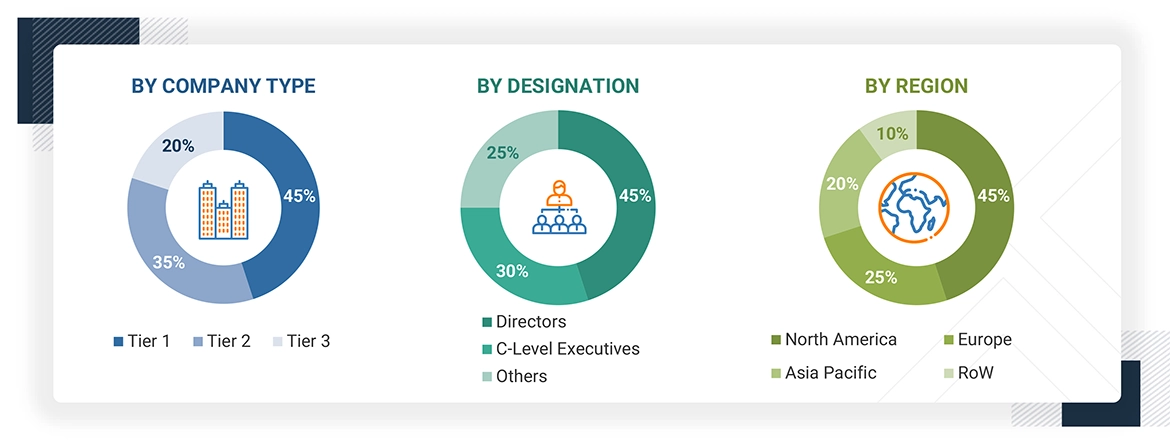
Note: Other designations include sales and product managers and project engineers. The three tiers of the companies are defined based on their total revenue in 2024: Tier 1 - revenue ≥ USD 1 billion; Tier 2 - revenue USD 100 million–USD 1 billion; and Tier 3 - revenue < USD 100 million.
To know about the assumptions considered for the study, download the pdf brochure
Market Size Estimation
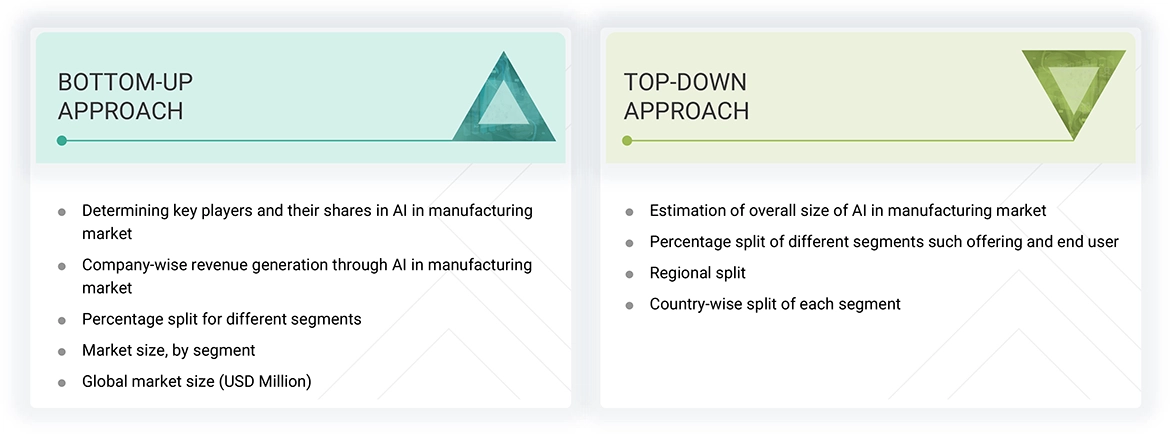
Both top-down and bottom-up approaches have been used to estimate and validate the total size of the AI in manufacturing market. These methods have also been used extensively to estimate the size of various subsegments on the market. The following research methodology has been used to estimate the market size:
- Major players in the industry and markets have been identified through extensive secondary research.
- The industry’s value chain and market size (in terms of value) have been determined through primary and secondary research processes.
- All percentage shares, splits, and breakdowns have been determined using secondary sources and verified through primary sources.
Artificial Intelligence in Manufacturing Market : Top-Down and Bottom-Up Approach
Data Triangulation
After arriving at the overall size of the AI in manufacturing market from the market size estimation process explained above, the total market has been split into several segments and subsegments. Data triangulation and market breakdown procedures have been employed, wherever applicable, to complete the overall market engineering process and arrive at the exact statistics for all segments and subsegments of the market. The data has been triangulated by studying various factors and trends from both the demand and supply sides. Along with this, the market size has been validated using both top-down and bottom-up approaches.
Market Definition
Artificial Intelligence (AI) in manufacturing refers to the use of advanced technologies that simulate human intelligence to analyze data, interact with machines, and carry out key processes. It enables functions such as material handling, equipment monitoring, quality checks, and self-diagnostics, tasks that traditionally required human labor or operator-assisted robotics, to be performed faster, more accurately, and at lower cost. By minimizing manual intervention and optimizing resources, AI improves productivity, reduces downtime, and enhances operational efficiency. As a result, it serves as a strategic driver of digital transformation, strengthening competitiveness and resilience in the global manufacturing sector.
Key Stakeholders
- Semiconductor companies
- Technology providers
- Universities and research organizations
- System integrators
- AI solution providers
- AI platform providers
- Cloud service providers
- AI system providers
- AI service providers
- Energy and power companies
- Automobile companies
- Aircraft companies
- Textile companies
- Heavy metal companies
- Food & beverage companies
- Packaging companies
- Pharmaceutical companies
- Manufacturing consulting companies
- Investors and venture capitalists
- Manufacturers implementing AI technology
Report Objectives
- To define, describe, and forecast the artificial intelligence (AI) in manufacturing market, in terms of value, based on offering, technology, application, and industry
- To describe and forecast the artificial intelligence in manufacturing market, in terms of value, based on region—North America, Europe, Asia Pacific, and Rest of the World (RoW)
- To provide detailed information on drivers, restraints, opportunities, and challenges influencing market growth
- To strategically analyze micromarkets with respect to individual growth trends, prospects, and contributions to the total market
- To provide information on patent analysis, technology analysis, pricing analysis, Porter’s Five Forces analysis, key stakeholders and buying criteria, key conferences and events, regulatory bodies, government agencies, and regulations pertaining to the market under study
- To analyze the probable impact of the recession on the market in the near future
- To study the complete value chain of the artificial intelligence in manufacturing ecosystem, along with market trends and case studies
- To profile key players and comprehensively analyze their market positions in terms of ranking and core competencies, along with detailing the competitive landscape for market leaders
- To analyze the competitive developments such as joint ventures, collaborations, agreements, contracts, partnerships, mergers & acquisitions, product launches, and research & development (R&D) in the artificial intelligence in manufacturing market
Customization Options
With the market data given, MarketsandMarkets offers customizations according to the company’s specific needs. The following customization options are available for the report:
Company Information
- Detailed analysis and profiling of additional market players (up to 5)
Get the Full Artificial Intelligence in Manufacturing Market Report
Full forecast, segment splits, and company analysis for all Artificial Intelligence in Manufacturing Market.
- US Artificial Intelligence in Manufacturing Market
- Canada Artificial Intelligence in Manufacturing Market
- Mexico Artificial Intelligence in Manufacturing Market
- Germany Artificial Intelligence in Manufacturing Market
- UK Artificial Intelligence in Manufacturing Market
- France Artificial Intelligence in Manufacturing Market
- Italy Artificial Intelligence in Manufacturing Market
- Poland Artificial Intelligence in Manufacturing Market
- Spain Artificial Intelligence in Manufacturing Market
- China Artificial Intelligence in Manufacturing Market
- Japan Artificial Intelligence in Manufacturing Market
- South Korea Artificial Intelligence in Manufacturing Market
- India Artificial Intelligence in Manufacturing Market
- Australia Artificial Intelligence in Manufacturing Market
- Malaysia Artificial Intelligence in Manufacturing Market
- Indonesia Artificial Intelligence in Manufacturing Market
- Vietnam Artificial Intelligence in Manufacturing Market
- Nordic Artificial Intelligence in Manufacturing Market
- Rest Of Europe Artificial Intelligence in Manufacturing Market
- Rest Of Asia Pacific Artificial Intelligence in Manufacturing Market
- Bahrain Artificial Intelligence in Manufacturing Market
- Kuwait Artificial Intelligence in Manufacturing Market
- Oman Artificial Intelligence in Manufacturing Market
- Qatar Artificial Intelligence in Manufacturing Market
- Rest Of Middle East Artificial Intelligence in Manufacturing Market
- Saudi Arabia Artificial Intelligence in Manufacturing Market
- UAE Artificial Intelligence in Manufacturing Market
- Other African Countries Artificial Intelligence in Manufacturing Market
- South Africa Artificial Intelligence in Manufacturing Market
- Argentina Artificial Intelligence in Manufacturing Market
- Brazil Artificial Intelligence in Manufacturing Market
- Rest Of South America Artificial Intelligence in Manufacturing Market
Need a Tailored Report?
Customize this report to your needs
Get 10% FREE Customization
Customize This Report
