
Europe Artificial Intelligence (AI) Robots Market (2025-2030)

The Europe Artificial Intelligence (AI) Robots Market was valued at $1030.4 Million in 2025 and projected to reach to $5475.4 Million by 2030, representing a compound annual growth rate of 39.7%. Europe's AI Robots Market is positioned for exceptional growth through 2030, driven by the region's commitment to Industry 4.0 standards and digital manufacturing excellence.


| Market Size in | USD 26.32 MN |
| Market Forecast in | |
| CAGR | |
| Forecast Period | |
| Units Considered | Value (USD MN) |
Europe Artificial Intelligence (AI) Robots Market Trends and Insights
- This represents a compound annual growth rate (CAGR) of 39.7%, reflecting Europe's strong commitment to automation and AI-driven innovation across manufacturing, logistics, and service sectors.
- Europe is positioning itself as a global leader in intelligent robotics, driven by advanced technological infrastructure and regulatory frameworks supporting AI adoption. The European market benefits from significant investments in Industry 4.0 initiatives and digital transformation programs across member states.
- Europe's focus on sustainable and ethical AI development differentiates its market trajectory from other regions.
- By 2030, Europe is expected to capture a substantial share of the global AI robots market, with enterprises increasingly deploying collaborative robots, autonomous systems, and AI-enabled solutions to enhance operational efficiency and workforce productivity..
Key Market Statistics
- CAGR (2025-2030) 39.7% CAGR
- Market Size, 2025 ~USD 1030.4 Million
- Forecast, 2030 ~USD 5475.4 Million
- Geography Europe
Europe Artificial Intelligence (AI) Robots Market Overview
Market Valuation Growth :
Europe's AI Robots Market is valued at $1,030.4 million in 2025 and is projected to reach $5,475.4 million by 2030, representing a robust 39.7% CAGR driven by industrial automation and digital transformation initiatives across the region.
Manufacturing & Logistics Leadership :
European manufacturers are increasingly adopting AI-powered robotic solutions for precision assembly, quality control, and supply chain optimization, particularly in Germany, France, and Italy's advanced manufacturing sectors.
Regulatory & Innovation Framework :
Europe's stringent AI regulations and strong R&D investments create a competitive advantage, with countries like Germany and Sweden leading in collaborative robotics and autonomous systems development for industrial applications.
Service Sector Expansion :
Beyond manufacturing, European service industries including healthcare, logistics, and hospitality are rapidly deploying AI robots, expanding market opportunities beyond traditional industrial automation.
Europe Artificial Intelligence (AI) Robots Market Dynamics
- Key growth catalysts include increasing labor costs, skilled workforce shortages, and substantial EU funding for automation technologies.
- The market benefits from Europe's advanced technological infrastructure and strong emphasis on sustainable, human-centric robotics solutions. The forecast period will witness significant adoption across diverse sectors including automotive, pharmaceuticals, food processing, and logistics.
- European companies are increasingly investing in collaborative robots and AI-integrated systems that enhance productivity while maintaining workplace safety.
- Strategic partnerships between technology providers and industrial enterprises will accelerate market penetration, positioning Europe as a global leader in responsible AI robotics innovation..
Market Ecosystem
-robots-market-img-ecosystem.webp)
Artificial Intelligence (AI) Robots Market: COMMERCIAL USE CASES ACROSS INDUSTRIES
| COMPANY | USE CASE DESCRIPTION | BENEFITS |
|---|---|---|
 |
Jetson and RTX-class GPUs for onboard perception, sensor fusion and neural-network inference; CUDA/ROS integrations for real-time vision, SLAM and motion planning; developer SDKs for multi-agent simulation and digital twins. | High throughput for neural inference and sensor processing | Mature software stack (CUDA, Isaac SDK) shortens time-to-market | Easy scaling from edge (Jetson) to data-center (RTX) for training and fleet analytics |
 |
Edge vision accelerators (Movidius/Myriad), CPUs for control/coordination, OpenVINO for model optimization; Intel RealSense depth cameras used for obstacle detection and human interaction. | Low-power edge inference, wide CPU compatibility for control tasks, strong tools for model optimization, | heterogeneous compute |Depth sensors provide robust short-range perception |
 |
High-performance GPUs for onboard or server-side inference and simulation; ROCm ecosystem for training and inference workloads in robotics cloud/back-end. | Cost-competitive high compute for perception and simulation |Strong parallelism for batched inference, enabling complex perception stacks and simulation-based testing |
 |
Microcontrollers, motor-control analog and gate-driver ICs, power management and sensor front-ends used in motor drivers, encoders, and low-latency control loops for manipulators and mobile bases. | Deterministic, real-time control with proven motor-control IP| Highly integrated power and analog parts reduce BOM | Simplify motor-drive design, and improve energy efficiency and reliability |
 |
Power MOSFETs, gate drivers, battery-management ICs, and safety MCU solutions (incl. sensor interfaces) for drive stages, BMS and functional safety; radar and sensing ICs for environment awareness. | Robust power-efficiency and reliable safety features (ASIL-capable MCUs) |high-voltage & high-current components support mobile bases and heavy manipulators | Improves system safety, thermal performance, and longevity |
Logos and trademarks shown above are the property of their respective owners. Their use here is for informational and illustrative purposes only.
Related Ecosystem
Drones And Robotics
- Sensors
- Articulated Robots
- Cartesian Robots
- Scara Robots
- Actuators
- ABB India Limited
- KUKA AG
- MOMENTIVE PERFORMANCE MATERIALS INC.
- STAUBLI INTERNATIONAL AG
- Fanuc Corporation
Electronics System And Components
- Sensors
- Temperature Sensors
- Pressure Sensors
- Actuators
- Image Sensors
- Lenovo
- Samsung
- Texas Instruments Incorporated
- HONEYWELL INTERNATIONAL INC.
- Teledyne Technologies Incorporated
Key Takeaways
- Europe's AI Robots Market is valued at $1,030.4 million in 2025 and will grow to $5,475.4 million by 2030, representing a 39.7% CAGR.
- Europe leads in ethical AI and sustainable robotics development, differentiating its market from other global regions.
- Industry 4.0 adoption and digital transformation initiatives across Europe are primary drivers of AI robot deployment.
- Europe's advanced regulatory framework and technological infrastructure position it as a competitive hub for intelligent robotics innovation.
Artificial Intelligence (AI) Robots Market Report Scope
| Report Metric | Details |
|---|---|
| Base Year | 2025 |
| Fastest Growing Segment | SOFTWARE (Component) |
| Forecast Period | 2025–2030 |
| Growth Rate | CAGR of 40.4% from 2025 to 2030 |
| Largest Segment | SERVICE ROBOTS (Robot Type) |
| Market Size Base Year (Billions) | ~USD 6.12 (2025) |
| Revenue Forecast (Billions) | ~USD 33.39 (2030) |
| Segments Covered | Component, Type, Technology, Robot Type, Application |
Europe Artificial Intelligence (AI) Robots Market Report Segmentation
5 segment dimensions are covered across the global market.
By Component
- Hardware
- Software
By Type
- Application Software
- Asic
- Asics
- Batteries
- Batteries (Volts)
- Collaborative Robots
- Control Systems
- Cpu
- Drive Systems
- Dsp
- Encoders
- Energy Supply Systems
- Fpga
- Gear Systems/Gearboxes
- Gearboxes
- Gpu
- Image Sensors
- Imus
- Lidar Sensors
- Motor Controllers
- Motors
- Other Control Systems
- Other Sensors
- Power Supply Units
- Power Supply Units (Thousand Units)
- Pressure Sensors
- Robotic Os/Ros
- Sensors
- Tactile Sensors
- Temperature Sensors
- Traditional Robots
- Ultrasonic Sensors
By Technology
- Computer Vision
- Context Awareness
- Localization & Mapping/Slam
- Machine Learning
- Motion Planning & Control
- Natural Language Processing
By Robot Type
- Industrial Robots
- Service Robots
By Application
- Industrial
- Other Applications
- Warehouse & Logistics
EUROPE: AI ROBOTS MARKET, BY APPLICATION, 2025–2030
| Segment | 2025 | 2026 | 2027 | 2028 | 2029 | 2030 | CAGR (%) |
|---|---|---|---|---|---|---|---|
| AGRICULTURE | 62.4 | 86 | 120.3 | 170.6 | 245.5 | 356.3 | 41.7 |
| EDUCATION & ENTERTAINMENT | 91.2 | 124.8 | 173.3 | 243.9 | 348.3 | 501.3 | 40.6 |
| HEALTHCARE ASSISTANCE | 151.5 | 210.5 | 296.7 | 424 | 614.8 | 898.7 | 42.8 |
| INDUSTRIAL | 40.8 | 53.8 | 71.5 | 98 | 134.4 | 180.2 | 34.6 |
| MILITARY & DEFENSE | 38.6 | 51.6 | 70 | 96.1 | 134 | 188.3 | 37.3 |
| OTHER APPLICATIONS | 96.1 | 128.7 | 174.7 | 240.7 | 336.2 | 472.2 | 37.5 |
| PERSONAL ASSISTANCE & CAREGIVING | 207.8 | 282.8 | 390.5 | 546.6 | 776.4 | 1111.7 | 39.9 |
| PUBLIC INFRASTRUCTURE | 48.4 | 64.1 | 86.2 | 117.5 | 162.4 | 226.3 | 36.2 |
| RESEARCH & SPACE EXPLORATION | 22.4 | 30.2 | 41.1 | 56.9 | 79.7 | 112.6 | 38.1 |
| RETAIL | 56.5 | 75.7 | 102.9 | 141.9 | 198.4 | 279.8 | 37.7 |
| SECURITY & SURVEILLANCE | 83.1 | 110.4 | 148.8 | 203.3 | 281.8 | 393.7 | 36.5 |
| WAREHOUSE & LOGISTICS | 131.5 | 181.5 | 254.1 | 361.4 | 520.8 | 754.3 | 41.8 |
| TOTAL | 1030.4 | 1400.2 | 1930.1 | 2700.9 | 3832.7 | 5475.4 | 39.7 |
Target Audience
- European Robotics Manufacturers : Manufacturers need regional market intelligence to benchmark performance, identify growth opportunities, understand competitive positioning, and optimize product portfolios for European industrial customers.
- Industrial Automation Integrators : System integrators require detailed market insights to identify emerging opportunities, understand customer needs across European sectors, and develop targeted solutions for manufacturing and logistics applications.
- Technology Investors & PE Firms : Investment professionals need comprehensive Europe-specific data to evaluate market potential, identify acquisition targets, assess growth trajectories, and make informed capital allocation decisions in the AI robotics space.
- Corporate Strategy & Innovation Teams : Enterprise decision-makers need regional market analysis to guide digital transformation initiatives, automation investments, and technology partnerships aligned with European market trends and regulatory requirements.
- Market Consultants & Analysts : Consulting professionals require detailed Europe market data to support client advisory services, competitive analysis, market entry strategies, and long-term business planning in the AI robotics sector.
Key Companies in the Europe Artificial Intelligence (AI) Robots Market
| Company | HQ | Ownership | Strongest segments |
|---|---|---|---|
| QINETIQ GROUP PLC | United Kingdom | Public Company | Test and Training,Mission Support and Operations,Research and Development, |
| IROBOT CORPORATION | United States | Private Company | Roomba robot vacuums,Roomba vacuum and mop combos,Robot vacuum accessories, |
| STARHUB | Singapore | Public Company | Mobile telecommunications,Broadband access (fixed and enterprise connectivity),Television subscription and broadcasting, |
| TELEKOM MALAYSIA BERHAD | Malaysia | Public Company | Fixed broadband & converged consumer services,Enterprise & government connectivity (data, VPN, managed network),ICT, cloud, and digital solutions, |
| FUJISOFT INCORPORATED | Japan | Private Company | IT services, outsourcing, and data warehousing,Cloud integration and broadband solutions,Embedded technologies and mobile development (FSMobile), |
| BRAIN CORPORATION | United States | Private Company | Autonomy software platform (navigation, fleet management, analytics),Embedded solutions for floor-scrubbing AMRs,Embedded solutions for vacuum and specialty cleaning AMRs, |
| VOITH | Germany | Private Company | Voith Hydro (turbines, generators, automation, services),Voith Paper (papermaking lines, components, services),Voith Turbo (drives, couplings, braking systems), |
| NABTESCO CORPORATION | Japan | Public Company | Precision reduction gears and gearheads for industrial robots,Hydraulic equipment for construction machinery,Railway vehicle brake and door systems, |
| NIDEC CORPORATION | Japan | Public Company | Small-size and precision motors,Medium- and large-size motors,Fans and blowers, |
| PANASONIC CORPORATION | Japan | Public Company | Energy (cylindrical EV batteries, storage, dry and secondary batteries),HVAC & CC (air-conditioners, heat pumps, ventilation, showcases, commercial refrigeration),Smart Life / Consumer Appliances and AV (white goods, personal care, TVs, audio-visual, cameras), |
| YASKAWA ELECTRIC CORPORATION | Japan | Public Company | Motion control (servo motors, drives, controllers, encoders),Industrial robots (welding, handling, palletizing, collaborative, biomedical),AC drives and motor systems for appliances and social infrastructure, |
| ABB | Switzerland | Public Company | Electrification,Motion,Automation, |
| NVIDIA CORPORATION | United States | Public Company | Data Center AI Compute & Networking,Gaming GPUs (GeForce),Professional Visualization (RTX/Workstations), |
| INTEL CORPORATION | United States | Public Company | Client Computing Group (CCG),Data Center and AI (DCAI),Intel Foundry, |
| ADVANCED MICRO DEVICES, INC. | United States | Public Company | Data Center (EPYC, Instinct, DC GPUs, DPUs),Client (Ryzen, Ryzen AI, Athlon, PRO),Gaming (Radeon discrete, semi-custom SoCs), |
| TEXAS INSTRUMENTS INCORPORATED | United States | Public Company | Analog – Power Management,Analog – Signal Chain,Embedded Processing (MCUs, processors, connectivity, radar), |
| INFINEON TECHNOLOGIES AG | Germany | Public Company | Automotive (MCUs, power, sensors, connectivity),Green Industrial Power (IGBTs, SiC modules, industrial drives),Power & Sensor Systems (MOSFETs, GaN, sensors, USB, RF), |
| IBM | United States | Public Company | Software (Hybrid Cloud & AI platforms),Consulting (Strategy, Technology, Operations),Infrastructure (Servers, Storage, Hybrid Cloud), |
| SONY GROUP CORPORATION | Japan | Public Company | Game & Network Services,Music,Pictures, |
| BOSCH SENSORTEC GMBH | Germany | Subsidiary | Motion sensors (accelerometers, gyroscopes, IMUs),Environmental sensors (pressure, humidity, gas, air quality),Smart sensor hubs and integrated AI sensing platforms, |
QINETIQ GROUP PLC
QinetiQ Group PLC is a United Kingdom-based public company founded in 2001 with 7,378 employees.
IROBOT CORPORATION
iRobot Corporation is a United States private company founded in 1990 with 541 employees.
STARHUB
StarHub is a Singapore-based public company founded in 1998 with 1,637 employees.
TELEKOM MALAYSIA BERHAD
Telekom Malaysia Berhad is a Malaysian public company founded in 1946 with 18,000 employees.
FUJISOFT INCORPORATED
Fujisoft Incorporated is a Japanese private company founded in 1970 with 19,689 employees.
BRAIN CORPORATION
Brain Corporation is a United States private company founded in 2009.
VOITH
Voith is a German private company founded in 1867 with 23,224 employees.
NABTESCO CORPORATION
Nabtesco Corporation is a Japanese public company founded in 2003 with 8,472 employees.
NIDEC CORPORATION
Nidec Corporation is a Japanese public company founded in 1973 with 104,285 employees.
PANASONIC CORPORATION
Panasonic Corporation is a Japanese public company founded in 1918 with 183,685 employees.
YASKAWA ELECTRIC CORPORATION
Yaskawa Electric Corporation is a Japanese public company founded in 1915 with 12,483 employees.
ABB
ABB is a Swiss public company founded in 1883 with 111,900 employees.
NVIDIA CORPORATION
NVIDIA Corporation is a United States public company founded in 1993 with 42,000 employees.
INTEL CORPORATION
Intel Corporation is a United States public company founded in 1968 with 85,100 employees.
ADVANCED MICRO DEVICES, INC.
Advanced Micro Devices, Inc. is a United States public company founded in 1969 with 31,000 employees.
TEXAS INSTRUMENTS INCORPORATED
Texas Instruments Incorporated is a United States public company founded in 1930 with 33,000 employees.
INFINEON TECHNOLOGIES AG
Infineon Technologies AG is a German public company founded in 1952 with 56,500 employees.
IBM
IBM is a United States public company founded in 1911 with 264,300 employees.
SONY GROUP CORPORATION
Sony Group Corporation is a Japanese public company founded in 1946 with 94,900 employees.
BOSCH SENSORTEC GMBH
Bosch Sensortec GmbH is a German subsidiary company founded in 2005.
Countries within Europe - compare and drill down
| Country | 2025 size (native) |
|---|
Country market size visualization
Reasons to Buy this Report
- Regional Market Specificity : Gain detailed insights exclusive to Europe's AI robotics landscape, including country-level analysis, regulatory frameworks, and market dynamics specific to EU member states and key industrial hubs.
- Competitive Intelligence : Understand European market leaders, emerging players, and competitive positioning within the region's rapidly evolving AI robotics ecosystem across manufacturing, logistics, and service sectors.
- Investment & Growth Opportunities : Identify high-potential segments and geographic markets within Europe for strategic investments, partnerships, and expansion, backed by comprehensive market sizing and growth projections through 2030.
- Regulatory & Compliance Insights : Navigate Europe's complex AI regulations, data protection requirements, and industry standards that impact robotics deployment, ensuring compliant market entry and operational strategies.
- Strategic Decision Support : Leverage Europe-focused market data to inform product development, go-to-market strategies, and resource allocation decisions for maximizing ROI in this high-growth regional market.
Frequently asked questions
What is the current size of Europe's AI Robots Market?
Europe's AI Robots Market is valued at $1,030.4 million in 2025, with strong growth anticipated through the forecast period.
What is the projected market size for Europe's AI Robots Market by 2030?
Europe's AI Robots Market is projected to reach $5,475.4 million by 2030, representing significant expansion from 2025 levels.
What is the CAGR for Europe's AI Robots Market?
Europe's AI Robots Market is expected to grow at a compound annual growth rate (CAGR) of 39.7% between 2025 and 2030.
Which industries are driving AI robot adoption in Europe?
Manufacturing, logistics, healthcare, and service sectors are primary drivers of AI robot adoption across Europe, supported by Industry 4.0 initiatives.
How does Europe's AI Robots Market compare to global trends?
Europe's 39.7% CAGR is competitive with the global 40.4% CAGR, reflecting Europe's strong position in intelligent robotics innovation and deployment.
RESEARCH METHODOLOGY
The study involved major activities in estimating the current size of the AI robots market. Exhaustive secondary research was done to collect information on AI-powered robots. The next step was to validate these findings, assumptions, and sizing with industry experts across the value chain using primary research. Different approaches, including top-down and bottom-up methods, were employed to estimate the total market size. After that, the market breakup and data triangulation procedures were used to determine the size of the segments and subsegments within the AI robots market.
Secondary Research
Various secondary sources were used to identify and collect information relevant to this study. These include corporate filings such as annual reports, press releases, investor presentations, and financial statements; trade, business, and professional associations; white papers, journals, and articles from recognized authors; certified publications related to AI robots; directories; and databases.
Secondary research was conducted to gather key information about the industry's supply chain, the market's monetary chain, the total pool of key players, market segmentation based on industry trends, geographic markets, and key developments from a market-oriented perspective. Secondary data has been collected and analyzed to arrive at the overall market size, which has been further validated through primary research.
Primary Research
During the primary research process, various primary sources, including both supply and demand sides, were interviewed to gather qualitative and quantitative information for this report. Primary sources from the supply side included experts such as chief executive officers (CEOs), vice presidents, marketing directors, technology and innovation directors, SMEs, consultants, and related key executives from the major companies and organizations operating in the AI robots market.
After the complete market engineering process (which includes market statistics calculations, market breakdown, market size estimations, market forecasting, and data triangulation), extensive primary research was conducted to gather information and verify and validate the critical market numbers.
Several primary interviews were conducted with experts from both the demand and supply sides across four major regions—North America, Europe, Asia Pacific, and RoW. Approximately 35% of the primary interviews were conducted with demand-side respondents, while 65% were conducted with supply-side respondents. This primary data has been collected through questionnaires, emails, and telephonic interviews.
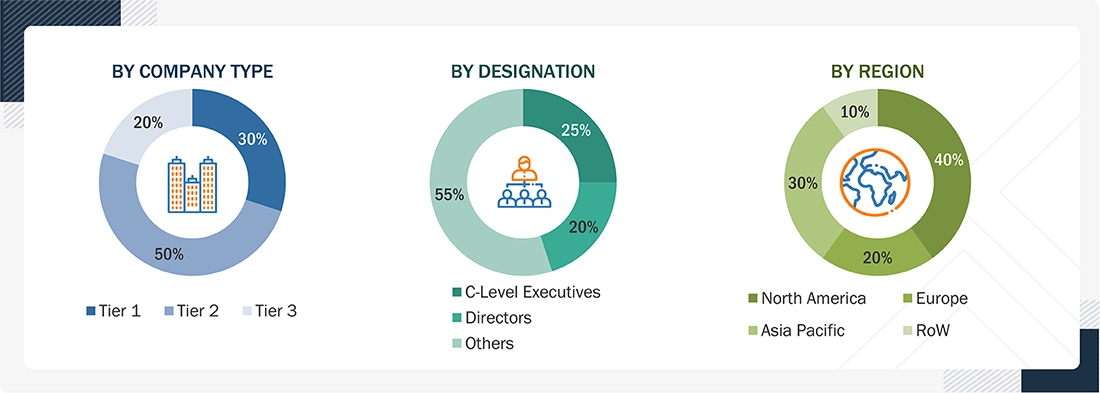
Notes: Other designations include sales & marketing executives, and researchers
Note: The three tiers of companies are based on their total revenue as of 2024: Tier 1, equal to or greater than USD 1,000 million; Tier 2, between USD 500 million and USD 1,000 million; and Tier 3, less than or equal to USD 500 million. Other designations include managers and academicians.
To know about the assumptions considered for the study, download the pdf brochure
Market Size Estimation
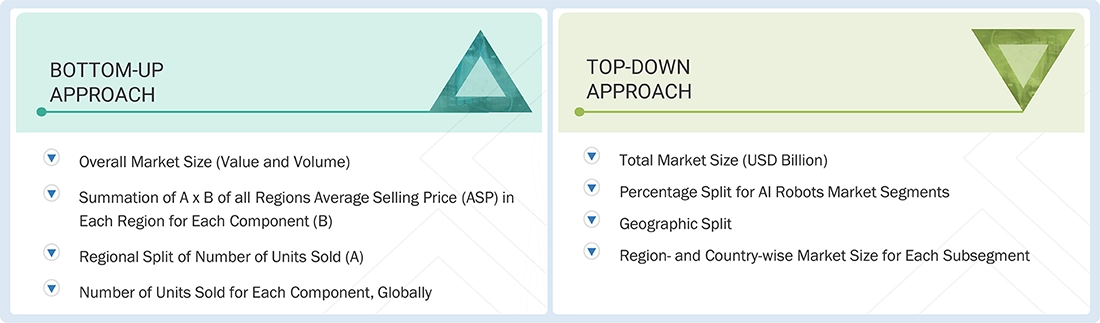
A bottom-up approach was employed to determine the overall size of the AI robots market, based on the revenues of key players and their corresponding market shares.
Approach to arrive at market size using bottom-up analysis (supply side)
- Shipments of various robot types (industrial AI robots, service AI robots) were identified through primary and secondary research.
- The number of semiconductor components integrated into each robot type was mapped across, drive systems, sensors, control systems, energy supply systems and software.
- Robot shipments were multiplied by the average number of components per robot to calculate component shipment volumes.
- Component shipment volumes were multiplied with the average selling price (ASP) of each component category to derive global number.
- The process was repeated for all robot categories, including industrial (traditional, collaborative), service (human assist, mobile, social).
- The global AI robots market size for robots was derived by summing revenues across all robot types and component segments.
- CAGR was estimated based on robotics penetration rate, industry adoption trends, and demand-supply dynamics for AI robots.
- All estimates were validated through discussions with key stakeholders (AI robot vendors, robotics OEMs, and domain experts) and cross-checked with company reports, press releases, and industry databases.
Top-down Approach
In the top-down approach, the overall market size has been used to estimate the size of the individual markets (mentioned in the market segmentation) through percentage splits obtained from secondary and primary research. The bottom-up approach has also been implemented for the data extracted from the secondary research to validate the market size of various segments.
The approximate market share of each company has been estimated to verify revenue shares used earlier in the bottom-up approach. With the help of the data triangulation procedure and the validation of data through primary interviews, the overall market size and each individual market size have been determined and confirmed in this study.
The data triangulation procedure used in this study is explained in the next section.
Approach to arrive at market size using top-down analysis (demand side)
- Focusing on the top-line investment and spending being made across various industry ecosystems.
- Building and developing the information related to revenue generated through key components used in robotic systems.
- Carrying out multiple on-field discussions with key opinion leaders (KOLs) across each major company involved in the development of AI robots.
- Estimating the application split using secondary sources, based on factors such as the robot type and the component mix (drive systems, sensors, control systems, energy supply systems).
- Estimating the regional split using secondary sources, based on various factors such as the number of players in a specific country and region, robot adoption maturity, and types of products demanded.
- Estimating the geographic split with the help of secondary sources based on various factors, such as the number of players in a specific country/region and systems used in various applications, such as personal assistance & care giving, warehousing & logistics, healthcare assistance, industrial and military & defense.
Artificial Intelligence (AI) Robots Market : Top-Down and Bottom-Up Approach
Data Triangulation
After determining the overall market size through the process explained earlier, the total market was divided into several segments. The market breakdown and data triangulation procedures were employed, wherever applicable, to complete the overall market engineering process and arrive at the exact statistics for all the segments and subsegments. The data was triangulated by studying various factors and trends from both the demand and supply sides. The market has also been validated using both top-down and bottom-up approaches.
Market Definition
Artificially intelligent robots refer to service and industrial robots that are integrated with AI technology. These robots can learn a few repetitive tasks without any human intervention and can even communicate with humans or, in some cases, with other peer robots. Hardware such as AI processors and network devices, along with AI platforms, are the key differentiating components of an AI robot from a traditional robot. Hence, this AI robots market report comprises a study of the differentiating components, along with various types of robots.
Key Stakeholders
- AI robot providers
- AI robot manufacturers
- End users for AI robots
- Research organizations and consulting companies
- Associations, organizations, forums, and alliances related to AI robots
- Government bodies such as regulatory authorities and policymakers
- Venture capitalists, private equity firms, and startup companies
Report Objectives
- To define, describe, segment, and forecast the AI robots market size, by component, robot type, technology, and application, in terms of value
- To estimate the global AI robots market, by component, in terms of volume
- To forecast the market size of four key regions, namely, North America, Europe, Asia Pacific, and the RoW, in terms of value
- To present detailed information regarding market dynamics such as drivers, restraints, opportunities, and challenges influencing the growth of the market
- To provide an ecosystem analysis, case study analysis, patent analysis, technology analysis, ASP analysis, Porter's five forces analysis, and regulations pertaining to the market
- To offer a comprehensive overview of the value chain of the AI robots market ecosystem
- To critically assess micromarkets1 with respect to individual growth trends, prospects, and contributions to the total market
- To strategically profile the key players and comprehensively analyze their market shares and core competencies2
- To assess the opportunities in the market for stakeholders and describe the competitive landscape of the market
- To analyze competitive developments in the market, such as collaborations, partnerships, product developments, and R&D
- To evaluate the macroeconomic outlook for each region and the US tariff impact on the AI robots market
Note: Micromarkets are defined as the further segments and subsegments of the AI robots market included in the report.
Available Customizations:
With the market data given, MarketsandMarkets offers customizations according to the company's specific needs. The following customization options are available for the report:
Company Information
- Detailed analysis and profiling of additional market players (up to 7)
Get the Full Artificial Intelligence (AI) Robots Market Report
Full forecast, segment splits, and company analysis for all Artificial Intelligence (AI) Robots Market.
Need a Tailored Report?
Customize this report to your needs
Get 10% FREE Customization
Customize This Report
