
North America Artificial Intelligence (AI) Robots Market (2025-2030)

The North America Artificial Intelligence (AI) Robots Market was valued at $1982.5 Million in 2025 and projected to reach to $10731.5 Million by 2030, representing a compound annual growth rate of 40.2%. North America's AI Robots Market is positioned for sustained hypergrowth through 2030, driven by technological maturity, regulatory frameworks favoring automation, and enterprise digital transformation initiatives.


| Market Size in | USD 26.32 MN |
| Market Forecast in | |
| CAGR | |
| Forecast Period | |
| Units Considered | Value (USD MN) |
North America Artificial Intelligence (AI) Robots Market Trends and Insights
- This robust growth trajectory reflects North America's leadership in AI innovation, advanced manufacturing capabilities, and substantial investment in robotics automation across industrial and service sectors.
- North America's market dominance is driven by early adoption of AI-powered robotic solutions in manufacturing, logistics, healthcare, and enterprise automation. The region's strong technological infrastructure and presence of major AI and robotics companies position North America as a critical growth engine for the global market.
- Between 2025 and 2030, North America is expected to maintain its competitive advantage through continuous R&D investments and integration of machine learning capabilities into robotic systems.
- North America's regulatory environment and venture capital ecosystem further accelerate the commercialization of next-generation AI robots, supporting the forecasted 40.2% compound annual growth rate..
Key Market Statistics
- CAGR (2025-2030) 40.2% CAGR
- Market Size, 2025 ~USD 1982.5 Million
- Forecast, 2030 ~USD 10731.5 Million
- Geography North America
North America Artificial Intelligence (AI) Robots Market Overview
Market Valuation Growth :
North America's AI Robots Market is valued at $1,982.5 million in 2025, with projections reaching $10,731.5 million by 2030, representing a 40.2% CAGR and demonstrating exceptional market momentum in the region.
Regional Innovation Leadership :
North America leads global AI robotics innovation with advanced R&D capabilities, major tech hubs in Silicon Valley, Boston, and Toronto, and significant venture capital investment driving breakthrough autonomous and collaborative robot technologies.
Industrial Automation Adoption :
Manufacturing sectors across the US and Canada are rapidly deploying AI robots for precision tasks, supply chain optimization, and labor augmentation, with automotive, electronics, and pharmaceuticals leading adoption rates.
Service Sector Expansion :
Beyond manufacturing, North American enterprises are increasingly deploying AI robots in healthcare, logistics, retail, and hospitality sectors, creating diverse revenue streams and accelerating market diversification.
North America Artificial Intelligence (AI) Robots Market Dynamics
- The region's competitive advantage stems from established semiconductor ecosystems, AI talent concentration, and early-mover advantages in robotics deployment across Fortune 500 companies. Key growth catalysts include increasing labor costs, supply chain resilience demands, and integration of advanced AI capabilities like machine learning and computer vision into robotic systems.
- Investment in autonomous systems, collaborative robots, and AI-powered logistics solutions will continue accelerating market expansion, with North America maintaining its position as the global innovation epicenter for intelligent robotics technologies..
Market Ecosystem
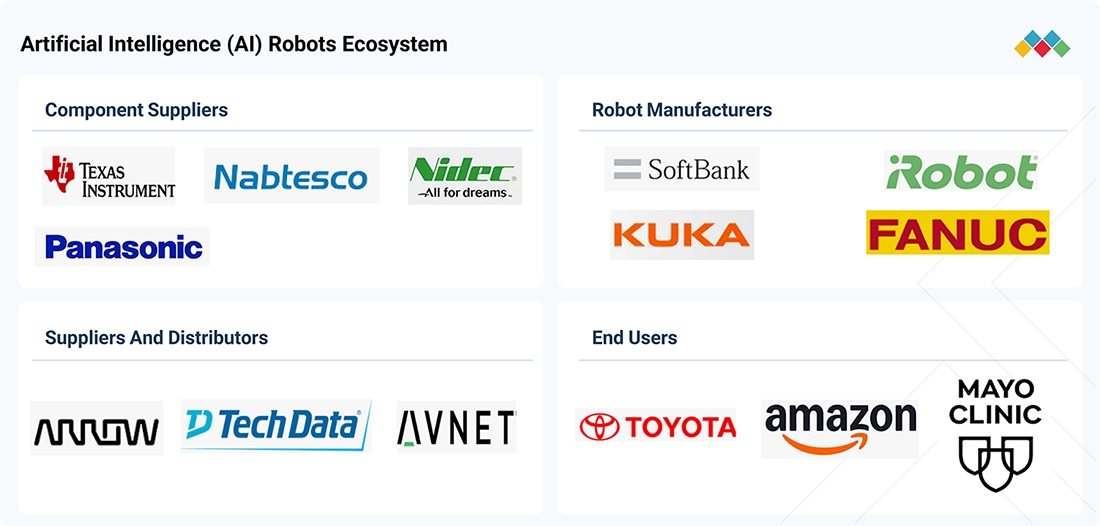
ARTIFICIAL INTELLIGENCE (AI) ROBOTS MARKET SIZE, SHARE & TRENDS: COMMERCIAL USE CASES ACROSS INDUSTRIES
| COMPANY | USE CASE DESCRIPTION | BENEFITS |
|---|---|---|
 |
Jetson and RTX-class GPUs for onboard perception, sensor fusion and neural-network inference; CUDA/ROS integrations for real-time vision, SLAM and motion planning; developer SDKs for multi-agent simulation and digital twins | High throughput for neural inference and sensor processing | Mature software stack (CUDA, Isaac SDK) shortens time-to-market | Easy scaling from edge (Jetson) to data-center (RTX) for training and fleet analytics |
 |
Edge vision accelerators (Movidius/Myriad), CPUs for control/coordination, OpenVINO for model optimization; Intel RealSense depth cameras used for obstacle detection and human interaction | Low-power edge inference, wide CPU compatibility for control tasks, strong tools for model optimization | Heterogeneous compute | Depth sensors provide robust short-range perception |
 |
High-performance GPUs for onboard or server-side inference and simulation; ROCm ecosystem for training and inference workloads in robotics cloud/back-end | Cost-competitive high compute for perception and simulation | Strong parallelism for batched inference, enabling complex perception stacks and simulation-based testing |
 |
Microcontrollers, motor-control analog and gate-driver ICs, power management and sensor front-ends used in motor drivers, encoders, and low-latency control loops for manipulators and mobile bases | Deterministic, real-time control with proven motor-control IP | Highly integrated power and analog parts reduce BOM | Simplify motor-drive design, and improve energy efficiency and reliability |
 |
Power MOSFETs, gate drivers, battery-management ICs, and safety MCU solutions (incl. sensor interfaces) for drive stages, BMS and functional safety; radar and sensing ICs for environment awareness | Robust power-efficiency and reliable safety features (ASIL-capable MCUs) | High-voltage & high-current components support mobile bases and heavy manipulators | Improves system safety, thermal performance, and longevity |
Logos and trademarks shown above are the property of their respective owners. Their use here is for informational and illustrative purposes only.
Related Ecosystem
Drones And Robotics
- Sensors
- Articulated Robots
- Cartesian Robots
- Scara Robots
- Actuators
- ABB India Limited
- KUKA AG
- MOMENTIVE PERFORMANCE MATERIALS INC.
- STAUBLI INTERNATIONAL AG
- Fanuc Corporation
Electronics System And Components
- Sensors
- Temperature Sensors
- Pressure Sensors
- Actuators
- Image Sensors
- Lenovo
- Samsung
- Texas Instruments Incorporated
- HONEYWELL INTERNATIONAL INC.
- Teledyne Technologies Incorporated
Key Takeaways
- North America's AI Robots Market is valued at $1,982.5 million in 2025 and will expand to $10,731.5 million by 2030, representing a 40.2% CAGR.
- North America leads global AI robotics adoption due to advanced manufacturing infrastructure, significant R&D investments, and strong venture capital support.
- Industrial automation, logistics optimization, and healthcare applications are primary growth drivers accelerating North America's market expansion through 2030.
- North America's competitive advantage stems from its concentration of technology leaders, favorable regulatory frameworks, and early-stage AI robotics commercialization.
Artificial Intelligence (AI) Robots Market Report Scope
| Report Metric | Details |
|---|---|
| Base Year | 2025 |
| Fastest Growing Segment | SOFTWARE (Component) |
| Forecast Period | 2025–2030 |
| Growth Rate | CAGR of 40.4% from 2025 to 2030 |
| Largest Segment | SERVICE ROBOTS (Robot Type) |
| Market Size Base Year (Billions) | ~USD 6.12 (2025) |
| Revenue Forecast (Billions) | ~USD 33.39 (2030) |
| Segments Covered | Component, Type, Technology, Robot Type, Application |
North America Artificial Intelligence (AI) Robots Market Report Segmentation
5 segment dimensions are covered across the global market.
By Component
- Hardware
- Software
By Type
- Application Software
- Asic
- Asics
- Batteries
- Batteries (Volts)
- Collaborative Robots
- Control Systems
- Cpu
- Drive Systems
- Dsp
- Encoders
- Energy Supply Systems
- Fpga
- Gear Systems/Gearboxes
- Gearboxes
- Gpu
- Image Sensors
- Imus
- Lidar Sensors
- Motor Controllers
- Motors
- Other Control Systems
- Other Sensors
- Power Supply Units
- Power Supply Units (Thousand Units)
- Pressure Sensors
- Robotic Os/Ros
- Sensors
- Tactile Sensors
- Temperature Sensors
- Traditional Robots
- Ultrasonic Sensors
By Technology
- Computer Vision
- Context Awareness
- Localization & Mapping/Slam
- Machine Learning
- Motion Planning & Control
- Natural Language Processing
By Robot Type
- Industrial Robots
- Service Robots
By Application
- Industrial
- Other Applications
- Warehouse & Logistics
Target Audience
- Robotics Manufacturers & OEMs : Need regional market data to optimize product development, identify growth segments, and strategically position AI-enabled robotic solutions for North American industrial and service sector customers.
- Enterprise Technology Leaders : Require market intelligence to evaluate automation investments, benchmark competitor deployments, and justify capital expenditures for AI robotics integration across North American operations.
- Venture Capital & Private Equity Firms : Seek detailed market analysis to identify promising AI robotics startups, assess investment opportunities, and understand growth trajectories within the high-potential North American market.
- Management Consultants & Strategy Firms : Need comprehensive regional insights to advise clients on digital transformation strategies, automation roadmaps, and competitive positioning in North America's rapidly evolving AI robotics landscape.
- Government & Policy Organizations : Require market data to inform technology policy, workforce development initiatives, and regulatory frameworks supporting North America's competitive advantage in AI robotics innovation and deployment.
Key Companies in the North America Artificial Intelligence (AI) Robots Market
| Company | HQ | Ownership | Strongest segments |
|---|---|---|---|
| QINETIQ GROUP PLC | United Kingdom | Public Company | Test and Training,Mission Support and Operations,Research and Development, |
| IROBOT CORPORATION | United States | Private Company | Roomba robot vacuums,Roomba vacuum and mop combos,Robot vacuum accessories, |
| STARHUB | Singapore | Public Company | Mobile telecommunications,Broadband access (fixed and enterprise connectivity),Television subscription and broadcasting, |
| TELEKOM MALAYSIA BERHAD | Malaysia | Public Company | Fixed broadband & converged consumer services,Enterprise & government connectivity (data, VPN, managed network),ICT, cloud, and digital solutions, |
| FUJISOFT INCORPORATED | Japan | Private Company | IT services, outsourcing, and data warehousing,Cloud integration and broadband solutions,Embedded technologies and mobile development (FSMobile), |
| BRAIN CORPORATION | United States | Private Company | Autonomy software platform (navigation, fleet management, analytics),Embedded solutions for floor-scrubbing AMRs,Embedded solutions for vacuum and specialty cleaning AMRs, |
| VOITH | Germany | Private Company | Voith Hydro (turbines, generators, automation, services),Voith Paper (papermaking lines, components, services),Voith Turbo (drives, couplings, braking systems), |
| NABTESCO CORPORATION | Japan | Public Company | Precision reduction gears and gearheads for industrial robots,Hydraulic equipment for construction machinery,Railway vehicle brake and door systems, |
| NIDEC CORPORATION | Japan | Public Company | Small-size and precision motors,Medium- and large-size motors,Fans and blowers, |
| PANASONIC CORPORATION | Japan | Public Company | Energy (cylindrical EV batteries, storage, dry and secondary batteries),HVAC & CC (air-conditioners, heat pumps, ventilation, showcases, commercial refrigeration),Smart Life / Consumer Appliances and AV (white goods, personal care, TVs, audio-visual, cameras), |
| YASKAWA ELECTRIC CORPORATION | Japan | Public Company | Motion control (servo motors, drives, controllers, encoders),Industrial robots (welding, handling, palletizing, collaborative, biomedical),AC drives and motor systems for appliances and social infrastructure, |
| ABB | Switzerland | Public Company | Electrification,Motion,Automation, |
| NVIDIA CORPORATION | United States | Public Company | Data Center AI Compute & Networking,Gaming GPUs (GeForce),Professional Visualization (RTX/Workstations), |
| INTEL CORPORATION | United States | Public Company | Client Computing Group (CCG),Data Center and AI (DCAI),Intel Foundry, |
| ADVANCED MICRO DEVICES, INC. | United States | Public Company | Data Center (EPYC, Instinct, DC GPUs, DPUs),Client (Ryzen, Ryzen AI, Athlon, PRO),Gaming (Radeon discrete, semi-custom SoCs), |
| TEXAS INSTRUMENTS INCORPORATED | United States | Public Company | Analog – Power Management,Analog – Signal Chain,Embedded Processing (MCUs, processors, connectivity, radar), |
| INFINEON TECHNOLOGIES AG | Germany | Public Company | Automotive (MCUs, power, sensors, connectivity),Green Industrial Power (IGBTs, SiC modules, industrial drives),Power & Sensor Systems (MOSFETs, GaN, sensors, USB, RF), |
| IBM | United States | Public Company | Software (Hybrid Cloud & AI platforms),Consulting (Strategy, Technology, Operations),Infrastructure (Servers, Storage, Hybrid Cloud), |
| SONY GROUP CORPORATION | Japan | Public Company | Game & Network Services,Music,Pictures, |
| BOSCH SENSORTEC GMBH | Germany | Subsidiary | Motion sensors (accelerometers, gyroscopes, IMUs),Environmental sensors (pressure, humidity, gas, air quality),Smart sensor hubs and integrated AI sensing platforms, |
QINETIQ GROUP PLC
QinetiQ Group PLC is a United Kingdom-based public company founded in 2001 with 7,378 employees.
IROBOT CORPORATION
iRobot Corporation is a United States private company founded in 1990 with 541 employees.
STARHUB
StarHub is a Singapore-based public company founded in 1998 with 1,637 employees.
TELEKOM MALAYSIA BERHAD
Telekom Malaysia Berhad is a Malaysian public company founded in 1946 with 18,000 employees.
FUJISOFT INCORPORATED
Fujisoft Incorporated is a Japanese private company founded in 1970 with 19,689 employees.
BRAIN CORPORATION
Brain Corporation is a United States private company founded in 2009.
VOITH
Voith is a German private company founded in 1867 with 23,224 employees.
NABTESCO CORPORATION
Nabtesco Corporation is a Japanese public company founded in 2003 with 8,472 employees.
NIDEC CORPORATION
Nidec Corporation is a Japanese public company founded in 1973 with 104,285 employees.
PANASONIC CORPORATION
Panasonic Corporation is a Japanese public company founded in 1918 with 183,685 employees.
YASKAWA ELECTRIC CORPORATION
Yaskawa Electric Corporation is a Japanese public company founded in 1915 with 12,483 employees.
ABB
ABB is a Swiss public company founded in 1883 with 111,900 employees.
NVIDIA CORPORATION
NVIDIA Corporation is a United States public company founded in 1993 with 42,000 employees.
INTEL CORPORATION
Intel Corporation is a United States public company founded in 1968 with 85,100 employees.
ADVANCED MICRO DEVICES, INC.
Advanced Micro Devices, Inc. is a United States public company founded in 1969 with 31,000 employees.
TEXAS INSTRUMENTS INCORPORATED
Texas Instruments Incorporated is a United States public company founded in 1930 with 33,000 employees.
INFINEON TECHNOLOGIES AG
Infineon Technologies AG is a German public company founded in 1952 with 56,500 employees.
IBM
IBM is a United States public company founded in 1911 with 264,300 employees.
SONY GROUP CORPORATION
Sony Group Corporation is a Japanese public company founded in 1946 with 94,900 employees.
BOSCH SENSORTEC GMBH
Bosch Sensortec GmbH is a German subsidiary company founded in 2005.
Countries within North America - compare and drill down
| Country | 2025 size (native) |
|---|
Country market size visualization
Reasons to Buy this Report
- Regional Market Sizing & Forecasts : Obtain precise valuation data specific to North America's AI Robots Market with detailed 2025-2030 projections, enabling accurate budget allocation and investment planning for regional expansion strategies.
- Competitive Landscape Intelligence : Understand North American market dynamics, key players, technology leaders, and competitive positioning to identify partnership opportunities and benchmark performance against regional competitors.
- Sector-Specific Deployment Insights : Access detailed analysis of AI robot adoption across North American industries—manufacturing, healthcare, logistics, retail—to identify high-growth verticals and tailor solutions for specific market segments.
- Investment & Growth Opportunity Analysis : Leverage comprehensive market intelligence to identify emerging opportunities, venture capital trends, and growth vectors within North America's rapidly expanding AI robotics ecosystem.
- Strategic Decision-Making Support : Make informed decisions on market entry, product development, and resource allocation with data-driven insights specific to North American regulatory environment, customer preferences, and technology adoption patterns.
Frequently asked questions
What is the current market size of AI Robots in North America?
North America's AI Robots Market is estimated at $1,982.5 million in 2025, with strong growth anticipated through the forecast period.
What is the projected market size for North America's AI Robots Market by 2030?
North America's AI Robots Market is forecasted to reach $10,731.5 million by 2030, driven by accelerating adoption across multiple sectors.
What is the CAGR for North America's AI Robots Market?
North America's AI Robots Market is expected to grow at a compound annual growth rate of 40.2% from 2025 to 2030.
Which industries are driving growth in North America's AI Robots Market?
North America's market growth is primarily driven by manufacturing, logistics, healthcare, and enterprise automation sectors implementing AI-powered robotic solutions.
Why is North America a leader in the global AI Robots Market?
North America leads due to its advanced technological infrastructure, concentration of major AI and robotics companies, substantial R&D investments, and supportive regulatory environment.
RESEARCH METHODOLOGY
The research process for this technical, market-oriented, and commercial study of the artificial intelligence (AI) robots market included systematic gathering, recording, and analysis of data about companies operating in the market. It involved the extensive use of secondary sources, directories, and databases to identify and collect relevant information. In-depth interviews were conducted with primary respondents, including experts from core and related industries and leading manufacturers, to obtain and verify critical qualitative and quantitative information, as well as assess the growth prospects of the market. Key players were identified through secondary research, and their market rankings were determined through primary and secondary research. This included studying annual reports of leading players and interviewing key industry experts, such as CEOs, directors, and marketing executives.
Secondary Research
In the secondary research process, various secondary sources were referred to for identifying and collecting information relevant to this study. These sources included annual reports, press releases, and investor presentations of companies; white papers, certified publications, and articles from recognized authors; industry reports; trade and professional associations; directories; and databases. Secondary research was mainly conducted to obtain key information about the supply chain of the industry, the total pool of key players, segmentation of the market according to industry trends and geographic markets, and key developments from market- and technology-oriented perspectives.
Primary Research
In the primary research process, primary sources from the supply and demand sides were interviewed to obtain qualitative and quantitative information for this report. Primary sources from the supply side included experts such as CEOs, vice presidents, marketing directors, technology and innovation directors, subject-matter experts, consultants, and related key executives from major companies and organizations operating in the artificial intelligence (AI) robots market.
After the complete market engineering process (market statistics calculations, market breakdown, market size estimations, market forecasting, and data triangulation), extensive primary research was conducted to gather information and verify and validate critical market numbers.
Several primary interviews were conducted with experts from the demand and supply sides across four major regions: North America, Europe, Asia Pacific, and RoW. Approximately 25% of the primary interviews were conducted with the demand side and 75% with the supply side. This primary data was collected through questionnaires, emails, and telephonic interviews.
Breakdown of Primary Interview Participants
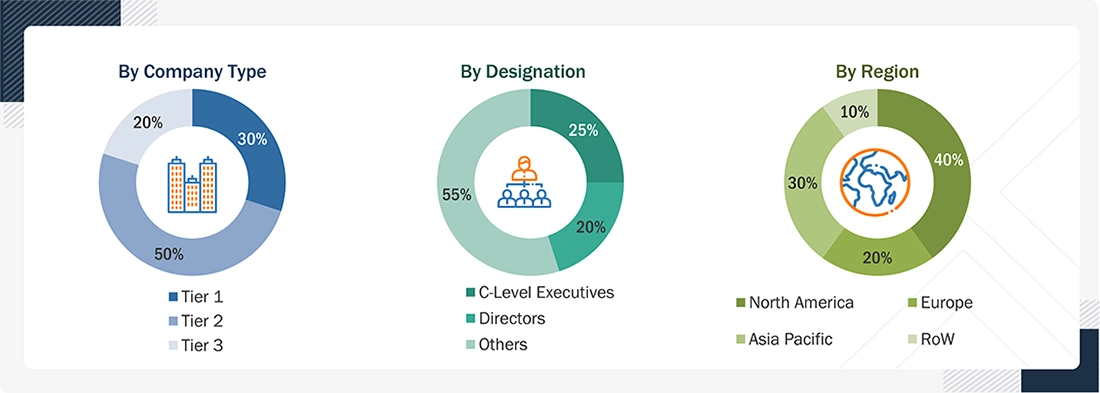
Note: Other designations include sales, marketing specialists, and product managers.
RoW mainly includes the Middle East & Africa and South America.
The 3 tiers of the companies are defined based on their total revenue as of 2025: Tier 1, equal to or greater than USD 1,000 million; Tier 2, between USD 500 million and USD 1,000 million; and Tier 3, less than or equal to USD 500 million.
To know about the assumptions considered for the study, download the pdf brochure
Market Size Estimation
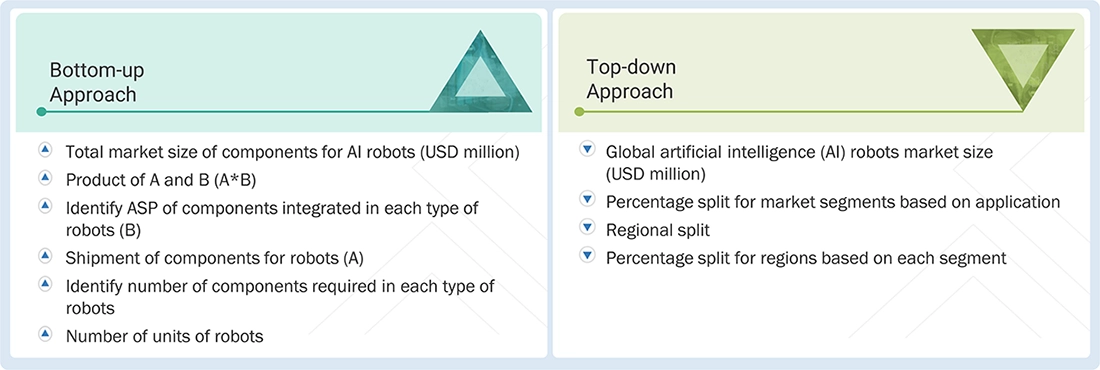
In the complete market estimation process, top-down and bottom-up approaches were used, along with several data triangulation methods, to estimate and forecast the size of the artificial intelligence (AI) robots market and its segments and subsegments listed in the report. Extensive qualitative and quantitative analyses were carried out throughout the market engineering process to identify key information and insights pertaining to the market.
Key players in the artificial intelligence (AI) robots market were identified through secondary research, and their rankings in the respective regions were determined through primary and secondary research. This process involved studying the annual reports and financial reports of leading players and conducting interviews with industry experts, such as chief executive officers, vice presidents, directors, and marketing executives, to obtain quantitative and qualitative insights. All percentage shares, splits, and breakdowns were determined using secondary sources and verified through primary sources. All parameters affecting the markets covered in this research study were accounted for, examined in detail, verified through primary research, and analyzed to obtain the final quantitative and qualitative data. This data was consolidated and enhanced with detailed inputs and analysis from MarketsandMarkets and presented in this report.
BOTTOM-UP APPROACH
- Shipments of various robot types (industrial and service AI robots) were identified through primary and secondary research.
- The number of semiconductor components integrated into each robot type was mapped across drive systems, sensors, control systems, energy supply systems, and software.
- Robot shipments were multiplied by the average number of components per robot to calculate component shipment volumes.
- Component shipment volumes were multiplied by the average selling price (ASP) of each component category to derive global revenue.
- The process was repeated for all robot categories, including industrial (traditional and collaborative) and service (human assist, mobile, and social).
- The global artificial intelligence (AI) robots market size was derived by summing revenues across all robot types and component segments.
- CAGR was estimated based on robotics penetration rate, industry adoption trends, and demand-supply dynamics for AI robots.
- All estimates were validated through discussions with key stakeholders (AI robot vendors, robotics OEMs, and domain experts) and cross-checked with company reports, press releases, and industry databases.
TOP-DOWN APPROACH
- Focusing on the top-line investment and spending being made across various industry ecosystems.
- Building and developing the information related to revenue generated through key components used in robotic systems.
- Carrying out multiple on-field discussions with key opinion leaders (KOLs) across each major company involved in the development of AI robots.
- Estimating the application split using secondary sources, based on factors such as the robot type and the component mix (drive systems, sensors, control systems, and energy supply systems).
- Estimating the regional split using secondary sources, based on various factors such as the number of players in a specific country and region, robot adoption maturity, and types of products demanded.
- Estimating the geographic split with the help of secondary sources based on various factors, such as the number of players in a specific country/region and systems used in various applications, such as personal assistance & caregiving, warehousing & logistics, healthcare assistance, industrial, and military & defense.
Artificial Intelligence (AI) Robots Market: Top-Down and Bottom-Up Approach
Data Triangulation
After arriving at the overall market size through the market size estimation process explained in the previous section, the total artificial intelligence (AI) robots market was divided into several segments and subsegments. Market breakdown and data triangulation procedures were employed, wherever applicable, to complete the overall market engineering process and determine the statistics for all segments and subsegments. The data were triangulated by studying various factors and trends from both the demand and supply sides. In addition, the market was validated using both top-down and bottom-up approaches.
Market Definition
Artificially intelligent robots refer to service and industrial robots that are integrated with AI technology. These robots can learn a few repetitive tasks without any human intervention and can even communicate with humans or, in some cases, with other peer robots. Hardware such as AI processors and network devices, along with AI platforms, are the key differentiating components of an AI robot from a traditional robot. Hence, this artificial intelligence (AI) robots market report comprises a study of the differentiating components, along with various types of robots.
Key Stakeholders
- AI robot providers
- AI robot manufacturers
- End users for AI robots
- Research organizations and consulting companies
- Associations, organizations, forums, and alliances related to AI robots
- Government bodies such as regulatory authorities and policymakers
- Venture capitalists, private equity firms, and startup companies
Report Objectives
- To describe, segment, and forecast the artificial intelligence (AI) robots market size, by component, robot type, technology, and application, in terms of value
- To estimate the global market, by component, in terms of volume
- To forecast the market size of four key regions, namely, North America, Europe, Asia Pacific, and RoW, in terms of value
- To present detailed information regarding market dynamics such as drivers, restraints, opportunities, and challenges influencing the market growth
- To provide an ecosystem analysis, case study analysis, patent analysis, technology analysis, ASP analysis, Porter’s five forces analysis, and regulations pertaining to the market
- To offer a comprehensive overview of the supply chain of the artificial intelligence (AI) robots ecosystem
- To critically assess micromarkets with respect to individual growth trends, prospects, and contributions to the total market
- To strategically profile the key players and comprehensively analyze their market shares and core competencies
- To assess the opportunities in the market for stakeholders and describe the competitive landscape of the market
- To analyze competitive developments in the market, such as collaborations, partnerships, product developments, and R&D
- To evaluate the macroeconomic outlook for each region and the US tariff impact on the market
Available customizations:
With the given market data, MarketsandMarkets offers customizations according to the company’s specific needs. The following customization options are available for the report:
Company Information
- Detailed analysis and profiling of additional market players (up to 7)
Get the Full Artificial Intelligence (AI) Robots Market Report
Full forecast, segment splits, and company analysis for all Artificial Intelligence (AI) Robots Market.
Need a Tailored Report?
Customize this report to your needs
Get 10% FREE Customization
Customize This Report
