
Japan Autoinjectors Market (2026-2031)

The Japan Autoinjectors Market was valued at $3583.55 Million in 2026 and projected to reach to $8222.16 Million by 2031, representing a compound annual growth rate of 18.1%. Japan's autoinjectors market is poised for substantial growth through 2031, driven by demographic shifts toward an older population with higher incidence of chronic diseases requiring injectable medications.


| Market Size in | USD 26.32 MN |
| Market Forecast in | |
| CAGR | |
| Forecast Period | |
| Units Considered | Value (USD MN) |
Japan Autoinjectors Market Trends and Insights
- This represents a compound annual growth rate of 18.1%, reflecting strong demand for self-administration devices across Japan's healthcare system.
- Japan's aging population and rising prevalence of chronic conditions such as allergies, autoimmune disorders, and cardiovascular diseases are driving adoption of autoinjectors among both patients and healthcare providers. The Japanese autoinjectors market benefits from advanced healthcare infrastructure, high patient awareness, and favorable reimbursement policies that support device accessibility.
- Japan's pharmaceutical and medical device manufacturers are investing in innovation to develop next-generation autoinjectors with improved usability and connectivity features.
- Between 2026 and 2031, Japan is expected to see increased market penetration in both hospital and home-care settings, supported by regulatory approvals and clinical evidence demonstrating the efficacy of autoinjector-based therapies. Key therapeutic areas driving growth in Japan include epinephrine autoinjectors for anaphylaxis management and biologics delivery systems for immunological conditions.
- Japan's competitive landscape features both established global manufacturers and emerging local players, positioning the country as a significant growth market within the Asia Pacific region..
Key Market Statistics
- CAGR (2026-2031) 18.1% CAGR
- Market Size, 2026 ~USD 3583.55 Million
- Forecast, 2031 ~USD 8222.16 Million
- Country Japan
Japan Autoinjectors Market Overview
Rapid Market Expansion :
Japan's autoinjectors market is projected to grow from $3,583.55 million in 2026 to $8,222.16 million by 2031, representing an 18.1% CAGR and demonstrating exceptional growth momentum in the Japanese healthcare sector.
Aging Population Driving Demand :
Japan's rapidly aging demographic is significantly increasing the prevalence of chronic conditions requiring autoinjector therapy, including allergies, anaphylaxis, and autoimmune disorders, creating sustained market demand.
Self-Administration Preference :
Japanese patients and healthcare providers increasingly favor autoinjectors for their convenience, ease of use, and reduced need for clinical administration, aligning with Japan's advanced healthcare infrastructure and patient autonomy trends.
Technological Innovation Hub :
Japan's strong pharmaceutical and medical device manufacturing capabilities position it as a leader in developing next-generation autoinjector technologies with enhanced safety features and user-friendly designs.
Japan Autoinjectors Market Dynamics
- The market's 18.1% CAGR reflects strong adoption of self-administration devices across both hospital and home-care settings.
- Regulatory support from Japan's Pharmaceuticals and Medical Devices Agency (PMDA) and increasing reimbursement coverage for autoinjector therapies are accelerating market penetration.
- Additionally, rising healthcare awareness and patient preference for convenient, self-managed treatment options continue to fuel expansion.
- The convergence of aging demographics, technological advancement, and supportive healthcare policies positions Japan as a high-growth market within the Asia-Pacific region..
Market Ecosystem
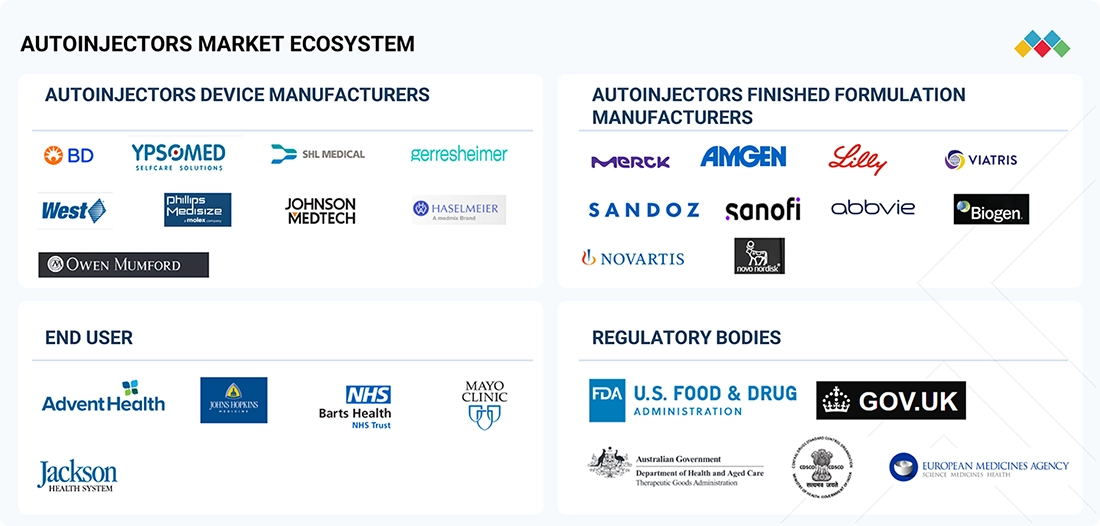
AUTOINJECTORS MARKET: COMMERCIAL USE CASES ACROSS INDUSTRIES
| COMPANY | USE CASE DESCRIPTION | BENEFITS |
|---|---|---|
 |
Provides management of chronic diseases such as obesity through pre-filled auto-injector platforms such as FlexTouch | Offers ease of use with pre-filled systems that ensure dose accuracy and patient compliance, with audible confirmation of dose delivery and a design that meets patient needs |
 |
Develops formulations such as the KwikPen prefilled injection systems, facilitating the routine administration of biologic injections for diabetes and immunology treatment | Makes dosing more convenient and precise, simplifies the process, and increases compliance through ready-to-use injection systems |
 |
Offers treatment of autoimmune disease using autoinjectors for biologics such as Humira Pen, intended for self-injection at home | Simplifies biologics delivery, decreases reliance on clinical settings, and increases patient comfort and compliance through self-injection technology |
 |
Enables use in various therapeutic areas such as rheumatoid arthritis and cardiovascular diseases through autoinjector platforms such as SureClick (e.g., Enbrel) | Enables consistent and reliable delivery of the drug, ease of use, and long-term therapy compliance in home care settings |
 |
Develops auto-injector systems for biologics such as Dupixent, enabling patients to self-administer treatments for conditions such as asthma, atopic dermatitis, and other chronic diseases at home | Improves patient adherence and ease of use through ergonomic, ready-to-use auto-injector designs with hidden needles, consistent dose delivery, and reduced need for clinical visits, supporting safe and convenient self-injection |
Logos and trademarks shown above are the property of their respective owners. Their use here is for informational and illustrative purposes only.
Related Ecosystem
Key Takeaways
- Japan's autoinjectors market is projected to grow from $3,583.55 million in 2026 to $8,222.16 million by 2031, representing an 18.1% CAGR.
- Japan's aging demographic and increasing prevalence of chronic diseases are primary drivers of autoinjector adoption across the country.
- Advanced healthcare infrastructure and favorable reimbursement policies in Japan support widespread market penetration and device accessibility.
- Epinephrine autoinjectors and biologics delivery systems represent the largest therapeutic segments driving growth in Japan's market.
Autoinjectors Market Report Scope
| Report Metric | Details |
|---|---|
| Base Year | 2026 |
| Fastest Growing Segment | OBESITY (Therapy Area) |
| Forecast Period | 2026–2031 |
| Growth Rate | CAGR of 18.7% from 2026 to 2031 |
| Largest Segment | FINISHED FORMULATION AUTOINJECTORS (Type) |
| Market Size Base Year (Billions) | ~USD 127.51 (2026) |
| Revenue Forecast (Billions) | ~USD 300.46 (2031) |
| Segments Covered | Type, Usage, Actuation Mechanism, Route Of Administration, Therapy Area, Drug Type, Volume, End User |
Japan Autoinjectors Market Report Segmentation
8 segment dimensions are covered across the global market.
By Type
- Autoinjector Devices
- Finished Formulation Autoinjectors
By Usage
- Disposable
- Reusable
By Actuation Mechanism
- Electronic
- Mechanical (Spring-Based)
By Route Of Administration
- Intramuscular
- Subcutaneous
By Therapy Area
- Anaphylaxis
- Diabetes
- Multiple Sclerosis
- Obesity
- Other Therapy Areas
- Rheumatoid Arthritis
By Drug Type
- Biologics
- Biosimilars
- Small Molecules
By Volume
- Above 3Ml
- Up To 3Ml
By End User
- Ambulatory Care Centers
- Cdmos
- Home Care Settings
- Hospitals & Clinics
- Other End Users
- Pharmaceutical & Biotechnology Companies
JAPAN: FINISHED FORMULATION AUTOINJECTORS MARKET, BY END USER, 2024–2031
| Segment | 2024 | 2025 | 2026 | 2027 | 2029 | 2030 | 2031 | CAGR (%) |
|---|---|---|---|---|---|---|---|---|
| AMBULATORY CARE CENTERS | 132.46 | 188.27 | 221.88 | 261.72 | 365.97 | 433.5 | 513.92 | 18.3 |
| HOME CARE SETTINGS | 1584.4 | 2259.23 | 2671.11 | 3160.76 | 4448.23 | 5285.88 | 6286.54 | 18.7 |
| HOSPITALS & CLINICS | 406.66 | 564.81 | 650.44 | 749.68 | 1000.97 | 1158.57 | 1342.12 | 15.6 |
| OTHER END USERS | 23.84 | 34.12 | 40.12 | 46.78 | 62.16 | 70.71 | 79.59 | 14.7 |
| TOTAL | 2147.35 | 3046.42 | 3583.55 | 4218.94 | 5877.34 | 6948.66 | 8222.16 | 18.1 |
JAPAN: AUTOINJECTOR DEVICES MARKET, BY END USER, 2024–2031
| Segment | 2024 | 2025 | 2026 | 2027 | 2029 | 2030 | 2031 | CAGR (%) |
|---|---|---|---|---|---|---|---|---|
| CDMOS | 10.75 | 12.96 | 14.6 | 16.49 | 21.11 | 23.97 | 27.23 | 13.3 |
| PHARMACEUTICAL & BIOTECHNOLOGY COMPANIES | 36.75 | 43.76 | 48.7 | 54.29 | 67.77 | 75.94 | 85.18 | 11.8 |
| TOTAL | 47.49 | 56.72 | 63.31 | 70.78 | 88.88 | 99.91 | 112.41 | 12.2 |
Target Audience
- Pharmaceutical Manufacturers : Pharmaceutical companies developing autoinjector-based therapies need Japan-specific market data to guide product development priorities, clinical trial planning, and commercial launch strategies in this rapidly expanding market.
- Medical Device Companies : Device manufacturers require detailed market insights to understand Japan's regulatory requirements, competitive dynamics, and customer preferences for designing and positioning autoinjector products effectively.
- Healthcare Investors & PE Firms : Investment professionals evaluating opportunities in Japan's healthcare sector need comprehensive market analysis to assess growth potential, identify acquisition targets, and make informed capital allocation decisions.
- Healthcare Providers & Hospital Networks : Japanese hospitals and clinics need market intelligence to understand emerging autoinjector technologies, procurement trends, and patient demand patterns to optimize inventory and service offerings.
- Market Consultants & Analysts : Research firms and business consultants require Japan-specific autoinjector market data to support client advisory services, competitive benchmarking, and strategic recommendations for healthcare stakeholders.
Key Companies in the Japan Autoinjectors Market
| Company | HQ | Ownership | Strongest segments |
|---|---|---|---|
| SANOFI | France | Public Company | Vaccines (pediatric, RSV, hexavalent, travel),Immunology & Inflammation,Rare Diseases & Neurology, |
| DIALOG SEMICONDUCTOR PLC | United Kingdom | Private Company | Custom Mixed Signal (PMICs, battery, display, automotive, motor control),Advanced Mixed Signal (configurable ICs, AC/DC, LED/SSL drivers),Connectivity & Audio (BLE, low-power Wi-Fi, audio ICs), |
| GERRESHEIMER AG | Germany | Public Company | Primary Packaging Glass (vials, cartridges, ampoules, flacons),Plastics & Devices (syringes, bottles, closures, drug delivery devices),Advanced Technologies & Medical/Diagnostic Devices, |
| HASELMEIER GMBH | Germany | Subsidiary | Disposable injection pens for chronic therapies,Autoinjectors and prefilled device platforms,Reusable pens and mechanical devices, |
| SMC LTD | United States | Public Company | AI and GPU-optimized servers (liquid and air-cooled),General-purpose rackmount and blade systems (Hyper, CloudDC, WIO, SuperBlade, BigTwin, GrandTwin, MicroBlade),Storage systems (SuperStorage) and MicroCloud, |
| SOLTEAM INCORPORATION CO., LTD. | Taiwan | Public Company | Switches, inlets/outlets, adapters, battery holders,Controller modules and EV parts,Appliance turbidity sensors and aqua devices, |
| CROSSJECT | France | Public Company | ZENEO platform – emergency neurology (Midazolam, ZEPIZURE development),ZENEO – anaphylaxis (Epinephrine),ZENEO – respiratory and migraine (Terbutaline, Sumatriptan), |
| JABIL, INC. | United States | Public Company | Regulated Industries (healthcare, medical devices, packaging, automotive safety-critical),Intelligent Infrastructure (5G, wireless, cloud, networking, storage, industrial, semi-cap),Connected Living and Digital Commerce (consumer devices, mobility, digital print, retail, smart building), |
| XERIS PHARMACEUTICALS, INC. | United States | Public Company | Gvoke (ready-to-use glucagon for severe hypoglycemia),Keveyis (primary periodic paralysis),Recorlev (Cushing’s syndrome), |
SANOFI
Sanofi is a French public pharmaceutical company founded in 1994 with 74,846 employees. The company operates as a major player in the innovative medicines sector.
DIALOG SEMICONDUCTOR PLC
Dialog Semiconductor PLC is a United Kingdom-based private company founded in 1998 with 2,300 employees specializing in semiconductor solutions.
GERRESHEIMER AG
Gerresheimer AG is a German public company established in 1864 with 13,528 employees, operating as a long-established industrial manufacturer.
HASELMEIER GMBH
Haselmeier GmbH is a German subsidiary company founded in 1920, operating as part of a larger corporate structure.
SMC LTD
SMC Ltd is a United States-based public company founded in 1993 with 6,238 employees providing industrial automation and fluid control solutions.
SOLTEAM INCORPORATION CO., LTD.
Solteam Incorporation Co., Ltd. is a Taiwanese public company established in 1992 operating in the industrial or manufacturing sector.
CROSSJECT
Crossject is a French public company founded in 2001 with 99 employees specializing in pharmaceutical delivery technologies.
JABIL, INC.
Jabil, Inc. is a United States public company founded in 1966 with 135,000 employees providing electronics manufacturing and supply chain solutions.
XERIS PHARMACEUTICALS, INC.
Xeris Pharmaceuticals, Inc. is a United States public company founded in 2005 with 435 employees focused on specialty pharmaceutical development.
Reasons to Buy this Report
- Market Size & Growth Validation : Obtain precise market valuation data for Japan ($3.58B in 2026, $8.22B in 2031) to validate investment decisions, competitive positioning, and revenue forecasting for autoinjector products and services in this high-growth market.
- Demographic Insights & Opportunity Mapping : Understand Japan's aging population dynamics and chronic disease prevalence patterns to identify target patient segments, optimize product development, and tailor marketing strategies for maximum market penetration.
- Competitive Landscape Intelligence : Gain comprehensive analysis of Japan's autoinjector competitive environment, including key players, market share distribution, and differentiation opportunities to inform strategic planning and market entry strategies.
- Regulatory & Reimbursement Framework : Access detailed insights into Japan's PMDA approval pathways, insurance coverage policies, and reimbursement mechanisms to accelerate product launches and optimize pricing strategies for the Japanese market.
- Strategic Growth Planning : Leverage Japan-specific market forecasts and trend analysis to develop data-driven business strategies, identify emerging opportunities, and allocate resources effectively for sustainable growth through 2031.
Frequently asked questions
What is the projected market size of autoinjectors in Japan by 2031?
Japan's autoinjectors market is projected to reach $8,222.16 million by 2031, growing from $3,583.55 million in 2026 at an 18.1% CAGR.
What factors are driving autoinjector market growth in Japan?
Key growth drivers in Japan include an aging population, rising prevalence of chronic diseases, advanced healthcare infrastructure, high patient awareness, and favorable reimbursement policies supporting device adoption.
Which therapeutic areas dominate Japan's autoinjectors market?
Epinephrine autoinjectors for anaphylaxis management and biologics delivery systems for immunological conditions represent the largest therapeutic segments in Japan's market.
How does Japan's autoinjectors market compare to other Asia Pacific countries?
Japan represents a significant growth market within Asia Pacific, driven by its advanced healthcare system, high disposable income, and strong regulatory framework supporting medical device innovation and adoption.
What is the competitive landscape of Japan's autoinjectors market?
Japan's autoinjectors market features both established global manufacturers and emerging local players, with companies investing in next-generation devices featuring improved usability and connectivity features.
RESEARCH METHODOLOGY
This study utilized both primary and secondary sources extensively. The research involved analyzing various factors affecting the industry to identify segmentation types, industry trends, key players, the competitive landscape, market dynamics, and strategies of major players.
Secondary Research
The secondary research process involves extensively using secondary sources, directories, databases (such as Bloomberg Businessweek, Factiva, and D&B Hoovers), white papers, annual reports, company house documents, investor presentations, and SEC filings. It was employed to gather information for the detailed, technical, market-focused, and commercial analysis of the autoinjectors market. Additionally, it helped obtain important data about key players and market classification and segmentation based on industry trends, down to the most detailed levels, along with key developments related to market and technology perspectives. A database of leading industry players was also created through secondary research.
Primary Research
In the primary research process, various sources from both the supply and demand sides were interviewed to gather qualitative and quantitative information for this report. The primary sources from the supply side include industry experts such as CEOs, vice presidents, marketing and sales directors, technology and innovation directors, and other key executives from various important companies and organizations in the autoinjectors market. The primary sources from the demand side include medical OEMs, medical device ISOs, and service providers, among others. Primary research was conducted to validate the market segmentation, identify key players in the market, and gather insights into major industry trends and key market dynamics.
A breakdown of the primary respondents for the autoinjectors market (supply side) market is provided below:
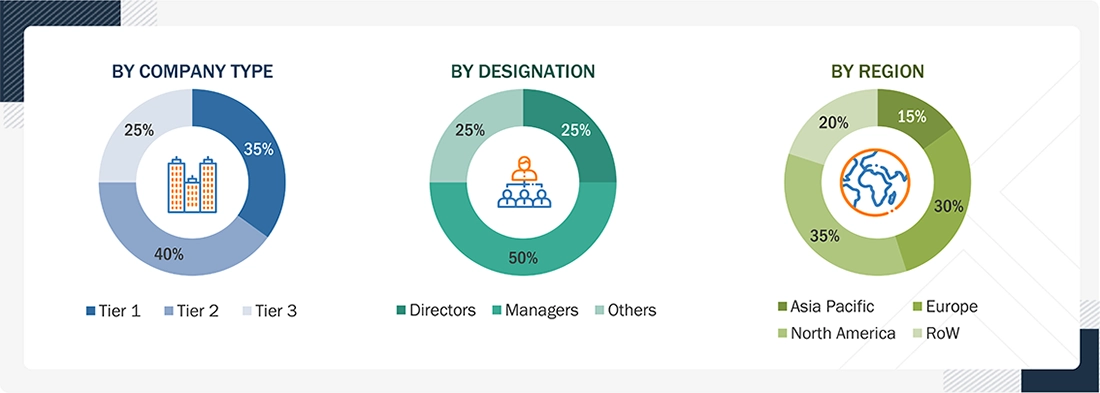
Note 1: C-level primaries include CEOs, COOs, CTOs, and VPs.
Note 2: Others include sales, marketing, and product managers.
Note 3: Companies are classified into tiers based on their total revenue. As of 2025, Tier 1 = >USD 2 billion, Tier 2 = USD 50 million to USD 2 billion, and Tier 3 = < USD 50 million.
To know about the assumptions considered for the study, download the pdf brochure
Market Size Estimation
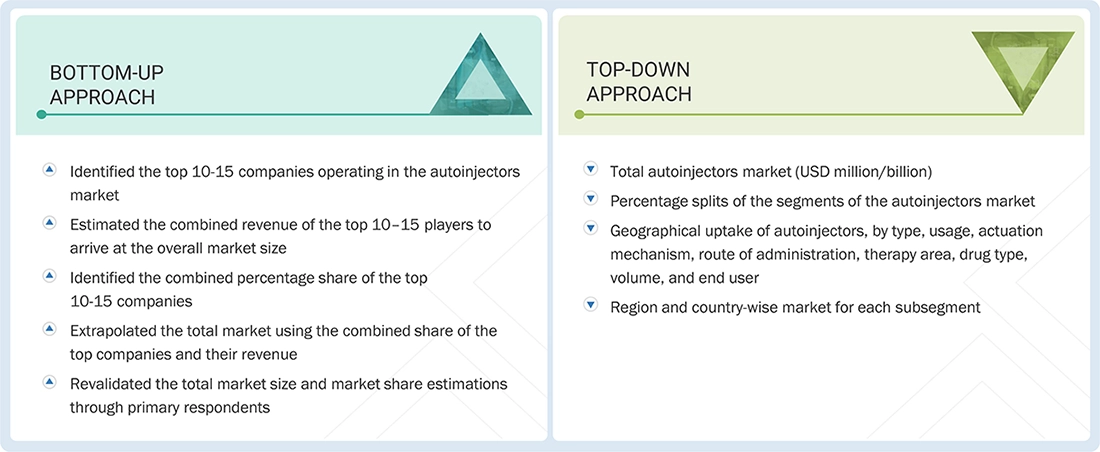
In this report, the global autoinjectors market size was determined through revenue share analysis of leading players. To do this, key market players were identified, and their revenues from autoinjectors were estimated based on insights gathered during primary and secondary research. Secondary research involved analyzing the annual and financial reports of top market players, while primary research included extensive interviews with key opinion leaders such as CEOs, directors, and key marketing executives.
To calculate the global market value, the segmental revenue was calculated based on the revenue mapping of major solution/service providers. This process involves the following steps:
- Generating a list of major global players operating in the autoinjectors market
- Mapping annual revenues generated by major global players from the autoinjectors segment (or nearest reported business unit/service category)
- Revenue mapping of key players to cover a major share of the global market as of 2024
- Extrapolating the global value of the autoinjectors industry
Data Triangulation
After determining the overall market size from the estimation process described above, the global Autoinjectors market was divided into segments and subsegments. Data triangulation and market breakdown methods were used to complete the market analysis and obtain precise statistics for all segments and subsegments. The data was triangulated by examining various factors and trends from both the demand and supply perspectives. Additionally, the autoinjectors market was validated using both, the top-down and bottom-up approaches.
Market Definition
Autoinjectors with finished formulations are prefilled, self-administered devices designed to deliver a precise dose of medication. These devices come pre-loaded with a specific drug formulation, ensuring accurate dosing and ease of use, especially in emergencies or for patients needing regular injections. The design usually includes an automatic needle insertion and drug delivery system, reducing user error and discomfort. Autoinjectors are frequently used for conditions such as allergies, migraines, and chronic diseases, improving patient compliance and making medication administration more convenient.
Stakeholders
- Companies manufacturing autoinjectors
- Original equipment manufacturing companies
- Suppliers and distributors of autoinjectors
- Healthcare service providers
- Health insurance payers
- Government bodies/municipal corporations
- Regulatory bodies
- Medical research institutes
- Business research and consulting service providers
- Venture capitalists
- Market research and consulting firms
Report Objectives
- To define, describe, and forecast the global autoinjector devices market based on type, usage, actuation mechanism, route of administration, drug type, volume, end user, and region
-
To provide detailed information regarding the major factors influencing the market growth
(such as drivers, restraints, opportunities, and challenges) along with the current trends - To strategically analyze micromarkets1 concerning individual growth trends, prospects, and contributions to the overall autoinjectors market
- To analyze the opportunities in the global autoinjectors market for stakeholders and provide details of the competitive landscape for market leaders
- To forecast the size of market segments concerning five main regions, namely, North America, Europe, the Asia Pacific, Latin America, and the Middle East & Africa
- To profile key players and analyze their market share and core competencies2
- To analyze competitive developments, such as product launches, partnerships, agreements, collaborations, expansions, strategic alliances, and acquisitions in the global autoinjector devices and autoinjector finished formulations market.
- To benchmark players within the market using the proprietary “Company Evaluation Matrix” framework, which analyzes market players on various parameters within the broad categories of business and product excellence strategy
Get the Full Autoinjectors Market Report
Full forecast, segment splits, and company analysis for all Autoinjectors Market.
- Canada Autoinjectors Market
- US Autoinjectors Market
- France Autoinjectors Market
- Germany Autoinjectors Market
- Italy Autoinjectors Market
- Netherlands Autoinjectors Market
- Spain Autoinjectors Market
- UK Autoinjectors Market
- Australia Autoinjectors Market
- China Autoinjectors Market
- India Autoinjectors Market
- South Korea Autoinjectors Market
- Thailand Autoinjectors Market
- Vietnam Autoinjectors Market
- Brazil Autoinjectors Market
- Mexico Autoinjectors Market
- Rest Of Europe Autoinjectors Market
Need a Tailored Report?
Customize this report to your needs
Get 10% FREE Customization
Customize This Report
