
China Automated Stationary NDT & Inspection Systems Market (2025-2030)

The China Automated Stationary NDT & Inspection Systems Market was valued at $88.3 Million in 2025 and projected to reach to $146.3 Million by 2030, representing a compound annual growth rate of 10.6%. China's automated stationary NDT and inspection systems market is poised for sustained expansion, driven by the country's dominance in semiconductor and electronics manufacturing.


| Market Size in | USD 26.32 MN |
| Market Forecast in | |
| CAGR | |
| Forecast Period | |
| Units Considered | Value (USD MN) |
China Automated Stationary NDT & Inspection Systems Market Trends and Insights
- China's semiconductor and electronics manufacturing sector is driving demand for advanced quality assurance technologies, as manufacturers increasingly adopt automated inspection solutions to meet stringent international standards and reduce defect rates.
- The 10.6% compound annual growth rate reflects China's strategic investments in manufacturing automation and Industry 4.0 initiatives across electronics production facilities. China's market expansion is underpinned by rising labor costs, heightened competition in global supply chains, and regulatory pressures for product quality and safety compliance.
- China's electronics manufacturers are integrating stationary NDT systems into production lines to enhance throughput and minimize human error.
- Between 2025 and 2030, China is expected to consolidate its position as a leading adopter of automated inspection technologies, supported by government incentives for smart manufacturing and technological innovation in the semiconductor sector..
Key Market Statistics
- CAGR (2025-2030) 10.6% CAGR
- Market Size, 2025 ~USD 88.3 Million
- Forecast, 2030 ~USD 146.3 Million
- Country China
China Automated Stationary NDT & Inspection Systems Market Overview
Market Valuation Growth :
China's automated stationary NDT & inspection systems market is valued at USD 88.3 million in 2025, with strong momentum driving expansion to USD 146.3 million by 2030, representing a 10.6% CAGR.
Semiconductor Manufacturing Demand :
China's semiconductor sector is rapidly adopting automated inspection solutions to enhance quality assurance and meet international compliance standards, fueling market growth across fabrication facilities.
Electronics Industry Integration :
Electronics manufacturers in China are increasingly integrating stationary NDT systems into production lines to reduce defects, improve yield rates, and maintain competitive advantage in global markets.
Outpacing Global Growth :
China's market CAGR of 10.6% exceeds the global average of 9.3%, reflecting the country's accelerated investment in automation and quality control technologies within manufacturing ecosystems.
China Automated Stationary NDT & Inspection Systems Market Dynamics
- Government initiatives promoting industrial automation and quality standards are accelerating adoption rates among domestic manufacturers seeking to enhance production efficiency and meet stringent export requirements. The market's 10.6% CAGR reflects China's strategic focus on technological advancement and supply chain resilience.
- As manufacturers invest in Industry 4.0 capabilities and advanced quality assurance infrastructure, demand for stationary NDT systems will continue to strengthen through 2030, positioning China as a critical growth engine within the global market..
Market Ecosystem
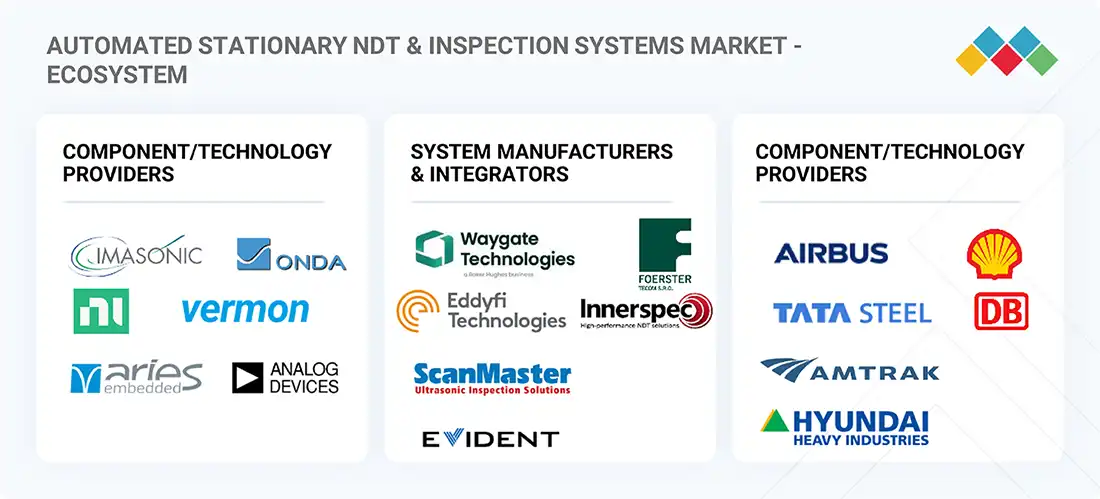
Automated Stationary NDT & Inspection Systems Market: COMMERCIAL USE CASES ACROSS INDUSTRIES
| COMPANY | USE CASE DESCRIPTION | BENEFITS |
|---|---|---|
 |
Automated phased array ultrasonic testing (PAUT) benches for aircraft composite structures | Detects micro-defects in carbon-fiber composites, ensures structural integrity, and reduces inspection time by 40% |
 |
Inline ultrasonic testing systems for continuous steel plate and pipe production | 100% real-time defect detection, reduced scrap, compliance with global metallurgical safety standards |
 |
Automated Magnetic Flux Leakage Testing (MFLT) for rail track inspection at manufacturing plants | Early detection of cracks and corrosion, improved passenger safety, and extended track lifecycle |
 |
Stationary immersion UT systems for refinery piping and pressure vessel inspection | Prevents leakage/failure, improves operational safety, and reduces unplanned downtime |
 |
Automated machine vision and laser-based VT systems for automotive welding line inspection | 100% inline weld quality checks, reduced recalls, and improved throughput and cost savings |
 |
Automated PAUT/ECT systems for weld inspection in ship hulls and LNG storage tanks | Enhanced weld reliability, faster certification compliance, and reduced manual re-inspection |
Logos and trademarks shown above are the property of their respective owners. Their use here is for informational and illustrative purposes only.
Related Ecosystem
Electrical System And Components
- Natural Language Processing (NLP)
- Sensors
- Machine Learning
- Temperature Sensors
- Actuators
- ABB India Limited
- Siemens ag
- SCHNEIDER ELECTRIC SE
- Eaton Corporation plc
- General Electric Company
Industrial Automation
- Sensors
- Image Sensors
- Manufacturing Execution System (MES)
- Actuators
- Flow Sensors
- ABB India Limited
- Siemens ag
- Emerson Electric Co.
- HONEYWELL INTERNATIONAL INC.
- SCHNEIDER ELECTRIC SE
Information System And Analytics
- Machine Learning
- Natural Language Processing (NLP)
- Sensors
- Software as A Service (SaaS)
- Data Loss Prevention (DLP)
- International Business Machines Corporation
- MICROSOFT CORPORATION
- Amazon.com, Inc.
- Oracle Corporation
Key Takeaways
- China's automated stationary NDT & inspection systems market grows from $88.3M (2025) to $146.3M (2030) at 10.6% CAGR, outpacing global growth.
- China's semiconductor and electronics manufacturers are primary drivers, adopting automated inspection to meet quality standards and reduce production costs.
- China's government support for Industry 4.0 and smart manufacturing initiatives accelerates adoption of stationary NDT systems across production facilities.
- China's competitive manufacturing landscape and rising labor costs incentivize investment in automated quality assurance technologies through 2030.
Automated Stationary NDT & Inspection Systems Market Report Scope
| Report Metric | Details |
|---|---|
| Base Year | 2025 |
| Fastest Growing Segment | AEROSPACE (Vertical) |
| Forecast Period | 2025-2030 |
| Growth Rate | CAGR of 9.3% from 2025 to 2030 |
| Largest Segment | OFFLINE (System Type) |
| Market Size Base Year (Billions) | ~USD 0.77 (2025) |
| Revenue Forecast (Billions) | ~USD 1.2 (2030) |
| Segments Covered | System Type, Technology, Vertical, Type |
China Automated Stationary NDT & Inspection Systems Market Report Segmentation
4 segment dimensions are covered across the global market.
By System Type
- Inline
- Offline
By Technology
- Eddy Current Testing (Ect)
- Magnetic Flux Leakage Testing (Mflt)
- Other Technologies
- Ultrasonic Testing (Ut)
- Visual Testing (Vt)
By Vertical
- Aerospace
- Metals & Metallurgy
- Oil & Gas
- Other Verticals
- Rail
- Railway
By Type
- Eddy Current Array Testing (Ecat)
- Other Eddy Current Testing (Ect) Types
- Other Ultrasonic Testing (Ut) Types
- Phased Array Ultrasonic Testing (Paut)
- Pulsed Eddy Current Testing (Pect)
Target Audience
- Chinese Semiconductor Manufacturers : Fabrication plants and chipmakers need market intelligence to benchmark their inspection technology investments, identify automation gaps, and align capital expenditure with industry growth trends in China.
- Electronics OEMs & Contract Manufacturers : Chinese electronics manufacturers require data on inspection system adoption rates and ROI benchmarks to justify automation investments and optimize quality control processes for global supply chains.
- NDT Equipment Suppliers & Vendors : Equipment manufacturers and system integrators need China-specific market sizing and growth forecasts to develop localized product strategies, identify customer segments, and plan distribution expansion.
- Private Equity & Investment Firms : Investors evaluating opportunities in Chinese manufacturing technology need detailed market data, growth projections, and sector dynamics to assess investment returns and portfolio company valuations.
- Government & Policy Organizations : Chinese industrial policy makers and economic development agencies require market intelligence to evaluate automation adoption rates and inform technology development initiatives supporting manufacturing competitiveness.
Reasons to Buy this Report
- China-Specific Market Sizing : Access precise valuation data for China's market (USD 88.3M in 2025) with detailed forecasts through 2030, enabling accurate investment planning and resource allocation decisions specific to the Chinese market.
- Competitive Landscape Intelligence : Understand China's unique competitive dynamics, local manufacturer strategies, and regional adoption patterns that differ from global markets, providing actionable insights for market entry and expansion.
- Semiconductor Sector Insights : Gain deep understanding of how China's semiconductor manufacturing boom is driving NDT system adoption, including facility-level demand patterns and technology preferences among Chinese chipmakers.
- Growth Trajectory Analysis : Leverage China's 10.6% CAGR data to identify high-growth opportunities and benchmark performance against global 9.3% growth, revealing China's outsized market potential through 2030.
- Regulatory & Compliance Context : Understand China-specific quality standards, export compliance requirements, and government automation initiatives driving inspection system adoption among domestic electronics and semiconductor manufacturers.
Frequently asked questions
What is the market size of automated stationary NDT systems in China?
China's automated stationary NDT & inspection systems market was valued at USD 88.3 million in 2025 and is forecast to reach USD 146.3 million by 2030.
What is the growth rate for China's NDT inspection systems market?
China's market is projected to grow at a compound annual growth rate (CAGR) of 10.6% from 2025 to 2030, exceeding the global average.
Which industries drive demand for automated NDT systems in China?
China's semiconductor and electronics manufacturing sectors are the primary drivers, requiring advanced quality assurance and defect detection capabilities.
What factors support market growth in China?
China's market growth is supported by government Industry 4.0 initiatives, rising labor costs, competitive pressures, and regulatory compliance requirements for product quality.
How will China's NDT market evolve by 2030?
By 2030, China is expected to strengthen its position as a leading adopter of automated inspection technologies, with increased integration into smart manufacturing ecosystems.
RESEARCH METHODOLOGY
The study involved major activities in estimating the current size of the automated stationary NDT & inspection systems market. Exhaustive secondary research has been done to collect information on the market, peer market, and parent market. To validate these findings, assumptions, and sizing with industry experts across the supply chain through primary research has been the next step. Both top-down and bottom-up approaches have been employed to estimate the complete market size. After that, market breakdown and data triangulation methods have been used to estimate the market size of segments and subsegments. Secondary and primary sources have been used to identify and collect information for an extensive technical and commercial study of the automated stationary NDT & inspection systems market.
Secondary Research
Various secondary sources have been referred to in the secondary research process to identify and collect information important for this study. The secondary sources include annual reports, press releases, and investor presentations of companies; white papers; journals and certified publications; and articles from recognized authors, websites, directories, and databases. Secondary research has been conducted to obtain key information about the industry’s supply chain, the market’s value chain, the total pool of key players, market segmentation according to the industry trends (to the bottom-most level), regional markets, and key developments from market- and technology-oriented perspectives. The secondary data has been collected and analyzed to determine the overall market size, further validated by primary research.
Primary Research
Extensive primary research was conducted after gaining knowledge about the current scenario of the automated stationary NDT & inspection systems market through secondary research. Several primary interviews were conducted with experts from the demand and supply sides across four major regions—North America, Europe, Asia Pacific, and RoW. This primary data was collected through questionnaires, emails, and telephonic interviews.
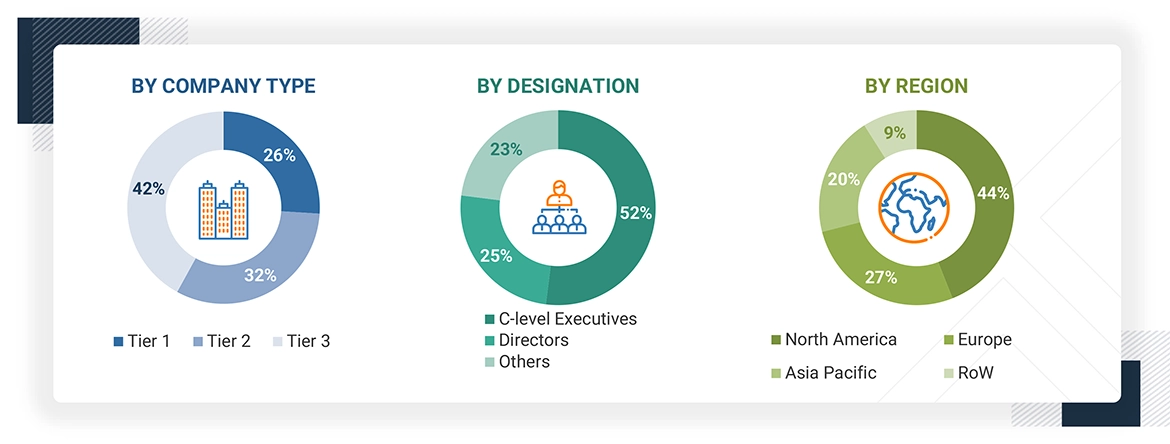
Note: RoW mainly comprises the Middle East & Africa (MEA) and South America.
Other designations include product managers, sales managers, and marketing managers.
Three tiers of companies have been defined based on their total revenue as of 2024; tier 3: Revenue less than USD 500 million; tier 2: Revenue between USD 500 million and 1 billion; and tier 1: Revenue more than USD 1 billion.
To know about the assumptions considered for the study, download the pdf brochure
Market Size Estimation
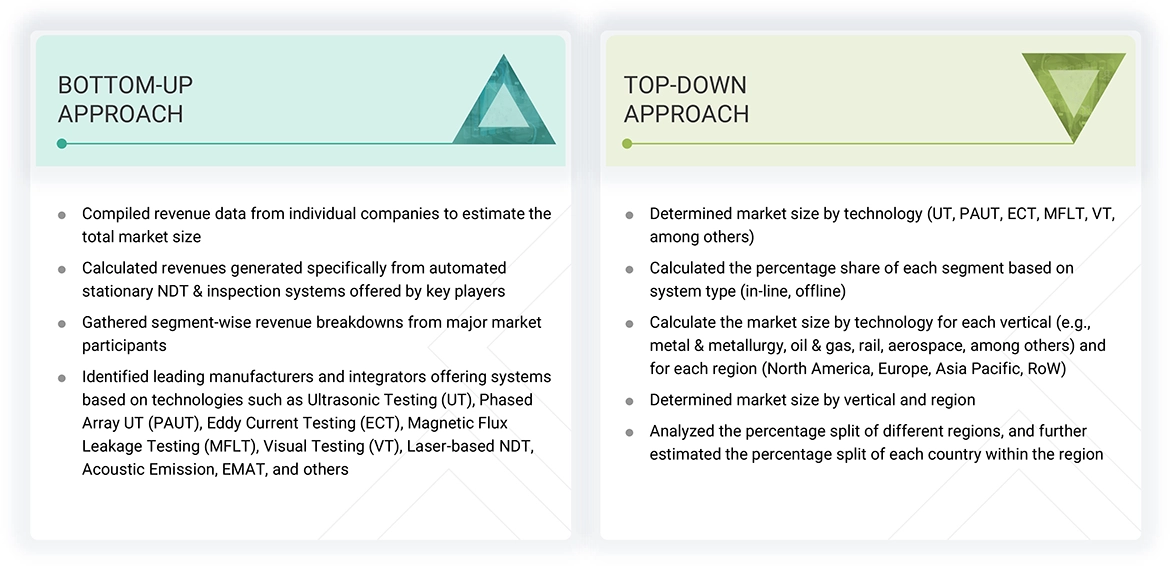
The bottom-up procedure has been employed to arrive at the overall size of the automated stationary NDT & inspection systems market.
- Collected financial data from individual equipment manufacturers and system integrators focused on automated stationary NDT & inspection systems
- Focused exclusively on revenues from fixed or installed inspection systems, excluding portable, handheld, and service-based revenues
- Estimated technology-specific revenues for systems based on Ultrasonic Testing (UT), Phased Array UT (PAUT), Eddy Current Testing (ECT), Magnetic Flux Leakage Testing (MFLT), Visual Testing (VT), Laser-based NDT, Acoustic Emission Testing, EMAT, and other emerging or hybrid NDT technologies
- Analyzed segment-wise revenue splits across key verticals such as oil & gas, rail, metals & metallurgy, aerospace, automotive, power generation, and other verticals
- Extracted product-level and vertical-specific revenue data from public company filings, investor reports, and direct disclosures
- Identified and mapped key market participants, including global OEMs, regional integrators, and specialized technology vendors across various NDT technologies and industry sectors
- Aggregated all data points to arrive at the total estimated market size for automated stationary NDT & inspection systems
The top-down approach has been used to estimate and validate the total size of the automated stationary NDT & inspection systems market.
- Assessed the overall NDT equipment market and filtered it to focus solely on the automated stationary NDT & inspection systems segment
- Segmented the market by key NDT technologies such as Ultrasonic Testing (UT), Phased Array UT (PAUT), Eddy Current Testing (ECT), Magnetic Flux Leakage Testing (MFLT), Visual Testing (VT), and other emerging methods
- Estimated market split by system type, differentiating between in-line and offline automated systems
- Calculated the share of each technology across major end-use verticals, including Metals & Metallurgy, Oil & Gas, Rail, Aerospace, Automotive, Power Generation, and others
- Mapped market size by region—North America, Europe, Asia Pacific, and Rest of the World (RoW)—for each technology and vertical
- Further refined estimates by analyzing the intra-regional share of countries within each broader geography
- Consolidated the above layers to derive the final market size and segmentation for the automated stationary NDT & inspection systems market
Automated Stationary NDT & Inspection Systems Market : Top-Down and Bottom-Up Approach
Data Triangulation
After arriving at the overall market size-using the market size estimation processes as explained above-the market has been split into several segments and subsegments. To complete the entire market engineering process and arrive at the exact statistics of each market segment and subsegment, data triangulation and market breakdown procedures have been employed, wherever applicable. The data has been triangulated by studying various factors and trends from the demand and supply sides in the automated stationary NDT & inspection systems market.
Market Definition
The Automated Stationary NDT (Non-Destructive Testing) & Inspection Systems encompasses permanently installed or fixed-position systems designed to evaluate the integrity, properties, or defects of materials and components without causing damage. These systems operate in-line or at fixed inspection stations within manufacturing, maintenance, or quality control environments. They utilize technologies such as Ultrasonic Testing (UT), Phased Array UT (PAUT), Eddy Current Testing (ECT), Magnetic Flux Leakage Testing (MFLT), Visual Testing (VT via machine vision), Laser-based NDT, Acoustic Emission Testing, Electromagnetic Acoustic Transducers (EMAT), and emerging hybrid methods. Unlike portable or manual inspection tools, automated stationary systems are integrated into production lines or test cells, enabling continuous, high-throughput, and repeatable inspection processes. These systems are used by equipment manufacturers and integrators (excluding NDT services) across critical industries such as Oil & Gas, Rail, Metals & Metallurgy, Aerospace, Automotive, General Manufacturing, Power Generation, and Marine. The market scope excludes radiography/CT, thermography, magnetic particle and penetrant testing, and handheld/manual inspection devices.
Key Stakeholders
- Equipment Manufacturers
- System Integrators
- Software & Analytics Providers
- Component & Sensor Suppliers
- End-use Industries
- Regulatory Bodies
- Standards Organizations
- Research Institutions
- Certification Bodies
- Distributors & Channel Partners
- Industry Associations
- Investors & Financial Institutions
- Automation & Robotics Providers
- Maintenance & Calibration Service Providers
Report Objectives
- To define, describe, and forecast the size of the automated stationary NDT & inspection systems market by technology, vertical, and system type, in terms of value
- To describe and forecast the market size for various segments concerning key regions, namely, North America, Europe, Asia Pacific, and RoW, in terms of value
- To provide detailed information regarding the key factors such as drivers, restraints, opportunities, and challenges influencing the growth of the market
- To understand and analyze the impact of evolving technologies on the overall supply chain of the automated stationary NDT & inspection systems market and upcoming trends in the ecosystem
- To provide macroeconomic outlooks with respect to the main geographies, namely, North America, Europe, Asia Pacific, and RoW
- To provide a detailed overview of the automated stationary NDT & inspection systems market, industry trends, and use cases
- To strategically analyze micromarkets for individual growth trends, prospects, and contributions to the total market
- To provide ecosystem analysis, trends/disruptions impacting customer business, case study analysis, ecosystem analysis, and Gen AI impact related to the automated stationary NDT & inspection systems market
- To analyze the opportunities in the market for stakeholders by identifying high-growth segments and detailing the competitive landscape for market players
- To profile the key players and comprehensively analyze their market position in terms of the market share and core competencies, along with a detailed competitive landscape for the market leaders
- To analyze the competitive developments, such as acquisitions, product launches, expansions, agreements, partnerships, and collaborations carried out by market players
Available customizations:
With the given market data, MarketsandMarkets offers customizations according to the company‘s specific needs. The following customization options are available for the report
Company Information
- Detailed analysis and profiling of additional market players (up to five)
Get the Full Automated Stationary NDT & Inspection Systems Market Report
Full forecast, segment splits, and company analysis for all Automated Stationary NDT & Inspection Systems Market.
- US Automated Stationary NDT & Inspection Systems Market
- Canada Automated Stationary NDT & Inspection Systems Market
- Mexico Automated Stationary NDT & Inspection Systems Market
- Germany Automated Stationary NDT & Inspection Systems Market
- UK Automated Stationary NDT & Inspection Systems Market
- France Automated Stationary NDT & Inspection Systems Market
- Italy Automated Stationary NDT & Inspection Systems Market
- Rest Of Europe Automated Stationary NDT & Inspection Systems Market
- Japan Automated Stationary NDT & Inspection Systems Market
- India Automated Stationary NDT & Inspection Systems Market
- South Korea Automated Stationary NDT & Inspection Systems Market
- Rest Of Asia Pacific Automated Stationary NDT & Inspection Systems Market
Need a Tailored Report?
Customize this report to your needs
Get 10% FREE Customization
Customize This Report
