
China Automated Passenger Counting and Information System Market (2025-2030)

The China Automated Passenger Counting and Information System Market was valued at $15.4 Million in 2025 and projected to reach to $34.1 Million by 2030, representing a compound annual growth rate of 17.3%. China's Automated Passenger Counting and Information System market is positioned for exceptional growth through 2030, driven by the nation's commitment to smart city development and sustainable urban transportation.


| Market Size in | USD 26.32 MN |
| Market Forecast in | |
| CAGR | |
| Forecast Period | |
| Units Considered | Value (USD MN) |
China Automated Passenger Counting and Information System Market Trends and Insights
- This exceptional growth trajectory, driven by China's aggressive urbanization and smart transportation initiatives, significantly outpaces the global market CAGR of 8.8%.
- China's investment in intelligent public transit infrastructure, coupled with government mandates for real-time passenger analytics, positions the country as a critical growth engine within the Asia Pacific region. The market in China is propelled by modernization of urban transit networks across major metropolitan areas and the integration of IoT and AI technologies into passenger management systems.
- China's focus on reducing operational inefficiencies and enhancing passenger experience through data-driven insights has accelerated adoption of counting and information systems.
- By 2030, China is expected to capture a substantial share of regional demand, reflecting the nation's commitment to sustainable and technology-enabled public transportation solutions..
Key Market Statistics
- CAGR (2025-2030) 17.3% CAGR
- Market Size, 2025 ~USD 15.4 Million
- Forecast, 2030 ~USD 34.1 Million
- Country China
China Automated Passenger Counting and Information System Market Overview
Rapid Market Expansion :
China's Automated Passenger Counting and Information System market is projected to nearly double from $15.4 million in 2025 to $34.1 million by 2030, representing a robust 17.3% CAGR that significantly exceeds the global average of 8.8%.
Urbanization-Driven Growth :
China's aggressive urbanization agenda and smart city initiatives are catalyzing demand for advanced passenger counting and real-time information systems across metro networks, bus rapid transit systems, and integrated transportation hubs.
Government Smart Transportation Investment :
Central and provincial government mandates for intelligent public transit infrastructure are accelerating adoption of automated systems in major cities including Beijing, Shanghai, Guangzhou, and Chengdu, creating substantial market opportunities.
Technology Integration Momentum :
Integration of AI, IoT, and big data analytics into passenger counting systems is enabling Chinese transit operators to optimize route planning, improve service efficiency, and enhance passenger experience across expanding urban mobility networks.
China Automated Passenger Counting and Information System Market Dynamics
- Government policies prioritizing intelligent public transit infrastructure, combined with rapid urbanization in tier-2 and tier-3 cities, are creating substantial demand for advanced counting and information technologies.
- Major metropolitan areas are increasingly deploying integrated systems to manage congestion and improve operational efficiency. The market will benefit from technological convergence, including AI-powered analytics, real-time passenger flow monitoring, and predictive maintenance capabilities.
- Chinese manufacturers and system integrators are gaining competitive advantages through localized solutions tailored to regional transit operator requirements.
- Strategic partnerships between technology providers and transit authorities will accelerate system deployment, positioning China as a critical growth engine for the global automated passenger counting market..
Market Ecosystem
Related Ecosystem
Electronics System And Components
- Sensors
- Temperature Sensors
- Pressure Sensors
- Actuators
- Image Sensors
- Lenovo
- Samsung
- Texas Instruments Incorporated
- HONEYWELL INTERNATIONAL INC.
- Teledyne Technologies Incorporated
Smart Lighting
- Fiber Laser
- Fluorescent Lighting
- Gas Lasers
- Sensors
- 3D Sensors
- Zumtobel group ag
- Nedap n.v.
- Acuity Brands, Inc.
- OSRAM Licht AG
- Philips
Key Takeaways
- China's market is valued at $15.4 million in 2025 and forecast to reach $34.1 million by 2030, representing a 17.3% CAGR.
- China's growth rate significantly exceeds the global average of 8.8%, driven by urbanization and smart city initiatives.
- China's government-backed smart transportation programs and IoT integration are primary catalysts for market expansion.
- China is positioned as the Asia Pacific region's fastest-growing market for automated passenger counting systems.
Automated Passenger Counting and Information System Market Report Scope
| Report Metric | Details |
|---|---|
| Base Year | 2025 |
| Fastest Growing Segment | STEREOSCOPIC VISION (Technology) |
| Forecast Period | 2025-2030 |
| Growth Rate | CAGR of 8.8% from 2025 to 2030 |
| Largest Segment | PASSENGER INFORMATION SYSTEM (Offering) |
| Market Size Base Year (Billions) | ~USD 9.71 (2025) |
| Revenue Forecast (Billions) | ~USD 14.8 (2030) |
| Segments Covered | Offering, Installation Type, Technology, Application, Type |
China Automated Passenger Counting and Information System Market Report Segmentation
5 segment dimensions are covered across the global market.
By Offering
- Automated Passenger Counting System
- Passenger Information System
By Installation Type
- Infrastructure-Based Systems
- Vehicle-Integrated Systems
By Technology
- Infrared
- Other Technologies
- Stereoscopic Vision
- Time-Of-Flight
By Application
- Airways
- Buses
- Ferries
- Railways
- Roadways
- Trains & Trams
By Type
- Announcement & Emergency Communication Systems
- Display Systems
- Infotainment Systems
- Mobile Applications
Target Audience
- Transit Authority Operators : Chinese metro, bus, and integrated transit operators need market intelligence to justify capital investments in automated passenger counting systems, benchmark against peer implementations, and optimize procurement decisions.
- Technology Solution Providers : Hardware and software vendors require detailed market sizing, growth forecasts, and competitive landscape data to develop localized solutions, identify partnership opportunities, and allocate R&D resources effectively in China.
- System Integrators & Consultants : Integration firms and transportation consultants need comprehensive market analysis to advise clients on technology selection, implementation roadmaps, and ROI projections for passenger counting system deployments across Chinese cities.
- Investment & Private Equity Firms : Investors evaluating opportunities in Chinese smart transportation and urban mobility sectors require validated market data, growth trajectories, and competitive dynamics to assess portfolio companies and identify acquisition targets.
- Government & Policy Makers : Municipal and provincial government officials need market intelligence to inform smart city planning, transit modernization budgets, and technology procurement standards aligned with national urbanization and sustainability objectives.
Reasons to Buy this Report
- Market Size & Growth Validation : Obtain precise market valuation data for China ($15.4M in 2025) with verified 17.3% CAGR projections through 2030, enabling accurate investment planning and competitive positioning in this high-growth segment.
- Regional Opportunity Identification : Identify tier-1, tier-2, and tier-3 city opportunities across China's fragmented transit market, with insights into which regions offer highest ROI potential for automated passenger counting system deployments.
- Government Policy & Regulatory Landscape : Understand China's smart city mandates, transit authority procurement requirements, and government incentive programs driving adoption of automated systems, enabling strategic market entry and partnership development.
- Competitive Intelligence & Market Dynamics : Analyze competitive positioning of Chinese and international vendors, identify market gaps, assess technology adoption rates, and benchmark against global standards to inform product development and go-to-market strategies.
- Investment & Partnership Strategy : Leverage detailed market forecasts and trend analysis to evaluate M&A opportunities, joint venture potential with Chinese transit operators, and strategic partnerships with local system integrators and technology providers.
Frequently asked questions
What is the market size of automated passenger counting systems in China in 2025?
China's Automated Passenger Counting and Information System market is valued at $15.4 million in 2025.
What is the projected market size for China by 2030?
China's market is projected to reach $34.1 million by 2030, representing more than a doubling of the 2025 valuation.
What is the CAGR for China's automated passenger counting market?
China's market is growing at a CAGR of 17.3% from 2025 to 2030, significantly outpacing global growth.
Why is China's market growing faster than the global average?
China's rapid urbanization, government smart city initiatives, and widespread adoption of IoT and AI technologies in public transit are driving above-average growth compared to the global 8.8% CAGR.
What are the primary drivers of growth in China's market?
Key drivers include modernization of urban transit networks, government mandates for real-time passenger analytics, integration of smart technologies, and China's commitment to sustainable public transportation solutions.
RESEARCH METHODOLOGY
The research process for this study included systematic gathering, recording, and analysis of data about customers and companies operating in the automated passenger counting and information system market. This process involved the extensive use of secondary sources, directories, and databases (Factiva and Oanda) to identify and collect valuable information for the comprehensive, technical, market-oriented, and commercial study of the automated passenger counting and information system market. In-depth interviews were conducted with primary respondents, including experts from core and related industries and preferred manufacturers, to obtain and verify critical qualitative and quantitative information and assess growth prospects. Key players in the automated passenger counting and information system market were identified through secondary research, and their market rankings were determined through primary and secondary research. This research included studying annual reports of top players and interviewing key industry experts such as CEOs, directors, and marketing executives.
Secondary Research
Various sources were used in the secondary research process to identify and collect information important for this study. These include company annual reports, press releases, investor presentations, white papers, technology journals, certified publications, articles by recognized authors, directories, and databases.
Secondary research was mainly used to obtain key information about the industry’s value chain, the total pool of market players, the market classification according to industry trends to the bottom-most level, regional markets, and key developments from market and technology-oriented perspectives.
Primary Research
Primary research was also conducted to identify the segmentation types, key players, competitive landscape, and key market dynamics, such as drivers, restraints, opportunities, challenges, and industry trends, along with key strategies adopted by players operating in the automated passenger counting and information system market. Extensive qualitative and quantitative analyses were performed on the complete market engineering process to list key information and insights throughout the report.
Extensive primary research has been conducted after acquiring knowledge about automated passenger counting and information system market scenarios through secondary research. Several primary interviews have been conducted with experts from the demand (end use and region) and supply side (image detection technique, type) across four major geographic regions: North America, Europe, Asia Pacific, and RoW. Approximately 60% and 40% of the primary interviews were conducted from the supply and demand sides, respectively. These primary data have been collected through questionnaires, emails, and telephonic interviews.
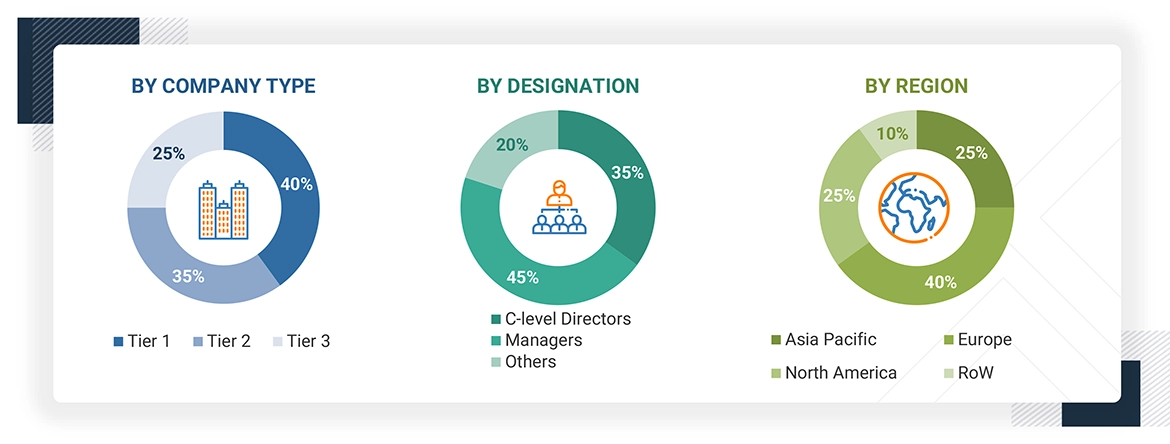
Notes: The three tiers of the companies have been defined based on their total/segmental revenue as of 2024: Tier 1 = >USD 1 billion, Tier 2 = USD 1 billion–USD 500 million, and Tier 3 = USD 500 million.
‘Others’ include sales, marketing, and product managers.
To know about the assumptions considered for the study, download the pdf brochure
Market Size Estimation
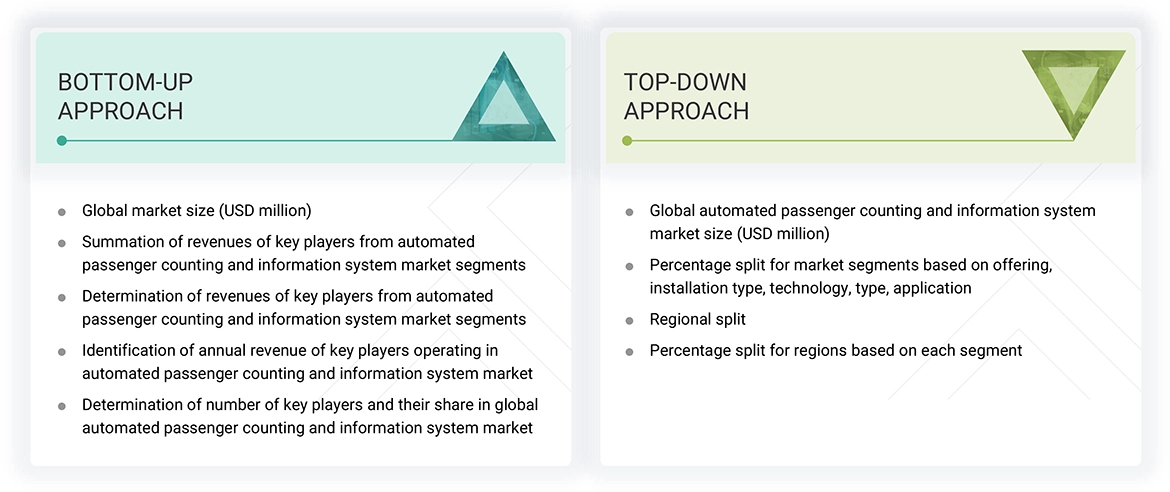
In the complete market engineering process, top-down and bottom-up approaches and several data triangulation methods were implemented to estimate and validate the size of the automated passenger counting and information system market and various other dependent submarkets. Key players in the market were identified through secondary research, and their market share in the respective regions was determined through primary and secondary research. This entire research methodology included the study of annual and financial reports of the top players, as well as interviews with experts (such as CEOs, VPs, directors, and marketing executives) for key insights (quantitative and qualitative).
All percentage shares, splits, and breakdowns were determined using secondary sources and verified through primary sources. All the possible parameters that affect the markets covered in this research study were accounted for, viewed in detail, verified through primary research, and analyzed to obtain the final quantitative and qualitative data. This data was consolidated and supplemented with detailed inputs and analysis from MarketsandMarkets and presented in this report.
Automated Passenger Counting and Information System Market : Top-Down and Bottom-Up Approach
Data Triangulation
After arriving at the overall market size from the estimation process, as explained above, the total market has been split into several segments and subsegments. To complete the overall market engineering process and arrive at the exact statistics for all segments and subsegments, market breakdown and data triangulation procedures have been employed, wherever applicable. The data have been triangulated by studying various factors and trends from the demand and supply sides. Along with this, the market has been validated using top-down and bottom-up approaches.
Market Definition
Automated passenger counting (APC) systems comprise electronic devices that count the number of passengers boarding and alighting transit vehicles, including buses, trains, and ferries. These systems offer more accurate and reliable results than the traditional method of counting passengers manually. With the help of the automatic passenger counter, every passenger who goes on board and alights a public transit vehicle at each stop of any route can be monitored and recorded easily. This helps simplify data collection and enables far greater accuracy and scope for generating database reports on ridership information.
Passenger information systems (PIS) are electronic information systems that provide passengers with real-time information. This information can include the arrival and departure times of transit vehicles and the nature and cause of disruptions in case of delays. These systems are installed at transportation hubs or can be used remotely through web browsers and smartphones.
Key Stakeholders
- End users
- Government bodies, venture capitalists, and private equity firms
- Technology providers
- Technology distributors
- System integrators
- Mobile application developers
- Networking and communication service providers
- Passenger information system software providers
- Automated passenger counting and information system industry associations
- Professional service/solution providers
- Research institutions and organizations
- Standards organizations and regulatory authorities
- Technology consultants
Report Objectives
- To define, describe, and forecast the automated passenger counting and information system market, based on offering and installation type in terms of value
- To define, describe, and forecast the automated passenger counting system market based on technology and application, in terms of value
- To define, describe, and forecast the passenger information system market based on type and application, in terms of value
- To forecast the automated passenger counting and information system market size, in terms of volume
- To forecast the size of the market segments for four major regions—North America, Europe, Asia Pacific, and Rest of the World (RoW)
- To provide detailed information regarding the major drivers, restraints, opportunities, and challenges influencing the growth of the market
- To strategically analyze micromarkets concerning individual growth trends, prospects, and contributions to the total market
- To study the complete value chain and allied industry segments and perform a value chain analysis of the market
- To strategically profile the key players and comprehensively analyze their market shares and core competencies
- To analyze the opportunities in the market for stakeholders and describe the competitive landscape of the market
- To analyze competitive developments such as joint ventures, collaborations, agreements, contracts, partnerships, mergers & acquisitions, product developments, and research & development (R&D) in the market
- To understand the impact of AI on the automated passenger counting and information system market
- To understand the 2025 US tariff impact
Available customizations:
With the given market data, MarketsandMarkets offers customizations according to the company’s specific needs. The following customization options are available for the report:
Get the Full Automated Passenger Counting and Information System Market Report
Full forecast, segment splits, and company analysis for all Automated Passenger Counting and Information System Market.
- US Automated Passenger Counting and Information System Market
- Canada Automated Passenger Counting and Information System Market
- Mexico Automated Passenger Counting and Information System Market
- Germany Automated Passenger Counting and Information System Market
- UK Automated Passenger Counting and Information System Market
- France Automated Passenger Counting and Information System Market
- Spain Automated Passenger Counting and Information System Market
- Italy Automated Passenger Counting and Information System Market
- Nordics Automated Passenger Counting and Information System Market
- Poland Automated Passenger Counting and Information System Market
- Rest Of Europe Automated Passenger Counting and Information System Market
- Japan Automated Passenger Counting and Information System Market
- India Automated Passenger Counting and Information System Market
- South Korea Automated Passenger Counting and Information System Market
- Australia Automated Passenger Counting and Information System Market
- Rest Of Asia Pacific Automated Passenger Counting and Information System Market
Need a Tailored Report?
Customize this report to your needs
Get 10% FREE Customization
Customize This Report
