
China Automotive Suspension Market (2025-2030)

The China Automotive Suspension Market was valued at $125986 Million in 2025 and projected to reach to $116753 Million by 2030, representing a compound annual growth rate of -1.1%. China's automotive suspension market faces headwinds as the industry undergoes a fundamental transformation driven by electrification and competitive pressures.


| Market Size in | USD 26.32 MN |
| Market Forecast in | |
| CAGR | |
| Forecast Period | |
| Units Considered | Value (USD MN) |
China Automotive Suspension Market Trends and Insights
- This downturn in China reflects structural shifts in the automotive sector, including the transition toward electric vehicles with different suspension architectures and intensifying price competition among domestic manufacturers.
- China's suspension market faces headwinds from overcapacity in traditional suspension component production and the rapid adoption of advanced suspension technologies that reduce component complexity. The decline in China's market is driven by several interconnected factors specific to the region's automotive landscape.
- China's shift toward electrification is fundamentally altering suspension design requirements, as electric vehicles often utilize simplified or integrated suspension systems compared to conventional internal combustion engine vehicles.
- Additionally, China's domestic OEM consolidation and the rise of cost-competitive local suppliers are pressuring margins across the suspension supply chain.
- Between 2025 and 2030, China's automotive suspension market will likely see continued rationalization as manufacturers adapt to evolving vehicle architectures and consumer preferences..
Key Market Statistics
- CAGR (2025-2030) -1.1%
- Market Size, 2025 ~USD 125986 Million
- Forecast, 2030 ~USD 116753 Million
- Country China
China Automotive Suspension Market Overview
Market Contraction :
China's automotive suspension market is declining at -1.1% CAGR, contracting from USD 125,986 million in 2025 to USD 116,753 million by 2030, reflecting structural challenges in the domestic automotive sector.
EV Transition Impact :
The rapid shift toward electric vehicles in China is fundamentally reshaping suspension demand, as EVs require different architectures and components compared to traditional internal combustion engine vehicles.
Intensifying Price Competition :
Chinese manufacturers face severe pricing pressures from both domestic competitors and international players, eroding margins and forcing consolidation across the suspension component supply chain.
Market Divergence from Global Trends :
While the global automotive suspension market grows at 0.9% CAGR, China's negative trajectory highlights regional market maturity and the unique challenges posed by rapid electrification adoption.
China Automotive Suspension Market Dynamics
- The projected decline to USD 116,753 million by 2030 reflects not demand destruction, but rather a shift in component specifications and supplier dynamics as OEMs prioritize EV-compatible suspension systems.
- Traditional suspension manufacturers must innovate to capture opportunities in adaptive and lightweight suspension technologies demanded by electric platforms. Despite the negative CAGR, strategic opportunities exist for suppliers who can deliver cost-effective solutions for mass-market EVs and advanced suspension systems for premium segments.
- Market consolidation will accelerate, with leading players leveraging scale and R&D capabilities to maintain competitiveness.
- Companies investing in electric suspension technologies and supply chain optimization will be best positioned to navigate China's evolving automotive landscape..
Market Ecosystem
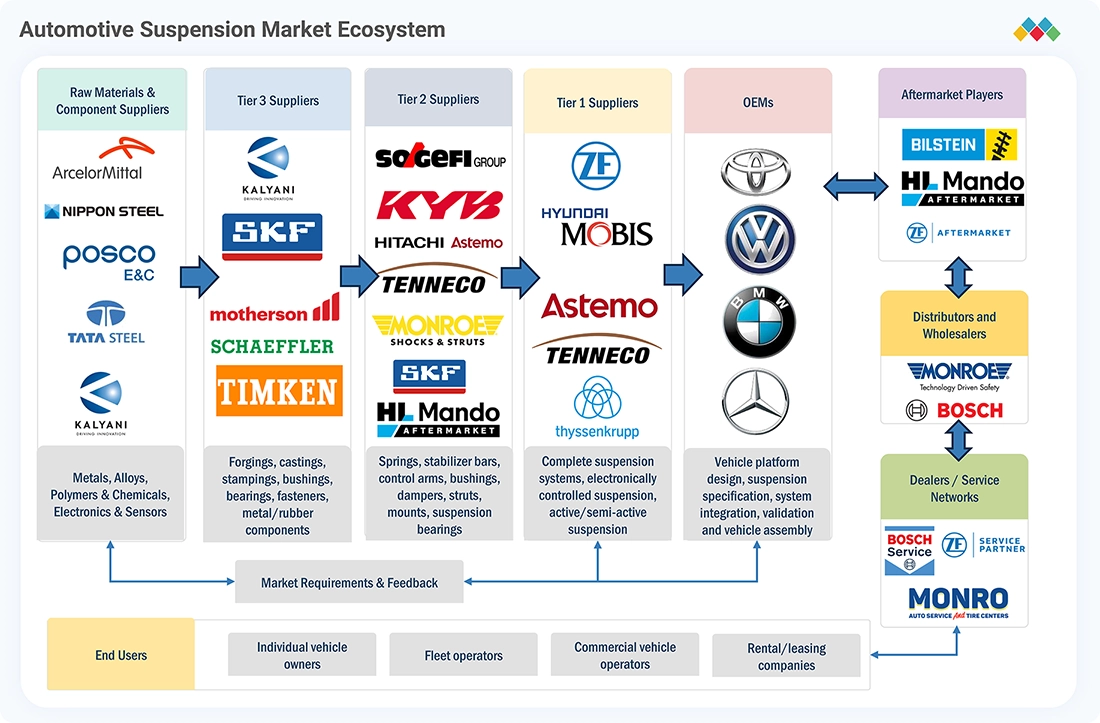
AUTOMOTIVE SUSPENSION MARKET SIZE, SHARE & ANALYSIS: COMMERCIAL USE CASES ACROSS INDUSTRIES
| COMPANY | USE CASE DESCRIPTION | BENEFITS |
|---|---|---|
 |
ZF applies electronically controlled suspension technologies, including Continuous Damping Control (CDC), sMOTION, and its cubiX chassis-control software, across passenger cars, EVs, SUVs, and commercial vehicles. These systems use vehicle and road-condition data to continuously adjust damping and coordinate chassis functions. ZF is also developing AI-enabled suspension control through AI Road Sense, which can anticipate road conditions and adapt chassis behavior. | Improved ride comfort and handling; enhanced vehicle stability; predictive suspension response; better control of heavier EVs; reduced body movement; and opportunities for software-enabled chassis functions and OTA feature upgrades. |
 |
Hyundai Mobis is developing e-Corner and integrated wheel-end technologies that combine steering, braking, driving, and suspension functions at individual wheels. The technology is particularly suited to next-generation EVs, where independent wheel control can support new vehicle architectures, flexible packaging, and advanced maneuverability. | Greater vehicle maneuverability; improved low-speed turning and parking; flexible EV packaging; enhanced wheel-level control; reduced mechanical interdependencies; and greater freedom in future vehicle design. |
 |
Tenneco applies Monroe Intelligent Suspension technologies, including CVSAe and CVSA2 electronically controlled dampers, to continuously adjust suspension response based on vehicle inputs and road conditions. Its newer CVSA2 steel-tube variant and DCx passive damper valve expand the technology across EVs, SUVs, premium vehicles, and higher-volume applications. | Adaptive ride comfort; improved handling and body control; optimized suspension response across different driving conditions; lower NVH; broader vehicle application coverage; and improved balance between performance and system cost. |
 |
thyssenkrupp develops lightweight springs, stabilizer bars, tubular/split stabilizers, and active-roll-control components for passenger vehicles and EVs. Its VarioShape technology optimizes stabilizer geometry to reduce mass, while split stabilizer bars can be integrated with active roll-control systems. | Lower suspension weight; improved roll stability; better handling and ride comfort; reduced material consumption; improved energy efficiency for EVs; and enhanced chassis performance without significant weight increase. |
Logos and trademarks shown above are the property of their respective owners. Their use here is for informational and illustrative purposes only.
Related Ecosystem
Body Exterior Interior
- Battery Electric Vehicle (BEV)
- Fuel Cell Electric Vehicle (FCEV)
- Light Commercial Vehicles (LCVs)
- Hybrid Electric Vehicle (HEV)
- Agricultural Tractors
- AISIN CORPORATION
- Magna International Inc.
- GORKOVSKY AVTOMOBILNY ZAVOD
- BOCAR
- Continental ag
Driving Support Security
- Battery Electric Vehicle (BEV)
- Hybrid Electric Vehicle (HEV)
- Light Commercial Vehicles (LCVs)
- Fuel Cell Electric Vehicle (FCEV)
- Blind Spot Detection (BSD)
- BOSCH LIMITED
- Continental ag
- DENSO Corporation
- Magna International Inc.
- ZF FRIEDRICHSHAFEN AG
Electric Hybrid Vehicles
- Battery Electric Vehicle (BEV)
- Fuel Cell Electric Vehicle (FCEV)
- Light Commercial Vehicles (LCVs)
- Hybrid Electric Vehicle (HEV)
- Agricultural Tractors
- Visteon Corporation
- BOSCH LIMITED
- Byd company ltd.
- Tesla, Inc.
- FORD MOTOR COMPANY
Key Takeaways
- China's automotive suspension market will contract from USD 125,986M (2025) to USD 116,753M (2030) at a -1.1% CAGR.
- Electric vehicle adoption in China is reducing demand for traditional suspension components due to simplified EV architectures.
- Intense domestic competition and overcapacity in China's suspension supply chain are eroding profitability and consolidating the market.
- China's transition to advanced suspension technologies and integrated systems is reshaping component requirements and supplier dynamics.
Automotive Suspension Market Report Scope
| Report Metric | Details |
|---|---|
| Base Year | 2025 |
| Fastest Growing Segment | ELECTRONICALLY ACTUATED (Actuation) |
| Forecast Period | 2025–2030 |
| Growth Rate | CAGR of 0.9% from 2025 to 2030 |
| Largest Segment | PASSIVE (System) |
| Market Size Base Year (Billions) | ~USD 39.85 (2025) |
| Revenue Forecast (Billions) | ~USD 41.68 (2030) |
| Segments Covered | Actuation, Component, Architecture, System, Vehicle Type |
China Automotive Suspension Market Report Segmentation
5 segment dimensions are covered across the global market.
By Actuation
- Electronically Actuated
- Hydraulically Actuated
By Component
- Air Springs
- Ball Joints
- Coil Springs
- Control Arms
- Leaf Springs
- Link Stabilizer/ Sway Bars
- Link Stabilizer/Sway Bars
- Rubber Bushings
- Shock Absorbers
- Struts
By Architecture
- Air Suspension
- Double Wishbone
- Leaf Spring
- Macpherson Strut
- Multilink
- Twist Beam/ Torsion Beam
- Twist Beam/Torsion Beam
By System
- Active
- Passive
- Semi-Active
By Vehicle Type
- Buses
- Lcvs
- Passenger Cars
- Trucks
Target Audience
- Automotive OEMs : Chinese and international OEMs need this data to optimize suspension sourcing strategies, plan EV platform development, and anticipate supplier consolidation impacts on supply chain stability.
- Suspension Component Suppliers : Domestic and global suspension manufacturers require market insights to navigate declining demand, identify cost reduction opportunities, and develop innovative EV-compatible products for Chinese OEMs.
- Investment & Private Equity Firms : Investors evaluating opportunities in China's automotive supply chain need this analysis to identify consolidation targets, assess valuation trends, and understand long-term market viability.
- Market Entry & Expansion Teams : Companies considering entry into or expansion within China's suspension market require detailed forecasts and competitive analysis to validate business cases and optimize market positioning strategies.
- Strategic Consultants & Analysts : Consulting firms and research teams advising automotive clients need comprehensive China-specific data to develop market strategies, competitive benchmarking, and technology roadmap recommendations.
Key Companies in the China Automotive Suspension Market
| Company | HQ | Ownership | Strongest segments |
|---|---|---|---|
| GAZ | Russia | Public Company | Gas business (upstream, midstream, sales),Oil and refined products,Electric power and heat, |
| ALTEN | France | Public Company | Engineering and R&D services,Digital and IT services,Quality, testing, and QA services, |
| AISIN SEIKI CO LTD | Japan | Public Company | Automatic, CVT, and manual transmissions,eAxle and electrified driveline,Brakes, steering, and chassis systems, |
| METALSA | Mexico | Private Company | Light vehicle chassis structures and side rails,Heavy vehicle and commercial chassis structures,Fuel tanks and related structural systems, |
| WABCO HOLDINGS INC | Switzerland | Private Company | Electronic braking and stability systems (ABS, EBS, ESC, brake controls),Air management and conventional braking hardware (compressors, valves, actuators, air disc brakes),Transmission automation and driveline control, |
| RHEINMETALL AG | Germany | Public Company | Vehicle Systems (combat, logistics, support, special vehicles),Weapon and Ammunition (weapons, ammo, protection, propellants, services),Electronic Solutions (sensors, C2, networking, training & simulation), |
| FEDERAL-MOGUL CORPORATION | United States | Private Company | Engine and powertrain components,Sealing systems and gaskets,Friction and braking solutions, |
| ZF FRIEDRICHSHAFEN AG | Germany | Private Company | Passenger car driveline, chassis, and safety systems,Commercial vehicle and fleet systems (truck, bus, LCV, trailers),Industrial applications (construction, agriculture, marine, wind, rail, material handling), |
| HYUNDAI MOBIS | South Korea | Public Company | Auto modules (chassis, cockpit, front-end, bumpers),Electrification (power conversion, drive, battery, 48V),Autonomous driving and safety (ADAS, airbags, ECUs, in-cabin sensing), |
| TENNECO INC. | United States | Private Company | Clean air / emissions-control systems,Powertrain / engine components,Ride performance / suspension and damping, |
| THYSSENKRUPP AG | Germany | Public Company | Materials Services,Steel Europe,Automotive Technology, |
| DANA LIMITED | United States | Public Company | Biotechnology (bioprocessing and therapeutic manufacturing solutions),Life Sciences (research tools and genomic medicines),Diagnostics (clinical instruments, consumables, software, services), |
| MAGNA INTERNATIONAL INC. | Canada | Public Company | Body Exteriors & Structures,Power & Vision (incl. ADAS and control modules),Seating Systems and Interior/Exterior Mechatronics, |
| CONTINENTAL AG | Germany | Public Company | Passenger and light truck tires,Truck, bus, and fleet tires,Two-wheel and specialist vehicle tires, |
| KYB CORPORATION | Japan | Public Company | Restaurant Leasing and Subleasing Business,Food Retail Business (Restaurant Operations and Consultancy), |
| HL MANDO CORPORATION | South Korea | Public Company | Braking systems (electronic and foundation),Steering systems (EPS and mechanical),Suspension and EV suspension, |
| MERITOR, INC. | United States | Private Company | Axles, drivelines, and suspension systems,Brakes and related safety systems,Engines and power systems (on/off-highway), |
| SOGEFI | Italy | Public Company | Suspensions (coil, leaf, precision springs, stabilizer bars),Air & Cooling (intake manifolds, air induction, charged air ducts),EV Thermal (battery cooling plates, coolant pumps and modules), |
GAZ
GAZ is a Russian public company founded in 1993, employing 468,000 people and operating as a major industrial enterprise.
ALTEN
ALTEN is a French public company founded in 1988 with 56,376 employees, providing engineering and technology services.
AISIN SEIKI CO LTD
AISIN SEIKI CO LTD is a Japanese public company founded in 1943 with 113,292 employees, specializing in automotive components and systems.
METALSA
METALSA is a Mexican private company founded in 1956 with 13,000 employees, operating in the manufacturing sector.
WABCO HOLDINGS INC
WABCO Holdings Inc is a Swiss private company founded in 1869 with 13,911 employees, providing technology and components for commercial vehicles.
RHEINMETALL AG
Rheinmetall AG is a German public company founded in 1889 with 28,815 employees, operating in defense, automotive, and industrial sectors.
FEDERAL-MOGUL CORPORATION
Federal-Mogul Corporation is a United States-based private company founded in 1899 with 44,275 employees, specializing in automotive components and powertrain systems.
ZF FRIEDRICHSHAFEN AG
ZF Friedrichshafen AG is a German private company founded in 1915 with 145,909 employees, a leading global supplier of driveline and chassis technology.
HYUNDAI MOBIS
Hyundai Mobis is a South Korean public company founded in 1977, providing automotive components and systems to major vehicle manufacturers.
TENNECO INC.
Tenneco Inc. is a United States-based private company founded in 1930 with 71,000 employees, specializing in automotive emission control and suspension systems.
THYSSENKRUPP AG
ThyssenKrupp AG is a German public company founded in 1811 with 90,916 employees, operating across steel, industrial, and automotive sectors.
DANA LIMITED
Dana Limited is a United States-based public company founded in 1969 with 59,000 employees, providing drivetrain and mobility solutions for vehicles.
MAGNA INTERNATIONAL INC.
Magna International Inc. is a Canadian public company founded in 1957 with 156,000 employees, a leading global automotive supplier and parts manufacturer.
CONTINENTAL AG
Continental AG is a German public company founded in 1871 with 22,076 employees, specializing in automotive technology and tire manufacturing.
KYB CORPORATION
KYB Corporation is a Japanese public company founded in 2019, providing hydraulic and automotive suspension components.
HL MANDO CORPORATION
HL Mando Corporation is a South Korean public company founded in 1962 with 3,585 employees, specializing in automotive braking and steering systems.
MERITOR, INC.
Meritor, Inc. is a United States-based private company founded in 1909 with 9,600 employees, supplying drivetrain and mobility solutions for commercial vehicles.
SOGEFI
SOGEFI is an Italian public company founded in 1980 with 3,243 employees, specializing in automotive filtration and engine components.
Reasons to Buy this Report
- Identify Market Contraction Drivers : Understand the specific factors causing China's -1.1% CAGR decline, including EV architecture shifts and competitive dynamics, to inform strategic positioning and investment decisions.
- EV Transition Strategy : Gain detailed insights into how electrification is reshaping suspension demand in China's market, enabling suppliers to pivot product portfolios toward EV-compatible solutions ahead of competitors.
- Competitive Landscape Analysis : Access comprehensive data on pricing pressures and consolidation trends among Chinese suspension manufacturers to benchmark performance and identify partnership or acquisition opportunities.
- Forecast-Driven Planning : Leverage 2030 market projections (USD 116.8B) to develop long-term capacity planning, R&D investment strategies, and geographic expansion plans tailored to China's unique market trajectory.
- Regional Divergence Insights : Compare China's negative performance against the 0.9% global CAGR to understand regional market maturity, identify export opportunities, and assess domestic vs. international growth strategies.
Frequently asked questions
Why is China's automotive suspension market declining?
China's suspension market is contracting due to the rapid shift toward electric vehicles, which require simplified suspension designs, combined with overcapacity and intense price competition among domestic suppliers.
What is the market size of China's automotive suspension sector in 2025?
China's automotive suspension market is valued at USD 125,986 million in 2025 and is expected to decline to USD 116,753 million by 2030.
How does electrification impact China's suspension market?
Electrification in China reduces suspension component demand because electric vehicles typically use integrated or simplified suspension systems that require fewer traditional components than internal combustion engine vehicles.
What is the CAGR for China's automotive suspension market?
China's automotive suspension market is declining at a negative CAGR of -1.1% from 2025 to 2030.
Which factors are driving consolidation in China's suspension supply chain?
Consolidation in China is driven by overcapacity, margin pressure from cost-competitive local suppliers, and the need for manufacturers to adapt to EV-specific suspension requirements and advanced technologies.
RESEARCH METHODOLOGY
The research study relied heavily on secondary sources, including company annual reports/presentations, industry association publications, magazines, directories, technical handbooks, the World Economic Outlook, trade websites, technical articles, and databases, to identify and collect information on the automotive suspension market. In-depth interviews were conducted with primary-source experts from related industry players, automotive suspension suppliers, and automotive OEMs to obtain and verify critical information and assess growth prospects and market estimates.
Secondary Research
In the secondary research process, various secondary sources were used to identify and collect information on the automotive suspension market for this study. The sources included automotive industry organizations such as Organisation Internationale des Constructeurs d'Automobiles (OICA), CAAM, JAMA, ACEA, etc., OE and aftermarket suspension manufacturers and suppliers, automotive component and aftermarket associations such as CLEPA, MEMA Aftermarket Suppliers, Auto Care Association, and AASA, suspension-specific technical and product publications, regulatory bodies, corporate filings such as annual reports, investor presentations, and financial statements, and trade, business, and automotive associations. Secondary data has been collected and analyzed to arrive at the overall market size, which has been further validated through primary research.
Primary Research
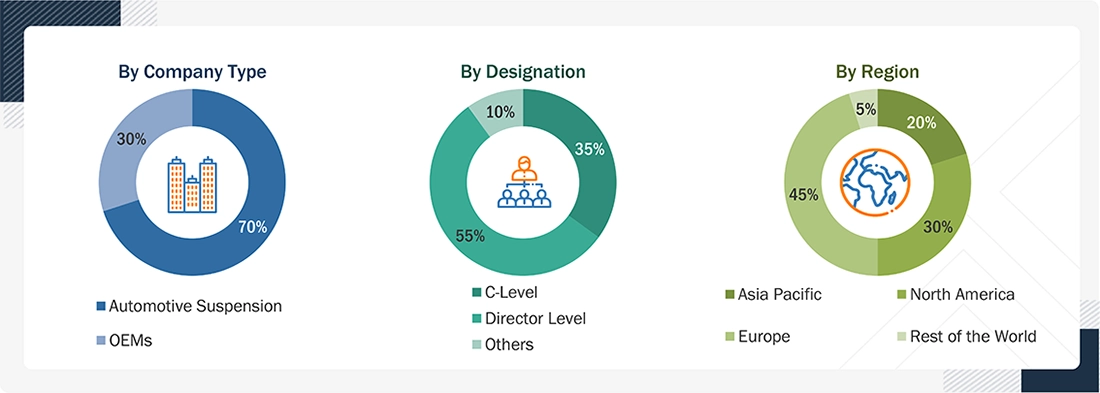
Extensive primary research was conducted after gaining an understanding of the automotive suspension market scenario through secondary research. Several primary interviews have been conducted with market experts from both the demand side (automotive OEMs) and the supply side (automotive suspension manufacturers and distributors), and players across 4 major regions, namely, North America, Europe, Asia Pacific, and the Rest of the World. Approximately 30% of primary interviews from the demand side and 70% from the supply side have been conducted. Primary data has been collected through questionnaires, emails, and telephonic interviews.
In our canvassing of primary interviews, we have strived to cover various departments within organizations, such as sales, operations, and administration, to provide a holistic viewpoint in our reports. After interacting with industry participants, we have also conducted brief sessions with highly experienced independent consultants to reinforce the findings from our primary interviews. This, along with the in-house subject-matter experts’ opinions, has led us to the findings as described in the remainder of this report.
To know about the assumptions considered for the study, download the pdf brochure
Market Size Estimation
A detailed market estimation approach was followed to estimate and validate the size of the automotive suspension market and other dependent submarkets, as mentioned below:
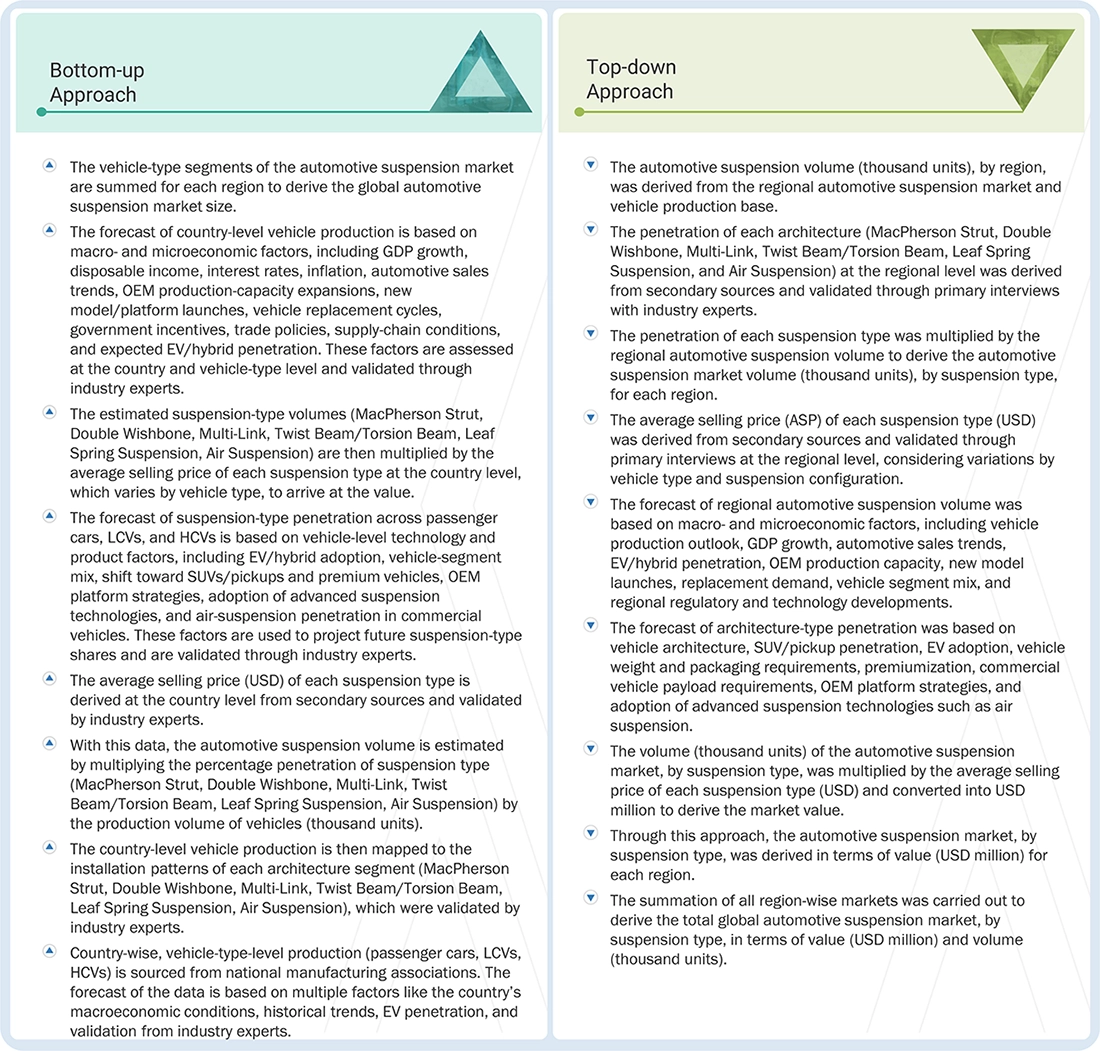
Bottom-up Approach
- Key players in the automotive suspension market were identified through secondary research, and their global market share was determined through primary and secondary research.
- The study identified the percentage penetration of major suspension types—MacPherson Strut, Double Wishbone, Multi-Link, Twist/Torsion Beam, Leaf Spring, Air Suspension, and other advanced systems—across passenger cars, LCVs, HCVs, buses, and EVs. Model-level mapping of OEM vehicles was used to determine the suspension configuration by country, vehicle type, model/variant, and powertrain.
- The suspension penetration rates for each vehicle type and country were multiplied by the corresponding vehicle production volume to calculate suspension demand in million units. These calculations were performed at the country level and aggregated to regional and global market volumes.
- All major penetration rates, vehicle-type splits, suspension-type shares, model mappings, and volume estimates were derived through secondary research and subsequently validated and refined through primary interviews with OEMs, Tier-1 suppliers, suspension manufacturers, and industry experts.
- Country-level average selling prices (ASPs) were established for each suspension type based on vehicle category, technology content, system configuration, and regional pricing. ASPs for MacPherson Strut, Double Wishbone, Multi-Link, Twist/Torsion Beam, Leaf Spring, Air Suspension, and advanced suspension systems were benchmarked through secondary research and validated through primary interviews.
- The value market was derived by multiplying the validated number of suspension units (thousand units) by the corresponding country-level ASP for each suspension type and vehicle category, followed by aggregation across countries and regions to determine the global market value.
- The summation of all country-level data for volume and value gave the global market for automotive suspension.
-
Top-down Approach
- The top-down approach was used to estimate and validate the regional size of the automotive suspension market, by suspension type (MacPherson Strut, Double Wishbone, Multi-Link, Twist Beam/Torsion Beam, Leaf Spring Suspension, and Air Suspension), in terms of volume and value.
- The global automotive suspension market was broken down into regional markets across North America, Europe, Asia Pacific, Latin America, and Middle East & Africa, based on regional vehicle production, suspension technology adoption, and market penetration.
- The market share/penetration of each suspension type was estimated at the regional level using historical installation patterns, vehicle mix, OEM fitment data, technology adoption trends, and secondary research. It was validated through primary interviews with industry experts.
- The penetration of each suspension type was multiplied by the regional vehicle production volume to estimate the automotive suspension market volume by suspension type and region.
- The average selling price (ASP) of each suspension type was derived from secondary sources, supplier/OEM pricing references, industry databases, and primary interviews, with variations considered by vehicle type and region.
- The volume of each suspension type was multiplied by its respective regional ASP to estimate the market value in USD million.
- Forecasts of the regional automotive suspension market were based on macro- and microeconomic factors, including vehicle production growth, GDP and automotive demand trends, EV/hybrid penetration, OEM production capacity, vehicle segment mix, new model launches, adoption of advanced suspension technologies, and regional regulatory and technology developments.
- The suspension-type mix forecast considered vehicle architecture changes, increasing SUV/pickup penetration, EV weight and packaging requirements, premium vehicle adoption, commercial vehicle payload requirements, and OEM adoption of air and other advanced suspension systems, supported by industry expert validation.
- The summation of region-wise markets was carried out to derive the total global automotive suspension market, by suspension type, in terms of value (USD million) and volume (thousand units).
Data Triangulation
After arriving at the overall market size of the global market through the above-mentioned methodology, this market was split into several segments and subsegments. The data triangulation and market breakdown procedures were employed, wherever applicable, to complete the overall market engineering process and arrive at the exact data for the market by value for the key segments and subsegments. The extrapolated market data was triangulated by studying various macro indicators and regional trends from both the demand and supply participants.
Market Definition
A suspension is the arrangement of shock absorbers, springs, tires, and linkages that connect a vehicle to its wheels and allow movement between the wheel and suspension components. The suspension system minimizes shocks transmitted to the vehicle body while moving over a surface. It makes the ride comfortable and keeps the tires in constant contact with the surface, regardless of contours. A suspension needs to keep the wheel in contact with the road surface to maintain the driver’s control of the vehicle.
Key Stakeholders
- Automotive suspension manufacturers
- Automotive raw material suppliers
- Automotive OEMs
- Research & Development (R&D) Centers
- Associations, forums, and alliances related to automobiles
- Automobile organizations/associations
- EV component manufacturers
- EV manufacturers
- Government agencies and policymakers
- Traders and distributors of automotive suspension
Report Objectives
- To segment and forecast the size of the automotive suspension market in terms of volume (Million Units) & value (USD million) from 2022 to 2033
- To define, describe, and forecast the automotive suspension market in terms of volume & value (USD million)
- To define, describe, and forecast the global automotive suspension market based on system, vehicle type, architecture, OE component, EV type, off-highway vehicles, ATV, and region.
- To segment and forecast the market size of the automotive suspension market by architecture (MacPherson Strut, Double Wishbone, Multilink, Twist Beam/Torsion Beam, and Air Suspension).
- To segment and forecast the market size of the automotive suspension market by vehicle type (ICE) (Passenger Car, Light Commercial Vehicle, and Heavy Commercial Vehicle)
- To segment and forecast the market size of the Electric & Hybrid Passenger Cars Suspension Market by Architecture (MacPherson Strut, Double Wishbone, Multilink, Twist Beam/Torsion Beam, and Air Suspension)
- To segment and forecast the market size of the Electric & Hybrid HCVs Suspension Market, by Vehicle Type (Trucks and Buses)
- To segment and forecast the market size of the Off-highway Vehicles Suspension Market, by Application (Construction Equipment and Agricultural Tractors)
- To segment and forecast the market size of the ATV Suspension Market by Region (Asia Pacific, Europe, and North America)
- To forecast market size by key regions, namely Asia Pacific, Europe, North America, and the Rest of the World.
- To provide detailed information regarding the major factors influencing market growth (drivers, challenges, restraints, and opportunities)
- To strategically analyze markets with respect to individual growth trends, prospects, and contributions to the total market
- To strategically profile key players and comprehensively analyze their market share and core competencies
- To study the following with respect to the market:
- Supply Chain Analysis
- Ecosystem Analysis
- Technology Analysis
- HS Code Analysis
- Case Study Analysis
- Patent Analysis
- Regulatory Landscape
- Conferences and Events
- Key Stakeholders and Buying Criteria
- Investment and Funding Scenario
- Unmet Needs and White Spaces
- Strategic Moves by Tier 1/2/3 Players
- Interconnected Markets and Cross-sector Opportunities
- Market Profitability
- To analyze opportunities for stakeholders and the competitive landscape for market leaders
- To track and analyze competitive developments such as product developments, deals, and others undertaken by the key industry participants
Available customizations:
With the given market data, MarketsandMarkets offers customizations to meet the company’s specific needs.
- Front Suspension, by architecture and vehicle type — Passenger Cars, LCVs, HCVs; MacPherson Strut, Double Wishbone, Multi-link, Torsion Beam, Leaf Spring, and Other Architectures — Country/Regional Level
- Rear Suspension, by architecture and vehicle type — Passenger Cars, LCVs, HCVs; Multi-link, Torsion Beam, Leaf Spring, Double Wishbone, MacPherson Strut, and Other Architectures — Country/Regional Level
- Passive, Semi-active, and Active Suspension, by architecture and vehicle type — Passenger Cars, LCVs, HCVs; Country/Regional Level
- Electric and Hybrid Vehicles, by vehicle type — Passenger Cars, LCVs, HCVs — Regional Level
- Off-highway Vehicles, by vehicle type and region — Construction, Agriculture, Mining, and Other Off-highway Vehicles — Regional Level
Get the Full Automotive Suspension Market Report
Full forecast, segment splits, and company analysis for all Automotive Suspension Market.
- India Automotive Suspension Market
- Japan Automotive Suspension Market
- South Korea Automotive Suspension Market
- US Automotive Suspension Market
- Mexico Automotive Suspension Market
- Canada Automotive Suspension Market
- Germany Automotive Suspension Market
- UK Automotive Suspension Market
- France Automotive Suspension Market
- Spain Automotive Suspension Market
- Italy Automotive Suspension Market
- Russia Automotive Suspension Market
- Brazil Automotive Suspension Market
- South Africa Automotive Suspension Market
- Iran Automotive Suspension Market
Need a Tailored Report?
Customize this report to your needs
Get 10% FREE Customization
Customize This Report