
Iran Automotive Filters Market (2024-2029)

The Iran Automotive Filters Market was valued at $6424.7 Million in 2024 and projected to reach to $7371.5 Million by 2029, representing a compound annual growth rate of CAGR 2.3%. Iran's automotive filters market is positioned for steady growth through 2029, driven by the continuous maintenance needs of the country's aging vehicle fleet and replacement demand cycles.


| Market Size in | USD 26.32 MN |
| Market Forecast in | |
| CAGR | |
| Forecast Period | |
| Units Considered | Value (USD MN) |
Iran Automotive Filters Market Trends and Insights
- The market in Iran reflects steady demand driven by the country's vehicle fleet maintenance requirements and aftermarket replacement cycles.
- Iran's automotive filters sector is supported by both domestic consumption and regional trade dynamics, with air, oil, and cabin filters representing core product categories serving the nation's transportation infrastructure..
Key Market Statistics
- CAGR (2024-2029) CAGR 2.3%
- Market Size, 2024 ~USD 6424.7 Million
- Forecast, 2029 ~USD 7371.5 Million
- Country Iran
Iran Automotive Filters Market Overview
Market Size & Growth :
Iran's automotive filters market is valued at USD 6,424.7 million in 2024, with projected growth to USD 7,371.5 million by 2029, representing a steady CAGR of 2.3%.
Aftermarket Demand Driver :
The market is primarily sustained by Iran's large vehicle fleet maintenance requirements and consistent aftermarket replacement cycles, ensuring stable demand for filter products.
Domestic Consumption Focus :
Iran's automotive filters sector is heavily supported by domestic consumption patterns, with local manufacturers and suppliers playing a significant role in meeting regional demand.
Moderate Growth Trajectory :
With a CAGR of 2.3%, Iran's market demonstrates steady but conservative growth compared to the global average of 2.1%, indicating resilience in the domestic automotive aftermarket.
Iran Automotive Filters Market Dynamics
- The market benefits from strong domestic consumption patterns and local manufacturing capabilities that support both OEM and aftermarket channels.
- Economic factors and vehicle ownership trends will continue to influence filter replacement rates across the region.
- The market's growth trajectory reflects Iran's automotive sector dynamics and the essential nature of filter products in vehicle maintenance, ensuring consistent demand regardless of broader economic fluctuations..
Market Ecosystem
Related Ecosystem
Automotive Materials
- Light Commercial Vehicles (LCVs)
- Battery Electric Vehicle (BEV)
- Hybrid Electric Vehicle (HEV)
- Fuel Cell Electric Vehicle (FCEV)
- Agricultural Tractors
- AISIN CORPORATION
- GORKOVSKY AVTOMOBILNY ZAVOD
- Continental ag
- Basf se
- BOSCH LIMITED
Key Takeaways
- Iran's automotive filters market is valued at USD 6,424.7 million in 2024 with projected growth to USD 7,371.5 million by 2029.
- Iran's market is expanding at a 2.3% CAGR, reflecting moderate but consistent growth in vehicle maintenance demand.
- Iran's automotive filters sector is driven by fleet maintenance cycles and aftermarket replacement needs across the country.
- Iran's market growth is supported by regional trade dynamics and domestic vehicle ownership patterns through 2029.
Automotive Filters Market Report Scope
| Report Metric | Details |
|---|---|
| Base Year | 2024 |
| Fastest Growing Segment | BRAKE DUST (Filter Type) |
| Forecast Period | 2024-2029 |
| Growth Rate | CAGR of 2.1% from 2024 to 2029 |
| Largest Segment | DPF (Filter Type) |
| Market Size Base Year (Billions) | ~USD 12.89 (2024) |
| Revenue Forecast (Billions) | ~USD 14.3 (2029) |
| Segments Covered | Filter Type, Media Type, Material Type, Fuel Type, Equipment Type, Vehicle Type |
Iran Automotive Filters Market Report Segmentation
6 segment dimensions are covered across the global market.
By Filter Type
- Air
- Brake Dust
- Cabin
- Cabin Air
- Coolant
- Cooling Air Particle
- Crankcase Ventilation
- Dpf
- Emi/Emc
- Engine Oil
- Fuel
- Gpf
- Oil
- Oil Separator
- Steering
- Transmission Oil
- Urea
By Media Type
- Cellulose
- Synthetic
By Material Type
- Activated Carbon Cabin Filters
- Electrostatic Cabin Filters
- Particle Cabin Filters
By Fuel Type
- Diesel
- Gasoline
By Equipment Type
- Agricultural Tractor
- Construction Equipment
By Vehicle Type
- Bev
- Bus
- Lcv
- Passenger Car
- Phev
- Truck
Target Audience
- Automotive Filter Manufacturers : Manufacturers need Iran-specific market data to assess production capacity requirements, identify local competition, and develop targeted distribution strategies for the region.
- Aftermarket Distributors & Retailers : Distributors require detailed market insights to optimize inventory management, forecast demand cycles, and identify growth opportunities in Iran's replacement filter segment.
- Investment & Private Equity Firms : Investors need accurate market sizing and growth projections to evaluate acquisition targets, assess market attractiveness, and determine capital allocation for Iran operations.
- OEM Supply Chain Managers : Supply chain professionals need Iran market data to plan supplier relationships, forecast component demand, and optimize sourcing strategies for local vehicle manufacturers.
- Market Research & Consulting Firms : Research professionals require Iran-specific cutout data to support client advisory services, competitive analysis, and strategic recommendations in the automotive aftermarket sector.
Reasons to Buy this Report
- Accurate Market Sizing : Obtain precise valuation data for Iran's automotive filters market with verified estimates for 2024 and 2029, enabling accurate financial forecasting and investment planning.
- Growth Trajectory Insights : Understand Iran's specific 2.3% CAGR and how it compares to global trends, helping identify market opportunities and competitive positioning within the region.
- Aftermarket Opportunity Assessment : Analyze Iran's strong aftermarket replacement cycles and domestic consumption patterns to identify revenue streams and distribution channel opportunities.
- Strategic Market Entry Planning : Leverage detailed Iran-specific data to develop market entry strategies, assess local competition, and understand domestic manufacturing and supply chain dynamics.
- Investment Decision Support : Make informed investment and expansion decisions with comprehensive market intelligence specific to Iran's automotive filters sector and its growth potential through 2029.
Frequently asked questions
What is the current size of Iran's automotive filters market?
Iran's automotive filters market is estimated at USD 6,424.7 million in 2024.
What is the projected market size for Iran's automotive filters by 2029?
Iran's automotive filters market is forecast to reach USD 7,371.5 million by 2029.
What is the growth rate of Iran's automotive filters market?
Iran's automotive filters market is growing at a compound annual growth rate of 2.3% from 2024 to 2029.
What are the main drivers of growth in Iran's automotive filters market?
Growth in Iran's market is driven by vehicle fleet maintenance requirements, aftermarket replacement cycles, and regional trade dynamics.
Which filter types dominate Iran's automotive filters market?
Air filters, oil filters, and cabin filters represent the core product categories in Iran's automotive filters market.
RESEARCH METHODOLOGY
The study involves four main activities to estimate the current size of the automotive filters market.
- Exhaustive secondary research and country-wise model mapping to collect information on automotive filter type, vehicle type, filter media type, fuel type, and automotive filter materials.
- The next step was to validate these findings, assumptions, and market analysis with industry experts across value chains through primary research.
- Bottom-up and top-down approaches were employed to estimate the complete market size for different segments considered in this study.
- After that, market breakdown and data triangulation processes were used to estimate the market size of segments and subsegments.
Secondary Research
In the secondary research process, various secondary sources were used to identify and collect information for this study. The secondary sources referred for this research study include automotive organizations such as the Organisation Internationale des Constructeurs d'Automobiles (OICA), the International Energy Agency (IEA), and the European Automobile Manufacturers' Association. The secondary sources included annual reports, press releases, and investor presentations of manufacturers; white papers, certified publications; articles from recognized authors, directories, and industry databases; and articles from recognized associations and government publishing sources.
Secondary research was used to obtain critical information about the industry's value chain, the overall pool of key players, market classification and segmentation according to industry trends to the bottom-most level, regional markets, and key developments from the market and technology-oriented perspectives.
Primary Research
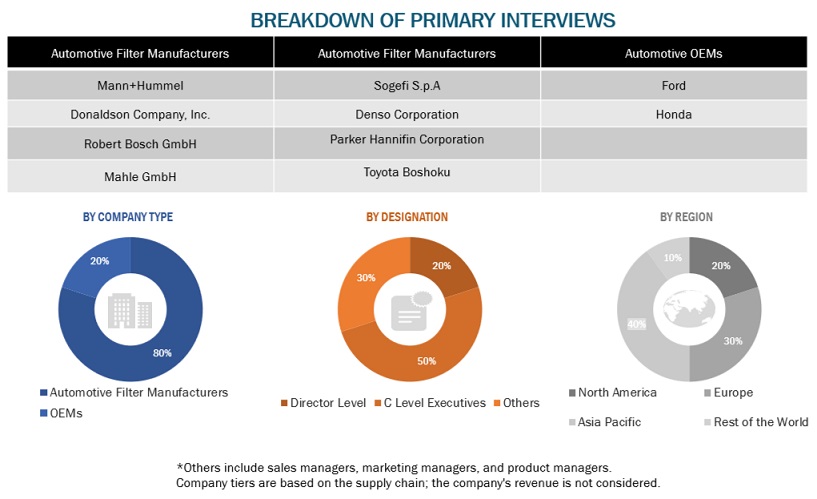
After understanding the automotive filters market scenario, extensive primary research was conducted. Several industry experts from automotive filter providers, component/system providers, and end-user organizations across four major regions, North America, Europe, Asia Pacific, and RoW, were contacted for the primary interviews. Most interviews were conducted from the supply side and some from OEMs. Primary data was collected through questionnaires, emails, and telephonic interviews. Various departments within organizations, including sales, operations, and administration, were contacted to provide a holistic viewpoint in the report while canvassing primaries. After interacting with industry participants, some brief sessions were conducted with experienced independent consultants to reinforce the findings from the primaries. This and the opinions of in-house subject matter experts led to the conclusions delineated in the rest of this report.
To know about the assumptions considered for the study, download the pdf brochure
Market Size Estimation
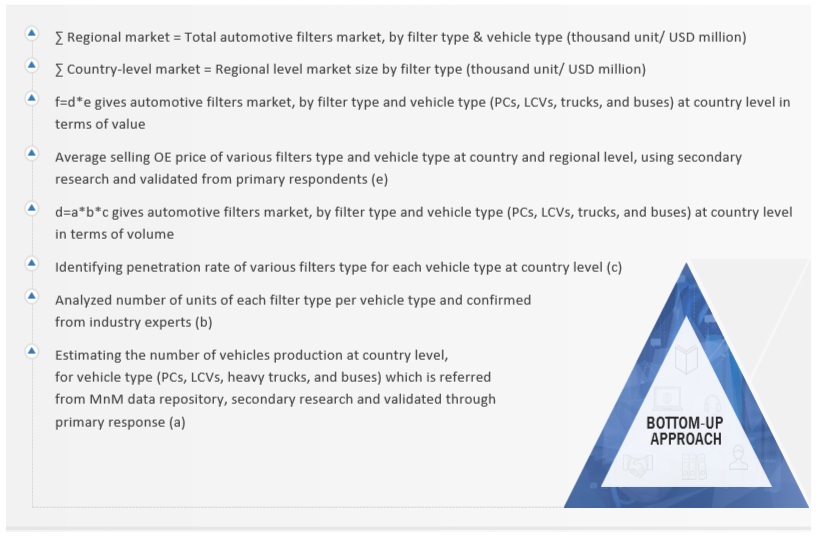
The bottom-up approach has been used to estimate and validate the size of the automotive filter market. The market size, by volume, of the automotive filters market has been derived by identifying the country-level vehicle production data (a) for each vehicle type (PCs, LCVs, trucks, and buses) and the number of units installed of different filter types per vehicle in all considered vehicle types (b) and penetration rate of each filter type in different vehicle types considered (c). Multiplying all three factors will provide the country-level market size by volume filter and vehicle type. The market size, by value, has been arrived at by multiplying the average selling OE price of filters for each vehicle type at the country level. The summation of the country-level market gives regional and global automotive filter markets by filter type and vehicle type. A similar approach is followed for the electric & hybrid vehicle filters market by vehicle type and filter types, off-highway by equipment type and filter type, and aftermarket by filter type in terms of volume and value.
Automotive Filters Market: Bottom-Up Approach
To know about the assumptions considered for the study, Request for Free Sample Report
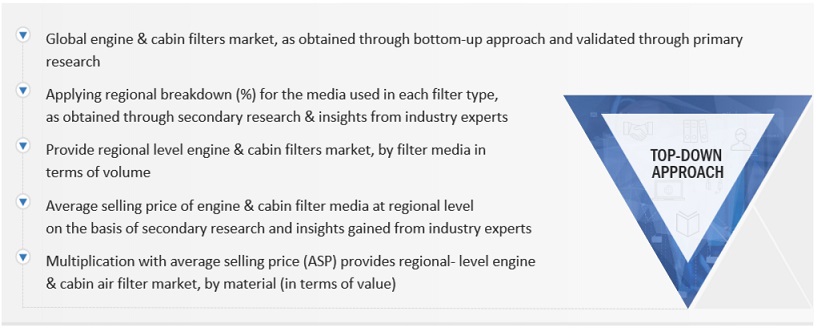
The market size of engine & cabin air filters, by material, was calculated using the top-down approach. Extensive secondary and primary research was carried out to understand the global market scenario for the types of material used in engine & cabin air filters. Several primary interviews were conducted with key opinion leaders concerning cabin air filter development, including key OEMs, Tier-I suppliers, and filter manufacturers. Qualitative aspects, such as market drivers, restraints, opportunities, and challenges, were considered while calculating and forecasting the market size.
Automotive Filters Market: Top-Down Approach
Market Definition:
Filters in a vehicle remove foreign and unwanted substances/particles, which can cause severe damage to the vehicle system or human health. Some automotive filters include air filters, oil filters, brake dust filters, steering filters, cabin air filters, fuel filters, and coolant filters.
According to Mann+Hummel, a renowned automotive filter market player, combustion air always contains particles that should not be allowed to penetrate the inside of the engine. Therefore, applying air filters is essential to protect the engine and its components.
Stakeholders:
- Automotive OEMs
- Filters Manufacturers
- Component and Raw Material Suppliers of Automotive Filters
- On-highway and Off-highway Vehicle Manufacturers
- Automotive Component Providers
- Filters Design Companies
- Automobile Organizations/Associations
- Traders, Distributors, and Suppliers of Automotive Filters
- Legal and Regulatory Authorities
- Dealers, Distributors, and Retailers
- Associations, Forums, and Alliances Related to ICE and Electric Vehicles
- Government Agencies and Policymakers
- Automobile Organizations/Associations
Report Objectives
-
To define, describe, and forecast the automotive filters market based on
- Filter types (air filters, fuel filters, oil filters, oil separators, transmission oil filters, coolant filters, steering filters, brake dust filters, cabin filters, urea filters, DPF (Diesel Particulate Filters), GPF (Gasoline Particulate Filters), and crankcase ventilation filters)
- Air filter by media type (cellulose and synthetic)
- Cabin filter by material type (particle cabin filters, activated carbon filters, and electrostatic cabin filters)
- Fuel filter by fuel type (gasoline filters and diesel filters)
- Automotive Filter Aftermarket, by Filter Type (oil filters, fuel filters, air filters, cabin filters, coolant filters, and transmission oil filters)
- Automotive Filters Market by vehicle type (passenger cars, light commercial vehicles, buses, and trucks)
- Electric & hybrid vehicle filters market by vehicle type (BEV (battery electric vehicle) and PHEV (Plug-in hybrid electric vehicle)
- Electric & hybrid vehicle filters market by filter type (air filters, fuel filters, oil filters, transmission oil filters, EMI/EMC filters, brake dust filters, cabin filters, cooling air particle filters)
- Off-highway filters market by equipment type (agriculture tractors and construction equipment)
- Off-highway filters market by filter type (fuel filters, engine oil filters, air filters, cabin air filters, and transmission oil filters)
- By Region [Asia Pacific (China, India, Japan, South Korea, Thailand, and Rest of Asia Pacific), Europe (France, Germany, Russia, Spain, Turkey, the UK, and Rest of Europe), North America (Canada, Mexico, US) and RoW (Iran, Brazil, and Others in RoW)
- To provide detailed information about significant factors influencing the growth of the market (drivers, restraints, opportunities, and industry-specific challenges)
- To evaluate the opportunities in the market for stakeholders and provide details of the competitive landscape for market leaders
- To strategically profile key players and comprehensively analyze their market shares and core competencies
- To strategically analyze the key player strategies/right to win
- To study the market with supply chain analysis, ecosystem analysis, trade analysis, case study analysis, pricing analysis, patent analysis, trends/disruptions impacting buyers, technology trends, regulatory analysis, and recession impact analysis
- Analyzing the competitive leadership mapping of the global automotive filter manufacturers in the market and understanding their market position with the help of a company evaluation matrix.
- To track and analyze competitive developments, such as joint ventures, collaborations, partnerships, mergers & acquisitions, new product developments, and expansions, in the automotive filters market
Available Customizations
With the given market data, MarketsandMarkets offers customizations based on the company’s needs.
Automotive Filters Market By Sales Channel (Region Level)
- Aftermarket
- OEM
Automotive Filters Market By Ice Vehicle Type (Country Level)
- Passenger Cars
- LCVs
- Trucks
- Buses
Electric And Hybrid Vehicle Filters Market, By Filter Type And Vehicle Type
- Oil Filters
- Fuel Filters
- Air Filters
- Cabin Filters
- Transmission Oil Filters
- Brake Dust Filters
- EMI/EMC Filters
- Cooling Air Particle Filters
Note: Asia Pacific (China, India, Japan, South Korea, Thailand, and others); Europe (France, Germany, Russia, Spain, Turkey, the UK, and others); North America (Canada, Mexico, the US) and RoW (Iran, Brazil, and others)
Get the Full Automotive Filters Market Report
Full forecast, segment splits, and company analysis for all Automotive Filters Market.
- France Automotive Filters Market
- Italy Automotive Filters Market
- UK Automotive Filters Market
- Spain Automotive Filters Market
- Turkey Automotive Filters Market
- Russia Automotive Filters Market
- Canada Automotive Filters Market
- Mexico Automotive Filters Market
- US Automotive Filters Market
- Brazil Automotive Filters Market
- Rest Of Europe Automotive Filters Market
- Rest Of Asia Pacific Automotive Filters Market
- China Automotive Filters Market
- India Automotive Filters Market
- Japan Automotive Filters Market
- South Korea Automotive Filters Market
- Thailand Automotive Filters Market
- Germany Automotive Filters Market
Need a Tailored Report?
Customize this report to your needs
Get 10% FREE Customization
Customize This Report
