
South Korea Automotive Piston Market (2025-2030)

The South Korea Automotive Piston Market was valued at $100476 Million in 2025 and projected to reach to $98120 Million by 2030, representing a compound annual growth rate of -0.2%. South Korea's automotive piston market faces headwinds as the nation accelerates its transition to electric vehicles, a strategic priority for major domestic manufacturers.


| Market Size in | USD 26.32 MN |
| Market Forecast in | |
| CAGR | |
| Forecast Period | |
| Units Considered | Value (USD MN) |
South Korea Automotive Piston Market Trends and Insights
- This contraction in South Korea signals structural shifts in the domestic automotive sector, driven by the accelerating transition toward electric vehicles and reduced demand for traditional internal combustion engine components.
- Despite South Korea's strong automotive manufacturing heritage, the country faces headwinds as major OEMs pivot investment toward EV powertrains and battery technologies. The decline in South Korea's piston market reflects broader industry consolidation and technological displacement.
- South Korea's automotive suppliers are increasingly focusing on electrification-related components rather than conventional engine parts, reshaping the competitive landscape.
- Market participants in South Korea must adapt to changing OEM requirements and invest in next-generation technologies to remain competitive as the forecast period extends through 2030..
Key Market Statistics
- CAGR (2025-2030) -0.2%
- Market Size, 2025 ~USD 100476 Million
- Forecast, 2030 ~USD 98120 Million
- Country South Korea
South Korea Automotive Piston Market Overview
Negative Growth Trajectory :
South Korea's automotive piston market is contracting with a -0.2% CAGR from 2025 to 2030, declining from USD 100,476 million to USD 98,120 million, reflecting structural challenges in the domestic ICE sector.
EV Transition Impact :
The shift toward electric vehicles in South Korea is significantly reducing demand for traditional internal combustion engine components, including pistons, as major manufacturers pivot their production strategies.
Market Underperformance :
South Korea's negative CAGR contrasts sharply with the global market's positive 1.3% CAGR, indicating the country faces unique headwinds compared to other automotive markets worldwide.
Structural Sector Shifts :
The domestic automotive industry is undergoing fundamental transformation, with reduced ICE vehicle production and component demand reshaping the piston market landscape through 2030.
South Korea Automotive Piston Market Dynamics
- The projected decline to USD 98,120 million by 2030 reflects diminishing demand for traditional internal combustion engine components as electrification gains momentum across the sector. Despite global market growth, South Korea's negative trajectory presents both challenges and opportunities for market participants.
- Suppliers must adapt by investing in EV-compatible technologies, exploring adjacent markets, and optimizing production efficiency.
- The market contraction will likely consolidate the supplier base, favoring companies with diversified portfolios and innovation capabilities in emerging automotive technologies..
Market Ecosystem

Related Ecosystem
Engine Engine System Exhaust
- Light Commercial Vehicles (LCVs)
- Agricultural Tractors
- Battery Electric Vehicle (BEV)
- Hybrid Electric Vehicle (HEV)
- Sensors
- TENNECO
- GORKOVSKY AVTOMOBILNY ZAVOD
- Titan Company Limited
- AISIN CORPORATION
- TI AUTOMOTIVE
Key Takeaways
- South Korea's automotive piston market will contract from USD 100.5B (2025) to USD 98.1B (2030) at a -0.2% CAGR.
- Electric vehicle adoption in South Korea is displacing traditional internal combustion engine piston demand.
- South Korea's automotive suppliers are redirecting capital toward EV and battery component manufacturing.
- Market participants in South Korea must innovate beyond conventional piston technology to sustain competitiveness.
Automotive Piston Market Report Scope
| Report Metric | Details |
|---|---|
| Base Year | 2025 |
| Fastest Growing Segment | ALTERNATE FUELS (Fuel Type) |
| Forecast Period | 2025–2030 |
| Growth Rate | CAGR of 1.3% from 2025 to 2030 |
| Largest Segment | ALUMINUM (Material Type) |
| Market Size Base Year (Billions) | ~USD 2.44 (2025) |
| Revenue Forecast (Billions) | ~USD 2.61 (2030) |
| Segments Covered | Vehicle Type, Fuel Type, Material Type, Shape, Coating, Component |
South Korea Automotive Piston Market Report Segmentation
6 segment dimensions are covered across the global market.
By Vehicle Type
- Heavy Commercial Vehicles
- Light Commercial Vehicles
- Passenger Cars
By Fuel Type
- Alternate Fuel
- Alternate Fuels
- Alternate Fuelss
- Biodiesel
- Diesel
- E-Fuel
- Ethanol
- Gasoline
By Material Type
- Aluminum
- Steel
By Shape
- Bowl
- Dome
- Flat -Top
By Coating
- Dry Film Lubricant Coating
- Oil Shedding Coating
- Thermal Barrier Coating
By Component
- Piston Head
- Piston Heads
- Piston Pin
- Piston Pins
- Piston Ring
- Piston Rings
Target Audience
- Automotive Component Suppliers : Piston manufacturers and suppliers need South Korea-specific data to adjust production capacity, evaluate market viability, and plan technology transitions amid declining ICE demand.
- OEM Strategy Teams : Original equipment manufacturers operating in South Korea require localized market insights to optimize component sourcing, supplier relationships, and production planning decisions.
- Investment & Private Equity Firms : Investors evaluating automotive sector opportunities in South Korea need precise market forecasts and trend analysis to assess portfolio companies and identify acquisition targets.
- Market Entry & Expansion Teams : Companies considering South Korea market entry or expansion require detailed market sizing, competitive landscape analysis, and growth projections to validate business cases.
- Industry Consultants & Analysts : Consulting firms and research professionals need comprehensive South Korea market data to support client advisory work, competitive benchmarking, and strategic recommendations.
Key Companies in the South Korea Automotive Piston Market
| Company | HQ | Ownership | Strongest segments |
|---|---|---|---|
| GAZ | Russia | Public Company | Fuel-type mix influence (gasoline vs diesel vs gas engines),Upstream feedstock for piston materials (steel, aluminum),Power generation for automotive manufacturing hubs, |
| THYSSENKRUPP AG | Germany | Public Company | Flat-top pistons (mainly aluminum, OEM),Bowl and dome pistons for diesel and high-compression engines,Steel pistons and high-duty applications, |
| NEXTEER AUTOMOTIVE GROUP LIMITED | China | Public Company | Flat-top pistons (all materials, coatings),Bowl and dome pistons for performance and commercial ICE,Aluminum pistons with advanced coatings, |
| NOVELIS, INC | United States | Private Company | Aluminum piston feedstock (sheet, billet, specialty alloys),Coating-compatible aluminum substrates,Piston component stock (pins, rings, heads interfaces), |
| ALCOA INC | United States | Public Company | Aluminum feedstock for piston heads (flat-top, bowl, dome),Aluminum for piston pins and rings,Specialty aluminum powders for coatings and thermal barriers, |
| MAHLE GMBH | Germany | Private Company | Aluminum pistons (flat-top/bowl/dome),Steel pistons (mainly bowl/dome),Coated pistons (thermal barrier, dry film, oil shedding), |
| TENNECO INC. | United States | Private Company | Aluminum pistons and assemblies (flat-top, bowl, dome),Steel pistons and high-load assemblies,Piston rings and pins, |
| AISIN CORPORATION | Japan | Public Company | Flat-top aluminum pistons,Bowl pistons (aluminum and steel),Dome pistons and performance variants, |
| SHRIRAM PISTONS | India | Public Company | Flat-top pistons,Bowl pistons,Dome pistons, |
| NPR-RIKEN CORPORATION | Japan | Public Company | Piston rings (all shapes, coatings, and fuel types),Cylinder liners and valve seat inserts,Piston-related casting parts and heads, |
| HIRSCHVOGEL GROUP | Germany | Private Company | Pins,Rings,Heads, |
| C.S. PISTON (THAILAND) CO., LTD. | Thailand | Flat-top aluminum pistons,Bowl and dome aluminum pistons,Piston rings, | |
| PT ASTRA OTOPARTS TBK. | Indonesia | Public Company | Aluminum flat-top pistons (two-wheeler and small passenger vehicles),Aluminum bowl and dome pistons (light commercial and higher-compression engines),Steel pistons and heavy-duty applications, |
GAZ
GAZ is a Russian public company founded in 1993 with 468,000 employees, making it a major industrial enterprise in Russia.
THYSSENKRUPP AG
ThyssenKrupp AG is a German public company established in 1811 with 90,916 employees, operating as a diversified industrial conglomerate.
NEXTEER AUTOMOTIVE GROUP LIMITED
Nexteer Automotive Group Limited is a Chinese public company founded in 1906 with 12,500 employees, specializing in automotive components.
NOVELIS, INC
Novelis, Inc. is a United States-based private company founded in 2004 with 13,250 employees.
ALCOA INC
Alcoa Inc. is a United States public company established in 1886 with 14,900 employees, operating as a major industrial manufacturer.
MAHLE GMBH
Mahle GmbH is a German private company established in 1920 with 61,729 employees, operating as a major industrial enterprise.
TENNECO INC.
Tenneco Inc. is a United States private company founded in 1930 with 71,000 employees.
AISIN CORPORATION
Aisin Corporation is a Japanese public company established in 1943 with 113,292 employees, operating as a major automotive supplier.
SHRIRAM PISTONS
Shriram Pistons is an Indian public company founded in 1963.
NPR-RIKEN CORPORATION
NPR-Riken Corporation is a Japanese public company founded in 2023 with 6,511 employees.
HIRSCHVOGEL GROUP
Hirschvogel Group is a German private company founded in 1938.
C.S. PISTON (THAILAND) CO., LTD.
C.S. Piston (Thailand) Co., Ltd. is a Thailand-based company.
PT ASTRA OTOPARTS TBK.
PT Astra Otoparts Tbk. is an Indonesian public company founded in 1976 with 6,914 employees.
Reasons to Buy this Report
- Localized Market Intelligence : Gain country-specific insights into South Korea's unique automotive piston market dynamics, including EV transition impacts and local manufacturer strategies unavailable in global reports.
- Competitive Positioning Strategy : Understand South Korea's contracting market landscape to identify consolidation opportunities, supplier partnerships, and strategic positioning before competitors capitalize on market shifts.
- Investment Decision Support : Make informed capital allocation decisions with precise South Korea market forecasts, growth trajectories, and risk assessments through 2030 for automotive component investments.
- Supply Chain Optimization : Optimize sourcing and manufacturing strategies by understanding South Korea's declining ICE demand, enabling proactive supply chain restructuring and cost management initiatives.
- Technology Transition Planning : Identify emerging opportunities in EV-compatible piston technologies and alternative applications as South Korea's market evolves, positioning your organization for future growth segments.
Frequently asked questions
What is the current size of South Korea's automotive piston market?
South Korea's automotive piston market is valued at USD 100,476 million in 2025 according to verified KS table data.
What is the forecast for South Korea's piston market by 2030?
South Korea's automotive piston market is projected to reach USD 98,120 million by 2030, representing a decline from 2025 levels.
Why is South Korea's piston market declining?
South Korea's market contraction is driven by accelerating EV adoption, reduced ICE component demand, and OEM investment shifts toward electrification technologies.
What is the CAGR for South Korea's automotive piston market?
South Korea's automotive piston market exhibits a negative CAGR of -0.2% from 2025 to 2030.
How are South Korea's suppliers responding to market decline?
South Korea's automotive suppliers are pivoting toward EV components, battery technologies, and next-generation powertrains to offset traditional piston market contraction.
RESEARCH METHODOLOGY
The study encompassed four primary tasks to determine the present and future scope of the automotive piston market. Initially, extensive secondary research was conducted to gather data on the market, its related sectors, and overarching industries. Subsequently, primary research involving industry experts across the value chain corroborated and validated these findings and assumptions. The complete market size was estimated by using both top-down and bottom-up methodologies. Following this, a market breakdown and data triangulation approaches were utilized to determine the size of specific segments and subsegments within the market.
Secondary Research
The secondary sources referred to for this research study include auto industry organizations (such as OICA), corporate filings (such as annual reports, investor presentations, and financial statements), and trade, business, and automotive associations. The secondary data was collected and analyzed to determine the overall market size, which was further validated through primary research.
Primary Research
Extensive primary research was conducted after understanding the automotive piston system market scenario through secondary research. Several primary interviews were conducted with market experts from the demand (OEM) and supply side (automotive piston manufacturers and distributors) players across four major regions—namely, North America, Europe, Asia Pacific, and the Rest of the World. Approximately 30% of primary interviews were conducted on the demand side and 70% on the supply side.
Primary data was collected through questionnaires, mail, and telephonic interviews. In the canvassing of primaries, various departments within organizations, such as sales, operations, administration, and so on, were covered to provide a holistic viewpoint in the report.
After interacting with industry participants, brief sessions were conducted with highly experienced independent consultants to reinforce the findings from the primaries. This and the opinions of the in-house subject matter experts led to the findings described in the remainder of this report.
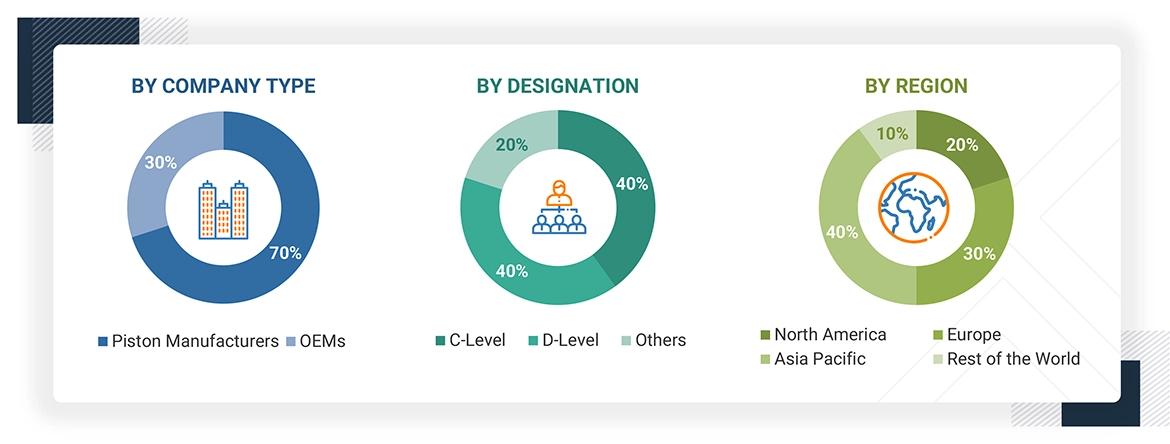
Note 1: Others include sales managers, marketing managers, and product managers.
Note 2: Tier 1 companies’ revenues are more than USD 10 billion; tier 2 companies’ revenues range between USD 1 and 10 billion; and tier 3 companies’ revenues range between USD 500 million and USD 1 billion.
Source: Industry Experts
To know about the assumptions considered for the study, download the pdf brochure
Market Size Estimation
Both top-down and bottom-up approaches were used to estimate and validate the total size of the automotive piston market. These methods were also used extensively to estimate the size of various subsegments in the market. The research methodology used to estimate the market size includes the following:
Bottom-up Approach
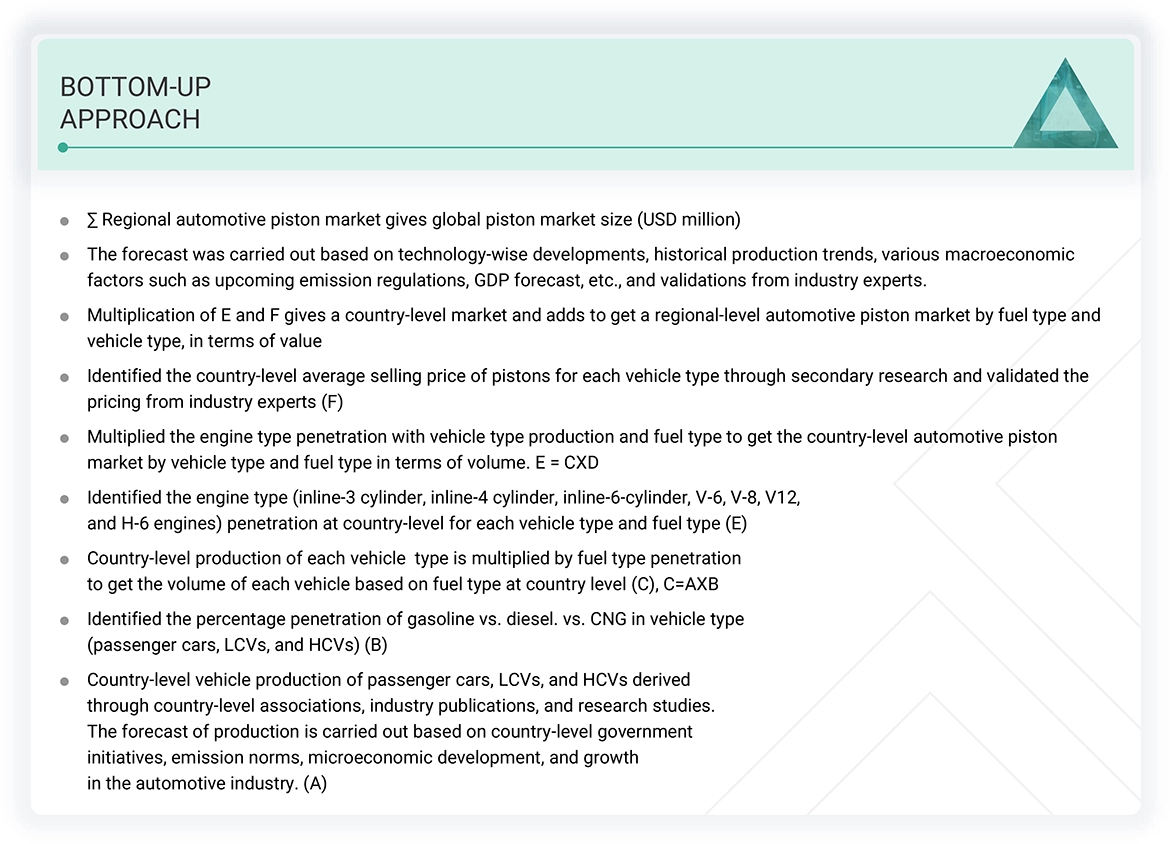
The global market size was estimated and validated using a bottom-up approach, analyzing country-level vehicle production (passenger cars, LCVs, HCVs) through industry associations and OICA. Market forecasts are based on macroeconomic indicators, emissions regulations, industry growth, GDP, and government initiatives. Piston market volume was calculated by multiplying vehicle production by country-specific fuel type distribution (diesel, gasoline, alternative), then further multiplied by engine configuration penetration (inline-3/4/5/6, V-6/8/12, H-6) identified through model mapping, giving the country-level automotive piston market volumes by fuel type.
Further, the country-level piston market size, by volume, was multiplied by the country-level average OE price (AOP) of each fuel type for each vehicle type to get the country-level piston market by fuel type in terms of value.
The summation of the country-level market gives the regional market; further summation of the regional market provides the global automotive piston market by fuel type. A similar methodology was followed for the automotive piston market by vehicle type (passenger cars, LCVs, HCVs).
Automotive Piston Market : Bottom-Up Approach
Data Triangulation
All percentage shares, splits, and breakdowns were determined using secondary sources and verified through primary sources. All parameters that are said to affect the markets covered in this research study were accounted for, viewed in extensive detail, verified through primary research, and analyzed to obtain the final quantitative and qualitative data. This data was consolidated, supplemented with detailed inputs and analysis from MarketsandMarkets, and presented in the report.
Market Definition
Pistons are essential components in internal combustion engines that transform combustion's thermal energy into mechanical work. Sealed within cylinders by piston rings, they maintain gas-tight conditions while transferring expansion force to the crankshaft via connecting rods, enabling the engine's power generation process.
The main functions of the piston are: -
- To transmit the gas forces via a connecting rod to the crankshaft.
- To seal the clearance between piston rings and cylinder liner against gas leakage to the crankcase and prevent oil infiltration into the combustion chamber.
Stakeholders
- Automotive component manufacturers
- Associations, forums, and alliances related to automobiles
- Automotive original equipment manufacturers
- Automotive investors
- Manufacturers of automotive piston systems
- Raw material suppliers for automotive piston systems
- Traders, distributors, and suppliers of automotive piston systems
- The automotive industry as an end-use industry and regional automobile associations
- Government agencies and policymakers
Report Objectives
-
To define, describe, and forecast the size of the automotive piston market in terms of value (USD million) and volume (thousand units) based on the following segments:
- By Component (Piston Heads, Piston Rings, and Piston Pins)
- By Coating (Dry Film Lubricant, Thermal Barrier, and Oil Shedding)
- By Shape (Flat-top Pistons, Bowl Pistons, and Dome Pistons)
- By Vehicle Type (Passenger Vehicles, Light Commercial Vehicles, and Heavy Commercial Vehicles)
- By Fuel Type (Gasoline, Diesel, and Alternate Fuels)
- By Material (Steel and Aluminum)
- By Aftermarket Component ( Piston Heads, Piston Rings, and Piston Pins)
- By Region (Asia Pacific, Europe, North America, and Rest of the World)
- To understand the market dynamics (drivers, restraints, opportunities, and challenges)
- To analyze the share of key players operating in the market
- To analyze the competitive landscape and prepare a competitive leadership mapping for the global market players
- To analyze recent developments, alliances, joint ventures, mergers & acquisitions, new product launches, and other activities carried out by key industry participants in the market
-
To study the following with respect to the market
- Trends and Disruptions Impacting Customer Business
- Ecosystem Analysis
- Technology Analysis
- Supply Chain Analysis
- Patent Analysis
- Regulatory Landscape
- Case Study Analysis
- Key Stakeholders and Buying Criteria
- Key Conferences and Events
- Trade Analysis
- Pricing Analysis
- To analyze the supplier analysis of the market to understand the OEM-wise piston suppliers
- To analyze and give MnM insights on the impact of biofuel & e-fuel-based vehicles on automotive pistons
- To strategically profile key players and analyze their strategies and core competencies
Available Customizations
Along with the market data, MarketsandMarkets offers customizations per company-specific needs.
The following customization options are available for the report:
AUTOMOTIVE PISTON MARKET, BY COUNTRY AND VEHICLE TYPE
- Passenger Cars
- LCVs
- HCVs
Note: This market will be provided at the country level in terms of volume and value.
AUTOMOTIVE PISTON AFTERMARKET, BY COUNTRY AND COMPONENT
- Piston Heads
- Piston Rings
- Piston Pins
Note: This market will be provided at the country level in terms of volume and value.
AUTOMOTIVE PISTON MARKET, BY COUNTRY AND COMPONENT
- Piston Heads
- Piston Rings
- Piston Pins
Note: This market will be provided at the country level in terms of volume and value.
Get the Full Automotive Piston Market Report
Full forecast, segment splits, and company analysis for all Automotive Piston Market.
- China Automotive Piston Market
- India Automotive Piston Market
- Japan Automotive Piston Market
- Germany Automotive Piston Market
- UK Automotive Piston Market
- France Automotive Piston Market
- Spain Automotive Piston Market
- Mexico Automotive Piston Market
- Canada Automotive Piston Market
- US Automotive Piston Market
- Rest Of Europe Automotive Piston Market
- Rest Of Asia Pacific Automotive Piston Market
Need a Tailored Report?
Customize this report to your needs
Get 10% FREE Customization
Customize This Report
