
Japan Automotive Telematics Market (2025-2030)

The Japan Automotive Telematics Market was valued at $1035.1 Million in 2025 and projected to reach to $2036.4 Million by 2030, representing a compound annual growth rate of 10.1%. Japan's automotive telematics market is poised for accelerated expansion through 2030, driven by increasing consumer preference for connected vehicle solutions and stringent safety regulations.


| Market Size in | USD 26.32 MN |
| Market Forecast in | |
| CAGR | |
| Forecast Period | |
| Units Considered | Value (USD MN) |
Japan Automotive Telematics Market Trends and Insights
- Japan's market is growing at a compound annual growth rate (CAGR) of 10.1%, outpacing global averages and reflecting strong demand for connected vehicle technologies.
- Japan's automotive manufacturers and consumers are increasingly adopting telematics solutions for fleet management, vehicle diagnostics, and driver safety monitoring. The expansion of Japan's telematics market is driven by regulatory mandates, rising vehicle connectivity standards, and consumer preference for advanced in-vehicle services.
- Japan's aging population and labor shortages are accelerating adoption of autonomous and connected vehicle technologies across commercial and passenger segments.
- By 2030, Japan is expected to solidify its position as a leading telematics market in Asia Pacific, supported by investments in 5G infrastructure and smart mobility ecosystems. Japan's automotive industry, comprising major global OEMs and suppliers, continues to innovate in telematics platforms and data analytics capabilities.
- Japan's market growth reflects both domestic demand and the country's role as a technology export hub for connected vehicle solutions across regional markets..
Key Market Statistics
- CAGR (2025-2030) 10.1% CAGR
- Market Size, 2025 ~USD 1035.1 Million
- Forecast, 2030 ~USD 2036.4 Million
- Country Japan
Japan Automotive Telematics Market Overview
Market Valuation & Growth :
Japan's automotive telematics market is valued at USD 1,035.1 million in 2025, with a robust CAGR of 10.1% through 2030, significantly outpacing the global growth rate of 7.6%.
Connected Vehicle Adoption :
Japanese automotive manufacturers are leading the adoption of connected vehicle technologies, driven by consumer demand for advanced safety, navigation, and vehicle diagnostics features.
Forecast Expansion :
The market is projected to reach USD 2,036.4 million by 2030, nearly doubling in value over five years and reflecting Japan's commitment to automotive innovation and digital transformation.
Regional Leadership :
Japan's telematics market growth rate exceeds global averages, positioning the country as a key driver of innovation in connected automotive technologies within the Asia-Pacific region.
Japan Automotive Telematics Market Dynamics
- Japanese OEMs are investing heavily in IoT integration, real-time vehicle monitoring, and predictive maintenance capabilities to enhance customer experience and operational efficiency.
- The market's 10.1% CAGR reflects strong domestic demand and the country's technological leadership in automotive innovation. Government initiatives promoting smart mobility and autonomous vehicle development further support market growth.
- Integration of 5G technology and AI-powered analytics will enable advanced telematics services, including enhanced navigation, vehicle health monitoring, and emergency response systems.
- Japan's aging population and urbanization trends create additional opportunities for mobility solutions, positioning the country as a critical market for telematics innovation and investment through the forecast period..
Market Ecosystem
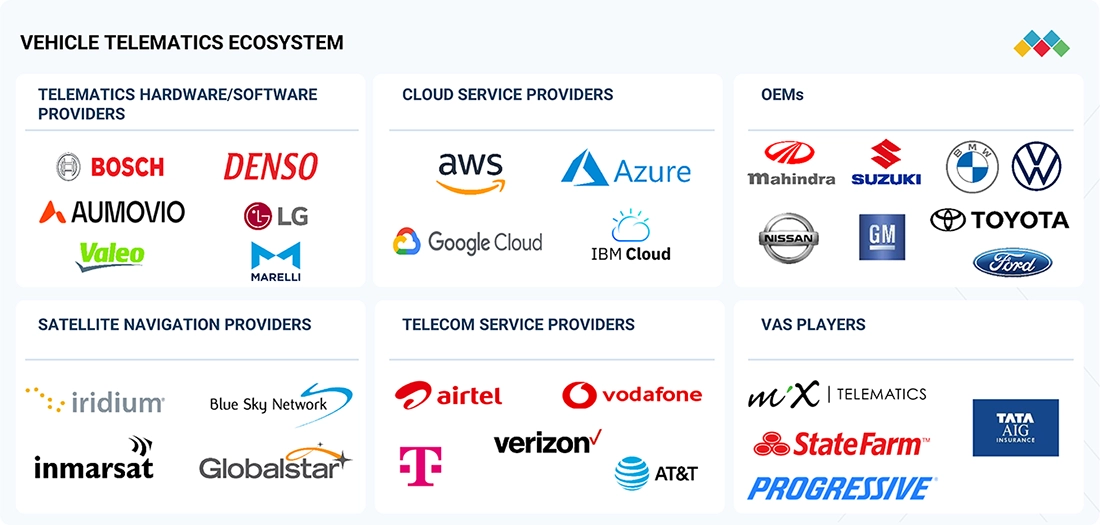
VEHICLE TELEMATICS MARKET: COMMERCIAL USE CASES ACROSS INDUSTRIES
| COMPANY | USE CASE DESCRIPTION | BENEFITS |
|---|---|---|
 |
Provides cloud-based telematics solutions for logistics, transportation, and commercial fleets, enabling real-time vehicle tracking, driver behavior monitoring, and predictive maintenance | Improves fleet utilization, reduces fuel consumption, minimizes downtime, and enhances driver safety |
 |
Delivers telematics platforms for fleet operators with GPS tracking, route optimization, vehicle diagnostics, and asset monitoring | Lowers operating costs, improves delivery efficiency, and enhances fleet visibility |
 |
Integrates telematics control units (TCUs) with connected car platforms supporting eCall, OTA updates, navigation, and infotainment services | Enhances connected vehicle experience, enables remote diagnostics, and supports software-defined vehicles |
 |
Supplies connected telematics solutions for passenger vehicles and commercial fleets, including predictive maintenance and remote vehicle diagnostics | Reduces maintenance costs, improves vehicle uptime, and enables data-driven fleet management |
 |
Provides telematics solutions for trucking, construction, and transportation fleets with route planning and compliance management | Optimizes logistics operations, improves regulatory compliance, and reduces fuel expenses |
Logos and trademarks shown above are the property of their respective owners. Their use here is for informational and illustrative purposes only.
Related Ecosystem
Automotive Advance Technologies
- Battery Electric Vehicle (BEV)
- Light Commercial Vehicles (LCVs)
- Fuel Cell Electric Vehicle (FCEV)
- Hybrid Electric Vehicle (HEV)
- Internal Combustion Engine (ICE)
- BOSCH LIMITED
- Continental ag
- Visteon Corporation
- DENSO Corporation
- ZF FRIEDRICHSHAFEN AG
Automotive Electronics And Electrical Equipment
- Battery Electric Vehicle (BEV)
- Light Commercial Vehicles (LCVs)
- Fuel Cell Electric Vehicle (FCEV)
- Sensors
- Hybrid Electric Vehicle (HEV)
- BOSCH LIMITED
- Continental ag
- DENSO Corporation
- Panasonic Holdings Corporation
- Texas Instruments Incorporated
Automotive Systems
- Light Commercial Vehicles (LCVs)
- Battery Electric Vehicle (BEV)
- Hybrid Electric Vehicle (HEV)
- Agricultural Tractors
- Fuel Cell Electric Vehicle (FCEV)
- BOSCH LIMITED
- DENSO Corporation
- ZF FRIEDRICHSHAFEN AG
- Continental ag
- GORKOVSKY AVTOMOBILNY ZAVOD
Key Takeaways
- Japan's automotive telematics market will nearly double from USD 1,035.1M (2025) to USD 2,036.4M (2030), driven by 10.1% CAGR growth.
- Japan's regulatory environment and 5G infrastructure investments are accelerating telematics adoption across passenger and commercial vehicle segments.
- Japan's aging demographics and labor shortages are propelling demand for autonomous and connected vehicle technologies with advanced telematics capabilities.
- Japan's major automotive OEMs are leveraging telematics for competitive differentiation in global markets while addressing domestic mobility challenges.
Automotive Telematics Market Report Scope
| Report Metric | Details |
|---|---|
| Base Year | 2025 |
| Fastest Growing Segment | INSURANCE RISK ASSESSMENT (Service) |
| Forecast Period | 2025-2030 |
| Growth Rate | CAGR of 7.6% from 2025 to 2030 |
| Largest Segment | EMBEDDED (Form Type) |
| Market Size Base Year (Billions) | ~USD 10.01 (2025) |
| Revenue Forecast (Billions) | ~USD 14.44 (2030) |
| Segments Covered | Vehicle Type, Form Type, Offering, Connectivity, Fleet Management Service, Service |
Japan Automotive Telematics Market Report Segmentation
6 segment dimensions are covered across the global market.
By Vehicle Type
- Bev
- Bus
- Emergency Calling
- Fcev
- Heavy Commercial Vehicle
- Insurance Risk Assessment
- Light Commercial Vehicle
- On-Road Assistance
- Passenger Car
- Phev
- Remote Diagnostics
- Stolen Vehicle Assistance
- Truck
By Form Type
- Embedded
- Integrated
By Offering
- Hardware
- Software
By Connectivity
- Cellular
- Satellite
By Fleet Management Service
- Fleet Analytics And Reporting
- Operations Management
- Vehicle Maintenance And Diagnostics
By Service
- Emergency Calling
- Insurance Risk Assessment
- On-Road Assistance
- Remote Diagnostics
- Stolen Vehicle Assistance
Target Audience
- Automotive OEMs : Japanese and international car manufacturers need market intelligence to develop connected vehicle strategies, allocate R&D budgets, and launch telematics services aligned with Japan's high-growth market demands.
- Technology & Software Providers : Telematics platform developers, IoT solution providers, and software companies require Japan-specific market data to identify partnership opportunities with OEMs and develop localized offerings.
- Investment & Private Equity Firms : Investors evaluating automotive technology opportunities need comprehensive Japan market analysis to assess growth potential, competitive landscape, and exit opportunities in the telematics sector.
- Telecommunications Companies : 5G and connectivity providers require detailed market insights to understand telematics adoption rates, service requirements, and revenue opportunities in Japan's connected vehicle ecosystem.
- Automotive Suppliers & Tier-1s : Component manufacturers and system integrators need Japan market forecasts to plan production capacity, develop telematics-compatible products, and secure contracts with OEMs.
Reasons to Buy this Report
- Market Size & Growth Validation : Obtain precise valuation data for Japan's telematics market (USD 1,035.1M in 2025) with verified 10.1% CAGR projections through 2030 to support strategic planning and investment decisions.
- Competitive Benchmarking : Analyze Japan's market performance against global benchmarks (7.6% CAGR) to identify competitive advantages and market positioning opportunities for automotive manufacturers and technology providers.
- Technology Adoption Insights : Understand Japanese consumer preferences and OEM strategies for connected vehicle technologies, including 5G integration, AI analytics, and predictive maintenance capabilities driving market expansion.
- Investment & Partnership Opportunities : Identify high-growth segments and emerging partnerships within Japan's telematics ecosystem to guide M&A strategies, joint ventures, and technology collaborations through 2030.
- Regulatory & Market Trend Analysis : Access detailed insights on Japanese government initiatives, safety regulations, and smart mobility policies shaping the telematics landscape and influencing market dynamics.
Frequently asked questions
What is the current size of Japan's automotive telematics market?
Japan's automotive telematics market is valued at USD 1,035.1 million in 2025 and is projected to reach USD 2,036.4 million by 2030.
What is the growth rate of Japan's automotive telematics market?
Japan's automotive telematics market is growing at a compound annual growth rate (CAGR) of 10.1% from 2025 to 2030.
What are the primary drivers of growth in Japan's telematics market?
Japan's market growth is driven by regulatory mandates, 5G infrastructure expansion, consumer demand for connected services, and the need for autonomous vehicle technologies to address labor shortages.
Which vehicle segments are driving Japan's telematics adoption?
Both passenger vehicles and commercial fleets in Japan are adopting telematics for safety, diagnostics, and fleet management, with commercial segments showing particularly strong growth.
How does Japan's telematics market compare to global trends?
Japan's 10.1% CAGR outpaces the global average of 7.6%, reflecting Japan's advanced automotive infrastructure and early adoption of connected vehicle technologies.
RESEARCH METHODOLOGY
The study involved four major activities in estimating the current size of the vehicle telematics market. Exhaustive secondary research was done to collect information on the market, peer, and child markets. The next step was to validate these findings and assumptions and size them with industry experts across value chains through primary research. The top-down and bottom-up approaches were employed to estimate the complete market size. Thereafter, market breakdown and data triangulation processes were used to estimate the market size of segments and subsegments.
Secondary Research
In the secondary research process, various secondary sources such as company annual reports, investor presentations, press releases, industry association publications [for example, International Organization of Motor Vehicle Manufacturers (OICA), European Automobile Manufacturers' Association (ACEA), National Highway Traffic Safety Administration (NHTSA), European Commission, International Telecommunication Union (ITU), GSMA, 5G Automotive Association (5GAA), Society of Automotive Engineers (SAE International), and International Energy Agency (IEA)], government publications, technical articles, white papers, journals, trade websites, company product brochures, technical handbooks, and databases (for example, MarkLines and Factiva) have been used to identify and collect information for an extensive commercial study of the global vehicle telematics market.
Primary Research
Extensive primary research was conducted after understanding the scenario of the vehicle telematics market through secondary research. Several primary interviews were conducted with market experts from both demand (automotive OEMs, fleet operators, insurance providers, and mobility service providers) and supply (telematics solution providers, hardware manufacturers, software platform developers, connectivity providers, and system integrators) sides across Asia Pacific, Europe, North America, and the Rest of the World. Approximately 18% and 82% of primary interviews were conducted from the demand and supply sides. Primary data were collected through questionnaires, emails, and telephonic interviews.
In the canvassing of primary data, various departments within organizations, such as sales, operations, and administration, were covered to provide a holistic viewpoint in this report. After interacting with industry experts, brief sessions with highly experienced independent consultants were also conducted to reinforce the findings from primary data. This and the in-house subject matter experts’ opinions led to the findings described in the remainder of this report.
Breakdown Of Primaries
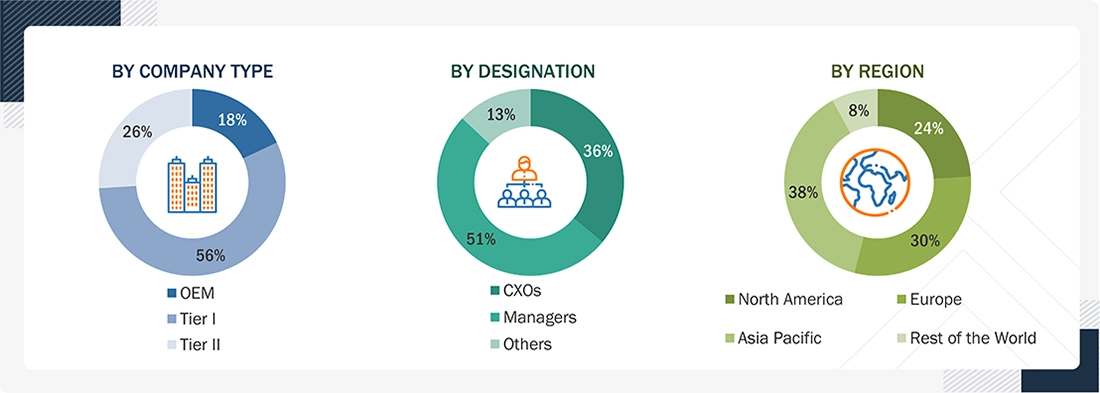
Note: Others include subject-matter experts (SMEs), engineers, consultants, and business development professionals.
Company tiers are based on the value chain; company revenue is not considered.
To know about the assumptions considered for the study, download the pdf brochure
Market Size Estimation
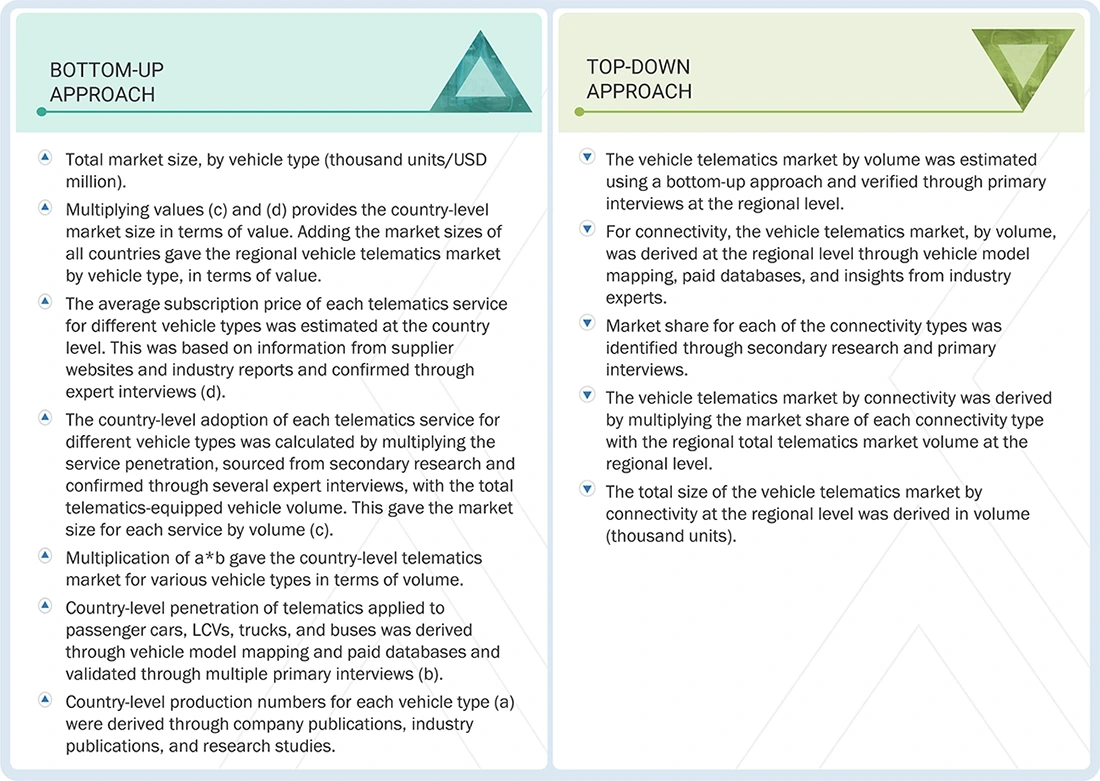
Both top-down and bottom-up approaches were used to estimate and validate the total size of the vehicle telematics market. These methods were also used extensively to estimate the size of various subsegments in the market. The research methodology used to estimate the market size includes the following:
Vehicle Telematics Market : Top-Down and Bottom-Up Approach
Data Triangulation
After arriving at the overall market size using the market size estimation processes as explained above, the market was split into several segments and subsegments. To complete the overall market engineering process and arrive at the exact statistics of each market segment and subsegment, data triangulation and market breakdown procedures were employed, wherever applicable. The data was triangulated by studying various factors and trends from both the demand and supply sides.
Market Definition
Automotive telematics refers to the integration of telecommunications and informatics systems in vehicles to enable real-time data communication. It combines GPS, onboard diagnostics, and wireless technologies to monitor and manage vehicle performance, location, and driver behavior. Telematics systems are widely used for navigation, fleet management, vehicle tracking, insurance, and safety applications.
Key Stakeholders
- Authorized Service Centers and Independent Aftermarket Service Providers
- Automobile Organizations/Associations and Government Bodies
- Automobile Original Equipment Manufacturers (OEMs)
- Automotive Component Manufacturers
- Automotive Research Organizations
- Automotive TCU and ECU Manufacturers
- Automotive Telematics Hardware Suppliers
- Automotive Telematics Service Providers
- Automotive Telematics Software and Platform Providers
- Autonomous Driving Platform Providers
- EV and EV Component Manufacturers
- Internet Service Providers
- Vehicle Safety Regulatory Bodies
Report Objectives
-
To define, segment, and forecast the size of the vehicle telematics market in terms of volume (thousand units) and value (USD million) based on the following categories:
- Service (emergency calling, stolen vehicle assistance, insurance risk assessment, on-road assistance, remote diagnostics, and others)
- Form type (embedded and integrated)
- Fleet management service (operation management, vehicle maintenance and diagnostics, fleet analytics and reporting, and others)
- Offering (hardware and software)
- Aftermarket based on vehicle type (passenger car, light commercial vehicle, and heavy commercial vehicle)
- EV service (emergency calling, stolen vehicle assistance, insurance risk assessment, on-road assistance, remote diagnostics, and others)
- EV vehicle type [battery electric vehicle (BEV), plug-in hybrid electric vehicle (PHEV), and fuel cell electric vehicle (FCEV)]
- Connectivity (satellite and cellular)
- Vehicle type (passenger, car, light commercial vehicle, truck, and bus)
-
To segment and forecast the size of the vehicle telematics market, by volume and value, based on region
- Region [North America, Europe, Asia Pacific, and the Rest of the World (RoW)]
- Fuel Cell Electric Vehicles are covered qualitatively under the EV type segment.
- To evaluate the key market dynamics influencing the vehicle telematics market, including strategic drivers, restraints, opportunities, challenges, and emerging technology trends shaping future market growth across ICE, hybrid, and electric vehicles.
-
To study the following with respect to the market:
- Supply chain analysis
- Ecosystem analysis
- Technology analysis
- Trade analysis
- Investment and funding scenario
- Pricing analysis
- Case study analysis
- Patent analysis
- Regulatory landscape
- Europe-India trade deals: Impact analysis
- Israel-Iran war impact on the automotive industry
- Impact of AI on the vehicle telematics market
- Key stakeholders and buying criteria
- OEM analysis
- OEM connected vehicle strategy benchmarking
- Emerging revenue models in connected mobility
- Connected vehicle platform benchmarking
- Automotive telematics architecture analysis
- India automotive telematics landscape and key market trends
- To benchmark the competitive positioning of key players in the vehicle telematics market through a comprehensive analysis of market share, revenue performance, strategic initiatives, innovation capabilities, product differentiation, and competitive strengths across the automotive telematics value chain.
- To map the competitive ecosystem of the vehicle telematics market by categorizing market participants into Stars, Emerging Leaders, Pervasive Players, and Participants using a robust evaluation framework based on the strength of their automotive telematics portfolio, business strategy, innovation capability, geographic footprint, and market presence.
- To assess the competitive landscape of the vehicle telematics market by profiling leading global manufacturers based on their business overview, automotive telematics product portfolio, geographic presence, financial performance, and recent strategic developments such as product launches, partnerships, acquisitions, capacity expansions, and technological advancements.
Available customizations:
With the given market data, MarketsandMarkets offers customizations in accordance with company-specific needs.
- Additional Company Profiles
- Detailed Analysis of the Vehicle Telematics Market, by Vehicle Type
- Detailed Analysis of the Vehicle Telematics Market, by Form Type
Get the Full Automotive Telematics Market Report
Full forecast, segment splits, and company analysis for all Automotive Telematics Market.
- China Automotive Telematics Market
- India Automotive Telematics Market
- South Korea Automotive Telematics Market
- Thailand Automotive Telematics Market
- Germany Automotive Telematics Market
- France Automotive Telematics Market
- Italy Automotive Telematics Market
- Spain Automotive Telematics Market
- Russia Automotive Telematics Market
- UK Automotive Telematics Market
- Canada Automotive Telematics Market
- Mexico Automotive Telematics Market
- US Automotive Telematics Market
- Brazil Automotive Telematics Market
- South Africa Automotive Telematics Market
- Iran Automotive Telematics Market
- Rest Of Europe Automotive Telematics Market
- Rest Of Asia Pacific Automotive Telematics Market
Need a Tailored Report?
Customize this report to your needs
Get 10% FREE Customization
Customize This Report
