
Rest Of Asia Pacific Base Oil Market (2025-2030)

The Rest Of Asia Pacific Base Oil Market was valued at $1491.1 Million in 2025 and projected to reach to $1713.3 Million by 2030, representing a compound annual growth rate of 2.8%. Rest Of Asia Pacific's base oil market is positioned for steady growth through 2030, driven by expanding lubricant manufacturing capabilities and rising automotive demand across emerging economies in the region.


| Market Size in | USD 26.32 MN |
| Market Forecast in | |
| CAGR | |
| Forecast Period | |
| Units Considered | Value (USD MN) |
Rest Of Asia Pacific Base Oil Market Trends and Insights
- The region is projected to expand to $1,713.3 million by 2030, reflecting a compound annual growth rate (CAGR) of 2.8%.
- Rest Of Asia Pacific's base oil market is driven by increasing demand from lubricant manufacturers, automotive sectors, and industrial applications across emerging economies in the region. The growth trajectory of Rest Of Asia Pacific's base oil market is supported by rising industrialization, expanding manufacturing capabilities, and growing automotive production in key markets.
- Rest Of Asia Pacific continues to attract investment in refining infrastructure and base oil production facilities, positioning the region as a critical supply hub.
- Between 2025 and 2030, Rest Of Asia Pacific is expected to maintain steady growth momentum, though at a measured pace compared to other regional segments, reflecting mature market dynamics and competitive pricing pressures..
Key Market Statistics
- CAGR (2025-2030) 2.8% CAGR
- Market Size, 2025 ~USD 1491.1 Million
- Forecast, 2030 ~USD 1713.3 Million
- Country Rest Of Asia Pacific
Rest Of Asia Pacific Base Oil Market Overview
Market Size & Growth :
Rest Of Asia Pacific base oil market valued at $1,491.1 million in 2025, expanding to $1,713.3 million by 2030 at a steady 2.8% CAGR, reflecting stable regional demand.
Lubricant Manufacturing Demand :
Growing lubricant production across Rest Of Asia Pacific countries drives base oil consumption, supported by expanding industrial and consumer applications in emerging economies.
Automotive Sector Growth :
Rising vehicle production and ownership in Rest Of Asia Pacific nations fuel demand for automotive lubricants, directly boosting base oil requirements across the region.
Regional Market Dynamics :
Rest Of Asia Pacific demonstrates moderate growth compared to global 2.9% CAGR, indicating unique regional challenges and opportunities distinct from major Asia Pacific markets.
Rest Of Asia Pacific Base Oil Market Dynamics
- The 2.8% CAGR reflects consistent industrial development and increasing mechanization in smaller Asia Pacific nations. Key growth catalysts include infrastructure development, growing middle-class consumption, and industrial expansion in secondary markets.
- However, the region faces competition from established markets and price volatility.
- Strategic investments in local production capacity and supply chain optimization will be critical for market participants seeking to capture growth opportunities in Rest Of Asia Pacific..
Market Ecosystem
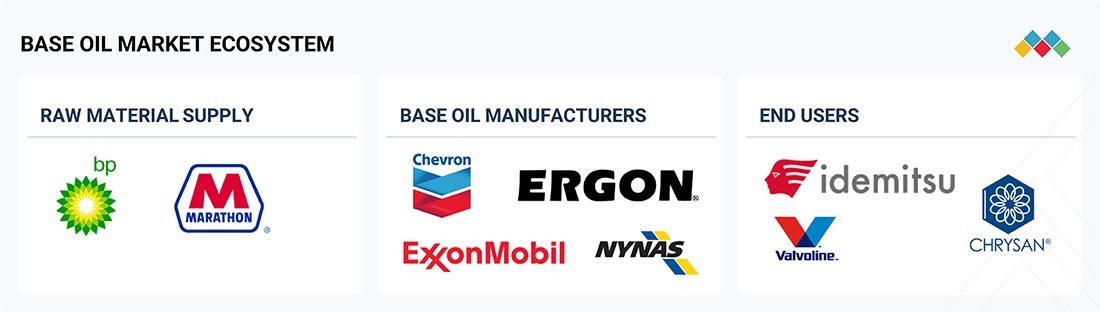
BASE OIL MARKET: COMMERCIAL USE CASES ACROSS INDUSTRIES
| COMPANY | USE CASE DESCRIPTION | BENEFITS |
|---|---|---|
 |
Base oils are used to formulate passenger car and commercial vehicle engine oils that provide lubrication, cooling, and engine protection. | Improve fuel efficiency | Reduce engine wear | Support long oil drain intervals | Ensure compliance with stringent emission standards |
 |
High-quality Group III base oils are used in automatic transmission fluids (ATFs), gear oils, and driveline lubricants. | Enhance thermal stability | Reduces friction | Improve shift performance | Extend component life in modern vehicles |
 |
Base oils are used in hydraulic oils, compressor oils, turbine oils, and circulating oils across manufacturing and power generation industries. | Ensure reliable equipment operation | Reduce downtime | Improve oxidation resistance | Lower maintenance costs |
 |
Base oils are used in marine engine oils and cylinder oils for ships and offshore vessels. | Provide protection against corrosion | Support operation under high-load conditions | Ensure compliance with marine emission regulations |
 |
Base oils serve as a key component in cutting, grinding, and machining fluids used in metal fabrication. | Improve surface finish | Reduce tool wear | Enhance cooling and lubrication | Increase machining efficiency |
Logos and trademarks shown above are the property of their respective owners. Their use here is for informational and illustrative purposes only.
Related Ecosystem
Bulk Chemicals And Inorganics
- Corrosion Inhibitors
- Glycol Ethers
- Acetic Acid
- Acetone
- Ammonium Nitrate
- Basf se
- DOW CHEMICAL COMPANY
- Exxon Mobil Corporation
- AZELIS HOLDINGS SA
- Sinopec limited
Lubricants
- Polyalkylene Glycol (PAG)
- Tankers
- Exxon Mobil Corporation
- AZELIS HOLDINGS SA
- Chevron Corporation
- PETROLIAM NASIONAL BERHAD (NATIONAL PETROLEUM LIMITED)
- Idemitsu Kosan Co.,Ltd.
Key Takeaways
- Rest Of Asia Pacific base oil market valued at $1,491.1 million in 2025, expanding to $1,713.3 million by 2030
- Rest Of Asia Pacific demonstrates a 2.8% CAGR, indicating steady but moderate growth over the forecast period
- Rest Of Asia Pacific's market growth is driven by automotive, industrial, and lubricant manufacturing demand across emerging economies
- Rest Of Asia Pacific faces competitive pricing and mature market dynamics, requiring strategic positioning and operational efficiency
Base Oil Market Report Scope
| Report Metric | Details |
|---|---|
| Base Year | 2025 |
| Fastest Growing Segment | GROUP III (Group) |
| Forecast Period | 2025–2030 |
| Growth Rate | CAGR of 2.9% from 2025 to 2030 |
| Largest Segment | AUTOMOTIVE OIL (Application) |
| Market Size Base Year (Billions) | ~USD 40.38 (2025) |
| Revenue Forecast (Billions) | ~USD 46.59 (2030) |
| Segments Covered | Group, Application |
Rest Of Asia Pacific Base Oil Market Report Segmentation
2 segment dimensions are covered across the global market.
By Group
- Group I
- Group Ii
- Group Iii
- Group Iv
- Group V
By Application
- Automotive Oil
- Grease
- Hydraulic Oil
- Industrial Oil
- Metalworking Fluid
Target Audience
- Base Oil Manufacturers : Need regional market sizing and growth forecasts to optimize production capacity, plan facility investments, and develop distribution strategies for Rest Of Asia Pacific.
- Lubricant Producers : Require demand insights for Rest Of Asia Pacific to secure base oil supply contracts, forecast raw material needs, and identify emerging customer opportunities in the region.
- Automotive Industry Players : Seek market data on Rest Of Asia Pacific to understand lubricant demand trends, plan regional operations, and align supply chain with automotive sector growth.
- Investment & Private Equity Firms : Need regional market analysis and growth projections for Rest Of Asia Pacific to evaluate acquisition targets, assess investment returns, and identify market entry opportunities.
- Market Consultants & Analysts : Require detailed Rest Of Asia Pacific market data to support client advisory, competitive analysis, and strategic recommendations for regional market participants.
Key Companies in the Rest Of Asia Pacific Base Oil Market
| Company | HQ | Ownership | Strongest segments |
|---|---|---|---|
| QATAR PETROLEUM | Qatar | Private Company | Crude oil and condensate,LNG and natural gas liquids,Refined products and jet fuel, |
| ADEKA CORPORATION | Japan | Public Company | Polymer additives and PVC stabilizers,Electronics and semiconductor materials,Surfactants, cosmetic ingredients, and lubricant additives, |
| KAO CORPORATION | Japan | Public Company | Hygiene and Living Care (fabric, kitchen, home, sanitary),Health and Beauty Care (facial, body, hair, oral, warming),Cosmetics and Salon (self-selection, counseling, salon products), |
| MOL GROUP | Hungary | Public Company | Fuels (gasoline, diesel, heating oil, bunker diesel, JET A-1, LPG/autogas),Retail convenience and mobility services (Fresh Corner, e-mobility, car/bike sharing, fleet management),Petrochemicals and black products (bitumen, HFO, petrolcoke, liquid sulphur, residues), |
| PETROBRAS | Brazil | Public Company | Exploration and Production,Refining, Transportation & Marketing,Gas & Low Carbon Energies, |
| AZELIS HOLDINGS SA | Belgium | Private Company | Life sciences (food & nutrition, personal care, pharma, home care),Industrial specialties (coatings, plastics, lubricants, advanced materials),Other and emerging specialties, |
| CHEVRON CORPORATION | United States | Public Company | Upstream oil and gas (including LNG),Downstream refining and marketing,Chemicals, additives, and plastics, |
| EXXONMOBIL | United States | Public Company | Upstream (crude oil and natural gas),Energy Products (fuels, aromatics, catalysts, licensing),Chemical Products (olefins, polyolefins, intermediates), |
| S-OIL CORPORATION | Canada | Public Company | Light crude oil,Natural gas,NGLs and other hydrocarbons, |
| MOTIVA ENTERPRISES LLC | United States | Private Company | Gasoline (branded and unbranded),Diesel (ULSD, export, Texas low emissions, heating oil),Aviation fuel, |
| SK ENMOVE | South Korea | Private Company | Lube base oil (Yubase),Automotive lubricants (SK ZIC gasoline and diesel engine oils),Industrial lubricants and fluids, |
| SAUDI ARABIAN OIL CO. | Saudi Arabia | Public Company | Crude oil and condensate,Refined products and retail fuels,Chemicals and polymers, |
| ENEOS | Japan | Public Company | Petroleum product refining and sales,Petrochemical products,Lubricant products, |
| SHANDONG QINGYUAN GROUP CO., LTD. | China | Private Company | Lubricant base oils (Class I–III) and finished lubricants,Fuels and light petroleum products (gasoline, diesel, naphtha, light fuel oil, LPG),Carbon products (petroleum coke, needle coke, calcined coke, electrodes, anode/cathode materials), |
| HINDUSTAN PETROLEUM CORPORATION LIMITED | India | Public Company | High-speed diesel and motor spirit,LPG and domestic fuels,Petrochemicals, naphtha, and light distillates, |
| SHELL | United Kingdom | Public Company | Integrated Gas (including LNG and GTL),Upstream (oil, gas, NGLs),Marketing (mobility, lubricants, commercial fuels), |
| NYNAS AB | Sweden | Private Company | Bitumen and bituminous binders (road and industrial),Naphthenic base oils,Process oils (adhesives, chemicals, agriculture, explosives, inks, sealants, wood), |
| REPSOL | Spain | Public Company | Industrial (refining, trading, wholesale fuels, hydrogen, sustainable and synthetic fuels),Customer (mobility/gas stations, retail power and gas, lubricants, LPG, apps and tools),Upstream (oil and gas exploration and production, low-carbon geological solutions), |
| CALUMET, INC. | United States | Public Company | Specialty Products and Solutions,Montana/Renewables,Performance Brands, |
QATAR PETROLEUM
Qatar Petroleum is a private petroleum company based in Qatar, established in 1974. With 8,270 employees, the company operates as a key player in Qatar's oil and gas sector.
ADEKA CORPORATION
Adeka Corporation is a Japanese public company founded in 1917, specializing in chemical products and solutions. The company employs 5,434 people and maintains a significant presence in the Asian chemical industry.
KAO CORPORATION
Kao Corporation is a major Japanese public company established in 1887, operating in consumer products, chemicals, and specialty materials. With 31,514 employees, it is one of Japan's leading diversified chemical manufacturers.
MOL GROUP
MOL Group is a Hungarian public company founded in 1991, operating in the oil, gas, and petrochemical sectors. The company employs 24,744 people and serves as a significant energy provider in Central Europe.
PETROBRAS
Petrobras is a Brazilian public company established in 1953, operating as one of the world's largest integrated energy companies. With 43,199 employees, it is a major player in oil exploration, production, and refining.
AZELIS HOLDINGS SA
Azelis Holdings SA is a Belgian private company founded in 2001, specializing in specialty chemicals and ingredients. The company employs 1,325 people and serves various industrial and consumer markets.
CHEVRON CORPORATION
Chevron Corporation is a major American public company founded in 1879, operating in oil and gas exploration, production, and refining. With 43,039 employees, it is one of the world's largest energy companies.
EXXONMOBIL
ExxonMobil is an American public company established in 1870, operating as a global leader in oil, gas, and petrochemical production. The company employs 57,900 people and maintains operations across multiple continents.
S-OIL CORPORATION
S-Oil Corporation is a Canadian public company founded in 2001, with 373 employees operating in the oil sector. The company maintains a focused presence in the energy industry.
MOTIVA ENTERPRISES LLC
Motiva Enterprises LLC is a private American company established in 1998, operating in petroleum refining and marketing. With 3,000 employees, it is a significant player in the U.S. energy sector.
SK ENMOVE
SK Enmove is a South Korean private company founded in 1968, specializing in lubricants and energy products. The company employs 315 people and serves industrial and automotive markets.
SAUDI ARABIAN OIL CO.
Saudi Aramco is a Saudi Arabian public company established in 1933, operating as one of the world's largest and most profitable oil and gas companies. With 79,000 employees, it plays a dominant role in global energy markets.
ENEOS
ENEOS is a Japanese public company founded in 1888, operating in oil refining, marketing, and petrochemical production. With 34,099 employees, it is a major energy provider in Japan and Asia.
SHANDONG QINGYUAN GROUP CO., LTD.
Shandong Qingyuan Group Co., Ltd. is a Chinese private company founded in 1985, operating in the energy and chemical sectors. The company employs 4,000 people and serves domestic and regional markets.
HINDUSTAN PETROLEUM CORPORATION LIMITED
Hindustan Petroleum Corporation Limited is an Indian public company established in 1910, operating in oil refining, marketing, and distribution. With 8,049 employees, it is a major energy provider in India.
SHELL
Shell is a British public company founded in 1897, operating as a global leader in oil, gas, and renewable energy. With 84,000 employees, it is one of the world's largest integrated energy companies.
NYNAS AB
Nynas AB is a Swedish private company established in 1928, specializing in naphthenic crude oil and bitumen products. The company employs 600 people and serves industrial and infrastructure markets.
REPSOL
Repsol is a Spanish public company founded in 1927, operating in oil, gas, and renewable energy sectors. With 24,881 employees, it is a major integrated energy company in Europe and Latin America.
CALUMET, INC.
Calumet, Inc. is an American public company founded in 1919, specializing in specialty hydrocarbon products and solutions. With 1,540 employees, it serves industrial, automotive, and consumer markets globally.
Reasons to Buy this Report
- Regional Market Sizing : Accurate market valuation for Rest Of Asia Pacific ($1,491.1M in 2025) enables precise budget allocation and investment decisions specific to this emerging region.
- Growth Trajectory Insights : Understand the 2.8% CAGR trajectory through 2030 to identify expansion opportunities and competitive positioning within Rest Of Asia Pacific's distinct market dynamics.
- Sector-Specific Demand Analysis : Detailed insights into lubricant manufacturing and automotive sector drivers specific to Rest Of Asia Pacific help target high-growth customer segments effectively.
- Competitive Benchmarking : Compare Rest Of Asia Pacific's 2.8% growth against global 2.9% CAGR to identify relative market strength and strategic entry or expansion opportunities.
- Strategic Planning Data : Comprehensive regional forecasts through 2030 support long-term supply chain planning, capacity investments, and market penetration strategies for Rest Of Asia Pacific.
Frequently asked questions
What is the current market size of base oil in Rest Of Asia Pacific?
Rest Of Asia Pacific's base oil market is estimated at $1,491.1 million in 2025, representing a substantial portion of the Asia Pacific region's overall base oil demand.
What is the projected market size for Rest Of Asia Pacific base oil by 2030?
Rest Of Asia Pacific's base oil market is forecasted to reach $1,713.3 million by 2030, reflecting consistent growth throughout the forecast period.
What is the CAGR for Rest Of Asia Pacific base oil market?
Rest Of Asia Pacific's base oil market is expected to grow at a CAGR of 2.8% from 2025 to 2030, indicating moderate and stable expansion.
What are the primary drivers of growth in Rest Of Asia Pacific base oil market?
Rest Of Asia Pacific's base oil market growth is primarily driven by increasing automotive production, industrial expansion, rising lubricant demand, and infrastructure development across emerging economies.
What challenges does Rest Of Asia Pacific base oil market face?
Rest Of Asia Pacific's base oil market faces challenges including competitive pricing pressures, market maturity, regulatory compliance, and the need for continuous investment in refining infrastructure.
RESEARCH METHODOLOGY
The study involved four major activities in estimating the current size of the base oil market. Exhaustive secondary research was done to collect information on the market, peer markets, and parent market. The next step was to validate these findings, assumptions, and sizing with the industry experts across the base oil value chain through primary research. Both top-down and bottom-up approaches were employed to estimate the complete market size. After that, market breakdown and data triangulation were used to estimate the market size of segments and subsegments.
Secondary Research
Secondary sources referred to for this study include Hoovers, Bloomberg, BusinessWeek, and Dun & Bradstreet, were referred for identifying and collecting information for this study. These secondary sources included annual reports, press releases & investor presentations of companies, white papers, certified publications, and articles by recognized authors, authenticated directories, and databases. Secondary data has been collected and analyzed to arrive at the overall market size, which is further validated by primary research.
Primary Research
The base oil market comprises several stakeholders, such as raw material suppliers, manufacturers, distributors, end-use products’ manufacturers, and regulatory organizations in the supply chain.
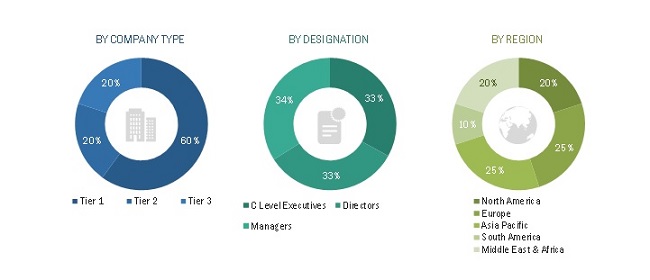
As part of the primary research process, various primary sources from both the supply and demand sides were interviewed to obtain qualitative and quantitative information for this report on the base oil market. Primary sources from the supply side included industry experts such as Chief Executive Officers (CEOs), vice presidents, technology and innovation directors, and related key executives from various key companies and organizations operating in the base oil market. Primary sources from the demand side included directors, marketing heads, and purchase managers from various end-use industries.
Breakdown of the Primary Interviews
To know about the assumptions considered for the study, download the pdf brochure
Market Size Estimation
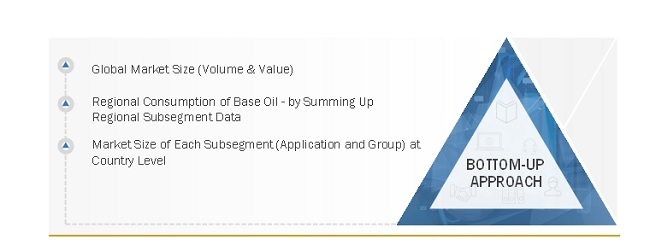
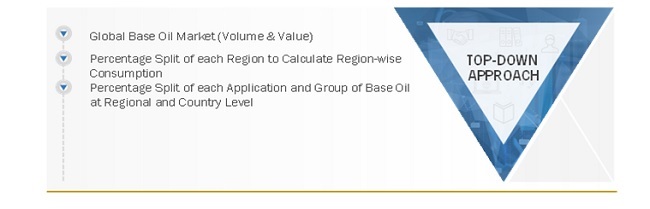
Both the top-down and bottom-up approaches were used to estimate and validate the total size of the base oil market. These methods were also used extensively to estimate the size of various subsegments in the market. The research methodology used to estimate the market size included the following:
- The key players were identified through extensive primary and secondary research.
- The value chain and market size of the base oil market, in terms of value and volume, were determined through primary and secondary research.
- All percentage shares, splits, and breakdowns were determined using secondary sources and verified through primary sources.
- All possible parameters that affect the market covered in this research study were accounted for, viewed in extensive detail, verified through primary research, and analyzed to obtain the final quantitative and qualitative data.
- The research included the study of reports, reviews, and newsletters of top market players, along with extensive interviews for opinions from key leaders, such as CEOs, directors, and experts.
Global Base oil Market Size: Bottom-Up Approach
Global Base oil Market Size: Top-Down Approach
Data Triangulation
After arriving at the overall market size—using the market size estimation processes as explained above—the market was split into several segments and subsegments. In order to complete the overall market engineering process and arrive at the exact statistics of each market segment and subsegment, the data triangulation and market breakdown procedures were employed, wherever applicable. The data was triangulated by studying various factors and trends from both the demand and supply sides. In addition to this, the market size was validated using both top-down and bottom-up approaches.
Report Objectives
- To analyze and forecast the size of the base oil market, in terms of value and volume
- To define, segment, and estimate the base oil market by group, application, and region
- To project the size of the market segments, in terms of volume and value, with respect to five main regions, namely, Asia Pacific, North America, Europe, Middle East & Africa, and South America
- To provide detailed information regarding the crucial factors influencing the growth of the market (drivers, restraints, opportunities, and challenges)
- To analyze the opportunities in the base oil market for stakeholders and provide a competitive landscape of the market
- To track and analyze competitive developments, such as business expansions, agreements, new product launches, acquisitions, investments, and partnerships in the base oil market
- To strategically profile key players and comprehensively analyze their market share and core competencies
Available Customizations
MarketsandMarkets offers the following customizations for this market report:
- A further breakdown of the regional market on the basis of country
- A detailed comparison of product portfolios of various companies
- Details and profiling of additional market players (up to five)
Get the Full Base Oil Market Report
Full forecast, segment splits, and company analysis for all Base Oil Market.
- China Base Oil Market
- Japan Base Oil Market
- India Base Oil Market
- South Korea Base Oil Market
- Indonesia Base Oil Market
- Thailand Base Oil Market
- Russia Base Oil Market
- Germany Base Oil Market
- France Base Oil Market
- Italy Base Oil Market
- UK Base Oil Market
- Spain Base Oil Market
- Canada Base Oil Market
- Mexico Base Oil Market
- US Base Oil Market
- Turkey Base Oil Market
- Iran Base Oil Market
- Brazil Base Oil Market
- Colombia Base Oil Market
- Argentina Base Oil Market
- Rest Of Europe Base Oil Market
Need a Tailored Report?
Customize this report to your needs
Get 10% FREE Customization
Customize This Report
