
Mexico Breath Analyzers Market (2026-2031)

The Mexico Breath Analyzers Market was valued at $34 Million in 2026 and projected to reach to $77.6 Million by 2031, representing a compound annual growth rate of 17.9%. Mexico's breath analyzers market is positioned for sustained high-growth expansion through 2031, driven by strengthened regulatory frameworks around impaired driving detection and workplace safety compliance.


| Market Size in | USD 26.32 MN |
| Market Forecast in | |
| CAGR | |
| Forecast Period | |
| Units Considered | Value (USD MN) |
Mexico Breath Analyzers Market Trends and Insights
- This represents a compound annual growth rate of 17.9%, significantly outpacing global trends.
- Mexico's market growth is driven by increasing regulatory emphasis on drunk-driving prevention, rising healthcare awareness, and expanding adoption of point-of-care diagnostic devices across clinical and law enforcement sectors. The Mexican breath analyzers market benefits from strengthening healthcare infrastructure and growing demand for non-invasive diagnostic tools.
- Mexico's regulatory environment increasingly mandates breath testing in traffic safety protocols, creating sustained demand from government agencies and private healthcare providers.
- Between 2026 and 2031, Mexico is expected to capture growing market share within North America's breath analyzer segment, supported by technological advancement and cost-reduction initiatives that improve device accessibility across urban and emerging markets..
Key Market Statistics
- CAGR (2026-2031) 17.9% CAGR
- Market Size, 2026 ~USD 34 Million
- Forecast, 2031 ~USD 77.6 Million
- Country Mexico
Mexico Breath Analyzers Market Overview
Exceptional Growth Trajectory :
Mexico's breath analyzers market is expanding at 17.9% CAGR, nearly 30% faster than the global average of 13.8%, reflecting strong regional demand and market maturation.
Regulatory Driving Force :
Stringent drunk-driving prevention regulations in Mexico are compelling law enforcement agencies and healthcare facilities to adopt advanced breath analysis technologies for compliance and public safety.
Healthcare Modernization :
Rising healthcare awareness and investment in diagnostic infrastructure across Mexico are accelerating the adoption of point-of-care breath analyzers in clinical and occupational health settings.
Market Valuation Growth :
The Mexican market is projected to more than double from $34.0 million in 2026 to $77.6 million by 2031, representing a $43.6 million value increase over five years.
Mexico Breath Analyzers Market Dynamics
- Government initiatives promoting road safety and healthcare modernization are creating robust demand across law enforcement, clinical diagnostics, and occupational health sectors.
- The market's 17.9% CAGR significantly outpaces global trends, indicating Mexico as a priority growth region. Expanding middle-class healthcare consumption and increasing adoption of point-of-care diagnostic devices are expected to accelerate market penetration beyond traditional law enforcement applications.
- Strategic investments by regional distributors and manufacturers, combined with rising awareness of alcohol-related health risks, will further propel market growth.
- By 2031, Mexico is anticipated to represent a substantial market opportunity within Latin America's broader healthcare diagnostics landscape..
Market Ecosystem
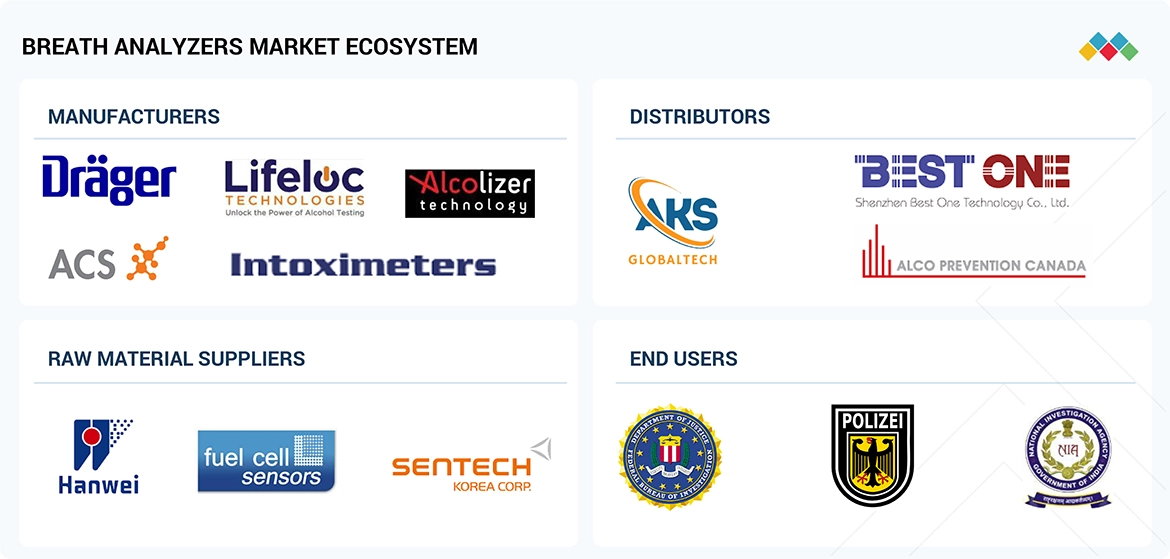
BREATH ANALYZER MARKET: COMMERCIAL USE CASES ACROSS INDUSTRIES
| COMPANY | USE CASE DESCRIPTION | BENEFITS |
|---|---|---|
 |
Provides advanced fuel-cell-based breath analyzers, such as the Alcotest series, used by law enforcement agencies for evidential and roadside alcohol testing, as well as for workplace safety monitoring in the transportation, mining, and industrial sectors. | High measurement accuracy | fast response time | reliable evidential testing | durable devices for field use |
 |
Develops portable and evidential breath alcohol testing systems used by police departments, corrections facilities, and workplace compliance programs for alcohol monitoring and DUI enforcement. | Portable testing solutions | evidential-grade accuracy | easy device calibration | supports regulatory compliance |
 |
Offers a wide range of professional breath analyzers and ignition interlock devices designed for law enforcement, rehabilitation programs, and driver alcohol monitoring systems. | Prevents drunk driving | continuous alcohol monitoring | integration with vehicle safety systems | high reliability |
 |
Manufactures evidential breath testing instruments used by police departments and forensic laboratories for accurate blood alcohol concentration (BAC) measurement in legal and roadside testing environments. | Forensic-grade accuracy | court-admissible test results | robust device performance | efficient DUI enforcement |
 |
Provides handheld, wall-mounted, and automated breath alcohol testing systems used in workplace safety programs, law enforcement checkpoints, and transportation sector compliance testing. | Rapid alcohol screening | non-invasive testing | improved workplace safety | scalable testing for large organizations |
Logos and trademarks shown above are the property of their respective owners. Their use here is for informational and illustrative purposes only.
Related Ecosystem
Medical Devices
- Polymerase Chain Reaction (PCR)
- Magnetic Resonance Imaging (MRI)
- Disposable Autoinjectors
- Pulse Oximeters
- Blood Pressure Monitors
- Medtronic plc
- Abbott Laboratories
- Stryker Corporation
- Becton, Dickinson and Company
- CONMED Corporation
Key Takeaways
- Mexico's breath analyzers market will nearly double from $34.0M (2026) to $77.6M (2031), driven by 17.9% CAGR growth.
- Regulatory mandates for traffic safety testing in Mexico are accelerating adoption of breath analyzer devices across law enforcement and healthcare.
- Mexico's expanding healthcare infrastructure and rising diagnostic awareness support sustained demand for point-of-care breath testing solutions.
- Mexico represents a high-growth opportunity within North America, with market expansion outpacing global breath analyzer industry trends.
Breath Analyzers Market Report Scope
| Report Metric | Details |
|---|---|
| Base Year | 2026 |
| Fastest Growing Segment | DRUG ABUSE DETECTION (Application) |
| Forecast Period | 2026–2031 |
| Growth Rate | CAGR of 13.8% from 2026 to 2031 |
| Largest Segment | ALCOHOL DETECTION (Application) |
| Market Size Base Year (Billions) | ~USD 2.95 (2026) |
| Revenue Forecast (Billions) | ~USD 5.63 (2031) |
| Segments Covered | Technology, Application, End User |
Mexico Breath Analyzers Market Report Segmentation
3 segment dimensions are covered across the global market.
By Technology
- Fuel Cells
- Other Technologies
- Semiconductor Oxide Sensors
By Application
- Alcohol Detection
- Drug Abuse Detection
- Medical Applications
By End User
- Enterprises
- Individuals
- Law Enforcement Agencies
MEXICO: BREATH ANALYZERS MARKET, BY END USER, 2024–2031
| Segment | 2024 | 2025 | 2026 | 2027 | 2028 | 2029 | 2030 | 2031 | CAGR (%) |
|---|---|---|---|---|---|---|---|---|---|
| ENTERPRISES | 18 | 20.3 | 23.2 | 26.5 | 30.2 | 34.6 | 39.6 | 45.4 | 14.4 |
| INDIVIDUALS | 10.3 | 11.8 | 13.5 | 15.6 | 18 | 20.7 | 23.9 | 27.7 | 15.4 |
| LAW ENFORCEMENT AGENCIES | 19.5 | 22.7 | 26.5 | 31 | 36.2 | 42.5 | 49.8 | 58.5 | 17.2 |
| TOTAL | 47.8 | 54.8 | 63.2 | 73 | 84.4 | 97.8 | 113.3 | 131.6 | 15.8 |
Target Audience
- Medical Device Manufacturers : Manufacturers need Mexico-specific market data to evaluate expansion opportunities, assess competitive dynamics, and develop localized product strategies for the high-growth 17.9% CAGR market.
- Healthcare Distributors & Suppliers : Distributors require detailed Mexico market insights to forecast demand, negotiate supplier contracts, identify growth segments, and optimize inventory planning for clinical and occupational health channels.
- Government & Law Enforcement Agencies : Mexican regulatory bodies and law enforcement need market intelligence to inform procurement decisions, budget allocation, and technology adoption strategies for DUI prevention and road safety programs.
- Investment & Private Equity Firms : Investors evaluating Mexico healthcare opportunities need quantified market data, growth projections, and sector analysis to assess portfolio companies, identify acquisition targets, and validate investment theses.
- Healthcare Facility Administrators : Hospital and clinic administrators need Mexico market data to justify capital expenditures for breath analyzer equipment, benchmark adoption rates, and plan diagnostic service expansion initiatives.
Key Companies in the Mexico Breath Analyzers Market
| Company | HQ | Ownership | Strongest segments |
|---|---|---|---|
| HONEYWELL | United States | Public Company | Industrial Automation (controls, instrumentation, smart energy, sensing, PPE, software and analytics),Building Automation (building control software, BMS, security, fire, field devices, services),Energy and Sustainability Solutions / UOP (licensed process technology, equipment, catalysts, services, connectivity and software), |
| DRäGERWERK AG & CO. KGAA | Germany | Public Company | Acute care medical systems (ventilators, anaesthesia, monitoring),Perinatal and neonatal care,Hospital infrastructure, consumables, and planning services, |
| LIFELOC TECHNOLOGIES, INC. | United States | Public Company | Law enforcement and corrections breathalyzers,Workplace and industrial safety breathalyzers,Calibration systems, services, and accessories, |
| ABBOTT | United States | Public Company | Diagnostic Products,Medical Devices,Nutritional Products, |
| CMI | United States | Public Company | Engine segment (on- and off-highway diesel and natural gas engines),Distribution, aftermarket parts, and services,Components (aftertreatment, turbochargers, fuel systems, controls), |
HONEYWELL
Honeywell is a diversified technology and manufacturing company founded in 1885 and headquartered in the United States. As a public company, it employs approximately 101,000 people globally. The company operates across multiple industrial and commercial sectors.
DRäGERWERK AG & CO. KGAA
Drägerwerk AG & Co. KGaA is a German public company established in 1889 with approximately 16,033 employees. The company operates as a multinational corporation serving industrial and commercial markets.
LIFELOC TECHNOLOGIES, INC.
LifeLoc Technologies, Inc. is a publicly traded U.S. company founded in 1983 with 37 employees. The company operates as a small-cap public enterprise.
ABBOTT
Abbott is a diversified healthcare and pharmaceutical company founded in 1888 and headquartered in the United States. As a public company, it employs approximately 115,000 people globally.
CMI
CMI is a U.S.-based public company founded in 1919 with approximately 67,400 employees. The company operates as a large, established enterprise.
Reasons to Buy this Report
- Market Size & Growth Validation : Quantified market data for Mexico showing $34.0M (2026) to $77.6M (2031) growth enables accurate revenue forecasting and investment ROI calculations specific to the Mexican market opportunity.
- Regulatory Landscape Intelligence : Detailed insights into Mexico's drunk-driving prevention regulations and healthcare compliance requirements help businesses align product development and market entry strategies with local legal frameworks.
- Competitive Positioning Analysis : Mexico-specific market data reveals growth drivers and adoption patterns, enabling competitors to identify market gaps, benchmark performance, and develop targeted go-to-market strategies for regional expansion.
- Sector-Specific Opportunity Mapping : Understand demand across Mexico's law enforcement, clinical diagnostics, and occupational health segments to prioritize distribution channels, partnerships, and product customization for maximum market penetration.
- Investment Decision Support : Comprehensive Mexico market analysis with 5-year forecasts provides institutional investors and stakeholders with data-driven confidence for capital allocation, M&A decisions, and market entry timing.
Frequently asked questions
What is the projected market size of breath analyzers in Mexico by 2031?
Mexico's breath analyzers market is projected to reach $77.6 million by 2031, up from $34.0 million in 2026, representing a 17.9% compound annual growth rate.
What factors are driving growth in Mexico's breath analyzers market?
Mexico's market growth is driven by regulatory mandates for traffic safety testing, expanding healthcare infrastructure, rising diagnostic awareness, and increasing adoption of point-of-care devices in clinical and law enforcement settings.
How does Mexico's breath analyzers market compare to global trends?
Mexico's breath analyzers market is growing at 17.9% CAGR, significantly outpacing the global market growth rate of 13.8%, positioning Mexico as a high-growth regional opportunity.
Which sectors are driving demand for breath analyzers in Mexico?
Primary demand in Mexico comes from government law enforcement agencies implementing traffic safety protocols, private healthcare providers, and clinical diagnostic centers adopting non-invasive testing solutions.
What is the market value of breath analyzers in Mexico in 2026?
Mexico's breath analyzers market is valued at $34.0 million in 2026, serving as the baseline for projected growth through 2031.
RESEARCH METHODOLOGY
The study involved major activities in estimating the current size of the breath analyzers market. Exhaustive secondary research was done to collect information on the Breath analyzers market. The next step was to validate these findings, assumptions, and sizing with industry experts across the value chain using primary research. Different approaches, such as top-down and bottom-up, were employed to estimate the total market size. After that, the market breakup and data triangulation procedures were used to estimate the market sizes of the segments and subsegments of the breath analyzers market.
Secondary Research
This research study involved the extensive use of secondary sources, directories, databases such as Dun & Bradstreet, Bloomberg Businessweek, and Factiva, whitepapers, and Companies House documents. Secondary research was undertaken to identify and collect information for this extensive, technical, market-oriented, and commercial study of the breath analyzers market. It was also used to obtain important information on the top players, market classification, segmentation by industry trends, bottom-most-level geographic markets, and key developments related to the market. A database of the key industry leaders was also prepared using secondary research.
Primary Research
In the primary research process, various supply- and demand-side sources were interviewed to obtain qualitative and quantitative information for this report. Primary sources from the supply side included industry experts such as CEOs, VPs, managing directors, marketing heads, sales directors, marketing and sales managers, regional or area sales managers, export and import heads or managers, as well as other professionals related to the breath analyzers market from various companies and organizations operating within this sector.
On the demand side, primary sources comprised representatives from law enforcement agencies, including vice presidents and C-level executives, as well as department heads, enterprises, individuals, supply management teams from hospitals, clinic personnel, and laboratory technicians.
Breakdown of Primary Interviews
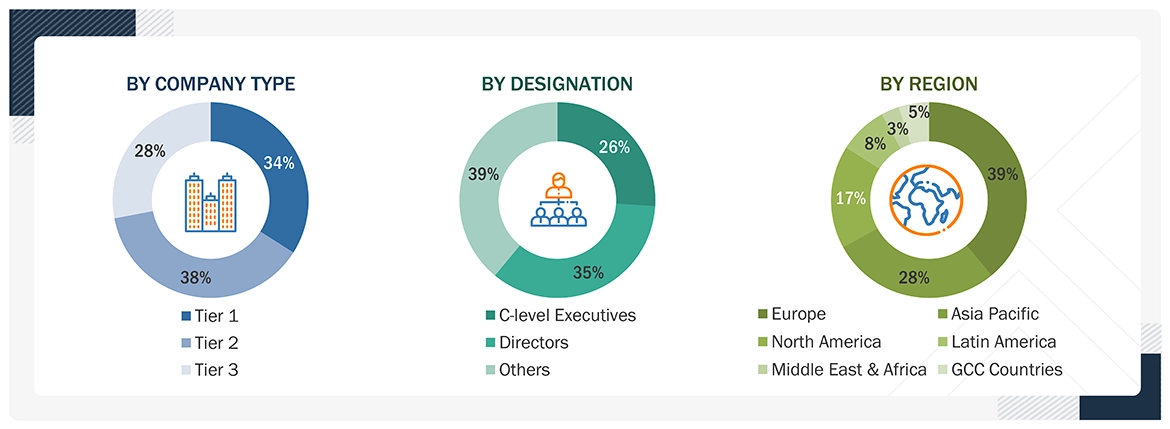
Note 1: C-level executives include CEOs, COOs, CTOs, and VPs.
Note 2: Others include sales, marketing, and product managers.
Note 3: Companies are classified into tiers based on their total revenue. As of 2025: Tier 1 = >USD 1 billion, Tier 2 = USD 500 million to USD 1 billion, and Tier 3 = < USD 500 million.
To know about the assumptions considered for the study, download the pdf brochure
Market Size Estimation
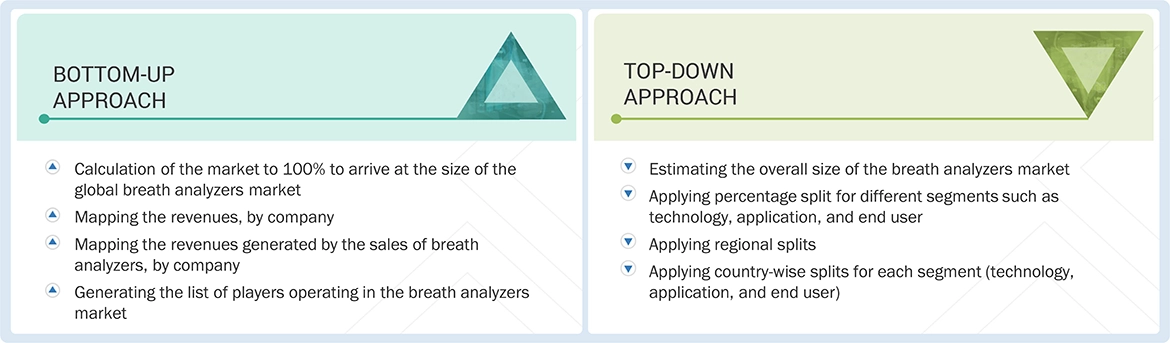
Both top-down and bottom-up approaches were used to estimate and validate the total size of the breath analyzers market. These methods were also widely used to estimate the sizes of various subsegments in the market. The research methodology used to estimate the market size includes the following:
Data Triangulation
The entire market was split into three segments when the market size was determined. Data triangulation and market breakdown processes were used where necessary to complete the entire market engineering process and arrive at precise statistics for all segments. Approach to derive the market size and estimate market growth: Using secondary data from paid and unpaid sources, the market rankings for the major players were determined following a thorough analysis of their sales of breath analyzers. Due to data restrictions, the revenue share in certain cases was determined after a thorough analysis of the product portfolio of big corporations and their individual sales performance. This information was verified at each stage by in-depth interviews with professionals in the field.
Market Definition
Breath analyzers are devices used to determine the presence of different compounds in an individual’s breath sample. These devices are most commonly used to measure the blood alcohol content in a breath sample.
Stakeholders
- Breath analyzer device vendors/manufacturers
- Breath analyzer device distributors and suppliers
- Breath testing service providers
- Venture capitalists
- Corporate entities
- Healthcare institutes, such as hospitals, medical groups, physician practices, diagnostic centers, and outpatient clinics
- Government agencies
Report Objectives
- To describe, analyze, and forecast the breath analyzers market, by technology, application, end user, and region
- To describe and forecast the breath analyzers market for key regions: North America, Europe, the Asia Pacific, Latin America, the Middle East & Africa, and GCC Countries
- To provide detailed information regarding drivers, restraints, opportunities, and challenges influencing the growth of the breath analyzers market
- To strategically analyze the ecosystem, regulations, patenting trend, value chain, Porter’s five forces, and prices pertaining to the market under study
- To strategically analyze micromarkets1 with respect to individual growth trends, prospects, and contributions to the overall market
- To analyze market opportunities for stakeholders and provide details of the competitive landscape for market players
- To profile key players and comprehensively analyze their market shares and core competencies2 in the breath analyzers market
- To analyze competitive developments such as collaborations, acquisitions, product launches, expansions, and R&D activities in the breath analyzers market
Get the Full Breath Analyzers Market Report
Full forecast, segment splits, and company analysis for all Breath Analyzers Market.
- US Breath Analyzers Market
- Canada Breath Analyzers Market
- Germany Breath Analyzers Market
- UK Breath Analyzers Market
- France Breath Analyzers Market
- Italy Breath Analyzers Market
- Spain Breath Analyzers Market
- China Breath Analyzers Market
- Japan Breath Analyzers Market
- India Breath Analyzers Market
- Australia Breath Analyzers Market
- South Korea Breath Analyzers Market
- Brazil Breath Analyzers Market
- GCC Countries Breath Analyzers Market
Need a Tailored Report?
Customize this report to your needs
Get 10% FREE Customization
Customize This Report
