
South Korea Building Automation System Market (2025-2030)

The South Korea Building Automation System Market was valued at $3124.1 Million in 2025 and projected to reach to $5420.4 Million by 2030, representing a compound annual growth rate of 11.7%. South Korea's Building Automation System market is poised for sustained expansion through 2030, driven by stringent energy efficiency regulations and the nation's commitment to carbon neutrality.


| Market Size in | USD 26.32 MN |
| Market Forecast in | |
| CAGR | |
| Forecast Period | |
| Units Considered | Value (USD MN) |
South Korea Building Automation System Market Trends and Insights
- This 11.7% compound annual growth rate reflects South Korea's strong emphasis on smart building technologies and energy efficiency standards across commercial and residential sectors.
- South Korea's advanced infrastructure, coupled with government initiatives promoting green buildings and IoT integration, positions the nation as a key regional player in building automation adoption. The South Korea market benefits from high technology adoption rates and a mature electronics manufacturing base that supports rapid deployment of automation solutions.
- South Korea's focus on reducing energy consumption in buildings and enhancing occupant comfort drives demand for integrated control systems, HVAC automation, and intelligent lighting solutions.
- Between 2025 and 2030, South Korea is expected to see accelerated investment in smart city projects and retrofitting existing structures with modern automation capabilities, further solidifying its market leadership in the Asia Pacific region..
Key Market Statistics
- CAGR (2025-2030) 11.7% CAGR
- Market Size, 2025 ~USD 3124.1 Million
- Forecast, 2030 ~USD 5420.4 Million
- Country South Korea
South Korea Building Automation System Market Overview
Market Valuation Growth :
South Korea's Building Automation System market is valued at USD 3,124.1 million in 2025, with a projected expansion to USD 5,420.4 million by 2030, representing a robust 11.7% CAGR.
Smart Building Adoption :
South Korea demonstrates strong emphasis on smart building technologies driven by government energy efficiency mandates and corporate sustainability initiatives across Seoul, Busan, and major metropolitan areas.
Technology Infrastructure :
Advanced 5G connectivity and IoT infrastructure in South Korea enable seamless integration of building automation systems, positioning the country as a regional leader in smart building deployment.
Sector Expansion :
Growth spans both commercial real estate and residential sectors, with increasing adoption in office buildings, shopping centers, hospitals, and apartment complexes throughout South Korea.
South Korea Building Automation System Market Dynamics
- The market benefits from South Korea's technological prowess, high urbanization rates, and substantial investments in smart city infrastructure.
- Commercial property developers and facility managers increasingly prioritize automated climate control, lighting management, and security systems to reduce operational costs and enhance occupant comfort.
- Government incentives for green building certifications further accelerate market penetration across major urban centers..
Market Ecosystem
BUILDING AUTOMATION SYSTEM MARKET SIZE, SHARE & TRENDS, 2025 TO 2030: COMMERCIAL USE CASES ACROSS INDUSTRIES
| COMPANY | USE CASE DESCRIPTION | BENEFITS |
|---|---|---|
 |
Deployment of an advanced building automation system (BAS) integrating HVAC, lighting, and air quality monitoring across hospital facilities for optimized energy and comfort management | Improved air quality and patient comfort, 20% reduction in energy costs, enhanced regulatory compliance, and streamlined facility operations |
 |
Implementation of a centralized BAS platform connecting HVAC, refrigeration, and lighting systems across stores to enable real-time energy management and predictive maintenance | Achieved 25–30% reduction in store-level energy use, enhanced equipment uptime, and improved in-store comfort for customers and staff |
 |
Integration of a smart room automation system with occupancy sensors and centralized energy management to enhance sustainability and guest experience | 18% reduction in energy consumption, reduced maintenance costs, and improved guest satisfaction through personalized room control |
 |
Deployment of a smart campus BAS integrating IoT sensors and analytics for classrooms, dormitories, and labs to optimize energy and environmental conditions | 25% improvement in energy efficiency, better indoor comfort, and real-time data-driven facility planning for sustainable operations |
 |
Implementation of a residential BAS enabling centralized control of lighting, HVAC, and water systems through smart apps for luxury housing complexes | 15–20% reduction in energy bills, enhanced resident convenience and security, and improved property value through sustainability features |
Logos and trademarks shown above are the property of their respective owners. Their use here is for informational and illustrative purposes only.
Related Ecosystem
Electrical System And Components
- Natural Language Processing (NLP)
- Sensors
- Machine Learning
- Temperature Sensors
- Actuators
- ABB India Limited
- Siemens ag
- SCHNEIDER ELECTRIC SE
- Eaton Corporation plc
- General Electric Company
Key Takeaways
- South Korea's Building Automation System market will grow from USD 3,124.1M (2025) to USD 5,420.4M (2030) at an 11.7% CAGR.
- South Korea's advanced technology infrastructure and government green building mandates are primary drivers of market expansion.
- South Korea's smart city initiatives and energy efficiency regulations accelerate adoption of integrated automation solutions.
- South Korea's mature electronics sector enables rapid commercialization and deployment of building automation technologies.
Building Automation System Market Report Scope
| Report Metric | Details |
|---|---|
| Base Year | 2025 |
| Fastest Growing Segment | WIRELESS TECHNOLOGIES (Communication Technology) |
| Forecast Period | 2025–2030 |
| Growth Rate | CAGR of 13.4% from 2025 to 2030 |
| Largest Segment | COMMERCIAL (Application) |
| Market Size Base Year (Billions) | ~USD 101.92 (2025) |
| Revenue Forecast (Billions) | ~USD 191.13 (2030) |
| Segments Covered | Offering, System Type, Application, Type, Hvac Component, Product, Component, Communication Technology |
South Korea Building Automation System Market Report Segmentation
8 segment dimensions are covered across the global market.
By Offering
- Bas Services
- Building Energy Management Software
- Facility Management Systems
- Fire Protection Systems
- Other Offerings
- Security & Access Control Systems
By System Type
- Access Control Systems
- Hvac Control Systems
- Hvac Controls
- Lighting Control Systems
- Lighting Controls
- Video Surveillance Systems
By Application
- Commercial
- Industrial
- Residential
By Type
- Access Control Systems
- Blind/Shutter Actuators
- Daylight Sensors
- Dimming Actuators
- Hardware
- Occupancy Sensors
- Receivers
- Relays
- Services
- Software/Video Analytics
- Switch Actuators
- Timers
- Transmitters
- Video Surveillance Systems
By Hvac Component
- Actuators
- Control Valves
- Dampers
- Heating & Cooling Coils
- Pumps & Fans
- Sensors
- Smart Thermostats
- Smart Vents
By Product
- Accessories
- Cameras
- Monitors
- Storage
By Component
- Emergency Lighting, Voice Evacuation & Public Alert Devices
- Fire Alarms
- Fire Sprinklers
- Sensors & Detectors
By Communication Technology
- Wired Technologies
- Wireless Technologies
Target Audience
- Building Automation Manufacturers : Manufacturers need South Korea market data to assess demand for HVAC controls, lighting systems, and security automation, and to benchmark against regional competitors and plan product localization.
- Real Estate Developers & Property Managers : Developers and facility managers require market insights to understand automation investment ROI, regulatory compliance requirements, and tenant expectations for smart building features in South Korea.
- System Integrators & Solution Providers : Integration firms need detailed market analysis to identify client segments, evaluate technology trends, and develop competitive service offerings aligned with South Korea's smart building standards.
- Investment & Private Equity Firms : Investors need comprehensive market sizing and growth forecasts to evaluate acquisition targets, assess portfolio companies' market positioning, and identify emerging opportunities in South Korea's BAS sector.
- Government & Policy Organizations : Policy makers and government agencies require market data to evaluate the effectiveness of energy efficiency programs, benchmark against global standards, and refine building automation regulations.
Key Companies in the South Korea Building Automation System Market
| Company | HQ | Ownership | Strongest segments |
|---|---|---|---|
| DSP GROUP, INC. | United States | Private Company | Security & Access Control endpoints (panels, locks, intercoms),Residential smart home devices linked to BAS,Commercial and industrial IoT endpoints, |
| FOXCONN INDUSTRIAL INTERNET CO LTD | United States | Public Company | Facility Management Systems,Security & Access Control,Fire Protection Systems, |
| PLDT ENTERPRISE | Philippines | InvalidIdentifier | Facility Management Systems enablement (connectivity, hosting, integration support),Security & Access Control networking and cloud backhaul,Fire Protection Systems connectivity and monitoring backbones, |
| LENOVO | China | Public Company | Facility Management Systems (compute and endpoints),Security & Access Control (clients and controllers),Fire Protection Systems (monitoring workstations), |
| L&T TECHNOLOGY SERVICES LIMITED | India | Public Company | Building Energy Management Software,Facility Management Systems,Security & Access Control, |
| UPONOR CORPORATION | Finland | Private Company | Facility Management Systems–linked hydronic and radiant infrastructure,Security & Access Control–adjacent plumbing for secure facilities,Fire Protection Systems–compatible piping solutions, |
| FIRST SENSOR AG | Germany | Public Company | Sensors and Sensor Systems for Building Automation Devices,Connectivity, Antennas, and EMI/EMC Solutions for BAS,Building-Focused Services and Custom Engineering, |
| SOMFY GROUP | France | Private Company | Facility Management Systems,Security & Access Control,Fire Protection Systems, |
| JOHNSON CONTROLS | Ireland | Public Company | Facility Management Systems / BMS Platforms,Security & Access Control,Fire Protection Systems, |
| SCHNEIDER ELECTRIC | Canada | Public Company | Building Management Systems & Facility Management Platforms,Building Energy Management Software & Power Metering,Security, Access Control & Fire Protection Interfaces, |
| HONEYWELL INTERNATIONAL INC. | United States | Public Company | Facility Management Systems,Security & Access Control,Fire Protection Systems, |
| SIEMENS | Germany | Public Company | Facility Management Systems,Security & Access Control,Fire Protection Systems, |
| CARRIER | United States | Public Company | Facility Management Systems,Security & Access Control,Fire Protection Systems, |
| ROBERT BOSCH GMBH | Germany | Private Company | Security & Access Control,Fire Protection Systems,Building Management & Energy Software, |
| LEGRAND | France | Public Company | Facility Management Systems,Security & Access Control,Fire Protection Systems, |
| HUBBELL | United States | Public Company | Facility Management Systems–linked electrical and control hardware,Security & Access Control–enabling devices and communication systems,Fire Protection Systems–related electrical infrastructure, |
| ABB | Switzerland | Public Company | Facility Management Systems,Security & Access Control,Fire Protection Systems, |
| TRANE TECHNOLOGIES PLC | Ireland | Public Company | Building Energy Management Software & Controls,Building Automation System Services,Facility Management Systems, |
| HITACHI, LTD. | Japan | Public Company | Building Energy Management Software,Facility Management Systems,Security & Access Control, |
DSP GROUP, INC.
DSP Group, Inc. is a United States-based private company established in 1987 with 352 employees.
FOXCONN INDUSTRIAL INTERNET CO LTD
Foxconn Industrial Internet Co Ltd is a United States-based public company founded in 2015 with approximately 217,084 employees.
PLDT ENTERPRISE
PLDT Enterprise is a Philippines-based company with insufficient data available for a complete description.
LENOVO
Lenovo is a Chinese public company founded in 1984.
L&T TECHNOLOGY SERVICES LIMITED
L&T Technology Services Limited is an Indian public company founded in 2012 with approximately 21,039 employees.
UPONOR CORPORATION
Uponor Corporation is a Finnish private company founded in 1918 with approximately 3,527 employees.
FIRST SENSOR AG
First Sensor AG is a German public company established in 1991 with 538 employees.
SOMFY GROUP
Somfy Group is a French private company founded in 1969 with approximately 6,433 employees.
JOHNSON CONTROLS
Johnson Controls is an Ireland-based public company founded in 1885 with approximately 87,000 employees.
SCHNEIDER ELECTRIC
Schneider Electric is a Canadian public company founded in 1836 with approximately 158,122 employees.
HONEYWELL INTERNATIONAL INC.
Honeywell International Inc. is a United States-based public company founded in 1885 with approximately 101,000 employees.
SIEMENS
Siemens is a German public company founded in 1847 with approximately 310,312 employees.
CARRIER
Carrier is a United States-based public company founded in 2019 with approximately 47,000 employees.
ROBERT BOSCH GMBH
Robert Bosch GmbH is a German private company founded in 1886 with approximately 412,774 employees.
LEGRAND
Legrand is a French public company founded in 1865 with approximately 35,410 employees.
HUBBELL
Hubbell is a United States-based public company founded in 1888 with approximately 18,200 employees.
ABB
ABB is a Swiss public company founded in 1883 with approximately 112,700 employees.
TRANE TECHNOLOGIES PLC
Trane Technologies PLC is an Ireland-based public company founded in 1885 with approximately 44,000 employees.
HITACHI, LTD.
Hitachi, Ltd. is a Japanese public company founded in 1910 with approximately 287,901 employees.
Reasons to Buy this Report
- Market Size & Growth Validation : Obtain precise valuation data for South Korea's BAS market with verified CAGR of 11.7%, enabling accurate financial forecasting and investment decision-making for regional expansion strategies.
- Competitive Landscape Intelligence : Understand South Korea-specific market dynamics, local competitor positioning, and technology adoption patterns to identify market entry opportunities and differentiation strategies.
- Regulatory & Policy Insights : Access detailed analysis of South Korea's energy efficiency standards, green building certifications, and government incentives driving market growth and shaping procurement requirements.
- Sector-Specific Opportunities : Identify high-growth segments within commercial and residential sectors, including office buildings, hospitality, healthcare facilities, and smart residential complexes across major Korean cities.
- Strategic Planning & Forecasting : Leverage 2030 market projections and trend analysis to develop long-term business strategies, product roadmaps, and partnership opportunities tailored to South Korea's unique market conditions.
Frequently asked questions
What is the current size of South Korea's Building Automation System market?
South Korea's Building Automation System market is valued at USD 3,124.1 million in 2025.
What is the projected market size for South Korea by 2030?
South Korea's Building Automation System market is forecast to reach USD 5,420.4 million by 2030.
What is the CAGR for South Korea's Building Automation System market?
South Korea's Building Automation System market is expected to grow at a compound annual growth rate of 11.7% from 2025 to 2030.
What factors are driving growth in South Korea's market?
South Korea's market growth is driven by government green building initiatives, energy efficiency mandates, smart city projects, and high technology adoption rates.
How does South Korea's market compare to global trends?
South Korea's 11.7% CAGR is slightly below the global average of 13.4%, reflecting a mature but steady market with strong foundational infrastructure.
RESEARCH METHODOLOGY
The research study involved four major steps in estimating the size of the building automation system market. Exhaustive secondary research has been done to collect important information about the market and peer markets. The next step has been to validate these findings and assumptions and size them with the help of primary research with industry experts across the value chain. Both top-down and bottom-up approaches have been used to estimate the market size. After this, the market breakdown and data triangulation approaches have been adopted to estimate the market sizes of segments and subsegments.
Secondary Research
Various secondary sources have been referred to in the secondary research process to identify and collect important information for this study. The secondary sources include annual reports, press releases, and investor presentations of companies; white papers; journals and certified publications; and articles from recognized authors, websites, directories, and databases. Secondary research has been conducted to obtain key information about the industry's supply chain, the market's value chain, the total pool of key players, market segmentation according to the industry trends (to the bottom-most level), regional markets, and key developments from market- and technology-oriented perspectives. The secondary data has been collected and analyzed to determine the overall market size, further validated by primary research.
Primary Research
Extensive primary research has been conducted after understanding the building automation system market scenario through secondary research. Several primary interviews have been conducted with key opinion leaders from demand- and supply-side vendors across major regions— North America, Europe, Asia Pacific, and RoW. This primary data has been collected mainly through telephonic interviews, which consist of 80% of the total primary interviews; questionnaires and emails have also been:
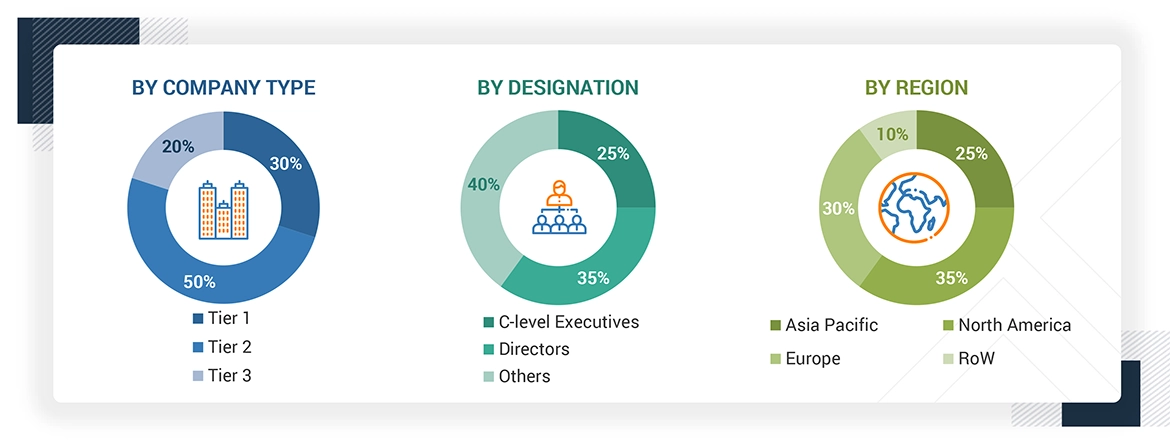
Note: Others include sales, marketing, and product managers.
To know about the assumptions considered for the study, download the pdf brochure
Market Size Estimation
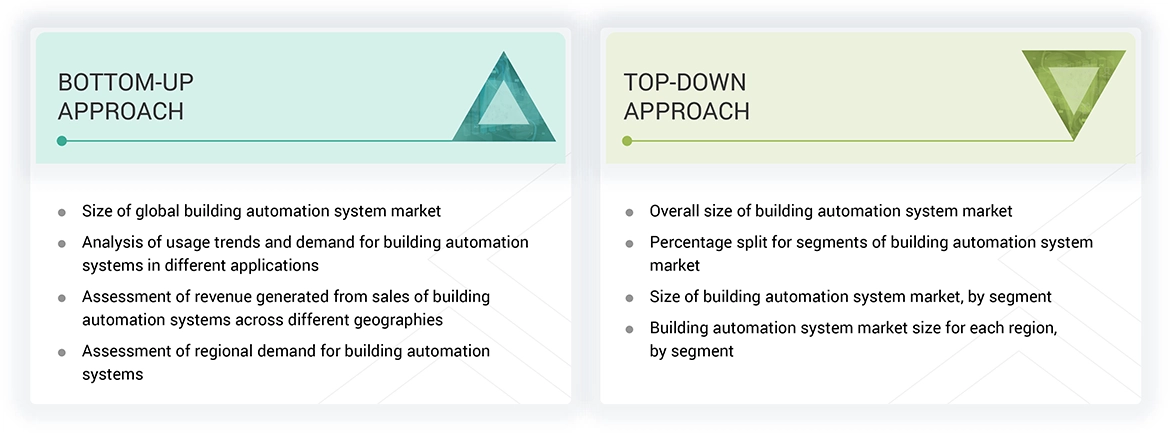
In the market engineering process, both top-down and bottom-up approaches, along with data triangulation methods, have been used to estimate and validate the size of the building automation system and other dependent submarkets. The research methodology used to estimate the market sizes includes the following:
- Identifying major companies that provide building automation solutions and products
- Identifying major segments of building automation system products and solutions across various regions
- Identifying the market share estimates for deployments in different applications by understanding the demand for building automation system products and solutions
- Tracking the ongoing and upcoming developments of building automation system products
- Tracking the ongoing and upcoming offerings of building automation systems and forecasting the market size based on demand, investments, needs, and changes in demand
- Estimating the market size in various regions by analyzing the adoption of building automation system solutions in different applications
- Combining the regional market size for each segment to arrive at regional market estimates
- Interviewing multiple key leaders to understand the scope of the building automation system market, the demand for the product, and the market's future growth.
- Arriving at market estimates by identifying companies that provide building automation system products in different geographic regions and then combining this information to arrive at the market estimates for each region
- Verifying and validating estimates at every level by cross-checking them with the primaries, discussions with leaders, and finally with domain experts at MarketsandMarkets
- Studying various paid and unpaid information sources, such as annual reports, press releases, white papers, and databases
Building Automation System Market : Top-Down and Bottom-Up Approach
Data Triangulation
After arriving at the overall market size, using the market size estimation processes as explained above, the market has been split into several segments and subsegments. Data triangulation and market breakdown procedures have been employed to complete the entire market engineering process and arrive at each market segment's and subsegment's exact statistics. The data has been triangulated by studying various factors and trends from the demand and supply sides in the building automation system market.
Market Definition
A building automation system (BAS) is a centralized control system that manages and monitors a building's mechanical and electrical equipment, such as HVAC, lighting, security, and fire systems. It integrates various subsystems to optimize energy efficiency, reduce operational costs, and enhance occupant comfort. BAS uses sensors, controllers, and software to automate tasks like adjusting temperature, controlling lighting based on occupancy, or managing ventilation. It is commonly used in commercial buildings, hospitals, and schools to streamline operations and support sustainability goals. Advanced BAS incorporates IoT and smart technologies for remote monitoring and data-driven decision-making.
Key Stakeholders
- Original device manufacturers (ODMs)
- Building automation service providers
- Networking technology vendors
- Real estate developers
- Building automation software and solution providers
- Building automation service providers
- Component suppliers
- Research organizations and consulting companies
- Sub-component manufacturers
- Technology providers
- Building automation system-related associations, organizations, forums, and alliances.
Report Objectives
- To describe and forecast the building automation system market based on communication technology, offering, application, and region in terms of value
- To describe and forecast the market, in terms of value, for various segments in four key regions, namely, North America, Europe, Asia Pacific, and Rest of the World (RoW)
- To forecast the size of the building automation system market for facility management systems, by type, in terms of volume
- To strategically analyze the 2025 US Tariff pertaining to the market under study
- To analyze the micromarkets1 with respect to individual growth trends, prospects, and contribution to the total market
- To provide a detailed overview of the building automation system supply chain and its industry trends
- To analyze opportunities in the market for various stakeholders by identifying the high-growth segments of the building automation system market
- To profile the key players and comprehensively analyze their market position in terms of the market share and core competencies2, along with a detailed competitive landscape for the market leaders
- To analyze competitive developments such as partnerships, collaborations, acquisitions, and product launches in the building automation system market
Available customizations:
With the given market data, MarketsandMarkets offers customizations according to the specific requirements of companies. The following customization options are available for the report:
- Detailed analysis and profiling of additional market players based on various blocks of the supply chain
Get the Full Building Automation System Market Report
Full forecast, segment splits, and company analysis for all Building Automation System Market.
- US Building Automation System Market
- Canada Building Automation System Market
- Mexico Building Automation System Market
- Germany Building Automation System Market
- UK Building Automation System Market
- France Building Automation System Market
- Italy Building Automation System Market
- Rest Of Europe Building Automation System Market
- China Building Automation System Market
- Japan Building Automation System Market
- India Building Automation System Market
- Rest Of Asia Pacific Building Automation System Market
Need a Tailored Report?
Customize this report to your needs
Get 10% FREE Customization
Customize This Report
