
Japan Photovoltaics Market (2025-2030)

The Japan Photovoltaics Market was valued at $19700 Million in 2025 and projected to reach to $31720 Million by 2030, representing a compound annual growth rate of 10.0%. Japan's photovoltaics market is positioned for sustained growth through 2030, driven by aggressive renewable energy targets and technological innovation.


| Market Size in | USD 26.32 MN |
| Market Forecast in | |
| CAGR | |
| Forecast Period | |
| Units Considered | Value (USD MN) |
Japan Photovoltaics Market Trends and Insights
- Japan has emerged as a critical hub for solar technology innovation and deployment in the Asia Pacific region, driven by government renewable energy mandates and declining manufacturing costs.
- The market in Japan reflects strong domestic demand for distributed solar solutions, supported by the country's commitment to carbon neutrality and energy security objectives. The photovoltaics sector in Japan is characterized by advanced manufacturing capabilities and a mature supply chain that positions the nation as both a significant consumer and exporter of solar technologies.
- Between 2025 and 2030, Japan's market expansion will be underpinned by residential rooftop installations, utility-scale solar farms, and integration with energy storage systems.
- Japan's strategic focus on renewable energy transition and technological leadership ensures sustained market momentum throughout the forecast period..
Key Market Statistics
- CAGR (2025-2030) 10.0% CAGR
- Market Size, 2025 ~USD 19700 Million
- Forecast, 2030 ~USD 31720 Million
- Country Japan
Japan Photovoltaics Market Overview
Market Valuation Growth :
Japan's photovoltaics market is valued at USD 19,700 million in 2025 and is projected to reach USD 31,720 million by 2030, demonstrating strong market expansion and investor confidence in solar energy infrastructure.
Regional Innovation Leadership :
Japan has established itself as a critical hub for solar technology innovation and deployment in the Asia Pacific region, with advanced manufacturing capabilities and cutting-edge R&D facilities driving technological advancement.
Government Support & Mandates :
Japanese government renewable energy mandates and feed-in tariff policies continue to incentivize solar adoption, creating a favorable regulatory environment for market growth and long-term investment sustainability.
Cost Competitiveness :
Declining manufacturing costs and economies of scale in Japan's photovoltaic production have improved market competitiveness, making solar solutions more accessible to residential, commercial, and industrial sectors.
Japan Photovoltaics Market Dynamics
- The country's commitment to carbon neutrality by 2050 and increasing electricity demand create substantial opportunities for solar deployment across residential, commercial, and utility-scale segments.
- Government incentives and declining system costs will continue to accelerate market penetration. The competitive landscape in Japan is characterized by both established domestic manufacturers and emerging players leveraging advanced technologies such as perovskite and bifacial solar cells.
- Integration with energy storage systems and smart grid technologies will further enhance market attractiveness.
- Regional supply chain advantages and export capabilities position Japan as a key player in the broader Asia Pacific photovoltaics ecosystem..
Market Ecosystem
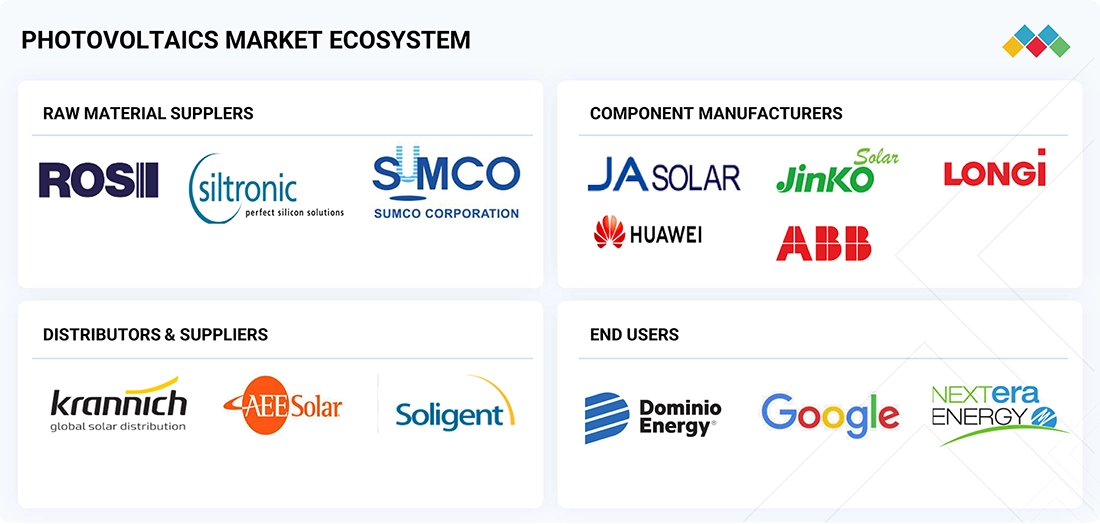
Photovoltaics (PV) Market: COMMERCIAL USE CASES ACROSS INDUSTRIES
| COMPANY | USE CASE DESCRIPTION | BENEFITS |
|---|---|---|
 |
Deployment of high-efficiency Tiger Neo N-type bifacial modules in utility-scale solar farms and commercial rooftops | Enhances energy yield with higher conversion efficiency and improved performance under low-light conditions |
 |
Supply of PERC and bifacial modules for industrial and commercial solar power plants across Europe and Asia | Provides stable power generation and reduces the overall levelized cost of electricity (LCOE) | Provides stable power generation and reduces overall levelized cost of electricity (LCOE) |
 |
Implementation of Vertex series ultra-high-power modules in large commercial installations and smart energy projects | Delivers greater energy density, space optimization, and long-term reliability |
 |
Integration of monocrystalline P-type and HJT modules in corporate and industrial solar projects | Offers superior efficiency, longer lifespan, and consistent performance in diverse climates |
 |
Production and deployment of high-efficiency solar cells and modules for distributed commercial energy systems | Ensures cost-effective energy production with high conversion rates and sustainability benefits |
Logos and trademarks shown above are the property of their respective owners. Their use here is for informational and illustrative purposes only.
Related Ecosystem
Electrical System And Components
- Natural Language Processing (NLP)
- Sensors
- Machine Learning
- Temperature Sensors
- Actuators
- ABB India Limited
- Siemens ag
- SCHNEIDER ELECTRIC SE
- Eaton Corporation plc
- General Electric Company
Key Takeaways
- Japan's photovoltaics market will grow from USD 19.7 billion in 2025 to USD 31.7 billion by 2030 at a 10.0% CAGR.
- Japan leads Asia Pacific in solar technology innovation with advanced manufacturing and mature supply chain infrastructure.
- Government renewable energy mandates and carbon neutrality commitments are primary growth catalysts for Japan's photovoltaics sector.
- Residential rooftop installations and utility-scale solar farms will drive Japan's market expansion through 2030.
Photovoltaics Market Report Scope
| Report Metric | Details |
|---|---|
| Base Year | 2025 |
| Fastest Growing Segment | FLEXIBLE (Type) |
| Forecast Period | 2025–2030 |
| Growth Rate | CAGR of 9.6% from 2025 to 2030 |
| Largest Segment | RIGID (Type) |
| Market Size Base Year (Billions) | ~USD 612.3 (2025) |
| Revenue Forecast (Billions) | ~USD 968.32 (2030) |
| Segments Covered | Component, Value And Volume, Application, Bos Type, Type |
Japan Photovoltaics Market Report Segmentation
5 segment dimensions are covered across the global market.
By Component
- Balance Of System (Bos)
- Inverters
- Modules
By Value And Volume
- Market Value (Usd Billion)
- Market Volume (Gw)
By Application
- Commercial & Industrial
- Residential
- Utilities
By Bos Type
- Batteries
- Connections & Cables
- Junction Boxes
- Monitoring Systems
- Other Bos Types
- Safety Equipment
- Trackers
By Type
- Flexible
- Rigid
Target Audience
- Solar Equipment Manufacturers : Manufacturers need Japan-specific market data to assess production capacity requirements, pricing strategies, and competitive positioning within Asia Pacific's largest solar technology hub.
- Investment & Financial Firms : Investors require detailed market forecasts and growth metrics for Japan to evaluate portfolio opportunities, fund allocation decisions, and risk assessment in the renewable energy sector.
- Energy Project Developers : Project developers need localized market insights on regulatory frameworks, cost structures, and demand patterns to plan solar installations and optimize project economics in Japan.
- Government & Policy Makers : Policy officials require comprehensive market data to evaluate renewable energy program effectiveness, adjust incentive structures, and align policies with carbon neutrality and energy security objectives.
- Consulting & Research Firms : Consultants need Japan-specific photovoltaics data to support client advisory services, competitive benchmarking, market entry strategies, and technology assessment recommendations.
Key Companies in the Japan Photovoltaics Market
| Company | HQ | Ownership | Strongest segments |
|---|---|---|---|
| SOJITZ CORPORATION | Japan | Public Company | Energy, Power & Infrastructure (IPP, IPP/IWPP, LNG, oil & gas),Automotive, Aerospace & Transportation (autos, aircraft, defense, business jets, marine),Metals, Minerals & Resource Recycling, |
| ALFA LAVAL AB | Sweden | Public Company | Heat transfer (plate, air-cooled, tubular, scraped surface),Separation (decanters, separators),Fluid handling (pumps, valves, mixers, tank cleaning), |
| OCI COMPANY LTD. | Netherlands | Public Company | Nitrogen fertilizers (ammonia, urea, UAN, CAN, ammonium sulphate, AN+S),Methanol (US and Europe),Industrial nitrogen derivatives (nitric acid, melamine, CO2, DEF, other nitrogen products), |
| BOREALIS AG | Austria | Private Company | Polyethylene solutions,Polypropylene solutions,Recyclates and circular solutions, |
| ZUMTOBEL GROUP AG | Austria | Public Company | Professional indoor luminaires,Outdoor and infrastructure luminaires,Components (LED drivers, modules, sensors), |
| JA SOLAR TECHNOLOGY CO.,LTD. | China | Public Company | PV modules,Monocrystalline silicon rods and wafers,PV materials and components, |
| TONGWEI CO., LTD. | China | Public Company | Industrial and high-purity crystalline silicon,Solar cells and modules,PV power generation and operation, |
| CANADIAN SOLAR | Canada | Public Company | Photovoltaic modules,Battery energy storage products and solutions,Solar system kits, inverters, and power electronics, |
| FIRST SOLAR | United States | Public Company | Utility-scale CdTe module sales,Project development and EPC-related activities,Operations, maintenance, and other services, |
| HANWHA QCELLS | South Korea | Public Company | PV modules,PV cells,Silicon ingots and wafers, |
| MITSUBISHI ELECTRIC CORPORATION | Japan | Public Company | Factory Automation & Industrial Systems,Building Systems (Elevators, Escalators, BMS),Air Conditioning, Refrigeration & Home Equipment, |
| SHARP CORPORATION | Japan | Public Company | Smart Life & Energy (appliances, air treatment, solar, storage),Smart Office (MFPs, information displays, POS, PCs, solutions),Universal Network (telecoms, mobile, routers, consumer AV), |
| SUNGROW | China | Public Company | Photovoltaic inverters,Energy storage systems,Wind power converters and transmission products, |
| SMA SOLAR TECHNOLOGY AG | Germany | Public Company | Home & Business PV Inverters,Battery & Hybrid Inverters,Large Scale & Project Inverters, |
| SOLAREDGE | Israel | Public Company | Inverters and power optimizers,Storage solutions (home battery 400V, CSS-OD),EV chargers (residential and commercial), |
SOJITZ CORPORATION
Sojitz Corporation is a Japanese public company founded in 1862 with 26,789 employees. It operates as a diversified trading and investment company serving global markets.
ALFA LAVAL AB
Alfa Laval AB is a Swedish public company established in 1883 with 24,832 employees. The company specializes in heat transfer, separation, and fluid handling technologies.
OCI COMPANY LTD.
OCI Company Ltd. is a Dutch public company founded in 2013 with 761 employees. The company operates in the chemical and materials sector.
BOREALIS AG
Borealis AG is an Austrian private company founded in 1994 with 5,887 employees. The company is a leading provider of polyolefins and base chemicals.
ZUMTOBEL GROUP AG
Zumtobel Group AG is an Austrian public company founded in 1950 with 5,148 employees. The company is a leading provider of lighting solutions and components.
JA SOLAR TECHNOLOGY CO.,LTD.
JA Solar Technology Co., Ltd. is a Chinese public company founded in 2000 with 25,260 employees. The company manufactures photovoltaic products and solar cells.
TONGWEI CO., LTD.
Tongwei Co., Ltd. is a Chinese public company founded in 1995 with 44,798 employees. The company operates in feed production, aquaculture, and photovoltaic materials.
CANADIAN SOLAR
Canadian Solar is a Canadian public company founded in 2001 with 12,587 employees. The company designs, develops, and manufactures solar photovoltaic modules and systems.
FIRST SOLAR
First Solar is an American public company founded in 1999. The company manufactures thin-film photovoltaic solar modules and provides solar energy solutions.
HANWHA QCELLS
Hanwha Q Cells is a South Korean public company. Insufficient employment and founding data available for complete description.
MITSUBISHI ELECTRIC CORPORATION
Mitsubishi Electric Corporation is a Japanese public company founded in 1921 with 150,386 employees. The company manufactures electrical and electronic equipment across multiple industries.
SHARP CORPORATION
Sharp Corporation is a Japanese public company founded in 1912 with 34,549 employees. The company manufactures electronics, displays, and solar energy products.
SUNGROW
Sungrow is a Chinese public company founded in 1997 with 19,006 employees. The company manufactures power conversion and energy storage systems for solar applications.
SMA SOLAR TECHNOLOGY AG
SMA Solar Technology AG is a German public company founded in 1981 with 3,659 employees. The company develops and manufactures solar inverters and energy management systems.
SOLAREDGE
SolarEdge is an Israeli public company founded in 2006 with 3,576 employees. The company designs and manufactures power optimizers and inverters for solar photovoltaic systems.
Reasons to Buy this Report
- Market Size & Growth Validation : Access precise market valuation data for Japan's photovoltaics sector with verified CAGR of 10%, enabling accurate financial forecasting and investment decision-making for the 2025-2030 period.
- Competitive Intelligence : Understand Japan's position as an Asia Pacific innovation leader in solar technology, identifying key competitors, market consolidation trends, and technological differentiation opportunities specific to the Japanese market.
- Regulatory & Policy Insights : Gain detailed understanding of Japanese government renewable energy mandates, feed-in tariff structures, and carbon neutrality targets that directly impact market dynamics and investment viability.
- Segment-Specific Opportunities : Identify high-growth segments within Japan's photovoltaics market including residential solar, commercial installations, utility-scale projects, and energy storage integration opportunities with localized demand drivers.
- Strategic Market Entry Planning : Develop informed market entry strategies for Japan with comprehensive data on manufacturing costs, supply chain dynamics, distribution channels, and customer preferences specific to the Japanese photovoltaics ecosystem.
Frequently asked questions
What is the projected market size of photovoltaics in Japan by 2030?
Japan's photovoltaics market is projected to reach USD 31,720 million by 2030, up from USD 19,700 million in 2025.
What is the CAGR for Japan's photovoltaics market?
Japan's photovoltaics market is expected to grow at a compound annual growth rate of 10.0% between 2025 and 2030.
What are the main drivers of growth in Japan's photovoltaics market?
Key growth drivers in Japan include government renewable energy mandates, carbon neutrality commitments, declining solar technology costs, and strong domestic demand for distributed solar solutions.
Which segments are driving Japan's photovoltaics market expansion?
Japan's market growth is driven by residential rooftop installations, utility-scale solar farms, and integration with energy storage systems.
Why is Japan significant in the Asia Pacific photovoltaics market?
Japan is a critical hub for solar technology innovation and deployment in Asia Pacific, with advanced manufacturing capabilities and a mature supply chain that supports both domestic consumption and regional exports.
RESEARCH METHODOLOGY
The study involved major activities in estimating the current size of the photovoltaics market. Exhaustive secondary research was done to collect information on photovoltaics. The next step was to validate these findings, assumptions, and sizing with industry experts across the value chain using primary research. Different approaches, such as top-down and bottom-up, were employed to estimate the total market size. After that, the market breakup and data triangulation procedures were used to estimate the market size of the segments and subsegments of the photovoltaics.
Secondary Research
Secondary sources for this research study include government sources, corporate filings (annual reports, investor presentations, and financial statements), trade journals, articles, white papers, industry news, and business and professional associations. The secondary data has been collected and analyzed to arrive at the overall market size, which has been further validated through primary research. A few important secondary sources referred to for this research study are the Solar Energy Industries Association (SEIA), the American Solar Energy Society (ASES), the International Electrotechnical Commission (IEC), and the Indian Solar Manufacturers Association (ISMA).
Primary Research
Extensive primary research has been conducted after understanding and analyzing the photovoltaics market scenario through secondary research. Several primary interviews have been conducted with key opinion leaders from the demand and supply sides across four major regions—North America, Europe, Asia Pacific, and RoW. Approximately 30% of the primary interviews were conducted with the demand side and 70% with the supply side. Primary data was mainly collected through telephonic interviews, which comprised 80% of the overall primary interviews; questionnaires and emails were also used to collect the data.
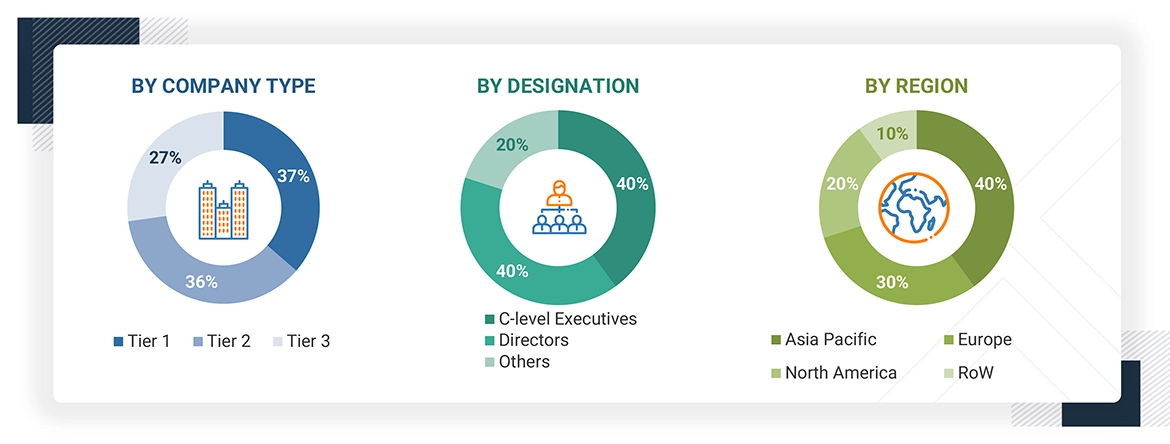
Note: Other designations include sales and marketing executives and researchers, as well as members of various photovoltaic technology organizations.
Sales, business development, and product managers are covered under the “managers” category.
Three tiers of companies are defined based on their total revenue as of 2024: tier 1: revenue more than or equal to USD 500 million, tier 2: revenue between USD 100 million and USD 500 million, and tier 3: revenue less than or equal to USD 100 million.
To know about the assumptions considered for the study, download the pdf brochure
Market Size Estimation
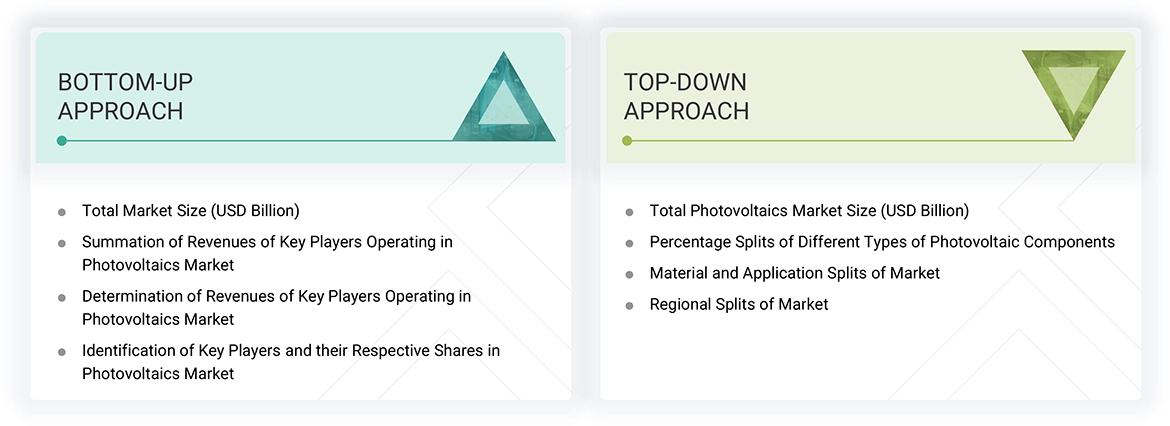
In this report, we have implemented top-down and bottom-up approaches to estimate and validate the size of the photovoltaics market and various other dependent submarkets. Key players in the photovoltaics market have been identified through secondary research, and their market shares in respective regions have been determined through primary and secondary research. This entire research methodology includes the study of annual and financial reports of top companies, as well as interviews with experts (CEOs, VPs, directors, and marketing executives) for key insights (quantitative and qualitative). All percentage shares, splits, and breakdowns have been determined using secondary sources and verified through primary sources. All the possible parameters that affect the market covered in this research study have been accounted for, viewed in detail, verified through primary research, and analyzed to obtain the final quantitative and qualitative data. This data has been consolidated and supplemented with detailed input and analysis from MarketsandMarkets and presented in this report. The figures below show the overall market size estimation process employed for this study.
Bottom-Up Approach
- Identifying key participants in the photovoltaics market that influence the entire market, along with the related component players
- Analyzing major manufacturers of PV components such as modules, inverters, and BOS, studying their portfolios, and understanding their different products
- Analyzing trends pertaining to the use of PV devices for different kinds of applications
- Tracking the ongoing and upcoming developments in the market, such as investments, R&D activities, product launches, collaborations, and partnerships, and forecasting the market based on these developments and other critical parameters
- Carrying multiple discussions with key opinion leaders to understand different types of PV components and applications and recent trends in the market, analyzing the breakup of the scope of work carried out by major companies
- Arriving at the market estimates by analyzing revenues of companies generated and then combining the same to get the market estimate
- Segmenting the overall market into various other market segments
- Verifying and cross-checking the estimate at every level from the discussion with key opinion leaders such as CXOs, directors, and operations managers, and finally with the domain experts in MarketsandMarkets
- Studying various paid and unpaid sources of information such as annual reports, press releases, white papers, and databases
Top-Down Approach
- Focusing initially on the top-line investments and expenditures being made in the ecosystem of the photovoltaics market. Further splitting into component, material, cell type, installation type, and application, and listing key developments in key market areas
- Identifying all major players in the photovoltaic devices market by component and material, and their penetration in various applications through secondary research and verifying with a brief discussion with industry experts
- Analyzing revenues, product mix, geographic presence, and key applications for which photovoltaic systems and components are served by all identified players to estimate and arrive at the percentage splits for all key segments
- Discussing these splits with the industry experts to validate the information and identify key growth pockets across all key segments
- Breaking down the total market based on verified splits and key growth pockets across all segments
- Breaking down the total market based on verified splits and key growth pockets across all segments
Photovoltaics Market : Top-Down and Bottom-Up Approach
Data Triangulation
After arriving at the overall market size through the process explained above, the overall market has been split into several segments. To complete the overall market engineering process and arrive at the exact statistics for all the segments, the data triangulation procedure has been employed wherever applicable. The data has been triangulated by studying various factors and trends from the demand and supply sides. The market has also been validated using the top-down and bottom-up approaches.
Market Definition
According to the Solar Energy Industries Association (SEIA), photovoltaic (PV) devices generate electricity directly from sunlight via an electronic process that occurs naturally in certain types of materials called semiconductors. Electrons in these materials are freed by solar energy and can be induced to travel through an electrical circuit, powering electrical devices or sending electricity to the grid.
Key Stakeholders
- PV cell manufacturers
- PV module manufacturers
- Raw materials and manufacturing equipment suppliers
- PV market technical consultants
- Technology standards organizations, forums, alliances, and associations
- Governments, financial institutions, and investment communities
- Research organizations
- Analysts and strategic business planners
- Venture capitalists, private equity firms, and startup companies
- Distributors
Report Objectives
- To describe, segment, and forecast the photovoltaics market, by component, type, material type, cell type, installation type, and application, in terms of value
- To describe and forecast the photovoltaics market, by component, in terms of volume
- To describe the power capacity ranges and photovoltaic (PV) concentration systems of photovoltaics (PV)
- To describe and forecast the market for four key regions: North America, Europe, Asia Pacific, and RoW, in terms of value
- To provide detailed information regarding drivers, restraints, opportunities, and challenges influencing the growth of the photovoltaics market
- To provide a detailed overview of the supply chain and ecosystem pertaining to the photovoltaics market, along with the average selling price of PV components
- To provide an ecosystem analysis, case study analysis, patent analysis, technology analysis, ASP analysis, Porter’s five forces analysis, 2025 US tariff, AI/Gen AI impact, and regulations pertaining to the market
- To strategically analyze the ecosystem, tariffs and regulations, patent landscape, trade landscape, and case studies pertaining to the market under study
- To strategically analyze micromarkets about individual growth trends, prospects, and contributions to the overall market
- To analyze opportunities in the market for stakeholders and provide a competitive landscape of the market
- To analyze competitive developments such as product launches and developments, expansions, partnerships, collaborations, contracts, and acquisitions in the photovoltaics market
- To strategically profile the key players in the PV market and comprehensively analyze their market ranking and core competencies.
- To evaluate the impact of macroeconomic factors on the regional market
Available customizations:
With the market data given, MarketsandMarkets offers customizations according to the company’s specific needs. The following customization options are available for the report:
Company Information
- Detailed analysis and profiling of additional market players (up to 7)
Get the Full Photovoltaics Market Report
Full forecast, segment splits, and company analysis for all Photovoltaics Market.
- US Photovoltaics Market
- Canada Photovoltaics Market
- Mexico Photovoltaics Market
- UK Photovoltaics Market
- Germany Photovoltaics Market
- France Photovoltaics Market
- Italy Photovoltaics Market
- Spain Photovoltaics Market
- Poland Photovoltaics Market
- China Photovoltaics Market
- India Photovoltaics Market
- South Korea Photovoltaics Market
- Australia Photovoltaics Market
- Indonesia Photovoltaics Market
- Malaysia Photovoltaics Market
- Thailand Photovoltaics Market
- Vietnam Photovoltaics Market
Need a Tailored Report?
Customize this report to your needs
Get 10% FREE Customization
Customize This Report
