
Japan Busbar Market (2025-2030)

The Japan Busbar Market was valued at $1063.7 Million in 2025 and projected to reach to $1922.7 Million by 2030, representing a compound annual growth rate of 6.1%. Japan's busbar market is positioned for sustained growth through 2030, driven by the nation's strategic focus on renewable energy integration and grid modernization initiatives.


| Market Size in | USD 26.32 MN |
| Market Forecast in | |
| CAGR | |
| Forecast Period | |
| Units Considered | Value (USD MN) |
Japan Busbar Market Trends and Insights
- This represents a compound annual growth rate (CAGR) of 6.1%, driven by Japan's ongoing infrastructure modernization and increased demand for efficient power distribution systems.
- Japan's commitment to renewable energy integration and grid modernization initiatives is accelerating busbar adoption across industrial, commercial, and utility sectors. The Japanese busbar market benefits from the country's advanced manufacturing capabilities and stringent electrical safety standards.
- Japan's focus on smart grid technology and energy efficiency has positioned busbars as critical components in power management infrastructure.
- Between 2025 and 2030, Japan is expected to see heightened investment in electrical infrastructure upgrades, particularly in urban centers and industrial zones, further propelling market expansion. Japan's strategic emphasis on sustainable energy solutions and industrial automation continues to create favorable conditions for busbar market growth.
- The country's aging electrical infrastructure replacement cycle, combined with new construction projects, supports sustained demand throughout the forecast period..
Key Market Statistics
- CAGR (2025-2030) 6.1% CAGR
- Market Size, 2025 ~USD 1063.7 Million
- Forecast, 2030 ~USD 1922.7 Million
- Country Japan
Japan Busbar Market Overview
Market Valuation Growth :
Japan's busbar market is valued at USD 1,063.7 million in 2025 and is projected to reach USD 1,922.7 million by 2030, representing an 80.7% increase over the forecast period.
Strong CAGR Performance :
Japan's busbar market is growing at a CAGR of 6.1%, outpacing the global average of 5.8%, indicating accelerated adoption driven by domestic infrastructure investments.
Renewable Energy Integration :
Japan's commitment to renewable energy expansion and grid modernization is driving demand for advanced busbar systems to support efficient power distribution and smart grid technologies.
Infrastructure Modernization :
Ongoing modernization of Japan's aging power infrastructure and increased focus on energy efficiency are creating sustained demand for next-generation busbar solutions across industrial and utility sectors.
Japan Busbar Market Dynamics
- The country's commitment to achieving carbon neutrality and upgrading its aging power infrastructure creates significant opportunities for advanced busbar technologies that enhance power distribution efficiency and reliability. The market will benefit from increased investments in smart grid development, industrial automation, and renewable energy projects.
- Japan's emphasis on energy security and grid resilience, coupled with technological advancements in busbar design and materials, will support continued market expansion.
- Key growth drivers include infrastructure upgrades in urban and industrial zones, rising electricity demand, and the transition toward decentralized energy systems..
Market Ecosystem
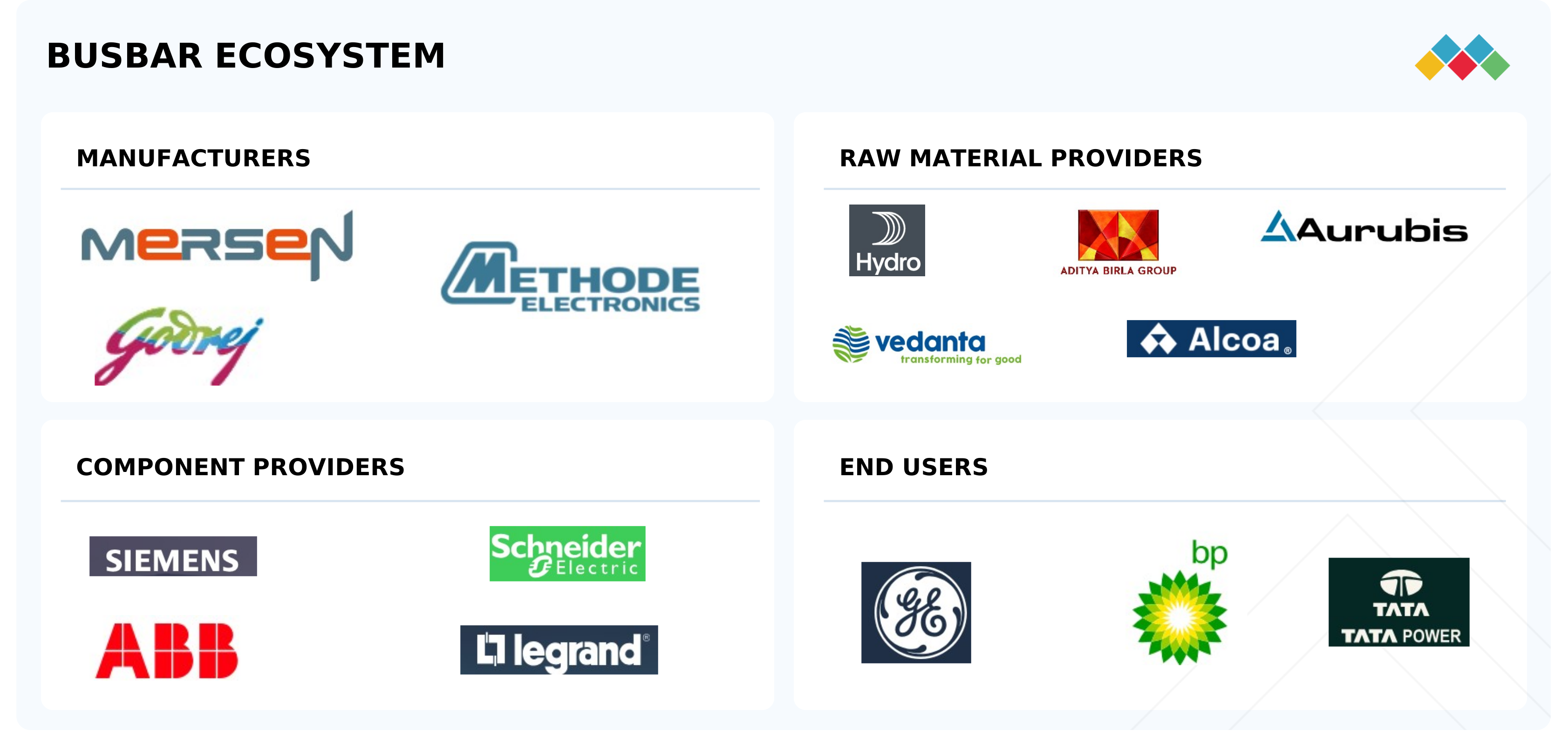
busbar market: COMMERCIAL USE CASES ACROSS INDUSTRIES
| COMPANY | USE CASE DESCRIPTION | BENEFITS |
|---|---|---|
 |
Deploys Armor Clad Busway systems in industrial plants and commercial facilities to distribute electricity effectively, connecting to transformers, panelboards, and switchgear for high-demand applications | Enhanced safety through protection against physical damage and electrical faults |
 |
Implements busbar systems in power generation and oil & gas facilities to ensure reliable power distribution to equipment and machinery across refineries and production sites | Improved reliability of power supply|Reduced energy losses|Lower operational costs |
 |
Installs busbar systems in compact and vertical substations integrated within high-rise buildings and urban networks to supply electricity efficiently in space-constrained areas | Increased grid resilience |Efficient renewable energy integration|Decreased utility costs |
Logos and trademarks shown above are the property of their respective owners. Their use here is for informational and illustrative purposes only.
Related Ecosystem
Key Takeaways
- Japan's busbar market will grow from USD 1,063.7 million in 2025 to USD 1,922.7 million by 2030, representing a 6.1% CAGR.
- Japan's renewable energy transition and smart grid initiatives are primary drivers of busbar market expansion.
- Japan's advanced manufacturing standards and infrastructure modernization support sustained market growth through 2030.
- Industrial and commercial sectors in Japan are increasingly adopting efficient busbar systems for power distribution optimization.
Busbar Market Report Scope
| Report Metric | Details |
|---|---|
| Base Year | 2025 |
| Fastest Growing Segment | LAMINATED (Insulation) |
| Forecast Period | 2025–2030 |
| Growth Rate | CAGR of 5.8% from 2025 to 2030 |
| Largest Segment | BARE (Insulation) |
| Market Size Base Year (Billions) | ~USD 15.77 (2025) |
| Revenue Forecast (Billions) | ~USD 20.9 (2030) |
| Segments Covered | Material, Power Rating, Insulation, Manufacturing Process, End-Use Application |
Japan Busbar Market Report Segmentation
5 segment dimensions are covered across the global market.
By Material
- Aluminum
- Copper
By Power Rating
- High
- Low
- Medium
By Insulation
- Bare
- Laminated
- Powder-Coated
By Manufacturing Process
- Flexible
- Hybrid
- Molded
- Stamped
By End-Use Application
- Automotive
- Commercial & Residential
- Data Centers
- Industrial
- Locomotive
- Renewables
- Residential & Commercial
- Utilities
Target Audience
- Busbar Manufacturers : Manufacturers need Japan-specific market data to assess demand trends, identify growth opportunities, and develop localized product strategies for the expanding Japanese power distribution sector.
- Power Utility Companies : Utility operators require market insights to plan infrastructure investments, evaluate busbar technology upgrades, and align procurement strategies with Japan's grid modernization roadmap.
- Industrial Equipment Suppliers : Suppliers serving industrial clients need Japan market intelligence to understand busbar adoption rates, customer requirements, and competitive positioning in the industrial automation segment.
- Investment & Private Equity Firms : Investors evaluating opportunities in Japan's energy sector need comprehensive market data to assess growth potential, identify acquisition targets, and evaluate portfolio companies in the busbar industry.
- Consulting & Engineering Firms : Consultants advising on infrastructure projects and energy transitions require Japan-specific market analysis to provide clients with accurate forecasts and strategic recommendations for busbar solutions.
Key Companies in the Japan Busbar Market
| Company | HQ | Ownership | Strongest segments |
|---|---|---|---|
| PENTAIR PLC | United Kingdom | Public Company | Pool,Flow,Water Solutions, |
| GODREJ GROUP | India | Private Company | Home appliances (refrigerators, washing machines, ACs, microwaves, coolers, disinfecting appliances),Commercial appliances and cooling (medical refrigerators, deep freezers, vending, personal cooling),Locks, architectural hardware, kitchen fittings, home and institutional security, |
| ABB | Switzerland | Public Company | Electrification,Motion,Automation, |
| EATON | Ireland | Public Company | Electrical components, power distribution and assemblies,Power quality, connectivity, and circuit protection,Hazardous duty, emergency lighting, fire detection, structural support, |
| ROGERS CORPORATION | Canada | Public Company | Wireless services & devices,Cable & broadband (internet, TV, telephony),Media, sports & financial services, |
| LITTELFUSE, INC. | United States | Public Company | Electronics (fuses, TVS, Si/SiC MOSFETs, IGBTs, sensing),Transportation (fuses, power distribution modules, sensors),Industrial (fuses, relays, contactors, protection devices), |
| TE CONNECTIVITY | Ireland | Public Company | Transportation Solutions (automotive, e-mobility, commercial and industrial vehicles, autosport, rail),Industrial Solutions (automation, aerospace and defense, energy, intelligent buildings, medical, rail, oil and gas/marine),Data and Devices (5G, wireless, data centers, IoT connectivity, personal electronics, connected home), |
| SALZER | India | Public Company | Industrial components (switches, ducts, relays, control panels, plugs/sockets),Motor control and protection (contactors, MPCB, MCB, CTs, coils, transformers, EV chargers),Residential and building electricals (MCB, DBs, modular and smart switches, sensors, house wires), |
PENTAIR PLC
Pentair PLC is a United Kingdom-based public company founded in 1966 with approximately 9,000 employees. The company operates as an established industrial enterprise with a significant global workforce.
GODREJ GROUP
Godrej Group is an Indian private company founded in 1897 with 13,316 employees. The company represents a major industrial conglomerate with over a century of business operations.
ABB
ABB is a Swiss public company founded in 1883 with 111,900 employees. As a large multinational enterprise, ABB operates across multiple industrial sectors with a substantial global workforce.
EATON
Eaton is an Irish-registered public company founded in 1911 with 97,303 employees. The company operates as a major multinational industrial enterprise with extensive global operations.
ROGERS CORPORATION
Rogers Corporation is a Canadian public company founded in 1960 with 25,000 employees. The company operates as a significant industrial enterprise with a substantial workforce.
LITTELFUSE, INC.
Littelfuse, Inc. is a United States-based public company founded in 1927 with 17,000 employees. The company operates as an established industrial manufacturer with a considerable global workforce.
TE CONNECTIVITY
TE Connectivity is an Ireland-registered public company founded in 1941 with 80,000 employees. The company operates as a major multinational enterprise with extensive global operations.
SALZER
Salzer is an Indian public company founded in 1985 with 924 employees. The company operates as a mid-sized industrial enterprise with regional market presence.
Reasons to Buy this Report
- Market Size & Growth Data : Access precise valuation figures for Japan's busbar market (USD 1,063.7M in 2025) with detailed 5-year forecasts to 2030, enabling accurate business planning and investment decisions.
- Competitive Landscape Intelligence : Understand Japan-specific market dynamics, key players, and competitive positioning to identify opportunities for market entry, partnerships, or expansion within the Japanese busbar sector.
- Growth Driver Analysis : Gain insights into Japan's infrastructure modernization, renewable energy initiatives, and grid upgrade projects that are fueling busbar demand, helping you align products with market needs.
- Regional Performance Benchmarking : Compare Japan's 6.1% CAGR against global trends (5.8%) to assess relative market strength and identify Japan as a high-growth opportunity within your Asia-Pacific strategy.
- Strategic Investment Guidance : Make informed decisions on R&D investments, manufacturing capacity, and market entry timing based on comprehensive Japan-specific market forecasts and trend analysis through 2030.
Frequently asked questions
What is the current size of Japan's busbar market in 2025?
Japan's busbar market is valued at USD 1,063.7 million in 2025.
What is the projected size of Japan's busbar market by 2030?
Japan's busbar market is projected to reach USD 1,922.7 million by 2030.
What is the CAGR for Japan's busbar market from 2025 to 2030?
Japan's busbar market is expected to grow at a compound annual growth rate (CAGR) of 6.1% during the forecast period.
What are the main drivers of growth in Japan's busbar market?
Key drivers include Japan's renewable energy integration, smart grid modernization, infrastructure upgrades, and industrial automation initiatives.
Which sectors are driving demand for busbars in Japan?
Industrial, commercial, and utility sectors are primary demand drivers, supported by infrastructure replacement cycles and new construction projects.
RESEARCH METHODOLOGY
The study involved major activities in estimating the current size of the busbar market. Exhaustive secondary research was done to collect information on the peer and parent markets. The next step was to validate these findings, assumptions, and sizing with industry experts across the value chain through primary research. Both top-down and bottom-up approaches were employed to estimate the complete market size. Thereafter, market breakdown and data triangulation were used to estimate the market size of the segments and subsegments.
Secondary Research
This research study on the busbar market involved the use of extensive secondary sources, directories, and databases, such as Hoovers, Bloomberg, Businessweek, Factiva, International Energy Agency, and BP Statistical Review of World Energy, to identify and collect valuable information for a technical, market-oriented, and commercial study of the global busbar market. The other secondary sources included annual reports, press releases, and investor presentations of companies, white papers, certified publications, articles by recognized authors, manufacturer associations, trade directories, and databases.
Primary Research
The busbar market comprises stakeholders, including busbar manufacturers, technology providers, and support providers, throughout the supply chain. On the demand side, the market is driven by growing adoption of busbar systems in various sectors, including data centers, renewable energy, industrial, and commercial applications, due to their high energy efficiency, compact design, and superior performance compared to conventional power distribution systems. Rising infrastructure development and urbanization in emerging economies further fuel demand for busbar solutions. On the supply side, manufacturers are witnessing increasing opportunities through contracts from utility and industrial distribution networks, as well as strategic initiatives, such as mergers, acquisitions, and partnerships, by market players to expand their footprint and enhance technological capabilities. Various primary sources from both the supply and demand sides of the market were interviewed to obtain qualitative and quantitative information. The following is the breakdown of primary respondents:
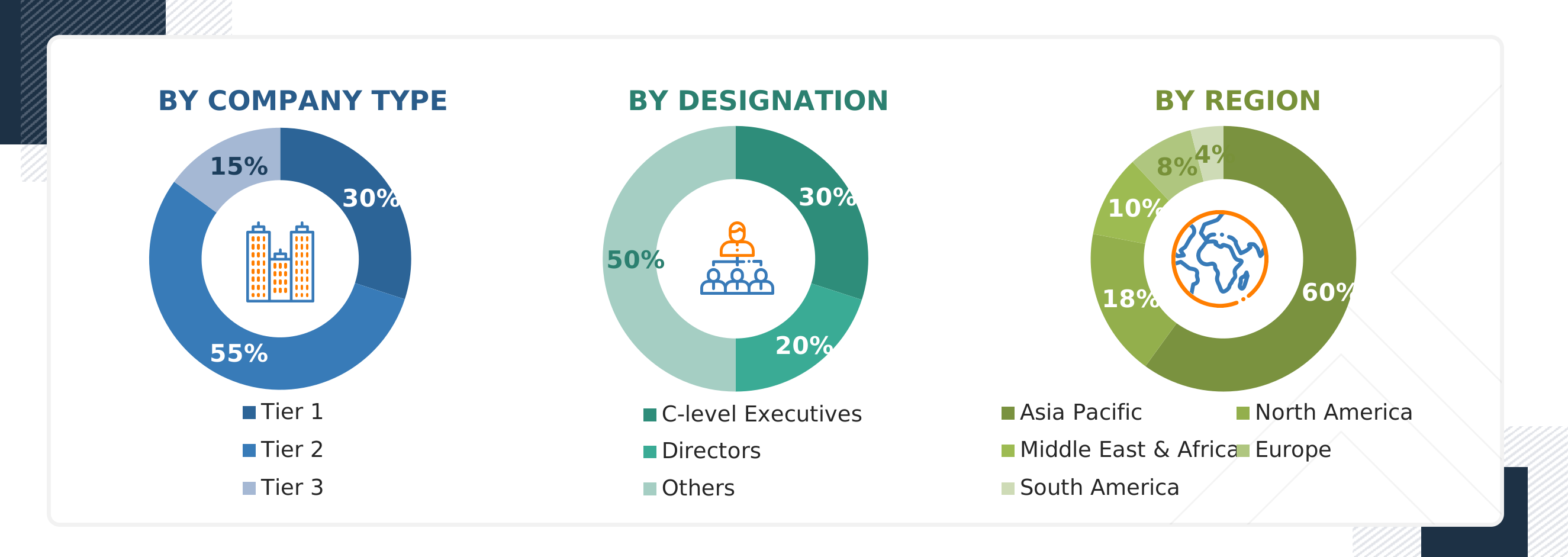
Note: “Others” include sales managers, engineers, and regional managers.
The tiers of the companies are defined based on their total revenue as of 2024: Tier 1: >USD 1 billion, Tier 2: USD 500 million–1 billion,
and Tier 3:
To know about the assumptions considered for the study, download the pdf brochure
Market Size Estimation
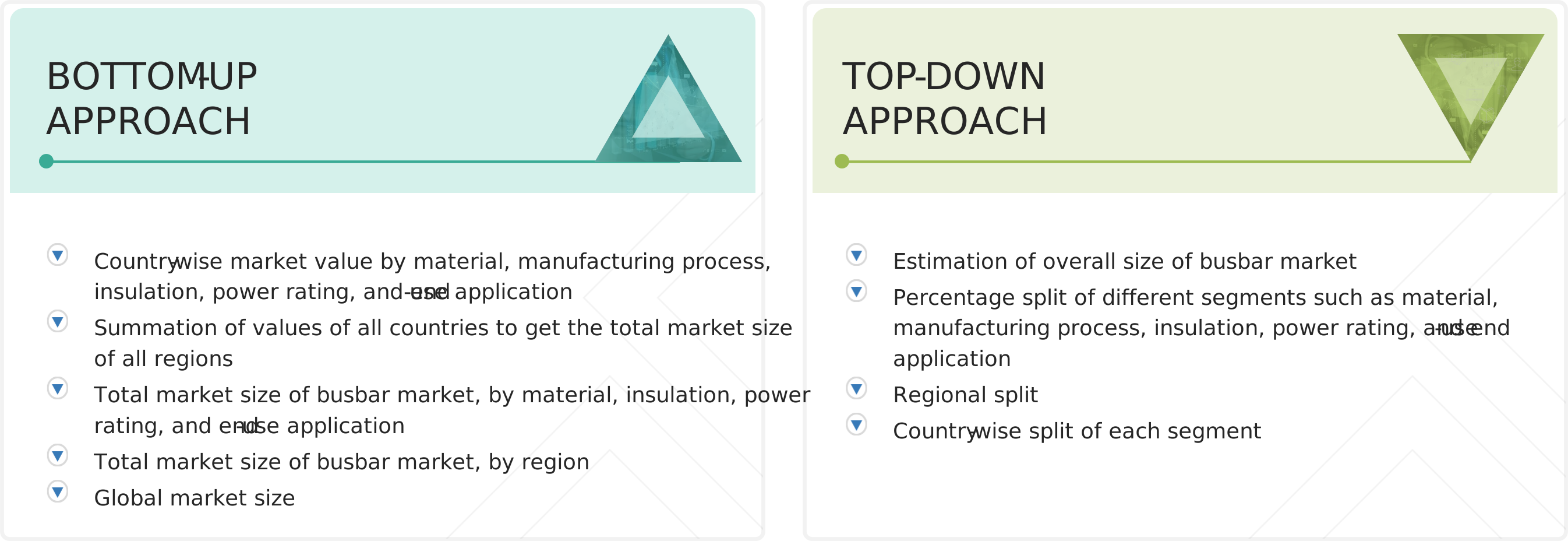
Both the top-down and bottom-up approaches were used to estimate and validate the size of the busbar market and its dependent submarkets. The key players in the market were identified through secondary research, and their market share in the respective regions was determined through a combination of primary and secondary research. The research methodology involves analyzing the annual and financial reports of top market players and conducting interviews with industry experts, including chief executive officers, vice presidents, directors, sales managers, and marketing executives, to gather key quantitative and qualitative insights related to the busbar market.
Busbar Market : Top-Down and Bottom-Up Approach
Data Triangulation
After determining the overall market size through the estimation process explained above, the total market was divided into several segments and subsegments. To complete the overall market engineering process and obtain the exact statistics for all segments and subsegments, the data triangulation and market breakdown processes were employed, as applicable. The data was triangulated by studying various factors and trends from both the demand and supply sides. Additionally, the market size was validated using both top-down and bottom-up approaches.
Market Definition
A busbar is an electrical element that simplifies complex power distributions, making them more affordable and flexible. It is a metallic strip or bar, typically housed inside switchgear, panel boards, and busway enclosures for local high-current power distribution. The bus bar system consists of an isolator and a circuit breaker. It allows new circuits to branch off anywhere along the busway route, rather than branching the main supply at a single location. A busbar is an electrical junction that collects electric power from incoming feeders and distributes it to the outgoing feeders. The primary purpose of a busbar is to carry electricity and distribute it. It is used to make the systems more efficient. They can be an excellent solution for complicated electrical systems.
Stakeholders
- Government & research organizations
- Institutional investors
- Investors/Shareholders
- Environmental research institutes
- Manufacturers’ associations
- Busbar manufacturers, dealers, and suppliers
- Organizations, forums, alliances, and associations
- Renewable power generation and equipment manufacturing companies
- Public & private power generation, transmission & distribution companies (utilities)
- Substation equipment manufacturing companies
- Smart grid project developers
- Switchgear and power cable manufacturing companies
- State and national regulatory authorities
- Venture capital firms
Report Objectives
- To describe and forecast the busbar market, by material, power rating, insulation, manufacturing process, end-use application, and region, in terms of value
- To describe and forecast the busbar market for various segments with respect to five main regions: North America, Europe, Asia Pacific, South America, and the Middle East & Africa, in terms of value
- To describe and forecast the busbar market, by region, in terms of volume
- To provide detailed information regarding drivers, restraints, opportunities, and challenges influencing the growth of the market
- To provide a detailed overview of the busbar supply chain analysis, use case analysis, key stakeholders and buying criteria, patent analysis, trade analysis, tariff analysis, regulations, macroeconomic outlook, pricing analysis, Porter’s five forces analysis, impact of gen AI/AI, and the 2024 US tariff impact
- To strategically analyze micromarkets1 with respect to individual growth trends, prospects, and contributions to the total market
- To analyze opportunities in the market for various stakeholders by identifying high-growth segments
- To strategically profile key players and comprehensively analyze their market position in terms of ranking and core competencies1, along with detailing the market’s competitive landscape.
- To analyze growth strategies, such as acquisitions, investments, expansions, and product launches, adopted by market players in the busbar market
1 Micromarkets are defined as the segments and subsegments of the busbar market included in the report.
2 Core competencies of companies are defined in terms of key developments and strategies adopted to sustain their positions in the busbar market.
Available Customizations
MarketsandMarkets offers customizations tailored to the specific needs of companies, utilizing the provided market data.
The following customization options are available for the report:
Product Analysis
- Product matrix, which gives a detailed comparison of the product portfolio of each company
Geographic Analysis as per Feasibility
- Further breakdown of the busbar market, by country
Company Information
- Detailed analysis and profiling of additional market players (up to five)
Get the Full Busbar Market Report
Full forecast, segment splits, and company analysis for all Busbar Market.
- Rest Of Europe Busbar Market
- Rest Of Asia Pacific Busbar Market
- GCC Busbar Market
- Rest Of GCC Busbar Market
- China Busbar Market
- India Busbar Market
- South Korea Busbar Market
- Germany Busbar Market
- UK Busbar Market
- Italy Busbar Market
- France Busbar Market
- Canada Busbar Market
- Mexico Busbar Market
- US Busbar Market
- Saudi Arabia Busbar Market
- UAE Busbar Market
- Qatar Busbar Market
- South Africa Busbar Market
- Brazil Busbar Market
- Argentina Busbar Market
Need a Tailored Report?
Customize this report to your needs
Get 10% FREE Customization
Customize This Report
