
Latin America Causal AI Market (2024-2029)

The Latin America Causal AI Market was valued at $3.2 Million in 2024 and projected to reach to $24.08 Million by 2029, representing a compound annual growth rate of 40.0%. Latin America's Causal AI market is poised for transformative growth, driven by increasing digital transformation initiatives and enterprise demand for sophisticated decision-making tools.


| Market Size in | USD 26.32 MN |
| Market Forecast in | |
| CAGR | |
| Forecast Period | |
| Units Considered | Value (USD MN) |
Latin America Causal AI Market Trends and Insights
- Latin America's adoption of causal AI technologies is accelerating as enterprises across the region recognize the value of advanced analytics and decision-making capabilities.
- By 2029, Latin America is projected to reach a market size of $24.08 million USD, representing a compound annual growth rate (CAGR) of 40.0%. Latin America's causal AI market growth is driven by increasing digital transformation initiatives and the region's growing demand for AI-powered solutions in financial services, healthcare, and manufacturing sectors.
- Latin America is witnessing heightened investment in AI infrastructure and talent development, positioning the region as an emerging hub for causal AI innovation.
- The forecast period from 2024 to 2029 will be critical for Latin America as organizations seek to leverage causal inference methodologies to improve business outcomes and competitive advantage..
Key Market Statistics
- CAGR (2024-2029) 40.0% CAGR
- Market Size, 2024 ~USD 3.2 Million
- Forecast, 2029 ~USD 24.08 Million
- Geography Latin America
Latin America Causal AI Market Overview
Rapid Growth Trajectory :
Latin America's Causal AI market is expanding at a 40% CAGR, significantly outpacing many mature markets. This acceleration reflects growing enterprise recognition of causal AI's value in driving data-informed decision-making across the region's diverse industries.
Brazil's Market Leadership :
Brazil dominates Latin America's Causal AI adoption with a market size of $9.73 million USD in 2024, representing nearly 75% of the region's total market. The country's advanced tech ecosystem and large enterprise base position it as the primary growth engine for regional expansion.
Emerging Opportunities in Mexico :
Mexico's Causal AI market, valued at $5.09 million USD in 2024, presents significant growth potential as manufacturing, financial services, and telecommunications sectors increasingly adopt advanced analytics solutions for competitive advantage.
Regional Market Consolidation :
Beyond Brazil and Mexico, the Rest of Latin America accounts for $9.26 million USD, indicating untapped opportunities across Colombia, Argentina, Chile, and other emerging markets seeking to modernize their analytical capabilities.
Latin America Causal AI Market Dynamics
- The region's projected expansion from $3.2 million USD in 2024 to $24.08 million USD by 2029 reflects growing awareness among Latin American organizations of causal AI's competitive advantages in understanding complex business relationships and optimizing outcomes. Key growth catalysts include rising cloud adoption, expanding fintech ecosystems, and regulatory pressures requiring enhanced analytical transparency.
- As Latin American enterprises mature their AI capabilities and seek differentiation in competitive markets, causal AI adoption will accelerate across financial services, retail, manufacturing, and healthcare sectors.
- Strategic investments in local talent development and partnerships with global technology providers will further accelerate regional market penetration..
Market Ecosystem
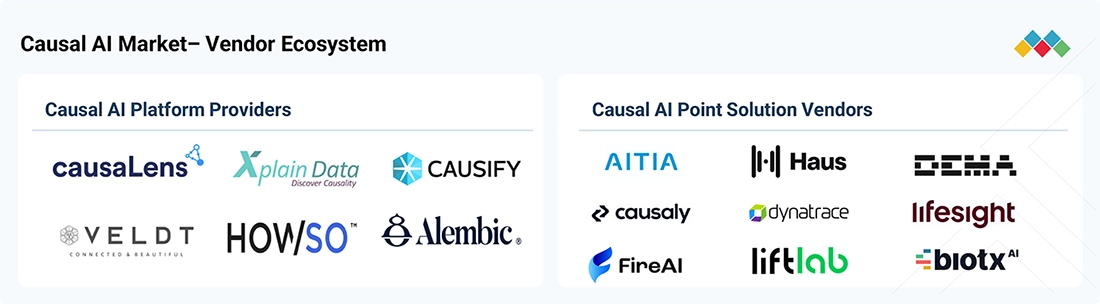
CAUSAL AI MARKET: COMMERCIAL USE CASES ACROSS INDUSTRIES
| COMPANY | USE CASE DESCRIPTION | BENEFITS |
|---|---|---|
 |
Syneos Health deployed causaLens Digital Workers across biopharma commercialization workflows, including HCP targeting, engagement optimization, territory planning, media execution, and other analytical processes that previously relied on manual work and multiple point tools. | Removed more than USD 1 million of point-SaaS costs | Avoided the need to hire 7+ full-time employees | Achieved payback in less than 3 months |
 |
Quicken used LiftLab forecasting, causal marketing measurement, and scenario planning to evaluate a major year-end budget increase, reallocate spend across channels, and support the investment case with modeled marginal returns and experiment-backed evidence. | Generated a 19% gross revenue lift in the critical year-end window while maintaining incremental return on ad spend |
 |
Mejuri used Haus GeoLift to test whether reallocating part of its Meta budget toward upper-funnel campaigns could reach genuinely incremental customers rather than audiences that were already likely to convert. | Delivered a 12.9% lift in incremental sales and a 57% improvement in incremental ROAS after the post-treatment period |
 |
Dermalogica adopted Measured to replace last-click attribution with incrementality-based measurement, align marketing and finance around a common view of media contribution, and use causal testing to guide portfolio optimization. | Measured reports that Dermalogica generated more than USD 10 million in incremental revenue from marketing after operationalizing incrementality across its decision process |
 |
Seidensticker implemented Lifesight's unified measurement framework combining causal MMM, causal attribution, scenario simulation, and geo-based incrementality experiments to improve budget allocation and validate upper-funnel channels. | Achieved 11.5% higher revenue versus target with 11.7% lower ad spend | Forecasted iROAS improved 19.3% | Outbrain experiments proved 13.6% incremental lift |
Logos and trademarks shown above are the property of their respective owners. Their use here is for informational and illustrative purposes only.
Related Ecosystem
Software And Services
- Natural Language Processing (NLP)
- Machine Learning
- Supply Chain Management
- Predictive Analytics
- Image Sensors
- International Business Machines Corporation
- MICROSOFT CORPORATION
- Oracle Corporation
- SAP SE
- Amazon.com, Inc.
Key Takeaways
- Latin America's Causal AI market is valued at $3.2 million USD in 2024 and is expected to grow to $24.08 million USD by 2029.
- Latin America is experiencing a 40.0% CAGR, reflecting strong regional demand for causal AI solutions across multiple industries.
- Latin America's market growth is fueled by digital transformation, increased AI adoption in financial services and healthcare, and rising enterprise investment.
- Latin America represents a high-growth emerging market opportunity for causal AI vendors and solution providers through 2029.
Causal AI Market Report Scope
| Report Metric | Details |
|---|---|
| Base Year | 2024 |
| Fastest Growing Segment | SOFTWARE & TECHNOLOGY PROVIDERS (End User) |
| Forecast Period | 2024-2029 |
| Growth Rate | CAGR of 41.8% from 2024 to 2029 |
| Largest Segment | MACHINE LEARNING (Technology) |
| Market Size Base Year (Billions) | ~USD 0.06 (2024) |
| Revenue Forecast (Billions) | ~USD 0.32 (2029) |
| Segments Covered | Offering, Type, Application, Vertical, Software Type, Causal Ai Solution, Service, Financial Management, Sales And Customer Management, Operations & Supply Chain Management, Marketing & Pricing Management, Business Function, Technology, Product Type, Functionality, End User |
Latin America Causal AI Market Report Segmentation
16 segment dimensions are covered across the global market.
By Offering
- Hardware
- Services
- Software
By Type
- Bottleneck Remediation
- Causal AI Apis
- Causal AI Platforms
- Causal AI Solutions
- Causal Discovery
- Causal Modeling
- Churn Prediction & Prevention
- Competitive Pricing Analysis
- Consulting Services
- Customer Experience Optimization
- Customer Lifetime Value (Clv) Prediction
- Customer Segmentation
- Decision Intelligence
- Deployment & Integration Services
- Factor Investing
- Inventory Management
- Investment Analysis
- Marketing Channel Optimization
- Personalized Recommendations
- Portfolio Simulation
- Predictive Maintenance
- Price Elasticity Modeling
- Promotional Impact Analysis
- Real-Time Failure Response
- Root-Cause Analysis
- Software Development Kits
- Training, Support & Maintenance Services
By Application
- Financial Management
- Marketing & Pricing Management
- Operations & Supply Chain Management
- Other Applications
- Sales & Customer Management
By Vertical
- Agriculture
- Automotive, Transportation & Logistics
- Bfsi
- Energy & Utilities
- Government & Defense
- Healthcare & Life Sciences
- Healthcare& Life Sciences
- It/Ites
- Manufacturing
- Media & Entertainment
- Other Verticals
- Retail & E-Commerce
- Retail & Ecommerce
- Telecommunications
- Transportation & Logistics
By Software Type
- Causal AI Platforms
- Causal AI Solutions
By Causal Ai Solution
- Causal AI Apis
- Causal Discovery
- Causal Inference (Decision Intelligence)
- Causal Modeling
- Root-Cause Analysis
- Software Development Kits (Sdk)
By Service
- Consulting Services
- Deployment & Integration Services
- Training, Support & Maintenance Services
By Financial Management
- Factor Investing
- Investment Analysis
- Portfolio Simulation
By Sales And Customer Management
- Churn Prediction & Prevention
- Customer Experience Optimization
- Customer Lifetime Value (Clv) Prediction
- Customer Segmentation
- Personalized Recommendations
By Operations & Supply Chain Management
- Bottleneck Remediation
- Inventory Management
- Predictive Maintenance
- Real-Time Failure Response
By Marketing & Pricing Management
- Competitive Pricing Analysis
- Marketing Channel Optimization
- Price Elasticity Modeling
- Promotional Impact Analysis
By Business Function
- Cybersecurity
- Finance & Accounting
- Human Resources
- Marketing & Sales
- Operations
By Technology
- Computer Vision
- Context-Aware AI
- Machine Learning
- Natural Language Processing
By Product Type
- AI Governance As A Service
- AI Governance Consulting Services
- Data Governance Platforms
- Data Privacy Tools
- End-To-End AI Governance Platforms
- Focused AI Governance Platforms
- Llmops Tools
- Mlops Tools
- Responsible AI Toolkits
By Functionality
- Data Governance
- Ethics & Responsible AI
- Model Lifecycle Management
- Monitoring & Auditing
- Other Functionality Types
- Risk Management & Compliance
- Transparency & Explainability
By End User
- Automotive
- Bfsi
- Government & Defense
- Healthcare & Life Sciences
- Manufacturing
- Media & Entertainment
- Other End Users
- Retail & Consumer Goods
- Software & Technology Providers
- Telecommunications
Target Audience
- Enterprise Technology Leaders : CIOs and technology executives in Latin American enterprises need this data to evaluate Causal AI adoption, benchmark regional adoption rates, and justify investments in advanced analytics capabilities to drive competitive advantage.
- Market Entry & Expansion Teams : Companies planning to enter or expand in Latin America require detailed market sizing, growth forecasts, and country-specific insights to develop localized strategies, identify priority markets, and allocate resources effectively.
- Investment & Private Equity Firms : Investors evaluating opportunities in Latin America's AI and analytics sectors need comprehensive market data, growth trajectories, and competitive landscapes to identify promising portfolio companies and assess investment returns.
- Consulting & Systems Integration Partners : Solution providers and consultants serving Latin American clients require regional market intelligence to advise on Causal AI adoption, identify client opportunities, and develop service offerings aligned with regional demand patterns.
- Government & Policy Organizations : Regional development agencies and policy makers need market insights to understand AI adoption trends, identify skills gaps, and develop initiatives supporting Latin America's digital transformation and competitive positioning.
Countries within Latin America - compare and drill down
| Country | 2025 size (native) |
|---|---|
| Brazil | USD 9.73 Million |
| Mexico | USD 5.09 Million |
| Rest Of Latin America | USD 9.26 Million |
Country market size visualization
Reasons to Buy this Report
- Regional Market Sizing & Forecasts : Gain precise market size data for Latin America's Causal AI sector with country-level breakdowns for Brazil, Mexico, and emerging markets. Detailed 2024-2029 forecasts enable accurate business planning and investment decisions specific to regional dynamics.
- Competitive Landscape Intelligence : Understand market positioning across Latin America's key markets. Identify leading players, emerging competitors, and market gaps to inform go-to-market strategies and partnership opportunities tailored to regional preferences and regulatory environments.
- Growth Driver Analysis : Discover what's fueling Latin America's 40% CAGR expansion. Analyze sector-specific adoption patterns, digital transformation initiatives, and enterprise priorities driving Causal AI investment across Brazil, Mexico, and secondary markets.
- Investment & Expansion Strategy : Make informed decisions about market entry, resource allocation, and expansion priorities in Latin America. Benchmark regional performance against global trends and identify high-potential segments for targeted growth initiatives.
- Stakeholder Communication : Leverage comprehensive regional data to support board presentations, investor pitches, and strategic planning. Demonstrate market opportunity, growth potential, and competitive positioning specific to Latin American operations and expansion plans.
Frequently asked questions
What is the current size of the Causal AI market in Latin America?
The Causal AI market in Latin America is estimated at $3.2 million USD in 2024.
What is the projected market size for Causal AI in Latin America by 2029?
Latin America's Causal AI market is forecasted to reach $24.08 million USD by 2029.
What is the CAGR for the Causal AI market in Latin America?
Latin America's Causal AI market is projected to grow at a compound annual growth rate (CAGR) of 40.0% from 2024 to 2029.
Which industries are driving Causal AI adoption in Latin America?
Latin America's Causal AI adoption is primarily driven by financial services, healthcare, and manufacturing sectors seeking advanced analytics and decision-making solutions.
Why is Latin America's Causal AI market growing faster than other regions?
Latin America's rapid growth is attributed to accelerating digital transformation initiatives, increased enterprise investment in AI infrastructure, and rising demand for data-driven decision-making capabilities across key industries.
RESEARCH METHODOLOGY
The research methodology for the global causal AI market report involved the use of extensive secondary sources and directories, as well as various reputed open-source databases, to identify and collect information useful for this technical and market-oriented study. In-depth interviews were conducted with various primary respondents, including causal AI platform providers, causal AI point solution providers, causal AI service providers, and enterprise end users; high-level executives of multiple companies offering causal AI software & services; and industry consultants to obtain and verify critical qualitative and quantitative information and assess the market prospects and industry trends.
Secondary Research
In the secondary research process, various secondary sources were referred to for identifying and collecting information for the study. The secondary sources included annual reports; press releases and investor presentations of companies; product documentation; technical white papers; developer documentation; and certified publications such as Journal of Causal Inference, Journal of Machine Learning Research, Journal of the American Statistical Association, Biometrika, The Annals of Statistics, Artificial Intelligence, Nature Machine Intelligence, Statistics in Medicine, and Epidemiology. Research papers and proceedings from leading conferences, including the Conference on Neural Information Processing Systems (NeurIPS), International Conference on Machine Learning (ICML), Conference on Uncertainty in Artificial Intelligence (UAI), International Conference on Artificial Intelligence and Statistics (AISTATS), AAAI Conference on Artificial Intelligence, and ACM SIGKDD Conference on Knowledge Discovery and Data Mining, were also referred to for developments in causal discovery, causal inference, counterfactual reasoning, treatment-effect estimation, experimentation, and decision intelligence. Standards, frameworks, and guidance from recognized organizations and government bodies were also reviewed, including the Association for Computing Machinery (ACM), Institute of Electrical and Electronics Engineers (IEEE), American Statistical Association (ASA), Royal Statistical Society (RSS), National Institute of Standards and Technology (NIST), Organisation for Economic Co-operation and Development (OECD), International Organization for Standardization/International Electrotechnical Commission (ISO/IEC), European Commission, US Food and Drug Administration (FDA), and European Medicines Agency (EMA). These sources were supplemented with publications on AI governance, explainability, model validation, experimentation, digital twins, agentic AI, and responsible AI to assess the evolving technological, regulatory, and commercial landscape of the Causal AI market.
The secondary research was used to obtain key information about the industry’s value chain, the market’s monetary chain, the overall pool of key players, market classification and segmentation according to industry trends to the bottom-most level, regional markets, and key developments from the market and technology-oriented perspectives.
Primary Research
In the primary research process, a diverse range of stakeholders from both the supply and demand sides of the Causal AI ecosystem were interviewed to gather qualitative and quantitative insights specific to this market. From the supply side, key industry experts, such as chief executive officers (CEOs), vice presidents (VPs), marketing directors, technology & innovation directors, as well as technical leads from vendors offering causal AI software & services, were consulted. Additionally, system integrators, service providers, and IT service firms that implement and support causal AI were included in the study. On the demand side, input from IT decision-makers, product managers, and business heads of prominent enterprise end users was collected to understand the user perspectives and adoption challenges within targeted industries.
The primary research ensured that all crucial parameters affecting the causal AI market—from technological advancements and evolving use cases (decision intelligence & scenario planning, root-cause analysis & causal diagnostics, treatment-effect estimation & uplift analysis, marketing incrementality & optimization, etc.) to regulatory and compliance needs (GDPR, CCPA, Europe AI Act, AIDA, etc.)—were considered. Each factor was thoroughly analyzed, verified through primary research, and evaluated to obtain precise quantitative and qualitative data for this market.
Once the initial phase of market engineering was completed, including detailed calculations for market statistics, segment-specific growth forecasts, and data triangulation, an additional round of primary research was undertaken. This step was crucial for refining and validating critical data points, such as causal AI offerings (software & services), industry adoption trends, the competitive landscape, and key market dynamics like demand drivers (Rising demand for explainable, action-oriented AI; growing adoption of causal inference and counterfactual analysis; increasing use of experimentation and treatment-effect estimation; expansion of digital twins and agentic workflows), challenges (Maintaining causal validity as business conditions change; integrating fragmented data while meeting governance and explainability requirements), and opportunities (Integration with agentic AI and digital twins; growth of domain-specific Causal AI point solutions; rising use of causal decision intelligence and scenario planning).
In the comprehensive market engineering process, the top-down and bottom-up approaches, along with several data triangulation methods, were extensively employed to perform market estimation and forecasting for the overall market segments and subsegments listed in this report. Extensive qualitative and quantitative analysis was performed on the complete market engineering process to record the critical information/insights throughout the report.
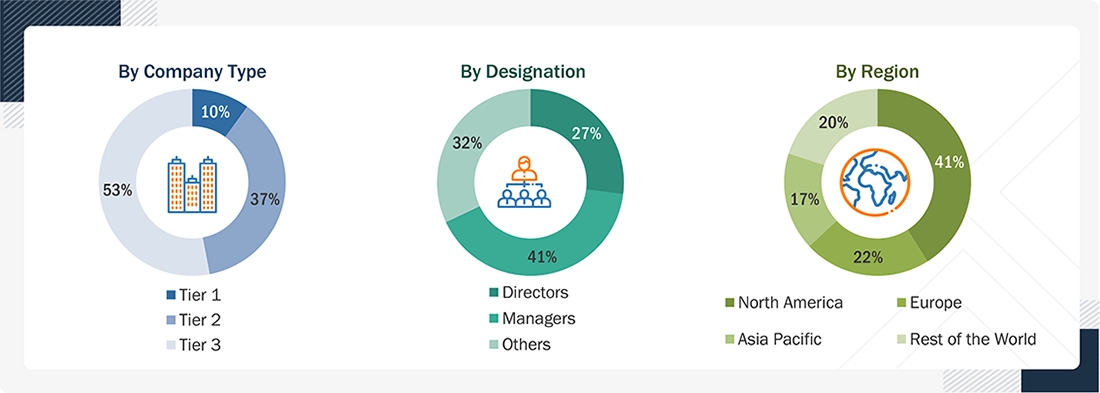
Note: Three tiers of companies are defined based on their total revenue for the year ended 31st December 2025; Tier 1 companies’ revenue is more than USD 100 million; Tier 2 companies' revenue ranges between USD 10 million and USD 100 million; and Tier 3 companies’ revenue is less than USD 10 million
Source: MarketsandMarkets Analysis
To know about the assumptions considered for the study, download the pdf brochure
Market Size Estimation
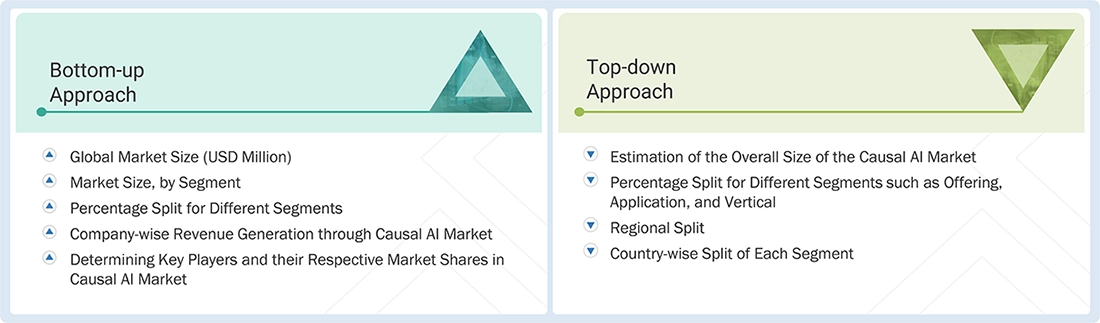
The top-down and bottom-up approaches were employed to estimate and forecast the causal AI market, as well as its dependent submarkets. This multi-layered analysis was further reinforced through data triangulation, which incorporated primary and secondary research inputs. The market figures were also validated against the existing MarketsandMarkets repository for accuracy.
Causal AI Market: Top-Down and Bottom-Up Approach
Data Triangulation
The market was divided into several segments and subsegments after determining the overall market size using the market size estimation processes described above. To complete the overall market engineering process and determine the exact statistics for each market segment and subsegment, data triangulation and market segmentation procedures were employed, wherever applicable. The overall market size was then used in the top-down approach to estimate the size of other individual markets by applying percentage splits to the market segmentation.
Market Definition
The Causal AI market comprises software platforms, point solutions, and related services that use causal reasoning techniques to identify cause-and-effect relationships, estimate the impact of interventions, and support decisions beyond correlation-based prediction. Causal AI technologies include causal discovery, causal inference, treatment-effect estimation, counterfactual analysis, root-cause diagnostics, experimentation and uplift analysis, and causal decision intelligence. These capabilities help enterprises determine why an outcome occurred, what is likely to change if a specific action is taken, and which intervention is most likely to improve the desired result.
The market covers horizontal Causal AI platforms as well as domain-specific solutions deployed across financial services, healthcare and life sciences, retail, manufacturing, telecommunications, energy, IT services, government, and other industries.
Key Stakeholders
- Academia and causal inference research institutions
- Agentic AI and AI agent platform providers
- AI consulting and implementation service providers
- AI, machine learning, and foundation model providers
- Business strategy, finance, marketing, operations, and risk leaders
- Causal AI service providers
- Causal AI software vendors
- Chief Information Officers, Chief Technology Officers, Chief Data Officers, and AI leaders
- Cloud, data, and enterprise AI platform providers
- Data science, machine learning, and analytics teams
- Enterprise end users
- Government agencies and regulatory authorities
- Investors, venture capital firms, and private equity firms
- Market research and consulting firms
- Security, risk, compliance, and AI governance teams
- Standards bodies and industry associations
- System integrators and digital engineering service providers
Report Objectives
- To define, describe, and forecast the causal AI market, by offering (software and services), application, and vertical
- To provide detailed information related to major factors (drivers, restraints, opportunities, and industry-specific challenges) influencing market growth
- To analyze the micro markets with respect to individual growth trends, prospects, and their contribution to the total market
- To analyze the opportunities in the market for stakeholders by identifying the high-growth segments of the causal AI market
- To analyze opportunities in the market and provide details of the competitive landscape for stakeholders and market leaders
- To forecast the market size of segments for four main regions: North America, Europe, Asia Pacific, and Rest of the World
- To profile the key players and comprehensively analyze their market ranking and core competencies
- To analyze competitive developments, such as partnerships, product launches, and mergers and acquisitions, in the causal AI market
- To analyze the impact of various macroeconomic factors in the causal AI market across all four regions
Available customizations:
With the given market data, MarketsandMarkets offers customizations based on the company’s specific needs. The following customization options are available for the report.
Brand/Product Comparative Analysis
- Brand/product comparative analysis of additional vendors
Geographic Analysis
- Inclusion of additional European countries, with a breakdown by offering, application, and industry vertical segments
- Inclusion of additional Asia Pacific countries, with breakup by offering, application, and industry vertical segments
- Breakdown of Middle East & Africa by countries, with a breakdown by offering, application, and industry vertical segments
- Breakdown of Latin America by countries, with breakdown by offering, application, and industry vertical segments
Company Information
-
Detailed analysis and profiling of additional market players (up to five)
Get the Full Causal AI Market Report
Full forecast, segment splits, and company analysis for all Causal AI Market.
- Canada Causal AI Market
- US Causal AI Market
- UK Causal AI Market
- Germany Causal AI Market
- France Causal AI Market
- China Causal AI Market
- India Causal AI Market
- Japan Causal AI Market
- South Korea Causal AI Market
- Saudi Arabia Causal AI Market
- UAE Causal AI Market
- South Africa Causal AI Market
- Brazil Causal AI Market
- Mexico Causal AI Market
- Rest Of Europe Causal AI Market
- Asean Causal AI Market
- Rest Of Asia Pacific Causal AI Market
- Rest Of Latin America Causal AI Market
- Rest Of Mea Causal AI Market
Need a Tailored Report?
Customize this report to your needs
Get 10% FREE Customization
Customize This Report
