
Asia Pacific Causal AI Market (2024-2029)

The Asia Pacific Causal AI Market was valued at $16.31 Million in 2024 and projected to reach to $154.42 Million by 2029, representing a compound annual growth rate of 45.4%. Asia Pacific is positioned as the fastest-growing Causal AI market globally, with enterprises increasingly recognizing the value of causal inference for strategic decision-making.


| Market Size in | USD 26.32 MN |
| Market Forecast in | |
| CAGR | |
| Forecast Period | |
| Units Considered | Value (USD MN) |
Asia Pacific Causal AI Market Trends and Insights
- Asia Pacific's 45.4% compound annual growth rate significantly outpaces global trends, driven by increasing enterprise adoption of AI-driven decision-making systems across finance, healthcare, and manufacturing sectors.
- The region's strong digital infrastructure, rising cloud adoption, and growing investment in AI research position Asia Pacific as a critical growth engine for causal AI technologies. Asia Pacific organizations are increasingly recognizing the value of causal inference in improving business outcomes and reducing operational risks.
- Between 2024 and 2029, Asia Pacific enterprises are expected to accelerate deployment of causal AI solutions to enhance predictive accuracy and enable more sophisticated root-cause analysis.
- Government initiatives supporting AI innovation, coupled with a large talent pool of data scientists and engineers, further strengthen Asia Pacific's competitive advantage in the causal AI landscape..
Key Market Statistics
- CAGR (2024-2029) 45.4% CAGR
- Market Size, 2024 ~USD 16.31 Million
- Forecast, 2029 ~USD 154.42 Million
- Geography Asia Pacific
Asia Pacific Causal AI Market Overview
Exceptional Growth Trajectory :
Asia Pacific's Causal AI market is expanding at 45.4% CAGR, significantly outpacing the global rate of 41.8%, driven by rapid digital transformation and enterprise AI adoption across the region.
Market Size Expansion :
The region's market is projected to grow from $16.31 million in 2024 to $154.42 million by 2029, representing a nearly 10-fold increase over the five-year forecast period.
Sector-Specific Adoption :
Finance, healthcare, and manufacturing sectors in Asia Pacific are leading Causal AI implementation, leveraging decision-making systems to optimize operations and enhance competitive advantage.
Regional Digital Infrastructure :
Strong digital infrastructure and increasing cloud adoption across Asia Pacific are accelerating enterprise investment in AI-driven decision-making technologies and causal inference solutions.
Asia Pacific Causal AI Market Dynamics
- The region's robust technology ecosystem, coupled with government initiatives supporting AI adoption, creates a favorable environment for market expansion.
- Major economies including China, India, Japan, and South Korea are driving innovation and implementation across multiple sectors. The forecast period through 2029 will witness accelerated adoption as organizations prioritize data-driven insights and predictive analytics.
- Investment in AI talent, infrastructure development, and regulatory frameworks will further strengthen Asia Pacific's market position.
- The convergence of big data availability, computational advances, and business demand positions the region for sustained double-digit growth and increased market consolidation..
Market Ecosystem
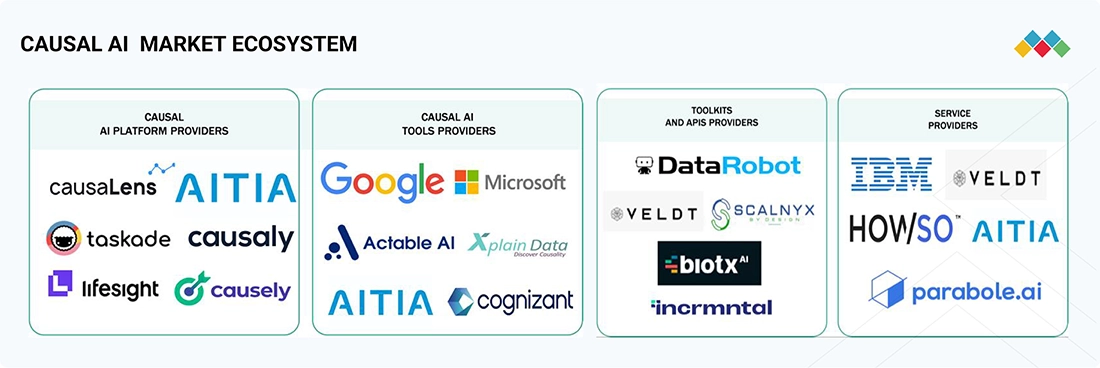
CAUSAL AI MARKET: COMMERCIAL USE CASES ACROSS INDUSTRIES
| COMPANY | USE CASE DESCRIPTION | BENEFITS |
|---|---|---|
 |
BMO Financial Group leveraged Dynatrace’s Grail technology and causal AI to gain real-time, explainable insights across hybrid cloud infrastructure, enhancing operational efficiency and innovation. | BMO achieved an 80% reduction in root-cause analysis time and freed up 40 hours per team monthly, enabling faster issue resolution and innovation. |
 |
Fingersoft adopted Incrmntal’s causal AI actionable insights to optimize marketing campaigns under privacy constraints, enabling scalable, data-driven decisions for improved performance and growth. | The company achieved continuous, privacy-compliant incrementality measurement, enhancing marketing decision-making and campaign ROI, supporting accelerated growth and more effective budget allocation. |
 |
A global electronics company implemented Causalens’ CausalNet causal AI to create explainable, domain-aligned fault detection models for reliable predictive maintenance across complex manufacturing processes. | The company reduced R&D cycle time, improved defect detection reliability, and deployed a generalized, extensible causal AI model adaptable across products for enhanced operational efficiency. |
 |
TRUMPF used Xplain Data’s causal AI to identify actionable cause-and-effect relationships in operational data, improving root-cause analysis and predictive equipment maintenance. | TRUMPF reduced equipment failure rates, automated scalable analyses, and improved predictive maintenance, enabling proactive interventions that strengthened operational efficiency and quality management. |
Logos and trademarks shown above are the property of their respective owners. Their use here is for informational and illustrative purposes only.
Related Ecosystem
Software And Services
- Natural Language Processing (NLP)
- Machine Learning
- Supply Chain Management
- Predictive Analytics
- Image Sensors
- International Business Machines Corporation
- MICROSOFT CORPORATION
- Oracle Corporation
- SAP SE
- Amazon.com, Inc.
Key Takeaways
- Asia Pacific Causal AI market will grow from $16.31M (2024) to $154.42M (2029) at a 45.4% CAGR, outpacing global growth rates.
- Asia Pacific enterprises across finance, healthcare, and manufacturing are rapidly adopting causal AI for enhanced decision-making and risk mitigation.
- Strong digital infrastructure, cloud adoption, and government AI initiatives position Asia Pacific as a leading regional market for causal AI innovation.
- Asia Pacific's large pool of AI talent and research capabilities create competitive advantages in developing and deploying causal AI solutions through 2029.
Causal AI Market Report Scope
| Report Metric | Details |
|---|---|
| Base Year | 2024 |
| Fastest Growing Segment | SOFTWARE & TECHNOLOGY PROVIDERS (End User) |
| Forecast Period | 2024-2029 |
| Growth Rate | CAGR of 41.8% from 2024 to 2029 |
| Largest Segment | MACHINE LEARNING (Technology) |
| Market Size Base Year (Billions) | ~USD 0.06 (2024) |
| Revenue Forecast (Billions) | ~USD 0.32 (2029) |
| Segments Covered | Offering, Type, Application, Vertical, Software Type, Causal Ai Solution, Service, Financial Management, Sales And Customer Management, Operations & Supply Chain Management, Marketing & Pricing Management, Business Function, Technology, Product Type, Functionality, End User |
Asia Pacific Causal AI Market Report Segmentation
16 segment dimensions are covered across the global market.
By Offering
- Hardware
- Services
- Software
By Type
- Bottleneck Remediation
- Causal AI Apis
- Causal AI Platforms
- Causal AI Solutions
- Causal Discovery
- Causal Modeling
- Churn Prediction & Prevention
- Competitive Pricing Analysis
- Consulting Services
- Customer Experience Optimization
- Customer Lifetime Value (Clv) Prediction
- Customer Segmentation
- Decision Intelligence
- Deployment & Integration Services
- Factor Investing
- Inventory Management
- Investment Analysis
- Marketing Channel Optimization
- Personalized Recommendations
- Portfolio Simulation
- Predictive Maintenance
- Price Elasticity Modeling
- Promotional Impact Analysis
- Real-Time Failure Response
- Root-Cause Analysis
- Software Development Kits
- Training, Support & Maintenance Services
By Application
- Financial Management
- Marketing & Pricing Management
- Operations & Supply Chain Management
- Other Applications
- Sales & Customer Management
By Vertical
- Agriculture
- Automotive, Transportation & Logistics
- Bfsi
- Energy & Utilities
- Government & Defense
- Healthcare & Life Sciences
- Healthcare& Life Sciences
- It/Ites
- Manufacturing
- Media & Entertainment
- Other Verticals
- Retail & E-Commerce
- Retail & Ecommerce
- Telecommunications
- Transportation & Logistics
By Software Type
- Causal AI Platforms
- Causal AI Solutions
By Causal Ai Solution
- Causal AI Apis
- Causal Discovery
- Causal Inference (Decision Intelligence)
- Causal Modeling
- Root-Cause Analysis
- Software Development Kits (Sdk)
By Service
- Consulting Services
- Deployment & Integration Services
- Training, Support & Maintenance Services
By Financial Management
- Factor Investing
- Investment Analysis
- Portfolio Simulation
By Sales And Customer Management
- Churn Prediction & Prevention
- Customer Experience Optimization
- Customer Lifetime Value (Clv) Prediction
- Customer Segmentation
- Personalized Recommendations
By Operations & Supply Chain Management
- Bottleneck Remediation
- Inventory Management
- Predictive Maintenance
- Real-Time Failure Response
By Marketing & Pricing Management
- Competitive Pricing Analysis
- Marketing Channel Optimization
- Price Elasticity Modeling
- Promotional Impact Analysis
By Business Function
- Cybersecurity
- Finance & Accounting
- Human Resources
- Marketing & Sales
- Operations
By Technology
- Computer Vision
- Context-Aware AI
- Machine Learning
- Natural Language Processing
By Product Type
- AI Governance As A Service
- AI Governance Consulting Services
- Data Governance Platforms
- Data Privacy Tools
- End-To-End AI Governance Platforms
- Focused AI Governance Platforms
- Llmops Tools
- Mlops Tools
- Responsible AI Toolkits
By Functionality
- Data Governance
- Ethics & Responsible AI
- Model Lifecycle Management
- Monitoring & Auditing
- Other Functionality Types
- Risk Management & Compliance
- Transparency & Explainability
By End User
- Automotive
- Bfsi
- Government & Defense
- Healthcare & Life Sciences
- Manufacturing
- Media & Entertainment
- Other End Users
- Retail & Consumer Goods
- Software & Technology Providers
- Telecommunications
Target Audience
- Enterprise Technology Leaders : CIOs and technology executives across Asia Pacific need market intelligence to evaluate Causal AI investments, benchmark adoption rates, and align technology roadmaps with regional growth trends.
- AI Solution Providers & Vendors : Software companies and AI platform providers require detailed market segmentation and competitive analysis to identify expansion opportunities and tailor solutions for Asia Pacific enterprises.
- Investment & Private Equity Firms : Investors seeking high-growth opportunities in Asia Pacific's AI sector need comprehensive market data, valuation benchmarks, and growth forecasts to inform investment decisions and portfolio strategy.
- Management Consultants : Strategy consultants advising enterprises on digital transformation require region-specific market insights and sector analysis to develop informed recommendations for Causal AI adoption.
- Government & Policy Makers : Regional government bodies and policy organizations need market intelligence to develop AI-supportive regulatory frameworks and digital infrastructure initiatives aligned with Asia Pacific's growth potential.
Countries within Asia Pacific - compare and drill down
| Country | 2025 size (native) |
|---|---|
| China | USD 39.56 Million |
| India | USD 23.92 Million |
| Japan | USD 20.74 Million |
| South Korea | USD 20.88 Million |
| Asean | USD 26.98 Million |
| Rest Of Asia Pacific | USD 22.34 Million |
Country market size visualization
Reasons to Buy this Report
- Regional Market Sizing & Forecasts : Obtain precise market valuations for Asia Pacific and individual country-level data, enabling accurate investment planning and resource allocation decisions specific to the region's growth trajectory.
- Competitive Landscape Intelligence : Understand key players, market share distribution, and competitive dynamics across Asia Pacific's Causal AI ecosystem to identify partnership and acquisition opportunities.
- Sector-Specific Insights : Access detailed analysis of Causal AI adoption patterns across finance, healthcare, and manufacturing sectors in Asia Pacific, revealing high-potential verticals for market entry and expansion.
- Growth Driver Analysis : Identify region-specific catalysts including digital infrastructure development, regulatory frameworks, and enterprise transformation initiatives driving the 45.4% CAGR in Asia Pacific.
- Strategic Market Entry Planning : Leverage comprehensive country-level breakdowns and market maturity assessments to develop targeted go-to-market strategies for Asia Pacific's high-growth Causal AI opportunities.
Frequently asked questions
What is the projected size of the Asia Pacific Causal AI market in 2029?
The Asia Pacific Causal AI market is projected to reach $154.42 million by 2029, growing from $16.31 million in 2024.
What is the CAGR for Asia Pacific's Causal AI market?
Asia Pacific's Causal AI market is expected to grow at a compound annual growth rate of 45.4% between 2024 and 2029.
Which industries in Asia Pacific are driving Causal AI adoption?
Finance, healthcare, and manufacturing sectors in Asia Pacific are leading the adoption of causal AI solutions for improved decision-making and operational efficiency.
What factors are accelerating Causal AI growth in Asia Pacific?
Asia Pacific's growth is driven by strong digital infrastructure, increasing cloud adoption, government AI initiatives, and a large pool of AI talent and research capabilities.
How does Asia Pacific's Causal AI growth compare to global trends?
Asia Pacific's 45.4% CAGR significantly outpaces the global Causal AI market CAGR of 41.8%, making the region a key growth driver for the industry.
RESEARCH METHODOLOGY
The research methodology for the global Causal AI market report involved the use of extensive secondary sources and directories, as well as various reputed open-source databases, to identify and collect information useful for this technical and market-oriented study. In-depth interviews were conducted with various primary respondents, including key opinion leaders, subject matter experts on causal inference, causal modelling and causal discovery, high-level executives of multiple companies offering Causal AI, and industry consultants to obtain and verify critical qualitative and quantitative information and assess the market prospects and industry trends.
Secondary Research
In the secondary research process, various secondary sources were referred to for identifying and collecting information for the study. The secondary sources included annual reports; press releases and investor presentations of companies; white papers, certified publications such as Journal of Big Data, Journal of Artificial Intelligence Research, Data & Knowledge Engineering (DKE) Journal, Big Data and Cognitive Computing Journal, International Journal of Data Science and Analytics, and International Journal of Advances in Intelligent Informatics; and articles from recognized associations and government publishing sources including but not limited to AI Global, Global Initiative on Ethics of Autonomous and Intelligent Systems, Global Partnership on Artificial Intelligence, The Responsible AI Institute, European AI Alliance, AI for Good (United Nations), and World Economic Forum’s Whitepaper on Future of Mobility and Big Data.
The secondary research was used to obtain key information about the industry’s value chain, the market’s monetary chain, the overall pool of key players, market classification and segmentation according to industry trends to the bottom-most level, regional markets, and key developments from the market and technology-oriented perspectives.
Primary Research
In the primary research process, a diverse range of stakeholders from both the supply and demand sides of the Causal AI ecosystem were interviewed to gather qualitative and quantitative insights specific to this market. From the supply side, key industry experts, such as chief executive officers (CEOs), vice presidents (VPs), marketing directors, technology & innovation directors, as well as technical leads from vendors offering Causal AI were consulted. Additionally, system integrators, service providers, and IT service firms that implement and support Causal AIs were included in the study. On the demand side, input from IT decision-makers, infrastructure managers, and AI/data analytics heads was collected to understand the user perspectives and adoption challenges within targeted industries.
The primary research ensured that all crucial parameters affecting the Causal AI market—from technological advancements and evolving use cases (financial management, marketing & pricing management, operations & supply chain management, etc.) to regulatory and compliance needs (GDPR, EU AI Act, California Consumer Privacy Act etc.)—were considered. Each factor was thoroughly analyzed, verified through primary research, and evaluated to obtain precise quantitative and qualitative data for this market.
Once the initial phase of market engineering was completed, including detailed calculations for market statistics, segment-specific growth forecasts, and data triangulation, an additional round of primary research was undertaken. This step was crucial for refining and validating critical data points, such as Causal AI offerings (causal AI platforms, causal discovery tools, causal modelling tools, causal inference tools, root cause analysis tools, and causal AI services), industry adoption trends, the competitive landscape, and key market dynamics like demand drivers (increasing demand for explainable AI in regulated industries, growing demand for robust counterfactual analysis, surge in demand for predictive maintenance and root cause analysis, shift from predictive analytics to causal AI-based prescriptive analytics), challenges (lack of standardized tools and frameworks for causal inference, high computational costs for causal modeling), and opportunities (Causal AI in precision healthcare and drug discovery, scalable causal inference APIs for real-time applications, integrating causal AI with IoT for real-time decision making.)
In the complete market engineering process, the top-down and bottom-up approaches and several data triangulation methods were extensively used to perform the market estimation and market forecast for the overall market segments and subsegments listed in this report. Extensive qualitative and quantitative analysis was performed on the complete market engineering process to record the critical information/insights throughout the report.
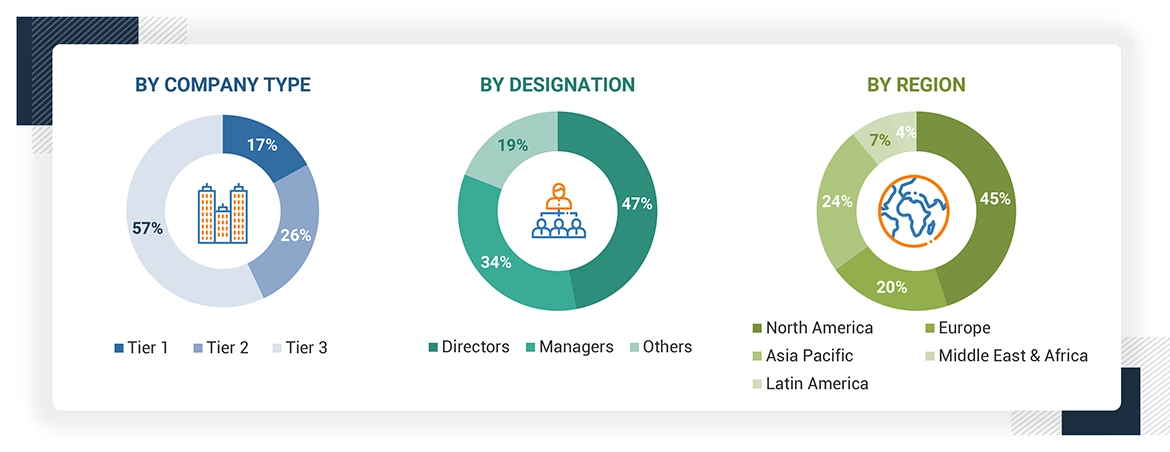
Note: Three tiers of companies are defined based on their total revenue as of 2023; tier 1 = revenue more
than USD 500 million, tier 2 = revenue between USD 100 million and 500 million, tier 3 = revenue less
than USD 100 million Source: MarketsandMarkets Analysis
To know about the assumptions considered for the study, download the pdf brochure
Market Size Estimation
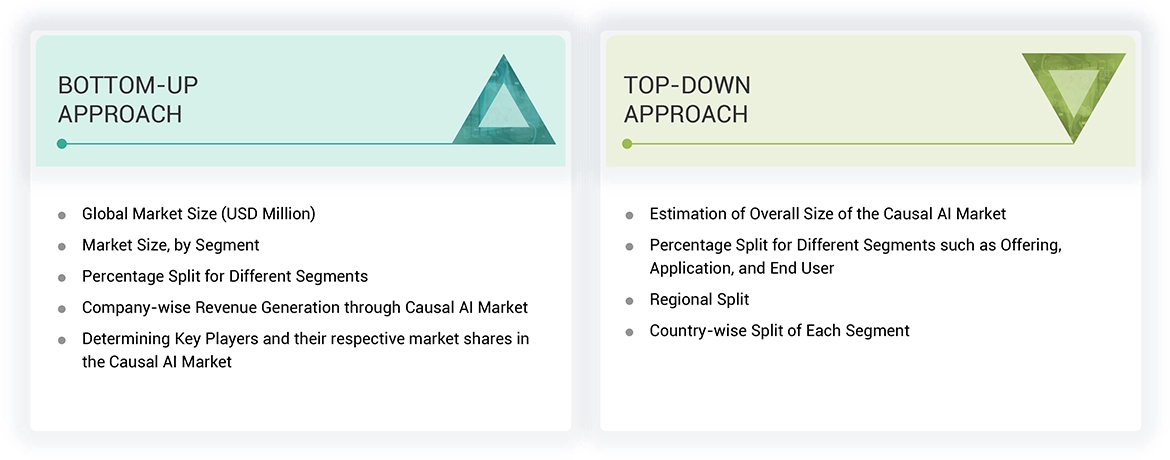
To estimate and forecast the Causal AI market and its dependent submarkets, both top-down and bottom-up approaches were employed. This multi-layered analysis was further reinforced through data triangulation, incorporating both primary and secondary research inputs. The market figures were also validated against the existing MarketsandMarkets repository for accuracy. The following research methodology has been used to estimate the market size:
Causal AI Market : Top-Down and Bottom-Up Approach
Data Triangulation
After arriving at the overall market size using the market size estimation processes as explained above, the market was split into several segments and subsegments. To complete the overall market engineering process and arrive at the exact statistics of each market segment and subsegment, data triangulation and market breakup procedures were employed, wherever applicable. The overall market size was then used in the top-down procedure to estimate the size of other individual markets via percentage splits of the market segmentation.
Market Definition
Causal AI focuses on understanding and modeling cause-and-effect relationships within data to move beyond correlation-based predictions. By employing techniques like causal discovery, intervention analysis, and counterfactual reasoning, it enables AI systems to simulate interventions, predict outcomes, and make robust, explainable decisions even in novel or shifting environments. Rooted in principles of causal inference and structural causal models, Causal AI enhances generalization, fairness, and transparency while providing actionable insights. It has wide-ranging applications in healthcare, finance, marketing, and AI ethics to create adaptive and trustworthy AI systems.
Stakeholders
- Causal AI platform vendors
- Root cause analysis software vendors
- Causal AI service providers
- Causal inferencing software providers
- Causal discovery software providers
- Causal modelling software providers
- Business analysts
- Cloud service providers
- Enterprise end-users
- Distributors and Value-added Resellers (VARs)
- Government agencies
- Independent Software Vendors (ISV)
- Market research and consulting firms
- AI technology providers
Report Objectives
- To define, describe, and predict the Causal AI market by offering, application, and region
- To provide detailed information related to major factors (drivers, restraints, opportunities, and industry-specific challenges) influencing the market growth
- To analyze the micro markets with respect to individual growth trends, prospects, and their contribution to the total market
- To analyze the opportunities in the market for stakeholders by identifying the high-growth segments of the Causal AI market
- To analyze opportunities in the market and provide details of the competitive landscape for stakeholders and market leaders
- To forecast the market size of segments for five main regions: North America, Europe, Asia Pacific, Middle East Africa, and Latin America
- To profile key players and comprehensively analyze their market rankings and core competencies.
- To analyze competitive developments, such as partnerships, new product launches, and mergers and acquisitions, in the Causal AI market
- To analyze the impact of recession across all the regions across the Causal AI market
Available Customizations
With the given market data, MarketsandMarkets offers customizations as per the company’s specific needs. The following customization options are available for the report:
Product Analysis
- Product matrix provides a detailed comparison of the product portfolio of each company
Geographic Analysis as per Feasibility
- Further breakup of the North American market for Causal AI
- Further breakup of the European market for Causal AI
- Further breakup of the Asia Pacific market for Causal AI
- Further breakup of the Latin American market for Causal AI
- Further breakup of the Middle East & Africa market for Causal AI
Company Information
- Detailed analysis and profiling of additional market players (up to five)
Get the Full Causal AI Market Report
Full forecast, segment splits, and company analysis for all Causal AI Market.
- Canada Causal AI Market
- US Causal AI Market
- UK Causal AI Market
- Germany Causal AI Market
- France Causal AI Market
- China Causal AI Market
- India Causal AI Market
- Japan Causal AI Market
- South Korea Causal AI Market
- Saudi Arabia Causal AI Market
- UAE Causal AI Market
- South Africa Causal AI Market
- Brazil Causal AI Market
- Mexico Causal AI Market
- Rest Of Europe Causal AI Market
- Asean Causal AI Market
- Rest Of Asia Pacific Causal AI Market
- Rest Of Latin America Causal AI Market
- Rest Of Mea Causal AI Market
Need a Tailored Report?
Customize this report to your needs
Get 10% FREE Customization
Customize This Report
