
Japan Cell Analysis Market (2023-2028)

The Japan Cell Analysis Market was valued at $774.74 Million in 2023 and projected to reach to $1276.62 Million by 2028, representing a compound annual growth rate of 10.5%. Japan's cell analysis market is poised for sustained expansion through 2028, supported by the nation's commitment to advancing healthcare technology and increasing prevalence of chronic diseases requiring sophisticated diagnostic capabilities.


| Market Size in | USD 26.32 MN |
| Market Forecast in | |
| CAGR | |
| Forecast Period | |
| Units Considered | Value (USD MN) |
Japan Cell Analysis Market Trends and Insights
- Japan is positioned as a key regional player within Asia Pacific, driven by advanced healthcare infrastructure, significant investment in life sciences research, and increasing adoption of automated cell analysis technologies across clinical and research laboratories.
- By 2028, Japan's market is forecast to reach $1,276.62 million, reflecting a compound annual growth rate of 10.5%. The growth trajectory in Japan is underpinned by rising demand for precision diagnostics, expanding pharmaceutical and biotechnology sectors, and government support for healthcare innovation.
- Japan's aging population and prevalence of chronic diseases have accelerated the need for efficient cell analysis solutions in both diagnostic and therapeutic applications.
- The market benefits from Japan's technological leadership and strong presence of multinational and domestic cell analysis equipment manufacturers. Japan's cell analysis market remains competitive and innovation-driven, with continued investment in R&D and regulatory support fostering market expansion through 2028..
Key Market Statistics
- CAGR (2023-2028) 10.5% CAGR
- Market Size, 2023 ~USD 774.74 Million
- Forecast, 2028 ~USD 1276.62 Million
- Country Japan
Japan Cell Analysis Market Overview
Market Valuation :
Japan's cell analysis market reached $774.74 million in 2023, establishing the country as a significant regional hub within Asia Pacific for advanced diagnostic and research technologies.
Robust Growth Trajectory :
With a CAGR of 10.5% through 2028, Japan's market is expanding faster than many developed economies, driven by healthcare modernization and increased R&D spending in life sciences.
Advanced Healthcare Infrastructure :
Japan's sophisticated medical ecosystem, including leading hospitals and research institutions, supports widespread adoption of automated cell analysis systems across clinical diagnostics and pharmaceutical development.
Forecast Expansion :
The market is projected to reach $1,276.62 million by 2028, representing a 64.8% increase from 2023, reflecting strong demand for precision medicine and cellular research technologies.
Japan Cell Analysis Market Dynamics
- The country's aging population and emphasis on preventive medicine are driving adoption of automated cell analysis solutions in clinical laboratories and research facilities. Key growth drivers include substantial government funding for life sciences research, partnerships between academic institutions and technology providers, and the integration of artificial intelligence in cell analysis platforms.
- Japan's regulatory environment and quality standards position it as a leader in cell analysis innovation, attracting both domestic and international market participants seeking to establish regional operations..
Market Ecosystem
Related Ecosystem
Advanced Genetic Sequencing
- Polymerase Chain Reaction (PCR)
- Reagents
- Assay Kits
- Bioinformatics
- Flow Cytometry
- Thermo Fisher Scientific Inc.
- Illumina, Inc.
- Qiagen N.V.
- Agilent Technologies, Inc.
- Danaher Corporation
Biotechnology
- Reagents
- Polymerase Chain Reaction (PCR)
- Stem Cells
- Assay Kits
- Flow Cytometers
- Thermo Fisher Scientific Inc.
- Merck KGaA
- Danaher Corporation
- Agilent Technologies, Inc.
- Bio-Rad Laboratories, Inc.
Key Takeaways
- Japan's cell analysis market was valued at $774.74 million in 2023 and is projected to grow to $1,276.62 million by 2028 at a 10.5% CAGR.
- Japan's advanced healthcare infrastructure and strong life sciences R&D ecosystem position it as a leading market within Asia Pacific.
- Rising demand for precision diagnostics and Japan's aging population are key drivers of cell analysis market growth.
- Japan's technological leadership and presence of major equipment manufacturers support sustained market competitiveness and innovation.
Cell Analysis Market Report Scope
| Report Metric | Details |
|---|---|
| Base Year | 2023 |
| Fastest Growing Segment | SINGLE-CELL ANALYSIS (Process) |
| Forecast Period | 2023–2028 |
| Growth Rate | CAGR of 10.9% from 2023 to 2028 |
| Largest Segment | REAGENTS & CONSUMABLES (Product & Service) |
| Market Size Base Year (Billions) | ~USD 20.21 (2023) |
| Revenue Forecast (Billions) | ~USD 33.9 (2028) |
| Segments Covered | Product & Service, Technique, Process, End User |
Japan Cell Analysis Market Report Segmentation
4 segment dimensions are covered across the global market.
By Product & Service
- Accessories
- Instruments
- Reagents & Consumables
- Services
- Software
By Technique
- Cell Microarrays
- Flow Cytometry
- High-Content Screening
- Microscopy
- Other Techniques
- Pcr
- Spectrophotometry
By Process
- Cell Counting And Quality Control
- Cell Identification
- Cell Interaction
- Cell Proliferation
- Cell Signaling Pathways/ Signal Transduction
- Cell Signaling Pathways/Signal Transduction
- Cell Structure Study
- Cell Viability
- Single-Cell Analysis
- Target Identification And Validation
By End User
- Academic And Research Institutes
- Hospitals And Clinical Testing Laboratories
- Other End Users
- Pharmaceutica And Biotechnology Companies
- Pharmaceutical & Biotechnology Companies
- Pharmaceutical And Biotechnology Companies
JAPAN: CELL ANALYSIS MARKET, BY END USER, 2021–2028
| Segment | 2021 | 2022 | 2023 | 2024 | 2025 | 2026 | 2027 | 2028 | CAGR (%) |
|---|---|---|---|---|---|---|---|---|---|
| ACADEMIC AND RESEARCH INSTITUTES | 265.31 | 304.37 | 330.83 | 361.55 | 397.99 | 441.25 | 492.71 | 554.56 | 10.9 |
| HOSPITALS AND CLINICAL TESTING LABORATORIES | 338.6 | 391.61 | 429.13 | 472.8 | 524.67 | 586.41 | 660.08 | 748.93 | 11.8 |
| OTHER END USERS | 377.15 | 435.61 | 476.72 | 524.54 | 581.33 | 648.91 | 729.5 | 826.65 | 11.6 |
| PHARMACEUTICAL AND BIOTECHNOLOGY COMPANIES | 519.73 | 594.98 | 645.35 | 703.79 | 773.07 | 855.25 | 952.92 | 1070.2 | 10.6 |
| TOTAL | 1500.79 | 1726.58 | 1882.03 | 2062.68 | 2277.06 | 2531.82 | 2835.22 | 3200.34 | 11.2 |
Target Audience
- Medical Device Manufacturers : Need Japan-specific market data to evaluate expansion opportunities, assess competitive positioning, and develop localized product strategies for the $1.28B projected market.
- Healthcare Investors & PE Firms : Require detailed financial projections and growth metrics for Japan to make informed investment decisions in cell analysis technology companies and healthcare infrastructure.
- Pharmaceutical & Biotech Companies : Seek insights into Japan's research capabilities and cell analysis adoption rates to optimize R&D operations, clinical trial planning, and drug development strategies.
- Healthcare Consultants & Advisors : Need comprehensive Japan market analysis to support client strategy development, market entry planning, and competitive benchmarking in the cell analysis sector.
- Laboratory & Diagnostic Service Providers : Require Japan-specific demand forecasts and technology adoption trends to guide capital investment in automated cell analysis systems and service expansion planning.
Key Companies in the Japan Cell Analysis Market
| Company | HQ | Ownership | Strongest segments |
|---|---|---|---|
| PATHEON INC | Netherlands | Private Company | Drug product services (finished dosage manufacturing & packaging),Pharmaceutical development services (formulation & clinical supply),Drug substance services (API & biologics), |
| ABCAM PLC | United Kingdom | Private Company | Primary and secondary antibodies,Conjugated antibodies and conjugation kits,Singleplex immunoassays, |
| BRUKER CORPORATION | United States | Public Company | BSI BioSpin (NMR/EPR and preclinical imaging),BSI CALID (mass spectrometry and diagnostics),BSI Nano (X-ray, AFM, microscopy, nano-metrology), |
| WAFERGEN BIO-SYSTEMS | United States | Private Company | SmartChip Real-Time PCR and Target Enrichment Systems,SmartChip Single-Cell Isolation System,Apollo 324 Library Preparation System and Reagents, |
| THERMO FISHER SCIENTIFIC INC. | United States | Public Company | Life Sciences Solutions,Analytical Instruments,Specialty Diagnostics, |
| DANAHER | United States | Public Company | Biotechnology (bioprocessing and single-use solutions),Life Sciences (instruments, genomics, and analytical systems),Diagnostics (clinical instruments and consumables), |
| GENERAL ELECTRIC | United States | Public Company | Commercial Engines & Services,Defense & Propulsion Technologies,Additive, Components & Other Systems, |
| MERCK KGAA | Germany | Public Company | Life Science (reagents, consumables, bioprocessing, CDMO),Healthcare (prescription drugs and biopharmaceuticals),Electronics (semiconductor and display materials, equipment), |
| AGILENT TECHNOLOGIES, INC. | United States | Public Company | Life Sciences and Diagnostics Markets,Agilent CrossLab,Applied Markets, |
| BIO-RAD LABORATORIES, INC. | United States | Public Company | Clinical Diagnostics,Life Science Research and Bioprocess, |
| STANDARD BIOTOOLS | United States | Public Company | Proteomics platforms and consumables (SomaScan, CyTOF, Hyperion),Genomics platforms and consumables (Biomark X9 and legacy systems),Services, software, and other, |
| OLYMPUS CORPORATION | Japan | Public Company | Gastrointestinal Solutions (endoscopes, devices, services),Urology (visualization, stone management, BPH, bladder cancer),Respiratory (bronchoscopy, lung cancer, COPD), |
PATHEON INC
Patheon Inc. is a Netherlands-based private company with 9,100 employees operating in the pharmaceutical and biotechnology services sector.
ABCAM PLC
Abcam PLC is a United Kingdom-based private company founded in 1998 with 1,760 employees providing research reagents and tools for the life sciences industry.
BRUKER CORPORATION
Bruker Corporation is a publicly traded U.S. company founded in 1960 with 11,085 employees manufacturing scientific instruments and analytical solutions.
WAFERGEN BIO-SYSTEMS
WaferGen Bio-Systems is a U.S. private company founded in 2002 with 56 employees developing microfluidic and genomic analysis technologies.
THERMO FISHER SCIENTIFIC INC.
Thermo Fisher Scientific Inc. is a publicly traded U.S. company founded in 1956 with 125,000 employees serving the life sciences, analytical, and diagnostics markets.
DANAHER
Danaher is a publicly traded U.S. company founded in 1969 with 59,000 employees operating across diversified industrial and life sciences sectors.
GENERAL ELECTRIC
General Electric is a publicly traded U.S. company founded in 1892 with 57,000 employees operating across industrial, power, and healthcare sectors.
MERCK KGAA
Merck KGaA is a publicly traded German company founded in 1668 with 59,077 employees engaged in pharmaceuticals, life sciences, and performance materials.
AGILENT TECHNOLOGIES, INC.
Agilent Technologies, Inc. is a publicly traded U.S. company founded in 1999 with 18,000 employees providing analytical instruments and life sciences solutions.
BIO-RAD LABORATORIES, INC.
Bio-Rad Laboratories, Inc. is a publicly traded U.S. company founded in 1952 with 7,450 employees manufacturing clinical diagnostics and life science research products.
STANDARD BIOTOOLS
Standard Biotools is a publicly traded U.S. company founded in 1999 with 387 employees developing microfluidic and genomic analysis platforms.
OLYMPUS CORPORATION
Olympus Corporation is a publicly traded Japanese company founded in 1919 with 28,138 employees manufacturing optical and digital precision instruments.
Reasons to Buy this Report
- Regional Market Leadership Data : Gain comprehensive insights into Japan's positioning as a key Asia Pacific player, with detailed market sizing and growth projections essential for regional expansion strategies.
- Investment Decision Support : Access validated financial forecasts ($774.74M to $1,276.62M) and CAGR analysis to support capital allocation decisions and business case development for Japan market entry.
- Competitive Landscape Intelligence : Understand Japan-specific market dynamics, healthcare infrastructure advantages, and technology adoption patterns to identify competitive positioning opportunities and differentiation strategies.
- Regulatory & Infrastructure Insights : Leverage detailed analysis of Japan's advanced healthcare system, quality standards, and regulatory environment to navigate market entry and operational planning effectively.
- Growth Driver Analysis : Identify Japan-specific growth catalysts including aging population trends, government R&D funding, and precision medicine adoption to prioritize market development initiatives.
Frequently asked questions
What is the current size of Japan's cell analysis market?
Japan's cell analysis market was valued at $774.74 million in 2023 and is expected to reach $1,276.62 million by 2028.
What is the projected growth rate for Japan's cell analysis market?
Japan's cell analysis market is projected to grow at a compound annual growth rate (CAGR) of 10.5% from 2023 to 2028.
What factors are driving growth in Japan's cell analysis market?
Key drivers include Japan's aging population, rising demand for precision diagnostics, expanding pharmaceutical and biotechnology sectors, and government support for healthcare innovation.
How does Japan's cell analysis market compare to other Asia Pacific countries?
Japan is a leading market within Asia Pacific, supported by advanced healthcare infrastructure, strong life sciences R&D investment, and technological leadership in cell analysis equipment manufacturing.
What applications are most significant in Japan's cell analysis market?
Clinical diagnostics, pharmaceutical research, biotechnology development, and therapeutic applications represent the primary segments driving demand for cell analysis solutions in Japan.
RESEARCH METHODOLOGY
This study involved four major activities in estimating the current size of the cell analysis market. Exhaustive secondary research was carried out to collect information on the market, its peer markets, and its parent market. The next step was to validate these findings, assumptions, and sizing with industry experts across the value chain through primary research. Both top-down and bottom-up approaches were employed to estimate the complete market size. After that, market breakdown and data triangulation procedures were used to estimate the market size of segments.
Secondary Research
Secondary research was used mainly to identify and collect information for the extensive, technical, market-oriented, and commercial study of the cell analysis market. The secondary sources used for this study include World Health Organization (WHO), Organisation for Economic Co-operation and Development (OECD), International Society for Advancement of Cytometry (ISAC), International Society for Stem Cell Research (ISSCR), International Agency for Research on Cancer (IARC), Centers for Disease Control and Prevention (CDC), Society for Laboratory Automation and Screening (SLAS), Centers for Medicare & Medicaid Services (CMS), National Cancer Institute (NCI), European Commission (EC), American Society for Cell Biology (ASCB), European Society for Toxicology In Vitro (ESTIV), European Federation of Pharmaceutical Industries and Associations (EFPIA), Japan Society for Cell Biology (JSCB), Shanghai Institute of Biochemistry and Cell Biology (SIBCB), Indian Society of Cell Biology (ISCB), Food and Drug Administration (FDA), Society of Biomolecular Imaging and Informatics (SBI2), Annual Reports, SEC Filings, Investor Presentations, Press Releases, Conferences, Journals, Expert Interviews, and MarketsandMarkets Analysis. These sources were also used to obtain key information about major players, market classification, and segmentation according to industry trends, regional/country-level markets, market developments, and technology perspectives.
Primary Research
In-depth interviews were conducted with various primary respondents, including key industry participants, subject-matter experts (SMEs), C-level executives of key market players, and industry consultants, among other experts, to obtain and verify the critical qualitative and quantitative information as well as assess future prospects of the market. Various primary sources from both the supply and demand sides of the market were interviewed to obtain qualitative and quantitative information. The following is a breakdown of the primary respondents:
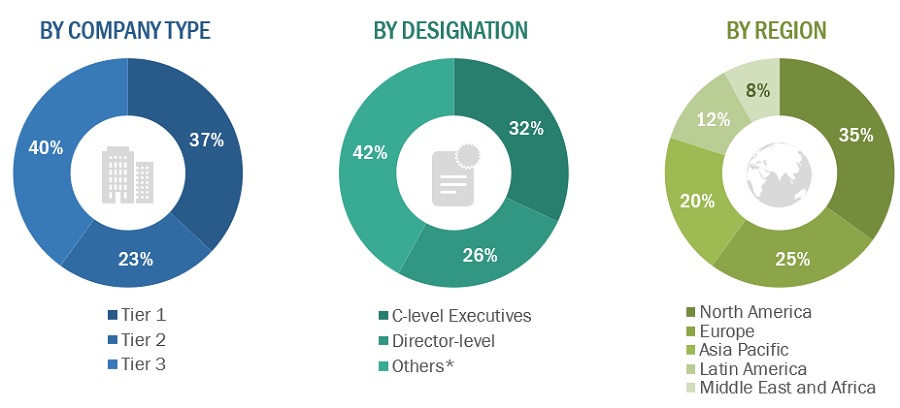
*Others include sales managers, marketing managers, and product managers.
Note: Tiers are defined based on a company’s total revenue. As of 2021, Tier 1 = >USD 1 billion, Tier 2 = USD 500 million to USD 1 billion, and Tier 3 <USD 500 million.
To know about the assumptions considered for the study, download the pdf brochure
Market Size Estimation
Both top-down and bottom-up approaches were used to estimate and validate the total size of the cell analysis market. These methods were also used extensively to estimate the size of various subsegments in the market. The research methodology used to estimate the market size includes the following:
- The key players in the industry and market have been identified through extensive secondary research
- The revenues generated from the cell analysis business of leading players have been determined through primary and secondary research
- All percentage shares, splits, and breakdowns have been determined using secondary sources and verified through primary sources
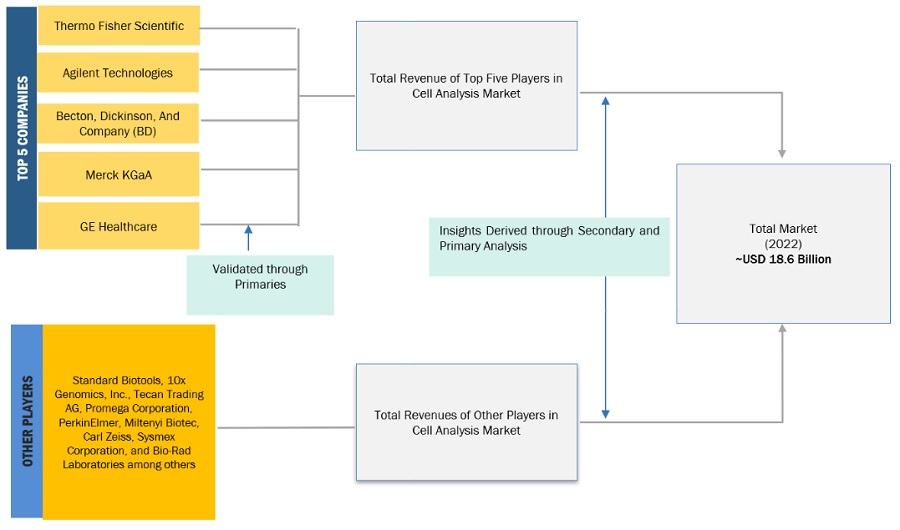
Data Triangulation
After arriving at the overall market size from the market size estimation process, the total market was split into several segments and subsegments. To complete the overall market engineering process and arrive at the exact statistics for all segments and subsegments, data triangulation and market breakdown procedures were employed, wherever applicable. The data was triangulated by studying various factors and trends from both the demand and supply sides.
Market Definition
Cell analysis is a technique used to study groups of cells and individual cells based on multiple parameters. It is used to measure cell properties such as size, shape, presence of specific proteins, proliferation, growth, morphology, porosity, and complexity.
Cell analysis products are used in various processes, which include cell identification, cell viability, cell proliferation, cell structure study, cell signaling pathway/signal transduction, cell counting & quality control, target identification & validation, cell interaction, and single-cell analysis. These processes are carried out by various end users such as hospitals & clinical testing laboratories, academic and research institutes, pharmaceutical & biotechnology companies, and other end users (CROs, cell culture collection repositories, food & beverage manufacturers, environmental monitoring organizations, forensic laboratories, and blood banks).
Key Stakeholders
- Pharmaceutical and biopharmaceutical companies
- Manufacturers of cell analysis equipment
- Contract research organizations (CROs)
- Life science research institutes
- Venture capitalists
- Research & consulting firms
Report Objectives
- To define, describe, and forecast the global cell analysis market based on the product & service, technique, process, end user and region
- To provide detailed information regarding the major factors influencing the growth of the market (such as drivers, restraints, and opportunities)
- To strategically analyze micromarkets with respect to individual growth trends, future prospects, and contributions to the overall cell analysis market
- To analyze opportunities in the market for stakeholders and provide details of the competitive landscape for market leaders
- To forecast the size of the market segments with respect to five main regions, namely, North America, Europe, Asia Pacific, Latin America, and the Middle East and Africa
- To strategically profile the key players and comprehensively analyze their product portfolios, market positions, and core competencies
- To track and analyze competitive developments such as acquisitions, product launches, expansions, agreements, partnerships, and R&D activities in the cell analysis market.
Available Customizations
With the given market data, MarketsandMarkets offers customizations as per the company’s specific needs. The following customization options are available for this report:
Company Information
- An additional five company profiles
Get the Full Cell Analysis Market Report
Full forecast, segment splits, and company analysis for all Cell Analysis Market.
- US Cell Analysis Market
- Canada Cell Analysis Market
- Germany Cell Analysis Market
- France Cell Analysis Market
- UK Cell Analysis Market
- Italy Cell Analysis Market
- Spain Cell Analysis Market
- China Cell Analysis Market
- India Cell Analysis Market
- Rest Of Europe Cell Analysis Market
- Rest Of Asia Pacific Cell Analysis Market
Need a Tailored Report?
Customize this report to your needs
Get 10% FREE Customization
Customize This Report
