
North America Ceramic Fiber Market (2024-2029)

The North America Ceramic Fiber Market was valued at $373.5 Million in 2024 and projected to reach to $535 Million by 2029, representing a compound annual growth rate of 7.45%. North America's ceramic fiber market is positioned for steady expansion through 2029, supported by ongoing industrial modernization initiatives and stringent energy efficiency mandates.


| Market Size in | USD 26.32 MN |
| Market Forecast in | |
| CAGR | |
| Forecast Period | |
| Units Considered | Value (USD MN) |
North America Ceramic Fiber Market Trends and Insights
- North America's ceramic fiber sector benefits from robust demand across industrial insulation, aerospace, and high-temperature applications, driven by stringent energy efficiency regulations and manufacturing modernization.
- The region's established infrastructure and technological advancement position North America as a key growth hub for ceramic fiber solutions through the forecast period..
Key Market Statistics
- CAGR (2024-2029) 7.45% CAGR
- Market Size, 2024 ~USD 373.5 Million
- Forecast, 2029 ~USD 535 Million
- Geography North America
North America Ceramic Fiber Market Overview
Strong Market Valuation :
North America's ceramic fiber market is valued at $373.5 million in 2024, with projected growth to $535.0 million by 2029, representing a robust 7.45% CAGR driven by industrial modernization and energy efficiency demands.
US Market Dominance :
The United States leads North America's ceramic fiber sector with $436.7 million in market size, accounting for the majority of regional demand across aerospace, industrial insulation, and high-temperature applications.
Regulatory-Driven Growth :
Stringent energy efficiency regulations and environmental compliance standards across North America are accelerating adoption of ceramic fiber insulation in manufacturing facilities and industrial processes.
Aerospace & Industrial Expansion :
North America's established aerospace and manufacturing sectors are driving sustained demand for ceramic fiber products in thermal management, engine components, and high-temperature industrial applications.
North America Ceramic Fiber Market Dynamics
- The region's mature manufacturing base and advanced aerospace sector continue to drive consistent demand for high-performance thermal insulation solutions.
- Investment in sustainable manufacturing practices and regulatory compliance further accelerates market growth. The forecast period will see increased adoption of ceramic fiber products across diverse applications including furnace linings, kiln insulation, and aerospace thermal protection systems.
- North America's technological leadership and established supply chains provide competitive advantages, while growing emphasis on reducing industrial energy consumption creates sustained opportunities for market participants..
Market Ecosystem
Related Ecosystem
Ceramics And Glass
- Zirconia
- Alumina Ceramics
- Silicon Carbide
- Silicon Nitride
- Titanate Ceramics
- Saint-gobain
- 3M COMPANY
- Kyocera Corporation
- CERAMTEC GMBH
- COORSTEK INCORPORATED
Energy Circularity
- Epoxy Resin
- Progressive Cavity Pumps
- Amphoteric
- Bisphenol-A
- Cartridge Filters
- TotalEnergies SE
- ENEOS Holdings, Inc.
- Hess Corporation
- Baker Hughes Company
- Weatherford International plc
Fibers And Composites
- Polyetheretherketone (PEEK)
- Polyphenylene Sulfide (PPS)
- Epoxy Resin
- Polycarbonate
- Polyester Resin
- Toray Industries, Inc.
- Teijin Limited
- Sgl carbon se
- Hexcel Corporation
- Solvay sa
Key Takeaways
- North America's ceramic fiber market is valued at $373.5 million in 2024 with a 7.45% CAGR through 2029.
- North America will see market growth to $535.0 million by 2029, driven by industrial and aerospace demand.
- North America's regulatory environment and energy efficiency standards are primary growth catalysts for ceramic fiber adoption.
- North America maintains competitive advantages through advanced manufacturing capabilities and established supply chains.
Ceramic Fiber Market Report Scope
| Report Metric | Details |
|---|---|
| Base Year | 2024 |
| Fastest Growing Segment | AES WOOL (Type) |
| Forecast Period | 2024-2029 |
| Growth Rate | CAGR of 8.6% from 2024 to 2029 |
| Largest Segment | RCF (Type) |
| Market Size Base Year (Billions) | ~USD 2.32 (2024) |
| Revenue Forecast (Billions) | ~USD 3.5 (2029) |
| Segments Covered | Type, Product Form, End-Use Industry |
North America Ceramic Fiber Market Report Segmentation
3 segment dimensions are covered across the global market.
By Type
- Aes Wool
- Other Types
- Rcf
By Product Form
- Blanket
- Board
- Module
- Other Product Forms
- Paper
By End-Use Industry
- Metals
- Other End-Use Industries
- Power Generation
- Refining & Petrochemical
Target Audience
- Industrial Manufacturers : Manufacturers seeking to optimize thermal insulation solutions and comply with North American energy efficiency regulations require detailed market insights to guide procurement and product development strategies.
- Aerospace & Defense Companies : Aerospace suppliers and OEMs operating in North America need market intelligence on ceramic fiber availability, pricing trends, and supply chain dynamics for thermal protection systems and engine components.
- Ceramic Fiber Producers & Distributors : Market participants require regional demand forecasts, competitive positioning data, and growth opportunity analysis to optimize production capacity and distribution networks across North America.
- Investment & Private Equity Firms : Investors evaluating opportunities in the North American materials and chemicals sector need comprehensive market sizing, growth projections, and competitive landscape analysis for due diligence.
- Consulting & Engineering Firms : Consultants advising industrial clients on insulation solutions and energy efficiency require North America-specific market data and application trends to support strategic recommendations.
Countries within North America - compare and drill down
| Country | 2025 size (native) |
|---|---|
| US | USD 436.7 Million |
| Canada | USD 73.1 Million |
| Mexico | USD 25.2 Million |
Country market size visualization
Reasons to Buy this Report
- Regional Market Sizing & Forecasts : Access precise market valuations for North America ($373.5M in 2024) with country-level breakdowns for US, Canada, and Mexico, enabling accurate regional business planning and investment decisions.
- Growth Trajectory Analysis : Understand the 7.45% CAGR growth drivers specific to North America, including regulatory pressures, aerospace demand, and industrial modernization trends that differ from global patterns.
- Competitive Landscape Intelligence : Identify market opportunities and competitive positioning within North America's established ceramic fiber sector, with insights into key application segments and end-user industries.
- Regulatory & Compliance Insights : Gain detailed understanding of North American energy efficiency regulations and environmental standards driving ceramic fiber adoption across industrial and aerospace sectors.
- Strategic Market Entry Planning : Leverage country-specific market data for Canada and Mexico to develop targeted expansion strategies and assess market potential in emerging North American markets.
Frequently asked questions
What is the current size of the North America ceramic fiber market?
The North America ceramic fiber market was valued at $373.5 million in 2024 and is expected to reach $535.0 million by 2029.
What is the growth rate for ceramic fiber in North America?
North America's ceramic fiber market is projected to grow at a compound annual growth rate (CAGR) of 7.45% from 2024 to 2029.
Which industries drive ceramic fiber demand in North America?
North America's ceramic fiber demand is primarily driven by industrial insulation, aerospace, petrochemical, and high-temperature manufacturing applications.
What factors are accelerating ceramic fiber adoption in North America?
North America's adoption is accelerated by energy efficiency regulations, industrial modernization, and increased demand for lightweight, high-performance insulation materials.
How does North America's ceramic fiber market compare to global trends?
North America's 7.45% CAGR is slightly below the global average of 8.6%, reflecting mature market dynamics and established competitive structures in the region.
RESEARCH METHODOLOGY
The study involved four major activities in estimating the market size for ceramic fiber market. Exhaustive secondary research was done to collect information on the market, the peer market, and the parent market. The next step was to validate these findings, assumptions, and sizing with industry experts across the value chain through primary research. Both top-down and bottom-up approaches were employed to estimate the complete market size. After that, the market breakdown and data triangulation procedures were used to estimate the market size of the segments and subsegments.
Secondary Research
Secondary sources used in this study included annual reports, press releases, and investor presentations of companies; white papers; certified publications; articles from recognized authors; and gold standard & silver standard websites such as Factiva, ICIS, Bloomberg, and others. The findings of this study were verified through primary research by conducting extensive interviews with key officials such as CEOs, VPs, directors, and other executives. The breakdown of profiles of the primary interviewees is illustrated in the figure below:
Primary Research
The ceramic fiber market comprises several stakeholders, such as raw material suppliers, end-product manufacturers, and regulatory organizations in the supply chain. The demand side of this market is characterized by RCF, AES Wool, and other types. The supply side is characterized by advancements in technology and diverse application industries. Various primary sources from both the supply and demand sides of the market were interviewed to obtain qualitative and quantitative information.
Breakdown of Primary Participants
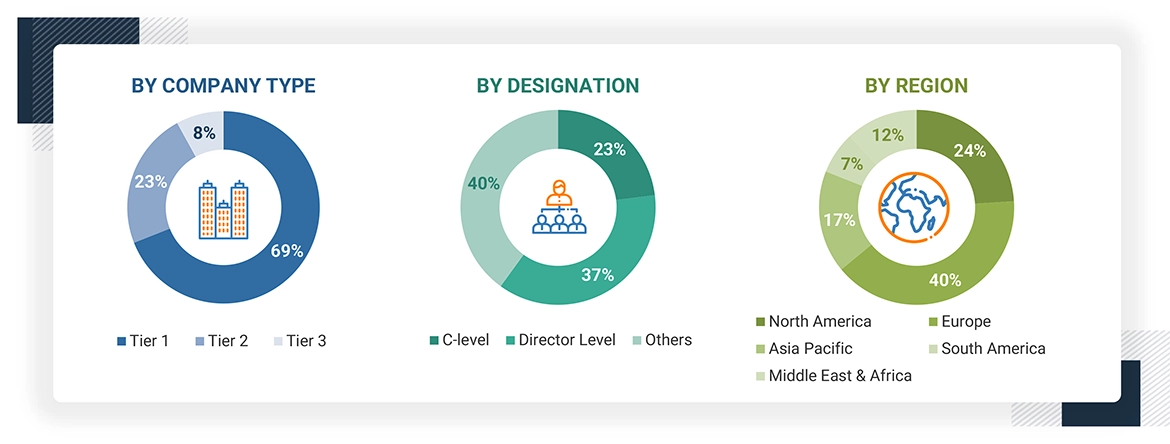
Note: Tier 1, Tier 2, and Tier 3 companies are classified based on their market revenue in 2023, available in the public domain, product portfolios, and geographical presence.
Other designations include consultants and sales, marketing, and procurement managers.
To know about the assumptions considered for the study, download the pdf brochure
| COMPANY NAME | DESIGNATION | |
|---|---|---|
| Alkegen | Senior Manager | |
| Rath Group | Innovation Manager | |
| Refmon Industries | Vice-President | |
| Morgan Advanced Materials plc | Production Supervisor | |
| IBIDEN Co., Ltd. | Sales Manager | |
Market Size Estimation
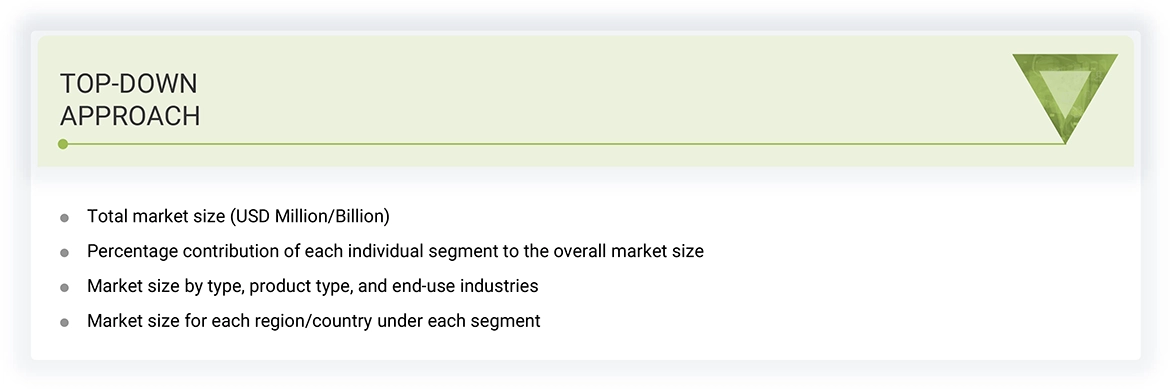
Both top-down and bottom-up approaches were used to estimate and validate the total size of the ceramic fiber market. These methods were also used extensively to estimate the size of various subsegments in the market. The research methodology used to estimate the market size includes the following:
- The key players in the industry have been identified through extensive secondary research.
- The supply chain of the industry has been determined through primary and secondary research.
- All percentage shares, splits, and breakdowns have been determined using secondary sources and verified through primary sources.
- All possible parameters that affect the markets covered in this research study have been accounted for, viewed in extensive detail, verified through primary research, and analyzed to obtain the final quantitative and qualitative data.
Ceramic Fiber Market: Bottom-Up Approach & Top-Down Approach
Data Triangulation
After arriving at the overall market size—using the market size estimation processes as explained above—the market was split into several segments and subsegments. To complete the overall market engineering process and arrive at the exact statistics of each market segment and subsegment, data triangulation, and market breakdown procedures were employed, wherever applicable. The data was triangulated by studying various factors and trends from both the demand and supply sides in the ceramic fiber industry.
Market Definition
The ceramic fiber market can be defined as the segment of the industry that deals with manufacturing and supply of ceramic fibers as well as the use of the fibers as insulation products derived from ceramic materials. Such fibers are characterised by high thermal stability, low coefficient of thermal expansion and high thermal conductivity and ageless at high temperatures. The market consists of various types of ceramic fibers products including RCF, AES Wool, and others, Product forms like blankets, boards, papers, module and others among others.
Stakeholders
- Ceramic fiber manufacturers
- Ceramic fiber suppliers
- Raw material suppliers
- Service providers
- End-use companies
- Government bodies
Report Objectives
- To define, describe, and forecast the ceramic fiber market in terms of value and volume
- To provide detailed information regarding the drivers, opportunities, restraints, and challenges influencing market growth
- To estimate and forecast the market size by type, product form, end-use industries, and region
- To forecast the size of the market for five main regions: Asia Pacific, Europe, North America, South America, and the Middle East & Africa, along with their key countries
- To strategically analyze micromarkets1 with respect to their growth trends, prospects, and contribution to the overall market
- To analyze opportunities in the market for stakeholders and provide a competitive landscape for market leaders
- To analyze competitive developments, such as deals and expansions, in the market
- To analyze the impact of the recession on the market
- To analyze the impact of COVID-19 on the market and end-use industry
- To strategically profile key players and comprehensively analyze their growth strategies
Get the Full Ceramic Fiber Market Report
Full forecast, segment splits, and company analysis for all Ceramic Fiber Market.
- Germany Ceramic Fiber Market
- Italy Ceramic Fiber Market
- Russia Ceramic Fiber Market
- Canada Ceramic Fiber Market
- Mexico Ceramic Fiber Market
- Iran Ceramic Fiber Market
- Brazil Ceramic Fiber Market
- Argentina Ceramic Fiber Market
- US Ceramic Fiber Market
- Rest Of Europe Ceramic Fiber Market
- Rest Of Asia Pacific Ceramic Fiber Market
- GCC Ceramic Fiber Market
- -Rest Of GCC Ceramic Fiber Market
- Rest Of South America Ceramic Fiber Market
- Rest Of Latin America Ceramic Fiber Market
- China Ceramic Fiber Market
- Japan Ceramic Fiber Market
- India Ceramic Fiber Market
Need a Tailored Report?
Customize this report to your needs
Get 10% FREE Customization
Customize This Report
