
GCC Circuit Breaker Market (2025-2030)

The GCC Circuit Breaker Market was valued at $229.6 Million in 2025 and projected to reach to $298.6 Million by 2030, representing a compound annual growth rate of 5.4%. The GCC circuit breaker market is poised for sustained growth through 2030, supported by ongoing investments in electrical infrastructure and the region's commitment to enhancing power distribution efficiency.


| Market Size in | USD 26.32 MN |
| Market Forecast in | |
| CAGR | |
| Forecast Period | |
| Units Considered | Value (USD MN) |
GCC Circuit Breaker Market Trends and Insights
- Rest Of GCC's circuit breaker sector is driven by expanding electrical infrastructure, rising energy demand, and modernization of power distribution networks across the region.
- The market in Rest Of GCC reflects steady investment in grid reliability and industrial electrification, supported by ongoing economic diversification initiatives and increased focus on renewable energy integration.
- Rest Of GCC's circuit breaker demand is expected to accelerate through 2030 as utilities and industrial operators prioritize equipment upgrades and safety compliance standards..
Key Market Statistics
- CAGR (2025-2030) 5.4% CAGR
- Market Size, 2025 ~USD 229.6 Million
- Forecast, 2030 ~USD 298.6 Million
- Country GCC
GCC Circuit Breaker Market Overview
Market Valuation :
The GCC circuit breaker market is valued at USD 229.6 million in 2025 and is projected to reach USD 298.6 million by 2030, demonstrating steady growth in the region's electrical infrastructure sector.
Regional Growth Rate :
GCC's circuit breaker market is expanding at a CAGR of 5.4% from 2025 to 2030, driven by increasing investments in power distribution modernization and electrical grid expansion across Gulf Cooperation Council nations.
Infrastructure Expansion :
Rising energy demand and rapid urbanization in GCC countries are fueling the need for advanced circuit breaker solutions to support expanding electrical networks and improved power distribution reliability.
Modernization Initiatives :
GCC nations are prioritizing the modernization of aging power distribution networks, creating significant opportunities for circuit breaker manufacturers and suppliers to upgrade infrastructure with advanced protection technologies.
GCC Circuit Breaker Market Dynamics
- Key drivers include rapid urbanization, industrial expansion, and the need to upgrade aging electrical systems across Saudi Arabia, UAE, Kuwait, Qatar, Bahrain, and Oman.
- The market's 5.4% CAGR reflects steady demand from utilities, construction projects, and industrial facilities requiring reliable circuit protection solutions. Future growth will be bolstered by renewable energy integration initiatives, smart grid development, and increased focus on electrical safety standards across GCC nations.
- As governments invest in diversifying energy sources and modernizing infrastructure, circuit breaker demand will remain robust.
- The region's economic diversification efforts and mega-projects will continue to create opportunities for advanced circuit breaker technologies that meet international standards and support grid stability..
Market Ecosystem
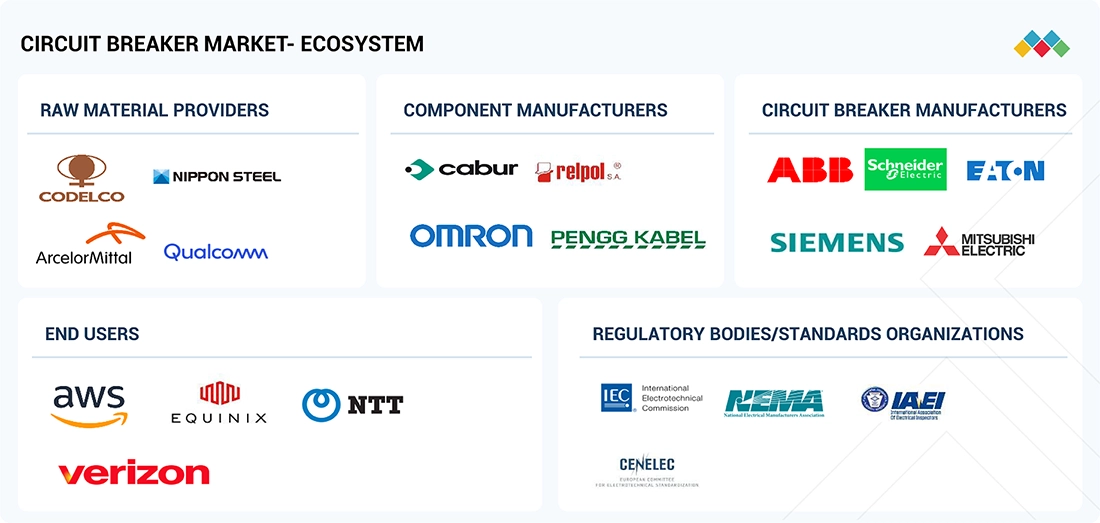
circuit-breaker-and-fuse-market: COMMERCIAL USE CASES ACROSS INDUSTRIES
| COMPANY | USE CASE DESCRIPTION | BENEFITS |
|---|---|---|
 |
ABB supplied medium- and low-voltage power distribution solutions to the KCY Cloud Data Center in Sichuan, China, which operated as a large AI-focused hyperscale facility with a computing capacity of about 500 petaflops. The project used ABB circuit breakers and switchgear to support reliable, efficient power distribution for high-density IT loads. | The integrated breaker and switchgear solution increased power system reliability, reduced unplanned outages, and improved energy efficiency by enabling detailed monitoring and control | The data center safely supported growth in AI workloads while maintaining high availability and optimizing its PUE over time. |
 |
Schneider Electric provided power distribution and digital energy management solutions for EcoDataCenter in Falun, Sweden, which operated as a high-performance colocation and HPC facility. The project used Schneider Electric’s EcoStruxure architecture and connected circuit breakers to support a low-carbon, energy-efficient, and highly available data center. | The solution helped EcoDataCenter reach very high electrical efficiency with low PUE while preserving 2N redundancy and strong reliability| Digital circuit breakers and smart panels enabled granular insight into power quality and asset health, simplified maintenance, and supported EcoDataCenter’s position as one of the most sustainable and resilient colocation providers. |
Logos and trademarks shown above are the property of their respective owners. Their use here is for informational and illustrative purposes only.
Related Ecosystem
High Voltage Products And Systems
- Analytics Software
- Connected Healthcare
- Connected Logistics
- Geographical Information System (GIS)
- Network Bandwidth Management
- ABB India Limited
- Siemens ag
- SCHNEIDER ELECTRIC SE
- Eaton Corporation plc
- Mitsubishi Electric Corporation
Power Infrastructure
- Geographical Information System (GIS)
- Cogeneration
- Battery Electric Vehicle (BEV)
- Cellular Network
- Fuel Cell
- Siemens ag
- ABB India Limited
- SCHNEIDER ELECTRIC SE
- General Electric Company
- Eaton Corporation plc
Key Takeaways
- Rest Of GCC's circuit breaker market will grow from USD 229.6M (2025) to USD 298.6M (2030) at a 5.4% CAGR.
- Rest Of GCC's market expansion is fueled by infrastructure modernization and increased renewable energy adoption.
- Rest Of GCC demonstrates steady demand from both utility and industrial sectors seeking grid reliability improvements.
- Rest Of GCC's growth trajectory reflects regional economic diversification and enhanced focus on electrical safety standards.
Circuit Breaker Market Report Scope
| Report Metric | Details |
|---|---|
| Base Year | 2025 |
| Fastest Growing Segment | DATA CENTERS (Application) |
| Forecast Period | 2025–2030 |
| Growth Rate | CAGR of 6% from 2025 to 2030 |
| Largest Segment | AIR (Insulation Type) |
| Market Size Base Year (Billions) | ~USD 22.66 (2025) |
| Revenue Forecast (Billions) | ~USD 30.32 (2030) |
| Segments Covered | Insulation Type, Voltage, Installation, Application |
GCC Circuit Breaker Market Report Segmentation
4 segment dimensions are covered across the global market.
By Insulation Type
- Air
- Gas
- Oil
- Vacuum
By Voltage
- High
- Low
- Medium
By Installation
- Indoor
- Outdoor
By Application
- Commercial & Residential
- Data Centers
- EV Charging
- Factory Automation
- Industrial
- Railways
- Renewables
- T&D Utilities
REST OF GCC: CIRCUIT BREAKER MARKET, BY APPLICATION, 2025–2030
| Segment | 2025 | 2026 | 2027 | 2028 | 2029 | 2030 | CAGR (%) |
|---|---|---|---|---|---|---|---|
| COMMERCIAL & RESIDENTIAL | 60.5 | 63.6 | 66.9 | 70.5 | 74.5 | 78.6 | 5.4 |
| DATA CENTERS | 2.2 | 2.6 | 3 | 3.7 | 4.4 | 5.3 | 19.7 |
| EV CHARGING | 12 | 12.8 | 13.8 | 14.8 | 16.1 | 17.3 | 7.7 |
| FACTORY AUTOMATION | 6.3 | 6.8 | 7.2 | 7.8 | 8.4 | 9 | 7.2 |
| INDUSTRIAL | 16.8 | 17.8 | 18.8 | 20 | 21.3 | 22.6 | 6.1 |
| OTHERS | 3.4 | 3.7 | 3.9 | 4.1 | 4.1 | 4.1 | 3.8 |
| RAILWAYS | 14.1 | 14.8 | 15.5 | 16.3 | 17.1 | 18 | 4.9 |
| RENEWABLES | 20.7 | 22 | 23.4 | 25 | 26.8 | 28.6 | 6.7 |
| T&D UTILITIES | 93.6 | 97.3 | 101.3 | 105.7 | 110.5 | 115.2 | 4.2 |
| TOTAL | 229.6 | 241.3 | 253.8 | 267.7 | 283.2 | 298.6 | 5.4 |
Target Audience
- Electrical Equipment Manufacturers : Circuit breaker manufacturers need GCC-specific market data to identify regional demand patterns, assess market entry feasibility, and develop localized product strategies for Gulf Cooperation Council nations.
- Power Utility Companies : Utility operators across GCC countries require market intelligence to plan infrastructure upgrades, forecast circuit breaker procurement needs, and align investments with regional grid modernization initiatives.
- Construction & Engineering Firms : Engineering companies executing infrastructure projects in GCC nations need market insights to estimate circuit breaker requirements, budget allocations, and supplier selection for electrical systems.
- Investment & Private Equity Firms : Investors evaluating opportunities in GCC's energy and power sector need detailed market sizing and growth forecasts to assess the circuit breaker market's investment potential and returns.
- Electrical Distributors & Suppliers : Regional distributors require GCC market data to optimize inventory planning, identify growth segments, and develop sales strategies aligned with regional infrastructure expansion and modernization trends.
Key Companies in the GCC Circuit Breaker Market
| Company | HQ | Ownership | Strongest segments |
|---|---|---|---|
| SIEMENS | Germany | Public Company | Digital Industries (automation, controls, industrial software),Smart Infrastructure (electrification, buildings, grid),Mobility (rail systems, automation, services), |
| EATON | Ireland | Public Company | Electrical distribution, protection, and residential products,Power quality, connectivity, and power reliability equipment,Aerospace systems and components, |
| SCHNEIDER ELECTRIC | Canada | Public Company | Low- and medium-voltage equipment and wiring devices,Building management, power metering, and smart controls,Industrial automation, drives, and control software, |
| ABB | India | Public Company | Electrification,Motion,Automation, |
| MITSUBISHI ELECTRIC CORPORATION | Japan | Public Company | Building Systems (elevators, escalators, building management),Air Conditioning, Refrigeration, and Home Equipment,Factory Automation and Industrial Systems, |
| EMERSON ELECTRIC CO. | United States | Public Company | Final Control,Measurement & Analytical,Discrete Automation, |
| FUJI ELECTRIC CO., LTD. | Japan | Public Company | Power Semiconductors,AC Drives, Motors, and Industrial Controls,Power Supply and Energy Management (UPS, Solar Inverters, Data Centers), |
| ROCKWELL AUTOMATION | United States | Public Company | Intelligent Devices,Software & Control,Lifecycle Services, |
| LS ELECTRIC CO., LTD. | South Korea | Public Company | Low and Medium Voltage, Protection/Measurement/Meter Devices,Power Transmission, Distribution Systems, Modular Substations,Smart Power Software & Microgrid (EMS, SCADA, DMS, LSPS, Microgrid), |
| TOSHIBA CORPORATION | Japan | Private Company | Energy Systems & Solutions,Infrastructure Systems & Solutions,Building Solutions, |
| WEG | Brazil | Public Company | Electric motors and gearmotors,Drives, frequency converters, and industrial automation,Transformers, substations, and power distribution equipment, |
| CG POWER & INDUSTRIAL SOLUTIONS LTD. | India | Public Company | Power Systems (transformers, switchgear, power quality, relays & automation),Industrial Systems (motors, large machines, drives & automation, stampings),Semiconductors (design, OSAT, turnkey solutions), |
| GE VERNOVA | United States | Public Company | Power (Gas, Nuclear, Hydro, Steam),Wind (Onshore & Offshore),Electrification (Grid, Power Conversion, Solar & Storage, Software), |
| HD HYUNDAI ELECTRIC CO., LTD. | South Korea | Public Company | Power and distribution transformers,Gas insulated and MV/LV switchgear,High- and low-voltage motors and generators, |
| TE CONNECTIVITY | Ireland | Public Company | Transportation Solutions (automotive, e-mobility, commercial and industrial vehicles, autosport, rail),Industrial Solutions (aerospace, defense, energy, industrial machinery, intelligent buildings, medical, oil and gas/marine, space, rail infrastructure),Data and Devices, IoT, and Personal Electronics (5G, wireless, data centers/AI, connected home, wearables, IoT connectivity), |
SIEMENS
Siemens is a German multinational public company founded in 1847, employing 310,312 people and operating across diverse industrial and technology sectors.
EATON
Eaton is a public company founded in 1911 and based in Ireland, with 97,303 employees providing diversified industrial manufacturing and technology solutions.
SCHNEIDER ELECTRIC
Schneider Electric is a Canadian-based public company founded in 1836, employing 158,122 people in electrical distribution and automation solutions.
ABB
ABB is an India-based public company founded in 1883, with 112,700 employees specializing in robotics, power, and automation technologies.
MITSUBISHI ELECTRIC CORPORATION
Mitsubishi Electric Corporation is a Japanese public company founded in 1921, employing 150,386 people in electrical equipment and industrial automation.
EMERSON ELECTRIC CO.
Emerson Electric Co. is a United States-based public company founded in 1890, with 71,000 employees providing process management and industrial technology solutions.
FUJI ELECTRIC CO., LTD.
Fuji Electric Co., Ltd. is a Japanese public company founded in 1923, employing 26,955 people in power electronics and industrial systems.
ROCKWELL AUTOMATION
Rockwell Automation is a United States-based public company founded in 1903, with 26,000 employees specializing in industrial automation and information technology.
LS ELECTRIC CO., LTD.
LS Electric Co., Ltd. is a South Korean public company founded in 1974, employing 3,267 people in electrical equipment and power solutions.
TOSHIBA CORPORATION
Toshiba Corporation is a Japanese private company founded in 1875, employing 106,648 people across electronics, energy, and infrastructure sectors.
WEG
WEG is a Brazilian public company founded in 1961, with 49,258 employees manufacturing electric motors, drives, and automation equipment.
CG POWER & INDUSTRIAL SOLUTIONS LTD.
CG Power & Industrial Solutions Ltd. is an India-based public company founded in 1878, employing 3,113 people in power and industrial solutions.
GE VERNOVA
GE Vernova is a United States-based public company founded in 2023, employing 78,000 people in energy and power technology solutions.
HD HYUNDAI ELECTRIC CO., LTD.
HD Hyundai Electric Co., Ltd. is a South Korean public company founded in 1977, with 2,022 employees in electrical equipment manufacturing.
TE CONNECTIVITY
TE Connectivity is an Ireland-based public company founded in 1941, employing 80,000 people in connectivity and sensor solutions for multiple industries.
Reasons to Buy this Report
- Market Size & Growth Data : Access precise valuation figures for the GCC circuit breaker market (USD 229.6M in 2025) with detailed 5-year forecasts, enabling accurate investment planning and revenue projections specific to the Gulf region.
- Regional Demand Drivers : Understand the specific factors driving GCC market growth including infrastructure expansion, energy demand increases, and power distribution modernization initiatives across individual Gulf nations.
- Competitive Positioning : Benchmark your business against regional market trends and identify growth opportunities in the GCC's expanding electrical infrastructure sector, supporting strategic market entry and expansion decisions.
- Investment Opportunity Analysis : Evaluate the GCC circuit breaker market's 5.4% CAGR and USD 69M growth potential to identify high-value investment opportunities in one of the world's most dynamic energy markets.
- Regulatory & Infrastructure Insights : Gain intelligence on GCC-specific electrical standards, modernization initiatives, and government infrastructure projects that shape circuit breaker demand and market dynamics in the region.
Frequently asked questions
What is the current size of the circuit breaker market in Rest Of GCC?
The Rest Of GCC circuit breaker market is estimated at USD 229.6 million in 2025.
What is the projected market size for Rest Of GCC by 2030?
Rest Of GCC's circuit breaker market is forecast to reach USD 298.6 million by 2030.
What is the CAGR for Rest Of GCC's circuit breaker market?
Rest Of GCC's circuit breaker market is expected to grow at a CAGR of 5.4% from 2025 to 2030.
What factors are driving growth in Rest Of GCC's circuit breaker market?
Rest Of GCC's market growth is driven by infrastructure modernization, rising energy demand, renewable energy integration, and industrial electrification initiatives.
Which sectors contribute most to Rest Of GCC's circuit breaker demand?
Rest Of GCC's circuit breaker demand is primarily driven by utility companies and industrial operators focused on grid reliability and equipment safety upgrades.
RESEARCH METHODOLOGY
To determine the current market size for circuit breakers, several key activities were undertaken. Extensive secondary research was conducted to gather information on the market and related industries. These findings were then validated through primary research, which involved discussions with industry experts across the entire value chain. Both top-down and bottom-up approaches were employed to estimate the overall market size. Additionally, market breakdown and data triangulation techniques were utilized to calculate the market size of specific segments and subsegments.
Secondary Research
This research study utilized a wide range of secondary sources, including directories, databases, and reputable sources such as Hoover's, Bloomberg BusinessWeek, Factiva, World Bank, US DOE, and IEA. These sources were instrumental in gathering valuable information for a comprehensive analysis of the global circuit breaker market from technical, market-oriented, and commercial perspectives. Additional secondary sources included annual reports, press releases, investor presentations, white papers, certified publications, articles by recognized authors, manufacturer associations, trade directories, and databases.
Primary Research
The circuit breaker market encompasses a diverse range of stakeholders, including public and private electric utilities, distribution companies, circuit breaker manufacturers, dealers, suppliers, circuit breaker component manufacturers, energy and power sector consulting firms, and other relevant entities. To understand the market dynamics, primary sources were interviewed from both the supply and demand sides. These sources provided qualitative and quantitative insights into the market. The breakdown of primary respondents is as follows—
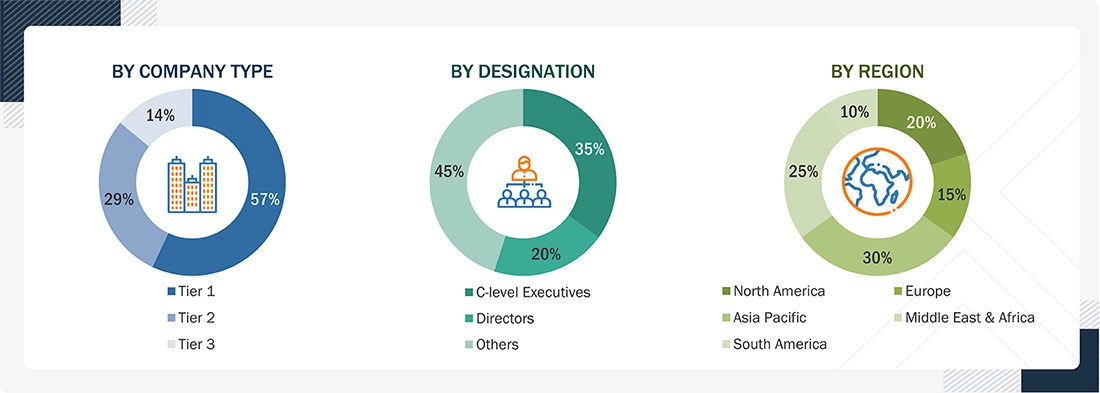
Note: The tier of companies has been defined based on their total revenue as of 2024: Tier 1 = >USD 5 billion, Tier 2 = USD 1 billion to USD 5 billion, and Tier 3 = USD 1 billion. Others include sales managers, engineers, and regional managers.
To know about the assumptions considered for the study, download the pdf brochure
Market Size Estimation
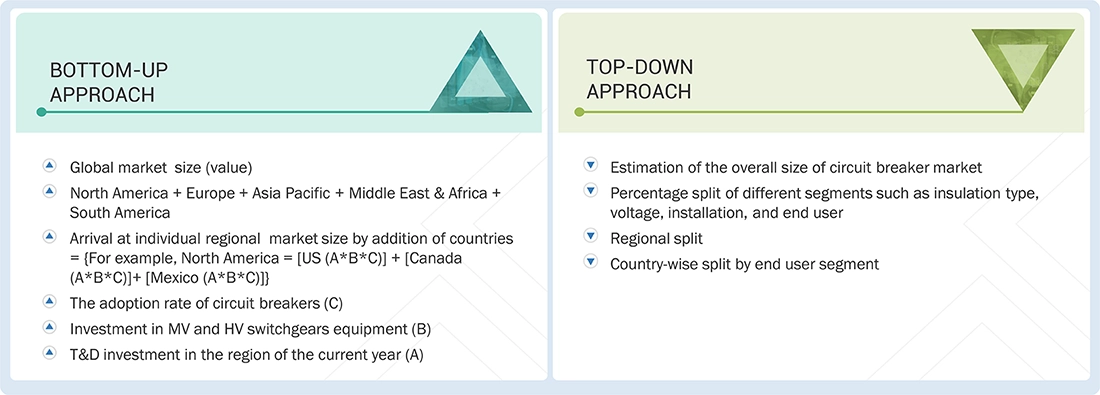
Both top-down and bottom-up approaches have been employed to estimate and validate the size of the global circuit breaker market, as well as its dependent submarkets. These methods were also used extensively to estimate the size of various market segments. The research methodology used to estimate the market size includes the following:
- The key players in the industry and market have been identified through extensive secondary research, and their market shares in the respective regions have been determined through both primary and secondary research.
- The industry’s supply chain and market size, in terms of value, have been determined through primary and secondary research processes.
- All percentage shares, splits, and breakdowns have been determined using secondary sources and verified through primary sources.
Circuit Breaker Market : Top-Down and Bottom-Up Approach
Data Triangulation
After determining the overall market size using the market size estimation processes explained above, the market was segmented into subsegments. To complete the overall market engineering process and determine the exact statistics for each market segment and subsegment, data triangulation and market breakdown procedures were employed, where applicable. The data was triangulated by studying various factors and trends from both the demand and supply sides.
Market Definition
A circuit breaker is a crucial component in an electric circuit that safeguards equipment from potential damage resulting from excessive current flow, which can occur due to overload or short-circuit situations. It functions as an automated switch that can both open and close circuits. Circuit breakers can be manually operated for maintenance purposes or automatically trip to interrupt the circuit in the event of a short circuit occurrence. These devices come in two main types: AC circuit breakers, which handle alternating current, and DC circuit breakers, which are designed for direct current applications.
The circuit breaker market refers to the global market for devices designed to protect electrical circuits from excessive current flows and short circuits. Circuit breakers are automatic switches that can interrupt electrical currents when they exceed safe levels, thereby preventing damage to equipment, electrical systems, and potentially hazardous situations, such as fires. The circuit breaker market is expected to witness growth during the forecast period, driven by the expanding capacity additions and improvements in transmission and distribution (T&D) networks across key regions, including North America, South America, Europe, Asia Pacific, and the Middle East & Africa. This growth is driven by the need to meet the increasing electricity demand and maintain a reliable power supply across these regions. Investments in enhancing T&D networks will facilitate the efficient transmission and distribution of electricity, creating opportunities for the circuit breaker market to expand.
Key Stakeholders
- Government utility providers
- Independent power producers
- Circuit breaker manufacturers
- Power equipment and garden tool manufacturers
- Consulting companies in the energy & power sector
- Distribution utilities
- Government and research organizations
- Organizations, forums, and associations
- Raw material suppliers
- State and national regulatory authorities
- Switchgear manufacturers, distributors, and suppliers
- Switchgear and circuit breaker original equipment manufacturers (OEMs)
Report Objectives
- To define, describe, circuit breaker market, based on insulation type, voltage, installation, and end user
- To provide detailed information on the major factors influencing the growth of the circuit breaker market (drivers, restraints, opportunities, and industry-specific challenges)
- To strategically analyze the circuit breaker market with respect to individual growth trends, prospects, and the contribution of each segment to the market
- To analyze market opportunities for stakeholders and the details of a competitive landscape for market leaders
- To forecast the growth of the circuit breaker market with respect to the major regions (Asia Pacific, Europe, North America, South America, the Middle East, & Africa)
- To strategically profile key players and comprehensively analyze their market share and core competencies
- To analyze competitive developments, such as product launches, contracts and agreements, investments and expansions, and mergers and acquisitions, in the circuit breaker market
Available Customizations:
With the given market data, MarketsandMarkets offers customizations as per the client’s specific needs. The following customization options are available for this report:
Regional Analysis
- Further breakdown of region or country-specific analysis
Company Information
- Detailed analyses and profiling of additional market players (up to 5)
Get the Full Circuit Breaker Market Report
Full forecast, segment splits, and company analysis for all Circuit Breaker Market.
- Rest Of Europe Circuit Breaker Market
- Rest Of Asia Pacific Circuit Breaker Market
- China Circuit Breaker Market
- Japan Circuit Breaker Market
- India Circuit Breaker Market
- Australia Circuit Breaker Market
- South Korea Circuit Breaker Market
- Germany Circuit Breaker Market
- UK Circuit Breaker Market
- France Circuit Breaker Market
- Spain Circuit Breaker Market
- Italy Circuit Breaker Market
- Canada Circuit Breaker Market
- Mexico Circuit Breaker Market
- US Circuit Breaker Market
- Saudi Arabia Circuit Breaker Market
- UAE Circuit Breaker Market
- Kuwait Circuit Breaker Market
- South Africa Circuit Breaker Market
- Brazil Circuit Breaker Market
- Argentina Circuit Breaker Market
- South America Circuit Breaker Market
Need a Tailored Report?
Customize this report to your needs
Get 10% FREE Customization
Customize This Report
