
Brazil Clinical Informatics Market (2024-2029)

The Brazil Clinical Informatics Market was valued at $4215.2 Million in 2024 and projected to reach to $11185.2 Million by 2029, representing a compound annual growth rate of 17.7%. Brazil's clinical informatics market is positioned for exceptional growth through 2029, driven by healthcare sector modernization and increased digital adoption across both public and private institutions.


| Market Size in | USD 26.32 MN |
| Market Forecast in | |
| CAGR | |
| Forecast Period | |
| Units Considered | Value (USD MN) |
Brazil Clinical Informatics Market Trends and Insights
- This represents a compound annual growth rate of 17.7%, significantly outpacing global trends as Brazil modernizes its healthcare infrastructure and digital capabilities.
- Brazil's healthcare sector is increasingly adopting electronic health records, clinical decision support systems, and integrated care platforms to enhance operational efficiency and patient outcomes. The growth trajectory in Brazil reflects rising government investment in healthcare digitalization, coupled with growing demand from both public and private healthcare institutions.
- Brazil's expanding middle class and increasing prevalence of chronic diseases are driving healthcare providers to implement advanced informatics solutions.
- Between 2024 and 2029, Brazil is expected to become a key market for clinical informatics vendors, with particular momentum in hospital information systems, data analytics, and interoperability solutions tailored to the Brazilian healthcare ecosystem..
Key Market Statistics
- CAGR (2024-2029) 17.7% CAGR
- Market Size, 2024 ~USD 4215.2 Million
- Forecast, 2029 ~USD 11185.2 Million
- Country Brazil
Brazil Clinical Informatics Market Overview
Rapid Market Expansion :
Brazil's clinical informatics market is growing at 17.7% CAGR, significantly outpacing the global rate of 16%, driven by aggressive healthcare digitalization initiatives and government modernization programs.
Substantial Market Valuation :
The market is valued at $4,215.2 million in 2024 and is projected to nearly triple to $11,185.2 million by 2029, reflecting strong investment in healthcare IT infrastructure across public and private sectors.
EHR Adoption Acceleration :
Brazil's healthcare sector is increasingly adopting electronic health records and integrated clinical systems, driven by regulatory requirements and the need to improve patient care coordination across fragmented healthcare networks.
Digital Healthcare Infrastructure :
Government initiatives and private sector investments are modernizing Brazil's healthcare infrastructure, creating substantial opportunities for clinical informatics solutions in hospitals, clinics, and primary care facilities.
Brazil Clinical Informatics Market Dynamics
- The country's expanding middle class and rising healthcare spending are accelerating demand for advanced clinical systems, EHR platforms, and integrated care solutions.
- Government policies promoting healthcare digitalization and interoperability standards are creating a favorable regulatory environment for market expansion. Key growth drivers include the need to improve operational efficiency in overburdened public healthcare systems, rising patient expectations for digital health services, and increasing investments from both domestic and international healthcare IT vendors.
- Brazil's large population and diverse healthcare landscape present significant opportunities for scalable clinical informatics solutions, positioning the market as a critical growth hub in Latin America through the forecast period..
Market Ecosystem
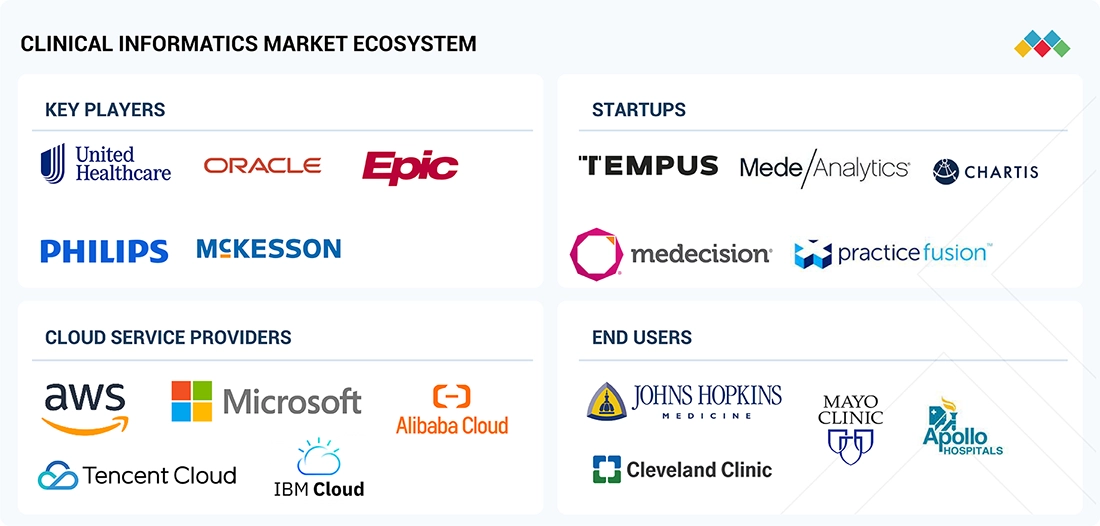
Clinical Informatics Market: COMMERCIAL USE CASES ACROSS INDUSTRIES
| COMPANY | USE CASE DESCRIPTION | BENEFITS |
|---|---|---|
 |
Comprehensive cloud-based informatics solutions for health data aggregation, population health analytics, and care coordination. | Improved data interoperability and sharing, streamlined patient care, and enhanced population health outcomes. |
|
|
Cloud-based health information platforms integrating EHR, population health management, and advanced analytics. | Enables proactive patient intervention, efficient clinical workflows, and more effective population health strategies. |
|
|
EHR and clinical informatics solutions focused on patient engagement, interoperability, and remote monitoring. | Enhanced coordinated care, reduced hospital readmissions, and expanded healthcare access to remote regions. |
|
|
Health informatics platforms integrating EHR, diagnostic imaging, and genomics data with advanced visualization and reporting tools. | Improved clinical efficiency, informed decision-making, and personalized treatment planning. |
|
|
Clinical decision support and care management systems using predictive analytics and integrated data exchange. | Optimized resource allocation, improved patient outcomes, and reduced unnecessary procedures. |
Logos and trademarks shown above are the property of their respective owners. Their use here is for informational and illustrative purposes only.
Related Ecosystem
Analytical And Scientific Instrumentation
- Environmental Testing
- Gas Chromatography
- Polymerase Chain Reaction (PCR)
- Automated Liquid Handling Systems
- Flow Cytometry
- Thermo Fisher Scientific Inc.
- Danaher Corporation
- Agilent Technologies, Inc.
- Shimadzu Corporation
- Merck KGaA
Healthcare Analytics
- Machine Learning
- Natural Language Processing (NLP)
- Blood Pressure Monitors
- Computed Tomography (CT)
- Magnetic Resonance Imaging (MRI)
- Oracle Corporation
- PHILIPS HEALTHCARE
- Siemens healthineers
- Zensar Technologies Limited
- EPIC SYSTEMS CORPORATION
Healthcare It
- Computed Tomography (CT)
- Machine Learning
- Magnetic Resonance Imaging (MRI)
- Natural Language Processing (NLP)
- Predictive Analytics
- CERNER CORPORATION
- PHILIPS HEALTHCARE
- Oracle Corporation
- GE HealthCare Technologies Inc.
- Siemens healthineers
Key Takeaways
- Brazil's clinical informatics market will grow from $4,215.2M (2024) to $11,185.2M (2029) at a 17.7% CAGR, outpacing global growth rates.
- Government healthcare digitalization initiatives and regulatory mandates are accelerating clinical informatics adoption across Brazil's public and private sectors.
- Brazil's rising chronic disease burden and expanding healthcare access are creating strong demand for integrated EHR and clinical decision support systems.
- Brazil represents a high-growth opportunity for clinical informatics vendors targeting Latin America's largest healthcare market.
Clinical Informatics Market Report Scope
| Report Metric | Details |
|---|---|
| Base Year | 2024 |
| Fastest Growing Segment | MOBILE HEALTH APPLICATIONS (Function) |
| Forecast Period | 2024-2029 |
| Growth Rate | CAGR of 16% from 2024 to 2029 |
| Largest Segment | SERVICES (Component) |
| Market Size Base Year (Billions) | ~USD 231.15 (2024) |
| Revenue Forecast (Billions) | ~USD 563.18 (2029) |
| Segments Covered | Function, Type, Deployment Model, Component, Therapeutic Area, End User, Type2022-2030 |
Brazil Clinical Informatics Market Report Segmentation
7 segment dimensions are covered across the global market.
By Function
- Clinical Decision Support Systems
- Clinical Workflow Management Systems
- Data Analytics & Reporting Solutions
- Diagnostic & Imaging Solutions
- Electronic Health Records
- Hcit Integration & Interoperability Systems
- Infection Surveillance Solutions
- Medication Management Systems
- Mobile Health Applications
- Other Functions
- Patient Portals & Engagement Solutions
- Population Health Management Solutions
- Practice Management Systems
- Specialty Information Management Solutions
- Telehealth & Telemedicine Solutions
By Type
- Cardiovascular Information Systems
- Clinical Communication & Collaboration Solutions
- Clinician & Staff Scheduling Solutions
- Computerized Physician Order Entry Systems
- Eprescribing Solutions
- Integrated Software
- Laboratory Information Systems
- Medical Image Analysis Software
- Oncology Information Systems
- Other Specialty Information Management Solutions
- Pacs & Vna
- Patient Flow Management Solutions
- Pharmacy Information Systems
- Radiology Information Systems
- Standalone Software
- Workflow Automation Solutions
By Deployment Model
- Cloud-Based Model
- Hybrid Model
- On-Premise Model
By Component
- Services
- Software
By Therapeutic Area
- Cardiology
- Immunology
- Infectious Diseases
- Metabolic Disorders
- Neurology
- Oncology
- Other Therapeutic Areas
- Respiratory Diseases
By End User
- Ambulatory Surgery Centers, Ambulatory Care Centers, And Other Outpatient Settings
- Diagnostic & Imaging Centers
- Home Healthcare, Long-Term Care, And Assisted Living Facilities
- Hospitals
- Other End Users
- Pharmacies
- Specialty Care Centers
By Type2022-2030
- Integrated Software
- Standalone Software
BRAZIL: CLINICAL INFORMATICS MARKET, BY END USER, 2022–2030
| Segment | 2022 | 2023 | 2024 | 2025 | 2026 | 2028 | 2030 | CAGR (%) |
|---|---|---|---|---|---|---|---|---|
| AMBULATORY SURGERY CENTERS, AMBULATORY CARE CENTERS, AND OTHER OUTPATIENT SETTINGS | 483.6 | 588.4 | 714 | 866.5 | 1048.9 | 1525.5 | 2197.3 | 20.6 |
| DIAGNOSTIC & IMAGING CENTERS | 313.5 | 374.4 | 445.9 | 531.1 | 631 | 884 | 1226.4 | 18.4 |
| HOME HEALTHCARE, LONG-TERM CARE, AND ASSISTED LIVING FACILITIES | 256.6 | 307.9 | 368.6 | 441.2 | 526.7 | 745.3 | 1044.3 | 19 |
| HOSPITALS | 1470 | 1725.7 | 2020.7 | 2366.1 | 2763.6 | 3741.9 | 5017.8 | 16.4 |
| OTHER END USERS | 53.3 | 65.2 | 78.6 | 93.9 | 110.8 | 148.2 | 187.1 | 15.5 |
| PHARMACIES | 152.7 | 178.3 | 207.6 | 241.7 | 280.8 | 376 | 498.6 | 15.7 |
| SPECIALTY CARE CENTERS | 269.7 | 320.4 | 379.7 | 450.1 | 532 | 738 | 1013.7 | 17.8 |
| TOTAL | 2999.3 | 3560.2 | 4215.2 | 4990.6 | 5893.7 | 8158.7 | 11185.2 | 17.7 |
Target Audience
- Healthcare IT Vendors : Clinical informatics software providers and EHR vendors need Brazil market data to identify growth opportunities, assess competitive positioning, and develop localized solutions for the rapidly expanding market.
- Healthcare Providers & Hospital Networks : Brazilian hospitals, clinics, and healthcare systems require market intelligence to benchmark digital transformation investments, evaluate vendor solutions, and align IT strategies with market trends.
- Private Equity & Investment Firms : Investors targeting healthcare IT opportunities in Latin America need Brazil-specific market data to evaluate acquisition targets, assess portfolio company growth potential, and identify emerging market leaders.
- Government & Policy Makers : Brazilian health ministry officials and policy makers need market insights to inform healthcare digitalization strategies, budget allocation, and regulatory frameworks supporting clinical informatics adoption.
- Management Consultants & Analysts : Consulting firms and research analysts advising healthcare clients in Brazil require detailed market data to support strategic recommendations, competitive analysis, and digital transformation roadmaps.
Reasons to Buy this Report
- Market Size & Growth Validation : Obtain precise market valuation data for Brazil ($4.2B in 2024) and verified forecasts through 2029, enabling accurate financial planning and investment decisions in this high-growth market segment.
- Competitive Positioning Strategy : Understand Brazil-specific market dynamics, adoption rates, and competitive landscape to develop targeted go-to-market strategies and identify partnership opportunities with local healthcare providers and government agencies.
- Investment & Expansion Planning : Leverage detailed market insights to justify capital allocation, assess market entry feasibility, and prioritize resource deployment across Brazil's diverse healthcare segments and geographic regions.
- Regulatory & Policy Intelligence : Access Brazil-specific regulatory environment analysis, government digitalization initiatives, and compliance requirements essential for product development and market penetration strategies.
- Revenue Forecasting Accuracy : Utilize Brazil-specific CAGR data (17.7%) and segment projections to build accurate financial models, revenue forecasts, and performance benchmarks for stakeholder reporting and strategic planning.
Frequently asked questions
What is the current size of Brazil's clinical informatics market?
Brazil's clinical informatics market was valued at $4,215.2 million in 2024 and is projected to reach $11,185.2 million by 2029.
What is the expected growth rate for clinical informatics in Brazil?
Brazil's clinical informatics market is expected to grow at a compound annual growth rate (CAGR) of 17.7% from 2024 to 2029.
What factors are driving clinical informatics adoption in Brazil?
Key drivers include government healthcare digitalization initiatives, rising chronic disease prevalence, expanding healthcare access, and increasing investment in hospital information systems and EHR platforms.
Which healthcare segments in Brazil are adopting clinical informatics most rapidly?
Brazil's public healthcare system (SUS) and private hospital networks are leading adoption, with particular focus on electronic health records, clinical decision support, and data analytics solutions.
How does Brazil's clinical informatics market compare to global trends?
Brazil's 17.7% CAGR significantly exceeds the global clinical informatics CAGR of 16%, positioning Brazil as a high-growth regional market within Latin America.
RESEARCH METHODOLOGY
The study involved major activities in estimating the current market size for the clinical informatics market market. Exhaustive secondary research was done to collect information on the clinical informatics industry. The next step was to validate these findings, assumptions, and sizing with industry experts across the value chain using primary research. Different approaches, such as top-down and bottom-up, were employed to estimate the total market size. After that, the market breakup and data triangulation procedures were used to estimate the market size of the segments and subsegments of the clinical informatics market.
Secondary Research
In the secondary research process, various secondary sources such as annual reports, press releases & investor presentations of companies, white papers, certified publications, articles by recognized authors, gold-standard & silver-standard websites, regulatory bodies, and databases (such as D&B Hoovers, Bloomberg Business, and Factiva) were referred to in order to identify and collect information for the study of Clinical Informatics Market. It was also used to obtain important information about the top players, market classification, and segmentation according to industry trends to the bottom-most level, geographic markets, and key developments related to the market. A database of the key industry leaders was also prepared using secondary research.
Primary Research
Extensive primary research was conducted after acquiring basic knowledge about the global Clinical informatics market scenario through secondary research. Several primary interviews were conducted with market experts from both the demand side (Hospital directors, Hospital Vice Presidents, Department heads, and Critical care specialists ) and supply side (such as C-level and D-level executives, technology experts, product managers, marketing and sales managers, among others) across five major regions—North America, Europe, the Asia Pacific, Latin America, Middle East, and Africa. This primary data was collected through questionnaires, e-mails, online surveys, personal interviews, and telephonic interviews
The following is a breakdown of the primary respondents:
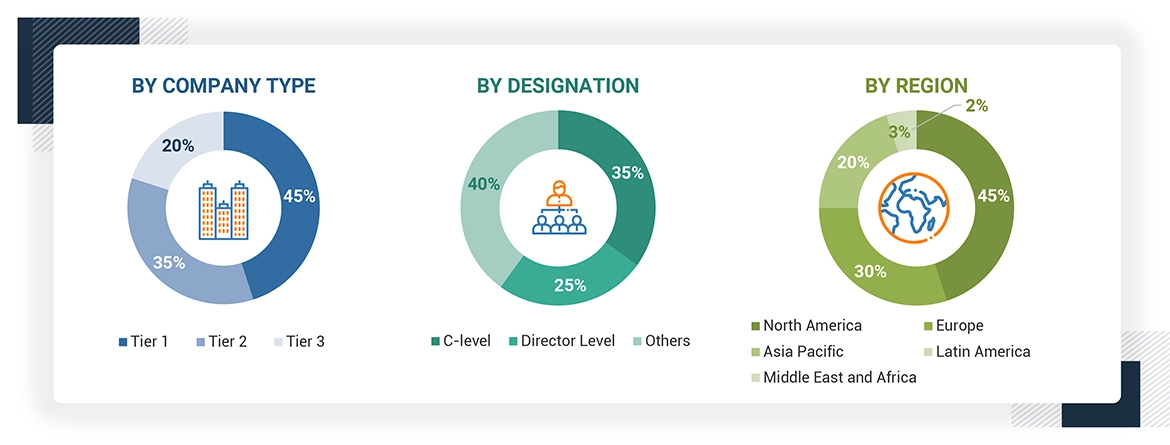
Note 1: Others include sales managers, marketing managers, and product managers.
Note 2: Tiers of companies are defined on the basis of their total revenues in 2023. Tier 1 = >USD 1 billion, Tier 2 = USD 500 million to USD 1 billion, and Tier 3 = < USD 500 million.
To know about the assumptions considered for the study, download the pdf brochure
Market Size Estimation
Both top-down and bottom-up approaches were used to estimate and validate the total size of the clinical informatics market. These methods were also used extensively to estimate the size of various subsegments in the market.
The research methodology used to estimate the market size includes the following:
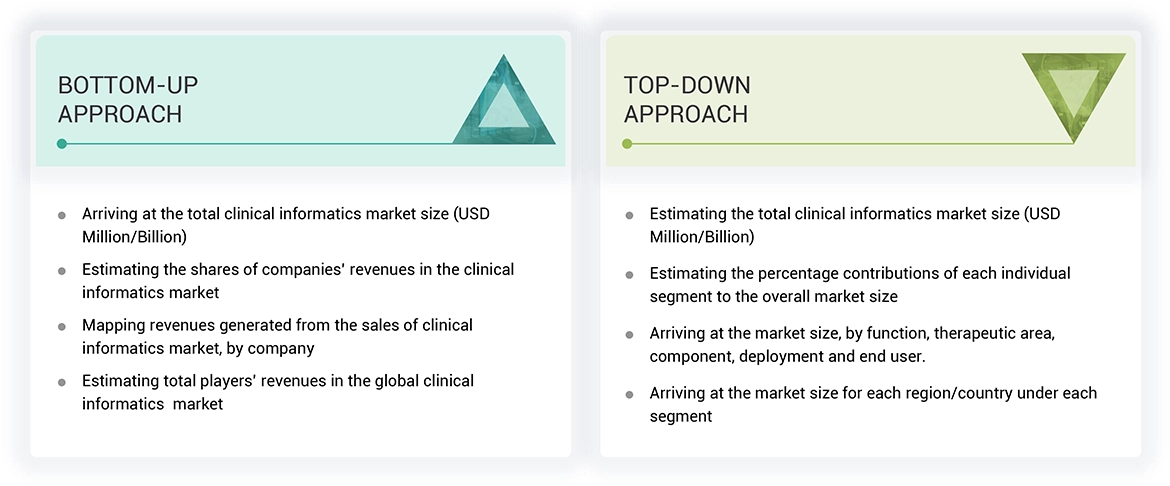
Data Triangulation
After arriving at the overall market size—using the market size estimation processes—the market was split into several segments and subsegments. To complete the overall market engineering process and arrive at the exact statistics of each market segment and sub-segment, data triangulation and market breakdown procedures were employed, wherever applicable. The data was triangulated by studying various factors and trends from both the demand and supply sides in the Clinical Informatics Market.
Market Definition
Clinical informatics involves the focus on how information technology is applied in healthcare. It includes using technologies and data to improve the ways healthcare professionals such as doctors, nurses, and dental specialists care for their patients. This field ranges from clinical decision support, patient documentation, visual imaging, and the designing and implementing health care systems. It connects electronic health records, data analytics, and other digital tools in managing and analyzing health information. Clinical informatics is a synthesis of knowledge from healthcare, computer science, and data management to improve the safety, quality, and efficiency of healthcare systems.
Stakeholders
- Healthcare IT solution providers
- Healthcare IT vendors
- Healthcare IT service providers
- Healthcare payers
- Academic research institutes
- Government institutes
- Market research and consulting firms
- Venture capitalists and investors
- Medical Societies and Professional Associations
- Consultants and IT Service Providers
- Technology Vendors and Developers
- Payers and Insurers
- Public Health Agencies
- Medical Device Manufacturers
- Regulatory Bodies and Policymakers
- Advocacy and Nonprofit Organizations
Report Objectives
- To define, describe, and forecast the global Clinical Informatics market based on function, therapeutic area, component, deployment, end user, and region.
- To provide detailed information regarding the major factors (such as drivers, restraints, opportunities, and challenges) influencing the market growth
- To strategically analyze micro-markets with respect to individual growth trends, prospects, and contributions to the overall Clinical Informatics market
- To analyze opportunities in the market for stakeholders and provide details of the competitive landscape for market leaders.
- To strategically analyze the market structure profile of the key players of the Clinical Informatics market and comprehensively analyze their core competencies.
- To forecast the size of the market segments with respect to five regions, namely, North America, Europe, Asia Pacific, Latin America, and the Middle East & Africa.
- To track and analyze competitive developments such as product launches and enhancements and investments, partnerships, collaborations, acquisitions, expansions, funding, grant, agreements, sales contracts, product testing, FDA approval, product approval, and alliances in the Clinical Informatics market during the forecast period.
Get the Full Clinical Informatics Market Report
Full forecast, segment splits, and company analysis for all Clinical Informatics Market.
- Canada Clinical Informatics Market
- US Clinical Informatics Market
- UK Clinical Informatics Market
- Germany Clinical Informatics Market
- France Clinical Informatics Market
- Italy Clinical Informatics Market
- Spain Clinical Informatics Market
- China Clinical Informatics Market
- Japan Clinical Informatics Market
- India Clinical Informatics Market
- Mexico Clinical Informatics Market
- Rest Of Europe Clinical Informatics Market
- Rest Of Asia Pacific Clinical Informatics Market
- Rest Of Latin America Clinical Informatics Market
Need a Tailored Report?
Customize this report to your needs
Get 10% FREE Customization
Customize This Report
